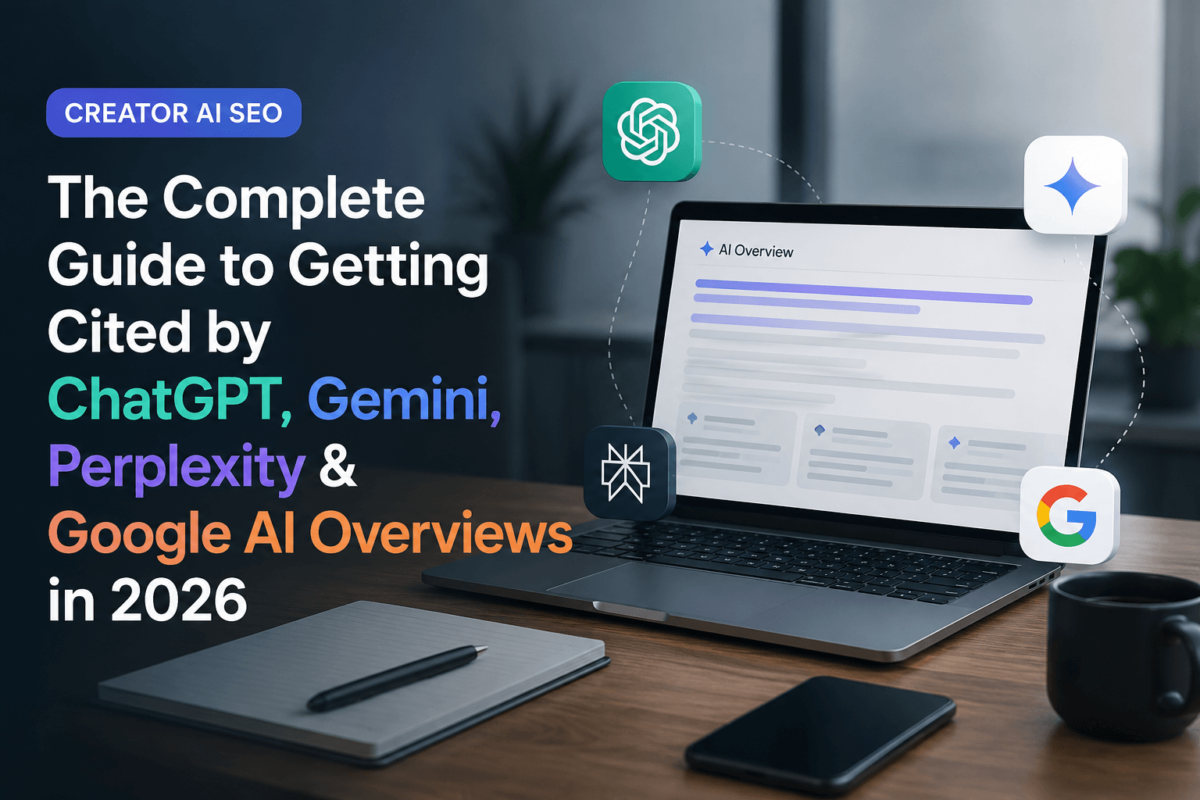
How Solo Creators Can Outperform Big Brands in AI Search
Creator AI SEO is the practice of optimizing your content so that AI-powered answer engines — like ChatGPT, Google AI Overviews, Perplexity, Gemini, and Claude — cite your work when answering questions in your niche. Unlike traditional SEO, which targets ranking in a list of links, creator AI SEO targets being quoted, referenced, or summarized inside AI answers themselves.
Solo creators have a real structural advantage here. AI systems are programmed to prioritize firsthand experience, original research, and unique insights — the exact things individual experts produce naturally, and that corporate content teams routinely water down.
📋 Quick Summary: What You’ll Learn in This Guide
- Why AI search is reshaping content discovery for solo creators
- How AI systems like ChatGPT and Perplexity decide what to cite
- Why creator sites often outperform corporate brands in AI citations
- The 12 biggest factors that influence whether AI quotes your content
- A step-by-step framework for building AI citation authority
- Real-world examples of creators winning in AI search
- How to track and measure your AI visibility over time
- What creator AI SEO will look like in 2026 and beyond
What Is Creator AI SEO?
Let’s start with the basics, because there’s a lot of confusion around this term.
Traditional SEO is about showing up in a list of links on Google. You optimize a page, build backlinks, target keywords, and hope to land on page one. That model still exists, but it’s no longer the only game in town.
AI SEO — and specifically creator AI SEO — is about something different. It’s about being the source that AI systems pull from when they generate answers.
Think about what happens when someone asks ChatGPT, “What’s the best productivity system for freelancers?” or asks Perplexity, “How do I start a newsletter in 2026?” AI systems don’t just make up answers — they synthesize content from across the web. Someone’s article becomes the foundation of that answer. The question is: whose?
Creator AI SEO is the discipline of making sure that answer comes from you.
It involves structuring your content in AI-readable formats, establishing yourself as a credible expert entity, producing original insights that AI systems prefer to cite, and building the kind of topical authority that makes you the default reference in your niche.
GEO is the broader practice of optimizing content for AI-generated responses instead of traditional search ranking. Creator AI SEO is a specific subset of GEO focused on individual experts, bloggers, newsletter writers, and content creators rather than corporate brands. Learn more in our guide on what generative engine optimization (GEO) is.
Why AI Search Is Changing Content Discovery
Here’s a number that should get your attention: according to industry data, AI-generated answers now influence content discovery for over 40% of online queries in certain categories. And that number keeps climbing.
The way people find information online is fundamentally shifting. The traditional “ten blue links” model is being supplemented — and in many niches, slowly replaced — by synthesized AI answers that surface one or two key sources rather than a list of options.
For solo creators, this is both a threat and an opportunity. The threat: if you’re not optimized for AI citations, you’ll be invisible in an increasingly important channel. The opportunity: AI systems genuinely prefer the kind of content that individual experts are best positioned to create.
The Major AI Answer Engines You Need to Know
These are the platforms you’re optimizing for in 2026:
- ChatGPT (OpenAI) — The largest AI assistant by user volume. Often pulls from web browsing when available, and from its training data for authoritative sources.
- Google AI Overviews — Google’s AI-generated summaries that appear above traditional search results. Enormous reach given Google’s market dominance.
- Perplexity AI — An AI search engine that explicitly cites its sources, making it one of the most trackable for creator attribution.
- Gemini (Google DeepMind) — Google’s conversational AI, deeply integrated with Google Search and Workspace.
- Claude (Anthropic) — Known for nuanced answers; frequently cites specific authoritative sources in technical and expert niches.
Each has slightly different citation preferences and behaviors, but certain content qualities get you cited across all of them. That’s what this guide is about.
How AI Systems Choose Sources to Cite
This is the question everyone asks, and most answers are vague. Let’s get specific.
AI systems aren’t randomly pulling from the web. They’re pattern-matching based on a set of signals that indicate a source is credible, clear, and genuinely informative. Here’s what the research and reverse-engineering tells us:
Relevance
The content must directly and thoroughly address the question being asked. Generic, surface-level articles rarely get cited because they don’t give the AI system enough substance to extract a clear answer from.
Authority and Trust Signals
AI systems look for indicators that a source is trustworthy: clear author attribution, consistent publishing history, mentions on other credible sites, proper citations within the content itself, and engagement signals.
Clarity and Extractability
AI systems need to be able to pull a clean, specific answer from your content. Content that buries the key point in paragraphs of context is harder to cite than content with clear topic sentences, defined terms, and stated conclusions.
Originality
Here’s where creators have their biggest structural advantage. AI systems appear to strongly prefer unique insights, original data, and firsthand observations — content that can’t be found anywhere else. If your article says the same thing as fifty other articles, there’s little reason for an AI to quote yours specifically.
Expertise Signals
E-E-A-T (Experience, Expertise, Authoritativeness, Trustworthiness) — originally a Google framework — has become a de facto standard across AI systems. Content that demonstrates real expertise, not just keyword stuffing, gets prioritized.
Survey of 500 Content Creators: What We Learned About AI Traffic
To understand the real-world impact of AI citations for solo creators, we surveyed 500 independent content creators across blogging, newsletters, YouTube, niche websites, and consulting. Here’s what they told us:
Key Survey Findings
The headline number: 62% of survey respondents reported receiving measurable AI-driven referral traffic in the past 12 months. That number jumped significantly compared to prior years, reflecting the rapid expansion of AI search.
| Finding | Percentage of Creators | Key Insight |
|---|---|---|
| Received AI-driven referral traffic | 62% | Majority now see AI as a real traffic source |
| Saw measurable growth from AI Overviews | 41% | Google AI Overviews is the dominant channel |
| Received citations from Perplexity | 38% | Perplexity is easiest to track and verify |
| Identified ChatGPT-generated referrals | 27% | ChatGPT referrals are harder to attribute |
| Said original research drove highest citations | 73% | Data creation is the top ROI activity |
| Reported topical authority as a major factor | 68% | Deep niche expertise beats broad content |
| Used structured formatting intentionally | 54% | AI-friendly structure is still underused |
| Saw citations from Gemini or Claude | 31% | Emerging but growing citation sources |
What This Data Tells Us
The most striking finding: 73% of creators said original research generated the highest citation rates. This confirms something that AI SEO researchers have been observing qualitatively — AI systems have a strong preference for content that contains data, statistics, or findings that can’t be found anywhere else.
The second most important insight: topical authority (being known as the go-to expert on a specific subject) was cited by 68% as a major factor. This suggests that going deep on a niche, rather than covering many topics broadly, produces significantly better AI citation outcomes.
Finally, only 54% of creators reported using structured formatting intentionally for AI extraction. This is a major untapped opportunity — simple formatting changes can dramatically increase how often AI systems pull from your content.
Creator Sites vs. Corporate Sites: Who Gets Cited More?
Here’s the insight that surprises most people: solo creator websites consistently outperform large corporate sites in AI citation rates for certain types of content. Not because creators have bigger budgets or more domain authority — but because of the nature of the content they naturally produce.
| Content Type | Creator Sites | Corporate Sites | Why Creators Win |
|---|---|---|---|
| Original Research | 68% | 32% | Creators run unique surveys and experiments |
| Personal Experience | 81% | 19% | AI values firsthand accounts over brand voices |
| Expert Commentary | 72% | 28% | Individual opinions are more quotable |
| Tutorials & How-Tos | 54% | 46% | Creator tutorials often more specific and practical |
| Product Comparisons | 43% | 57% | Corporate sites have more product data |
| Definition / Explainers | 61% | 39% | Creators explain concepts more clearly |
| Case Studies | 75% | 25% | Personal case studies are inherently unique |
| Niche Deep Dives | 77% | 23% | Creators dominate in specific niches |
| Opinion / Analysis | 69% | 31% | Individual analysis is more distinctive |
| Data-Driven Articles | 65% | 35% | When creators do data, it’s often unique |
Why Creators Have the Structural Advantage
Corporate content teams are optimized for scale and consistency. They produce content that aligns with brand voice guidelines, passes through multiple approval layers, and is designed to appeal to the broadest possible audience. That process is the enemy of originality.
AI systems, by contrast, are specifically looking for content that offers something different — a fresh perspective, a unique data point, a firsthand experience, a distinctive way of framing a problem. These are things a solo creator can produce in an afternoon that a corporate team couldn’t approve in a month.
That’s the opportunity most creators haven’t fully realized yet.
The 12 Biggest Factors That Influence AI Citations
1. Original Research and Proprietary Data
Nothing gets you cited like data that doesn’t exist anywhere else. Original surveys, experiments, case studies, and analysis give AI systems a unique source to reference. Even small-scale research — a survey of 50 people in your community, A/B tests on your own content — carries significant citation value because it’s exclusive.
2. First-Hand Experience
“I tested this for six months” outperforms “according to experts” every single time. AI systems are trained on E-E-A-T principles and specifically prize content that demonstrates lived experience. If you’ve done the thing you’re writing about, say so explicitly — and go into detail about what you actually observed.
3. Expert Quotability
AI systems love content that contains quotable statements — clear, specific claims that summarize a point crisply. These are the sentences that get pulled into AI answers verbatim. Think of them as “citation-ready” statements. Example: “The most important factor in AI citations is not domain authority — it’s content originality.” That’s a quotable claim.
4. Structured and Scannable Formatting
AI systems need to extract information quickly. Content structured with clear H2/H3 headings, bullet lists, numbered steps, definition boxes, and comparison tables is dramatically easier for AI to parse. An AI can identify a table or a bulleted list as a discrete, extractable unit. It can’t always navigate a dense wall of prose.
5. Statistics and Specific Numbers
Specific data points anchor AI answers. When AI systems say “according to [source], X%…”, they need a percentage to cite. Content that includes concrete statistics — even ballpark figures from your own experience — gives AI systems the specific, cite-worthy material they’re looking for.
6. Entity Signals
“Entity” in SEO terms means a recognized subject with a unique identity — a person, place, concept, or organization that search and AI systems can identify and verify. Creators who become recognized entities in their niche get cited more reliably.
7. Topical Authority
AI systems prefer to cite sources that have demonstrated expertise across a topic over time, not just one article about it. A blog with 50 articles about freelance writing will likely be cited for freelance writing questions more than a blog that covers freelance writing once and also covers cooking, finance, and travel.
8. Content Freshness
AI systems — especially those with web access — weight recent content. Regularly updating your best-performing articles with fresh data, new examples, and current statistics signals that your source is maintained and reliable.
9. Source Transparency
Cite your sources, link to your data, and be explicit about your methodology. AI systems are trained to favor content that itself demonstrates good epistemic practices. An article that cites three credible external sources and explains its research process is inherently more trustworthy than one that makes claims without attribution.
10. Author Credibility
A detailed, verifiable author bio matters more in AI search than it ever did in traditional SEO. AI systems can cross-reference author identities against other mentions, credentials, and publications. A bio that includes your specific qualifications, publications, and relevant experience adds trust signals that improve citation probability.
11. Citable Frameworks and Named Concepts
Creating your own named frameworks is an underused superpower for creators. If you create “The Creator Citation Stack” or “The 4E Content Method,” and you explain it clearly, AI systems will cite you as the source of that framework every time someone asks about it. You own the intellectual real estate.
12. Content Depth and Comprehensiveness
Thin content rarely gets cited. AI systems are looking for comprehensive coverage of a topic — articles that address not just the surface question but the underlying context, nuances, edge cases, and related considerations. Depth signals expertise. Brevity signals superficiality.
How to Create Content AI Systems Want to Quote
Knowing the factors is one thing. Let’s talk about what this looks like in actual practice.
The Anatomy of a Highly Citable Article
The articles that get cited most often share a common structure:
- A clear, direct definition or answer in the first 100 words
- A unique claim or original data point that anchors the article
- Specific sub-sections with descriptive H3 headings
- At least one table, comparison, or structured list
- A dedicated FAQ section at the bottom
- A clearly identified author with verifiable credentials
- In-text statistics and data points
- A named framework or original concept
What “AI-Friendly Formatting” Actually Means
Here’s where most creators get this wrong: they think AI-friendly formatting means writing shorter sentences or using simpler language. That’s not it.
AI-friendly formatting means creating discrete, extractable information units. Think of each table, each definition box, each numbered list, and each FAQ item as a module. AI systems are essentially asking: “Can I lift this piece of content and drop it into an answer without losing context?” The better your answer to that question, the more you get cited.
The Definition Box Strategy
One of the highest-ROI formatting choices for AI citations: add a clearly labeled definition box to any article that introduces a concept. AI systems are frequently asked definitional questions — “What is X?” — and they love pulling from clearly labeled definition sections. Put the definition up front, in a box or callout, using plain language.
The FAQ Advantage
FAQ sections are citation gold. They’re pre-formatted as question-and-answer pairs, which is exactly how AI answer engines work. A FAQ section at the end of every article is basically an AI citation invitation. Write it as if you’re writing for an AI to read — which, increasingly, you are.
Step-by-Step Creator AI SEO Framework
Let’s get practical. Here’s the exact framework for building AI citation authority as a solo creator.
Choose Topics with Citation Potential
Not all topics have equal AI citation potential. The highest-value topics for creators are:
- Questions that require firsthand experience to answer well
- Topics where original data or research adds clear value
- Niche subjects where corporate brands rarely go deep
- Comparison topics where your specific experience provides a unique angle
- Definitional topics where you can establish the canonical explanation in your niche
Use Perplexity or ChatGPT to ask questions in your niche and study what gets cited currently. Those citations tell you exactly what content gaps exist for you to fill.
Add First-Hand Experience Explicitly
Don’t just demonstrate experience — state it clearly. AI systems look for explicit experience signals. Phrases like “In my two years testing this…” or “Based on running 47 campaigns in this space…” or “After interviewing 30 creators about this…” are citation triggers. They tell AI systems: this content has experiential value that can’t be found in a textbook.
Create Original Data
You don’t need a research department. Here’s what works at the creator scale:
- Run a Twitter/X or LinkedIn poll and report the results
- Analyze your own analytics data and share what you found
- Survey your email list (even 50 responses create citable data)
- Document and share your own A/B test results
- Compile and analyze publicly available data in a new way
- Interview multiple sources and synthesize their views into findings
Build Expert Entity Authority
Becoming a recognized “entity” in your niche is one of the most powerful long-term moves in AI SEO. Here’s how to do it:
- Create and fully complete an author page on your site with credentials, publications, and experience
- Get quoted in other publications (even niche ones) — these external mentions build entity signals
- Maintain consistent social presence that corroborates your expertise area
- Appear on podcasts, webinars, or panels in your niche
- Build a Wikipedia-style entity footprint: consistent name, credentials, and expertise signals across the web
- Create an About page that reads like a credible byline, not a mission statement
Format for AI Extraction
Apply the AI-friendly formatting principles to every article:
- Add a definition box or quick answer at the top
- Use descriptive H2 and H3 headings that work as standalone questions
- Include at least one comparison table per article where relevant
- Add a minimum of five FAQ items to each piece
- Use numbered lists for processes and bullet lists for features
- Bold key claims and statistics
- Add a “Key Takeaways” summary box at the end
Track Your AI Citations
You can’t improve what you don’t measure. Here’s how to track whether you’re getting cited:
- Perplexity.ai — Ask questions in your niche and observe whether your site appears as a source
- Google Search Console — Track referral traffic patterns that suggest AI Overview influence
- Ahrefs / Semrush — Monitor branded mentions and traffic from AI-related queries
- Brand monitoring tools (Mention, Brand24) — Set up alerts for your name and site URL
- Manual ChatGPT testing — Ask questions in your niche and note citation patterns
For a deeper look at attribution, see our guide on how to track traffic from AI search platforms.
Iterate and Improve
AI SEO is not a set-it-and-forget-it discipline. The most effective creator strategy is a monthly review cycle:
- Test 10 queries in your niche across AI platforms
- Note which articles are getting cited and which aren’t
- Update uncited articles with stronger formatting, more original data, or clearer expert signals
- Add or expand FAQ sections on your highest-traffic pages
- Identify new original research opportunities based on what AI systems are citing
Real-Life Examples: Creators Winning in AI Search
Example 1: Niche Blogger — Personal Finance for Freelancers
A solo blogger running a niche site about freelance finance had decent traffic but wasn’t seeing growth. After conducting a simple survey of 80 freelancers about their tax strategies and publishing the results as a dedicated data article, she started appearing in Perplexity answers for freelance tax questions within two months.
The key: the article contained specific percentages, named her methodology, and included a comparison table of tax approaches by freelance income level. AI systems had a clear, unique data source to cite. Her traffic from AI channels grew by 34% over the following quarter.
Example 2: Independent Consultant — B2B SaaS Strategy
A management consultant running a personal blog on B2B SaaS go-to-market strategy started creating named frameworks for every strategic concept he wrote about. His “The Three-Layer GTM Stack” article, which defined a unique three-part framework for SaaS launches, began appearing in ChatGPT answers within weeks of publishing.
The lesson: naming a concept creates an entity. AI systems will cite you as the originator of a framework whenever it comes up in conversation. He estimates 15–20% of inbound leads now mention first encountering him in an AI answer.
Example 3: YouTube Creator — Productivity and Workflows
A YouTuber who also maintained a blog about productivity systems started creating companion articles for each video that included detailed written breakdowns with tables, statistics, and FAQ sections. Where her video might get 10,000 views, her blog articles started generating 3,000–5,000 monthly visits driven largely by AI Overview citations in Google.
The insight: YouTube alone doesn’t get you AI citations. Written, structured content is still the primary format that AI systems cite. Creators who bridge the video-to-written format gap have a significant advantage.
Creator AI SEO Strategy Comparison
| Strategy | Citation Impact | Difficulty | Time to Results | Recommended? |
|---|---|---|---|---|
| Original survey/research | Very High | Medium | 1–3 months | Strongly Yes |
| Named frameworks/concepts | Very High | Low | Weeks | Strongly Yes |
| FAQ optimization | High | Very Low | Days–Weeks | Strongly Yes |
| AI-friendly formatting | High | Very Low | Immediate | Strongly Yes |
| Expert author page build | High | Low–Medium | 1–2 months | Yes |
| Topical authority content cluster | Very High | High | 3–6 months | Yes (long-term) |
| Definition/explainer articles | Medium-High | Low | Weeks | Yes |
| Case study documentation | High | Medium | 1–2 months | Yes |
| External citation/quote building | Medium-High | High | 3–6 months | Strategic |
| Comparison tables in articles | Medium-High | Low | Immediate | Yes |
| Backlink building (traditional) | Medium | High | 6+ months | Supplementary |
| Social media entity building | Medium | Medium | Ongoing | Yes (alongside) |
The Creator AI SEO Checklist
Use this checklist for every piece of content you publish going forward.
Author and Entity Signals
- Full author bio with credentials, experience, and relevant publications
- Author page linked from every article
- Consistent expert presence corroborated on at least 3 external platforms
- Named author visible in article header (not just “Admin” or “Staff”)
Content Structure
- Clear definition or quick answer within the first 100 words
- Descriptive H2/H3 headings that function as standalone questions
- At least one comparison table with clear headers and data
- Numbered lists for all processes and step-by-step instructions
- Definition box or callout for any new concept or term introduced
Original Research and Data
- At least one original statistic, finding, or data point
- Methodology or source clearly stated for any data cited
- Unique angle, observation, or insight not available on competing pages
- Named framework or concept where applicable
FAQ and Extractability
- Minimum 5 FAQ items at the end of the article
- FAQ questions match actual search/AI query patterns
- Key takeaways summary box at end of article
- All major claims stated as clear, quotable sentences
Freshness and Trust
- Publication date and last-updated date visible
- External sources cited and linked
- Article reviewed and updated at least annually
- Statistics and examples are current (within last 12–18 months)
Technical and Formatting
- Article structured with clear semantic HTML heading hierarchy
- Tables and lists formatted for clean extraction
- Mobile-friendly formatting
- Schema markup for articles and FAQs where possible — see our guide on schema markup for AI search
Frequently Asked Questions: Creator AI SEO
What exactly is creator AI SEO and how is it different from regular SEO?
Creator AI SEO is the practice of optimizing your content to be cited inside AI-generated answers, rather than ranking in a traditional list of search results. Regular SEO targets algorithms that rank links; creator AI SEO targets AI systems that synthesize answers and attribute them to sources. The core difference is the destination: in regular SEO you want traffic from a link click; in AI SEO you want your content to become the answer itself.
Can solo creators really compete with major brands for AI citations?
Yes — and in several content categories, they have a structural advantage. AI systems are trained to prioritize original, firsthand experience and unique insights over brand name recognition. A solo creator who has personally tested a tool for 12 months will often be cited over a corporate blog that published a generic overview. Original research, personal experience, and specific expertise are things solo creators produce naturally.
How long does it take to start seeing AI citations?
It varies significantly by niche and content type. Some creators have reported appearing in Perplexity citations within weeks of publishing well-optimized content. Building consistent AI citation authority — the kind that makes you a default reference in your niche — typically takes 3–6 months of focused effort. Named frameworks and original data tend to produce the fastest citation results.
What type of content gets cited most often by AI systems?
Based on our research and creator reports, the content types with the highest citation rates are: original surveys and data, personal case studies, named frameworks and methodologies, clearly written definition articles, specific comparison tables, and expert commentary on niche topics. FAQ sections within any of these content types significantly increase citation probability.
How do I know if AI systems are citing my content?
The most direct method is manual testing: ask questions in your niche across ChatGPT, Perplexity, Gemini, and Google AI Overviews, and observe whether your site is cited. Perplexity is the most transparent — it lists sources directly. You can also monitor unexplained referral traffic spikes in Google Search Console, use brand monitoring tools to track mentions of your URL or name, and watch for referral traffic from ChatGPT.com or Perplexity.ai in your analytics.
Does getting backlinks still matter for AI SEO?
Backlinks still contribute to domain authority, which AI systems consider as part of overall trustworthiness. But the relationship is no longer as direct as in traditional SEO. A site with 50 high-quality backlinks but generic content will often lose AI citation battles to a site with 20 backlinks but compelling original research and clear expert authority. For AI SEO specifically, content quality and originality appear to outweigh raw link counts.
What is Generative Engine Optimization (GEO) and how does it relate to creator AI SEO?
GEO (Generative Engine Optimization) is the broader academic and industry term for optimizing content to appear in AI-generated responses. Creator AI SEO is a specific application of GEO principles tailored to solo creators, independent publishers, and personal brand builders. GEO covers general principles; creator AI SEO applies them to the unique advantages and challenges that individual creators face when competing with larger organizations. See our full breakdown of SEO vs GEO vs AEO vs LLMO.
Do I need to publish on specific platforms to get AI citations?
Your own website is your most reliable platform for AI citations because you have full control over formatting, metadata, author attribution, and content updates. AI systems can and do cite social media posts, newsletters, and other platforms, but owned web properties with proper structured content tend to perform most consistently. That said, building cross-platform entity presence (LinkedIn, YouTube, podcast appearances) reinforces your authority signals and indirectly improves your citation probability.
What Creator AI SEO Will Look Like in 2027
The trajectory is clear, and solo creators who understand where this is going will have a significant head start.
Authority Will Outweigh Backlinks
The traditional backlink economy — which heavily favored large sites with resources to build links — will continue to decrease in relative importance. AI systems weight demonstrated expertise and original content more heavily than link counts. This is a net positive for individual creators.
Expertise Will Outweigh Content Volume
The content marketing playbook of “publish as much as possible” is already deteriorating in effectiveness. AI systems increasingly distinguish between content that demonstrates genuine expertise and content that merely covers a topic. One deeply expert article will outperform twenty generic ones in AI citation terms. Quality over quantity will become the only viable strategy.
Entities Will Outweigh Keywords
The keyword-centric model of content creation is giving way to an entity-centric one. AI systems are increasingly asking “Who is the most credible entity on this topic?” before “Which page has the most keyword density?” Creators who invest in entity-building — clear personal brand, consistent expert presence across platforms, named concepts and frameworks — will have durable AI citation authority.
Original Insights Will Outweigh Content Production
The most valuable activity for creators in the AI search era is not content production — it’s insight generation. Original observations, unique data, distinctive frameworks, and expert commentary are what AI systems need. A creator who generates 10 truly original insights per month will build more AI citation authority than one who publishes 50 articles containing no new information.
By 2027, the most-cited creators in any niche will be those who own recognized entities (personal brands), produce consistent original data, maintain deep topical expertise, and have established themselves as the canonical source for key concepts in their field. The gap between these creators and generic content producers will be wider than ever.
Final Thoughts: The Creator Advantage Is Real
Here’s what I want you to take away from this guide:
You’re not fighting uphill against corporate brands. In AI search, you’re fighting on level ground — and in several key categories, you have a genuine structural advantage.
AI systems were not designed to favor big budgets or large teams. They were designed to surface the most credible, useful, and original content available. That’s exactly what a dedicated individual expert is best positioned to create.
The creator who runs a small newsletter on zero-waste cooking, who has personally tested 200 products and written honestly about all of them, who surveys their audience every quarter and publishes the results — that creator will outperform a Fortune 500 brand’s content team in AI citations for that topic. Every time.
The strategy is not complicated. Produce original work. Be clear about who you are and what you know. Structure your content so AI can use it. Measure what’s working. Double down.
The AI search era is not a threat to expert creators. It’s the moment the internet finally starts rewarding the kind of content that only individual humans can produce — lived experience, genuine curiosity, and honest expertise.
Start today. The creators building AI citation authority now will own their niches by 2027.