SpyFu vs SEMrush: Complete Comparison for SEO, PPC & Competitive Research (2026)
Which tool actually deserves your budget? A real-world breakdown of pricing, features, and use cases — not the marketing version.
Quick Answer: SEMrush is the overall winner thanks to its broader feature set, larger databases, and all-in-one platform. SpyFu is the runner-up, with unmatched PPC intelligence and far better value for budget-conscious users. If price and paid-search research matter most, start with SpyFu. If you need a full digital marketing suite, SEMrush is worth the premium. Keep reading for the complete breakdown.
Introduction
Choosing the right SEO platform in 2026 is not a small decision. The wrong tool can waste hundreds of dollars a month, send your strategy in the wrong direction, and leave you flying blind on competitive intelligence that your rivals are using to outrank you.
SpyFu and SEMrush are two of the most popular tools in the SEO industry — but they serve very different purposes, attract very different users, and are priced very differently. After two decades of working with both tools across hundreds of client accounts, personal affiliate sites, and content projects, I’ve put together the most thorough comparison you’ll find anywhere online.
This is not a regurgitation of their feature pages. This is a real-world breakdown of what each tool actually does well, where each one falls short, and — most importantly — which one is right for your specific situation.
By the end of this guide, you’ll know exactly which tool deserves your money.
Quick Verdict
Before we dive into the full breakdown, here’s the short version for readers who need a fast answer:
| Category | Best Tool |
|---|---|
| Overall Winner | SEMrush — broader feature set, larger database, better for most users |
| Runner-Up | SpyFu — unmatched PPC intelligence and excellent value at its price point |
| Best Budget | SpyFu — starts at $39/month; SEMrush starts at $139.95/month |
| Best Enterprise | SEMrush Business plan — API access, white label, advanced reports |
| Best for Agencies | SEMrush (scale, white-label reporting) / SpyFu (budget-conscious PPC agencies) |
| Best for Bloggers | SpyFu — affordable, great keyword research, no wasted features |
| Best for Ecommerce | SEMrush — site audits, product listing analysis, competitor tracking |
| Best for PPC | SpyFu — its ad intelligence is genuinely best-in-class |
| Best for Competitor Research | SpyFu for PPC rivals; SEMrush for organic & content gaps |
| Best for AI SEO | SEMrush — AI writing tools, SEO content templates, Copilot AI |
What is SpyFu?
SpyFu was founded in 2006 and built with a single, powerful idea at its core: let marketers spy on what their competitors are doing in both paid and organic search. The name says it all. For nearly two decades, SpyFu has been the go-to tool for PPC professionals who need to understand what ads competitors are running, which keywords they’re bidding on, and how much they’re spending. Our full SpyFu review covers every module in more depth.
Based in Scottsdale, Arizona, SpyFu has remained relatively focused compared to platforms like SEMrush. It doesn’t try to be everything to everyone — and that focus is both its biggest strength and its biggest limitation.
Core Features
- Competitor keyword research (organic and paid)
- PPC ad history dating back over 15 years
- Domain overview and traffic estimation
- Keyword grouping and list building
- Backlink tracking and analysis
- Rank tracking (SERP and keyword position history)
- SEO reports and white-label options on higher plans
- Lead generation tools (Kombat feature for domain comparison)
Who SpyFu is Best For
- PPC agencies and in-house paid search managers
- Freelance SEOs who need affordable competitive data
- Bloggers and affiliate marketers on a budget
- Small businesses researching what competitors are doing in Google Ads
- Content teams looking for keyword gaps to exploit
SpyFu Strengths
- Best-in-class PPC competitor intelligence
- Extensive ad history database (13+ years of Google Ads data)
- Very affordable entry-level pricing
- Extremely intuitive interface — minimal learning curve
- Domain comparison (Kombat) is genuinely unique
SpyFu Weaknesses
- Technical SEO audit capabilities are limited vs. SEMrush
- Backlink database is smaller than SEMrush or Ahrefs
- Content marketing toolkit is minimal
- Local SEO features are basic
- No dedicated content editor or AI writing tools
What is SEMrush?
SEMrush was founded in 2008 by Oleg Shchegolev and Dmitry Melnikov in Saint Petersburg, Russia. What started as a small keyword research tool has evolved into one of the most comprehensive digital marketing platforms on the planet. As of 2026, SEMrush (now officially rebranded as “Semrush”) boasts over 10 million registered users and more than 55 products and toolkits under one roof. See our in-depth SEMrush review for a closer look at each toolkit.
SEMrush went public on the NYSE in 2021 under the ticker SEMR, which signaled its ambitions well beyond being just an SEO tool. Today it competes not just with Ahrefs and SpyFu, but with content marketing platforms, social media tools, and enterprise marketing suites.
Platform Overview
- SEO Toolkit: keyword research, backlink analysis, rank tracking, site audit
- Content Marketing Toolkit: topic research, SEO writing assistant, content audit
- Advertising Research: Google Ads competitor analysis, PLA research, display ads
- Social Media Toolkit: scheduling, analytics, monitoring
- Local SEO: listing management, local rank tracking, review management
- Agency Solutions: white-label reporting, client management, lead generation
- AI Features: Copilot AI, AI writing, SEO recommendations
Use Cases
- Enterprise SEO teams managing large-scale technical audits
- Content marketers building topic clusters and pillar strategies
- E-commerce stores tracking product page rankings
- Agencies managing multiple client accounts with white-label reports
- Freelancers offering full-service SEO
- PPC managers running Google and Bing ad campaigns
SEMrush Pros
- All-in-one platform — reduces need for multiple tool subscriptions
- Massive keyword and backlink databases (updated daily)
- Best-in-class technical site audit tool
- Strong AI-powered features including Copilot, SEO Writing Assistant
- Robust reporting with white-label and scheduled reports
- Excellent integration ecosystem (GA4, GSC, Looker Studio, etc.)
SEMrush Cons
- Expensive — $139.95/month starting price is prohibitive for solo users
- Feature bloat can overwhelm beginners
- Data accuracy on traffic estimates can vary for smaller domains
- Some features (social, local) feel bolted on rather than fully developed
- Annual commitment needed for best pricing
SpyFu vs SEMrush at a Glance
Here’s a high-level comparison across all major dimensions to help orient you before we go deep:
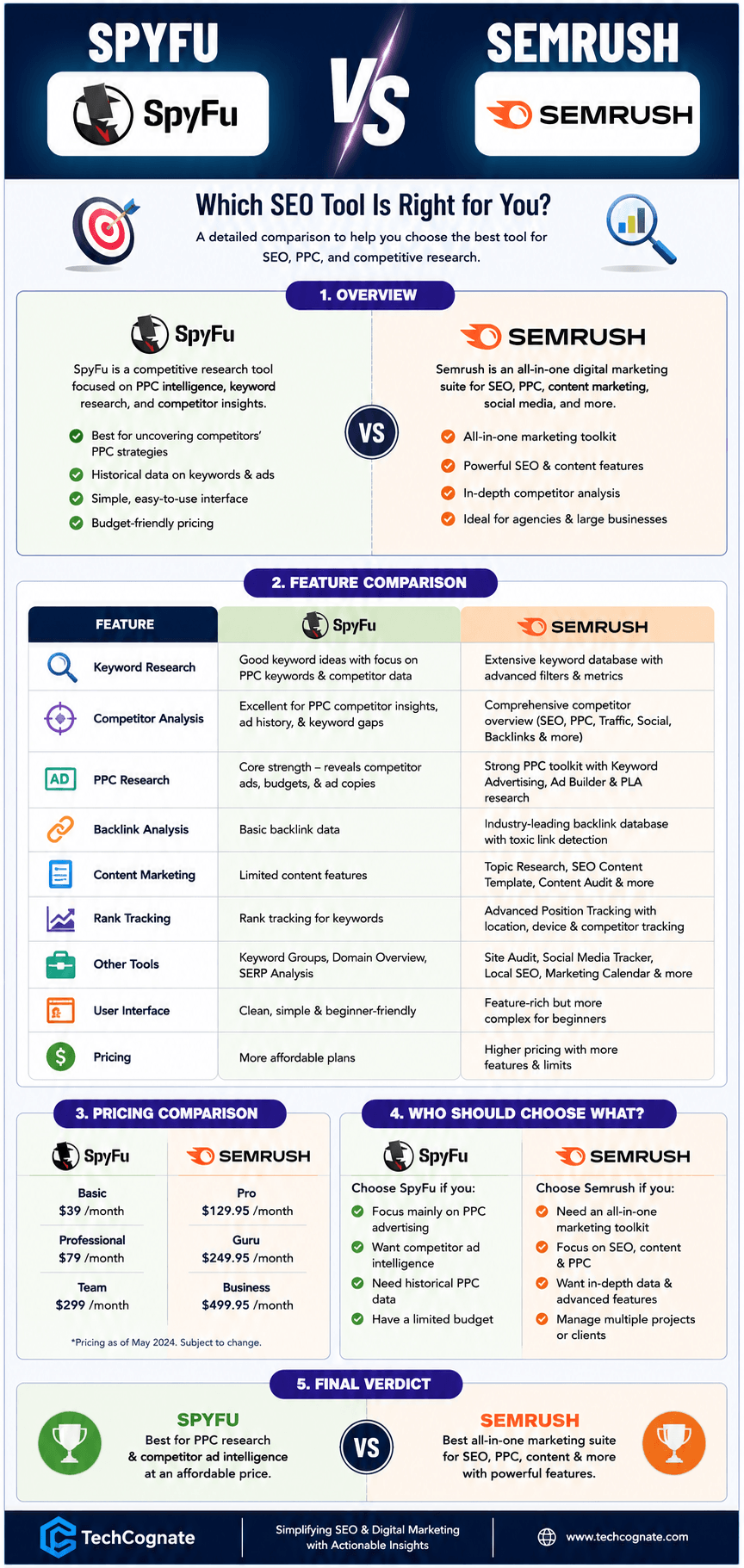
| Feature | SpyFu | SEMrush |
|---|---|---|
| Overall Score | 7.8 / 10 | 9.1 / 10 |
| Ease of Use | ★★★★★ (5/5) | ★★★★☆ (4/5) |
| Keyword Research | ★★★★☆ | ★★★★★ |
| Competitor Research | ★★★★★ (PPC) | ★★★★★ (Organic) |
| Backlink Analysis | ★★★☆☆ | ★★★★★ |
| Technical SEO | ★★☆☆☆ | ★★★★★ |
| Rank Tracking | ★★★☆☆ | ★★★★★ |
| Local SEO | ★★☆☆☆ | ★★★★☆ |
| Content Marketing | ★★☆☆☆ | ★★★★★ |
| PPC Research | ★★★★★ | ★★★★☆ |
| AI Features | ★★☆☆☆ | ★★★★☆ |
| Reporting | ★★★☆☆ | ★★★★★ |
| Integrations | ★★★☆☆ | ★★★★★ |
| API Access | Higher plans only | Pro+ (add-on) |
| Customer Support | ★★★☆☆ | ★★★★☆ |
| Starting Price | $39/month | $139.95/month |
| Free Plan | Limited (3 searches/day) | Limited (10 queries/day) |
| Learning Curve | Low | Medium–High |
| Overall Winner | — | ✅ SEMrush |
Pricing Comparison
Pricing is often the first decision point when comparing SpyFu vs SEMrush — and the gap between them is significant.
SpyFu Pricing
| Plan | Monthly | Annual (per mo.) | Best For |
|---|---|---|---|
| Basic | $39/mo | $33/mo | Solo bloggers, beginners |
| Professional | $79/mo | $58/mo | Freelancers, small agencies |
| Team | $299/mo | $199/mo | Growing agencies, teams |
SEMrush Pricing
| Plan | Monthly | Annual (per mo.) | Best For |
|---|---|---|---|
| Pro | $139.95/mo | $117.33/mo | Freelancers, startups |
| Guru | $249.95/mo | $208.33/mo | Growing agencies |
| Business | $499.95/mo | $416.66/mo | Enterprises, large agencies |
Free Trials & Plans
- SpyFu: No credit card free trial available; free account gives 3 searches/day with limited data
- SEMrush: 7-day free trial on Pro and Guru (credit card required); free account gives 10 searches/day
- SpyFu occasionally offers 30-day money-back guarantees on annual plans
- SEMrush offers a 7-day refund window depending on plan and region
Hidden Costs to Watch
- SEMrush charges separately for additional user seats on most plans
- Local SEO listing management in SEMrush is an add-on, not included by default
- SEMrush API access is an add-on to the Business plan
- SpyFu’s Team plan is the only tier with API access included
- Both tools charge extra for additional report exports beyond monthly limits
Pricing Verdict: SpyFu wins on price — and it’s not even close. SpyFu’s Professional plan ($79/month) delivers more value per dollar than SEMrush’s entry-level Pro plan ($139.95/month) for most independent SEOs and bloggers. However, if you need a full-featured platform, SEMrush’s higher price tag is justified by what it includes.
Feature-by-Feature Comparison
Let’s break down every major feature category side by side. I’ll give you the real-world picture — not the marketing version.
Keyword Research
Keyword research is the foundation of any SEO strategy. Both tools offer keyword data, but the depth and breadth differ significantly.
Best For: SEMrush for comprehensive keyword strategy; SpyFu for quick competitor keyword audits
Competitor Research
Competitive intelligence is where both tools shine — but in different directions.
Best For: PPC-focused teams: SpyFu. Organic/content teams: SEMrush
Backlink Analysis
Backlinks remain one of the top ranking factors. How does each tool handle link data?
Best For: Both tools for basic audits; SEMrush for serious link building campaigns
PPC Research
This is SpyFu’s home turf. Here’s how the battle plays out.
Best For: PPC agencies, Google Ads managers, paid search specialists
Technical SEO / Site Audit
Technical SEO is increasingly important as Google’s algorithms become more sophisticated.
Best For: Ecommerce stores, large websites, technical SEO specialists
Rank Tracking
Knowing where your pages rank — and tracking movement over time — is a core workflow for any SEO.
Best For: All SEOs; SEMrush for local SEO and agency reporting
Content Marketing
Content strategy and content optimization features have become an essential part of the modern SEO toolkit.
Best For: Bloggers, content teams, agencies running content campaigns
AI Features
Artificial intelligence is reshaping SEO tools. Where does each platform stand in 2026?
Best For: Content teams, agencies embracing AI-assisted workflows
Reporting & Dashboards
Reporting matters enormously for agencies and consultants who need to demonstrate value to clients.
Best For: Digital agencies, freelancers with multiple clients, enterprise SEO teams
Integrations
How well does each tool play with the rest of your marketing stack?
Best For: Teams using multiple marketing platforms
Ease of Use & Learning Curve
One of the most underrated factors when choosing an SEO tool is how long it takes to actually get value from it. A powerful tool that takes six months to learn is a liability for solo operators and small teams.
SpyFu
SpyFu is one of the most intuitive SEO tools I’ve ever used. The interface is clean, well-organized, and built around the assumption that you know what you’re looking for. Enter a domain, get instant competitor intelligence. The Kombat feature is drag-and-drop simple. New users can extract value within 20 minutes of signing up.
SEMrush
SEMrush has a much steeper learning curve. The platform is enormous — there are genuinely hundreds of reports, tools, and settings available. First-time users often feel overwhelmed by the navigation structure. That said, once you learn where things are, it becomes incredibly efficient. SEMrush has invested in onboarding flows, tutorials, and the SEMrush Academy to help new users get up to speed.
Accuracy: What the Data Actually Tells You
This is a critical point that many comparison articles gloss over: neither SpyFu nor SEMrush has access to Google’s actual data. Everything you see — keyword search volumes, traffic estimates, competitor rankings — is an estimate based on proprietary data collection methods, crawlers, and statistical models.
With that context:
- Keyword search volumes: Both tools tend to match Google Ads data reasonably well for high-volume keywords. For low-volume, niche, or very new keywords, estimates can diverge significantly.
- Traffic estimates: SEMrush’s traffic estimates tend to be more reliable for well-established domains with consistent traffic patterns. SpyFu’s estimates can undercount sites that rely heavily on branded search.
- Backlink data: SEMrush’s backlink database is larger and more current. SpyFu may miss links, especially from newer domains or obscure link sources.
- Ranking data: Both tools use their own crawlers to estimate rankings. Actual rankings vary by user location, personalization, and search history — no tool can capture that.
- PPC data: SpyFu’s ad intelligence is more comprehensive historically. SEMrush has improved but SpyFu’s 13+ year ad history remains unique.
Bottom Line on Accuracy: Use these tools for directional insight, not exact data. Both platforms are excellent for identifying trends, finding opportunities, and comparing competitors. Where they differ most is in database size (SEMrush wins) and PPC history depth (SpyFu wins).
Real-World Use Cases: Who Should Use What
Bloggers & Affiliate Marketers
If you’re running a content site or affiliate blog, your primary needs are keyword research, competitor content analysis, and rank tracking. SpyFu’s basic plan at $39/month covers these needs adequately. The keyword overlap tool is great for identifying what your competitors rank for that you don’t. For most individual bloggers, SEMrush is overkill and significantly over-budget.
Recommendation: Start with SpyFu. Upgrade to SEMrush when your site reaches a scale where you need technical audits and advanced content tools.
Digital Marketing Agencies
Agencies need white-label reporting, multi-client management, API access, and broad feature coverage. SEMrush’s Guru or Business plans are the standard for a reason — the reporting infrastructure is unmatched and the breadth of tools eliminates the need for additional subscriptions in most cases. PPC-focused agencies might supplement with SpyFu for its ad intelligence depth.
Recommendation: SEMrush as the primary platform. SpyFu as a PPC supplement if budget allows.
E-commerce Stores
E-commerce SEO requires technical audits, product page optimization, local SEO, and competitor tracking — all areas where SEMrush outperforms SpyFu. The Site Audit and Position Tracking tools alone justify the investment for a midsize e-commerce store.
Recommendation: SEMrush.
Local Businesses & Local SEO
Both tools have limited local SEO features. SEMrush’s local SEO add-on offers listing management and local rank tracking at the city/ZIP level. SpyFu’s local capabilities are minimal. For serious local SEO, consider pairing either tool with a dedicated local tool like BrightLocal.
Recommendation: SEMrush for integrated local SEO workflow.
PPC Agencies & Paid Search Managers
No contest. SpyFu was built for this. The 13+ years of Google Ads history, the keyword-to-ad copy mapping, and the budget estimation tools give SpyFu a clear edge in paid search competitive intelligence. SEMrush’s ad research is useful but doesn’t have the same depth.
Recommendation: SpyFu as primary PPC intelligence tool. SEMrush for organic if needed.
SaaS Companies & Startups
SaaS companies typically need competitor analysis, content marketing tools, and rank tracking. SEMrush is the better fit here because of its content toolkit, topic research, and ability to track SaaS-specific SERP features.
Recommendation: SEMrush.
Freelance SEOs
Budget often dictates this choice. SpyFu’s Professional plan at $79/month delivers excellent value for freelancers who focus on competitive research and keyword analysis. If you need to audit client sites technically or provide white-label reports regularly, the jump to SEMrush Guru becomes necessary.
Recommendation: SpyFu for budget-focused freelancers; SEMrush Guru for full-service SEO freelancers.
Pros and Cons Summary
SpyFu
✅ Pros
- Extremely affordable entry-level pricing ($39/month)
- Best-in-class PPC competitor intelligence with 13+ years of ad history
- Very low learning curve — beginners get value on day one
- Unique Kombat feature for three-way domain keyword comparison
- Strong historical keyword and ranking data
- Clean, focused interface without feature bloat
- Solid value for small businesses and freelancers
❌ Cons
- Small backlink database compared to SEMrush and Ahrefs
- No meaningful content marketing toolkit
- Technical SEO audit capability is very limited
- Minimal AI features as of 2026
- Local SEO tools are basic
- API access only on Team plan ($299/month)
- Weaker integration ecosystem
SEMrush
✅ Pros
- All-in-one platform — one subscription covers most marketing needs
- Massive keyword database (25+ billion keywords)
- Industry-leading site audit with 130+ issue types
- Excellent content marketing toolkit including SEO Writing Assistant
- Best-in-class reporting and white-label options
- Strong AI features with Copilot and AI-assisted optimization
- Deep integration with Google ecosystem and third-party tools
- Active user community and SEMrush Academy
❌ Cons
- Expensive — $139.95/month starting price excludes many solo users
- Steep learning curve — can take weeks to master
- Feature overload can slow down simple workflows
- Traffic estimates can be inconsistent for smaller or newer sites
- Local SEO features feel like an afterthought on core plans
- Social media tools are weak compared to dedicated platforms
What Real Users Are Saying
Looking across software review platforms like G2, Capterra, and Trustpilot, plus communities like Reddit’s r/SEO and various SEO forums, here’s what users consistently say about both tools:
SpyFu — Common Themes from Users
- Praised universally for PPC intelligence — “the best competitor ad analysis tool available” appears as a recurring sentiment
- Users love the simplicity and clean UI — “I can get the information I need in minutes”
- Price-to-value ratio is consistently called out as a strength
- Common frustration: backlink data feels incomplete compared to Ahrefs
- Some users wish the content tools were more developed
- Customer support response times get mixed reviews
SEMrush — Common Themes from Users
- Power users love the depth — “it’s the only tool I need for client SEO”
- Site Audit and Position Tracking are frequently called out as best-in-class
- The learning curve frustrates beginners — “overwhelming at first”
- Price is the top complaint — monthly plans are “too expensive for what you get at the lower tiers”
- The SEO Writing Assistant is highly rated by content teams
- Data refreshes and accuracy improvements over the years are noted positively
Best Alternatives to SpyFu and SEMrush
Neither tool is right for everyone. Here’s a quick rundown of the best alternatives and where they fit:
| Tool | Starting Price | Best For | vs SpyFu/SEMrush |
|---|---|---|---|
| Ahrefs | $129/mo | Backlink analysis, keyword research | Better backlinks than SpyFu; rivals SEMrush on links |
| Moz Pro | $99/mo | Beginners, local SEO | Easier than SEMrush; weaker than both for PPC |
| Mangools | $29/mo | Budget bloggers, keyword research | Cheapest quality option; limited features vs both |
| SE Ranking | $65/mo | Agencies, rank tracking | Strong rank tracking; better value than SEMrush for agencies |
| Serpstat | $59/mo | Budget teams, SEO audits | Good all-rounder at a competitive price |
| Ubersuggest | $29/mo | Beginners, basic research | Far less powerful than either SpyFu or SEMrush |
Which Tool Should You Choose? A Simple Decision Tree
- You are primarily a PPC manager or Google Ads specialist
- Your budget is under $100/month
- You’re a blogger or affiliate marketer focused on competitive keyword research
- You want a simple, easy-to-use tool with minimal learning curve
- Historical ad intelligence is critical to your workflow
- You’re just starting out with SEO and don’t need all the bells and whistles
- You run a digital marketing agency managing multiple clients
- You need a comprehensive technical SEO audit tool
- Content marketing strategy is core to your business
- You require robust white-label reporting and client deliverables
- You’re managing SEO for an e-commerce store
- AI-assisted SEO recommendations and writing tools matter to your workflow
- You need deep integrations with GA4, GSC, and Looker Studio
- Budget is very tight — Mangools or Ubersuggest start cheaper
- Backlink analysis is your #1 priority — consider Ahrefs
- You want strong rank tracking at a lower cost — consider SE Ranking
- You’re a beginner who wants simplicity over features — Moz Pro
Frequently Asked Questions (FAQ)
Is SpyFu better than SEMrush?
It depends entirely on your use case. SpyFu is better for PPC competitor intelligence and affordability. SEMrush is better for comprehensive SEO, technical audits, content marketing, and agencies. For most users, SEMrush provides more overall value — but not at its price premium over SpyFu if PPC research is your primary need.
Which tool is more accurate?
Both tools provide estimates rather than exact data. SEMrush generally has more accurate traffic estimates and a larger, more current database. SpyFu has more accurate and comprehensive PPC/ad data. Neither tool should be used for exact figures — they’re best for directional insight and competitive comparison.
Which is cheaper?
SpyFu is significantly cheaper. SpyFu’s entry plan starts at $39/month vs. SEMrush’s $139.95/month — a 72% price difference. On an annual basis, SpyFu’s Professional plan at $58/month vs. SEMrush Pro at $117.33/month continues the gap.
Which is better for agencies?
SEMrush for most agencies — the white-label reporting, multi-client management, and full-feature toolkit justify the price. SpyFu works well for PPC-focused boutique agencies that don’t need all of SEMrush’s capabilities.
Which is better for beginners?
SpyFu for beginners. The interface is intuitive, the learning curve is minimal, and you’ll be extracting competitive insights within minutes. SEMrush’s depth can overwhelm new users.
Does SpyFu have backlink analysis?
Yes, but it’s limited. SpyFu includes a backlink database and can show referring domains and anchor text, but the database is significantly smaller than SEMrush or Ahrefs. For serious link building campaigns, you’ll want SEMrush or Ahrefs.
Is SEMrush worth the price?
For agencies, e-commerce stores, and enterprise teams — yes, absolutely. For individual bloggers or budget-conscious freelancers — the pricing is hard to justify when SpyFu or SE Ranking offer comparable value at a fraction of the cost.
Which tool is better for PPC?
SpyFu — and it’s not close. SpyFu’s 13+ years of Google Ads history, competitor ad copy analysis, budget estimation, and keyword-to-ad mapping make it the best PPC intelligence tool at any price point.
Can SpyFu replace SEMrush?
For PPC-focused users — yes. For full-service SEO that includes technical audits, content marketing, and comprehensive backlink analysis — no. SpyFu is a specialized tool; SEMrush is a platform.
Which tool has better historical data?
SpyFu for PPC historical data (13+ years of ad history is unmatched). SEMrush for organic ranking history and traffic trend data.
Which tool is better for keyword research?
SEMrush for depth and database size. SpyFu for quick competitor keyword audits and the Kombat overlap feature. If you can only pick one for keyword research, SEMrush’s Keyword Magic Tool is more powerful.
Which tool has better rank tracking?
SEMrush — more granular location targeting, daily updates, mobile vs. desktop splits, and competitive share-of-voice tracking. SpyFu’s rank tracking is functional but not as feature-rich.
Is there a free version?
Both tools offer free versions with significant limitations. SpyFu’s free account allows 3 searches per day. SEMrush’s free account allows 10 queries per day. Neither free version is sufficient for ongoing work — they’re better used for one-off lookups.
Which tool updates data more frequently?
SEMrush updates its database more frequently — keyword rankings and backlink data refresh daily for most data points. SpyFu’s updates are less frequent, though PPC data has very good coverage.
Which tool is better for local SEO?
SEMrush — it has a dedicated local SEO add-on with listing management and local rank tracking. SpyFu’s local SEO capabilities are minimal. Neither replaces a dedicated local SEO tool like BrightLocal for serious local campaigns.
Which tool is best for ecommerce?
SEMrush — site audit capabilities, product listing ad (PLA) research, technical SEO tools, and rank tracking at scale make it far more suitable for ecommerce than SpyFu.
Which tool offers better reporting?
SEMrush by a wide margin. The My Reports feature with drag-and-drop customization, white-label branding, Looker Studio integration, and scheduled delivery is among the best in the industry.
Which tool is easier to learn?
SpyFu — significantly easier to onboard with and extract initial value from. SEMrush requires more time investment to learn the platform, though SEMrush Academy helps accelerate this.
Which tool is better for content marketing?
SEMrush — it has a dedicated Content Marketing Toolkit that SpyFu simply doesn’t have. Topic Research, SEO Writing Assistant, Content Audit — these are SEMrush-exclusive features.
Which tool do SEO professionals prefer?
Survey data from SEO communities consistently shows SEMrush and Ahrefs as the most widely used tools among professional SEOs, with SpyFu popular among PPC specialists. SEMrush has a larger professional user base, but SpyFu has deeply loyal users in the paid search community.
Which tool is better for Amazon sellers?
Neither SpyFu nor SEMrush is optimized for Amazon SEO. For Amazon-specific keyword research and competitive analysis, tools like Helium 10 or Jungle Scout are purpose-built for that marketplace.
Do these tools work for Bing/Microsoft Ads?
SpyFu focuses primarily on Google Ads data. SEMrush has added some Microsoft Advertising data but its depth there doesn’t match Google coverage. For Bing-specific ad intelligence, SEMrush is slightly better, but neither is a specialist.
What is the SpyFu Kombat feature?
Kombat is SpyFu’s competitive overlap tool. Enter up to three domains and it shows you which keywords all three share, which are unique to each, and which ones represent opportunity gaps. It’s a visually intuitive and genuinely useful feature for quick competitive keyword audits.
Final Verdict: SpyFu vs SEMrush (2026)
After putting both tools through their paces across keyword research, competitor analysis, backlinks, technical SEO, content marketing, PPC intelligence, and reporting — here’s my honest, experience-based take:
If you’re a freelancer or independent blogger…
Start with SpyFu. You’ll get excellent competitive keyword intelligence and PPC insights at a price point that actually makes sense for someone working with limited budget. When your business grows to where you need technical SEO audits and content marketing tools, that’s the time to graduate to SEMrush.
If you run an agency…
SEMrush is the professional standard for good reason. The reporting infrastructure, multi-toolkit coverage, and white-label capabilities make it the most justifiable investment for any agency managing more than two or three clients. Factor it into your client retainer pricing.
If you’re focused on PPC…
SpyFu is your tool. The 13+ years of Google Ads history, ad copy analysis, and budget estimation features are unmatched at SpyFu’s price point. Even paid search managers at large companies often use SpyFu alongside their primary SEO platform for this exact reason.
If you’re building an affiliate site…
SpyFu for the keyword and competitor research; SEMrush for the content strategy if your budget allows. If you can only pick one, SpyFu gets you further for less money in the early stages.
If budget matters above all else…
SpyFu wins. At $39/month for the basic plan, it’s one of the most affordable legitimate SEO tools on the market. SEMrush at $139.95/month is harder to justify unless you’re running a business where SEO is a primary revenue driver.
If you need an all-in-one SEO platform…
SEMrush is the clear choice. The breadth of tools — from keyword research and site audits to content marketing and social media — reduces the need to pay for multiple platforms. For businesses that want a single, comprehensive digital marketing platform, SEMrush delivers that at scale.
The Bottom Line: SEMrush is the more powerful, more comprehensive platform and earns the “Overall Winner” designation in this comparison. But SpyFu is not a loser — it’s a highly focused, excellent-value tool that outperforms SEMrush in its areas of specialty. The right choice is entirely dependent on your use case, budget, and where SEO and PPC fit in your business. Use this guide as your guide — not a generic recommendation.
Ready to Get Started? Try SpyFu free at spyfu.com — no credit card required for the basic free search. Try SEMrush free for 7 days at semrush.com — explore the full Pro toolkit before you commit. Still unsure? Bookmark this guide and revisit once you’ve tried both free tiers.