⚑️ SEO Tool Comparison · 2026 Update
Moz Pro vs Ahrefs (2026):
|
Let me cut straight to it. I’ve used both Moz Pro and Ahrefs professionally for years — across agency accounts, freelance clients, ecommerce brands, and my own affiliate sites. Neither tool is perfect, and the “best” one genuinely depends on what you’re trying to do.
|
💡 Quick Answer If you only have 30 seconds: Ahrefs wins for most SEO professionals, especially for backlink analysis, keyword research depth, and content intelligence. But Moz Pro still earns its place — particularly for beginners, local SEO practitioners, and teams that want a gentler learning curve with solid core functionality. |
|
⚡ TL;DR — Who Should Buy What Who should buy Ahrefs: SEO professionals who need deep backlink data, advanced keyword research, frequent data refreshes, content gap analysis, and comprehensive competitor intelligence. Also ideal for agencies managing multiple clients and in-house SEOs at mid-to-large companies. Who should buy Moz Pro: Beginners learning SEO, small business owners managing their own SEO, local SEO specialists, teams that want clean reporting without a steep learning curve, and budget-conscious operators who need solid core features. Who should avoid Ahrefs: Those on tight budgets who only need basic features. Ahrefs’ entry-level plan is pricier, and the volume of data can overwhelm users who are just starting out. Who should avoid Moz Pro: Power users who need granular backlink data, agencies that require fast data refreshes, or anyone whose primary workflow is link prospecting and competitive backlink analysis at scale. |
| Try Ahrefs → | Try Moz Pro → |
Quick Comparison: Feature-by-Feature Winner Table
| Feature | Winner | Reason |
|---|---|---|
| Keyword Research | Ahrefs | Larger keyword index, better SERP data, accurate KD scores |
| Backlink Analysis | Ahrefs | Bigger link index, faster updates, more filtering options |
| Technical SEO / Site Audit | Tie | Both solid; Ahrefs crawls faster, Moz has cleaner UI |
| Rank Tracking | Moz Pro | Accurate tracking, SERP feature tracking, clean dashboards |
| Local SEO | Moz Pro | Local rank tracking, local keyword data, citation tools |
| Ease of Use | Moz Pro | More intuitive, better for non-technical users |
| Reporting | Moz Pro | Cleaner client-ready reports out of the box |
| Pricing | Moz Pro | More affordable entry plans |
| Support | Moz Pro | Responsive support, strong community, great documentation |
| Learning Curve | Moz Pro | Significantly easier to get up to speed |
| AI Features | Ahrefs | Better AI-powered content suggestions and keyword clustering |
| Enterprise | Ahrefs | More data, API access, and scalability |
| Overall Winner | Ahrefs | More powerful for professional SEO work at scale |
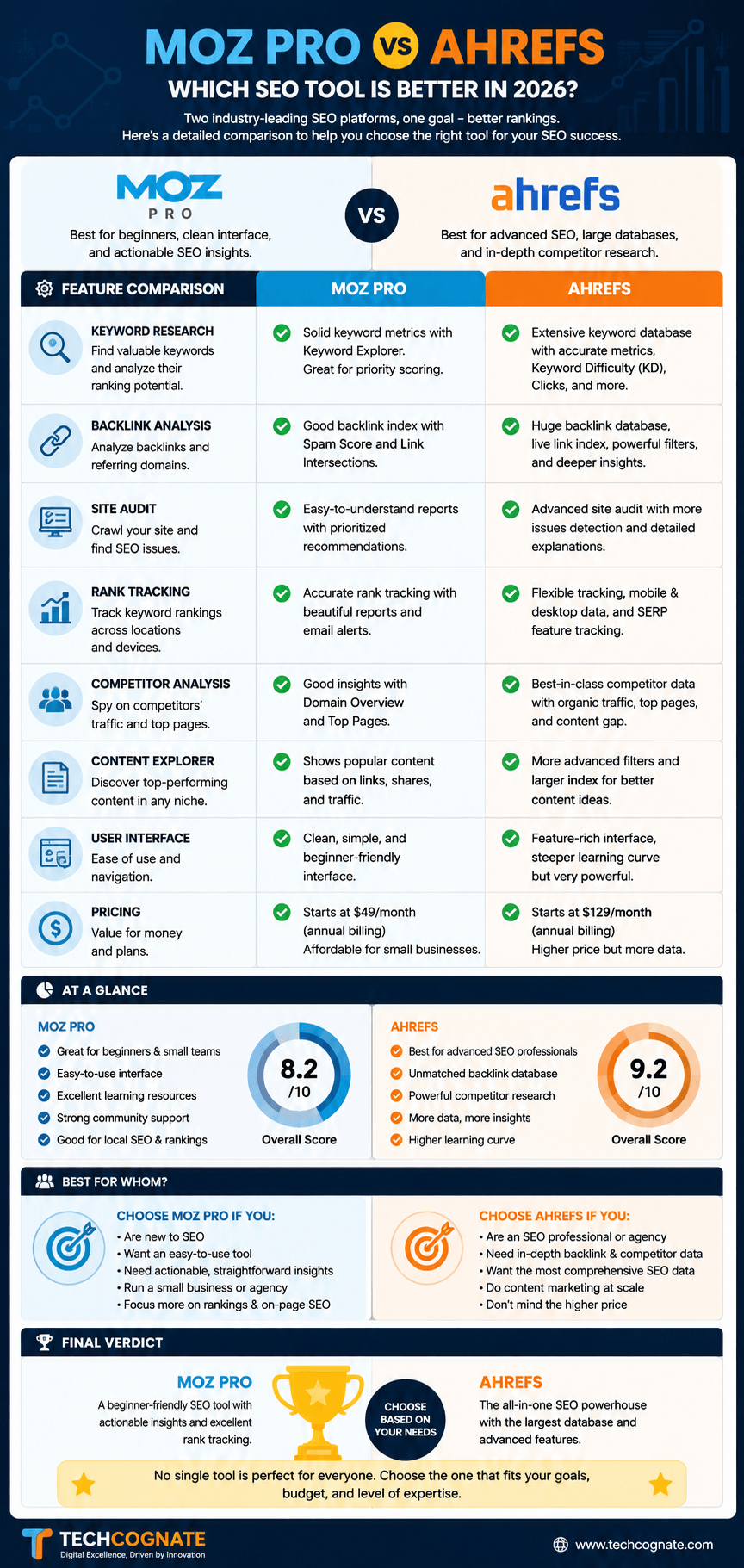
Moz Pro vs Ahrefs at a glance — pricing, features, and the winner in each category. |
1Meet the Contenders
Moz Pro: The SEO Industry Pioneer
Moz launched in 2004 as SEOmoz, a blog and community forum founded by Rand Fishkin and Gillian Muñoz. Over the following decade, it evolved into one of the most recognizable SEO software brands in the world — partly due to its educational content, partly due to metrics like Domain Authority (DA) and Page Authority (PA) that became industry shorthand even outside the tool itself.
Moz Pro is their all-in-one SEO platform. It covers keyword research, link analysis, site auditing, rank tracking, and reporting. The company rebranded to simply “Moz” in 2012, went through a notable restructuring in 2018 after an over-ambitious expansion, and has since refocused on delivering reliable core SEO functionality. Read the full Moz Pro review for a deeper breakdown.
Moz Pro is best suited for: small business owners, marketers new to SEO, local SEO practitioners, and teams that prioritize ease of use and clean reporting over raw data volume.
|
Strengths Moz Pro •Intuitive interface •Reliable Domain Authority metric •Solid local SEO tools •Gentle learning curve •Responsive customer support •Strong educational resources
|
|
Weaknesses Moz Pro •Smaller backlink index than Ahrefs •Slower data refresh rates •Less keyword data overall •Limited content intelligence features •Not ideal for large agencies managing many client accounts simultaneously
|
Ahrefs: The Data Powerhouse
Ahrefs launched in 2011 with a singular focus: building the most comprehensive backlink database in the industry. Founded by Dmitry Gerasimenko, the company bootstrapped its growth and has consistently reinvested in expanding its data infrastructure. Today, Ahrefs is widely considered one of the two or three most essential tools in a professional SEO’s stack — the other usual contenders being Semrush and Google Search Console.
What started as a pure backlink tool has grown into a full-featured SEO platform covering keyword research, content analysis, rank tracking, technical auditing, and competitive intelligence. Ahrefs crawls the web at a scale that rivals Google’s own crawlers, giving it arguably the best third-party backlink and content index available. See our full Ahrefs review for a hands-on breakdown.
Ahrefs is best suited for: SEO professionals, agencies, in-house SEOs at growth-stage and enterprise companies, content marketers, and link builders who need reliable, frequently refreshed data.
|
Strengths Ahrefs •Industry-leading backlink database •Excellent keyword research tools •Robust Content Explorer •Fast crawler •Precise data •Strong API •Constant product updates
|
|
Weaknesses Ahrefs •Higher price point •Steeper learning curve •Can feel overwhelming for beginners •No dedicated rank tracking dashboard as intuitive as Moz’s •No local SEO tools to speak of
|
2Feature-by-Feature Comparison
Keyword Research
|
💡 Quick Answer Ahrefs wins keyword research with a larger index, more accurate KD scores, and superior SERP analysis. Moz Pro’s Keyword Explorer handles core research needs well but covers a smaller data universe. |
When it comes to keyword research, Ahrefs has the edge — and it’s not particularly close. Their keyword index spans billions of keywords across 200+ countries and search engines (including YouTube, Amazon, and Bing), and the data tends to be more accurate and more up to date than Moz’s.
Keyword Difficulty (KD) in Ahrefs is calculated based on the number of referring domains pointing to the top-ranking pages. It’s not perfect — no tool’s KD metric is — but it correlates well with real-world ranking difficulty, especially for competitive niches. Moz’s Keyword Difficulty uses a different formula incorporating DA and PA of ranking pages, which can produce misleadingly high or low scores in certain contexts.
One thing I’ve noticed using both: Ahrefs tends to surface more specific long-tail variations and question-based keywords, especially for topical clusters. Moz’s Keyword Explorer is solid and covers the fundamentals, but the overall keyword universe it draws from is noticeably smaller.
SERP Analysis is another area where Ahrefs shines. Their SERP overview shows historical ranking positions, estimated traffic to competing pages, and backlink metrics for each ranking result — all in a single view. Moz gives you DR-equivalent data and some SERP features, but the depth isn’t comparable.
Content Explorer (Ahrefs only) is genuinely one of the best content intelligence tools I’ve used. You can search for content by topic and filter by organic traffic, backlinks, domain rating, social shares, and publication date. For content planning and link prospecting, there’s nothing quite like it on the Moz side.
| 🏆 Winner: Ahrefs | Best for Beginners: Moz Pro — the Keyword Explorer is straightforward, and the explanations are clear | Best for Agencies: Ahrefs — larger data set, better filtering, easier to scale across clients |
| Capability | Moz Pro | Ahrefs | Winner |
|---|---|---|---|
| Keyword Index Size | Large | Billions (200+ countries) | Ahrefs |
| Keyword Difficulty Accuracy | Good | Excellent | Ahrefs |
| Long-Tail Discovery | Moderate | Excellent | Ahrefs |
| SERP Analysis Depth | Basic | Deep + historical | Ahrefs |
| Question Keywords | Yes | Yes (more volume) | Ahrefs |
| YouTube/Amazon Keywords | No | Yes | Ahrefs |
| Content Explorer | No | Yes (best-in-class) | Ahrefs |
| Beginner Friendliness | High | Moderate | Moz Pro |
Backlink Analysis
|
💡 Quick Answer Ahrefs dominates backlink analysis. It maintains the industry’s largest link index with frequent updates, powerful filtering, and tools like Link Intersect that have no real equivalent in Moz Pro. |
This is Ahrefs’ home turf. Their backlink database is one of the largest in the industry — regularly cited as having more indexed links than Majestic, and updated more frequently than most competitors. For agencies doing link prospecting, competitor analysis, or link gap work, Ahrefs is the clear choice.
Moz’s Link Explorer has improved substantially over the years. It’s no longer the weak link in Moz Pro that it once was. But it still lags behind Ahrefs in index size, data freshness, and filtering options. If you’re doing anything link-intensive — outreach campaigns, disavow audits, link intersect analysis — Ahrefs will save you time and surface results Moz simply misses.
Link Intersect (Ahrefs) is one of my most-used features. You enter your domain and a handful of competitors, and Ahrefs shows you sites that link to them but not to you. It’s one of the most efficient ways to identify link opportunities at scale.
Moz’s equivalent — Link Opportunities under Link Explorer — exists but is less comprehensive and less flexible.
Domain Rating (Ahrefs DR) vs Domain Authority (Moz DA): Both are proprietary metrics attempting to approximate Google’s PageRank-like authority signals. Neither is a Google metric. Both correlate with rankings in practice. In the SEO world, DA has historically been more widely cited simply because Moz has been around longer. But among professional SEOs, DR is increasingly the go-to reference because Ahrefs’ link index is larger and more frequently updated.
| 🏆 Winner: Ahrefs — not even a debate for serious link work | Best for Basic Link Research: Moz Pro handles fundamental backlink tasks fine |
| Capability | Moz Pro | Ahrefs | Winner |
|---|---|---|---|
| Index Size | Good | Industry-leading | Ahrefs |
| Data Freshness | Weekly updates | Frequent/near-daily | Ahrefs |
| Link Intersect | Basic | Powerful | Ahrefs |
| Anchor Text Analysis | Yes | Yes (more granular) | Ahrefs |
| Broken Backlinks | Yes | Yes | Tie |
| Disavow Support | Yes | Yes | Tie |
| Referring Domain Trends | Yes | Yes + history | Ahrefs |
| Authority Metric | Domain Authority (DA) | Domain Rating (DR) | Tie |
Technical SEO & Site Audit
|
💡 Quick Answer Both tools offer solid technical auditing. Ahrefs crawls faster and handles JavaScript better, making it better for large or complex sites. Moz’s clearer issue explanations make it more accessible for less technical teams. |
Both tools offer site audit functionality, and both do a competent job. The differences are in crawl speed, issue categorization, and depth of analysis.
Ahrefs’ Site Audit crawls fast — impressively fast for larger sites — and surfaces technical issues organized by severity. JavaScript rendering is supported, which matters for modern SPAs and dynamically loaded content. The internal links report is particularly useful for understanding how link equity flows through a site.
Moz Pro’s Site Crawl is solid. For most small to mid-sized sites, it covers the essentials: broken links, redirect chains, duplicate content, missing meta tags, crawl errors, and page speed issues. The interface is cleaner and the issue explanations are more accessible for less technical users.
Where I’d give Moz a slight edge: the explanations of what each issue means and how to fix it are clearer. Ahrefs gives you more data; Moz helps you understand what to do with it.
For enterprise or large-scale technical SEO, Ahrefs wins on raw crawl power and data volume. For freelancers and small business owners running occasional audits, Moz does the job cleanly.
| 🏆 Winner: Tie — Ahrefs for power users, Moz for accessibility |
| Capability | Moz Pro | Ahrefs | Winner |
|---|---|---|---|
| Crawl Speed | Moderate | Fast | Ahrefs |
| JavaScript Rendering | Limited | Yes | Ahrefs |
| Issue Explanations | Excellent | Good | Moz Pro |
| Internal Link Analysis | Yes | Yes (more detail) | Ahrefs |
| Broken Link Detection | Yes | Yes | Tie |
| Redirect Chain Detection | Yes | Yes | Tie |
| Duplicate Content | Yes | Yes | Tie |
| Ease of Use (Audit) | High | Moderate | Moz Pro |
Rank Tracking
|
💡 Quick Answer Moz Pro’s rank tracking dashboard is cleaner and more client-ready. It tracks SERP features and local rankings effectively. Ahrefs’ Rank Tracker is functional but less polished for reporting workflows. |
Rank tracking is one of Moz Pro’s genuine strengths. Their SERP tracking is accurate, updates regularly, and the dashboards are among the cleaner, client-friendlier interfaces in the industry. Moz also tracks SERP feature ownership — knowing whether your target keyword triggers a Featured Snippet, People Also Ask box, or local pack, and whether you own any of them, is valuable intelligence.
Ahrefs’ Rank Tracker is capable and tracks rankings at the keyword level with location targeting. It’s functional. But the presentation isn’t as polished, and for client-facing reporting, Moz tends to produce output that requires less massaging.
If rank tracking is your primary SEO workflow — particularly for local clients or client reporting — Moz Pro’s tools hold their own and arguably lead in UX.
| 🏆 Winner: Moz Pro for reporting UX; Ahrefs for data integration within a broader workflow |
Local SEO
|
💡 Quick Answer Moz Pro is the clear winner for local SEO. It offers location-specific rank tracking, geo-modified keyword data, and better integration with local search workflows. Ahrefs has minimal local SEO functionality. |
Moz Pro has historically had a local SEO advantage, partly because it used to bundle Moz Local (a citation management tool) with some plans, and partly because its rank tracking handles local search well.
Ahrefs, by contrast, has minimal local SEO functionality. There’s no Google Business Profile integration, no citation tracking, and limited local SERP data. If you’re running local SEO campaigns — tracking rankings for “plumber in Dallas” type queries across specific zip codes — Moz is the more useful tool. See our local SEO ranking factors guide for the fundamentals.
That said, Moz Local is now a separate product, so the bundled advantage has diminished. Still, for the local practitioner, Moz Pro’s rank tracking at the local level and its keyword data for near-me and geo-modified queries give it a meaningful edge.
| 🏆 Winner: Moz Pro — not close for local SEO practitioners |
User Experience & Learning Curve
Moz Pro’s interface is cleaner and more approachable. If you handed both tools to someone who’d never used an SEO platform, they’d be producing useful reports from Moz within an hour. Ahrefs would take longer to navigate but rewards the investment.
Ahrefs has improved its UI considerably in recent years. The navigation is more logical now than it was in earlier versions, and the data visualizations (particularly in Site Explorer) are excellent. But there’s still an inherent complexity that comes with the volume of data it surfaces.
Documentation: Both tools have solid documentation. Moz has particularly good beginner-oriented SEO guides. Ahrefs has a strong blog and YouTube channel covering both tool usage and SEO strategy.
Support: Moz edges out on support responsiveness, with a more active community and historically faster response times. Ahrefs’ support has improved but can be slower.
| Aspect | Moz Pro | Ahrefs | Winner |
|---|---|---|---|
| Interface Clarity | Excellent | Good | Moz Pro |
| Onboarding Experience | Guided | Self-directed | Moz Pro |
| Time to First Value | < 1 hour | 2–4 hours | Moz Pro |
| Documentation Quality | Excellent | Good | Moz Pro |
| Video Learning Resources | Whiteboard Friday etc. | Strong YouTube channel | Tie |
| Customer Support | Excellent | Good | Moz Pro |
| Community | Active | Growing | Moz Pro |
| Client Report Quality | Excellent | Good | Moz Pro |
AI Features
|
💡 Quick Answer Ahrefs is ahead on AI feature integration, with keyword clustering and AI-assisted content gap analysis built into existing workflows. Moz Pro’s AI capabilities are more limited as of 2026. |
AI-powered features are increasingly baked into both platforms, though neither has made AI the core of their value proposition — they’re both still primarily data tools.
Ahrefs has rolled out AI-assisted keyword clustering, content gap identification, and content idea generation within its toolset. These features reduce the manual work of organizing keyword research into topical clusters — genuinely useful for content planning.
Moz’s AI features are more limited as of 2026. They’ve introduced some assisted suggestions within the keyword and campaign workflows, but the depth isn’t comparable to Ahrefs.
| 🏆 Winner: Ahrefs — more practical AI integration into existing workflows |
3Pricing Comparison
Pricing is one of the more significant practical differences between the two tools. Moz Pro has lower entry-level pricing, while Ahrefs costs more across all tiers but offers more data and features for that price.
Moz Pro Plans (approximate 2026 pricing, billed annually)
| Plan | Price | Details |
|---|---|---|
| Starter | ~$49/mo | 1 user, 1 campaign, 50 keywords tracked |
| Standard | ~$99/mo | 1 user, 3 campaigns, 300 keywords |
| Medium | ~$179/mo | 3 users, 10 campaigns, 900 keywords tracked |
| Large | ~$299/mo | 5 users, unlimited campaigns, 1,900 keywords |
Ahrefs Plans (approximate 2026 pricing, billed annually)
| Plan | Price | Details |
|---|---|---|
| Lite | ~$129/mo | 1 user, 5 projects, 750 keywords tracked |
| Standard | ~$249/mo | 1 user, 20 projects, 2,000 keywords |
| Advanced | ~$449/mo | 3 users, 50 projects, 5,000 keywords |
| Enterprise | Custom | Custom scope and pricing |
Hidden costs and limits to watch: Ahrefs’ Lite plan limits historical data access and crawl credits. Moz’s lower tiers have strict keyword tracking limits that add up quickly for agencies. Both tools charge more for additional users.
Value for money: For solo practitioners or small business owners, Moz Pro Starter at ~$49/month is genuinely good value. For SEO professionals who need comprehensive data, Ahrefs Standard at ~$249/month is worth it — you’re getting substantially more in return.
Refund policies: Moz offers a 30-day money-back guarantee. Ahrefs does not offer refunds but does offer a 7-day trial for some plans. Always verify current pricing on each tool’s official website before purchasing.
| 🏆 Winner: Moz Pro on price; Ahrefs on value-per-dollar for professionals |
| Plan Tier | Moz Pro | Ahrefs | Better Value |
|---|---|---|---|
| Entry Level | Starter: ~$49/mo | Lite: ~$129/mo | Moz Pro |
| Mid-Range | Standard: ~$99/mo | Standard: ~$249/mo | Moz Pro |
| Professional | Medium: ~$179/mo | Advanced: ~$449/mo | Depends on needs |
| Enterprise | Large: ~$299/mo | Custom | Depends on needs |
| Free Trial | 30-day money-back | 7-day (some plans) | Moz Pro |
| Additional Users | Included (plan-based) | Extra cost | Moz Pro |
| API Access | Medium+ plans | Standard+ plans | Similar |
|
💰 Money-Saving Tip Both tools offer significant discounts on annual billing (typically 15–20%). If you’ve validated that a tool fits your workflow, paying annually saves meaningful money. Always check current promotions on each tool’s website.
|
4Data Accuracy Testing
Data accuracy is something the SEO industry debates constantly, and the honest answer is: no third-party tool perfectly matches Google’s internal data. Both Ahrefs and Moz make reasonable approximations.
Keyword search volume: Ahrefs tends to be more accurate on high-volume commercial terms. Both tools undercount long-tail traffic. Moz’s volume estimates can be conservative.
Keyword difficulty: Ahrefs’ KD scores correlate better with real-world ranking difficulty in my experience, particularly in competitive niches where link profiles matter most.
Backlink data: Ahrefs wins clearly. Third-party studies have consistently shown Ahrefs with a larger, more fresh backlink index than Moz.
Rank tracking accuracy: Both tools track rankings reliably. Moz has a slight edge in consistency for local queries.
Closest to Google? Neither. But for backlink data and keyword research, Ahrefs gets you closer to what Google actually indexes.
| Data Type | Moz Pro | Ahrefs | Closer to Reality |
|---|---|---|---|
| Keyword Search Volume | Conservative estimates | More accurate on high-volume terms | Ahrefs |
| Keyword Difficulty | DA/PA-based, good | Link-based, more accurate | Ahrefs |
| Backlink Count | Good index | Larger, more current index | Ahrefs |
| Rank Tracking Accuracy | Reliable | Reliable | Tie |
| Site Audit Completeness | Good for most sites | Better for large/JS sites | Ahrefs |
| Traffic Estimates | Available | Available (Clickstream+) | Ahrefs |
5Real Use Cases by Business Type
6What Reddit Users Say
Reddit’s SEO communities (r/SEO, r/bigseo, r/juststart) are a reliable barometer of practitioner sentiment, and the consensus is fairly consistent.
|
Reddit Sentiment Positive opinions about Ahrefs •Users consistently praise the backlink database as the most comprehensive available. •Content Explorer is frequently cited as a daily-use tool for content marketers. •The keyword data quality — particularly for English-language search — gets strong marks. •Many Reddit SEOs describe Ahrefs as “the one tool I’d keep if I had to choose one.”
|
|
Reddit Sentiment Negative opinions about Ahrefs •The most common complaint is pricing. The jump from Lite to Standard is steep. •Lite’s limitations frustrate users who need historical data or higher crawl limits. •Several threads note that Ahrefs removed certain features from lower-tier plans over the years.
|
|
Reddit Sentiment Positive opinions about Moz •The Domain Authority metric is mentioned frequently — even by Ahrefs users who use Moz specifically to check DA. •Moz Pro’s local SEO capabilities get consistent praise. •Beginners routinely recommend it as the better starting point.
|
|
Reddit Sentiment Negative opinions about Moz •The most common criticism is that Moz has fallen behind the competition in data freshness and index size. •Several threads note that Moz “used to be the best” but has ceded ground to Ahrefs and Semrush. •Some users feel it’s coasting on brand reputation.
|
|
⚠️ Common Mistake to Avoid Don’t buy Ahrefs based on peer pressure or because it’s the ‘professional’ tool if you won’t use most of its capabilities. Many Reddit users mention paying for Ahrefs and using 20% of it. Assess your actual workflow needs first.
|
7Agency Perspective
Most agencies I’ve spoken to — and my own experience running client SEO campaigns — points in the same direction: Ahrefs for the heavy lifting, Moz optionally for DA checks and local rank tracking.
Why agencies choose Ahrefs: The volume and quality of backlink data is non-negotiable for link building campaigns. Content Explorer accelerates editorial planning for client blogs. The ability to run multiple site audits and competitor analyses within a single account matters at agency scale.
When agencies still choose Moz: Smaller agencies working primarily with local clients find Moz Pro sufficient. Some agencies use Moz specifically for reporting — the client-ready dashboards require less customization. A few agencies use both: Ahrefs for research and analysis, Moz for reporting and DA benchmarking.
If you’re running a boutique agency with under 10 active SEO clients and local businesses are your primary market, Moz Pro Medium or Large can be enough. If you’re scaling, do link building, or manage e-commerce and SaaS clients, Ahrefs is the professional choice.
8Beginners’ Perspective
For someone just getting into SEO, Moz Pro is the friendlier entry point. Here’s why.
The interface introduces features progressively rather than overwhelming you with data from the start. The keyword research workflow is clear: enter a keyword, get volume and difficulty, see related terms. The site audit surface actionable issues with plain-English explanations of why they matter and how to fix them.
Moz’s educational ecosystem also helps. The Moz Blog, their Beginner’s Guide to SEO, and the Whiteboard Friday video series are genuinely excellent learning resources. Using the tool alongside these resources accelerates the learning process in a way that Ahrefs’ equivalent materials — though improving — haven’t quite matched for pure beginners.
Ahrefs does have a strong educational YouTube channel, and their blog has become a go-to resource for intermediate and advanced SEOs. But the tool itself assumes more prior knowledge.
My recommendation for beginners: Start with Moz Pro. Get comfortable with core concepts — keyword difficulty, backlink metrics, site audits, rank tracking. Once you’ve developed an SEO workflow and understand what you’re looking for, evaluate Ahrefs to see if the additional data and features justify the cost for your use case.
|
🎯 Expert Takeaway for Beginners Start with Moz Pro. Master the fundamentals: keyword research, site audits, rank tracking, and basic link analysis. Once you have a clear SEO workflow and understand what you’re looking at, re-evaluate whether Ahrefs’ additional depth justifies the cost jump.
|
9Pros & Cons
Moz Pro
| Moz Pro | |
|---|---|
| ✓ | Competitive entry-level pricing starting around $49/month |
| ✓ | Genuinely beginner-friendly interface with clear explanations |
| ✓ | Strong local SEO rank tracking functionality |
| ✓ | Domain Authority metric widely recognized across the industry |
| ✓ | Excellent customer support and educational resources |
| ✓ | Clean, client-ready reporting dashboards |
| ✓ | 30-day money-back guarantee reduces risk |
| ✓ | Active community and extensive documentation |
| ✗ | Smaller backlink index than Ahrefs and Majestic |
| ✗ | Slower data refresh rates — backlink data can feel stale |
| ✗ | Keyword index is smaller, limiting long-tail discovery |
| ✗ | Limited content intelligence features |
| ✗ | Not ideal for large agencies managing many clients |
| ✗ | AI features lag behind Ahrefs |
| ✗ | Less useful for advanced link prospecting workflows |
Ahrefs
| Ahrefs | |
|---|---|
| ✓ | Industry-leading backlink database — largest among major SEO tools |
| ✓ | Comprehensive keyword research across 200+ countries and search engines |
| ✓ | Content Explorer is a best-in-class content intelligence tool |
| ✓ | Fast site crawler with JavaScript rendering support |
| ✓ | Excellent competitor analysis and link gap tools |
| ✓ | Strong API for enterprise integrations |
| ✓ | Constant product updates and feature improvements |
| ✓ | Data freshness is among the best in the industry |
| ✗ | Higher price point — entry plan starts around $129/month |
| ✗ | Steeper learning curve, especially for beginners |
| ✗ | No meaningful local SEO functionality |
| ✗ | Rank Tracker UI is less polished than Moz for client reporting |
| ✗ | No refund policy (only 7-day trial on some plans) |
| ✗ | Can feel overwhelming with the volume of data available |
| ✗ | Additional users are expensive on lower-tier plans |
10Migration Guide
Moving from Moz to Ahrefs: Export your tracked keywords from Moz’s Campaign dashboard (CSV export available). Import them into Ahrefs’ Rank Tracker as a new project. For backlink data, run your domain through Ahrefs’ Site Explorer and export the backlink profile — you’ll likely see significantly more data than Moz showed you. Your Moz campaigns and configuration don’t transfer; you’ll rebuild projects in Ahrefs. The good news is Ahrefs’ project setup is straightforward.
Moving from Ahrefs to Moz: Export keyword lists and backlink data from Ahrefs before your subscription ends. Moz’s import for tracked keywords is functional but requires CSV formatting. Be prepared for a smaller backlink index — this is the most significant practical downgrade when moving from Ahrefs to Moz.
What transfers easily: Keyword lists (as CSVs), site audit configurations (you’ll reconfigure manually but the concepts translate), and competitor URL lists.
What doesn’t transfer: Historical ranking data, backlink history, custom alerts, API integrations.
11Alternatives to Moz Pro and Ahrefs
12Full Feature Comparison Matrix (30+ Features)
| Feature | Ahrefs | Moz Pro | Winner |
|---|---|---|---|
| Keyword Database Size | Billions (200+ countries) | Large (primarily US/English) | Ahrefs |
| Keyword Difficulty Score | Link-based, highly accurate | DA/PA-based, solid | Ahrefs |
| SERP Analysis | Deep, with history | Basic SERP features | Ahrefs |
| Backlink Index Size | Industry-leading | Good, smaller than Ahrefs | Ahrefs |
| Backlink Freshness | Very frequent updates | Less frequent | Ahrefs |
| Link Intersect Tool | Yes, powerful | Basic version | Ahrefs |
| Domain Authority Metric | Domain Rating (DR) | Domain Authority (DA) | Tie |
| Site Audit Speed | Fast, JS rendering | Solid, slightly slower | Ahrefs |
| Site Audit Issue Explanations | Good | Excellent, beginner-friendly | Moz |
| Rank Tracking | Functional | Clean dashboards, SERP features | Moz |
| Local Rank Tracking | Limited | Strong | Moz |
| Content Explorer | Best-in-class | Not available | Ahrefs |
| Local SEO Tools | Minimal | Solid | Moz |
| Reporting UI | Good | Excellent, client-ready | Moz |
| Learning Curve | Steeper | Gentle | Moz |
| Beginner-Friendliness | Moderate | High | Moz |
| Agency Scalability | Excellent | Good | Ahrefs |
| API Access | Yes (Standard+) | Yes (Medium+) | Tie |
| Chrome Extension | SEO Toolbar | MozBar | Tie |
| AI Features | Keyword clustering, suggestions | Basic | Ahrefs |
| Educational Resources | Strong blog + YouTube | Excellent blog + guides | Moz |
| Customer Support | Good | Excellent | Moz |
| Entry-Level Price | ~$129/mo | ~$49/mo | Moz |
| Free Trial | 7-day (some plans) | 30-day money-back | Moz |
| Ecommerce SEO | Excellent | Good | Ahrefs |
| Content Gap Analysis | Excellent | Limited | Ahrefs |
| Competitor Analysis Depth | Deep | Moderate | Ahrefs |
| Historical Data Access | Standard+ plans | All plans | Moz |
| PPC Data | Limited | Limited | Tie |
13Decision Tree: Which Tool Is Right for You?
Work through the conditions below to find your best match.
| Condition | Recommendation |
|---|---|
| Primary need is link building or backlink analysis | → Choose Ahrefs |
| Primary need is local SEO rank tracking | → Choose Moz Pro |
| You’re a complete beginner to SEO | → Start with Moz Pro |
| You’re running an SEO agency with 5+ clients | → Choose Ahrefs |
| Your budget is under $100/month | → Choose Moz Pro Starter or Standard |
| You need Content Explorer-style content intelligence | → Choose Ahrefs (no Moz equivalent) |
| You primarily need rank tracking and reporting | → Choose Moz Pro |
| You’re doing ecommerce or SaaS SEO at scale | → Choose Ahrefs |
| You need clean client-ready reports | → Choose Moz Pro |
| You want the most comprehensive keyword data | → Choose Ahrefs |
| You need API access at reasonable cost | → Evaluate both; Ahrefs Standard, Moz Medium |
| You’re a blogger focused on content + links | → Ahrefs (after initial Moz learning) |
| You’re a small business owner doing DIY SEO | → Choose Moz Pro |
14Best Choice by Business Type
| Business Type | Best Choice | Reason |
|---|---|---|
| Personal blog / small publisher | Moz Pro | Affordable, beginner-friendly, covers the basics |
| Affiliate marketing site | Ahrefs | Content Explorer, backlink data, KD accuracy |
| Local service business (self-managed) | Moz Pro | Local rank tracking, simple interface |
| SEO agency (5+ clients) | Ahrefs | Data depth, scalability, link analysis |
| In-house SEO (startup) | Ahrefs | Keyword research depth, content gap analysis |
| In-house SEO (enterprise) | Ahrefs + Semrush | Enterprise plans, API, custom reporting |
| Ecommerce brand | Ahrefs | Category keyword research, competitor analysis |
| SaaS company | Ahrefs | Topical cluster research, content intelligence |
| Freelance SEO consultant | Ahrefs (if budget allows) | Client deliverables, link prospecting |
| Local SEO specialist | Moz Pro | Best-in-class local tracking and reporting |
15Verdict & Final Recommendation
After years of using both tools professionally, here’s my honest take.
Ahrefs is the better tool for most professional SEO applications. The backlink database is superior. The keyword research is deeper. Content Explorer is genuinely invaluable for content strategy. If you’re doing SEO as a career — whether as a freelancer, at an agency, or in-house at a company where SEO drives meaningful revenue — Ahrefs is worth the investment.
But Moz Pro isn’t a bad tool. It’s a different tool, optimized for different users. If you’re new to SEO, running local campaigns, managing a small business, or just need clean reporting without the complexity, Moz Pro delivers real value at a more accessible price point. The educational ecosystem alone makes it worth considering as a starting point.
The mistake to avoid: choosing Ahrefs because it’s “the professional tool” if you don’t yet have the workflows to take advantage of its data. A beginner spending $249/month on Ahrefs Standard and using 20% of its capabilities is wasting money. Start where the tool matches your needs and skill level.
My recommendation by reader type
Before committing, take advantage of free trials from both. Your own hands-on experience with the interface, data quality for your specific niche, and how well the tool fits your existing workflow will tell you more than any comparison article can.
|
✅ Bottom Line Ahrefs is the better tool for professional SEO work. Moz Pro is the better tool for beginners, local SEO practitioners, and budget-conscious teams. Both earn their place in the SEO ecosystem — the right choice depends on your goals, budget, and existing skill level.
|
| Try Ahrefs → | Try Moz Pro → |
16Frequently Asked Questions (25 Questions)
Covering People Also Ask, AI Overview triggers, and long-tail commercial intent queries.
Q: Is Ahrefs better than Moz?
For most professional SEO use cases, yes. Ahrefs has a larger backlink database, more comprehensive keyword data, and better content intelligence tools. However, Moz Pro outperforms Ahrefs in ease of use, local SEO, reporting quality, and pricing for entry-level users. The right answer depends on your specific needs.
Q: Is Moz still worth it in 2026?
Yes, for the right user. Moz Pro remains a solid choice for beginners, local SEO practitioners, small business owners, and teams that prioritize ease of use and client-friendly reporting over maximum data volume. It’s not the industry leader it once was, but it’s still a capable and cost-effective tool.
Q: Which tool has better backlink data?
Ahrefs. It’s not particularly close. Ahrefs has consistently maintained a larger backlink index with more frequent updates. For serious link building, competitive analysis, and backlink audits, Ahrefs is the professional standard.
Q: Can Moz replace Ahrefs?
For casual SEO tasks, yes. For professional link analysis, content intelligence, or large-scale competitive research, Moz is not a full replacement. The keyword and backlink data gaps are meaningful for power users.
Q: Which is cheaper, Moz or Ahrefs?
Moz Pro is significantly cheaper at the entry level (~$49/month vs. ~$129/month for Ahrefs). Moz also offers a 30-day money-back guarantee, reducing the financial risk of trying it.
Q: Is Ahrefs worth the price?
For professional SEOs, agencies, and in-house teams at growth-stage or larger companies: yes. The data quality and toolset justify the cost. For beginners or small businesses with limited SEO budgets, the value may not be there — Moz Pro or SE Ranking might be better entry points.
Q: Which tool is easier to use?
Moz Pro. Its interface is cleaner, more intuitive, and designed to guide users through workflows rather than present raw data. Ahrefs is more powerful but assumes more prior knowledge.
Q: Which tool is better for agencies?
Ahrefs, for most agency use cases. The link analysis depth, content intelligence, and scalability across multiple client accounts make it the preferred choice. Smaller agencies focused on local SEO may find Moz Pro sufficient.
Q: Can beginners use Ahrefs?
Yes, but expect a learning curve. Ahrefs has strong educational resources including a YouTube channel and blog tutorials. But the tool itself surfaces a lot of data simultaneously, which can be overwhelming for SEO newcomers. Moz Pro is a friendlier starting point.
Q: Which has better keyword research tools?
Ahrefs. Larger keyword index, more accurate difficulty scores, better SERP analysis, and Content Explorer for identifying high-value content opportunities. Moz’s keyword research is solid but covers a smaller data set.
Q: Does Moz have a free trial?
Moz Pro offers a 30-day free trial (or money-back guarantee depending on current promotions). Ahrefs offers a 7-day trial on some plans. Verify current offers on each tool’s website.
Q: Which tool is better for link building?
Ahrefs, without question. Link Intersect, backlink gap analysis, Content Explorer for finding linkable assets, and the quality of the backlink database all make Ahrefs the professional link builder’s tool of choice.
Q: Does Ahrefs offer a free version?
Ahrefs has Ahrefs Webmaster Tools (AWT), a free version that provides limited site audit and backlink data for verified websites. It’s a good entry point for understanding your own site’s SEO profile.
Q: Which tool is better for technical SEO?
It’s close. Ahrefs’ Site Audit is faster and handles JavaScript-rendered pages better. Moz’s Site Crawl has cleaner issue explanations. For large sites or advanced technical SEO, Ahrefs is the better fit. For straightforward audits on smaller sites, Moz is perfectly capable.
Q: Can I use both Moz and Ahrefs together?
Yes, and many professionals do. A common workflow: Ahrefs for keyword research, backlink analysis, content intelligence, and competitor research; Moz for DA checks, local rank tracking, and client-facing reporting.
Q: Which tool tracks SERP features better?
Moz Pro has better built-in SERP feature tracking — identifying whether a target keyword triggers a featured snippet, local pack, or people also ask box, and whether your page occupies any of them.
Q: Is Semrush better than both?
Semrush is a genuine competitor to Ahrefs in feature completeness, and many agencies use Semrush instead of or alongside Ahrefs. It has stronger PPC data and arguably comparable (though slightly different) keyword and backlink data. For pure SEO work, Ahrefs and Semrush are roughly equivalent; your preference may come down to interface, pricing, and specific workflow needs.
Q: Which tool is best for competitive analysis?
Ahrefs. Site Explorer’s competitive analysis features — traffic estimates, backlink profiles, organic keyword rankings for any domain — are comprehensive and frequently updated.
Q: What is Domain Authority?
Domain Authority (DA) is a proprietary metric created by Moz that attempts to predict how likely a website is to rank in search engine results, on a scale of 1 to 100. It’s based on factors including backlink quantity and quality. It is not a Google metric, but it’s widely used as a proxy for site authority across the industry.
Q: What is Domain Rating?
Domain Rating (DR) is Ahrefs’ equivalent to Moz’s Domain Authority — a proprietary score (1–100) reflecting the strength of a website’s backlink profile relative to other sites in Ahrefs’ database. Because Ahrefs has a larger backlink index, DR scores are often considered more reliable for comparative analysis.
Q: Which tool has better customer support?
Moz Pro generally earns higher marks for customer support responsiveness, an active community forum, and extensive documentation aimed at users of all skill levels. Ahrefs’ support has improved but historically lags behind Moz in response times.
Q: Can Moz Pro track local keyword rankings?
Yes. Local rank tracking is one of Moz Pro’s strengths. You can track keyword rankings with location specificity, which is essential for local SEO campaigns.
Q: Does Ahrefs have a chrome extension?
Yes — Ahrefs SEO Toolbar shows on-page SEO data and SERP metrics directly in your browser. Moz has MozBar, which has been available longer and shows DA/PA metrics for pages and domains in search results.
Q: What’s the best SEO tool for small businesses?
Moz Pro is the most beginner-friendly and cost-effective option for small business owners who want to manage their own SEO. The Starter plan at ~$49/month covers core needs without the complexity or cost of Ahrefs.
Q: Is there a free alternative to both?
Google Search Console and Bing Webmaster Tools are free and provide first-party data that no third-party tool can replicate. Ahrefs Webmaster Tools (free for verified sites) adds backlink and site audit data. These tools won’t replace a paid SEO platform but can supplement or delay the need for one.
Related Guides
Explore these related resources to build on your SEO tool knowledge:
|
Note: Pricing and features are approximate and based on publicly available information as of mid-2026. Always verify current pricing and plan details on each tool’s official website before purchasing. Affiliate disclosure: some links in this article may be affiliate links, meaning we may earn a commission if you make a purchase — at no extra cost to you. |