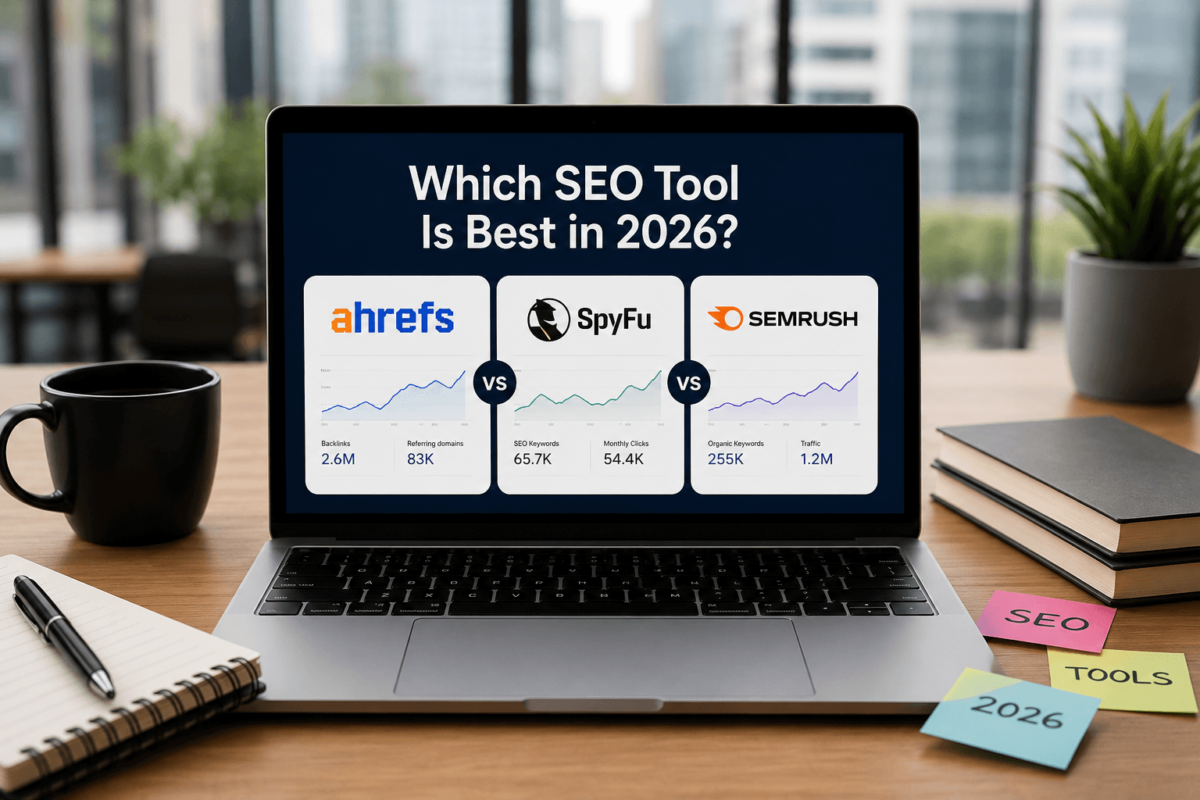
A complete buying resource for freelancers, agencies, and in-house teams — with real 2026 pricing, database sizes, and scenario-based recommendations.
Quick Answer
The honest answer, before you read another word: there is no single best SEO tool. There’s a best tool for your specific mix of budget, team size, and primary use case. If you only take one thing from this guide, it should be that none of these platforms see Google’s actual index — they estimate it from their own web crawlers and clickstream panels, and the three estimates disagree with each other more often than vendors like to admit.
| ● | Best Overall: Semrush — broadest toolkit covering SEO, content, PPC research, and AI-visibility tracking in one subscription. |
| ● | Best Value for Solo Users: SpyFu — unlimited searches and PPC history starting around $89/month on annual billing. |
| ● | Best for Agencies: Semrush Business or Ahrefs Advanced — white-label reporting, multi-client project limits, and API access. |
|
|
|
Quick Verdict: Who Should Buy What
| ● | Best Overall: Semrush — broadest toolkit covering SEO, content, PPC research, and AI-visibility tracking in one subscription. |
| ● | Best Value for Solo Users: SpyFu — unlimited searches and PPC history starting around $89/month on annual billing. |
| ● | Best for Agencies: Semrush Business or Ahrefs Advanced — white-label reporting, multi-client project limits, and API access. |
| ● | Best for Beginners: Ahrefs Starter ($29/month) or Semrush Pro — simpler interfaces with enough data to learn the fundamentals. |
| ● | Best for Bloggers and Content Creators: Ahrefs Standard — Content Explorer is the strongest topic and link-prospecting tool of the three. |
| ● | Best for Ecommerce: Semrush Guru — Content Marketing Toolkit plus broader keyword coverage for large product catalogs. |
| ● | Best for Local SEO: Semrush, paired with its Local toolkit add-on for Google Business Profile and map-rank tracking. |
| ● | Best Backlink Tool: Ahrefs — the most frequently cited as having the freshest, most actively-crawled link index. |
| ● | Best Keyword Research Tool: Semrush’s Keyword Magic Tool — broadest filtering and intent labeling. |
| ● | Best PPC Research Tool: SpyFu — purpose-built for competitor ad history since 2006, with nearly two decades of data. |
| ● | Best Enterprise Choice: Ahrefs Enterprise or Semrush Business — both offer API access and dedicated support, at custom or near-$500/month pricing. |
Full Feature Comparison Table
This table pulls together pricing, data limits, and feature availability across all three platforms’ mid-tier plans — Ahrefs Standard, SpyFu Pro + AI, and Semrush Guru — since these are the tiers most freelancers, consultants, and small agencies actually buy. Where a feature differs significantly by tier, that’s noted in the row.
| Feature | Ahrefs | SpyFu | Semrush |
|---|---|---|---|
| Entry-level price (monthly) | $129 (Lite) | $39 (Basic) | $139.95 (Pro) |
| Entry-level price (annual) | $108/mo | $29/mo | $117.33/mo |
| Mid-tier price (monthly) | $249 (Standard) | $119 (Pro + AI) | $249.95 (Guru) |
| Mid-tier price (annual) | $208/mo | $89/mo | $208.33/mo |
| Top-tier price (monthly) | $449 (Advanced) | $249 (Team/Agency) | $499.95 (Business) |
| Free trial | No | No (30-day refund) | 7 days (Pro/Guru) |
| Free plan | Ahrefs Free (verified sites only) | No | Limited free plan |
| Cheapest paid entry point | $29/mo Starter plan | $29/mo (annual Basic) | $117.33/mo (annual Pro) |
| Keyword database size | ~25 billion+ keywords | ~13–73 billion (estimates vary widely) | ~25 billion+ keywords |
| Backlink database size | 35 trillion+ links | Limited, supplementary only | 43 trillion+ links |
| Backlink data freshness | 15–30 minute refresh on active sites | Not a primary focus | Crawls ~10 billion pages/day |
| Keyword Difficulty scoring | Backlink-weighted KD score | Competitive keyword scoring | Multi-factor KD% (links + on-page + SERP) |
| Search intent labeling | Available in Keywords Explorer | Not a core feature | Labeled across most of the database |
| Traffic estimates | Site-level + page-level | Domain-level, PPC-weighted | Site-level + page-level |
| PPC / ad research | Basic, secondary feature | Core specialty since 2006 | Advertising Toolkit add-on |
| Historical ad data | Limited | 18+ years (since 2006) | Available via Advertising Toolkit |
| Rank tracking (tracked keywords, entry tier) | 750 | 5,000 weekly | 500 |
| Rank tracking (mid tier) | 2,000 | 15,000 weekly | 1,500 |
| Local SEO / Google Business Profile | GBP Monitor (beta) | Not supported | Local toolkit add-on, $30/location |
| Content marketing toolkit | Content Explorer + AI Content Helper | RivalFlow AI (1–10 sites by tier) | Full Content Marketing Toolkit on Guru+ |
| AI / LLM visibility tracking | Brand Radar + Custom Prompts | AI Brand Monitoring (limited on Basic) | AI Visibility Toolkit / Semrush One |
| ChatGPT integration | MCP Server support | Native, with credit-based limits | Available via AI Visibility add-on |
| Technical SEO / Site Audit | Full crawler-based Site Audit | None — no real site audit tool | 140+ issue checks, AI Search Health score |
| Site Audit crawl limit (entry tier) | 100,000 credits/mo | Not applicable | 100,000 pages/mo |
| Content Gap / Keyword Gap analysis | Content Gap tool | Kombat domain comparison | Keyword Gap tool |
| Link building / prospecting | Link Intersect, Content Explorer | Limited backlink view | Backlink Gap, Link Building Tool |
| Competitor keyword overlap tool | Content Gap | Kombat (signature feature) | Keyword Gap |
| API access | Included from Lite (rate-limited); full access higher tiers | Included from Pro + AI ($40–100 in credits) | Business tier only ($499.95/mo) |
| White-label / branded reporting | Available via Report Builder add-on | Included from Pro + AI | Included from Guru+ |
| Reporting and dashboards | Report Builder (5–25 reports by tier) | Automated reports (10–unlimited by tier) | My Reports + Looker Studio integration |
| Looker Studio / Data Studio integration | Advanced tier and up | Not supported | Available |
| Chrome extension / SEO toolbar | Yes (Ahrefs SEO Toolbar) | No dedicated extension | Yes (Semrush SEO Toolbar) |
| Social media management | Social Media Manager (beta, free while in beta) | Not supported | Social Media Toolkit add-on, $20/mo |
| Team collaboration / multi-user | 1 user included; $40–100/mo per extra seat | 1 user (Basic/Pro); 5 included on Team | 1 user per plan; per-seat add-on pricing |
| Projects (entry tier) | 5 | 1 Live Site project | 5 |
| Projects (mid tier) | 20 | 10 Live Site projects | 15 |
| Historical data depth | 6 months to 5+ years by tier | 10+ years (Pro + AI and up) | Back to January 2012 (Guru+) |
| Learning curve | Moderate — backlink-first mental model | Easiest — simplest interface of the three | Steepest — most modules to learn |
| Ease of use for beginners | Good | Best | Moderate — breadth can overwhelm |
| Customer support | Help center + email | Email, live chat, phone | 24/7 chat + email, phone on higher tiers |
| Money-back guarantee | None (restrictive refund policy) | 30-day, no questions asked | 7-day on new annual subscriptions |
| Best documented use case | Backlink analysis, content research | PPC competitor intelligence, budget research | All-in-one agency and in-house workflows |
A note on reading this table: list prices change reasonably often, and all three vendors run per-seat add-on pricing that can roughly double or triple the headline number once you add a second user, an API subscription, or a reporting add-on. Treat the numbers above as a same-day snapshot rather than a permanent reference, and check each vendor’s pricing page directly before you buy.
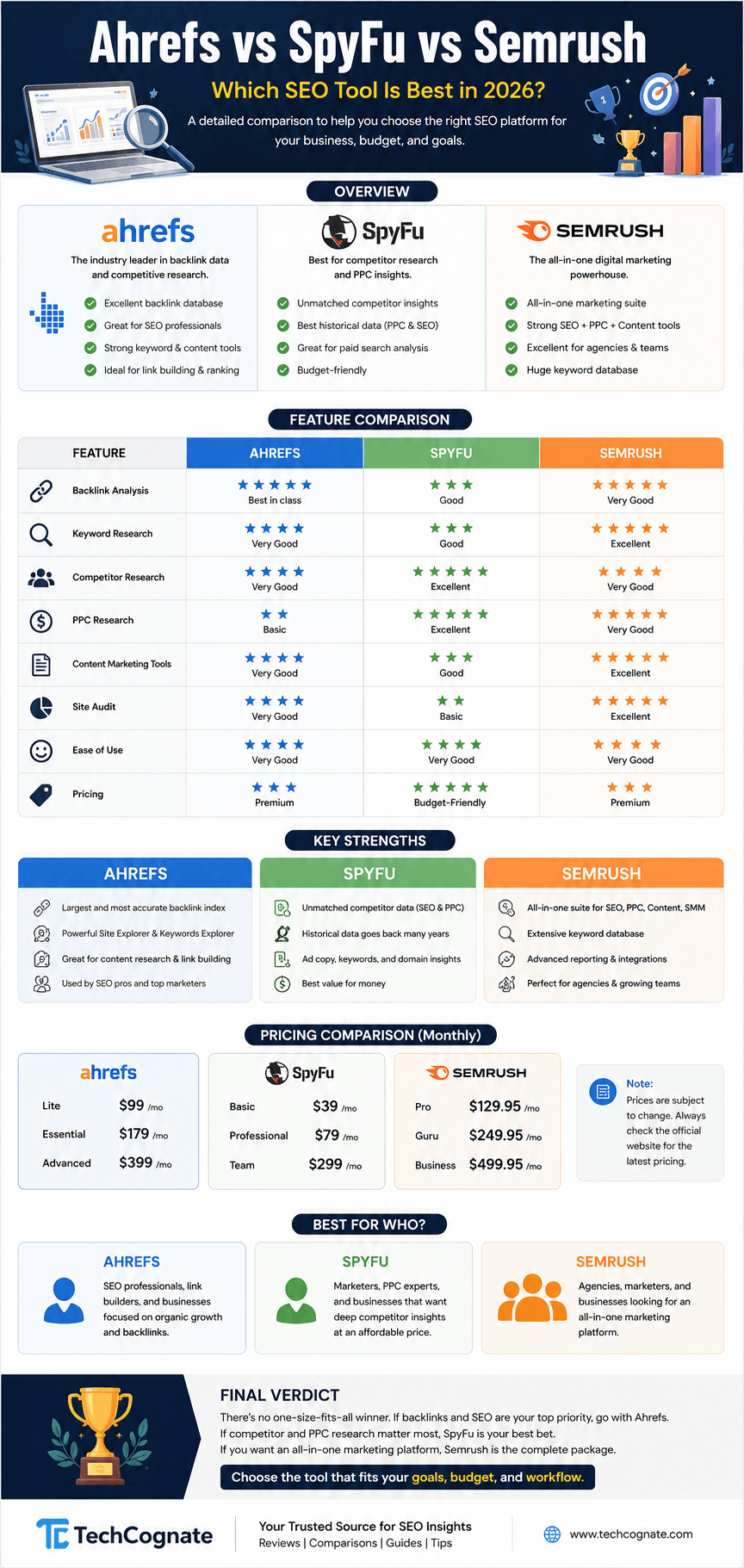
Ahrefs, SpyFu, and Semrush: Individual Reviews
Ahrefs Overview
Ahrefs launched as a backlink checker and has spent over a decade building what’s widely considered the most actively crawled link index in the industry. Today it’s a full SEO suite — Site Explorer, Keywords Explorer, Site Audit, Rank Tracker, and Content Explorer — but the backlink DNA still shows in how the product is organized and in features like Domain Rating, which has become something close to an industry-standard shorthand for link authority.
Who it’s built for
Ahrefs is built for people whose work lives or dies on link data: link builders, content marketers running digital PR campaigns, and SEO consultants who need to show a client exactly why a competitor outranks them. In agency environments, I’ve found Ahrefs is usually the tool the senior SEO opens first when a client asks “why did we lose rankings,” because the lost-link and ranking-drop alerts tend to surface the answer fastest.
Core strengths
| • | Backlink index widely cited as the largest and freshest, with reported refresh windows of 15–30 minutes on actively monitored sites. |
| • | Content Explorer is genuinely strong for finding link-worthy topics and prospecting for outreach targets — sort by referring domains or social shares and you have a content brief in minutes. |
| • | Clean, fast interface. Of the three tools, Ahrefs is the one I hand to a junior analyst with the least onboarding. |
| • | Site Audit is comprehensive and the crawl runs are fast relative to the credit cost. |
| • | Newer AI-era additions — Brand Radar, Custom Prompts, and an MCP Server for connecting Ahrefs data directly into AI workflows — show the company investing in AI-search visibility rather than only classic rank tracking. |
Weaknesses
| • | No free trial. The lowest-risk way to test the platform is the $29/month Starter plan or the free, ownership-verified Ahrefs Free tier — neither lets you research a competitor’s domain at full depth. |
| • | The jump from Starter ($29) to Lite ($129) is steep, and there’s no middle tier to soften it. |
| • | PPC and advertising research is present but clearly secondary; if paid search competitive intelligence is a major part of your job, Ahrefs will feel thin. |
| • | Refund policy is restrictive — Ahrefs does not issue refunds for material account activity, and there’s no standing discount or coupon program. |
| • | Add-ons (Content Kit, Report Builder, Project Boost) can push a working agency stack to 2–2.5x the headline plan price. |
Real use case
When auditing large ecommerce websites, I lean on Ahrefs’ Site Audit to triage thousands of product pages by crawl issue severity, then cross-reference the worst offenders against Content Explorer to see whether they’re also under-linked relative to competitors. That combination — technical health plus link gap — is where Ahrefs earns its subscription price for ecommerce work specifically.
Pricing snapshot
| Plan | Price & What You Get |
|---|---|
| Starter | $29/mo — basic keyword research and competitor lookups, no rank tracking |
| Lite | $129/mo ($108 annual) — 5 projects, 750 tracked keywords, 6 months historical data |
| Standard | $249/mo ($208 annual) — 20 projects, 2,000 tracked keywords, Content Explorer, 2 years historical data |
| Advanced | $449/mo ($374 annual) — 50 projects, 5,000 tracked keywords, Looker Studio integration, 5 years historical data |
| Enterprise | From $1,499/mo, annual commitment required — uncapped API, SSO, unlimited historical data |
Ideal customer
A freelance SEO consultant or in-house content marketer whose primary deliverable is link building, content strategy, or technical audits, and who’s comfortable committing to a plan without a trial run first.
SpyFu Overview
SpyFu was founded in 2006 with one job: let you type in a competitor’s domain and see every keyword they’ve ever ranked for, organically or via paid search, along with their estimated ad spend and the actual ad copy they tested. Almost twenty years later, that competitive-espionage core is still what the product does best, even as it’s added AI tools (RivalFlow, SpyGPT, ChatGPT integration) around the edges.
Who it’s built for
SpyFu is built for small businesses, freelancers, and PPC managers who want a fast answer to one question — “what is this specific competitor doing” — without paying for a 40-tool suite they’ll never fully use. For smaller local businesses with one or two real competitors, SpyFu’s domain-vs-domain comparison tool (Kombat) is often more directly useful than the broader keyword databases in Ahrefs or Semrush.
Core strengths
| • | Unlimited search results and data exports starting at the Pro + AI tier ($89/mo annual), with no per-report credit system to manage. |
| • | PPC ad history genuinely is the deepest of the three tools — 18+ years of historical ad copy, spend estimates, and bidding patterns. |
| • | Simplest interface of the three. New users tend to get to a usable competitor report fastest in SpyFu. |
| • | 30-day, no-questions-asked money-back guarantee — the most generous refund policy of the three vendors. |
| • | Flat $30/month additional-seat pricing across tiers, which is more predictable than Ahrefs’ tier-dependent seat costs. |
Weaknesses
| • | No real site audit or technical SEO crawler. If you need to find broken pages, redirect chains, or Core Web Vitals issues, SpyFu has nothing to offer — you’ll need a second tool. |
| • | Backlink data is described even by SpyFu-friendly reviewers as supplementary; it’s not built to support comprehensive link-building campaigns. |
| • | Keyword database size claims vary enormously across sources — anywhere from roughly 13 billion to over 70 billion keywords depending on which test or marketing page you read — which makes it the hardest of the three to verify with confidence. |
| • | No local SEO or Google Business Profile tracking features. |
| • | The advertised Pro + AI price is a promotional first-month rate ($59) that reverts to $119/month — worth confirming before you commit a budget. |
Real use case
In agency environments handling several small local-business clients, I’ve used SpyFu’s Kombat tool to build a one-page competitor snapshot in under ten minutes — fast enough to use live on a client call rather than as a leave-behind report. For a dentist or law firm with two or three direct local competitors, that speed matters more than database depth.
Pricing snapshot
| Plan | Price & What You Get |
|---|---|
| Basic | $39/mo ($29 annual) — 10,000 search results/exports, 1 site tracking project, no historical data |
| Pro + AI | $119/mo ($89 annual) — unlimited searches/exports, 10 tracking projects, 10+ years historical data, RivalFlow AI on 1 site |
| Team / Agency | $249/mo ($187 annual) — 5 user seats, unlimited tracking projects, RivalFlow on 5 sites, white-label reporting |
Ideal customer
A solo marketer, small agency, or local business owner whose top priority is understanding what specific competitors are doing in paid and organic search, on a budget that can’t stretch to Ahrefs or Semrush’s mid-tier pricing.
Semrush Overview
Semrush positions itself as the all-in-one marketing platform rather than a pure SEO tool, and the product lineup backs that up: SEO, content marketing, PPC research, social media, local listings, and — as of late 2025 — a dedicated AI Visibility Toolkit bundled into a new “Semrush One” offering that tracks brand mentions across ChatGPT, Google AI Overviews, and other AI answer engines. Adobe announced its acquisition of Semrush for roughly $1.9 billion in November 2025, with the deal expected to close in the first half of 2026, which is worth knowing if you’re evaluating a multi-year contract.
Who it’s built for
Semrush is built for agencies and in-house marketing teams who want one login instead of five. When auditing large ecommerce websites for clients who also run Google Ads, I’ve found the appeal of Semrush is less about any single feature being best-in-class and more about not having to export data between three different tools to build one report.
Core strengths
| • | Broadest toolkit of the three by a wide margin — Semrush’s own marketing claims 40+ tools, and even a conservative count covers SEO, content, PPC, social, and local in one subscription. |
| • | Keyword Magic Tool is the most feature-rich keyword research interface across all three platforms, with 20+ filters and built-in topic clustering. |
| • | Search intent labeling is applied across most of the keyword database by default, which saves real time when scoping new content. |
| • | Site Audit checks 140+ technical issues and now includes an AI Search Health score assessing how likely a page is to be cited in LLM answers. |
| • | Transparent, published tier pricing — unlike Ahrefs Enterprise or many competitors, Semrush Business is publicly priced at $499.95/month rather than quote-only. |
Weaknesses
| • | Highest entry price of the three platforms, and the gap between Pro and Guru ($139.95 to $249.95, a 79% jump) gates genuinely important features — historical data and the full Content Marketing Toolkit — behind the more expensive tier. |
| • | API access exists only on the Business plan, the most expensive standard tier. |
| • | Breadth can be disorienting for new users; the learning curve is the steepest of the three, even though documentation has improved. |
| • | No self-serve cancel button — cancellation requires contacting support directly, which is a recurring complaint in user reviews. |
| • | The pending Adobe acquisition introduces genuine pricing uncertainty for anyone signing a long annual contract in 2026. |
Real use case
For smaller local businesses bundled under one agency retainer, I’ve used Semrush’s Local toolkit alongside its Position Tracking to manage Google Business Profile visibility and map-pack rankings for several clients from a single dashboard — something that would require stitching together two separate tools with Ahrefs or SpyFu.
Pricing snapshot
| Plan | Price & What You Get |
|---|---|
| Pro | $139.95/mo ($117.33 annual) — 5 projects, 500 tracked keywords, no historical data or API |
| Guru | $249.95/mo ($208.33 annual) — 15 projects, 1,500 tracked keywords, Content Marketing Toolkit, historical data since 2012 |
| Business | $499.95/mo ($416.66 annual) — 40 projects, 5,000 tracked keywords, API access, Share of Voice, white-label reports |
| Semrush One (Starter/Pro+/Advanced) | From $199/mo — bundles SEO Classic with the AI Visibility Toolkit |
Ideal customer
An agency or in-house marketing team managing multiple client or brand properties across SEO, PPC, and content, with a budget that can absorb the higher entry price in exchange for not paying for three separate subscriptions.
Feature-by-Feature Deep Dive
Each section below answers the comparison question directly first, then expands with the context behind that answer. If you’re skimming, the bolded “Winner” line at the start of each section is the takeaway; the rest explains why and who actually benefits from that answer.
Keyword Research
Ahrefs and Semrush both maintain keyword databases in the tens of billions and update them on similar cycles, so for broad keyword ideation — starting from a seed term and discovering an entire topic landscape — they’re close enough that interface preference matters more than raw numbers. Semrush’s Keyword Magic Tool has the deeper filtering (20+ filters including question keywords and intent grouping), while Ahrefs’ Keywords Explorer leans on its backlink data to produce a more conservative, link-weighted difficulty score.
SpyFu takes a different approach entirely: instead of starting from a seed keyword, you start from a competitor’s domain and SpyFu shows you everything that domain already ranks for, organic and paid. That reverse-engineering workflow is faster for competitive research but isn’t designed for discovering entirely new topic opportunities the way Ahrefs’ Content Explorer or Semrush’s Keyword Magic Tool are.
Backlink Analysis
Ahrefs is consistently described across independent comparisons as having the freshest and most actively crawled backlink index of the three, with reported detection speeds of 2–4 days for new referring domains and a crawler frequently cited as the second-most-active on the web after Googlebot. Semrush’s stated index is actually larger by raw link count (43 trillion vs. Ahrefs’ 35 trillion), but several independent tests note that Semrush’s larger index includes a higher proportion of low-quality or spam links that need additional filtering before the data is actionable.
SpyFu’s backlink tooling is the clear third option here. It will show you some backlink data for a domain, but it isn’t built as a comprehensive link-building or link-audit tool, and most reviewers treat it as supplementary at best.
Competitor Analysis
Semrush’s domain comparison tools pull organic, paid, and traffic-trend data into one view, which makes it the strongest option when you need a full competitive landscape across multiple channels at once. SpyFu’s Kombat tool is narrower but faster — if your question is specifically “what keywords is this one competitor bidding on, and how has their ad spend changed,” SpyFu answers it with less clicking.
Ahrefs’ competitive analysis leans on its Content Gap and Site Explorer comparison features, which are strong for organic-only comparisons but weaker than either competitor once paid search enters the picture.
Technical SEO and Site Audit
Semrush’s Site Audit checks more than 140 individual issues and now surfaces an AI Search Health score alongside traditional technical findings, which is a genuinely useful addition as more traffic shifts toward AI Overviews and chat-based answers. Ahrefs’ Site Audit is comparably deep and tends to run crawls faster relative to the credits consumed, with the Always-On Audit and Project Boost add-ons letting agencies monitor priority client sites continuously rather than on a fixed schedule.
SpyFu simply doesn’t compete here. It has no true site crawler, so if technical health checks, broken-link discovery, or Core Web Vitals monitoring are part of your job, you’ll need Ahrefs, Semrush, or a dedicated technical SEO tool regardless of which platform you choose for everything else.
Rank Tracking
Semrush’s Position Tracking supports daily updates across Google, Bing, and other search engines, plus the ability to flag AI Overview appearances — a feature both Semrush and Ahrefs added in late 2025 and early 2026 in response to how much AI-generated answers have reshaped click-through behavior. Ahrefs’ Rank Tracker updates weekly across all tiers, which is less granular but still sufficient for most monthly reporting cycles.
SpyFu actually tracks more keywords on its entry tiers by raw count (5,000 weekly on Basic versus 750 on Ahrefs Lite and 500 on Semrush Pro), but it doesn’t offer the same multi-search-engine or AI Overview flagging that the other two have added recently.
Local SEO
Semrush offers a purpose-built Local SEO toolkit priced per location, covering Google Business Profile management, local rank tracking, and review monitoring — genuinely useful for multi-location businesses or agencies serving brick-and-mortar clients. Ahrefs has moved in this direction with its newer GBP Monitor, currently in beta, which manages Google Business Profiles at scale but is less mature than Semrush’s offering.
SpyFu has no local SEO or Google Business Profile features at all, which is one of its clearest gaps relative to the other two tools.
Content Marketing
Semrush’s Content Marketing Toolkit (available from Guru tier up) includes topic research, an AI article generator, and a content optimizer that checks drafts against top-ranking competitors — a more complete content production pipeline than either competitor offers natively. Ahrefs’ Content Explorer is narrower in scope but excellent specifically for finding proven, already-successful content ideas sorted by backlinks or social shares, which makes it a strong complement to — rather than a full replacement for — a dedicated content workflow tool.
SpyFu’s RivalFlow AI handles content optimization on a per-site basis (1 site on Pro + AI, 5 on Team/Agency) but doesn’t offer the topic-research or clustering capability of the other two.
PPC Research and Advertising Intelligence
SpyFu’s entire reason for existing is PPC competitive intelligence, and nearly twenty years of accumulated ad history shows. You can see a competitor’s actual ad copy variations over time, estimated monthly ad spend, and which keywords they’ve bid on historically — data depth neither Ahrefs nor Semrush is built to match. Semrush’s Advertising Toolkit (a separate add-on, priced in Base and Pro tiers) covers similar ground with AdClarity for display, video, and social ad intelligence, and is a reasonable second option for teams already inside the Semrush ecosystem.
Ahrefs provides some competitor paid-keyword visibility inside Site Explorer, but PPC research has always been a secondary feature layered onto an organic-search-first product, and it shows in the shallower historical depth.
AI Features and AI-Search Visibility
Both Ahrefs (Brand Radar, Custom Prompts) and Semrush (AI Visibility Toolkit, bundled into Semrush One) have built genuinely dedicated products for tracking how often a brand or domain gets cited inside ChatGPT, Google AI Overviews, Perplexity, and similar AI answer engines — a category that didn’t meaningfully exist in either platform two years ago and now commands its own pricing tier. Ahrefs prices this as an add-on starting around $199/month or via standalone custom-prompt packages from $50/month; Semrush bundles it into Semrush One starting at $199/month.
SpyFu offers AI Brand Monitoring and a ChatGPT integration that streams its own data into AI conversations, but the feature is more limited on lower tiers (capped at a few chats on Basic) and isn’t positioned as a dedicated AI-visibility tracking product the way the other two are.
Reporting, API, and Integrations
Ahrefs includes direct API access starting at the Lite tier, with rate limits that scale up by plan, while Semrush gates all API access behind its most expensive Business tier ($499.95/month) — a meaningful difference if programmatic access to your SEO data matters and budget is tight. Both offer Looker Studio integration on their upper tiers for building custom dashboards.
SpyFu includes API access from Pro + AI with credit allotments ($40–100 worth included depending on tier), which is more accessible than Semrush’s API gating, though SpyFu’s API documentation and ecosystem are less developed than the other two.
Ease of Use and Learning Curve
New users tend to reach a usable competitor report fastest in SpyFu because the interface has fewer modules and a more linear workflow — enter a domain, get a report. Ahrefs sits in the middle: the core Site Explorer and Keywords Explorer are intuitive, but the platform rewards understanding backlink concepts (Domain Rating, referring domains, anchor text distribution) that take a few sessions to internalize fully.
Semrush’s learning curve is the steepest simply because there’s more to learn — SEO, content, PPC, social, and local tools all live under one roof, and a new user can spend their first week not knowing where to look. That said, Semrush Academy’s free training and certification programs have meaningfully shortened this ramp-up for users willing to invest the time.
Accuracy Testing: How the Data Estimates Actually Compare
It’s worth saying plainly: no third-party SEO tool has access to Google’s actual index, actual search volume data, or actual ranking algorithm. Every platform — Ahrefs, SpyFu, and Semrush included — builds its own estimates from its own web crawler, its own clickstream panel data, and statistical modeling. That’s not a flaw unique to any one of them; it’s a structural limit of the entire category. The practical result is that the same domain, searched in all three tools on the same day, will often return meaningfully different traffic estimates, keyword counts, and difficulty scores.
| • | Traffic estimates: All three derive organic traffic estimates from a combination of ranking position and modeled click-through rates, not real analytics data — treat these as directional, not exact. |
| • | Keyword volume: Search volume figures can vary by a meaningful margin between tools for the same keyword, largely due to differences in clickstream panel size and how each platform handles seasonal averaging. |
| • | Difficulty scores: Not comparable across tools — Ahrefs’ KD is primarily a function of referring domains to the top-ranking pages, while Semrush’s KD% blends backlinks with on-page and SERP-feature signals. A score in one tool does not mean the same thing as the identical-looking score in another. |
| • | Backlinks: Index size differences (Ahrefs’ 35 trillion vs. Semrush’s 43 trillion) reflect different crawling and deduplication methodology as much as genuine index quality — bigger raw numbers don’t automatically mean more actionable data. |
| • | Freshness: Ahrefs’ near-real-time refresh on monitored sites is the most consistently verified freshness claim among the three in independent testing. |
| • | Index size: SpyFu’s keyword database size claims are the least consistent across sources, ranging from roughly 13 billion to over 70 billion depending on the source — worth treating with the most skepticism of any figure in this comparison. |
★ Key Takeaway
No SEO tool sees Google’s exact data. If a number matters for a real decision — a client report, an investment case, a content prioritization call — cross-check it against at least one other source rather than trusting a single tool’s estimate.
Pricing Comparison and Hidden Costs
The number on each pricing page is rarely the number you’ll actually pay once a real team starts using the tool. All three vendors monetize the same way: a published base plan, plus per-seat charges for additional users, plus optional add-ons that unlock features the base plan deliberately leaves out. Below is what each platform’s real-world cost tends to look like once those layers stack up.
Monthly vs. Annual Pricing
| Tier | Ahrefs | SpyFu | Semrush |
|---|---|---|---|
| Entry (monthly) | $129 | $39 | $139.95 |
| Entry (annual, /mo) | $108 | $29 | $117.33 |
| Annual savings | ~17% | ~25% | ~17% |
| Mid (monthly) | $249 | $119 | $249.95 |
| Mid (annual, /mo) | $208 | $89 | $208.33 |
| Top (monthly) | $449 | $249 | $499.95 |
| Top (annual, /mo) | $374 | $187 | $416.66 |
Hidden Costs to Budget For
Additional user seats
| • | Ahrefs: $40/mo per extra seat on Lite, $60/mo on Standard, $80/mo on Advanced, $100/mo on Enterprise — cost scales up with tier. |
| • | SpyFu: flat $15/mo per extra seat on Basic, $30/mo on Pro + AI and Team/Agency — the most predictable seat pricing of the three. |
| • | Semrush: per-seat add-on pricing in the $45–100/month range depending on tier; a five-person Guru team can run roughly $6,300+/year in seat costs alone once you add four extra users. |
Add-ons and toolkit upgrades
| • | Ahrefs: Content Kit from $99/mo, Report Builder $99/mo, Project Boost Pro $20/mo per project, Project Boost Max $200/mo per project, Brand Radar from $199/mo. |
| • | SpyFu: comparatively few paid add-ons; most additional value (AI tools, white-label reporting) is gated by plan tier rather than sold separately. |
| • | Semrush: Local SEO $30/mo per location, Social Media toolkit $20/mo, Content toolkit $60/mo, Advertising toolkit $99/mo, AI Visibility $99/mo, Traffic & Market Trends $289/mo. |
API access
| • | Ahrefs includes API access from the Lite tier with scaling rate limits, or a separate subscription from roughly $500–10,000/month for heavier usage. |
| • | SpyFu includes API credits ($40–100 worth) from Pro + AI; additional usage is billed per SpyFu’s published API pricing. |
| • | Semrush restricts API entirely to the Business tier ($499.95/month) — there’s no lower-cost way to get programmatic access. |
Realistic total cost of ownership
A two-person agency on Ahrefs Standard running Content Kit, Report Builder, and Project Boost Pro on five client projects lands around $600/month — roughly 2.4x the $249 headline plan price. A three-person Semrush Guru team adding AI Visibility on two client domains and Local on five locations can land around $1,000/month, close to 4x the sticker price. SpyFu’s stack tends to inflate the least: a five-person Team/Agency plan at $187/month annual already includes white-label reporting and unlimited projects, so there’s less left to bolt on.
★ Key Takeaway
Budget 1.5–2x the headline price for solo use, and 2.5–4x for an active agency stack with multiple seats and add-ons. SpyFu’s total cost of ownership inflates the least relative to its sticker price; Semrush’s inflates the most due to its modular add-on structure.
Value Per Dollar: A Practical ROI Framework
Rather than asking which tool is “worth it” in the abstract, it’s more useful to ask which tool pays for itself fastest given what you actually do.
| • | If your revenue depends on organic content and link building, Ahrefs’ premium is easiest to justify — better link data compounds into organic traffic gains over a 12–24 month horizon. |
| • | If you’re consolidating multiple point solutions (a keyword tool, a PPC research tool, a content tool, a social scheduler) into one subscription, Semrush’s higher price can still be a net saving versus paying for four separate tools. |
| • | If your budget is the binding constraint and your main need is competitive PPC intelligence, SpyFu typically delivers the fastest payback simply because the entry cost is so much lower. |
Real Use Cases by Role and Business Type
Generic advice breaks down fast once you get specific about who’s actually buying. Here’s how the recommendation shifts across the roles and business types that most commonly ask this question.
| Who You Are | Best Fit | Why |
|---|---|---|
| Freelancer | SpyFu or Ahrefs Lite | If you’re billing by the hour or the project, SpyFu’s lower entry cost protects your margin. Switch to Ahrefs once link-building work becomes a regular line item, since the data quality difference shows up directly in client results. |
| Agency (3–15 clients) | Semrush Guru or Ahrefs Standard | Agencies need white-label reporting and enough project slots to avoid constantly upgrading. Semrush’s broader toolkit reduces the number of subscriptions you’re reselling line items for; Ahrefs Standard is the leaner choice if your retainers are organic-SEO-only. |
| Affiliate marketer | Ahrefs Standard | Content Explorer is built almost exactly for affiliate content discovery — finding proven, already-monetizable topics with existing search demand and link equity. |
| Blogger | Ahrefs Lite or SpyFu Basic | Most bloggers don’t need rank tracking at scale or PPC research. Ahrefs Lite covers content and backlink basics; SpyFu Basic is the cheaper option if budget is the deciding factor. |
| YouTuber / content creator | SpyFu Pro + AI | Competitor content and keyword overlap matter more than backlinks for video-first creators expanding into blog or show-notes content; SpyFu’s lower cost and RivalFlow AI fit this use case well. |
| Local business owner | SpyFu Basic or Semrush Pro + Local add-on | A single-location business with two or three real local competitors gets more direct value from SpyFu’s fast competitor snapshots than from a 40-tool suite. |
| Dentist or law firm (local service) | Semrush Pro + Local toolkit | These businesses live and die by Google Business Profile visibility and map-pack rankings — Semrush’s dedicated Local toolkit directly addresses that need in a way SpyFu cannot. |
| SaaS company | Semrush Guru or Ahrefs Standard | SaaS content marketing usually blends bottom-of-funnel comparison content with top-of-funnel educational content; Semrush’s content tools plus PPC research cover both motions in one subscription. |
| Enterprise / Fortune 500 | Ahrefs Enterprise or Semrush Business | At this scale, API access, SSO, dedicated support, and audit logs matter more than any single feature — both Ahrefs Enterprise (from $1,499/mo) and Semrush Business ($499.95/mo) are built for this tier, with Ahrefs the pricier but more customizable option. |
| Shopify store / ecommerce brand | Semrush Guru or Ahrefs Standard | Large product catalogs benefit from Semrush’s broader keyword coverage and content tools for category and collection pages; Ahrefs Standard is the better fit if technical Site Audit and backlink health on thousands of product URLs is the priority. |
| Amazon seller | SpyFu Pro + AI | Amazon SEO leans more on competitive keyword research than backlinks; SpyFu’s competitor-first workflow and lower price point fit sellers who don’t need a full web-SEO suite. |
| In-house marketing team | Semrush Business | Cross-functional teams (SEO, content, paid) benefit most from one shared login and one set of reporting dashboards rather than stitching data from three vendors. |
| Startup (pre-Series A) | SpyFu Basic or Ahrefs Starter | Cash-constrained early-stage teams should start at the cheapest tier that still answers their single most pressing question, then upgrade once there’s revenue to justify it. |
Note that the table above compresses “why” into a short summary; the Real Use Case sections inside each tool’s individual review (earlier in this guide) go into more first-hand detail on how these workflows actually play out day to day.
Step-by-Step Workflow Examples
Feature lists only tell you so much. Here’s what eight common SEO and PPC workflows actually look like, step by step, in each tool — useful if you want to picture your actual Tuesday-morning task rather than an abstract feature comparison.
Finding Competitor Keywords
|
Enter the competitor’s domain into Site Explorer (Ahrefs) or the main search bar (SpyFu). | |
|
Filter to organic keywords ranking in positions 1–10 to focus on what’s actually driving traffic. | |
|
Sort by estimated traffic or keyword volume to prioritize the highest-impact terms. | |
|
Export the list and cross-reference against your own ranking keywords to find true gaps, not just overlap. | |
|
In SpyFu, repeat the same process for paid keywords to see where organic and PPC strategy diverge. |
Finding Backlink Opportunities
|
Run Link Intersect with your domain plus 3–5 competitor domains. | |
|
Filter results to domains linking to multiple competitors but not to you — these are your highest-probability outreach targets. | |
|
Check each prospect’s Domain Rating and organic traffic to prioritize quality over raw volume. | |
|
Use Content Explorer to find the specific competitor page earning the link, so your outreach pitch can reference exactly what worked. |
Building Content Clusters
|
Start with a broad seed topic relevant to your business. | |
|
In Ahrefs, search Content Explorer and sort by referring domains to surface proven, link-worthy subtopics. In Semrush, use Keyword Magic Tool’s clustering view instead. | |
|
Group resulting keywords by search intent (informational, commercial, transactional). | |
|
Map each cluster to a single pillar page plus supporting subpages, avoiding keyword cannibalization across the cluster. |
Content Optimization
|
Paste your draft or target URL into the optimizer. | |
|
Review the tool’s suggested terms, based on what’s already ranking on page one for your target keyword. | |
|
Check the readability and structure score against top-ranking competitors. | |
|
Revise the draft based on flagged gaps, then re-run the check before publishing. |
Keyword Gap Analysis
|
Enter your domain plus up to five competitor domains. | |
|
Filter to keywords competitors rank for that your domain does not. | |
|
Sort by search volume and estimated difficulty to prioritize realistic, high-value targets first. | |
|
Export the shortlist into your content calendar with assigned owners and target publish dates. |
Site Audit
|
Set up a new project and point the crawler at your domain. | |
|
Run the initial crawl and review the prioritized issues list (errors, warnings, notices). | |
|
Start with crawlability and indexability issues first, since these block everything downstream. | |
|
Schedule recurring crawls (weekly or monthly) to catch regressions before they compound. |
PPC Campaign Research
|
Enter a competitor’s domain to pull their current and historical paid keywords. | |
|
Review estimated monthly ad spend and budget allocation by keyword group. | |
|
Inspect actual ad copy variations they’ve tested over time to identify messaging angles worth testing yourself. | |
|
Export the keyword list and use it to seed your own campaign’s initial keyword set, adjusting bids based on their visible spend patterns. |
Recovering Lost Rankings
|
Check Rank Tracker for the exact date a ranking dropped. | |
|
Cross-reference that date against your site’s backlink history for lost or newly toxic links. | |
|
Check Site Audit for any technical changes (robots.txt, canonical tags, redirects) deployed around the same date. | |
|
Compare the page against newly ranking competitors to identify content or relevance gaps that may have opened up. |
Pros and Cons Summary
Ahrefs
| Pros | Cons |
|---|---|
| Industry-leading backlink index freshness and depth | No free trial; restrictive refund policy |
| Clean, fast interface with a gentle learning curve for core tasks | Steep price jump between Starter ($29) and Lite ($129) |
| Content Explorer is excellent for link-worthy topic research | PPC and advertising research is clearly secondary |
| API access included from the Lite tier | Add-ons can push real cost to 2–2.5x the headline plan price |
| Strong, fast-improving AI-visibility tools (Brand Radar, MCP Server) | Historical data is limited on lower tiers (6 months on Lite) |
SpyFu
| Pros | Cons |
|---|---|
| Lowest entry price of the three, with unlimited search/export from Pro + AI | No real site audit or technical SEO crawler at all |
| Deepest PPC and ad-history data of any of the three tools | Backlink data is supplementary, not comprehensive |
| Simplest interface; fastest path to a usable report for new users | Keyword database size claims are inconsistent across sources |
| 30-day, no-questions-asked money-back guarantee | No local SEO or Google Business Profile features |
| Flat, predictable additional-seat pricing | Advertised Pro + AI price is a first-month promo, reverting higher |
Semrush
| Pros | Cons |
|---|---|
| Broadest toolkit of the three — SEO, content, PPC, social, local in one login | Highest entry price of the three platforms |
| Keyword Magic Tool is the most feature-rich keyword research interface | 79% price jump from Pro to Guru gates important features |
| Site Audit covers 140+ checks plus an AI Search Health score | API access restricted to the most expensive Business tier |
| Transparent, publicly published pricing at every tier including Business | Steepest learning curve due to sheer platform breadth |
| Dedicated Local SEO toolkit for multi-location and local-service businesses | No self-serve cancellation; requires contacting support |
What Users and the SEO Community Actually Say
Beyond vendor marketing, it’s worth knowing how real users talk about these tools once they’ve been paying for a few months. The patterns below summarize recurring themes across public review platforms (like G2) and SEO community discussion, rather than quoting any individual review verbatim.
Ahrefs: Common Themes
What users praise
| • | Backlink data accuracy and crawl speed are the most consistently praised aspects across reviews. |
| • | Reviewers in marketing, IT, and small-business segments frequently describe the platform as expensive but justifiable for regular client or daily SEO work. |
| • | Interface cleanliness and onboarding speed for core tools are repeatedly called out as strengths relative to competitors. |
Common complaints
| • | Pricing is the single most recurring complaint, especially among freelancers, solopreneurs, and users in price-sensitive markets. |
| • | Credit-based usage limits on lower tiers are cited as a frequent source of frustration once usage scales up. |
| • | The 2023 price increase (from $99 to $129 for the entry tier at the time) generated visible, sustained frustration in SEO community discussion, with some threads running into the hundreds of comments. |
SpyFu: Common Themes
What users praise
| • | Price-to-value ratio is the most consistently cited reason users choose and stay with SpyFu, often after directly comparing annual costs against Semrush or Ahrefs. |
| • | Agencies report using automated, branded reports as a meaningful aid to client retention, since clients can see proof of ongoing work without extra manual reporting effort. |
| • | Long-tenured users (some citing continuous use since the mid-2010s) point to consistent feature additions over time without proportional price increases, at least until the recent Pro tier repricing. |
Common complaints
| • | Occasional concerns about data accuracy, particularly for niche or local-only use cases with limited search volume. |
| • | Price feels steep for infrequent users who only need occasional keyword checks rather than ongoing monitoring. |
| • | The promotional first-month pricing on Pro + AI, which reverts to a substantially higher rate, is a recurring point of confusion. |
Semrush: Common Themes
What users praise
| • | Breadth is the most-cited strength — users repeatedly mention consolidating multiple previously-separate tools into one Semrush subscription. |
| • | Site Audit depth and the newer AI Search Health scoring are called out positively in more recent reviews. |
| • | Semrush Academy’s free certification and training content is frequently credited with shortening the platform’s otherwise steep learning curve. |
Common complaints
| • | The lack of a self-serve cancellation flow — requiring direct contact with support — is one of the most frequently repeated billing-related complaints. |
| • | The gap between Pro and Guru pricing, and the features gated behind it, is a recurring source of buyer frustration once users realize what’s missing from the entry tier. |
| • | Some users flag uncertainty around the pending Adobe acquisition and what it could mean for future pricing or product direction. |
Where the Community Disagrees
Agencies tend to split along the same line as their service mix: shops doing primarily organic SEO and content work lean toward Ahrefs or Semrush, while shops with a heavier PPC or local-business client base lean toward SpyFu or Semrush’s Local toolkit. Bloggers and solo creators skew toward whichever tool they can afford at the volume they’re producing content, which in practice means SpyFu or Ahrefs’ lower tiers win by price alone more often than by feature fit. Beginners consistently report an easier on-ramp with SpyFu, while more experienced SEOs who’ve already internalized backlink concepts tend to prefer Ahrefs’ more specialized vocabulary and metrics.
The most consistent point of actual disagreement across community discussion is backlink index quality: some practitioners trust Ahrefs’ smaller-but-fresher index over Semrush’s larger-but-noisier one, while others argue Semrush’s broader crawl surfaces links Ahrefs misses entirely. Neither position has fully won out, and the honest takeaway is that serious link-building work often benefits from checking both rather than picking one as a permanent source of truth.
Frequently Asked Questions
Answers below lead with a direct response in the first sentence or two, then add context — written this way deliberately so the core answer is easy to extract whether you’re skimming or pulling this into an AI search summary.
Is Ahrefs better than Semrush?
Neither is universally better; Ahrefs wins on backlink data freshness and depth, while Semrush wins on overall toolkit breadth and content/PPC features. Choose Ahrefs if link building is central to your work, and Semrush if you want one platform covering SEO, content, and paid search.
Is SpyFu accurate?
SpyFu’s PPC and competitor ad data is widely regarded as accurate and uniquely deep, but its keyword database size claims vary significantly across sources and its backlink data is considered supplementary rather than comprehensive. Treat its organic SEO numbers with more caution than its PPC numbers.
Which tool is better for PPC?
SpyFu is built specifically for PPC competitor research and has the deepest historical ad data of the three, going back to 2006. Semrush’s Advertising Toolkit is a capable second option if you need it bundled with broader SEO tools.
Which tool is best for backlinks?
Ahrefs is most frequently cited as having the freshest, most actively crawled backlink index, even though Semrush’s raw index is larger by link count. For comprehensive link-building work, Ahrefs is the more commonly recommended starting point.
Which tool has the biggest keyword database?
Ahrefs and Semrush both maintain keyword databases in the tens of billions and are roughly comparable in scale. SpyFu’s reported size varies widely across sources, making direct comparison difficult to verify.
Can beginners use Semrush?
Yes, though Semrush has the steepest learning curve of the three platforms due to its breadth. Semrush Academy’s free training and certification programs are specifically designed to shorten this ramp-up period.
Which tool is cheaper?
SpyFu has the lowest entry price at $29/month on annual billing, compared to roughly $108/month for Ahrefs Lite and $117/month for Semrush Pro on annual billing. SpyFu also tends to have the lowest realistic total cost of ownership once add-ons are factored in.
Which tool is best for ecommerce SEO?
Semrush Guru is a strong fit for large product catalogs due to its broader keyword coverage and content tools; Ahrefs Standard is the better choice if technical site health and backlink monitoring across thousands of product pages is the priority.
Which tool has AI?
All three now offer AI features. Ahrefs has Brand Radar and an MCP Server for AI workflows; Semrush has a dedicated AI Visibility Toolkit bundled into Semrush One; SpyFu offers RivalFlow AI and a native ChatGPT integration.
Which tool replaces Google Keyword Planner?
Any of the three can replace Keyword Planner for keyword research, and all three typically provide more granular volume and difficulty data than Keyword Planner’s broad ranges. Ahrefs and Semrush offer the most comprehensive keyword discovery; SpyFu is stronger for competitor-specific keyword reverse-engineering.
Which tool is best for agencies?
Semrush is most commonly recommended for agencies needing one platform across multiple service lines; Ahrefs Standard or Advanced is the better fit for agencies focused specifically on organic SEO and content.
Which tool offers the best ROI?
It depends on your primary bottleneck: Ahrefs for link-building-driven organic growth, Semrush for consolidating multiple tools into one subscription, and SpyFu for the fastest payback on a constrained budget.
Does Ahrefs have a free trial?
No. Ahrefs removed its previous trial offering and currently has no standard free trial; the lowest-risk options are the $29/month Starter plan or the free, ownership-verified Ahrefs Free tier.
Does SpyFu have a free trial?
No, but SpyFu offers a 30-day money-back guarantee with no questions asked, which functions as a practical substitute for a trial.
Does Semrush have a free trial?
Yes, Semrush offers a 7-day free trial on its Pro and Guru plans, along with a 7-day money-back guarantee on new annual subscriptions.
Which tool is best for content marketing?
Semrush’s Content Marketing Toolkit (Guru tier and above) is the most complete end-to-end content production pipeline; Ahrefs’ Content Explorer is the strongest tool specifically for discovering proven, link-worthy topics.
Which tool is best for technical SEO?
Ahrefs and Semrush are both strong technical SEO platforms with comprehensive Site Audit tools; SpyFu has no comparable feature and isn’t a viable choice for technical SEO work.
How accurate are traffic estimates across these tools?
All three derive traffic estimates from modeled click-through rates applied to ranking position, not real analytics data, so figures should be treated as directional rather than exact, and can vary meaningfully between tools for the same domain.
Can I use more than one of these tools at once?
Yes, and many experienced SEOs do — commonly pairing Ahrefs for backlinks with SpyFu for PPC research, or using Semrush as a primary all-in-one tool supplemented by Ahrefs for deeper link analysis.
Which tool is easiest to cancel?
SpyFu and Ahrefs both allow self-serve cancellation from account settings. Semrush requires contacting support directly, which is a frequently cited frustration in user reviews.
Does SpyFu have an API?
Yes, API access is included from the Pro + AI tier with $40–100 worth of credits depending on plan, with additional usage billed per SpyFu’s published API pricing.
Does Ahrefs have an API?
Yes, direct API access is included starting at the Lite tier, with rate limits and row caps that increase by plan, scaling up to uncapped access on Enterprise.
Does Semrush have an API?
Yes, but only on the Business tier at $499.95/month — there is no lower-cost way to access the Semrush API directly through a standard plan.
Which tool tracks AI Overview visibility?
Both Ahrefs and Semrush added AI Overview flagging to their rank tracking tools in late 2025 and early 2026. SpyFu does not currently offer comparable AI Overview tracking.
Is Semrush being acquired by Adobe?
Adobe announced its acquisition of Semrush for approximately $1.9 billion in November 2025, with the deal expected to close in the first half of 2026. There is no public guarantee that current pricing or plan structures will remain unchanged after the acquisition closes.
What’s the difference between Ahrefs Lite and Standard?
Standard quadruples project capacity (from 5 to 20), adds Content Explorer, expands tracked keywords to 2,000, and extends historical data retention from 6 months to 2 years — a meaningful upgrade for anyone doing regular content or link prospecting.
Is SpyFu good for local SEO?
Not really — SpyFu has no dedicated local SEO or Google Business Profile features. Semrush’s Local toolkit is the stronger choice for local-service businesses and multi-location brands.
Which tool has the best customer support?
SpyFu offers email, live chat, and phone support and is generally regarded as the most accessible for direct support. Semrush offers 24/7 chat and email, with phone support on higher tiers.
How often do these tools update their backlink index?
Ahrefs is the most frequently cited for near-real-time updates, with reported refresh windows of 15–30 minutes on actively monitored sites. Semrush’s crawler processes roughly 10 billion pages per day but doesn’t market the same near-real-time refresh claim.
Can small businesses afford Semrush?
It’s possible but harder to justify than Ahrefs or SpyFu at the entry tier, since Semrush Pro is the most expensive of the three entry-level plans and much of the toolkit’s breadth goes unused by very small operations.
Which tool is best if I only do keyword research?
For pure keyword discovery, Ahrefs and Semrush are roughly comparable and both stronger than SpyFu for broad ideation; SpyFu is better specifically for reverse-engineering a known competitor’s keyword strategy.
Ready to Pick Your Tool?
Final Verdict and Decision Tree
There’s no single winner here, deliberately. Each platform was built around a different bet about what matters most in SEO work, and those bets still show up clearly in 2026: Ahrefs bet on backlink data, SpyFu bet on competitive PPC intelligence, and Semrush bet on breadth. The right call depends on which bet matches your actual job.
Recommendations by Scenario
| • | Best Overall: Semrush — the most complete toolkit for teams that need SEO, content, and PPC research in one place. |
| • | Best Budget: SpyFu — the lowest entry price with unlimited searches from the Pro + AI tier up. |
| • | Best Agency: Semrush Guru or Business — white-label reporting, multi-client project limits, and a broader feature set to resell. |
| • | Best Local SEO: Semrush, paired with its dedicated Local toolkit add-on. |
| • | Best PPC: SpyFu — unmatched historical depth on competitor ad data. |
| • | Best Backlinks: Ahrefs — the most consistently cited for index freshness and crawl frequency. |
| • | Best Keyword Research: Semrush’s Keyword Magic Tool, with Ahrefs Keywords Explorer a close second. |
| • | Best Enterprise: Ahrefs Enterprise for maximum customization, Semrush Business for transparent published pricing. |
| • | Best Content Marketing: Semrush’s Content Marketing Toolkit for full-pipeline production; Ahrefs Content Explorer for topic discovery specifically. |
| • | Best Technical SEO: Semrush and Ahrefs are roughly tied; SpyFu is not a contender here at all. |
Decision Tree
★ Final Takeaway
Match the tool to your actual weekly workflow, not to whichever platform has the loudest marketing. If you’re still unsure after reading this guide, start with whichever tool offers the lowest-risk way to test — SpyFu’s 30-day refund or Semrush’s 7-day trial — since Ahrefs offers neither.
Related Comparisons
If you’re still narrowing down your decision, these related comparisons cover adjacent questions this guide didn’t fully address:
| • | Ahrefs vs Semrush (head-to-head, no SpyFu) |
| • | Semrush vs Moz |
| • | SpyFu vs Semrush |
| • | SpyFu vs Ahrefs |
| • | Best SEO Tools for Agencies |
| • | Best Keyword Research Tools |
| • | Best Backlink Checkers |
Next Steps
Whichever direction you lean after reading this, the lowest-risk path is to test before committing to an annual plan:
|
Start with the lowest-cost entry point for your leading candidate — Ahrefs Starter ($29/mo), SpyFu Basic ($29/mo annual), or a Semrush 7-day trial. | |
|
Compare real pricing directly on each vendor’s pricing page before committing, since all three change tiers and promotions regularly. | |
|
If budget allows, read the individual tool review sections above in full before making a final call — the right tool depends more on your specific workflow than on any single comparison table. | |
|
Re-evaluate annually. All three platforms have meaningfully changed their pricing and feature structure within the past two years, and the AI-visibility category in particular is moving fast enough that this year’s right answer may shift again next year. |
Sources
Pricing and feature information in this guide was verified directly against each vendor’s official pricing page (ahrefs.com/pricing, spyfu.com/mainpurchase, semrush.com/pricing) as of June 2026, cross-referenced against multiple independent comparison sources for feature claims and database-size figures. Pricing and features are subject to change — confirm current terms directly with each vendor before purchasing.
Disclosure: This post may contain affiliate links. If you purchase a plan through one of these links, TechCognate may earn a commission at no additional cost to you. We only recommend tools we’ve researched and believe provide genuine value.