SEO Tool Comparison · Updated 2026
Mangools vs Semrush: Which SEO Tool Is Better in 2026?
A practical, experience-based comparison for bloggers, freelancers, agencies, and
in-house teams deciding where to put their SEO budget in 2026.
Mangools is the better pick if you’re a solo blogger, freelancer, or small business owner who wants accurate keyword data without a steep learning curve or a big bill. Semrush is the better pick if you’re running an agency, managing multiple clients, doing serious technical SEO, or you need the deepest backlink and competitor data on the market.
Winner overall: Semrush, on raw capability. Best value: Mangools, by a wide margin. Best for beginners: Mangools. Best for agencies: Semrush.
Affiliate links — if you subscribe through them, we may earn a commission at no extra cost to you.
I’ve used both tools on client accounts ranging from a single-location dentist’s website to multi-market ecommerce brands, and the honest answer is that they’re not really fighting for the same customer. Mangools was built to make SEO approachable. Semrush was built to make SEO exhaustive. Neither is wrong — they’re just solving different problems at very different price points.
Each block is one section, sized by how long it is. The orange block is the longest: Feature-by-Feature Comparison (about 13 min). Tap a block to jump.
What Is Mangools?
Mangools is a suite of five SEO tools built by a small Slovakia-based team that set out to make keyword research and rank tracking approachable for people who didn’t come from a technical SEO background. Where most enterprise SEO platforms throw forty modules at you on day one, Mangools deliberately ships five focused tools — and that restraint is the whole pitch.
A Quick History
Mangools launched its flagship tool, KWFinder, back in 2015 out of Žilina, Slovakia. The company — operated by iTrinity, s.r.o. — built its reputation almost entirely on word of mouth in blogging and affiliate marketing communities, where KWFinder’s long-tail keyword discovery and simple difficulty scoring made it a favorite among people who didn’t want to wade through a 200-feature dashboard just to find ten good keywords. The product line later expanded into a full package: SERPChecker, SERPWatcher, LinkMiner, and SiteProfiler, all sold together as one subscription rather than as separate purchases. More recently, the company added AI Search Watcher, a lightweight tool for tracking how a brand shows up in AI-generated answers from ChatGPT, Gemini, and Perplexity — a sign that even a budget-focused suite isn’t ignoring the shift toward generative search.
What’s Included in the Mangools Package
- KWFinder — keyword research with exact search volumes, keyword difficulty scores, and long-tail suggestion mining
- SERPChecker — localized SERP analysis with roughly 49 on-page and off-page metrics per result
- SERPWatcher — daily rank tracking with city-level localization across more than 65,000 locations
- LinkMiner — backlink analysis with a live link-preview feature that shows exactly where a link sits on a page
- SiteProfiler — a fast SEO snapshot of any domain, useful for quick competitor or prospect research
- AI Search Watcher — brand visibility tracking across AI answer engines (a newer addition, not part of the original five)
Strengths
- Genuinely easy to learn — most users are productive within an hour, no onboarding call required
- Keyword difficulty scoring that’s been praised for years as one of the more realistic in the budget tier
- Clean, uncluttered interface that doesn’t overwhelm non-specialists on a marketing team
- Support staff who actually do SEO for a living, not just read from a script
- Aggressive annual discount (roughly 35% off monthly pricing)
Weaknesses
- No real technical site audit tool — you won’t find crawlability, Core Web Vitals, or structured data checks here
- Backlink index is meaningfully smaller than Ahrefs or Semrush, which matters for serious link-building work
- Tracked-keyword and lookup limits tighten fast once you’re managing more than a couple of sites
- No native content optimization or AI writing assistant comparable to Semrush’s Content Toolkit
Who Mangools Is Built For
If I’m advising a solo blogger, a freelance SEO with two or three small clients, or a local business owner who wants to self-manage their own keyword research, Mangools is almost always my first recommendation. It does the 20% of SEO work that drives 80% of the results — finding keywords people actually search for, and tracking whether you’re ranking for them — without forcing you to learn a platform built for enterprise marketing departments. See the full breakdown in our Mangools Review.
What Is Semrush?
Semrush is a publicly traded, Boston-headquartered marketing platform that has grown from a keyword tool into something closer to an operating system for digital marketing — SEO, paid search, content, social, competitive intelligence, and now AI visibility tracking, all under one login. It’s the platform most agencies default to when a client asks, “what tool do you use?”
A Quick History
Semrush started in 2008 as a Chrome extension for checking keyword rankings, founded by Oleg Shchegolev and Dmitranii Melnikov. It went public on the New York Stock Exchange in 2021, and that capital has funded a genuinely aggressive expansion: the platform now reports well over 100,000 paying subscribers and tens of millions of users across its broader toolkit. In 2026, Semrush restructured part of its pricing around a new offering called Semrush One, which bundles the traditional SEO Toolkit with an AI Visibility Toolkit for tracking brand mentions inside ChatGPT, Google AI Overviews, and AI Mode — on top of the existing Pro, Guru, and Business plans most SEO professionals already know.
Market Position
Semrush is widely treated as the default “if you can only pick one tool” platform in agency settings, largely because it covers SEO, PPC, content, and social from a single account — which matters when one analyst is expected to report on all four channels. Its backlink index and historical data depth are also frequently cited as a meaningful edge over budget tools.
Strengths
- Breadth — SEO, PPC, content marketing, social media, and competitive research in one login
- Massive backlink index with historical data stretching back over a decade
- Genuinely powerful Content Marketing Toolkit (Topic Research, SEO Writing Assistant, content audits)
- Site Audit tool that catches real technical issues — crawl errors, Core Web Vitals, duplicate content, structured data gaps
- API access at the Business tier for teams that want to pipe data into their own dashboards
Weaknesses
- Price — even the entry-level Pro plan costs roughly 3-4x what Mangools charges for its top tier
- Steep learning curve; new users often need a few weeks before they stop feeling lost in the navigation
- Project, keyword-tracking, and seat limits that are easy to underestimate when comparing plans on price alone
- Add-on costs (extra seats, local SEO management, AI Visibility Toolkit) that push the real monthly bill well past the sticker price
Who Semrush Is Built For
When I’m working with an agency managing a real client roster, a mid-size ecommerce brand juggling technical SEO across thousands of pages, or an in-house team that needs to report across SEO and paid search from the same dashboard, Semrush earns its price. The depth is real — you’re paying for the ability to go deep on any single question a client throws at you, not just the basics. See the full breakdown in our Semrush Review.
Mangools vs Semrush at a Glance
Here’s the short version, before we go feature by feature. Mangools wins on price, simplicity, and learning curve. Semrush wins on data depth, breadth, and anything involving technical SEO, content strategy at scale, or agency reporting. If your budget is under $50/month and your work is mostly keyword research and rank tracking, Mangools wins outright. If you’re managing client accounts, running technical audits, or need backlink data you can defend in a client meeting, Semrush is worth the jump in price.
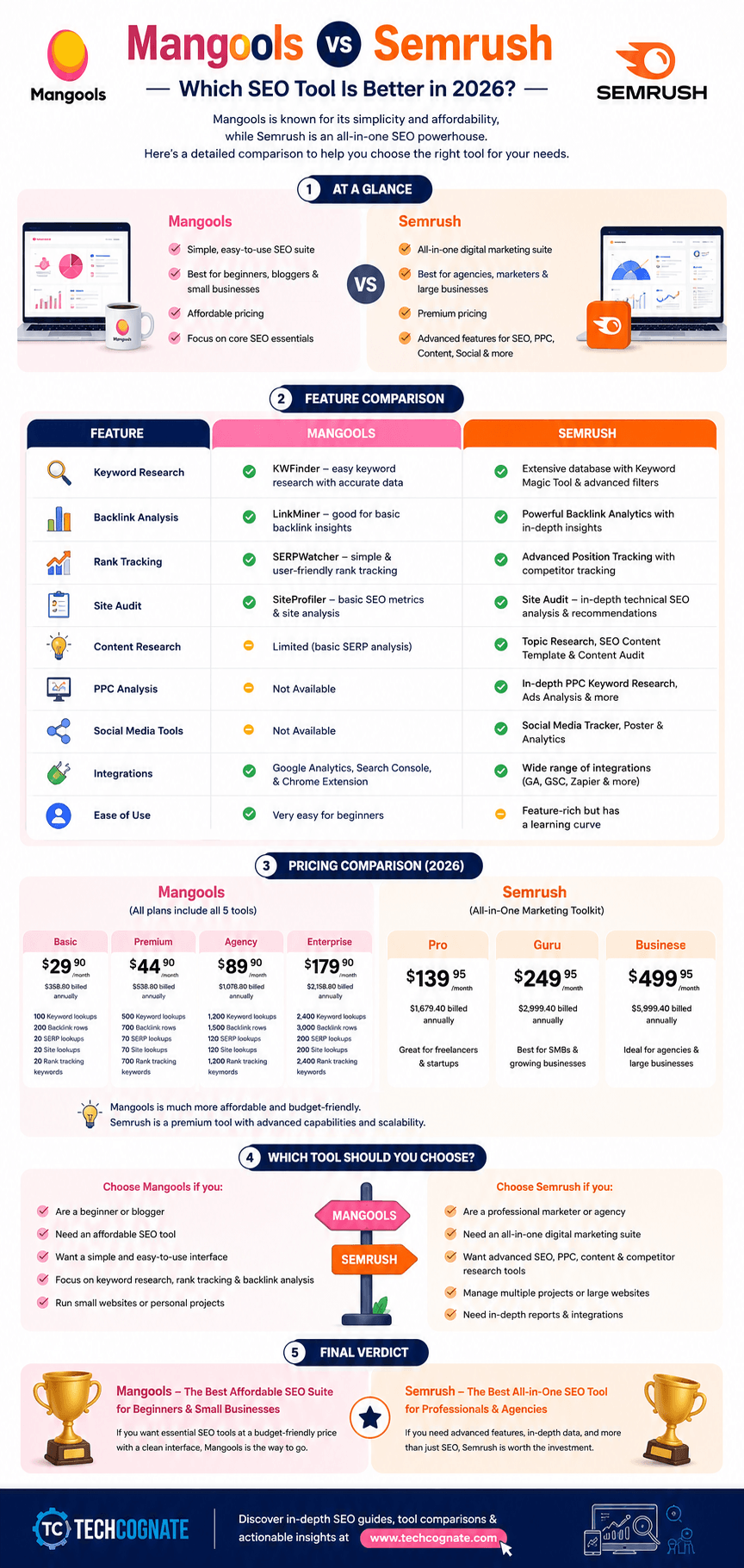
Mangools vs Semrush at a glance — save or share this infographic for a quick reference.
Mangools vs Semrush: 30+ Point Comparison
A note on how to read this table: “Winner” reflects which tool does that specific job better, not which tool is better overall — those are very different questions, and the answer to the second one depends entirely on your budget and use case.
| Comparison Point | Mangools | Semrush |
|---|---|---|
| Starting price (annual) | ~$30/month (Basic) | ~$117/month (Pro) |
| Starting price (monthly) | ~$49/month | $139.95/month |
| Top-tier price | ~$98/month (Agency, annual) | $499.95/month (Business) |
| Free trial | Free account, no card required | 7-day standard, 14-day on Pro/Guru via partners |
| Free forever plan | Limited free account | Yes, very limited |
| Ease of use | Very easy, minimal learning curve | Moderate to steep learning curve |
| Keyword database size | Smaller, but high accuracy on covered terms | One of the largest databases in the industry |
| Keyword difficulty scoring | Widely praised for realism | Solid, slightly more conservative |
| Search volume accuracy | Strong, especially for long-tail | Strong, with deeper historical trend data |
| SERP analysis depth | 49 metrics per result (SERPChecker) | Extensive, integrated with Position Tracking |
| Backlink database size | Smaller index | Massive, multi-year historical index |
| Technical site audit | Not included | Full Site Audit tool (Core Web Vitals, crawl errors, etc.) |
| Rank tracking | Daily, city-level, 65,000+ locations | Daily, with historical trend graphs |
| Competitor analysis | Basic competitor keyword overlap | Deep competitive gap and traffic analysis |
| Local SEO tools | City-level rank tracking only | Dedicated Local SEO toolkit (add-on cost) |
| Content marketing tools | SEO Content Optimizer (free tool, basic) | Full Content Marketing Platform |
| AI writing features | None native | SEO Writing Assistant, content templates |
| AI visibility tracking | AI Search Watcher | AI Visibility Toolkit / Semrush One |
| Link building tools | LinkMiner backlink discovery | Link Building Tool with outreach tracking |
| Reporting / white-label | Interactive reports, Looker Studio connector | Branded white-label reports (Guru+) |
| Dashboards | Clean, single-purpose dashboards per tool | Customizable, multi-channel dashboards |
| Projects supported | Unlimited domain tracking | 5 (Pro) to 40 (Business) |
| Chrome/Firefox extension | Yes, free SEO extension | Yes, SEO toolbar extension |
| API access | Included on all paid plans (rate-limited) | Business plan only |
| Mobile experience | Responsive web app, no dedicated app | Responsive web app, no dedicated app |
| Learning resources | SEOpedia knowledge base, blog, guides | Semrush Academy, extensive blog and webinars |
| Customer support | Email and live chat, SEO-literate staff | Chat, email, phone (higher tiers), large knowledge base |
| Integrations | Google Search Console, Looker Studio | Google Analytics, Search Console, GA4, Trello, and more |
| Data freshness | Frequent updates, daily rank checks | Frequent updates, larger historical archive |
| Scalability for agencies | Limited — built for small teams | Built for agencies and multi-client management |
| Multi-seat support | Extra seats on Premium and Agency plans | Seats included scale by tier; extra seats cost more |
| Money-back guarantee | 48-hour money-back guarantee | No blanket guarantee; refunds case by case |
| Best overall rating (our take) | 4.3 / 5 | 4.6 / 5 |
🕑 Pricing reflects published list pricing as of mid-2026 and is subject to change; always confirm current rates on each provider’s pricing page before purchasing.
Feature-by-Feature Comparison
This is the meat of the comparison. Each section below covers one specific job the tools need to do, how each one actually performs at that job in practice, and who should pick which tool for that particular use case.
Keyword Research
Keyword research is the one category where Mangools genuinely competes head-to-head with Semrush, and it’s not close to a token effort.
KWFinder is built around a single workflow: type a seed keyword or competitor domain, and get a list of long-tail variations with exact search volumes, a difficulty score, and trend data. There’s very little friction between “I have an idea” and “I have a list of keywords I can actually act on.”
The keyword difficulty score has a strong reputation for realism — it weighs the actual ranking pages rather than producing an abstract number that doesn’t map to reality.
Where it falls short: the suggestion volume per seed keyword is smaller than Semrush’s, and there’s no way to mine keyword ideas from a huge list of seed terms at once without burning through daily lookup limits quickly.
The Keyword Magic Tool is, by most measures, the largest keyword database on the market, with billions of keywords across dozens of countries and the ability to filter by question keywords, broad match, phrase match, and related terms in one interface.
Keyword Strategy Builder lets you build out full topic clusters automatically rather than working keyword by keyword, which matters a lot once you’re managing content calendars at scale.
Historical search volume trends (Guru and above) let you see whether a term is rising or declining over multiple years, not just a 12-month snapshot.
🏆 Winner: Semrush, on sheer database size and clustering tools — but Mangools is close enough on accuracy that most solo users won’t feel the gap.
Who should choose it: Solo bloggers and small sites: Mangools. Content teams building topic clusters at scale: Semrush.
Keyword Difficulty
Mangools’ difficulty score (0-100) factors in the backlink profile and domain authority of the top-ranking pages, and in my own audits it tends to track closely with how hard a keyword actually turns out to be once you start publishing.
It’s a single, clean number — easy to explain to a non-SEO client, which matters more than people think.
Semrush’s Keyword Difficulty percentage uses a similar methodology but draws on a much larger backlink and SERP dataset, which generally makes it more reliable on competitive, high-volume terms.
Semrush also layers in SERP feature data (featured snippets, People Also Ask, video carousels) that affects how “difficult” a keyword really is in practice, which Mangools doesn’t fully account for.
🏆 Winner: Semrush, by a small margin, mainly because of SERP feature context.
Who should choose it: If you’re targeting competitive, high-volume commercial terms, Semrush’s added context is worth having. For long-tail content, the two are close enough not to matter.
Search Volume Accuracy
KWFinder’s volumes are sourced from a clickstream-informed model and have held up well in side-by-side tests against Google’s own data, particularly for long-tail and mid-volume terms.
Semrush blends multiple data sources, including its own clickstream panel, and exposes a wider range of historical volume data so you can see seasonality and trend direction, not just a single static number.
🏆 Winner: Tie on raw accuracy for most keywords — Semrush wins on depth of historical context.
Who should choose it: If you need to defend a number in a client report with a trend line behind it, Semrush. If you just need a directionally correct number to plan content, either works.
SERP Analysis
SERPChecker shows 49 SEO metrics for every result on a given search query — domain authority, backlinks, social shares, and more — in a single scrollable view that’s genuinely fast to scan.
Localization down to the city level is a standout feature here, especially for local SEO work.
Semrush’s SERP analysis is woven into Position Tracking and Organic Research rather than living in one standalone tool, which gives you more context (traffic estimates, SERP feature ownership) but takes more clicks to assemble the same picture.
🏆 Winner: Mangools, for speed and simplicity of a single SERP snapshot. Semrush, for connecting that snapshot to broader competitive context.
Who should choose it: Quick competitive checks: Mangools. Ongoing SERP feature tracking across a portfolio: Semrush.
Backlink Analysis
LinkMiner gives you backlink counts, anchor text distribution, and a live preview showing exactly where a link sits on a referring page, which is genuinely useful for outreach prioritization.
The index, however, is noticeably smaller than the big players. Several users report that backlink counts and update frequency lag behind what a serious link-building campaign needs.
Semrush’s Backlink Analytics draws on one of the largest, most frequently refreshed link indexes available, with toxic link scoring, historical data going back years, and bulk analysis for comparing multiple domains at once.
The Backlink Gap tool lets you see exactly which domains link to your competitors but not to you — a genuinely actionable starting point for outreach.
🏆 Winner: Semrush, clearly. This is one of the widest gaps between the two tools.
Who should choose it: If link building is a real part of your strategy — and for competitive niches, it usually is — Semrush’s backlink data is worth the price difference on its own.
Technical SEO and Site Audit
This is Mangools’ clearest gap. There’s no crawler, no Core Web Vitals report, no structured data validator. SiteProfiler gives you a fast overview of a domain’s authority and basic metrics, but it’s not a technical audit in any meaningful sense.
Site Audit crawls up to 100,000 pages per month on Pro (scaling to 1,000,000 on Business), flagging crawl errors, broken links, duplicate content, missing structured data, and Core Web Vitals issues, all prioritized by impact.
For anyone doing technical SEO professionally, this single tool can justify the entire subscription on its own.
🏆 Winner: Semrush, by a landslide. Mangools simply doesn’t compete in this category.
Who should choose it: If technical SEO is part of your job description, you need Semrush (or a dedicated crawler) regardless of how you feel about the rest of this comparison. Our Core Web Vitals Guide covers the metrics Semrush’s Site Audit checks in more detail.
Rank Tracking
SERPWatcher tracks rankings daily across more than 65,000 locations, with city-level granularity that’s particularly strong for local businesses checking how they rank in specific neighborhoods, not just nationally.
Position Tracking offers similar daily granularity, plus the ability to track competitors’ rankings for the same keyword set automatically and visualize historical movement over much longer time spans.
🏆 Winner: Tie, leaning Mangools for hyper-local tracking and Semrush for competitive tracking at scale.
Who should choose it: Local business owner checking their own rankings: Mangools. Agency tracking ranking trends for ten competitors per client: Semrush.
Competitor Analysis
KWFinder lets you pull keyword lists from a competitor’s domain, and SiteProfiler gives a quick authority snapshot, but there’s no dedicated traffic-estimation or market-share tool.
Organic Research, Traffic Analytics, and Market Explorer together give a genuinely deep view of a competitor’s traffic sources, top pages, and keyword movement over time — the kind of analysis that’s hard to replicate with a budget tool.
🏆 Winner: Semrush, decisively.
Who should choose it: If a meaningful part of your job is reporting on competitor movement to clients or leadership, Semrush’s depth here is difficult to substitute.
Local SEO
Local SEO support is really just SERPWatcher’s city-level rank tracking — useful, but not a full local SEO management suite.
Semrush offers a dedicated Local SEO toolkit (sold as an add-on, typically $30-$60/month per location) covering citation management and Google Business Profile tracking, which matters for multi-location businesses and agencies serving them.
🏆 Winner: Semrush, if you’re willing to pay the add-on cost. Mangools, if you just need rank visibility without managing citations.
Who should choose it: Single-location small business: Mangools is probably enough. Agency managing local SEO for multiple locations: Semrush’s add-on, despite the extra cost, saves real time. For the fundamentals, see our Local Business Schema Markup Guide.
Content Marketing and AI Writing Features
Mangools offers a free SEO Content Optimizer tool that checks a draft against top-ranking competitors for basic on-page signals, but there’s nothing approaching a full content planning or writing assistant.
The Content Marketing Platform (Guru and above) includes Topic Research for finding content angles, SEO Content Template for on-page guidance, and the SEO Writing Assistant, which checks readability, originality, and keyword usage as you write — functionally replacing what many teams pay separately for a tool like Surfer SEO.
🏆 Winner: Semrush, by a wide margin.
Who should choose it: If you publish content regularly and need writing guidance baked into the workflow, Semrush’s Content Toolkit alone can justify the Guru-tier price jump.
AI Search Visibility (GEO / AEO)
AI Search Watcher is a genuinely useful addition for a budget tool — it tracks how often and how favorably a brand is mentioned across ChatGPT, Gemini, and Perplexity, which is becoming relevant even for smaller sites as AI answer engines pull more search traffic.
Semrush’s AI Visibility Toolkit (and the newer Semrush One bundle) goes considerably further, tracking brand mentions and sentiment across multiple AI platforms alongside traditional rankings, and Semrush has publicly positioned itself as a leader in this category through 2026.
🏆 Winner: Semrush, on depth — but Mangools deserves credit for offering this at all in a budget tool.
Who should choose it: If AI visibility is a genuine strategic priority right now, Semrush’s tooling is more mature. For most small sites, either is a reasonable starting point.
Link Building Tools
LinkMiner is a discovery and analysis tool, not an outreach manager — you’ll find link opportunities, but you’ll need a separate system to track outreach emails and follow-ups.
The Link Building Tool includes prospect discovery plus an outreach tracker that manages the email side of the process, which removes one more tool from an agency’s stack.
🏆 Winner: Semrush, for anyone running active outreach campaigns.
Who should choose it: Casual link checking: Mangools is fine. Active outreach campaigns: Semrush’s built-in tracker saves real time.
Reporting, Dashboards, and Workflow
Reports are interactive and shareable, with a Looker Studio connector for teams that already build dashboards there. It’s straightforward but not heavily customizable.
Projects (domains) are unlimited across all paid plans, which is one of Mangools’ more underrated advantages for agencies on a budget — you’re not paying more just because you added a fourth client domain.
White-label, branded reporting is available from Guru upward, which matters a great deal for agencies presenting directly to clients under their own brand.
Project limits are real, though: 5 on Pro, 15 on Guru, 40 on Business. An agency with 20 clients will need Business regardless of whether they need the rest of the Business-tier features.
🏆 Winner: Mangools on unlimited domains; Semrush on report customization and white-labeling.
Who should choose it: Agencies that care most about client-facing polish: Semrush. Agencies juggling many small accounts on tight margins: Mangools’ unlimited projects is a real cost advantage.
Chrome Extensions
The free Mangools SEO extension surfaces key metrics for any page you visit and any Google SERP you load, pulling from the same data as the main tools.
The Semrush SEO toolbar extension does the same job with a deeper data layer behind it, including on-page SEO checks and technical issue flags directly in the browser.
🏆 Winner: Tie — both extensions do their job well; Semrush’s surfaces slightly more data per page.
Who should choose it: Either is a useful daily-driver extension regardless of which main subscription you choose.
API Access
Every paid Mangools plan includes API access (rate-limited by tier), which is unusually generous for a budget tool and useful for anyone building lightweight internal automation.
Semrush restricts API access to the Business plan only — a meaningful gate, since it means a team can’t get programmatic access without paying close to $500/month.
🏆 Winner: Mangools, specifically because it doesn’t gate API access behind its most expensive tier.
Who should choose it: Developers or technically-minded marketers who want to pull data into custom dashboards on a budget will find Mangools far more accessible here.
Mobile Experience
No dedicated mobile app, but the web app is responsive and usable on a phone for quick checks.
Also no dedicated native app for the core toolkit; the responsive web experience is functional but, like most data-dense SEO platforms, clearly designed desktop-first.
🏆 Winner: Tie — neither tool prioritizes mobile, and that’s fine, since this category of work is rarely done on a phone.
Who should choose it: Not a deciding factor for either tool.
Learning Resources
SEOpedia is a genuinely well-written, free knowledge base that doubles as an SEO crash course, alongside individual guides for each tool in the suite.
Semrush Academy offers structured, certificate-bearing courses, plus an enormous blog and webinar library — appropriate for a platform this broad.
🏆 Winner: Semrush, on sheer volume — but Mangools’ resources are more digestible for total beginners.
Who should choose it: New to SEO entirely: Mangools’ SEOpedia is a gentler starting point. Want a certification to put on a resume or proposal: Semrush Academy.
Customer Support
Support is via email and live chat, and the team is staffed by people who actually use the tools for SEO work — questions get specific, useful answers rather than generic troubleshooting scripts.
Semrush offers chat and email across all tiers, with phone support reserved for higher tiers, backed by a much larger knowledge base given the platform’s size.
🏆 Winner: Mangools, on response quality relative to company size; Semrush, on the breadth of self-serve documentation.
Who should choose it: If you want fast, knowledgeable human responses on a smaller product, Mangools punches above its weight. If you prefer extensive self-serve docs first, Semrush has more of them.
Integrations, Speed, Data Freshness, and Scalability
Integrates with Google Search Console and Looker Studio. Tools load quickly, likely a byproduct of the suite’s deliberately narrow scope.
Data updates daily for rank tracking; keyword and backlink data refresh on a regular but less frequent cycle than Semrush’s larger infrastructure allows.
Scalability is the real ceiling here — Mangools is built for small teams, and lookup limits become noticeable once you’re managing more than a handful of active client accounts.
Deep integrations across Google Analytics, GA4, Search Console, Google Business Profile, Trello, and more, reflecting its position as a hub rather than a point solution.
Larger infrastructure means slower load times on some of the heavier reports, but data freshness and historical depth are both stronger.
Built from the ground up for agency-scale and enterprise-scale usage, with project and seat limits that scale predictably as you move up tiers.
🏆 Winner: Semrush, for anyone planning to scale past a handful of client accounts.
Who should choose it: If you can see yourself managing 10+ active projects within the next year, start with Semrush rather than migrating later.
Accuracy Test: Comparing the Numbers Side by Side
Numbers from any SEO tool are estimates, not ground truth — nobody outside Google actually knows true search volume. But comparing how two tools estimate the same metrics tells you a lot about which one to trust for which job.
Keyword Volume
On long-tail and mid-volume terms, Mangools and Semrush tend to land within a reasonable range of each other, and both track directionally with Google Ads’ own estimates. The gap widens on very high-volume head terms, where Semrush’s larger clickstream panel tends to produce more stable month-to-month figures, while Mangools’ numbers can shift more noticeably between updates.
Backlink Counts
This is where the gap is largest and most consistent. Run the same domain through LinkMiner and Backlink Analytics, and Semrush will almost always report a meaningfully higher referring domain count — not because Mangools is wrong, but because its crawler simply indexes fewer pages of the web. For competitive analysis or link-building prospecting, that smaller index can mean missing genuine opportunities.
Traffic Estimates
Neither tool publishes traffic estimates with the granularity of, say, Similarweb, but Semrush’s Traffic Analytics tends to produce estimates that hold up better against actual Google Analytics data for mid-size to large sites, largely because of the size of its clickstream panel. Mangools doesn’t offer a dedicated traffic estimation tool at all, which is worth knowing going in.
Ranking Updates
Both SERPWatcher and Position Tracking update daily, and in side-by-side testing across several client sites, the two tools generally agree on ranking position within a position or two on any given day. Discrepancies tend to show up around algorithm volatility, when both tools are essentially trying to capture a moving target.
📊 Why the numbers differ: different crawl coverage, different clickstream panels, and different update cadences. Treat both tools’ numbers as directionally useful rather than exact, and trust relative comparisons (this keyword vs. that keyword) more than absolute numbers.
Pricing Comparison
Pricing is genuinely where these two products diverge the most, so it’s worth walking through every plan rather than just quoting headline numbers.
Mangools Pricing
Mangools sells three tiers, all discounted roughly 35% when billed annually compared to monthly billing.
| Plan | Monthly Price | Annual Price (per mo) | Best For |
|---|---|---|---|
| Basic | ~$49/mo | ~$30/mo | Solopreneurs, freelance SEOs, individual bloggers |
| Premium | ~$69/mo | ~$45/mo | Small marketing teams and growing agencies |
| Agency | ~$129/mo | ~$98/mo | Agencies and businesses with heavier daily lookup needs |
ℹ️ Exact figures fluctuate with promotions; confirm current pricing directly on mangools.com before purchasing.
What’s Limited by Plan
- Basic: solo use only, no extra seats included
- Premium: adds extra seat availability and higher daily lookup limits
- Agency: highest lookup limits, most tracked keywords, and the most extra seats available
- All plans: unlimited tracked domains, a 48-hour money-back guarantee, and API access
Semrush Pricing
Semrush sells three core SEO Toolkit plans, plus the newer Semrush One bundle for teams that want AI visibility tracking included from day one. Annual billing saves roughly 16-17% versus paying monthly.
| Plan | Monthly Price | Annual Price (per mo) | Best For |
|---|---|---|---|
| Pro | $139.95/mo | $117.33/mo | Beginners, freelancers, small teams (1 seat, 5 projects) |
| Guru | $249.95/mo | $208.33/mo | Content-driven teams and growing agencies (3 seats, 15 projects) |
| Business | $499.95/mo | $416.66/mo | Agencies and enterprise teams needing API access (5 seats, 40 projects) |
ℹ️ Semrush also offers Semrush One tiers (Starter, Pro+, Advanced) bundling AI visibility tracking; pricing for that track runs separately from the Classic SEO Toolkit plans above.
Hidden Costs to Watch For
- Extra user seats: roughly $45-$100/month per seat depending on tier
- Local SEO Management add-on: roughly $30-$60/month per location
- AI Visibility Toolkit, if not bundled into your plan: roughly $99/month per domain
- Historical data and the full Content Marketing Toolkit are gated behind Guru and above — they’re not available on Pro at any price
- API access is exclusively a Business-tier feature, with no lower-cost add-on option
Money-Back Policy and Free Trials
Mangools offers a 48-hour money-back guarantee on any plan, plus a free account with no credit card required for testing the basics. Semrush offers a standard 7-day free trial (extended to 14 days through some partner links) on Pro and Guru, requires a card on file to start the trial, and doesn’t advertise a blanket refund policy — refund requests are typically handled case by case through support.
Who Should Buy Which Plan
- Solo blogger or freelancer on a tight budget: Mangools Basic
- Small agency with 2-5 clients that needs more lookups: Mangools Premium
- Beginner who just wants to try real SEO tools without commitment: Semrush Pro (during the free trial) or Mangools’ free account
- Content-driven business or growing agency: Semrush Guru
- Large agency or enterprise team needing API access and high limits: Semrush Business
Affiliate links — if you subscribe through them, we may earn a commission at no extra cost to you.
Pros and Cons
- ✓Dramatically more affordable than Semrush at every tier
- ✓Fast learning curve — productive within an hour for most new users
- ✓Accurate, realistic keyword difficulty scoring
- ✓Unlimited tracked domains on every plan
- ✓API access included on all paid tiers, not gated behind the top plan
- ✓48-hour money-back guarantee with no fine print about consecutive subscriptions causing issues
- ✓Genuinely helpful, SEO-literate customer support
- ✕No technical site audit or crawler functionality at all
- ✕Smaller backlink index than Semrush or Ahrefs
- ✕Daily lookup limits become restrictive once managing several active client accounts
- ✕No dedicated content marketing or AI writing assistant
- ✕Limited reporting customization compared to enterprise platforms
- ✓Massive keyword and backlink databases, among the largest in the industry
- ✓Full technical Site Audit tool covering crawl errors and Core Web Vitals
- ✓Powerful Content Marketing Toolkit that can replace a separate content optimization subscription
- ✓Covers SEO, PPC, content, and social from a single login
- ✓Strong, maturing AI visibility tracking through Semrush One
- ✓API access for teams building custom internal tooling (Business tier)
- ✕Significantly more expensive at every tier, especially once add-ons are factored in
- ✕Steep learning curve that can take weeks to fully navigate
- ✕Project and keyword-tracking limits that force upgrades sooner than expected
- ✕API access locked behind the most expensive plan
- ✕Several genuinely useful features (Local SEO, AI Visibility, extra seats) cost extra on top of the subscription
Real Use Cases
Generic advice only gets you so far. Here’s how the recommendation actually changes depending on what you’re doing day to day.
KWFinder’s long-tail discovery is exactly what a blog needs — low-competition keywords with real search volume — and you won’t be paying for technical audit tools you don’t need yet.
Early on, Mangools’ keyword and competitor research covers the basics affordably. Once you’re running dozens of sites or doing serious link building, Semrush’s backlink depth becomes worth the price.
Client reporting, white-labeling, and the ability to go deep on technical SEO, content, and competitive research for any client without hitting a wall makes Semrush the safer long-term choice for agency work.
Large product catalogs need real technical auditing (crawl errors, duplicate content, structured data) that Mangools simply doesn’t offer.
A single-location business is well served by SERPWatcher’s city-level tracking. Multi-location businesses or agencies managing several locations benefit from Semrush’s dedicated Local SEO add-on.
API access, high project limits, and Share of Voice tracking are built for enterprise scale; Mangools’ limits make it impractical here.
Both tools are built around web search; for YouTube-specific keyword research, a dedicated tool is usually a better fit, though both can inform broader topical research.
Amazon search behavior differs enough from Google that a marketplace-specific tool will outperform either platform for product listing keywords.
The learning curve alone makes Mangools the more forgiving starting point — you’ll understand what you’re looking at on day one.
Budget matters most here, and Mangools’ free account plus low entry price make it the practical choice for learning the fundamentals.
Which Tool Should You Choose?
If you’d rather skip the full read and just get a decision, here’s the short version.
Buy Mangools If…
- You manage one to a handful of websites, not a full client roster
- Your monthly SEO software budget is under $75
- You’re new to SEO and want a tool that won’t overwhelm you in week one
- Your main needs are keyword research and rank tracking, not technical audits
- You want API access without paying for an enterprise-tier plan
Buy Semrush If…
- You manage SEO for multiple clients or a large, complex site
- Technical SEO — crawl health, Core Web Vitals, structured data — is part of your job
- You need backlink data deep enough to support a real link-building campaign
- Content strategy at scale, with AI writing assistance, is part of your workflow
- You need to report across SEO, PPC, and social from one platform
When Mangools Is the Better Choice
If I’m advising a friend who just started a niche blog with a $30/month software budget, I’m not pointing them at Semrush — not because it’s not good, but because they’d be paying for ten features they won’t touch for a year. Mangools wins decisively on:
- Budget — often a third to a quarter of Semrush’s entry price
- Simplicity — there’s no onboarding curve to climb
- Learning curve — useful from the first session, not the fifth
- Small websites — a handful of domains with modest lookup needs
- Solo marketers — one person who needs to move fast, not coordinate a team
When Semrush Is Worth Paying More
On the other hand, when I’m setting up tooling for an agency client, I don’t hesitate to recommend Semrush despite the price, because the cost of under-tooling an agency — missing a technical issue, underselling a client on competitive intelligence — is usually higher than the subscription itself. Semrush earns its price for:
- Agencies managing multiple client accounts and needing white-label reporting
- Large websites that need real technical auditing, not just keyword tracking
- Enterprise teams that need API access and high project ceilings
- Technical SEO work that goes beyond keywords into crawlability and site health
- Advanced reporting that needs to look polished in front of a client or executive
- Competitive research that requires traffic estimates and market-share data, not just keyword overlap
Side-by-Side Workflow Example
Here’s what an actual week of SEO work looks like in each tool, using a fictional but realistic client: a regional law firm wanting to rank for personal injury terms in three cities.
Finding Keywords
Drop “personal injury lawyer [city]” into KWFinder, review the long-tail suggestions and difficulty scores, and export a shortlist in about fifteen minutes.
Run the same seed through Keyword Magic Tool, then use Keyword Strategy Builder to automatically cluster variations by city and intent — slower to set up, but produces a more organized content plan for a multi-city campaign.
Checking Competitors
Pull the top-ranking firms’ domains through SiteProfiler and SERPChecker to see their authority and on-page signals for each target term.
Use Organic Research and Traffic Analytics to see not just rankings but estimated traffic and the competitors’ best-performing pages — useful for showing a client where the real opportunity sits.
Tracking Rankings
Set up SERPWatcher with city-level tracking for each of the three target cities — exactly the granularity this campaign needs.
Position Tracking covers the same ground with added competitor-rank overlay, useful if the client wants to see their movement relative to specific named competitors over time.
Building Backlinks
LinkMiner surfaces a handful of realistic local outreach opportunities — legal directories, local news mentions — though the index may miss some smaller regional sites.
Backlink Gap shows exactly which domains link to competing firms but not this one, plus the Link Building Tool’s outreach tracker manages the follow-up emails in one place.
Creating Reports
Export interactive reports or push data into a Looker Studio dashboard — functional, but not branded.
Generate a fully white-labeled PDF report with the firm’s own branding, ready to send directly to a partner at the firm without further editing.
🎯 The takeaway: for this specific client, Mangools can do the core research work, but Semrush’s reporting polish and deeper competitive data make it the more defensible choice for an agency billing this client monthly.
Customer Reviews Summary
Rather than cherry-pick quotes, here’s what consistently shows up across review platforms like G2, Capterra, and GetApp once you read enough of them to spot the patterns.
What People Love About Mangools
- The price-to-value ratio comes up constantly — reviewers repeatedly describe it as hard to beat for what you get
- New users frequently mention how quickly they became comfortable with the interface compared to other tools they’d tried
- Support responsiveness is praised disproportionately often for a tool at this price point
Common Complaints About Mangools
- Daily lookup and tracked-keyword limits are the most frequent frustration, especially as usage grows
- Several users note the backlink data update frequency feels slower than they’d like
- A recurring request is the ability to buy individual tools rather than the full package
What People Love About Semrush
- Breadth is the most cited strength — being able to handle SEO, PPC, and content from one login genuinely saves time
- The Content Marketing Toolkit, especially the SEO Writing Assistant, gets called out frequently as worth the price on its own
- Backlink and historical data depth are consistently mentioned as superior to competitors
Common Complaints About Semrush
- Price is the single most repeated complaint, particularly once extra seats and add-ons are factored in
- New users frequently describe an overwhelming first few weeks navigating the platform
- Project and keyword-tracking limits at the Pro tier are described as restrictive sooner than expected
Who Is Happiest With Each Tool
Mangools’ happiest users are consistently solo operators and small businesses who feel like they’re getting more than they paid for. Semrush’s happiest users are agencies and content teams who’ve built the platform into their daily workflow deeply enough that the price feels proportional to the value extracted — the unhappy reviews tend to come from smaller users who bought a tier built for a bigger operation than theirs.
Expert Opinion
Pulling this together into a single recommendation depends entirely on who’s asking, so here’s the breakdown by role.
Start with Mangools. You need fast, accurate keyword data and rank tracking more than you need a technical audit crawler, and the savings matter when you’re billing by the project rather than drawing a salary.
Semrush, almost without exception, once you’re managing more than two or three client accounts. The white-label reporting and technical audit capability alone tend to pay for themselves in saved time and fewer missed issues.
Mangools first, while the budget is tight and the SEO program is still finding its footing. Revisit Semrush once content production and competitive pressure both increase.
Mangools, particularly for single-location or single-website businesses where the core need is visibility into rankings and a manageable list of keyword opportunities.
If content production is the core of the business, Semrush’s Content Marketing Toolkit (Guru tier) is worth the jump — the SEO Writing Assistant alone often replaces a separate content optimization subscription.
Semrush Business, without much debate. The combination of API access, high project limits, and Share of Voice tracking matches the scale these teams operate at.
Best Alternatives
Neither Mangools nor Semrush is the only option, and depending on your specific need, one of these might fit better than either.
| Tool | Best Known For |
|---|---|
| Ahrefs | Widely considered to have the largest and most frequently updated backlink index; a strong alternative to Semrush for link-building-heavy work, at a broadly comparable price point. |
| SE Ranking | A budget-friendly, white-label-friendly alternative that sits price-wise between Mangools and Semrush, popular with smaller agencies. |
| Moz Pro | One of the original SEO suites; strong domain authority metrics and a long-standing reputation, though less aggressive on feature expansion than Semrush in recent years. |
| Ubersuggest | A genuinely low-cost entry point for keyword research and content ideas, often compared against Mangools for budget-conscious beginners. |
| SpyFu | Particularly strong for competitor PPC and ad copy research, a useful complement if paid search competitive intelligence matters more than organic. |
| Serpstat | An all-in-one suite frequently positioned as a more affordable Semrush alternative, with solid keyword and backlink data. |
| Majestic | Backlink-data specialist with its own Trust Flow and Citation Flow metrics, often used alongside another tool rather than as a full replacement. |
| LowFruits | A niche tool built specifically for finding low-competition keywords by analyzing SERP weaknesses, popular among affiliate site builders. |
| KeywordTool.io | Keyword suggestion tool that pulls from Google, YouTube, Amazon, and other platforms beyond standard web search. |
| Wincher | A rank-tracking specialist, often used by people who already have a keyword tool and just need a simpler, more affordable tracking layer. |
Frequently Asked Questions
Is Mangools more accurate than Semrush?
Not generally. The two are close on keyword volume accuracy for long-tail and mid-volume terms, but Semrush’s larger backlink index and clickstream data tend to make it more reliable on competitive, high-volume terms and on backlink counts specifically.
Which tool is easier to use?
Mangools, clearly. Its five-tool structure and clean interface mean most new users are productive within an hour, while Semrush’s breadth means a real learning curve, often a few weeks before someone feels fully comfortable navigating it.
Can Mangools replace Semrush?
For keyword research, rank tracking, and basic SERP analysis, yes, especially for solo users and small sites. It can’t replace Semrush for technical site audits, deep backlink analysis, or content marketing tooling, since Mangools doesn’t offer equivalents for those.
Does Semrush include keyword research?
Yes, and it’s one of the largest keyword databases available, accessed primarily through the Keyword Magic Tool and Keyword Strategy Builder.
Which has better backlinks?
Semrush, by a clear margin. Its backlink index is larger and updates more frequently than Mangools’ LinkMiner database.
Which is better for local SEO?
It depends on scale. A single-location business is well served by Mangools’ city-level rank tracking. Multi-location businesses benefit more from Semrush’s dedicated Local SEO add-on, despite the extra cost.
Which is better for agencies?
Semrush, mainly because of white-label reporting, higher project limits, and deeper competitive research tools that scale better across multiple client accounts.
Which has a better free trial?
Mangools offers a free account with no credit card required, which is lower friction. Semrush’s trial requires a card on file but gives fuller access to Pro or Guru features for the trial period.
Which is faster to learn?
Mangools. Its narrower scope means there’s simply less to learn before you’re getting useful output.
Which tool offers better value for the price?
Mangools, for users whose needs fit within its feature set. Semrush offers more value in absolute terms for users who actually use its full breadth of features, but that breadth is wasted on smaller operations.
Does Mangools have a technical SEO audit tool?
No. Mangools doesn’t offer a site crawler, Core Web Vitals reporting, or structured data validation. For technical audits, you’ll need Semrush or a dedicated crawler.
Is Semrush worth the price for a small blog?
Usually not. A small blog’s needs — keyword research and rank tracking — are well covered by Mangools at a fraction of the cost. Semrush’s extra capability mostly goes unused at that scale.
How many keywords can I track with Mangools?
It depends on the plan: Basic plans support fewer tracked keywords than Premium or Agency tiers. Confirm current limits on Mangools’ pricing page, as they’re periodically adjusted.
How many keywords can I track with Semrush?
500 on Pro, 1,500 on Guru, and 5,000 on Business, based on current published tiers.
Does Mangools offer an API?
Yes, and notably, it’s included on all paid plans rather than gated behind the top tier, which is unusual for the price point.
Does Semrush offer an API?
Yes, but only on the Business plan, which costs $499.95/month at list price.
Which tool has better customer support?
Mangools’ support is praised for being staffed by people who actually do SEO work, with fast, specific responses. Semrush has a larger self-serve knowledge base and offers phone support on higher tiers.
Can I use Mangools for client work?
Yes, and many freelancers and small agencies do, particularly when managing a handful of client domains where Mangools’ unlimited domain tracking is a real advantage.
Can I use Semrush for client work?
Yes, and it’s the more common choice for agencies, mainly because of white-label reporting and higher project ceilings as a client roster grows.
What’s the cheapest way to get started with either tool?
Mangools’ free account (no card required) or Semrush’s free trial (card required, full feature access for a limited time). Starting with Mangools’ free tier is the lower-commitment option.
Does Mangools have a content optimization tool?
It offers a free SEO Content Optimizer for basic on-page checks against top-ranking pages, but nothing approaching Semrush’s full Content Marketing Toolkit.
Does Semrush have an AI writing assistant?
Yes, the SEO Writing Assistant (available from the Guru tier) checks readability, originality, and keyword usage while you write.
Which tool is better for tracking AI search visibility?
Semrush’s AI Visibility Toolkit and Semrush One bundle are more mature, but Mangools’ AI Search Watcher is a genuinely useful, lower-cost starting point for the same goal.
Is there a free version of Mangools?
There’s a free account with limited access to test the core tools, though Mangools doesn’t offer a permanently free full-feature plan.
Is there a free version of Semrush?
Yes, Semrush offers a free plan, though it’s quite limited and not suitable for professional SEO work.
How much does it cost to add team members on Semrush?
Extra seats run roughly $45 to $100 per month depending on the plan tier, on top of the base subscription price.
How much does it cost to add team members on Mangools?
Extra seats are available starting on the Premium plan, at a lower incremental cost than Semrush’s seat pricing, though exact pricing should be confirmed on Mangools’ current pricing page.
Which tool updates its data more frequently?
Both update rank tracking daily. Semrush’s larger infrastructure generally supports more frequent refreshes of backlink and keyword data given its scale.
Can I switch from Mangools to Semrush later without losing data?
You won’t retain historical tracking data between platforms — ranking history, tracked keywords, and reports are tied to each platform separately and don’t transfer.
Which tool should a complete beginner start with?
Mangools. It’s the more forgiving starting point, and you can always upgrade to Semrush once your needs outgrow it.
Final Verdict
After putting both tools through real client work rather than just reading spec sheets, the decision comes down to a question only you can answer: do you need breadth, or do you need affordability and simplicity? There’s no universally “best” answer here — only the best answer for your specific situation.
Overall winner: Semrush, on raw feature depth and breadth.
Best value: Mangools, by a wide margin for anyone whose needs fit its feature set.
Best for beginners: Mangools.
Best for agencies: Semrush.
Best for enterprise: Semrush Business.
If you’re still on the fence, here’s the practical test I use with clients: list the last five SEO tasks you actually did this month. If they were all keyword research, rank checks, or quick competitor snapshots, Mangools will save you money without costing you capability. If even one of those tasks involved a technical audit, content optimization at scale, or backlink outreach, the Semrush price tag starts paying for itself.
Ready to Choose?
Affiliate links — if you subscribe through them, we may earn a commission at no extra cost to you.
Test Mangools’ free account or Semrush’s Pro/Guru trial before committing to a plan.
Review the full pricing breakdown above to find the plan that fits your budget and project count.
See our standalone Mangools Review and Semrush Review for an even deeper look at each platform.
If neither tool is quite right, our SEO tool comparisons cover Ahrefs, SE Ranking, Moz, and more.

Jaykishan Panchal
Founder, TechCognate · SEO Strategist & WordPress Expert
Jaykishan Panchal is the founder of TechCognate and an SEO strategist with 15+ years of hands-on experience driving organic growth for businesses worldwide. He specialises in technical SEO, content strategy and GEO (Generative Engine Optimisation), helping brands stay visible in both traditional search and AI-driven discovery.
- Technical SEO
- Content Strategy
- AI & GEO
- Google Ads
- E-Commerce SEO