Search has quietly undergone its most dramatic transformation since Google replaced directories. When someone asks ChatGPT which project management tool to use, or queries Google AI Mode for the best CRM for small businesses, they’re no longer seeing ten blue links. They’re getting a single synthesized answer — and only the brands mentioned in that answer exist in the user’s world.
The stakes couldn’t be higher. AI search engines like ChatGPT, Google AI Overviews, Google AI Mode, Gemini, Perplexity, Claude, and Bing Copilot now handle hundreds of millions of queries every day. These platforms don’t just retrieve web pages — they synthesize, reason, and recommend. And their recommendation engine has different rules than traditional SEO.
Ranking #1 on Google doesn’t guarantee a mention in AI answers. Having a high domain authority doesn’t mean AI systems trust your brand. But building topical depth, establishing entity recognition, earning genuine citations, and publishing content that AI systems actually understand — that’s what determines whether your brand shows up when it matters most.
This guide covers every strategy that meaningfully improves brand visibility in AI search engines in 2026. No vague advice, no recycled tips — just specific, implementable strategies based on how these systems actually work.
Why AI Search Has Changed Brand Visibility Forever
For most of the internet’s history, search visibility followed a predictable playbook. Optimize your title tags, build backlinks, rank on page one, and traffic flows. The game rewarded technical precision and link accumulation.
That playbook still matters — but it’s no longer sufficient. AI search has layered an entirely new discovery model on top of traditional search, and the implications for brands are enormous.
The Evolution of Search
| Era | Model | What Brands Needed | Winner |
|---|---|---|---|
| Traditional Search (1998-2015) | Ten blue links | Keywords + Backlinks | High-authority domains |
| Rich Results Era (2015-2020) | Featured snippets, cards | Structured content | Well-formatted answers |
| AI Overviews (2020-2023) | AI-generated summaries | Entity authority | Recognized brands |
| Conversational AI Search (2023+) | Synthesized recommendations | Topical trust + citations | Authoritative experts |
| Agentic AI Search (2025+) | Task completion + recommendation | Full entity footprint | Deeply authoritative brands |
What Has Actually Changed
In traditional search, your goal was to rank — to appear in the list of results a user could choose from. In AI search, you need to be selected — cited, mentioned, or recommended by a system that’s already done the choosing on the user’s behalf.
Several fundamental shifts drive this:
| • | Fewer clicks, more citations. Users increasingly get their answers directly from AI without clicking through to websites. Brands that aren’t cited in the AI answer are effectively invisible. |
| • | Synthesized answers replace result lists. Rather than showing ten sources, AI engines synthesize a single answer from multiple inputs — and only sources they trust contribute to that synthesis. |
| • | Trust signals have shifted. AI systems weight factors like entity recognition, publication depth, author authority, and citation patterns — not just backlink counts. |
| • | Discovery happens conversationally. Users ask AI questions like they’d ask a knowledgeable colleague. The brands that appear in those answers win consideration before the user has even compared options. |
| • | AI acts as a recommendation engine. Ask Perplexity which email marketing tool is best for e-commerce, and it will recommend two or three. The brands not mentioned don’t get a second chance. |
The brands winning in AI search aren’t necessarily the ones with the biggest ad budgets or the most backlinks. They’re the ones AI systems have learned to recognize as trustworthy authorities in their domain. That recognition is built deliberately — through the strategies in this guide.
How AI Search Engines Choose Which Brands to Mention
Understanding why AI systems cite certain brands requires understanding how large language models (LLMs) actually work — at least at a conceptual level. AI search engines don’t browse the web in real time for most queries (though some use retrieval augmentation). They’ve absorbed patterns from massive datasets and learned to associate certain entities with certain concepts.
When someone asks “what’s the best SEO tool,” the AI doesn’t Google that question and read the results. It draws on its training data, retrieval indexes, and knowledge representations to produce an answer weighted toward entities it has seen frequently associated with SEO tools, in authoritative contexts, with positive signals.
The AI Citation Decision Flow
Each stage filters the available brand universe. Only brands that pass all stages appear in final AI answers.
Key Factors AI Systems Evaluate
Entity Recognition
Before an AI can mention your brand, it needs to recognize it as a distinct entity — not just a collection of keywords. Entities have names, attributes, relationships, and contexts. Semrush is an entity. It’s associated with the category “SEO software,” the attribute “keyword research,” and relationships with entities like “organic search” and “backlink analysis.” If your brand isn’t established as a clear entity, AI systems treat it as noise.
Topical Authority
AI systems gauge how deeply a source covers a topic. A brand that has published 200 pieces of content about email marketing — spanning beginner guides, advanced strategy, tool comparisons, case studies, and original research — will be perceived as far more authoritative than one with 10 generic posts. Breadth within a topic cluster signals expertise.
Citation Patterns
When other authoritative sources link to or mention your brand in the context of a topic, AI systems interpret that as a trust signal. It’s not just backlinks — it’s co-citation. When Forbes, Search Engine Journal, and three industry blogs all mention your brand alongside the term “B2B email marketing software,” that association gets reinforced in the AI’s understanding.
Structured Data & Schema
Schema markup gives AI systems machine-readable confirmation of who you are, what you do, and how your content is organized. Without it, AI systems have to infer — and inference is less reliable than explicit declaration.
Freshness & Consistency
AI systems and their retrieval components favor content that is current and consistently updated. A post that was last updated in 2021 signals potential staleness. Brands that actively maintain their content are more likely to appear in answers about current best practices.
Review & Reputation Signals
For product and service recommendations, AI systems incorporate signals from review platforms, user-generated content, and aggregate ratings. A SaaS tool with 4.7 stars across 3,000 G2 reviews carries more weight than one with no review presence.
| Signal | Weight | Why AI Uses It |
|---|---|---|
| Entity recognition & Knowledge Graph presence | Very High | Confirms brand identity and category |
| Topical authority (content depth + breadth) | Very High | Signals expertise and trustworthiness |
| External citations and co-mentions | High | Social proof from trusted third parties |
| Schema markup (Organization, Article, FAQ) | High | Machine-readable content structure |
| EEAT signals (author, experience, trust) | High | Human-readable credibility markers |
| Content freshness (update frequency) | Medium | Signals relevance to current conditions |
| Review platform presence (G2, Trustpilot) | Medium | Real-world reputation signals |
| Internal linking structure | Medium | Maps brand’s topical ecosystem |
| Brand mention consistency across web | Medium-High | Reinforces entity associations |
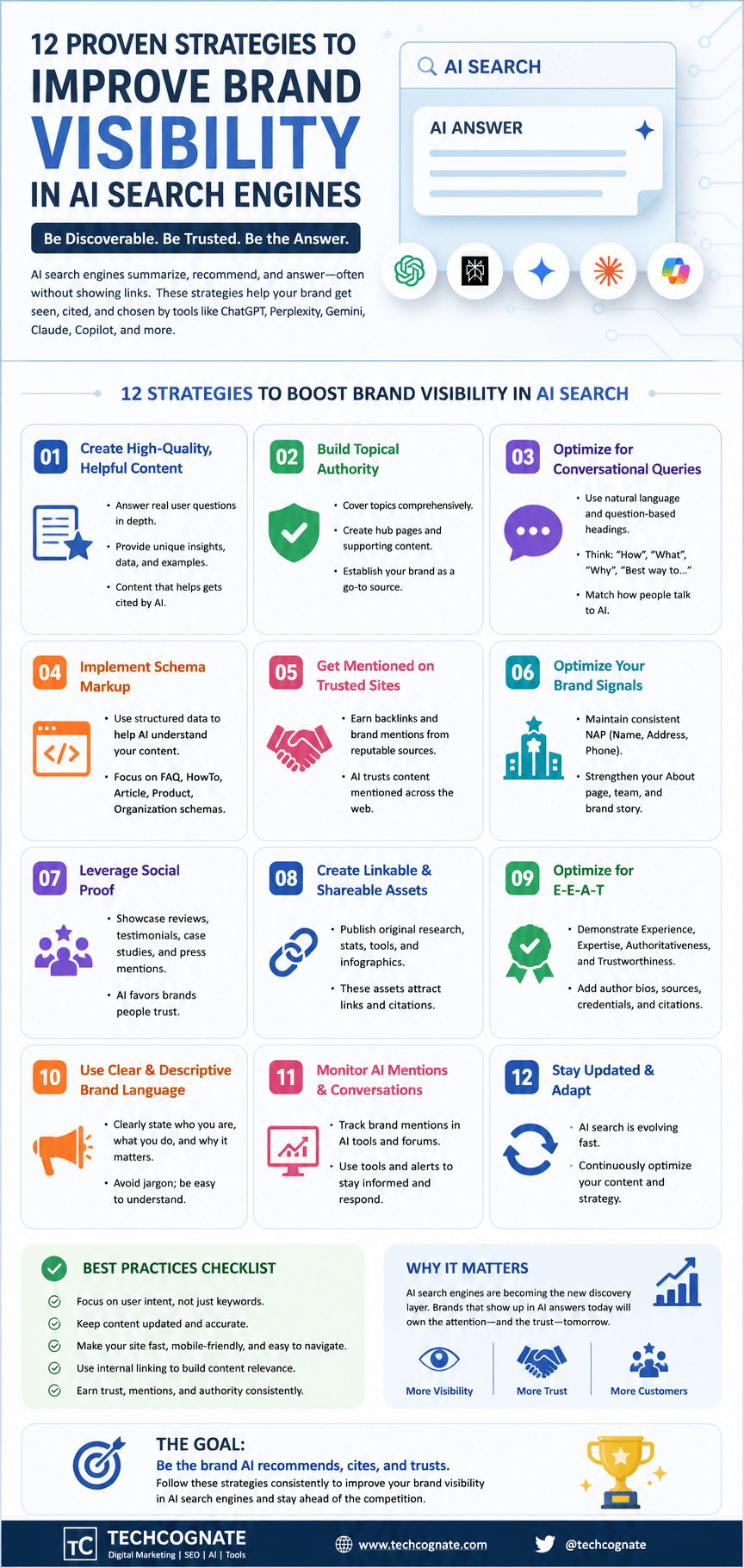
21 Proven Strategies That Improve Brand Visibility in AI Search Engines
The following strategies aren’t theoretical. They reflect how AI systems actually process and evaluate content in 2026. Each strategy includes the rationale, implementation steps, real-world examples, common mistakes, and a mini-checklist you can act on immediately.
Work through these systematically rather than cherry-picking. The strategies compound — entity recognition reinforces topical authority, which amplifies the value of citations, which strengthens schema trust signals.
|
1
|
Build Topical Authority Instead of Publishing Random Content
|
Topical authority is the single most powerful driver of AI visibility. AI systems don’t just look at whether you’ve published about a topic — they evaluate how comprehensively you’ve covered it. A brand that has addressed every meaningful question within a topic cluster is treated as an authority. One that publishes occasional, disconnected posts is treated as a generalist.
LLMs are trained on patterns of co-occurrence. When your domain consistently appears in the context of a specific topic — across articles, guides, comparisons, FAQs, and glossaries — the model learns to associate your brand with that topic. Thin or scattered content dilutes this association.
| ▸ | Choose 3-5 core topic pillars aligned with your products or services |
| ▸ | Map every subtopic, question, and use case under each pillar |
| ▸ | Build a hub-and-spoke content architecture: one comprehensive pillar page, 8-15 supporting cluster pages |
| ▸ | Ensure every cluster page links back to its pillar and to relevant sibling pages |
| ▸ | Cover beginner, intermediate, and advanced questions within each cluster |
| ▸ | Publish at a consistent cadence — 2-4 pieces per topic cluster per month minimum |
An email marketing platform publishes a complete Email Marketing hub: pillar page, plus cluster articles covering subject line optimization, segmentation strategy, A/B testing, deliverability, automation workflows, list hygiene, and platform comparisons. When AI is asked about email marketing strategy, this brand appears because it owns the topic.
| ✕ | Publishing in too many topic areas dilutes authority across all of them |
| ✕ | Building clusters without proper internal linking breaks the authority flow |
| ✕ | Creating shallow 500-word posts to fill out clusters — depth matters more than quantity |
| ✕ | Ignoring long-tail questions within the cluster that AI systems frequently retrieve |
| ★ | Use a content gap analysis tool to identify questions you haven’t answered yet |
| ★ | Include a ‘Related Questions’ section at the end of each cluster article to map to other cluster content |
| ★ | Update your pillar page every 6 months to reflect new subtopics added to the cluster |
| Defined 3-5 core topic pillars | |
| Mapped subtopics and questions for each pillar | |
| Published pillar page for each topic | |
| Created 8+ cluster articles per pillar | |
| Internal links connect all cluster pieces to pillar | |
| No single cluster article is under 1,500 words |
|
2
|
Become a Recognized Named Entity
|
In the world of AI and semantic search, entities are the fundamental units of knowledge. A named entity is a specific, identifiable thing — a brand, person, place, product, or concept. AI systems understand the world through entity relationships, not just keyword patterns. If your brand isn’t recognized as a distinct entity, you’re invisible to the part of AI search that operates on knowledge graphs.
LLMs and knowledge retrieval systems use Named Entity Recognition (NER) to identify and classify proper nouns. Brands that appear consistently across the web with the same name, description, category, and attributes build strong entity representations. These representations are what AI systems draw from when generating answers.
| ▸ | Claim and optimize your Google Business Profile and Bing Places listing |
| ▸ | Create and maintain a Wikipedia or Wikidata entry where eligible |
| ▸ | Ensure your brand name, description, and attributes are consistent across all web properties |
| ▸ | Build citations on trusted data aggregators: Crunchbase, LinkedIn Company Page, Bloomberg, industry directories |
| ▸ | Implement Organization schema on your homepage with complete attributes (name, url, logo, sameAs, description) |
| ▸ | Use ‘sameAs’ properties to link your schema to authoritative identity sources (Wikipedia, Wikidata, Crunchbase) |
| ▸ | Get mentioned consistently by authoritative publications in your niche |
HubSpot is mentioned on Forbes, TechCrunch, G2, Capterra, Wikipedia, and hundreds of industry blogs — always in the context of ‘CRM software’ and ‘marketing automation.’ That consistency across authoritative sources creates an extremely strong entity representation. When AI is asked about CRM tools, HubSpot’s entity recognition makes it a near-certain mention.
| ✕ | Using different variations of your brand name across properties (inconsistency weakens entity signals) |
| ✕ | Skipping the sameAs schema property — it’s the most direct way to link your entity to authoritative sources |
| ✕ | Neglecting Wikidata even if Wikipedia isn’t an option — Wikidata has no notability threshold |
| ✕ | Ignoring industry-specific directories that contribute to entity recognition in niche AI applications |
| ★ | Google your brand name + a core topic to see what entities appear alongside yours — these are co-citation opportunities |
| ★ | Monitor entity recognition using Google’s Knowledge Panel — if you have one, maintain it |
| ★ | Publish an ‘About’ page that reads like an entity profile: who you are, what you do, key attributes, founding date, location |
| Organization schema implemented on homepage | |
| sameAs links to Wikipedia, Wikidata, LinkedIn, Crunchbase | |
| Consistent brand name/description across all web properties | |
| Google Business Profile claimed and complete | |
| Brand mentioned on 3+ authoritative external sources |
|
3
|
Implement Schema Markup Across Your Entire Site
|
Schema markup is the closest thing to speaking AI’s native language. While human readers interpret meaning from context, AI systems benefit enormously from explicit, machine-readable declarations about what your content is and who it’s about. Schema bridges the gap between how humans write and how AI systems understand.
AI systems, including Google’s crawlers that feed AI Overviews, use structured data to verify and enrich their understanding of web content. Schema doesn’t just help with featured snippets — it provides the explicit entity and content signals that feed directly into AI retrieval systems.
| ▸ | Implement Article schema on every blog post with author, datePublished, dateModified, headline |
| ▸ | Add FAQPage schema to any page with Q&A content — this directly feeds AI Overview selection |
| ▸ | Use HowTo schema for step-by-step guides with numbered steps and estimated time |
| ▸ | Implement Organization schema with logo, contact, sameAs on your homepage |
| ▸ | Add Person schema for all authors with credentials, social profiles, and sameAs links |
| ▸ | Use BreadcrumbList schema on every page for clear hierarchy signaling |
| ▸ | Add Product and Review/AggregateRating schema for product pages |
| ▸ | Implement Speakable schema on key Q&A paragraphs to optimize for voice and AI retrieval |
| ▸ | Test all schema using Google’s Rich Results Test and Schema.org Validator |
An SEO software company adds FAQPage schema to its ‘What is keyword research?’ guide. When users ask voice assistants or ChatGPT about keyword research, the AI retrieves the structured Q&A from this page because it’s explicitly marked up as answer content. Organic schema visibility increases across AI platforms within weeks.
| ✕ | Implementing schema on only a few pages instead of site-wide — every page should have relevant markup |
| ✕ | Leaving dateModified as the original publication date instead of updating it when content is refreshed |
| ✕ | Using incorrect schema types — a blog post should be Article, not WebPage alone |
| ✕ | Forgetting to add author schema — AI systems use author signals to verify EEAT |
| ★ | Prioritize FAQPage and HowTo schema — these have the most direct impact on AI retrieval |
| ★ | Use JSON-LD format exclusively — it’s the easiest to implement and preferred by Google |
| ★ | Create a schema template for each content type so new posts automatically include the right markup |
| Article schema on all blog content | |
| FAQPage schema on all Q&A sections | |
| Organization schema on homepage | |
| Person schema on author pages | |
| BreadcrumbList schema site-wide | |
| Tested all schema with Rich Results Test |
|
4
|
Create Expert-Level Content That Demonstrates Real Experience
|
The era of mediocre, AI-generated content filling search results is ending fast. AI search engines are increasingly trained to recognize and prefer content that demonstrates genuine expertise, first-hand experience, and unique insight — the kind that could only come from someone who has actually done the work.
AI systems are trained on human-created content and have learned to recognize markers of genuine expertise: specific details, nuanced caveats, original frameworks, counter-intuitive observations, and practical implementation knowledge that goes beyond surface-level explanation.
| ▸ | Include specific, real-world examples in every article — not hypothetical scenarios |
| ▸ | Share original methodology: how you approach a problem, what you’ve tested, what the results were |
| ▸ | Add first-person practitioner insights even in educational content |
| ▸ | Include specific metrics, data points, and outcomes where possible |
| ▸ | Interview subject matter experts and include direct insights (not just quotes) |
| ▸ | Add proprietary frameworks, matrices, or decision trees that don’t exist elsewhere |
| ▸ | Create content at a depth that would be impossible without genuine domain expertise |
A cybersecurity firm writes a guide on penetration testing that includes a case study from an actual client engagement (anonymized), specific tools used with configuration notes, common findings with severity ratings, and lessons learned from failed approaches. This level of specificity signals genuine expertise that AI systems weight heavily.
| ✕ | Writing content that could have been written by anyone with a Wikipedia education on the topic |
| ✕ | Relying on secondary sources and research summaries rather than original insights |
| ✕ | Burying the expert insights in caveats — lead with the expertise, then qualify it |
| ✕ | Skipping the ‘hard parts’ of a topic because they’re difficult to explain — those are exactly what AI seeks |
| ★ | Add an ‘Editor’s Note’ or ‘From Experience’ sidebar to key articles sharing a practitioner perspective |
| ★ | Include ‘What I got wrong at first’ sections — counter-intuitive honesty signals genuine expertise |
| ★ | Publish ‘deep dives’ that go 3x deeper than any competing resource on a specific subtopic |
| Every article includes at least one real-world example | |
| Articles demonstrate experience beyond what’s publicly documented | |
| Original frameworks or analysis present in key pillar content | |
| No article could be accurately described as ‘generic’ |
|
5
|
Answer Real User Questions With Precision
|
AI search is fundamentally an answer engine. Its primary job is to find the most precise, trustworthy answer to a user’s question. Content that answers specific questions directly — in the first paragraph, in plain language, without hedging — is exactly what AI systems are designed to surface.
When a user asks an AI a question, the system looks for content where the answer appears clearly near the question. It prefers direct answers over buried conclusions. FAQPage schema, properly formatted Q&A sections, and ‘Quick Answer’ boxes at the top of articles are all signals that trigger AI retrieval.
| ▸ | Research the top 50 questions your audience is actually asking (use AnswerThePublic, AlsoAsked, Google PAA, Reddit) |
| ▸ | Create dedicated content for each significant question cluster |
| ▸ | Structure answers: Question as H2/H3, answer in first 1-2 sentences, elaboration in following paragraphs |
| ▸ | Add a Quick Answer box at the top of every article summarizing the main answer in 50-80 words |
| ▸ | Build comprehensive FAQ sections on every article with 8-15 related questions |
| ▸ | Use conversational phrasing in headings — write how people actually ask questions |
| ▸ | Include the question verbatim in the heading to maximize retrieval matching |
Instead of a heading like ‘Email Marketing Benefits,’ write ‘What are the main benefits of email marketing?’ Then answer it immediately: ‘The main benefits of email marketing include high ROI (averaging $36 for every $1 spent), direct customer access, full audience ownership, and easy personalization at scale.’ The AI retrieves this because the answer is clear, proximate to the question, and specific.
| ✕ | Burying the answer after several paragraphs of context — AI retrieval works best with proximate Q&A |
| ✕ | Using vague headings instead of question-format headings |
| ✕ | Writing FAQ sections that don’t actually answer the questions — vague answers get ignored |
| ✕ | Forgetting to add FAQPage schema after writing the FAQ content |
| ★ | Use Google Search Console’s ‘Queries’ data to find the exact questions driving impressions — those are your AI retrieval opportunities |
| ★ | Maintain a ‘People Also Ask’ database from your topic area and systematically address each one |
| ★ | Write FAQ answers in 40-80 words — short enough to be retrieval-friendly, long enough to be genuinely useful |
| Every article has a Quick Answer box in the first 100 words | |
| FAQ section on every article with 8+ questions | |
| FAQPage schema implemented on all Q&A content | |
| Question-format headings used throughout content | |
| Answers appear immediately after question headings |
|
6
|
Build Brand Citations Across the Web
|
A citation in the AI context is any authoritative mention of your brand — on trusted websites, industry publications, review platforms, news sites, podcasts, and data directories. The more places your brand is mentioned in association with your topic, the stronger your entity association becomes in AI training data and retrieval indexes.
AI systems learn entity associations partly from co-citation patterns — how often your brand appears alongside certain keywords or concepts, and how authoritative the sources of those mentions are. High-quality citations act as votes of confidence that AI systems incorporate into brand authority calculations.
| ▸ | Build a citation target list: industry publications, business directories, niche review sites |
| ▸ | Submit to relevant industry directories and association listings |
| ▸ | Create accounts and optimize profiles on G2, Capterra, Trustpilot, Product Hunt, and relevant review platforms |
| ▸ | Pursue podcast appearances where host introduces you and your brand in association with your expertise |
| ▸ | Contribute guest articles to industry publications with a natural brand mention in bio and content |
| ▸ | Submit original data or research to journalists for news citations (HARO/similar platforms) |
| ▸ | Ensure all citation mentions are consistent: same brand name, same description, same category |
A B2B HR software company pitches an original salary survey to HR publications. Four industry blogs cover the data, citing the brand as the source. TechCrunch mentions it briefly. The result: six high-quality brand citations all associating the company with ‘HR software + salary benchmarking data’ — a category association that AI systems reinforce over time.
| ✕ | Pursuing citations from low-authority or spammy directories — these can hurt rather than help |
| ✕ | Getting citations without topical relevance — a cybersecurity brand cited on a recipe site provides no value |
| ✕ | Inconsistent brand description across citation sources — pick a standard description and stick to it |
| ✕ | Ignoring review platforms — AI systems absolutely factor in aggregated user sentiment |
| ★ | Target citations on sites that already appear when AI answers questions about your topic |
| ★ | Track citation velocity — a steady stream is more natural and effective than a burst followed by silence |
| ★ | Prioritize cited-in-context mentions over bare brand name drops — ‘According to [Brand], a leader in X…’ is far more valuable |
| Optimized profiles on G2/Capterra/relevant review platforms | |
| Listed in top 5 industry directories | |
| Contributed guest content to 2+ authoritative industry publications | |
| Consistent brand description used across all citation sources | |
| Tracking brand mention velocity monthly |
|
7
|
Earn Mentions From Trusted, Authoritative Websites
|
Not all mentions are equal. An unprompted mention of your brand in a well-researched article on Search Engine Journal carries more AI authority weight than 50 directory listings. The quality and editorial context of third-party mentions is a major factor in how AI systems rate your brand’s trustworthiness.
AI training data and real-time retrieval both favor content from high-authority sources. When those sources mention your brand — especially in editorial, non-promotional contexts — the association between your brand and the relevant topic is strengthened significantly in the AI’s knowledge representation.
| ▸ | Create content remarkable enough that journalists and bloggers reference it without being asked |
| ▸ | Publish original research and data that industry writers need to cite |
| ▸ | Build relationships with industry journalists and publications over time |
| ▸ | Respond to media queries on platforms like HARO, Featured.com, and Qwoted with expert insights |
| ▸ | Develop a PR strategy that targets industry-specific publications rather than just general business press |
| ▸ | Create ‘linkable assets’ — tools, calculators, data reports, visual guides that earn editorial links |
| ▸ | Monitor competitor mentions to find publications open to covering your category |
An email deliverability tool publishes a landmark annual ‘Email Deliverability Benchmark Report’ with data from millions of sends. Email Geeks newsletter, Litmus, and Campaign Monitor all reference the report in their own content, mentioning the brand multiple times in context. This earns editorial mentions from exactly the sources AI systems consider authoritative on email marketing.
| ✕ | Pursuing low-quality editorial placements through paid link schemes — these increasingly trigger AI penalties |
| ✕ | Focusing only on quantity of mentions rather than authority of the source |
| ✕ | Missing the journalistic angle — editors want data, insight, and expertise, not promotional content |
| ✕ | Neglecting niche publications in favor of chasing general business press — niche authority often carries more weight in specialized AI queries |
| ★ | Audit the sources AI currently cites when answering questions about your topic — those are your primary PR targets |
| ★ | Invest in original annual research that naturally generates recurring citations year after year |
| ★ | Build a ‘media kit’ page with statistics, expert bios, and downloadable assets to make journalist coverage easy |
| Published at least one original research asset this year | |
| Active on journalist query platforms (HARO/Featured.com/Qwoted) | |
| Identified top 10 authoritative publications in niche | |
| Outreach strategy in place for key editorial targets | |
| Media kit page published on website |
|
8
|
Publish Original Research and Proprietary Data
|
Original research is the most reliable citation magnet in AI-optimized content strategy. When you publish data nobody else has — industry surveys, platform benchmarks, original analysis — you become the primary source. Primary sources are exactly what AI systems are designed to cite, attribute, and trust.
AI systems prioritize primary sources for factual, data-driven answers. If your brand is the originator of a statistic, framework, or dataset that appears across the web, AI systems associate your brand with authoritative data in your field. Every site that cites your data is another node reinforcing your entity’s authority.
| ▸ | Survey your customers, email list, or target audience annually on a topic of industry relevance |
| ▸ | Analyze your own platform or product data for benchmarks and publish them (anonymized, aggregated) |
| ▸ | Partner with complementary brands to pool data for larger, more authoritative research reports |
| ▸ | Create a ‘State of [Your Industry]’ annual report with clear methodology and downloadable data |
| ▸ | Design research around questions you know journalists and industry writers frequently ask |
| ▸ | Publish data in formats that are easy to reference: summary statistics, charts with data labels, shareable infographic summaries |
Mailchimp’s Email Marketing Benchmarks report — open rates by industry, click rates, bounce rates — is cited by dozens of marketing blogs, news sites, and industry publications every year. When AI answers questions about email marketing performance benchmarks, Mailchimp’s data appears because it’s the primary source of those statistics across the web.
| ✕ | Publishing vague or unsurprising findings — research must contain at least one counter-intuitive or newsworthy data point |
| ✕ | Not making the data easy to quote: always pull out 5-8 ‘headline statistics’ at the top of your report |
| ✕ | Burying methodology — AI systems weight transparent, methodologically sound research |
| ✕ | Publishing research once without promoting it — new citations require active outreach to editors and writers |
| ★ | Frame at least one finding as a ‘surprising’ result — counter-intuitive data generates more citations |
| ★ | Publish an annual update to the same research — recurring citations build compounding authority |
| ★ | Create a dedicated, stable URL for your research report so citations accumulate on a single page over years |
| One original research project planned or published this year | |
| Clear methodology section in all research content | |
| Headline statistics called out prominently at top of report | |
| Stable URL assigned for research report | |
| Outreach list prepared for research distribution |
|
9
|
Build Strong EEAT Signals Throughout Your Site
|
Google’s EEAT framework — Experience, Expertise, Authoritativeness, Trustworthiness — is the most publicly documented set of quality signals that feeds into AI search evaluation. While developed for Google’s quality raters, the underlying signals EEAT represents are exactly what AI systems use to assess source credibility across the board.
AI systems aren’t just evaluating the content of a page — they’re evaluating the credibility of the source publishing it. Author credentials, editorial transparency, external recognition, and trust signals like contact information and privacy policies all contribute to the AI’s confidence in citing a particular source.
| ▸ | Create comprehensive author bio pages for every content contributor with credentials, experience, and verifiable links |
| ▸ | Add ‘Reviewed by’ expert attribution on technical or sensitive content |
| ▸ | Publish a clear ‘About Us’ page detailing your company history, mission, and editorial standards |
| ▸ | Display editorial and fact-checking policies prominently |
| ▸ | Add verifiable trust signals: contact information, physical address (if applicable), editorial team profiles |
| ▸ | Earn and display industry recognition: awards, certifications, association memberships |
| ▸ | Link to external verification of credentials (LinkedIn, professional profiles, published work) |
| ▸ | Show content dates prominently and update them honestly when content is refreshed |
A financial planning blog adds detailed author bios showing CFP certification numbers, links to professional directories, and a published book. The ‘About’ page describes the editorial review process. A ‘Trust & Transparency’ page lists content policies. AI systems evaluating this source for a query about retirement planning find strong EEAT signals across multiple dimensions.
| ✕ | Using generic ‘admin’ author attribution instead of named, credentialed individuals |
| ✕ | Publishing EEAT signals on a few pages instead of site-wide — it needs to be pervasive |
| ✕ | Listing credentials without external verification links — AI systems value linkable proof |
| ✕ | Ignoring the Trust dimension: weak privacy policies, no contact info, and anonymous ownership are red flags |
| ★ | Use Person schema on all author bio pages with links to their external professional profiles |
| ★ | Conduct an ‘EEAT audit’ by asking: could an independent researcher verify every credential and claim on this site? |
| ★ | Consider a quarterly ‘Expert Review’ of your top articles — note the reviewer and date in the byline |
| Named, credentialed author bio pages for all contributors | |
| Author schema implemented on all bio pages | |
| About page details editorial standards | |
| Contact information clearly displayed | |
| External credential verification links present | |
| Content dates shown and updated accurately |
|
10
|
Optimize Content Specifically for Google AI Overviews
|
Google AI Overviews appear at the top of search results for an expanding range of queries and represent the highest-visibility placement available in modern search. Getting your content cited in an AI Overview is equivalent to occupying the featured snippet position — but for a platform that synthesizes from multiple sources simultaneously.
AI Overviews retrieve content from multiple sources and synthesize them into a single answer. Google’s systems select content based on query match, entity authority, content structure, and direct-answer proximity. Pages that directly answer the query in the first paragraph, use clear heading hierarchies, include lists and tables, and have strong EEAT signals are far more likely to be sourced.
| ▸ | Identify which queries in your topic area are triggering AI Overviews (check Google Search Console or manual SERP checks) |
| ▸ | For each query, ensure you have a page that answers it directly in the opening paragraph |
| ▸ | Structure content with clear H2/H3 question headings |
| ▸ | Use numbered lists and bullet points for procedural and comparison content |
| ▸ | Include a concise summary of the answer before the detailed explanation |
| ▸ | Ensure strong topical authority on the subject of the query |
| ▸ | Verify that FAQPage and Article schema are implemented on the page |
| ▸ | Update the page’s dateModified regularly to signal freshness |
A cybersecurity company notices that ‘what is zero-day vulnerability’ triggers an AI Overview. Their existing post on the topic answers the question in paragraph three. They restructure it to answer directly in the first sentence, add a Quick Answer box, implement FAQPage schema with 10 related questions, and update the dateModified. Within four weeks, their page is cited in the AI Overview for that query.
| ✕ | Targeting queries where AI Overviews are present but being beaten by higher-authority sources — fix authority first |
| ✕ | Ignoring page load speed — slow pages are less likely to be selected for AI Overview inclusion |
| ✕ | Leaving schema unimplemented on pages where AI Overview selection is the goal |
| ✕ | Not monitoring AI Overview appearances — use third-party tools to track where you appear and where you don’t |
| ★ | Build a tracking spreadsheet: list of target queries, current AI Overview status, your page URL, current selection status |
| ★ | Reformat your most important pages to match AI Overview selection criteria — this is high-leverage work |
| ★ | Test AI Overview variations by searching on mobile vs desktop and in different locations |
| Identified top 20 queries triggering AI Overviews in your niche | |
| Pages targeting these queries have direct answers in first paragraph | |
| FAQPage schema on all AI Overview targets | |
| Page speed above 90 on PageSpeed Insights | |
| Tracking AI Overview appearances monthly |
|
11
|
Optimize for Conversational and Long-Tail Queries
|
AI search has dramatically increased the prevalence of conversational, long-form queries. People ask AI systems complete questions — not keyword fragments. ‘best CRM for a 5-person real estate team with under $200/month budget’ is a real AI search query. Brands that create content addressing this level of specificity are far more likely to appear in AI answers than those targeting only broad head terms.
AI systems are optimized to retrieve content that matches the specific intent of a conversational query. The more precisely your content addresses the nuances of a question — specific use cases, constraints, comparisons — the higher its retrieval probability for that query type.
| ▸ | Use conversational language in your H2 and H3 headings — write how people speak |
| ▸ | Create ‘use case’ pages targeting specific scenarios: ‘Email Marketing for Restaurants,’ ‘CRM for Real Estate Teams’ |
| ▸ | Develop ‘vs’ and comparison pages that answer specific comparison queries conversationally |
| ▸ | Include ‘Is [Product] right for [specific audience]?’ sections in your content |
| ▸ | Address constraints directly: budget, team size, technical complexity, integration requirements |
| ▸ | Research long-tail queries using Google autocomplete, Reddit, Quora, and niche forums |
| ▸ | Write FAQ questions in the exact conversational format users would ask them |
A project management tool publishes a guide titled ‘Is Asana or Monday.com Better for Marketing Agencies Under 10 People?’ The conversational heading matches exactly how a marketing agency owner might query an AI. The article addresses budget, feature priorities, team size considerations, and learning curve — all the constraints real users include in conversational AI queries.
| ✕ | Writing for broad keywords when the actual AI query opportunity is long-tail and conversational |
| ✕ | Using formal, stiff language in headings instead of conversational phrasing |
| ✕ | Building comparison pages that are too generic — specificity is what wins conversational queries |
| ✕ | Ignoring Reddit, Quora, and forum queries as research sources — these are exactly what people ask AI |
| ★ | Use Reddit and Quora to find verbatim questions your audience asks — these are ready-made H2 and H3 headings |
| ★ | Create an ‘Is [your product] right for you?’ decision guide that addresses specific user segments and their constraints |
| ★ | Analyze your customer support transcripts for recurring questions — these are gold mines for conversational content |
| Identified 20+ high-intent conversational queries in target niche | |
| Use-case pages created for primary audience segments | |
| Comparison pages address specific constraints, not just features | |
| FAQ questions written in conversational language | |
| Customer support questions incorporated into content calendar |
|
12
|
Create Comparison Pages That Target High-Intent AI Queries
|
Comparison queries are among the highest-intent searches in any commercial category — and AI search handles them differently than traditional search. When a user asks ‘Mailchimp vs Klaviyo for e-commerce,’ they’re usually within days of making a purchase decision. Brands that appear in AI answers to comparison queries gain enormous conversion leverage.
AI systems retrieve comparison content that directly addresses the user’s stated alternatives. Pages structured explicitly around the comparison — with clear verdict sections, feature breakdowns, and use-case guidance — are far more likely to be cited than generic alternative pages.
| ▸ | Build a comparison page for every major competitor pairing in your market |
| ▸ | Include a ‘Quick Verdict’ box at the top: which tool wins and in what scenarios |
| ▸ | Structure comparisons around use-case fit: ‘Best for X if you need Y’ |
| ▸ | Create honest, balanced comparisons — AI systems distrust purely promotional content |
| ▸ | Include comparison tables with specific feature-by-feature breakdowns |
| ▸ | Address the budget dimension explicitly — users often have real price constraints |
| ▸ | Optimize for ‘[Your Tool] vs [Competitor]’ and ‘[Competitor] vs [Your Tool]’ query variations |
A CRM platform publishes ‘HubSpot vs Salesforce vs Pipedrive: Which CRM is Right for Your Team?’ with a comparison table, use-case breakdowns by company size, and clear recommendations for different scenarios. When AI handles this comparison query, it cites this page because it’s the most comprehensive answer to the specific comparison asked.
| ✕ | Being so obviously biased that the comparison loses credibility — AI systems and readers both notice this |
| ✕ | Missing comparison pages for your own brand vs competitors (you want to control this narrative) |
| ✕ | Creating thin, feature-list-only comparisons without genuine use-case guidance |
| ✕ | Ignoring three-way comparisons — these are increasingly common in AI queries |
| ★ | Add a ‘When to Choose [Competitor] Instead’ section — counter-intuitive honesty builds credibility |
| ★ | Include a ‘Migration Considerations’ section for switching costs — high-intent buyers think about this |
| ★ | Update comparison pages quarterly to reflect product changes and pricing updates |
| Comparison page for each major competitor pairing | |
| Quick Verdict box at top of each comparison | |
| Comparison table with feature-by-feature breakdown | |
| Honest pros/cons for both products | |
| Use-case recommendations by audience segment |
|
13
|
Build Glossary Pages for Entity and Semantic Authority
|
Glossary pages are underrated AI visibility assets. They demonstrate topical depth, establish your brand as an educational authority, and create dozens of opportunities to be cited as the definition source for industry terms. AI systems frequently retrieve definitions and explanations from glossary-style content.
When AI answers ‘what is [term]’ queries, it looks for clear, authoritative definitions with good entity context. Comprehensive glossary pages that define terms, explain relationships, and link to deeper content create semantic networks that AI systems use to map your brand’s topical authority.
| ▸ | Build a glossary of every key term in your industry (50-200 terms for most niches) |
| ▸ | Give each term its own page or anchor with a clear, concise definition in the first sentence |
| ▸ | Add ‘Related Terms’ sections to link glossary entries together semantically |
| ▸ | Include ‘See Also’ links to deeper content on related topics |
| ▸ | Implement DefinedTerm schema where applicable |
| ▸ | Arrange glossary content alphabetically with jump navigation for usability |
| ▸ | Update definitions when industry usage evolves |
A digital marketing agency builds a 200-term ‘Digital Marketing Glossary’ covering everything from ‘Anchor Text’ to ‘Zero-Click Searches.’ Each term page has a crisp definition, a usage example, related terms, and links to in-depth articles. When AI answers definitional questions about digital marketing concepts, this agency’s glossary is cited repeatedly — across dozens of terms.
| ✕ | Writing vague, encyclopedia-lite definitions instead of practical, contextually useful explanations |
| ✕ | Failing to link glossary entries to deeper content — the glossary should be an entry point, not the endpoint |
| ✕ | Not adding schema — DefinedTerm schema helps AI identify your content as a definitional resource |
| ✕ | Building glossaries for terms your audience doesn’t actually search — research demand first |
| ★ | Include a ‘How [Term] Works in Practice’ subsection for complex terms — practical application beats pure definition |
| ★ | Track which glossary terms AI systems use your content to define — double down on those entries |
| ★ | Cross-link glossary terms within your blog content to build a dense internal semantic network |
| 50+ glossary terms published for primary topic area | |
| Each term has clear definition in first sentence | |
| Related terms sections link entries together | |
| Internal links from glossary to deeper content | |
| DefinedTerm schema implemented where applicable |
|
14
|
Publish Statistics and Data Pages
|
Statistics pages are one of the highest-value assets for AI citation. When AI systems generate answers that need data support, they look for pages that aggregate reliable statistics — and they cite those pages. A well-maintained statistics page can earn citations from AI systems for years.
AI systems prioritize quantitative, factual claims over opinions or vague assertions. When your page is the source of a statistic that appears across multiple authoritative publications, AI systems learn to treat your brand as a data source for that category.
| ▸ | Create a ‘[Your Topic] Statistics’ page compiling the most-cited statistics in your niche |
| ▸ | Attribute each statistic to its original source with a link — this builds trust and citation credibility |
| ▸ | Organize statistics thematically: by use case, by industry, by metric type |
| ▸ | Update the page annually to replace outdated statistics with current data |
| ▸ | Include the year in statistic descriptions to help AI systems evaluate recency |
| ▸ | Add your own original statistics from proprietary research |
| ▸ | Make statistics easy to cite: clear formatting, specific numbers, source attribution |
A content marketing platform publishes ‘Content Marketing Statistics 2026: 150+ Data Points.’ Bloggers, journalists, and consultants link to and cite statistics from this page. Within 12 months, it has accumulated citations from 80+ domains. When AI answers questions requiring content marketing statistics, this page is the primary source — and the platform’s brand is mentioned with every citation.
| ✕ | Publishing statistics without source attribution — this destroys credibility with AI systems and readers |
| ✕ | Failing to update the page when cited statistics become outdated |
| ✕ | Creating a statistics page without adding any original or proprietary data points |
| ✕ | Making the page hard to scan — statistics pages should be ultra-readable with clear visual hierarchy |
| ★ | Include a ‘Key Takeaways’ section at the top summarizing the most surprising or actionable statistics |
| ★ | Add a ‘Methodology Note’ if you’re including original research statistics |
| ★ | Create individual statistic pages for your most-cited data points — search engines can rank these independently |
| Statistics page published for primary topic area | |
| All statistics attributed to original sources | |
| Page updated within last 12 months | |
| At least 50 statistics compiled | |
| Original research statistics included |
|
15
|
Use Internal Entity Linking to Build Semantic Networks
|
Internal linking is often treated as an SEO afterthought, but in AI search optimization it plays a critical role in mapping your brand’s topical ecosystem. Thoughtful internal links tell AI systems how your content is connected — which topics you own, how concepts relate, and how deep your coverage goes.
AI systems use internal link structures to understand semantic relationships within a site. A well-linked site communicates: ‘Here is our core topic, these are the related subtopics, here are the supporting concepts.’ That map is directly useful to AI systems building an entity representation of your brand.
| ▸ | Create an internal linking strategy that follows your content cluster architecture |
| ▸ | Every cluster article should link to its pillar page and 2-4 sibling cluster articles |
| ▸ | Use descriptive, keyword-rich anchor text that signals the content of the linked page |
| ▸ | Add ‘Related Articles’ sections at the bottom of every post linking to topically adjacent content |
| ▸ | Create entity pages for key concepts in your niche and link to them from relevant content |
| ▸ | Audit internal links quarterly using a tool like Screaming Frog to identify orphaned pages |
| ▸ | Prioritize internal links from high-authority pages to new or underperforming content |
An HR software company ensures that every article about ’employee onboarding’ links to the main Onboarding Software pillar page. Every article about ‘HRIS features’ links to the HR Software Comparison hub. The internal link structure creates a clear semantic map that tells AI systems: this brand owns the HR software topic space comprehensively.
| ✕ | Using generic anchor text like ‘click here’ or ‘read more’ instead of descriptive topic anchors |
| ✕ | Linking only to the homepage or a handful of high-level pages instead of building topical clusters |
| ✕ | Creating orphaned content that receives no internal links — invisible to AI navigation |
| ✕ | Over-linking (10+ internal links per article) — dilutes the signal of each individual link |
| ★ | Audit your most-visited pages and ensure they link outward to your deepest, most authoritative cluster content |
| ★ | Build ‘topic tag’ or ‘content hub’ pages that aggregate all content in a cluster — these become high-value internal link targets |
| ★ | Identify which pages rank on page 2 and add internal links to them from authoritative page-1 content |
| Every article links to its pillar page | |
| Every pillar page links to all cluster articles | |
| Descriptive anchor text used for all internal links | |
| No orphaned pages (all content receives at least one internal link) | |
| Internal link audit conducted quarterly |
|
16
|
Maintain Brand Consistency Across All Digital Touchpoints
|
Entity recognition is strengthened by consistency. When your brand name, description, category, and key attributes appear consistently across your website, social profiles, business directories, review platforms, and third-party mentions, AI systems develop a clear, stable entity representation. Inconsistency creates noise that weakens that representation.
AI systems encounter your brand through hundreds of different sources. Every time your brand appears with the same name, description, and categorical associations, it reinforces the entity signal. Every inconsistency creates ambiguity that the AI must resolve — and often resolves in favor of ignoring the conflicting signal.
| ▸ | Create a brand style guide that includes your exact brand name, tagline, description, and category terminology |
| ▸ | Audit all web properties for consistency: website, social profiles, review platforms, directories |
| ▸ | Ensure your company description is identical or nearly identical across Google Business Profile, LinkedIn, Crunchbase, and your website About page |
| ▸ | Use the same logo, header image, and brand colors consistently across all platforms |
| ▸ | Standardize how you describe your core product or service category |
| ▸ | Update outdated descriptions across all platforms whenever your positioning changes |
A SaaS company rebrands and updates their website and LinkedIn but forgets their Crunchbase listing, three industry directories, and a dozen guest post bios. AI systems now encounter conflicting brand information: old name in some places, new name in others, different descriptions, different category terms. The entity association weakens across all topics during the transition.
| ✕ | Letting old descriptions linger on secondary platforms after a rebrand or repositioning |
| ✕ | Using category terms inconsistently — ‘marketing automation software’ vs ’email marketing platform’ vs ‘CRM tool’ should be standardized |
| ✕ | Ignoring social profile bios as citation sources — AI systems absolutely read these |
| ✕ | Not creating an internal ‘brand description bank’ that all team members use for external mentions |
| ★ | Create a simple one-page ‘Brand Entity Sheet’ with your approved names, descriptions, and category terms — share it with every team member who creates external content |
| ★ | Conduct a yearly ‘entity audit’ — search your brand name and read through the top 30 results to identify inconsistencies |
| ★ | When partners or journalists cover you, provide them with your Brand Entity Sheet so they describe you consistently |
| Brand style guide includes entity-level description and category terms | |
| All major web profiles use consistent brand description | |
| Entity audit conducted at least annually | |
| Brand Entity Sheet shared with all external content contributors | |
| Category terminology standardized across all content |
|
17
|
Build Detailed, Credentialed Author Pages
|
Author pages are a direct EEAT signal that AI systems evaluate to assess the credibility of the content attributed to that author. An author with verifiable credentials, a track record of published work, and consistent topic expertise is treated as a more trustworthy source than anonymous or unverifiable content.
AI systems assign more weight to content from sources they can independently verify. Author pages with external credential links, professional history, published work, and topic associations allow AI systems to build a mini-entity representation for the author — which then elevates the authority of all content they’ve written.
| ▸ | Create a dedicated author page for every content contributor |
| ▸ | List relevant credentials, experience, certifications, and education |
| ▸ | Include links to external profiles: LinkedIn, professional directories, academic pages, published work |
| ▸ | Show a complete list of content published under that author’s byline |
| ▸ | Add a professional photo and biographical narrative — not just a credentials list |
| ▸ | Implement Person schema with all relevant attributes and sameAs links |
| ▸ | Update author pages regularly as credentials and publications accumulate |
A cybersecurity blog’s author page for their lead analyst includes: 10 years in penetration testing, CISSP and CEH certifications with verification links, LinkedIn profile link, published conference presentations, and a list of all 85 articles written for the blog. AI systems evaluating the credibility of cybersecurity content from this author find a well-established entity — and weight the content accordingly.
| ✕ | Using placeholder author pages with just a name and no verifiable information |
| ✕ | Forgetting to link author profiles in the byline of each article — readers and AI need to navigate to the author page |
| ✕ | Omitting Person schema — this is one of the highest-value EEAT schema implementations |
| ✕ | Creating author pages for pseudo-authors or AI-generated personas — AI systems can often detect inauthenticity |
| ★ | Ask authors to write ‘practitioner notes’ for key articles — first-person insights appended to articles that reinforce the human expertise signal |
| ★ | Display author credentials prominently in the byline, not just buried on the author page |
| ★ | Build internal links from author pages to their most authoritative content — this creates an entity-author-content relationship AI can follow |
| Dedicated author page for all content contributors | |
| External credential verification links on every author page | |
| Person schema implemented on all author pages | |
| Author page linked in byline of every article | |
| Published works listed on author pages |
|
18
|
Publish Regular Case Studies with Measurable Outcomes
|
Case studies are among the most EEAT-rich content formats available. They demonstrate Experience (you’ve done this work), Expertise (you understand the methodology), Authoritativeness (clients trusted you with real projects), and Trustworthiness (you’re willing to show specific, verifiable results). AI systems retrieving evidence-based content weight case studies heavily.
AI systems prioritize content that includes specific, verifiable evidence when answering questions about implementation or outcomes. Case studies with measurable results, clear methodologies, and named (or sufficiently described) clients provide exactly the kind of evidence-based content AI systems trust.
| ▸ | Publish at least one case study per quarter with specific, measurable outcomes |
| ▸ | Structure each case study: Challenge, Approach, Implementation, Results, Lessons Learned |
| ▸ | Include specific metrics wherever possible: percentage improvements, time savings, revenue impact |
| ▸ | Name clients where permission is granted — named case studies carry far more authority |
| ▸ | Ensure case studies are written by the practitioner who did the work, not a marketing writer |
| ▸ | Add Case Study schema where applicable |
| ▸ | Create a ‘Case Studies’ hub page that aggregates all cases by industry or use case |
An SEO agency publishes ‘How We Grew Organic Traffic by 340% in 9 Months for a SaaS Startup’ with the client named, specific strategies listed, Google Analytics screenshots, and a month-by-month timeline. When AI is asked for evidence of SEO strategies that produce results, this case study is retrieved because it meets every evidence standard AI systems apply.
| ✕ | Publishing vague case studies without specific metrics — ‘we helped them grow traffic’ is unverifiable |
| ✕ | Writing case studies from the marketing team’s perspective instead of the practitioner’s — the technical authenticity disappears |
| ✕ | Keeping case studies behind lead forms — AI systems can’t retrieve gated content |
| ✕ | Creating case studies that omit challenges and failures — perfect outcomes are less believable and less useful |
| ★ | Include a ‘What Didn’t Work’ section in case studies — honesty about missteps dramatically increases credibility |
| ★ | Create industry-specific case study clusters: all e-commerce cases together, all B2B SaaS cases together — AI can retrieve the right case for the context |
| ★ | Add testimonial quotes from the client within case studies — user voice reinforces authenticity |
| At least 4 case studies published per year | |
| All case studies include specific, measurable outcomes | |
| Case study hub page exists and is well-linked | |
| Case studies are written by practitioners, not marketing | |
| Case studies are accessible without gating |
|
19
|
Keep Content Freshly Updated and Actively Maintained
|
Freshness is a significant AI ranking signal, particularly for topics where information changes over time. An article about AI search strategies from 2022 is almost certainly outdated. AI systems favor content with recent modification dates, current examples, and up-to-date information — because that’s what serves users best.
AI systems and their retrieval components use publication and modification dates as relevance signals. For fast-moving topics, content updated recently is substantially more likely to be retrieved than older content, even if the older content is otherwise high quality.
| ▸ | Implement a content maintenance calendar: audit all content older than 12 months quarterly |
| ▸ | Update statistics, examples, and tool references when they become outdated |
| ▸ | Add ‘Last Updated’ dates visibly on all articles and keep them accurate |
| ▸ | Refresh internal links to reflect new content added to the site |
| ▸ | Add new sections to existing articles as subtopics emerge |
| ▸ | Republish significantly updated content with a refreshed publish date |
| ▸ | Identify your highest-traffic pages and prioritize them for active maintenance |
A martech blog’s ‘Best Email Marketing Platforms’ article was published in 2021. In 2026, the pricing is wrong, two platforms have been discontinued, and three major new entrants aren’t mentioned. Users reading this get outdated advice — and AI systems retrieving it produce wrong answers. A competitor’s equivalent article, updated in Q1 2026, gets cited instead.
| ✕ | Changing the ‘updated’ date without actually updating the content — AI systems increasingly detect cosmetic refreshes |
| ✕ | Updating only the date without reviewing statistics, examples, and recommendations for accuracy |
| ✕ | Treating content as ‘set and forget’ after initial publication |
| ✕ | Failing to remove or update outdated references that could damage credibility |
| ★ | Create a ‘Content Freshness Score’ for your inventory: tag each article by how time-sensitive the content is, and prioritize maintenance accordingly |
| ★ | Set calendar reminders 12 months after each article’s publication date to trigger a review |
| ★ | When updating articles, add a ‘What’s Changed’ note at the top — this signals transparency to readers and AI |
| Content maintenance calendar in place | |
| All articles show accurate Last Updated dates | |
| Quarterly audit of content older than 12 months | |
| Statistics and tool references verified for accuracy | |
| Highest-traffic pages reviewed at least twice annually |
|
20
|
Optimize Author Pages and Personal Brand Authority
|
In an AI search ecosystem where EEAT signals matter enormously, the personal brands of the experts behind your content are independent assets. A recognized industry expert with their own strong entity presence — speaking at conferences, publishing in trade journals, active on LinkedIn — amplifies the authority of every piece of content they contribute to.
AI systems treat high-profile authors as authority multipliers. When a recognized expert in a field publishes content on a brand’s website, the brand inherits some of that expert’s authority signal. The inverse is also true: brands that publish under anonymous or unverifiable authorship are penalized by AI trust evaluation.
| ▸ | Invest in building the public profiles of key subject matter experts at your company |
| ▸ | Encourage and support experts in publishing on LinkedIn, speaking at conferences, and contributing to industry publications |
| ▸ | Feature expert authors prominently in your content — don’t bury the byline |
| ▸ | Create ‘Expert Perspective’ content series that spotlights internal thought leaders |
| ▸ | Build external entity presence for key authors: Wikipedia (if eligible), Wikidata, industry award nominations |
| ▸ | Track author-level citation and mention patterns to understand which experts are most recognized by AI |
A B2B cybersecurity firm’s Head of Threat Research speaks at RSA Conference, publishes monthly threat intelligence reports, contributes to Dark Reading, and maintains an active LinkedIn presence. When she publishes on the company blog, AI systems recognize her as an authority entity — and weight the company’s security content accordingly, far above competitors who publish anonymously.
| ✕ | Keeping expert knowledge siloed within the company and not publishing it externally |
| ✕ | Treating author authority as separate from brand content strategy instead of integrated |
| ✕ | Neglecting the external entity building that creates AI-recognizable personal brands |
| ✕ | Under-featuring experts in content — a name in the byline isn’t enough without a credentialed profile behind it |
| ★ | Identify 2-3 internal experts who have the most potential to build recognized authority — focus investment there |
| ★ | Create a company ‘Thought Leadership Calendar’ that schedules expert publications, speaking submissions, and contribution pitches |
| ★ | Measure expert authority quarterly: are they getting cited, mentioned, interviewed more often than last quarter? |
| Key experts have complete, credentialed public profiles | |
| Expert content published externally on industry platforms | |
| Thought leadership calendar in place | |
| Expert author entities built on Wikidata where eligible | |
| Author authority tracked and measured quarterly |
|
21
|
Earn High-Quality Backlinks That Reinforce Topical Authority
|
Backlinks remain relevant in AI search — but their function has evolved. In traditional SEO, a backlink from any high-DA site boosted rankings. In AI search, the topical relevance of the linking source matters as much as its authority. A backlink from Search Engine Journal to an SEO article is far more valuable than a link from a general lifestyle blog to the same article.
AI systems use link patterns partially as trust signals, but the semantic context of links — the anchor text, the surrounding content, the topical relationship between source and target — carries more weight in AI evaluation than raw link count. Topically relevant backlinks strengthen entity associations; irrelevant links add noise.
| ▸ | Pursue backlinks from topically relevant sources in your niche — a smaller site that’s a recognized authority in your topic beats a large general site |
| ▸ | Create ‘linkable assets’ specifically designed to attract backlinks: original research, free tools, comprehensive guides, visual frameworks |
| ▸ | Prioritize editorial backlinks (where an author chose to link because it was useful) over transactional ones |
| ▸ | Participate actively in your industry community — backlinks from community members are often topically precise |
| ▸ | Build relationships with complementary brands for genuine content collaborations that generate organic links |
| ▸ | Monitor competitor backlinks to identify link opportunity patterns in your niche |
| ▸ | Disavow backlinks from spammy or unrelated sources that could dilute your topical entity signal |
A project management software company creates a free ‘Project Scope Calculator’ tool. Productivity bloggers, freelance consultants, and small business blogs all link to it because it’s genuinely useful. The links are topically relevant — all from sources that discuss project management — and they build a dense cluster of topically relevant backlinks that AI systems use to reinforce the brand’s authority in the project management category.
| ✕ | Building backlinks from unrelated or low-quality sites to boost domain authority metrics — this now actively hurts AI entity clarity |
| ✕ | Pursuing link quantity over topical quality |
| ✕ | Ignoring the anchor text of incoming links — poorly anchored links don’t reinforce topic associations |
| ✕ | Building backlinks without building supporting content — a well-linked thin page still fails in AI search |
| ★ | Evaluate backlink prospects using topical relevance as your primary filter — would this site be cited if AI answered a question about your topic? |
| ★ | Create a ‘linkable asset pipeline’ — at least one new linkable asset per quarter |
| ★ | Review your disavow file annually to ensure you’re not accumulating topical noise from irrelevant links |
| Backlink acquisition strategy focuses on topically relevant sources | |
| At least one linkable asset published per quarter | |
| Competitor backlink analysis conducted to identify opportunity sources | |
| Disavow file reviewed annually | |
| Editorial backlinks tracked separately from transactional backlinks |
AI Search Ranking Factors Explained
The following table consolidates the key factors that AI search systems evaluate when selecting brands and content to cite. Use this as a diagnostic framework to assess your current AI visibility profile.
| Factor | Importance (1-10) | Why AI Uses It | Quick Optimization Tip |
|---|---|---|---|
| Topical Authority | 10/10 | Signals deep expertise and reliable coverage of a domain | Build hub-and-spoke content clusters for each core topic |
| Entity Recognition | 10/10 | Enables AI to identify and classify your brand precisely | Implement Organization schema + sameAs to authoritative identity sources |
| EEAT Signals | 9/10 | Validates that content comes from credible, verifiable sources | Build author pages with external credential verification links |
| Schema Markup | 9/10 | Provides machine-readable content structure AI can parse directly | Prioritize FAQPage, Article, Organization, and Person schema |
| Content Freshness | 8/10 | Ensures AI cites current, accurate information | Maintain a quarterly content audit and update calendar |
| External Citations/Co-mentions | 8/10 | Social proof from trusted sources that reinforces entity authority | Earn mentions from sources AI already cites in your category |
| Topical Backlinks | 8/10 | Reinforces entity-topic associations from trusted sources | Pursue backlinks from topically relevant niche authorities |
| Review Platform Presence | 7/10 | Provides real-world user validation of brand quality | Actively solicit reviews on G2, Trustpilot, and niche platforms |
| Internal Link Architecture | 7/10 | Maps semantic relationships between your brand’s content | Build structured hub-and-spoke internal linking |
| Brand Mention Consistency | 7/10 | Reduces entity ambiguity across AI training data | Standardize brand descriptions across all external platforms |
| Conversational Query Optimization | 7/10 | Matches AI’s natural language retrieval patterns | Use question-format headings and direct-answer openers |
| Content Originality | 8/10 | AI systems weight primary sources over derivative content | Publish original research and proprietary insights |
How Entity SEO Improves Brand Visibility
Entity SEO is the practice of optimizing your brand, content, and online presence to be clearly understood as a distinct entity within AI and search systems. It’s the foundation beneath everything else in this guide — without entity recognition, none of the other strategies work at full effectiveness.
What Is an Entity?
An entity is anything that can be distinctly identified and has attributes, relationships, and a context. Google, Apple, and McKinsey are entities. So are ‘keyword research,’ ’email marketing,’ and ‘B2B SaaS.’ The people who lead these companies are entities. The concepts they specialize in are entities.
Entity SEO is about making sure your brand is clearly recognized as a specific entity — with a name, a category, key attributes, and relationships to other entities — rather than just a set of keywords that happen to appear together.
The Knowledge Graph and Why It Matters
Google’s Knowledge Graph is a massive database of entities and their relationships. When you search for a well-known brand and see a Knowledge Panel on the right side of search results, you’re seeing the Knowledge Graph surface that entity’s attributes. AI Overviews, Google AI Mode, and other AI systems draw heavily from the Knowledge Graph when generating answers.
If your brand exists clearly in the Knowledge Graph — with verified attributes, relationships, and sameAs links to authoritative external sources — AI systems can retrieve and cite your brand with confidence. Brands that aren’t in the Knowledge Graph are working from a much weaker position.
Key Entity Concepts for AI Visibility
| • | Co-occurrence: When your brand appears repeatedly alongside specific terms — ’email marketing platform,’ ‘campaign automation,’ ‘deliverability optimization’ — AI systems learn those associations. Every relevant mention of your brand in authoritative context strengthens a specific co-occurrence pattern. |
| • | Entity prominence: How frequently and authoritatively your entity appears across the web. Prominent entities get more citations; more citations increase prominence. Build this through consistent publishing, PR, and citation building. |
| • | Entity consistency: How reliably your brand presents the same name, description, and attributes across all sources. Inconsistency creates ambiguity that weakens entity recognition. |
| • | Entity relationships: The connections between your entity and other entities. ‘TechCognate’ related to ‘SEO’ related to ‘AI search optimization’ creates a relationship map AI systems use to determine relevance. |
| • | Named entity recognition (NER): The process by which AI systems identify and classify entities within text. Proper nouns, consistent naming, and schema markup all improve NER accuracy for your brand. |
| Entity Building Action | Impact Level | Time to Effect |
|---|---|---|
| Implement Organization schema with sameAs links | High | Weeks |
| Create Wikidata entry for your brand | High | Months |
| Build citations on Crunchbase, LinkedIn, industry directories | Medium-High | Months |
| Publish original research that earns topical citations | Very High | Months-Year |
| Earn Knowledge Panel from Google | Very High | 6-18 Months |
| Establish co-occurrence patterns through consistent content | High | Ongoing |
Why Brand Mentions Matter More Than Backlinks in AI Search
For over two decades, backlinks were the primary currency of SEO authority. A link was a vote. More votes meant more authority. That model still has value — but AI search has elevated brand mentions and co-citations to an equal or greater importance, particularly for the kind of unlinked, editorial mentions that occur naturally in authoritative content.
The Shift From Links to Mentions
Traditional backlinks are an explicit signal: someone liked your content enough to link to it. Brand mentions are a broader signal: someone found your brand relevant enough to reference, whether or not they linked. AI systems — trained on vast amounts of text — have learned that brand mentions in editorial contexts are powerful signals of relevance and authority.
| Signal Type | Traditional SEO Value | AI Search Value | Key Characteristic |
|---|---|---|---|
| Exact-match backlink | High | High | Explicit endorsement with topical anchor |
| Partial-match backlink | Medium | Medium-High | Endorsement with semantic context |
| Unlinked brand mention | Low | Medium-High | Editorial relevance signal without formal link |
| Co-citation (mentioned near competitor) | Low | High | Category association signal |
| Co-occurrence (topic + brand in same paragraph) | Very Low | High | Semantic entity-topic binding |
| Review platform mention | Low | Medium-High | User-generated trust signal |
| Academic/research citation | Medium | Very High | High-authority factual association |
How to Build Brand Mention Equity
The goal is to become the brand that authoritative sources naturally reach for when discussing your topic. Here’s how to engineer that:
| • | Become quotable: Publish opinions, predictions, and analysis that journalists and bloggers want to reference. Generic content doesn’t get mentioned; contrarian or insightful takes do. |
| • | Create citeable data: Original research gives other writers a reason to mention your brand — they need to attribute the source. |
| • | Build category leadership: When you’re the recognized leader in a category, you get mentioned as the baseline comparison. Competitors get evaluated against you, not the other way around. |
| • | Enable easy attribution: Make it simple for other writers to reference your brand correctly — consistent naming, a media kit, and downloadable assets all help. |
| • | Monitor and cultivate: Use Brand24, Mention, or similar tools to track unlinked brand mentions. Reach out to authors to request a link conversion where appropriate. |
Brand mentions and co-citations are particularly powerful in AI search because they reflect organic third-party recognition — exactly the kind of signal AI systems are designed to weight heavily.
How Structured Data Helps AI Understand Your Brand
Schema markup is the bridge between human-readable content and machine-readable understanding. When you implement schema, you’re not hoping AI systems will infer the right meaning from your content — you’re explicitly declaring it. In an AI search environment, explicit declarations win over inferences every time.
The Most Important Schema Types for AI Visibility
| Schema Type | Priority | What It Tells AI | Where to Implement |
|---|---|---|---|
| Organization | Critical | Who your brand is, what it does, how to verify it | Homepage |
| Article | Critical | Content type, author, dates, headline | Every blog post |
| FAQPage | Critical | Direct Q&A content for AI retrieval | All Q&A sections |
| Person (Author) | Critical | Author credentials, expertise, identity | All author pages |
| BreadcrumbList | High | Site hierarchy and content relationships | Every page |
| HowTo | High | Step-by-step instructional content | Tutorial/guide pages |
| Product | High | Product details, pricing, availability | Product pages |
| Review/AggregateRating | High | User satisfaction signals | Product/service pages |
| WebSite | High | Site identity and search functionality | Homepage |
| Speakable | Medium | Identifies AI-retrievable answer sections | Key Q&A content |
| VideoObject | Medium | Video content metadata | Pages with embedded videos |
| LocalBusiness | Medium | Physical location and contact details | Local business pages |
| SoftwareApplication | Medium | App features, rating, category | SaaS product pages |
| Service | Medium | Service descriptions and attributes | Service description pages |
JSON-LD Implementation Best Practices
Always use JSON-LD format for schema markup. It’s Google’s recommended format, the easiest to implement without touching HTML, and the safest to maintain. Here are the critical rules:
| • | Place JSON-LD in the or of each page — either location works |
| • | Keep schema current: dateModified should reflect actual content update dates |
| • | Use sameAs extensively — linking to Wikipedia, Wikidata, LinkedIn, and authoritative directories is one of the strongest entity signals available |
| • | Nest schema correctly: Article should reference the author’s Person entity, which should have its own sameAs links |
| • | Validate all schema with Google’s Rich Results Test before deploying |
| • | Avoid marking up content that isn’t visible on the page — schema should describe actual content, not hidden metadata |
How to Optimize for Google AI Overviews
Google AI Overviews (formerly Search Generative Experience) represent Google’s primary AI search surface. They appear for an expanding range of queries, synthesizing answers from multiple web sources with citations. Being cited in an AI Overview delivers brand visibility to users at the exact moment of search — before they click anything.
How AI Overviews Select Sources
| • | Strong topical authority on the subject of the query |
| • | Direct, proximate answer in the page’s opening section |
| • | Clear content structure: question headings, bullet points, tables |
| • | FAQPage and Article schema implementation |
| • | Recent modification date signaling current content |
| • | High EEAT signals throughout the page and site |
| • | Fast page load speed and mobile optimization |
The optimization strategy: for every query you want to appear in, build a dedicated page that answers the question directly in the first 100 words, structures the rest as organized Q&A and bullet content, implements relevant schema, and maintains current update dates.
How to Optimize for ChatGPT Search
ChatGPT Search, powered by Bing’s index and OpenAI’s models, retrieves real-time web content for factual queries. Its selection criteria overlap significantly with traditional web search authority signals but emphasize direct answers, citation-ready formatting, and authoritative sourcing.
ChatGPT Search Optimization Approach
| • | How it retrieves information: Bing crawl index + real-time web retrieval. Pages indexed by Bing with strong authority signals are eligible. |
| • | Key ranking signals: Domain authority, content relevance, direct-answer formatting, publication recency, entity recognition. |
| • | Optimization tips: Ensure Bing Webmaster Tools is configured, submit sitemaps, check Bing indexation regularly, use the same direct-answer content structure that works for Google. |
| • | Common mistakes: Focusing only on Google indexation while neglecting Bing, missing Bing Webmaster verification, publishing content structured for reading rather than retrieval. |
| • | Best practices: Claim your Bing Business profile, optimize your Bing Webmaster Tools setup, structure all content with retrieval-friendly formatting. |
How to Optimize for Perplexity
Perplexity is a dedicated AI answer engine with a rapidly growing user base in research-oriented audiences. It’s particularly popular with technical users, academics, and informed buyers — high-value audiences for most B2B and professional service brands.
Perplexity Optimization Approach
| • | How it retrieves information: Real-time web search across multiple sources, with strong preference for authoritative, well-structured pages. |
| • | Key ranking signals: Source authority, content accuracy, direct-answer structure, citation-ready formatting, primary source status. |
| • | Optimization tips: Structure content with clear headers and bullet points, publish original data that Perplexity’s systems can cite, maintain high accuracy standards since Perplexity’s users are research-oriented and will notice errors. |
| • | Mistakes: Publishing content that doesn’t cite its own sources — Perplexity users value source transparency, and content without clear attribution is trusted less. |
| • | Best practices: Include in-text citations to authoritative sources, use numbered lists for procedural content, make statistics highly visible and clearly attributed. |
How to Optimize for Claude and Gemini
Claude (Anthropic) and Gemini (Google) represent AI systems that, in their search and research modes, prioritize depth, accuracy, and source credibility over keyword density or domain authority alone.
Claude Optimization Approach
| • | How it retrieves information: Claude uses retrieval augmentation for current queries, drawing from indexed web sources. Content quality, accuracy, and source credibility are primary filters. |
| • | Key signals: Content accuracy, authoritative sourcing, transparent methodology, EEAT signals, clear organizational structure. |
| • | Best practices: Focus on accuracy over persuasion, include methodology notes for research content, maintain transparent editorial policies, ensure EEAT signals are pervasive across your site. |
Gemini Optimization Approach
| • | How it retrieves information: Deep integration with Google’s Knowledge Graph, Search index, and real-time information. Shares many characteristics with Google AI Overviews. |
| • | Key signals: All standard Google signals plus entity authority, schema markup, and Knowledge Graph presence. |
| • | Best practices: Everything that works for Google AI Overviews applies here — schema, EEAT, entity building, direct-answer formatting. |
Common Mistakes That Hurt AI Visibility
Understanding what not to do is as valuable as knowing the right strategies. These are the most common errors that actively reduce brand visibility in AI search engines:
| Mistake | Why It Hurts | How to Fix It |
|---|---|---|
| Publishing AI-generated fluff at scale | AI systems can detect low-information content and devalue sources that publish it | Focus on depth, original insight, and genuine expertise in every piece |
| No schema markup | Forces AI to infer content meaning instead of reading explicit declarations | Implement FAQPage, Article, Organization, Person schema as immediate priorities |
| Weak or absent EEAT signals | AI systems cannot verify source credibility and apply lower trust weight | Build credentialed author pages, add editorial policies, create verifiable trust signals |
| Thin content (under 800 words for complex topics) | Signals shallow topical coverage — the opposite of what AI values | Develop comprehensive content that fully addresses each topic’s depth |
| No topical authority — random publishing schedule | Dilutes entity associations across too many topics | Choose 3-5 core topic pillars and build focused content clusters |
| No citations in content | Reduces perceived accuracy and transparency | Cite authoritative external sources throughout content |
| Outdated information not updated | AI systems may cite outdated information or, worse, ignore the content entirely | Implement quarterly content audits with mandatory freshness reviews |
| Poor internal linking structure | Fails to communicate topical relationships to AI systems | Build proper hub-and-spoke internal linking for all content clusters |
| Duplicate or near-duplicate pages | Creates content ambiguity and dilutes entity signals | Consolidate similar content or establish clear canonical signals |
| No entity consistency across web properties | Creates ambiguous, conflicting entity representations | Standardize brand descriptions across all external platforms |
Step-by-Step AI Visibility Checklist
Foundation: Entity & Technical Setup
| Organization schema implemented on homepage with sameAs links to Wikipedia, Wikidata, LinkedIn, Crunchbase | |
| WebSite schema implemented on homepage | |
| Brand Name, description, and category consistent across all web properties | |
| Google Business Profile claimed, verified, and fully optimized | |
| Bing Webmaster Tools verified and sitemap submitted | |
| XML sitemap up to date and submitted to all search engines | |
| Robots.txt allows AI crawler access to key content | |
| Page speed above 90 on Google PageSpeed Insights (mobile and desktop) | |
| Core Web Vitals pass on all key pages | |
| HTTPS enabled across entire site |
Content Strategy & Topical Authority
| 3-5 core topic pillars defined and documented | |
| Hub-and-spoke content architecture mapped for each pillar | |
| Pillar page published for each core topic (2,000+ words) | |
| Minimum 8 cluster articles published per pillar | |
| Every cluster article links to its pillar page | |
| Pillar pages link out to all cluster articles | |
| Glossary section covering 50+ key terms in primary topic area | |
| Statistics page covering key data points in primary niche | |
| Comparison pages for all major competitor pairings | |
| FAQ sections on every article with 8+ questions | |
| Quick Answer box at top of every article (50-80 words) | |
| Question-format headings used throughout content | |
| Direct answers appear immediately after question headings | |
| At least one original research report published | |
| At least 4 case studies with measurable outcomes |
Schema Implementation
| Article schema on all blog posts (with author, dates, headline) | |
| FAQPage schema on all Q&A sections | |
| HowTo schema on all step-by-step guides | |
| Person schema on all author bio pages | |
| BreadcrumbList schema on all pages | |
| Product schema on product/service pages | |
| AggregateRating schema on product/service pages | |
| Speakable schema on key answer sections | |
| All schema validated with Google Rich Results Test |
EEAT & Trust Signals
| Named, credentialed author page for every content contributor | |
| External credential verification links on all author pages | |
| About page describes editorial standards and team | |
| Contact information clearly displayed site-wide | |
| Privacy policy, terms, and editorial policy published | |
| Content dates visible and accurate (including Last Updated) | |
| Industry recognition, awards, certifications displayed |
Off-Site Authority & Citations
| Wikidata entity entry created for brand | |
| Profiles complete on G2, Capterra, Trustpilot (or relevant review platforms) | |
| Listed in top industry directories | |
| Guest content published on 2+ authoritative niche publications | |
| Active on journalist query platforms (HARO/Featured.com/Qwoted) | |
| Media kit page published with downloadable assets | |
| Brand mention monitoring configured (Brand24, Mention, or similar) | |
| Unlinked brand mentions tracked and link conversion requested where appropriate |
Content Maintenance
| Content maintenance calendar in place | |
| Quarterly content audit scheduled | |
| All statistics verified for recency within last 12 months | |
| Tool references and pricing information updated | |
| Internal links updated to include new content | |
| dateModified in schema reflects actual update dates |
Real-World Example: Building AI Brand Visibility from Scratch
Month 1-2: Foundation Setup
StackFlow starts with zero AI visibility. They don’t appear in AI answers to ‘project management software’ queries. Their website has no schema, no author pages, and no clear topical focus — they’ve published about project management, productivity, remote work, and team communication with no coherent strategy.
Initial actions taken:
| • | Defined three core topic pillars: Project Management Software, Agile & Scrum Methodology, and Remote Team Productivity |
| • | Implemented Organization schema on homepage with sameAs links to LinkedIn, Crunchbase, and G2 |
| • | Claimed Google Business Profile and Bing Webmaster listing |
| • | Created credentialed author pages for all three content contributors with Person schema |
| • | Built a Wikidata entity entry for StackFlow |
| • | Submitted optimized profiles to G2 and Capterra |
Month 3-4: Content Architecture
With the foundation in place, the team maps their content architecture and begins building topic clusters.
| • | Published a 4,000-word pillar page: ‘The Complete Guide to Project Management Software in 2026’ |
| • | Published 8 cluster articles supporting the pillar: feature breakdowns, use-case guides, comparison articles |
| • | Added Quick Answer boxes and FAQ sections to every new and existing article |
| • | Implemented FAQPage and Article schema site-wide |
| • | Built a ‘Project Management Statistics 2026’ page with 80 data points |
Month 5-7: Authority Building & Citations
| • | Launched an original ‘State of Remote Project Management’ survey with 500 respondents |
| • | Report covered by three industry publications within two weeks of launch |
| • | Contributed expert insights to ProjectManagement.com, a leading industry publication |
| • | Published 12 additional cluster articles filling identified content gaps |
| • | Began active HARO participation — earned two journalist citations in months 6 and 7 |
Month 8-10: Deepening Topical Coverage
| • | Published Agile & Scrum pillar page and 8 supporting cluster articles |
| • | Launched comparison pages: ‘StackFlow vs Asana,’ ‘StackFlow vs Monday.com,’ ‘Asana vs Monday.com’ |
| • | Published 2 detailed case studies with named clients and specific outcome metrics |
| • | Updated all statistics in existing articles — refreshed dateModified across 23 pages |
| • | Built StackFlow glossary: 65 project management terms with definitions and internal links |
Month 11-12: Scale & Optimization
| • | Published Remote Team Productivity pillar and cluster articles — third content silo complete |
| • | Launched a free ‘Project Scope Calculator’ tool — earned 34 editorial backlinks in 60 days |
| • | Reached 50+ G2 reviews with 4.6-star average — AI systems began treating StackFlow as a validated choice |
| • | Systematically refreshed all content older than 8 months with current data |
| • | Internal link audit completed — eliminated 12 orphaned articles |
| Metric | Month 1 | Month 12 |
|---|---|---|
| AI Overview citations | 0 | 14 queries |
| ChatGPT mentions (tested 50 queries) | 0 | 11 mentions |
| Perplexity citations | 0 | 7 citations |
| Organic traffic (Google) | 4,200/mo | 18,700/mo |
| Schema-enabled pages | 0 | 87 pages |
| G2 reviews | 3 | 54 |
| Topical cluster articles published | 11 | 94 |
| External citations earned | 0 | 23 |
The 12-month StackFlow journey shows that AI visibility is achievable for any brand willing to build systematically. No shortcuts — but the compounding effect of topical authority, entity building, and citation accumulation creates durable visibility that paid placements can’t replicate.
Future of Brand Visibility in AI Search
The AI search landscape in 2026 is already dramatically different from 2023. The pace of change is accelerating, not slowing. Here’s where brand visibility in AI search is heading:
Agentic AI and Brand Selection
The next frontier isn’t search — it’s task completion. AI agents will be asked to book a restaurant, research and purchase software, schedule services, and manage projects on behalf of users. In that world, brands that have earned AI trust become the automatic choice. The brand an AI agent recommends for a SaaS purchase is determined by all the trust signals we’ve discussed — plus the brand’s ability to integrate with agentic workflows.
AI Browsers and Passive Discovery
AI-native browsers (Google Chrome with AI Mode, Perplexity’s browser, Microsoft Edge with Copilot) are turning every browsing session into a potential AI interaction. Brands can be discovered, evaluated, and recommended during tasks users didn’t even frame as searches. Visibility in this context requires the same foundation — entity recognition, topical authority, EEAT — but the surface area for discovery is vastly larger.
Multimodal Search
As AI search incorporates images, video, and voice, brand visibility extends beyond text. Brands that create rich multimedia content — explainer videos, visual frameworks, data visualizations — with proper schema markup (VideoObject, ImageObject) will appear in multimodal AI answers. Early movers in visual content optimization will have a significant advantage.
Real-Time Retrieval and Freshness Premium
AI systems are increasingly capable of real-time web retrieval, diminishing the advantage of content cached in training data. This accelerates the freshness imperative: brands that maintain current, accurate content will increasingly outcompete those coasting on historical authority.
Personalized AI Answers
As AI systems learn individual user preferences and history, brand recommendations will become personalized. A user who has previously engaged with a particular brand will see that brand suggested more often. This creates a ‘first touch’ dynamic where early AI visibility compounds over time — getting mentioned first creates a preference signal that persists.
Knowledge Graph Expansion
Google and other AI providers are actively expanding their knowledge graphs to encompass more entities and relationships. Brands that proactively build their entity presence now — through Wikidata, schema, citations, and consistent publishing — will be well-positioned as these graphs grow.
The throughline across all these future trends is the same: brands that are trustworthy, authoritative, consistent, and genuinely helpful will win. The specific mechanisms change; the underlying quality signals do not.
Frequently Asked Questions
What is AI visibility?
AI visibility refers to how prominently and frequently your brand appears in answers generated by AI search engines like ChatGPT, Google AI Overviews, Perplexity, Gemini, and Claude. Unlike traditional SEO, where visibility means ranking in a list of links, AI visibility means being cited, mentioned, or recommended in synthesized answers that users receive without clicking through to websites.
How does ChatGPT choose which brands to mention?
ChatGPT draws on its training data and, for search-enabled versions, real-time web retrieval. Brands appear in ChatGPT responses when they’ve been consistently associated with a topic across high-quality sources in the training data, when they’re indexed and authoritative in Bing’s search index (for ChatGPT Search), and when their content directly answers the type of question being asked.
Do backlinks still matter for AI search visibility?
Yes, but their function has evolved. Topically relevant backlinks from authoritative niche sources matter significantly. Generic high-DA backlinks from unrelated domains have diminishing returns. The more important signals in AI search are brand mentions, co-citations, topical authority, entity recognition, and schema markup — which work alongside rather than instead of quality backlinks.
Is schema markup required for AI visibility?
Not strictly required, but practically essential. Schema markup provides explicit, machine-readable declarations about your content that AI systems can process directly. Without it, AI systems must infer meaning from your content — which is less reliable. FAQPage and Article schema in particular have direct impact on AI Overview selection and retrieval probability.
How long does AI SEO take to show results?
Foundational work like schema implementation and entity building can show impact within weeks. Topical authority development typically takes 4-12 months depending on your starting position, publishing cadence, and competitive landscape. Citation building and brand mention accumulation is an ongoing process. Expect meaningful, measurable AI visibility improvements within 6-9 months of systematic implementation.
Can small businesses appear in AI answers?
Absolutely. AI systems aren’t purely biased toward large brands. A small business that is genuinely authoritative on a niche topic — with deep content coverage, strong EEAT signals, and consistent entity presence — can outperform large generalist brands for specific query types. Local businesses with well-optimized Google Business Profiles also appear frequently in location-based AI queries.
Does Google AI use EEAT?
Yes. EEAT (Experience, Expertise, Authoritativeness, Trustworthiness) is central to Google’s quality evaluation framework and directly influences which sources Google AI Overviews selects. Author credentials, editorial policies, external recognition, and trust signals are all evaluated. The same signals inform Gemini’s source selection.
How do brand mentions help AI visibility?
Brand mentions in editorial contexts — particularly in authoritative publications — reinforce the association between your brand and specific topics in AI training data and retrieval systems. Unlinked mentions carry more weight in AI than in traditional SEO because AI systems process meaning, not just explicit link structures. Consistent, high-quality mentions build entity authority over time.
What is GEO (Generative Engine Optimization)?
GEO is the practice of optimizing content specifically to be cited, recommended, or retrieved by AI-powered search engines and answer engines. It extends traditional SEO with additional focus on entity recognition, direct-answer formatting, citation-ready content structure, topical authority depth, and EEAT signals that AI systems weight heavily.
What is AEO (Answer Engine Optimization)?
AEO is the practice of structuring content to be selected and displayed as direct answers by answer engines — including AI search features like AI Overviews, ChatGPT’s direct answers, and Perplexity’s citations. Key AEO techniques include question-format headings, direct-answer openers, FAQPage schema, Quick Answer boxes, and concise, precise answer formatting.
How do I optimize for Perplexity specifically?
Structure content with clear headers and bullet points for easy retrieval, cite your sources transparently within your content, publish original data that Perplexity can use as a primary source, maintain high accuracy standards (Perplexity users are research-oriented), and ensure your site is indexed and authoritative. Perplexity particularly values primary source content with clear methodologies.
What is the difference between entity SEO and traditional SEO?
Traditional SEO focused primarily on keywords — matching search terms to page content. Entity SEO focuses on identity — establishing your brand as a clearly recognized, authoritatively associated entity within AI and search knowledge systems. Entity SEO uses schema, Knowledge Graph presence, citation building, and consistent brand identity signals to create an entity representation that AI systems can confidently cite.
How important is content length for AI visibility?
Content length matters less than content completeness. A 3,000-word article that comprehensively covers a topic and answers every related question beats a 10,000-word article stuffed with padding. For AI retrieval specifically, the key is direct answers near question headings — which can appear in short paragraphs. For topical authority signals, longer content that genuinely explores a topic in depth is valuable.
Should I use AI to write content for AI visibility?
AI-generated content can be a useful starting point or research aid, but publishing raw AI output is increasingly counterproductive. AI search systems are trained to detect and devalue content that lacks genuine human expertise, first-hand experience, and original insight. Content that demonstrates Experience and Expertise — the E and E of EEAT — must come from humans who have actually done the work.
What is topical authority and how do I build it?
Topical authority is the AI and search community’s recognition that a specific source covers a topic comprehensively and reliably. You build it by creating a complete hub-and-spoke content architecture around core topics: pillar pages, cluster articles, glossaries, statistics pages, comparison pages, FAQ content, and case studies — all interconnected and consistently updated.
How do I know if I’m appearing in AI answers?
Manual testing (searching for your target queries in ChatGPT, Perplexity, Claude, and Google AI Mode) is the most direct method. Several emerging tools track AI citation visibility, including Profound, Otterly, and similar AI visibility monitoring platforms. Google Search Console provides limited data on AI Overview appearances. Building a systematic testing protocol across your target query set is essential.
Does social media presence affect AI visibility?
Indirectly, yes. Social media profiles are entity signals — a complete, active LinkedIn Company Page contributes to entity recognition. Social content that earns shares and citations from authoritative sources creates brand mention signals. However, direct social media activity is a weaker AI visibility signal than publishing authoritative content on your own domain and earning third-party citations.
Is AI search visibility permanent once achieved?
No — AI visibility requires ongoing maintenance. Content freshness, updated statistics, current examples, and active citation building are all ongoing requirements. AI systems update their training data and retrieval indexes continuously. Brands that stop maintaining their content will see visibility erode as fresher, better-maintained competitors replace them in AI answers.
What is the role of reviews in AI visibility?
Reviews on platforms like G2, Trustpilot, and Capterra serve as real-world validation signals for AI systems evaluating brand credibility. For product and service recommendation queries, AI systems incorporate aggregated ratings and review volume as trust signals. A strong review profile doesn’t just help conversion — it directly influences AI recommendation probability.
How is AI visibility different for local businesses?
Local businesses have a somewhat different AI visibility pathway: Google Business Profile optimization is critical, local reviews matter significantly, LocalBusiness schema is essential, and AI Overviews for local queries draw heavily from Google’s local search index. The same topical authority and EEAT principles apply, but implemented through local content (area guides, local statistics, community involvement) rather than national content strategies.
Key Takeaways
These are the most important lessons from everything covered in this guide:
| ✓ | AI search has fundamentally changed how brands are discovered — ranking in search results is no longer enough. You need to be cited in AI answers. |
| ✓ | Topical authority is the single most powerful AI visibility driver. Build deep content clusters around 3-5 core topics instead of publishing broadly. |
| ✓ | Entity recognition is non-negotiable. Implement Organization schema with sameAs links, build a Wikidata entry, and maintain brand consistency across all web properties. |
| ✓ | Schema markup is your direct line to AI understanding. FAQPage, Article, Person, and Organization schema are the immediate priorities. |
| ✓ | EEAT signals determine whether AI systems trust your content. Invest in credentialed author pages, editorial policies, and verifiable trust signals. |
| ✓ | Brand mentions and citations from authoritative sources are as valuable as backlinks in AI search — often more so. |
| ✓ | Freshness matters continuously. Quarterly content audits and active maintenance are required, not optional. |
| ✓ | Original research is the most reliable citation magnet available. Invest in at least one data-driven report annually. |
| ✓ | AI visibility compounds. Each strategy reinforces the others — entity recognition amplifies the value of topical authority, which amplifies citations, which strengthens schema trust. |
| ✓ | This is a long game. Meaningful AI visibility improvements take 6-12 months of systematic implementation. Start now; the gap between early movers and late adopters will only widen. |
Final Thoughts
AI search is not an algorithm to game. It’s a system designed to identify and reward genuine authority, expertise, and trustworthiness. The brands that will dominate AI search in 2027, 2028, and beyond are the ones building something worth citing right now.
Every strategy in this guide ultimately traces back to the same principle: become the most genuinely useful, authoritative, and trusted resource in your topic area. Not the most optimized. Not the most technically polished. The most genuinely useful.
AI systems are extraordinarily good at distinguishing between content that exists to rank and content that exists to inform. They’re trained on the collective judgment of millions of human readers, editors, and experts who made the same distinction every time they chose to cite one source over another.
The good news is that this creates a level playing field that rewards genuine investment. A well-resourced team willing to build real topical depth, maintain honest EEAT signals, earn authentic citations, and publish consistently for their audience can outperform a competitor with ten times the domain authority — if that competitor is playing a different game.
Start with the checklist. Pick three strategies you can implement this week. Build from there. The brands that begin this work today will have a compounding advantage that grows with every AI system update, every new AI search platform, and every user who turns to AI for their next recommendation.
Start with the 60-item AI Visibility Checklist in this guide. Implement the foundation items first — schema, entity building, and author pages — and you’ll see your first AI citations within weeks.
For deeper implementation guidance, explore our related guides on Entity SEO, Topical Authority Building, and Schema Markup Strategy at techcognate.com.
| Get a Free GEO Audit → |
— End of Guide —
techcognate.com | By Jaykishan Panchal