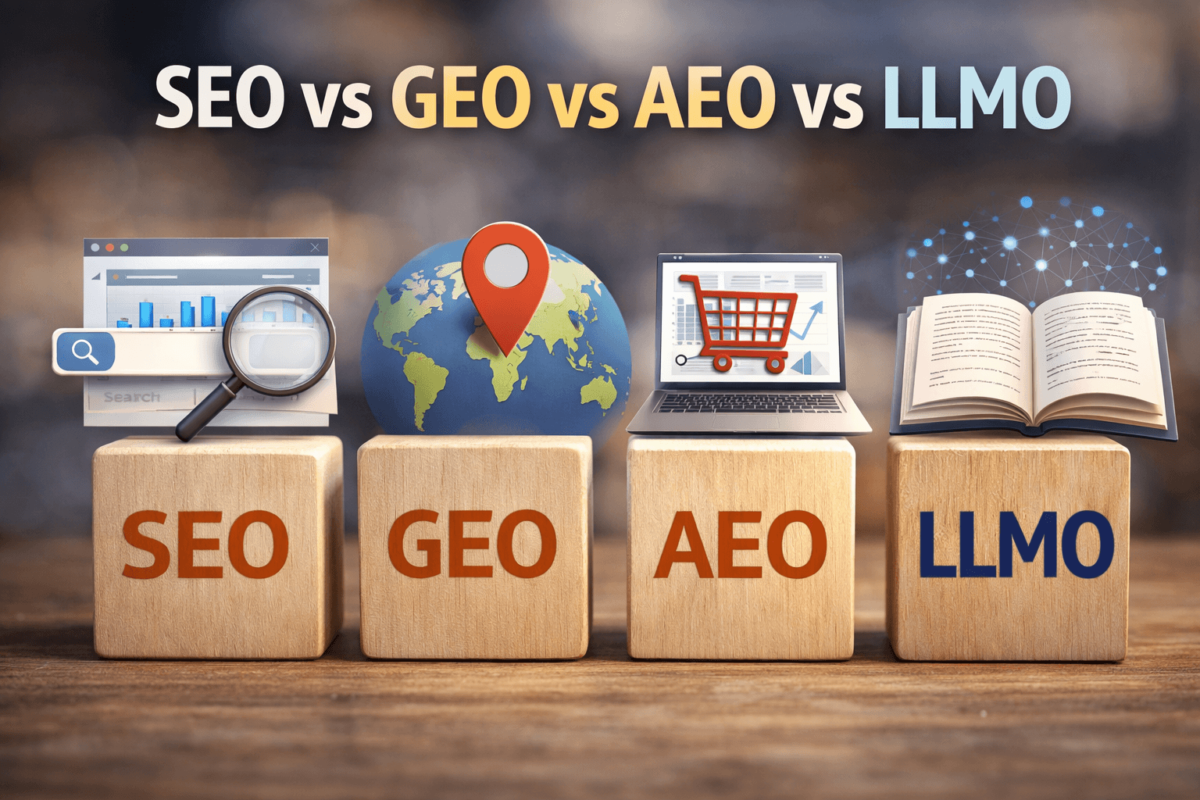
Let’s be honest — if you’ve spent even a minute in digital marketing lately, you’ve probably seen these four terms flying around: SEO, AEO, GEO, and LLMO. And at some point, you probably thought:
“Wait… are these actually different things — or just new buzzwords?”
Fair question. Because the truth is — most people are overcomplicating this. So in this guide, I’m going to break it all down in plain English, show you how each one works in real life, and most importantly — how to actually use them to get traffic, visibility, and authority in 2026.
This isn’t theoretical. These are strategies we’ve tested and applied at TechCognate, and the results speak for themselves.
- SEO = Rank on Google’s traditional search results
- AEO = Get featured as the direct answer (snippets, voice search)
- GEO = Show up inside AI-generated results (ChatGPT, Perplexity, SGE)
- LLMO = Optimize content for how AI models understand and retrieve it
- Think of it as evolution — not replacement. You need all four.
🔍 What is SEO (Search Engine Optimization)? SEO
Let’s start with the classic — the one that’s been around for over two decades and still drives the majority of organic traffic across the web.
SEO is simply: getting your website to rank on Google (and other search engines) so people find you when they’re searching for something you offer.
Real-life example: You search “best running shoes for flat feet” and click one of the top results. That’s SEO working exactly as intended. Someone created helpful content, structured it correctly, earned some authority — and Google rewarded them with visibility.
What Still Works in SEO (2026)
✓ What Works
- High-quality, helpful content — Google’s Helpful Content updates have doubled down on this. Thin, generic content is getting crushed.
- Search intent matching — Writing content that actually answers what the user wants, not just what they typed.
- Topical authority — Covering a subject deeply across multiple pages. One good article isn’t enough anymore.
- Technical foundations — Site speed, Core Web Vitals, mobile-first indexing. See our Technical SEO Checklist for the full breakdown.
- Internal linking — Connecting related content on your site signals topical depth to Google.
- Core Web Vitals — Google uses these as a ranking factor. See our Core Web Vitals Guide for exactly what to fix.
✗ What’s Dying
- Keyword stuffing — Google’s algorithms see right through it
- Thin, 300-word blog posts — They’re invisible now
- Low-quality backlink schemes — More harm than help
- Ignoring user experience — Bounce rates and engagement signals matter
SEO is not dead. But it’s no longer enough on its own. In 2026, SEO is your foundation — the table stakes. Everything else builds on top of it.
For the most powerful SEO tools to execute this, check out our in-depth reviews: Ahrefs Review, SEMrush Review, and Mangools Review — each serves a different use case and budget.
🎯 What is AEO (Answer Engine Optimization)? AEO
Here’s where things start shifting. AEO is about getting your content picked as the direct answer — not just ranking #1, but becoming the answer itself.
AEO = Optimizing your content to be selected as the featured answer by search engines and voice assistants.
Example: You search “How many calories in an apple?” and Google shows the answer at the top of the page, inside a box, before you even click anything. You got your answer — and no one visited any website. That’s AEO in action.
Where AEO Appears
Featured Snippets
The box at the very top of Google results, shown before any organic links.
Voice Search
Alexa, Siri, Google Assistant — they read one answer. Make it yours.
People Also Ask
Google’s expanding Q&A boxes that appear throughout the SERP.
Knowledge Panels
Instant answers surfaced in the sidebar or top of results pages.
How to Optimize for AEO
Ask the question directly in a heading (H2 or H3)
Then answer it in 40–60 words immediately below. That window is exactly what Google’s snippet algorithm targets.
Add FAQ sections with schema markup
This is one of the fastest wins in AEO. Our guide on Schema Markup for AI Search goes deep on this.
Use structured data (Schema.org)
Help Google understand your content format. Implement FAQ schema and HowTo schema where relevant.
Write in plain, direct language
Avoid jargon or overly complex sentences. If a 12-year-old can’t understand the first sentence of your answer, rewrite it.
Use comparison tables, numbered lists, and step-by-step formats
Google loves pulling these into featured snippets and AI Overviews.
We added FAQ schema to a client’s blog post targeting a competitive local keyword. Traffic didn’t just increase — it started showing up in voice search results and featured snippet positions within 6 weeks. The key wasn’t more content — it was better-structured content.
For a deeper look at how schema and structured data fits into your broader strategy, read: AI-Optimized Blog Content Guide.
🌍 What is GEO (Generative Engine Optimization)? GEO
Now we’re entering the AI era. And this is the one most SEOs are still sleeping on.
GEO = Optimizing your content so AI tools cite, reference, or include you in their generated answers.
Think: ChatGPT. Google’s AI Overviews (formerly SGE). Perplexity. Gemini. These are tools millions of people now use daily instead of — or before — searching Google. And they all pull information from content on the web.
Example: A user asks ChatGPT: “Best SEO strategies for small businesses.” If your content is cited, referenced, or has clearly influenced the model’s knowledge base — that’s GEO working for you.
Why GEO Is Different From SEO
In SEO, you’re competing for positions on a results page. In GEO, you’re competing to be the source that an AI model trusts and references. The user might never visit your site — but your brand, your expertise, and your ideas are still shaping their decisions.
We covered this shift in depth in our AI SEO Guide — it’s worth reading alongside this post.
How to Optimize for GEO
Write authoritative, well-sourced content
AI models favor content that demonstrates expertise, cites data, and provides clear explanations.
Include original statistics and unique insights
Regurgitated content doesn’t get cited. Original data does.
Build topical authority
Cover your subject comprehensively across multiple pages. AI models recognize domain expertise.
Get brand mentions
When other credible sites mention your brand, it signals to AI systems that you’re a trusted source.
Earn high-quality backlinks
Links from trusted sites still matter enormously for AI citation signals.
GEO is not about ranking. It’s about being referenced. The user might not come to your site — but your expertise shapes the answer they receive. Brand authority is the new backlink.
Local businesses should note: GEO also intersects with local AI results. Our Local SEO Strategies Guide explains how proximity, citations, and reviews factor in for location-based queries.
🤖 What is LLMO (Large Language Model Optimization)? LLMO
This is the newest — and most misunderstood — of the four. Most people haven’t even heard of it yet. Which means early movers have a real advantage.
LLMO = Optimizing your content for how AI language models (like GPT-4, Claude, Gemini) read, understand, and retrieve information.
Simple explanation: Instead of optimizing for Google’s crawling algorithm, you’re optimizing for how AI models interpret and store knowledge. The goal is to become a trusted source that these models naturally draw from when generating answers.
What LLMs Actually Prefer
This is where most SEO content fails. LLMs don’t care about keyword density. They care about:
✓ LLM Content Preferences
- Clear, logically structured explanations
- Natural language (not keyword-stuffed sentences)
- Context-rich writing that builds understanding step by step
- Factual accuracy with verifiable claims
- Content that reads like it was written by a genuine expert
The LLMO Content Test
❌ BAD (keyword-stuffed): “Best SEO tips 2026 fast rank Google AI GEO LLMO strategy”
✅ GOOD (LLMO-optimized): “Here are 5 proven SEO strategies that worked for small businesses in 2025, based on testing across 12 client accounts in competitive niches”
Guess which one AI models trust, cite, and learn from?
LLMO Best Practices
Write complete thoughts
Every paragraph should be able to stand alone as a useful piece of information.
Avoid ambiguity — be specific
“Improve your site” is useless. “Reduce Time to First Byte below 200ms” is valuable.
Use consistent terminology
Don’t call it SEO in one paragraph and “search optimization” in the next. AI models track term consistency.
Add context to claims
Don’t just state facts. Explain why they matter and how they work.
Format for readability
Logical flow, clear headings, and concise summaries help AI models extract the right information.
Content that performs well in LLMs usually doesn’t feel ‘optimized’ at all. It feels like it was written by someone who genuinely knows their subject and wants to explain it clearly. Not SEO — explanation.
For AI-first content writing techniques, our guide on AI-Optimized Blog Content covers the specific formats and writing patterns that perform best.
Also see: How to Rank in Google’s AI Overviews — a practical breakdown of what it takes to appear in Google’s AI-generated results.
⚔️ SEO vs AEO vs GEO vs LLMO: Side-by-Side
Here’s the clearest side-by-side breakdown you’ll find anywhere. Print this out. Screenshot it. Share it with your team.
| Factor | SEO | AEO | GEO | LLMO |
|---|---|---|---|---|
| Goal | Rank on Google | Be the answer | Cited by AI | Train/align AI |
| Platform | Search engines | Snippets & voice | ChatGPT, SGE | AI systems |
| Focus | Keywords | Questions | Authority | Clarity & context |
| Output | Blue links | Direct answers | AI responses | AI understanding |
| Key Signal | Backlinks | Schema markup | Brand mentions | Natural language |
| ROI Timeline | 3–6 months | 2–4 months | 6–12 months | Ongoing |
🔄 How They Work Together (This Is the Important Part)
Most people ask the wrong question. They say: “Which one should I focus on?” But that’s like asking: “Should I focus on the engine, the wheels, or the fuel?” You need all of them.
The real question is: How do I build a strategy that uses all four — without burning out my team or my budget?
The 4-Layer Visibility Stack
- SEO → Brings traffic from Google’s traditional search results
- AEO → Captures featured snippets and voice search answers
- GEO → Gets you cited and referenced in AI-generated answers
- LLMO → Makes your content the source AI models actually trust and learn from
The Real-World Analogy
Here’s how I like to explain it to clients:
SEO
Getting invited to the party
AEO
Being handed the microphone
GEO
Being quoted in tomorrow’s news coverage
LLMO
Becoming the expert source that everyone references
Each layer builds on the one before it. And together, they create a compounding visibility effect that gets stronger over time.
For the most comprehensive tool to manage all of this in one place, our Rank Math Review shows how one WordPress SEO plugin can handle schema, AEO, and technical optimization simultaneously.
🛠️ Proven Step-by-Step Strategy for 2026
Here’s a practical framework you can actually implement. We’ve used this exact approach across multiple client projects.
Step 1: Start With Search Intent (SEO Foundation)
Create in-depth, intent-matching content
Build internal links between related content to signal topical authority. Run a full technical audit first — our Technical SEO Checklist covers every element Google checks.
Step 2: Add Answer Blocks (AEO Layer)
Add an FAQ section to every major content piece
Use H2/H3 headings phrased as questions, followed by 40–60 word answers. Implement FAQ schema and HowTo schema where relevant.
Target “People Also Ask” questions
These are gold mines for AEO. Schema markup is now a must-have — our guide on Schema Markup for AI Search explains every schema type worth implementing in 2026.
Step 3: Build Authority Signals (GEO Layer)
Add original research, case studies, and data
Include quotes from experts or real-world experiments you’ve run. Pursue digital PR and brand mentions on credible sites.
Go deep on topical coverage
AI models reward domain expertise. Local businesses: don’t forget that GEO includes local AI search. Our Local SEO Strategies Guide covers Google Business Profile optimization and local citation building.
Step 4: Make It AI-Friendly (LLMO Layer)
Write in clear, complete sentences
No keyword-stuffed fragments. Use logical heading structure that an AI can follow. Include summaries at the top and bottom of long content.
Cite your sources and link to authoritative external references
For complete implementation guidance, our AI SEO Guide ties all four layers together with platform-specific tactics.
🚨 Common Mistakes (Avoid These)
One mistake I see all the time — even from experienced marketers — is treating these four as completely separate, competing strategies. They’re not. But there are specific mistakes that kill results at each layer.
SEO Mistakes
- Creating content for search engines instead of humans — Google’s HCU updates punish this
- Ignoring Core Web Vitals — Page speed is a ranking factor
- Building links without building authority — Low-quality links are now a liability
AEO Mistakes
- Skipping schema markup — Without it, Google can’t identify your answer blocks
- Writing answers that are too long — Google snippets pull 40–60 word answers, not 200-word essays
- Only targeting head keywords — Long-tail questions are where AEO wins
GEO Mistakes
- Publishing generic content — AI models won’t cite “7 tips for better SEO” articles
- Ignoring brand building — GEO rewards recognized, trusted brands over anonymous sites
- Focusing only on Google — ChatGPT, Perplexity, and Gemini are now significant traffic sources
LLMO Mistakes
- Writing for keywords instead of concepts — LLMs understand topics, not keyword density
- Using inconsistent terminology — This confuses AI models’ understanding of your content
- Neglecting content freshness — AI models favor content that’s regularly updated and verified
Treating SEO, AEO, GEO, and LLMO as separate strategies with separate budgets and teams. They’re one integrated system. The content you create for SEO should simultaneously answer questions (AEO), establish authority (GEO), and be structured for AI comprehension (LLMO). One piece of content. Four layers of value.
❓ Frequently Asked Questions
Is SEO still worth investing in for 2026? ▾
Absolutely. SEO remains the highest-ROI channel for most businesses. What’s changed is that SEO now needs to work alongside AEO, GEO, and LLMO — not as a standalone strategy.
What’s the difference between GEO and LLMO? ▾
GEO focuses on getting cited in AI-generated answers (the output). LLMO focuses on optimizing how AI models read and understand your content (the input). GEO is about visibility; LLMO is about comprehension. You need both.
How long does it take to see results from GEO? ▾
Typically 6–12 months, as it depends on building topical authority, earning brand mentions, and having your content indexed and referenced by AI systems. It’s slower than SEO — but the compounding effect is significant.
Do I need a different website for GEO vs SEO? ▾
No. The same content can be optimized for all four layers simultaneously. In fact, the best-performing content in 2026 naturally satisfies SEO, AEO, GEO, and LLMO requirements at once.
Which AI platforms matter most for GEO? ▾
ChatGPT, Google AI Overviews (SGE), Perplexity, and Gemini are the current major players. Perplexity in particular actively cites sources, making it highly valuable for GEO-focused strategies.
What tools help with LLMO? ▾
There’s no single dedicated LLMO tool yet — it’s an emerging field. However, tools like Rank Math (see our Rank Math Review) help with structured data, which supports both AEO and LLMO goals.
📚 Authoritative External Resources
For deeper research on each of these topics, these are the most reliable sources:
💡 Final Thoughts: Honest Take
Here’s the truth most blogs won’t tell you: SEO isn’t dying. It’s expanding.
The game hasn’t changed — the field has gotten bigger. You’re no longer just competing for the top 10 results on a Google page. You’re competing to be the answer inside AI chat interfaces, voice assistants, featured snippets, and AI-generated summaries. That’s more surface area — which means more opportunity.
The winners in 2026 will be the ones who:
- Write like humans — with depth, nuance, and genuine expertise
- Think like educators — prioritizing understanding over rankings
- Structure like machines — with clean formatting, logical flow, and schema markup
- Build like brands — earning mentions, trust, and authority across platforms
Don’t just try to rank. Try to be the answer — everywhere.