SEO Tools Comparison
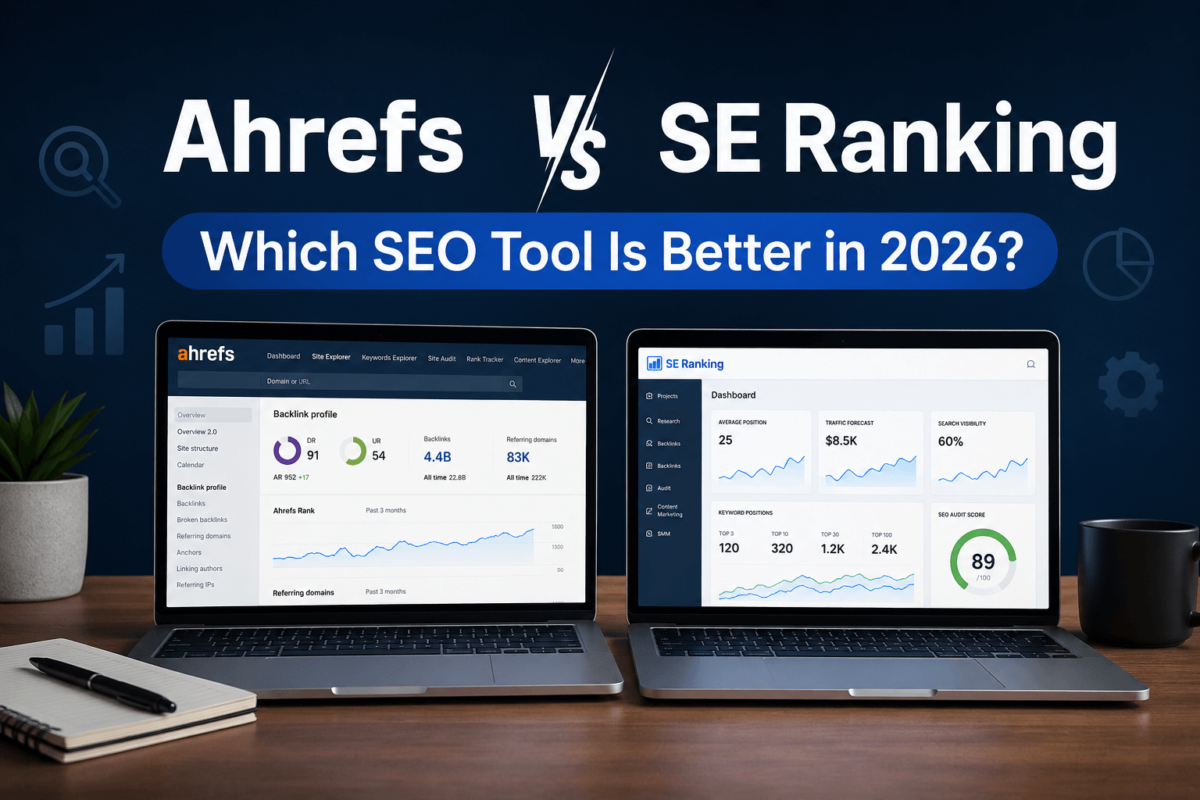
Ahrefs vs SE Ranking: Which SEO Tool Is Better in 2026?
By Jaykishan Panchal | Updated: June 2026 | 10-min read
Disclosure: TechCognate is reader-supported. We may earn a commission, at no extra cost to you, if you sign up through links on this page. This never affects which tool we recommend — our testing and verdicts come first.
Picking the wrong SEO tool is like hiring the wrong employee — it costs you time, money, and results. And with SEO software subscriptions often running $100–$500 a month, that’s not a small mistake.
Ahrefs and SE Ranking are two of the most popular choices in the market right now. They’re often compared because they share a lot of the same core features — keyword research, rank tracking, backlink analysis, and site audits. But they target very different users and budgets. If you want the full picture on Ahrefs alone, our in-depth Ahrefs review breaks down every feature in detail.
After testing both platforms extensively across client projects, in-house campaigns, and content publishing workflows, here’s what I’ve found: neither tool is universally better. The right pick depends entirely on what you need, how much you can spend, and who’s using it.
In this comparison, I’m going to walk through every major feature, their pricing, usability, and which types of businesses or SEOs each tool serves best. No fluff. No affiliate bias. Just a straight-up breakdown so you can make a confident call.
Quick Verdict
Not ready to read 8,000 words? Here’s the short version:
| Category | Winner | Why |
|---|---|---|
| Best Overall | Ahrefs | More powerful data across the board |
| Best Value | SE Ranking | Far cheaper with solid core features |
| Best for Beginners | SE Ranking | Simpler UI, gentler learning curve |
| Best for Agencies | SE Ranking | White-label + affordable multi-seat pricing |
| Best for Enterprise | Ahrefs | Scale, API access, and data depth |
| Best for Bloggers | SE Ranking | Budget-friendly rank tracking + audits |
| Best for Ecommerce | Ahrefs | Deep competitor & backlink intelligence |
| Best Backlink Tool | Ahrefs | Largest, most fresh backlink database |
| Best Rank Tracker | SE Ranking | Flexible update frequency at lower cost |
| Best Local SEO | SE Ranking | Built-in Local Marketing module |
| Best AI Features | SE Ranking | AI Writer + content tools included |
| Best Reporting | SE Ranking | White-label SEO reports out of the box |
| Overall Winner | Depends on you | See Final Verdict for your use case |
TL;DR — Bottom Line Up Front
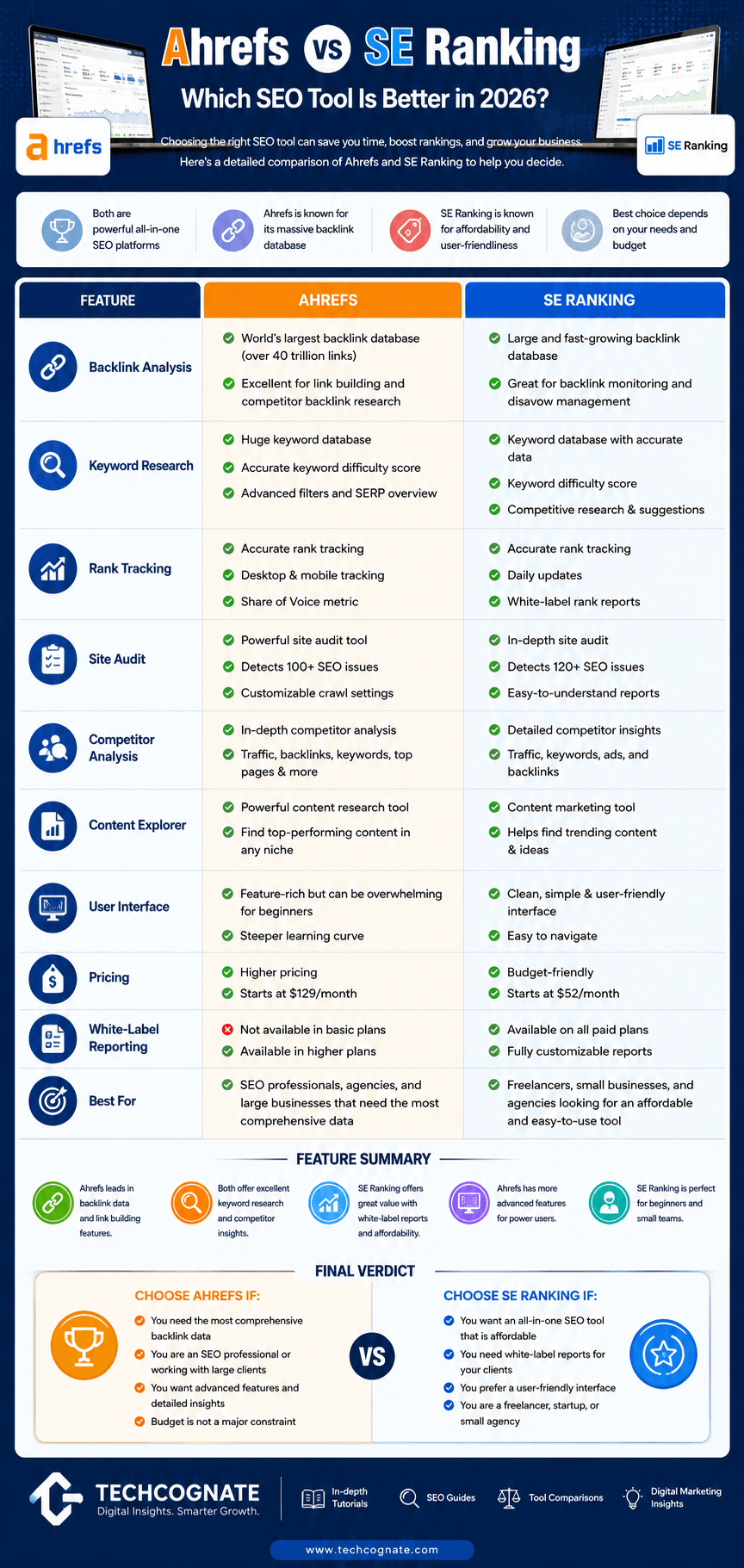
Ahrefs is the gold standard for backlink analysis, keyword research depth, and competitor intelligence. It’s the tool professional SEOs and enterprise teams trust most. SE Ranking is the better choice if you’re budget-conscious, running an agency that needs white-label reports, or just starting out with SEO. It packs nearly every core feature into a much cheaper package. If you can afford Ahrefs and need its data depth, go Ahrefs. If you want serious value without sacrificing essential features, SE Ranking wins on price every single time.
Ready to pick? Start your free trial:
Affiliate links — we may earn a commission if you sign up, at no extra cost to you.
Feature-by-Feature Overview
Here’s the full side-by-side before we dive into the details:
| Feature | Ahrefs | SE Ranking | Winner |
|---|---|---|---|
| Pricing (monthly) | $129–$449+ | $52–$152+ | SE Ranking ✅ |
| Ease of Use | Moderate | Easy | SE Ranking ✅ |
| Keyword Research | Excellent | Good | Ahrefs ✅ |
| Backlink Database | Industry-leading | Growing | Ahrefs ✅ |
| Rank Tracking | Good | Excellent | SE Ranking ✅ |
| Site Audit | Excellent | Excellent | Tie 🤝 |
| Local SEO | Basic | Dedicated module | SE Ranking ✅ |
| Content Tools | Good | AI-powered | SE Ranking ✅ |
| Competitor Research | Excellent | Good | Ahrefs ✅ |
| White Label | No | Yes | SE Ranking ✅ |
| Reporting | Standard | White-label + custom | SE Ranking ✅ |
| API Access | Yes (paid add-on) | Yes (higher plans) | Tie 🤝 |
| Support | Good | Good | Tie 🤝 |
| Learning Curve | Steep | Moderate | SE Ranking ✅ |
| Value for Money | Moderate | High | SE Ranking ✅ |
What Is Ahrefs?
Ahrefs is one of the most widely used SEO platforms in the world. Founded in 2011 by Dmitry Gerasimenko, it started as a pure backlink analysis tool and has since grown into a full-suite SEO platform used by agencies, enterprise brands, and professional SEOs globally. See our full Ahrefs review for a deeper dive into the platform.
Today, Ahrefs is best known for having the largest crawled backlink database in the industry — second only to Google itself — along with powerful keyword research tools, site auditing, and rank tracking.
Core Products in Ahrefs
Ahrefs Is Best For
Unmatched backlink database and keyword research depth.
Expensive. No white-label reporting. Steep learning curve for beginners.
Best for data depth
Try Ahrefs risk-free
See why professional SEOs and enterprise teams rely on Ahrefs’ backlink and keyword data.
Start Your $7 Trial →Affiliate link — we may earn a commission if you sign up.
What Is SE Ranking?
SE Ranking is a cloud-based SEO platform founded in 2013, initially designed as an affordable rank tracking tool. Over the years it’s evolved into a comprehensive SEO suite with keyword research, site auditing, competitor analysis, content tools, and a dedicated Local SEO module.
What sets SE Ranking apart is its pricing — it’s significantly cheaper than Ahrefs while still covering all the essential bases. It’s become a go-to platform for agencies, freelancers, and small business owners who need professional SEO tools without enterprise-level price tags.
Core Products in SE Ranking
SE Ranking Is Best For
Excellent value, white-label reports, and the best Local SEO module in this price range.
Backlink database smaller than Ahrefs. Less robust for deep enterprise-level research.
Best for value
Try SE Ranking Free for 14 Days
Get rank tracking, site audits, and white-label reports without the enterprise price tag.
Start Free Trial →Affiliate link — we may earn a commission if you sign up.
Feature-by-Feature Comparison
1. Keyword Research
Keyword research is the backbone of any SEO strategy — and both tools handle it differently.
Ahrefs Keywords Explorer
Ahrefs’ Keywords Explorer is arguably the best keyword research tool on the market. It pulls data from Google, Bing, Amazon, YouTube, and more. You get search volume, keyword difficulty (KD), traffic potential, click-through rates, parent topic mapping, and a detailed SERP overview showing who ranks and why. The traffic potential metric — which shows the total traffic a page could get if it ranked #1 — is a game-changer for prioritizing keywords.
SE Ranking Keyword Research Tool
SE Ranking’s keyword tool is solid and covers all the essentials. You can research volume, difficulty, CPC, and SERP features. It also shows historical data and keyword clustering, which helps build topical authority. It covers Google, Bing, and Yahoo. The data accuracy is good, though slightly smaller in database size compared to Ahrefs.
Winner: Ahrefs
Ahrefs wins on depth, accuracy, and the traffic potential metric. SE Ranking is perfectly adequate for most use cases but doesn’t quite match Ahrefs’ keyword research firepower.
2. Backlink Analysis
Backlinks remain one of the strongest ranking signals in Google Search, and having accurate backlink data is critical for off-page SEO.
Ahrefs Backlink Database
Ahrefs has the world’s most active web crawler — it processes more than 8 billion pages per day and maintains a backlink database that rivals Google’s own index. You get Domain Rating (DR), URL Rating (UR), referring domains, anchor text analysis, new and lost links, and link velocity data. It’s the most trusted backlink tool in the industry, full stop.
SE Ranking Backlink Checker
SE Ranking’s backlink data has improved significantly in recent years but still falls short of Ahrefs in both database size and freshness. It’s more than adequate for standard audits and monitoring, but if you’re running serious link building campaigns or performing deep competitor analysis, you’ll feel the gap.
Winner: Ahrefs
No contest here. Ahrefs’ backlink database is the industry gold standard. SE Ranking’s backlink data works fine for general monitoring but isn’t in the same league for advanced link building (see our best link building tools guide) or competitor research.
3. Rank Tracking
Knowing where your keywords rank — and how those positions change over time — is essential for measuring SEO progress.
Ahrefs Rank Tracker
Ahrefs’ Rank Tracker covers desktop and mobile rankings across Google, Bing, and YouTube. You can track rankings by country, city, or device. It also shows SERP features (featured snippets, image packs, etc.) and lets you benchmark competitors. Updates happen weekly by default on lower plans, with daily tracking on higher plans.
SE Ranking Rank Tracker
SE Ranking’s rank tracker is where it truly shines. It’s one of the most flexible rank tracking tools available. You can choose between daily, weekly, or on-demand updates. It covers Google, Bing, and Yahoo across 190+ countries. You also get SERP features, visibility scores, historical data, and competitor comparisons — all presented in a clean, easy-to-read dashboard. The frequency control is a major advantage over Ahrefs.
Winner: SE Ranking
SE Ranking edges ahead on flexibility, update frequency control, and cost per keyword tracked. It’s built around rank tracking and it shows.
4. Site Audit
A solid site audit helps you identify and fix technical SEO issues that could be holding back your rankings.
Ahrefs Site Audit
Ahrefs’ Site Audit crawls your entire site and checks for 100+ SEO issues including broken links, missing meta descriptions, duplicate content, slow pages, Core Web Vitals problems, and more. It visualizes your internal linking structure, shows crawl depth maps, and prioritizes issues by severity. The audit is thorough and the UI for navigating issues is clean and well-organized.
SE Ranking Website Audit
SE Ranking’s site audit is equally impressive and arguably offers more value considering the price difference. It checks for on-page issues, crawlability, internal linking, duplicate content, page speed, and Core Web Vitals. Run through our technical SEO checklist and both tools will catch the essentials. The audit reports are clear, well-structured, and can be exported or turned into white-label reports for clients.
Winner: Tie
Both tools offer comprehensive site audits. SE Ranking’s audit is slightly better value given its lower price point. Ahrefs offers marginally deeper crawl data for very large sites.
5. Competitor Research
Understanding what your competitors are doing — which keywords they rank for, what links they have, and where their traffic comes from — is one of the most valuable things any SEO tool can provide.
Ahrefs Competitor Analysis
Ahrefs is the king of competitor research. Site Explorer lets you enter any URL and see its organic traffic estimate, top pages, keyword gaps, backlink profile, and referring domains. The Content Gap and Link Intersect tools are particularly powerful for uncovering opportunities your competitors have that you don’t.
SE Ranking Competitor Research
SE Ranking has a solid Competitor Research module that shows traffic estimates, top keywords, and backlink summaries for any website. It’s good enough for most competitive analyses, but it doesn’t go as deep as Ahrefs on backlink-level details or content gap analysis.
Winner: Ahrefs
Ahrefs wins on competitor research depth, especially for backlink and content gap analysis. SE Ranking is sufficient for standard competitive audits. Our competitor analysis guide walks through the process either way.
6. Local SEO
Local SEO is increasingly important as more searches show local intent — and tools differ dramatically in how well they support it.
Ahrefs Local SEO
Ahrefs doesn’t have a dedicated local SEO module. You can track local rankings and do local keyword research, but there’s no Google Business Profile integration, no review management, and no local citation tracking.
SE Ranking Local Marketing Module
SE Ranking’s Local Marketing module is a major differentiator. It includes local keyword rank tracking (by city/ZIP), Google Business Profile management, local citation monitoring, review tracking, and location-level reporting. For local businesses or agencies managing local SEO clients, this module alone can justify the subscription.
Winner: SE Ranking
SE Ranking is the clear winner for local SEO. It has a dedicated, fully-featured local marketing module that Ahrefs simply doesn’t offer. Check our local SEO strategies guide for a step-by-step playbook.
7. Content Tools & AI Features
Content optimization is now central to modern SEO, and AI-powered tools are becoming table stakes.
Ahrefs Content Tools
Ahrefs has Content Explorer for finding high-performing content in any niche and a basic content editor. However, Ahrefs doesn’t have built-in AI writing capabilities — you’ll need to use third-party tools like Jasper or Surfer for AI-assisted content creation.
SE Ranking AI Content Tools
SE Ranking includes an AI-powered Content Editor and AI Writer directly inside the platform. You can create SEO-optimized content outlines, check your content against top-ranking pages, and generate AI-assisted copy — all without leaving the platform. For content marketers and bloggers, this integrated workflow is a significant advantage. See our AI content optimization guide for more.
Winner: SE Ranking
SE Ranking wins on content tools, especially for those who want AI content creation capabilities built into their SEO platform.
8. Agency Tools & White-Label Reporting
If you’re running a digital marketing agency, reporting to clients is a huge part of your workflow.
Ahrefs Agency Features
Ahrefs doesn’t offer white-label reporting. You can export data and build reports manually, but there’s no native white-label dashboard or branded PDF report builder. For agencies this is a significant gap.
SE Ranking Agency Features
SE Ranking was practically built for agencies. It has full white-label reporting with custom branding, logo, and domain. You can schedule automated PDF reports for clients, set client access levels, and manage multiple projects under one account. The agency pricing tiers are also far more cost-effective than Ahrefs for multi-client setups.
Winner: SE Ranking
SE Ranking wins hands-down for agencies. White-label reporting, client management, and agency-friendly pricing make it the better choice for SEO service providers. Our SEO reporting guide covers what to include in client reports.
9. SERP Analysis & Search Intent
Understanding search intent — why someone is searching for a keyword — is essential for creating content that ranks. Both tools provide SERP overview data, showing which pages rank for a keyword and what SERP features appear (featured snippets, People Also Ask, image packs, etc.).
Ahrefs shows more detailed SERP data including estimated traffic per ranking page, backlinks to each result, and the history of position changes. SE Ranking shows SERP feature presence and intent signals but with less historical granularity. For deep SERP analysis, Ahrefs wins. For everyday intent research, SE Ranking is sufficient.
Winner: Ahrefs
Ahrefs offers deeper SERP analysis and historical data. SE Ranking covers the essentials but doesn’t go as deep.
10. Integrations & API
Both platforms offer API access for developers who want to integrate SEO data into custom dashboards or workflows. Ahrefs’ API is available as a paid add-on and provides access to its full data set. SE Ranking’s API is available on higher-tier plans and covers rank tracking, audit, and backlink data.
Neither tool offers native integrations with Google Analytics 4 directly in the way Semrush does, though both support Google Search Console integration. SE Ranking connects with Google Analytics and Google Search Console natively, giving you a more complete picture of performance inside the platform.
Winner: Tie
Both offer API access, though at additional cost. SE Ranking’s native GSC and GA integrations give it an edge for holistic reporting inside the platform.
11. Ease of Use & Learning Curve
The best SEO tool is the one you’ll actually use — and usability matters.
Ahrefs Usability
Ahrefs has improved its UI significantly over the years, but it still carries a moderate-to-steep learning curve. The amount of data available can feel overwhelming for beginners. That said, once you’ve learned where everything lives, it’s incredibly powerful.
SE Ranking Usability
SE Ranking was designed with accessibility in mind. The dashboard is clean, onboarding is straightforward, and the tool walks you through key tasks with helpful prompts. Beginners consistently find SE Ranking easier to get started with.
Winner: SE Ranking
SE Ranking is the friendlier tool for beginners and non-technical users. Ahrefs is more powerful but requires a steeper investment of time to master.
12. Mobile Experience
More SEOs are checking data on the go — so mobile usability matters more than it used to.
Ahrefs Mobile
Ahrefs doesn’t have a dedicated mobile app. The web interface is responsive but not optimized for small screens. Checking rankings or reviewing audit issues from your phone works, but it’s not a smooth experience.
SE Ranking Mobile
SE Ranking also lacks a native mobile app, but its responsive web interface holds up better on smaller screens. The rank tracker dashboard in particular is quite readable on mobile. Neither tool is built for mobile-first use — but SE Ranking handles it marginally better.
Winner: SE Ranking (marginal)
SE Ranking’s mobile web experience is slightly better adapted, but neither tool is a true mobile-first platform.
13. Database Size & Data Freshness
The size and freshness of a tool’s database directly determines the quality of insights you can draw from it.
Ahrefs Database
Ahrefs crawls over 8 billion web pages daily. Its backlink index contains trillions of live links and hundreds of billions of pages in its historical index. It updates keyword data frequently and is the most comprehensive third-party web index available. This scale is why enterprise teams and professional link builders rely on it above every alternative.
SE Ranking Database
SE Ranking’s database has grown substantially in recent years. It covers billions of backlinks and keyword data across multiple search engines. For most use cases — rank tracking, site auditing, and standard keyword research — it delivers more than enough data. The gap with Ahrefs only becomes meaningful when doing large-scale link prospecting or pulling granular backlink metrics at scale.
Winner: Ahrefs
Ahrefs’ database is larger, fresher, and more comprehensive. For data-heavy research work, the gap is real and it matters.
14. Speed & Platform Performance
Slow tools cost you time — and both platforms are cloud-based, meaning performance depends on query complexity more than hardware. Ahrefs is fast for standard queries, but large site audits and complex Site Explorer reports on high-authority domains can take longer to load — especially when pulling millions of backlinks.
SE Ranking is consistently snappy across all its modules. The dashboard loads quickly, rank tracking results refresh fast, and site audit data comes in cleanly within a reasonable time for most site sizes. In day-to-day use, SE Ranking simply feels more consistently responsive.
Winner: SE Ranking (slight edge)
SE Ranking feels faster in daily use. Ahrefs can be slower on heavy, data-intensive queries — but the depth of data often justifies the wait.
15. Scalability & Team Collaboration
As your team or client roster grows, your SEO tool needs to scale without costs spiraling out of control.
Ahrefs Team Scaling
Ahrefs charges per additional user seat — starting at around $50 per extra user per month on most plans. For growing teams this adds up quickly. The platform handles enterprise-scale data very well, but the pricing model can make it expensive for larger teams.
SE Ranking Team Scaling
SE Ranking’s agency-focused pricing is built for scaling. You can add client workspaces, invite collaborators with defined access levels, and grow your project count without per-seat pricing penalties. For agencies scaling from 5 to 50 clients, SE Ranking’s cost curve stays manageable in a way Ahrefs simply can’t match.
Winner: SE Ranking
SE Ranking scales far more affordably for teams and agencies. Ahrefs’ per-seat pricing becomes a real financial challenge as headcount grows.
16. Automation & Scheduled Reporting
SE Ranking lets you schedule automated PDF reports on a weekly or monthly basis, delivered directly to client inboxes. You can brand them with your agency’s logo, colors, and domain for a completely white-label experience.
Ahrefs supports data exports and API-based automation for developers, but has no native automated client reporting system. If regular SEO reporting is part of your workflow, SE Ranking’s built-in automation is a genuine time-saver.
Winner: SE Ranking
SE Ranking wins on report automation. Ahrefs requires manual builds or third-party tools like Looker Studio to achieve similar automated reporting.
17. Dashboard & Everyday User Experience
The dashboard is the first thing you see every time you log in. It needs to give you a fast read on what matters without making you dig through menus.
Ahrefs Dashboard
Ahrefs’ dashboard surfaces project rank tracking, backlink alerts, and site audit health scores. It’s information-dense, which power users love. But beginners can feel immediately overwhelmed by the number of options and data points competing for attention.
SE Ranking Dashboard
SE Ranking’s dashboard is visually cleaner and better organized for daily workflow. You get a project-level summary of rankings, site health, backlinks, and traffic — all in one glance. The navigation is more intuitive and the visual hierarchy helps you prioritize what to address first. For account managers and agency professionals checking in on multiple clients daily, it’s a much more livable interface.
Winner: SE Ranking
SE Ranking’s dashboard is more user-friendly for day-to-day work. Ahrefs offers more raw data density, but SE Ranking makes better use of the screen real estate.
18. Data Accuracy: A Realistic Assessment
No third-party SEO tool has direct access to Google’s raw data — they all estimate. Here is how each tool’s accuracy stacks up in real-world testing:
Bottom line: Ahrefs is more accurate for backlink data and has a moderate edge on keyword metrics. For rank tracking and technical auditing, both tools are essentially equal.
19. Customer Support & Learning Resources
Both platforms offer email and chat support, help documentation, and video tutorials. Ahrefs’ blog and YouTube channel (Ahrefs TV) are among the best free SEO education resources available online — consistently cited by practitioners at every level. If you want to learn SEO while using the tool, the Ahrefs content library is a genuine asset.
SE Ranking has solid help documentation, responsive live chat support, and a growing library of tutorial videos. In practice, SE Ranking’s live chat responds faster for account and billing questions — which matters when you’re working against a client deadline.
Winner: Tie
Ahrefs edges ahead on educational content; SE Ranking edges ahead on live support responsiveness. Both cover the support fundamentals well.
Pricing Comparison
Pricing is often the deciding factor — and the gap between these two tools is significant.
| Plan | Ahrefs (mo.) | Ahrefs (ann.) | SE Ranking (mo.) | SE Ranking (ann.) |
|---|---|---|---|---|
| Starter / Essential | $29 (limited) | — | $52 | $44 |
| Basic / Pro | $129 | $108/mo | $95 | $80/mo |
| Standard / Business | $249 | $208/mo | $152 | $128/mo |
| Advanced / Custom | $449 | $374/mo | Custom | Custom |
| Enterprise | Custom | Custom | Custom | Custom |
Ahrefs Pricing
Important: Ahrefs charges for additional users ($50+/user/mo on most plans), and API access is an additional paid add-on.
SE Ranking Pricing
SE Ranking also lets you scale pricing based on how many keywords you track and how frequently you update rankings — a flexible pricing model that Ahrefs doesn’t offer.
Value Score
SE Ranking wins on value by a wide margin. For roughly $52–$95/month, you get rank tracking, site audit, keyword research, content tools, white-label reports, and local SEO. Ahrefs’ entry-level plan starts at $129/month with fewer features and restrictions on usage. For budget-conscious SEOs, SE Ranking is the clear choice.
Compare pricing for yourself — both offer free trials:
Affiliate links — we may earn a commission if you sign up, at no extra cost to you.
Pros & Cons
Ahrefs — Pros & Cons
✅ Pros
❌ Cons
SE Ranking — Pros & Cons
✅ Pros
❌ Cons
Real Use Cases: Who Should Use What?
Best for Bloggers and Content Publishers
If you’re a blogger or content publisher focused on ranking articles, SE Ranking is the smarter choice. You get keyword research, rank tracking, and the AI content editor all in one platform for under $100/month. You don’t need Ahrefs’ deep backlink data unless you’re running active link building campaigns.
Verdict: SE Ranking
Best for Affiliate Marketers
Affiliate marketers need keyword research and rank tracking more than anything else. SE Ranking covers both at a budget-friendly price. However, if you’re doing serious competitive niche research or link analysis for authority building, Ahrefs’ data depth can give you a real edge.
Verdict: SE Ranking for budget; Ahrefs for serious niche competition research
Best for SEO Agencies
For agencies, SE Ranking wins almost every time. White-label reporting, client management, affordable multi-seat pricing, and solid core data make it the best all-around agency SEO platform at this price point. If your agency focuses heavily on link building campaigns for clients, you may want to pair SE Ranking with a dedicated backlink tool.
Verdict: SE Ranking
Best for Ecommerce Brands
Ecommerce brands benefit most from Ahrefs’ competitor intelligence, product page keyword research, and backlink prospecting for digital PR campaigns. If you’re running a serious ecommerce SEO strategy, Ahrefs gives you deeper insight into what’s actually moving the needle for competitors.
Verdict: Ahrefs
Best for Enterprise SEO
Enterprise SEO teams need scale, data quality, and API access. Ahrefs delivers on all three. Its ability to crawl large sites, analyze millions of backlinks, and provide API-level data for custom reporting makes it the standard choice for enterprise environments.
Verdict: Ahrefs
Best for Local Businesses
For local businesses focused on dominating their local market, SE Ranking’s Local Marketing module is unmatched at this price point. Google Business Profile management, local rank tracking, and citation monitoring are all built in.
Verdict: SE Ranking
Best for Beginners
SE Ranking is the better starting point for anyone new to SEO. The interface is cleaner, the onboarding is friendlier, and the price is low enough that you won’t break the bank while you’re still learning the ropes.
Verdict: SE Ranking
Best for Advanced SEOs
Professional SEOs who need the deepest data, most accurate backlink index, and most powerful keyword research tool will gravitate toward Ahrefs. It’s the industry standard among senior SEO practitioners for good reason.
Verdict: Ahrefs
Best for YouTubers & Video Content Creators
If you’re growing a YouTube channel and want to find the right keywords to target in video titles and descriptions, Ahrefs has a Keywords Explorer that pulls data directly from YouTube — showing search volume and keyword difficulty for video queries. It’s genuinely useful for finding underserved YouTube topics. SE Ranking doesn’t cover YouTube-specific keyword data. For pure video SEO, Ahrefs has a real advantage.
Verdict: Ahrefs
Best for SaaS Companies
SaaS companies typically rely on content-led SEO to drive free trial signups and demo requests. Ahrefs is the better tool for SaaS keyword strategy — particularly for finding bottom-of-funnel comparison and alternative keywords (e.g., ‘Ahrefs alternative’, ‘best rank tracking software’). The Content Gap tool is excellent for identifying content opportunities competitors are capitalizing on. SE Ranking works well for SaaS companies with tighter budgets who need solid rank tracking and technical auditing without the full Ahrefs price tag.
Verdict: Ahrefs for growth-stage SaaS; SE Ranking for bootstrapped SaaS
Best for In-House SEO Teams
In-house SEO teams at mid-size companies face a unique challenge: they need enterprise-grade data but often have mid-range budgets. SE Ranking hits a sweet spot here — it’s powerful enough for serious SEO work, affordable enough to fit within a departmental budget, and easy enough for team members at varying skill levels to use without extensive training. Ahrefs is the better choice for in-house teams at larger companies where backlink analysis and competitor intelligence are central to the SEO strategy.
Verdict: SE Ranking for mid-size companies; Ahrefs for large enterprises
Best for Freelancers
As a freelancer, every dollar matters. SE Ranking gives you white-label reports to deliver to clients, keyword research for content briefs, rank tracking for multiple projects, and a site audit tool — all for under $100/month. That’s a remarkable toolkit for the price. Ahrefs is worth considering for freelancers who specialize in link building or competitive research and can justify the higher cost through the quality of insights it provides.
Verdict: SE Ranking
Performance Testing: How Each Tool Holds Up in the Real World
Features on a spec sheet are one thing. How a tool actually performs when you’re in the middle of a live campaign is another. Here’s an honest breakdown of each platform’s real-world performance across the metrics that matter most.
Keyword Data: Accuracy vs. Practical Usefulness
Neither Ahrefs nor SE Ranking has direct access to Google Search Console data — they both estimate search volume and keyword difficulty using clickstream data, web crawls, and proprietary algorithms. In practice:
For keyword research accuracy in commercial SEO campaigns, Ahrefs gives more confidence. For everyday content planning, SE Ranking’s data is practical and reliable enough.
Backlink Data: Freshness and Coverage
Backlink data quality is where the biggest gap between these tools exists.
For link building, link reclamation, and competitive backlink analysis, Ahrefs’ data quality is a genuine advantage worth paying for.
Rank Tracking: Reliability and Frequency
Rank tracking is arguably the most important day-to-day function for most SEO practitioners — and both tools handle it well, with different strengths.
For agencies that need to track rankings frequently and report on progress, SE Ranking’s flexible update frequency at a lower cost point makes it the practical winner.
Site Audit: Depth and Actionability
A site audit is only as valuable as the actions it helps you take. Here’s how both tools perform on real sites:
For agencies, SE Ranking’s audit combined with its white-label reporting is the more practical workflow. For technical SEO specialists auditing large sites, Ahrefs’ depth is worth having.
Overall Performance Verdict
Ahrefs wins on raw data quality, database size, and backlink freshness. SE Ranking wins on rank tracking flexibility, platform speed, and practical day-to-day usability. For performance-critical tasks like link building and enterprise competitor analysis, Ahrefs earns its premium. For everything else, SE Ranking delivers results at a fraction of the cost.
Hidden Costs and Limitations to Know Before You Buy
Pricing pages don’t tell the full story. Here are the real costs and gotchas you should know before committing to either platform.
Ahrefs Hidden Costs
Extra user seats: ~$50+/user/month on most plans. API access: paid add-on on top of your subscription. Crawl credits: Site Audit has monthly crawl limits; exceeding them requires purchasing additional credits. No white-label: agencies need third-party tools or manual report building, adding to overall cost.
SE Ranking Hidden Costs
Keyword tracking limits: pricing partly depends on how many keywords you track and how often. Tracking 5,000+ keywords daily costs more than tracking 1,000 weekly. Local Marketing module: available as an add-on on lower plans, not included by default. AI Writer credits: AI content features may have usage limits depending on your plan.
Common Mistakes When Choosing Between These Tools
Expert Tip: The Hybrid Approach
Many professional SEOs use SE Ranking for daily rank tracking and client reporting, then use Ahrefs specifically for link building prospecting and deep competitor analysis. Since Ahrefs is billed on usage in some configurations, using it strategically rather than as a daily driver can reduce costs while still accessing its superior data when it matters most.
Which Tool Wins For You: Decision Matrix
Still not sure? This matrix will point you in the right direction:
| If You Are / Need… | Best Choice | Reason |
|---|---|---|
| Tight budget (< $100/mo) | SE Ranking | Full SEO toolkit at a fraction of Ahrefs’ cost |
| Small agency with clients | SE Ranking | White-label reports, multi-seat, affordable |
| Enterprise / large brand | Ahrefs | Scale, API, deep data, and best backlinks |
| Freelance SEO consultant | SE Ranking | Low overhead, professional reports |
| Student / learning SEO | SE Ranking | Affordable entry point, clean UI |
| Content marketer / blogger | SE Ranking | Solid rank tracking + content tools |
| Technical SEO specialist | Ahrefs | Best crawler depth and backlink data |
| Link building campaigns | Ahrefs | Unmatched backlink database and prospecting |
| Local business / local SEO | SE Ranking | Dedicated Local Marketing module |
| Ecommerce brand | Ahrefs | Competitor gap analysis and product SEO |
Found your match? Claim your trial now:
Affiliate links — we may earn a commission if you sign up, at no extra cost to you.
Alternatives to Ahrefs and SE Ranking
If neither tool feels like the right fit, here are the best alternatives worth considering:
| Tool | Pricing | Backlinks | Best For |
|---|---|---|---|
| Semrush | $140–$500/mo | Excellent | Best Semrush alternative to Ahrefs; stronger content & PPC tools |
| Moz Pro | $99–$599/mo | Good | Reliable DR metric; good for beginners; smaller database |
| Mangools | $29–$79/mo | Good | Most beginner-friendly; limited depth vs Ahrefs |
| Ubersuggest | $12–$40/mo | Basic | Budget pick; limited data accuracy |
| Serpstat | $50–$200/mo | Good | Solid value; less known; decent backlink data |
| SpyFu | $33–$79/mo | Good | Best for PPC competitor research |
| Majestic | $50–$400/mo | Backlinks only | Best pure backlink tool; no keyword/rank data |
For a full breakdown, check out our detailed guides on Semrush, Ahrefs vs Moz, and the Best SEO Tools for Agencies.
Frequently Asked Questions
Is Ahrefs better than SE Ranking?
Ahrefs is more powerful for backlink analysis, keyword research depth, and competitor intelligence. SE Ranking is better for budget, agency use, local SEO, and beginners. Neither is universally better — it depends on your specific needs and budget.
Which tool has a bigger backlink database?
Ahrefs has a significantly larger and fresher backlink database. It’s considered the industry standard for backlink analysis and is second only to Google in terms of crawl coverage.
Which tool is cheaper?
SE Ranking is substantially cheaper. SE Ranking’s Pro plan starts at $95/month compared to Ahrefs’ entry-level Lite plan at $129/month — and SE Ranking includes more features like white-label reporting at that price point.
Which tool is more accurate?
Ahrefs is generally considered more accurate for keyword difficulty scores and backlink data. SE Ranking’s data is reliable for most practical purposes but may show more variance in traffic estimates.
Which tool is better for agencies?
SE Ranking wins for agencies. It has white-label reporting, client management tools, and affordable multi-seat pricing — features that Ahrefs lacks entirely.
Can beginners use Ahrefs?
Yes, but there’s a learning curve. Beginners will find SE Ranking easier to get started with. That said, Ahrefs offers excellent educational resources through its blog and YouTube channel that can help new users learn quickly.
Is SE Ranking enough for professional SEO?
For most professional SEO work — including agency campaigns, content strategy, technical audits, and rank tracking — SE Ranking is more than sufficient. Only when you need the deepest backlink data or most comprehensive competitor research will you feel the limitations vs Ahrefs.
Which tool updates rankings faster?
SE Ranking offers more flexible rank tracking frequency, including daily updates on all plans. Ahrefs defaults to less frequent updates on lower-tier plans.
Does Ahrefs include local SEO tools?
Ahrefs has basic local keyword tracking but no dedicated local SEO module. SE Ranking has a full Local Marketing module including Google Business Profile management, local rank tracking, citation monitoring, and review management.
Which tool offers white-label reports?
SE Ranking offers white-label reporting on all paid plans. Ahrefs does not have white-label reporting capabilities.
Do both tools offer free trials?
SE Ranking offers a 14-day free trial. Ahrefs offers a $7, 7-day trial for its Lite plan and also has a free version with limited features called Ahrefs Webmaster Tools, which gives you access to site audit and some backlink data for your own verified properties.
Which tool is better for keyword research?
Ahrefs wins for keyword research. Its Keywords Explorer is considered the most comprehensive keyword research tool available, with better data depth, traffic potential estimates, and SERP analysis than SE Ranking.
Can I use both tools together?
Absolutely. Many professional SEOs use SE Ranking for daily rank tracking and client reporting while using Ahrefs specifically for backlink analysis and deep competitor research. This combo can be more cost-effective than paying for Ahrefs alone at the highest tier.
Which tool is better for technical SEO?
Both tools offer solid site audit capabilities. Ahrefs has a slight edge for very large sites and deep crawl data. SE Ranking’s audit is excellent for small-to-mid-sized sites and offers better value given the price.
Which tool has better SERP analysis?
Ahrefs provides deeper SERP analysis including historical position data, estimated traffic per ranking page, and backlink counts for each SERP result. SE Ranking covers SERP feature tracking and intent signals but with less historical depth.
Is SE Ranking good for ecommerce SEO?
SE Ranking works for ecommerce SEO basics — rank tracking, audits, keyword research. For deeper ecommerce competitor analysis and product page optimization, Ahrefs offers more data depth. See our ecommerce SEO guide for the fundamentals.
Does Ahrefs have an AI content writer?
No. Ahrefs doesn’t have a built-in AI writing tool. SE Ranking has an integrated AI Writer and Content Editor.
What’s the best SEO tool for a SaaS company?
For SaaS companies focused on content-led growth, Ahrefs offers the best keyword and content gap data to identify growth opportunities. SE Ranking works well for SaaS companies with tighter budgets.
Which tool is better for link building?
Ahrefs is the better tool for link building campaigns. Its backlink database, Link Intersect tool, and referring domain analysis give you the most comprehensive prospecting data available outside of Google’s own index. Our link building strategies guide covers tactics that work with either tool.
Can I export data from both tools?
Yes, both tools allow CSV exports of keyword data, backlink data, audit reports, and rank tracking data. SE Ranking also supports direct PDF report exports with white-label branding for client delivery.
Which tool has better customer support?
Both tools offer responsive support via chat and email. SE Ranking is known for particularly quick live chat response times. Ahrefs has a strong self-service knowledge base and community forum.
What is Domain Rating (DR) in Ahrefs?
Domain Rating (DR) is Ahrefs’ proprietary metric that measures the strength of a website’s backlink profile on a scale from 0 to 100. It’s one of the most widely referenced third-party domain authority metrics in the SEO industry.
Does SE Ranking have a Domain Authority equivalent?
SE Ranking uses Domain Trust and Page Trust scores to measure link profile strength, similar to Ahrefs’ DR and UR metrics.
Which tool offers better value for money?
SE Ranking offers significantly better value for money. At less than half the price of Ahrefs, it covers all core SEO needs including features Ahrefs lacks (white-label, local SEO, AI writing). For most users, SE Ranking delivers the better ROI.
Are there discounts available for both tools?
Both tools offer approximately 20% discount on annual billing. SE Ranking occasionally runs promotional deals. Neither tool typically offers coupon codes, but both have free trial periods so you can test before committing.
Final Verdict: Which Should You Choose?
After comparing every major feature, pricing tier, and use case, here’s the bottom line:
Choose Ahrefs If…
You’re a professional SEO, enterprise team, or ecommerce brand that needs the most accurate backlink data, deepest keyword research, and most comprehensive competitor intelligence. Budget is less of a concern and data quality is your priority. Ahrefs is the industry benchmark for a reason — it earns its price for power users.
Choose SE Ranking If…
You’re an agency, freelancer, blogger, small business, or beginner who needs solid core SEO capabilities without paying enterprise-level prices. SE Ranking gives you white-label reporting, local SEO tools, AI content features, and reliable rank tracking at a fraction of Ahrefs’ cost. For most real-world SEO use cases, SE Ranking is more than enough — and the money you save can go straight back into your campaigns.
There’s no single winner that works for everyone. The best SEO tool is the one that fits your workflow, budget, and the specific outcomes you’re trying to achieve. Use the free trials from both platforms, test them with your actual projects, and let the results guide your decision.
Ready to Get Started?
Take the guesswork out of it — try both tools risk-free before you commit:
Best overall / most powerful data
Try Ahrefs Today
Get access to the industry’s largest backlink database, the sharpest keyword research tool, and deep competitor intelligence.
Start Your $7 Trial →Affiliate link — we may earn a commission if you sign up.
Best value / easiest to start
Try SE Ranking Free for 14 Days
No credit card required. Get rank tracking, site audits, AI content tools, and white-label reports in one affordable platform.
Start Free Trial →Affiliate link — we may earn a commission if you sign up.
Looking for more comparisons? Check out our related guides:
Published on TechCognate.com
Author: Jaykishan Panchal | June 2026