Ahrefs vs SpyFu: Which SEO Tool Is Better in 2026?
A complete, no-fluff comparison of pricing, keyword data, backlinks, PPC intelligence, and which tool actually fits your workflow.
Introduction
Every serious SEO eventually faces this question: between Ahrefs and SpyFu, which one deserves your subscription budget? It sounds simple. It isn’t.
Ahrefs and SpyFu are not the same kind of tool wearing different logos. They were built for different SEOs, with different priorities, at different budget points. Picking the wrong one doesn’t just waste money — it wastes time you spend working around limitations that didn’t need to exist.
This comparison is for three types of people:
- SEO professionals who already use one tool and are wondering if the other is worth adding.
- Agencies and consultants trying to decide which platform to standardize for client work.
- Business owners and marketers who need SEO intelligence but don’t want to overspend on features they’ll never use.
Ahrefs is the gold standard for backlink analysis and keyword research. It has the largest link index available, a crawler that rivals Google’s crawl frequency, and a content explorer that’s genuinely useful rather than just decorative. Enterprise teams love it. Agencies defending link-heavy clients rely on it daily. If you want a deeper standalone look at the platform, our full Ahrefs review covers it in detail.
SpyFu is built around a different idea entirely. It specializes in competitive intelligence — specifically, exposing what your competitors are spending on Google Ads, which keywords they’ve bought historically, and how their organic rankings have shifted over years of data. For PPC-focused agencies and businesses where paid search is a significant budget line, SpyFu often delivers faster, more actionable competitive insights than anything else on the market. See our complete SpyFu review for a standalone breakdown.
Here’s the honest framing: if you’re doing technical SEO, building links, or need the most accurate keyword data, Ahrefs wins. If you need deep PPC competitor intelligence at a price that doesn’t require a board meeting to approve, SpyFu wins.
If you’re short on time, jump to our Final Verdict section below.
Quick Verdict
Ahrefs is the better all-around SEO platform. Its backlink database is unmatched, its keyword data is the most reliable in the industry, and its site audit tool is genuinely enterprise-grade. If SEO is your primary channel and you can afford $129/month, Ahrefs is the right investment.
SpyFu is the smarter choice for PPC-heavy strategies, tight budgets, and competitive intelligence research. At $39/month, it’s the best value in the industry for the specific things it does well — particularly for agencies managing paid search campaigns alongside organic SEO.
| If You Need | Winner |
|---|---|
| Best backlink database | Ahrefs |
| Best PPC competitor research | SpyFu |
| Best keyword research | Ahrefs |
| Best value for freelancers | SpyFu |
| Best for agencies | Ahrefs |
| Best enterprise SEO | Ahrefs |
| Best budget option | SpyFu |
| Best all-around SEO suite | Ahrefs |
Ahrefs vs SpyFu: Full Comparison at a Glance
| Feature | Ahrefs | SpyFu |
|---|---|---|
| Company | Ahrefs Pte. Ltd. | SpyFu Inc. |
| Founded | 2011 | 2005 |
| Headquarters | Singapore | Scottsdale, AZ, USA |
| Best For | SEO, backlinks, content | PPC research, competitor intel |
| Starting Price | $129/month | $39/month |
| Free Trial | No (limited free tools) | Yes (limited free searches) |
| Keyword Database | 20+ billion keywords | 7+ billion keywords |
| Backlink Database | 35+ trillion links (largest) | Smaller, less updated |
| Rank Tracking | Yes (advanced) | Yes (basic) |
| Site Audit | Yes (enterprise-grade) | Basic only |
| Content Tools | Content Explorer, AI writing | Limited |
| PPC Research | Basic | Best-in-class |
| API | Yes (paid add-on) | Yes (higher plans) |
| Chrome Extension | Yes (SEO Toolbar) | Yes |
| Ease of Use | Moderate learning curve | Easier for beginners |
| Customer Support | Email + live chat (paid) | Email + phone support |
| Overall Rating | ★★★★★ (4.7/5) | ★★★★☆ (4.1/5) |
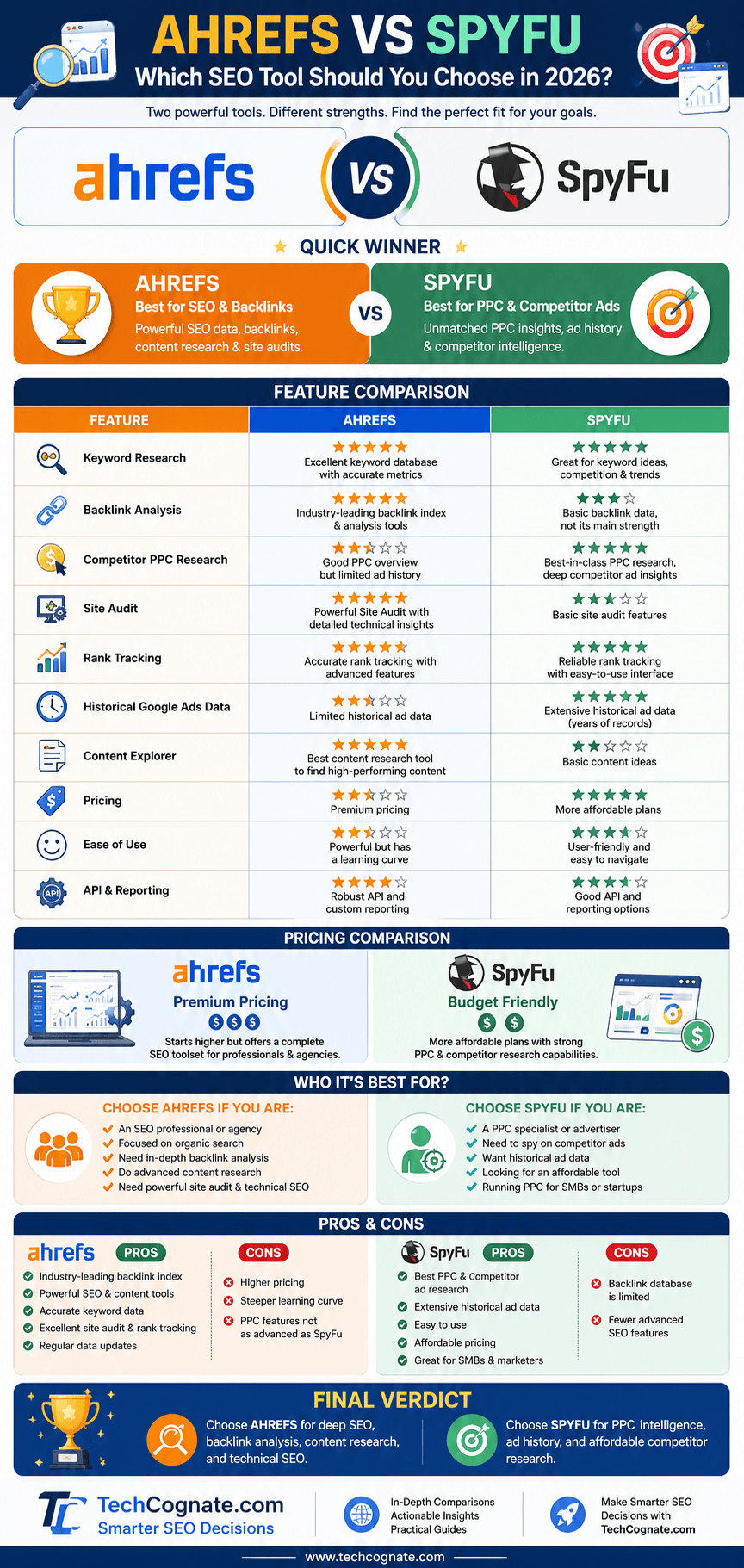
Ahrefs vs SpyFu 2026 comparison infographic — pricing, features, and winner by category
What Is Ahrefs?
Ahrefs is a comprehensive SEO platform founded in 2011, originally built around its backlink analysis tool. Over the years it expanded into keyword research, rank tracking, site auditing, and content research — becoming one of the most referenced SEO tools in the industry.
The platform’s core strength is its data infrastructure. Ahrefs maintains what is widely considered the largest active backlink index available, updated with a live index that refreshes faster than most competitors. For professionals who need to understand who’s linking to their site, who’s linking to their competitors, and where link-building opportunities exist, this is the foundation everything else is built on.
Core Ahrefs Products
- Site Explorer: Analyze any domain’s organic traffic, backlink profile, and top-ranking pages.
- Keywords Explorer: Research keywords across 10+ search engines with volume, difficulty, and traffic potential data.
- Content Explorer: Find high-performing content across any topic for link-building and content strategy.
- Site Audit: Crawl your own site to identify technical SEO issues.
- Rank Tracker: Monitor keyword positions daily across multiple locations and devices.
- Large SEO agencies managing enterprise clients
- In-house SEO teams at SaaS companies and ecommerce brands
- Content marketers running data-driven editorial strategies
- Link builders and digital PR professionals
- SEO consultants handling technical audits
What Is SpyFu?
SpyFu was founded in 2005, making it one of the older players in the SEO software market. It built its reputation on a specific promise: showing you exactly what your competitors are doing in Google Search — both organically and through paid ads.
Where Ahrefs focuses on your own site’s performance and comprehensive SEO tooling, SpyFu focuses on your competitors. It has 17+ years of historical data on competitor keyword rankings and Google Ads spend, which makes it genuinely unique for businesses trying to understand a competitive landscape rather than just improve their own metrics.
Core SpyFu Products
- Competitor Analysis: See which keywords any competitor ranks for organically and through paid search.
- PPC Research: View competitor ad history, estimated spend, and ad copy going back years.
- Keyword Research: Find keyword opportunities with related terms and ranking difficulty estimates.
- Rank Tracker: Track your own keyword positions with basic reporting.
- Backlink Analysis: Basic link research with outreach contact info included.
- PPC specialists and Google Ads managers
- Small agencies with budget-conscious clients
- Local businesses doing competitive research
- Affiliate marketers and bloggers building niche sites
- Marketing consultants who need quick competitive snapshots
Ahrefs vs SpyFu: Feature-by-Feature Comparison
1. Keyword Research
Ahrefs wins keyword research without a close contest. Its Keywords Explorer covers 10+ search engines including Google, YouTube, Amazon, and Bing, pulling from a database of 20+ billion keywords. The data includes search volume, keyword difficulty (KD), clicks, click-through rate distributions, traffic potential, and parent topic analysis. What makes it exceptional is the depth behind each keyword: you can see the actual SERP for any keyword, understand the traffic distribution across the top 10 results, and model realistic traffic expectations rather than chasing inflated search volumes.
SpyFu’s keyword research is more limited but not useless. Its strength is revealing competitor keyword overlaps — showing you which keywords a rival ranks for that you don’t, and which terms they’ve historically targeted in ads. For building PPC keyword lists from competitor data, SpyFu is genuinely useful. For building a comprehensive SEO content strategy from scratch, it’s insufficient.
Beginners often trust SpyFu’s keyword volume numbers for SEO strategy. SpyFu’s volume estimates are less precise than Ahrefs. Use SpyFu to discover keywords, then validate them in Ahrefs or a free keyword research tool or Google Search Console before building content around them.
| Factor | Ahrefs | SpyFu | Winner |
|---|---|---|---|
| Keyword database size | 20B+ | 7B+ | Ahrefs |
| Search volume accuracy | High | Moderate | Ahrefs |
| Keyword difficulty | Advanced model | Basic estimate | Ahrefs |
| Competitor keyword gaps | Yes (Content Gap) | Yes (strong) | Tie |
| Historical keyword data | 2 years+ | 17+ years | SpyFu |
| PPC keyword intelligence | Basic | Best-in-class | SpyFu |
2. Backlink Analysis
Backlink analysis is where Ahrefs is simply in a different league. Its link index contains 35+ trillion backlinks crawled from 3+ billion websites. More importantly, the index is actively maintained with a live index that refreshes frequently for high-authority sites. When working with enterprise SEO teams, the depth here consistently catches link opportunities and toxic links that other tools miss.
SpyFu has backlink data, but it’s a distant second. The database is smaller, updates are less frequent, and the analysis features are basic compared to Ahrefs’ Link Intersect, broken link analysis, anchor text distribution, and referring domain tracking. SpyFu does include outreach contact information alongside backlink data, which is genuinely useful, but the underlying data quality limits its usefulness for serious link research. If backlinks are your focus, see our best link building tools roundup for more options.
| Factor | Ahrefs | SpyFu | Winner |
|---|---|---|---|
| Index size | 35T+ links | Smaller | Ahrefs |
| Update frequency | Live + fresh | Weekly | Ahrefs |
| Anchor text analysis | Detailed | Basic | Ahrefs |
| Link Intersect tool | Yes | No | Ahrefs |
| Broken link finder | Yes | No | Ahrefs |
| Outreach contact info | No | Yes | SpyFu |
3. Competitor Analysis
This is SpyFu’s home territory. The platform was built specifically to expose competitor strategies, and it shows. You can search any competitor’s domain and immediately see their top organic keywords, estimated organic traffic, PPC spend history, ad copy over time, and the keywords they rank for that you don’t. The historical depth is particularly impressive — 17+ years of competitor keyword data lets you see long-term SEO trend shifts, not just a snapshot.
Ahrefs competitor analysis is excellent for SEO-focused intelligence. The Content Gap and Link Intersect tools are genuinely useful for finding content opportunities and link building targets. However, it completely lacks the PPC history and ad copy intelligence that makes SpyFu so valuable for paid search strategies. For a structured approach, see our SEO competitor analysis guide.
When onboarding a new client with both organic and paid channels, pull their top 5 competitors into SpyFu first for a quick PPC landscape snapshot. Then run the same competitors through Ahrefs’ Site Explorer for a deeper organic and backlink picture. The two tools complement each other here more than they compete.
4. Rank Tracking
Ahrefs’ Rank Tracker allows you to monitor keyword positions across multiple locations, devices, and search engines. It includes SERP feature tracking, visibility scores, and competitor comparison within tracked keyword sets. Data updates daily, and the reporting interface is clean and exportable.
SpyFu’s rank tracking is more limited. It covers the basics — weekly rank updates, position history, and competitive overlap — but lacks the multi-location granularity and SERP feature tracking that Ahrefs provides. For local SEO clients who need city-level tracking, Ahrefs is the clear choice.
| Factor | Ahrefs | SpyFu | Winner |
|---|---|---|---|
| Update frequency | Daily | Weekly | Ahrefs |
| Multi-location tracking | Yes | Limited | Ahrefs |
| SERP feature tracking | Yes | No | Ahrefs |
| Device tracking | Desktop + mobile | Desktop only | Ahrefs |
| Competitor tracking | Yes | Yes | Tie |
5. Site Audit
Ahrefs Site Audit is a genuinely comprehensive technical SEO tool. It crawls your site and surfaces issues across 100+ SEO checks including broken links, redirect chains, missing meta tags, duplicate content, Core Web Vitals data, hreflang errors, and structured data problems. The visual crawl map is useful for understanding site architecture at a glance. For enterprise sites with hundreds of thousands of pages, it performs reliably. Our technical SEO checklist pairs well with this workflow.
SpyFu does not offer a meaningful site audit tool. It has some basic on-page SEO scoring, but it’s not designed for technical auditing. If technical SEO is part of your workflow — and it should be — SpyFu simply cannot serve this need.
Ahrefs is the clear winner for site auditing. SpyFu is not a viable alternative for technical SEO work.
6. PPC Intelligence
SpyFu is the best PPC research tool at its price point, and one of the best available at any price for competitive ad intelligence. You can see exactly which keywords a competitor has bought in Google Ads, how long they’ve run specific ads, what ad copy they’ve used historically, and estimated monthly spend. The ability to see 17+ years of ad history means you can identify which keywords have consistently driven ROI for competitors — a shortcut that would otherwise take months of expensive testing.
Ahrefs’ paid search data is minimal. It shows some PPC keywords and estimated CPC data alongside organic keywords, but it’s not designed for PPC strategy. If your client’s budget is split meaningfully between SEO and Google Ads, and you only have one tool subscription, SpyFu’s PPC depth is worth serious consideration.
| Factor | Ahrefs | SpyFu | Winner |
|---|---|---|---|
| Competitor ad history | Minimal | 17+ years deep | SpyFu |
| Ad copy research | No | Yes (full history) | SpyFu |
| PPC spend estimates | Basic | Detailed | SpyFu |
| Google Ads keyword lists | No export | Yes | SpyFu |
| CPC data | Yes (basic) | Yes (detailed) | SpyFu |
7. Content Tools
Ahrefs Content Explorer searches a database of 14+ billion web pages to find the highest-performing content on any topic. You can filter by organic traffic, referring domains, social shares, domain rating, and date published. This makes it a powerful tool for content ideation, link prospecting, and identifying what content earns links in any niche.
SpyFu has no equivalent content exploration tool. It can show you which topics competitors rank for, which has some content planning utility, but it’s not a content research tool in the same sense.
8. Content Gap Analysis
Ahrefs’ Content Gap tool lets you input multiple competitor domains and immediately see keywords they all rank for that your site doesn’t. This is one of the fastest ways to identify content opportunities with established demand, and it’s particularly useful when entering a competitive niche or planning a content roadmap for a new client.
SpyFu’s competitor keyword overlap feature does something similar for both organic and PPC keywords. For PPC teams, this is actually more useful than Ahrefs’ version because it surfaces paid keyword gaps alongside organic ones. For purely organic SEO work, Ahrefs is more powerful.
9. Historical Data
This is one area where SpyFu holds a meaningful advantage: 17+ years of competitor keyword and PPC history. You can see how a competitor’s organic rankings have evolved since 2006, which keywords they consistently bought year after year, and how their SEO strategy has shifted over time. For long-term competitive research, this depth is genuinely valuable and hard to replicate elsewhere.
Ahrefs provides historical data, but with a shorter lookback window depending on your plan (typically 2–3 years for most data sets). For understanding recent trends and year-over-year changes, this is sufficient. For decade-spanning competitive analysis, SpyFu has the edge.
10. AI Features
Ahrefs has been integrating AI features into its platform. The AI Content Grader helps analyze content quality against top-ranking competitors. It also provides AI-assisted keyword clustering and content brief generation on higher-tier plans. These features are useful but still maturing relative to dedicated AI content platforms.
SpyFu’s AI features are less developed. The platform hasn’t prioritized AI integration to the same degree. For AI-assisted content workflows, neither tool is a replacement for dedicated AI writing platforms, but Ahrefs is ahead.
11. Local SEO
Ahrefs supports local SEO with city-level rank tracking, local SERP analysis, and the ability to audit local landing pages. For agencies managing multi-location clients, it handles geo-targeted keyword research reasonably well, though it’s not as specialized as tools built purely for local SEO. Our local SEO audit checklist covers this in more depth.
SpyFu has basic local SEO capabilities. You can search for local keywords and see local competitor rankings, but city-level tracking isn’t robust. For local businesses focused primarily on Google Ads, SpyFu’s PPC research remains valuable regardless.
12. Reporting & Integrations
Ahrefs offers custom PDF reports and the ability to export data across most features. It integrates with Google Search Console, Google Analytics 4, and Looker Studio. The report builder is functional though not as polished as some competitors’ reporting modules. See our guide on SEO reporting for building better client deliverables.
SpyFu’s reporting is simpler but includes white-label PDF reports on higher-tier plans, which agencies appreciate for client deliverables. Its integrations are more limited — primarily focused on Google Ads data rather than broader analytics platforms.
Pricing Comparison
Ahrefs Pricing (2026)
| Plan | Monthly | Annual (per mo.) | Key Limits |
|---|---|---|---|
| Lite | $129/mo | $108/mo | 5 projects, 6 months history, 500 tracked keywords |
| Standard | $249/mo | $208/mo | 20 projects, 2 years history, 1,500 tracked keywords |
| Advanced | $449/mo | $374/mo | 50 projects, 5 years history, 5,000 tracked keywords |
| Enterprise | Custom | Custom | Unlimited projects, full history, API, team access |
SpyFu Pricing (2026)
| Plan | Monthly | Annual (per mo.) | Key Features |
|---|---|---|---|
| Basic | $39/mo | $33/mo | 10K row exports, 6 months history, basic reports |
| Professional | $79/mo | $58/mo | Unlimited exports, full history, API, white-label reports |
| Team | $299/mo | $199/mo | 5 users, team features, priority support |
Ahrefs: Additional users cost $40/month each on most plans. API access requires an Enterprise plan. Credit system for some advanced AI features.
SpyFu: The Basic plan’s export limits (10K rows) can be restrictive for heavy users. White-label reports require Professional or higher. Phone support is an upsell on lower plans.
Both tools: Annual billing offers significant savings (roughly 17–22% off monthly rates). Always commit to annual after testing.
Best Value Assessment
At the entry point, SpyFu is significantly better value. For $39/month you get powerful PPC competitor research and decent keyword data. Ahrefs’ entry point ($129/month) is higher but justified by what you get: the most accurate keyword data in the industry, the largest backlink index, and a real site audit tool. If you can only afford one and SEO is your primary channel, save up for Ahrefs. If budget is the hard constraint, SpyFu at $39/month delivers more value than most tools in its price range.
Real Workflow Comparison
Finding Keywords for a New Blog Post
Auditing a Website for Technical Issues
Researching a Competitor’s Google Ads Strategy
Building a Link Prospecting List
Data Accuracy Comparison
No SEO tool has perfectly accurate data. Every platform estimates traffic, keyword volumes, and backlinks. The question is which estimates are closest to reality.
| Data Type | Ahrefs Accuracy | SpyFu Accuracy | Notes |
|---|---|---|---|
| Keyword search volume | High (±15–20%) | Moderate (±25–35%) | Both undercount long-tail |
| Traffic estimates | Moderate | Moderate | Neither matches GA4 exactly |
| Backlink index | Most complete | Less complete | Ahrefs has largest index |
| Rank tracking | High (verified) | Moderate | SpyFu updates weekly only |
| PPC spend estimates | Basic/rough | More reliable | SpyFu built for this |
| Historical organic data | 2–3 years | 17+ years | SpyFu leads here significantly |
The honest limitation to acknowledge with both tools: traffic estimates from third-party SEO tools consistently diverge from actual Google Analytics data. Research from multiple SEO professionals comparing tool estimates to real GA4 data shows variations of 30–60% in either direction, especially for smaller sites. Use these numbers directionally, not literally.
User Experience & Learning Curve
Ahrefs UX
Ahrefs has a steeper learning curve than SpyFu, primarily because it offers more features. New users often feel overwhelmed by the depth of data in Site Explorer and Keywords Explorer. Ahrefs has invested heavily in documentation, video tutorials, and their Ahrefs Academy (free SEO course) to address this. Once the initial learning period passes — typically 2–4 weeks of regular use — most SEO professionals find the interface intuitive and fast.
Dashboard navigation is clean and logical. Data loads quickly. The Chrome extension adds useful on-page SEO metrics while browsing. Customer support is available via email and live chat, with response times that are generally fast on paid plans.
SpyFu UX
SpyFu is more approachable for beginners. The core use case — search a competitor, see their keywords and ads — is immediately obvious from the interface. You don’t need a tutorial to get value in your first session. The downside of this simplicity is that the tool feels less powerful as you try to do more sophisticated analysis, because many advanced features simply don’t exist.
SpyFu includes phone support on higher plans, which is genuinely unusual in the SEO tool space and appreciated by teams who prefer direct communication for complex questions.
Best Tool by User Type
| User Type | Recommended Tool | Reason |
|---|---|---|
| Freelancers | SpyFu | Budget-efficient, PPC + organic basics covered |
| Small agencies (SEO focus) | Ahrefs | Backlinks, audits, keyword data critical |
| PPC agencies | SpyFu | Competitor ad intelligence is unmatched |
| Enterprise SEO teams | Ahrefs | Scale, accuracy, and API access needed |
| Affiliate marketers | Ahrefs | Keyword research and backlink analysis essential |
| Bloggers (budget) | SpyFu | $39/mo entry point; enough for content ideas |
| SaaS companies | Ahrefs | Comprehensive SEO suite for competitive markets |
| Ecommerce brands | Ahrefs | Product keyword research + technical SEO audits |
| Local businesses | SpyFu | Cost-effective for local competitive research |
| Content marketers | Ahrefs | Content Explorer and Content Gap invaluable |
| PPC specialists | SpyFu | Built specifically for this use case |
| Beginners | SpyFu | Lower cost to learn, easier interface |
Specific Use Cases: Which Tool to Use
| Scenario | Use | Why |
|---|---|---|
| “I need to build backlinks” | Ahrefs | Link Intersect, Content Explorer, broken link finder — all best-in-class. |
| “I need keyword research” | Ahrefs | 20B+ keyword database with accurate volume, KD, and traffic potential. |
| “I need competitor PPC data” | SpyFu | 17+ years of ad history, spend estimates, ad copy — nothing else comes close. |
| “I need a technical SEO audit” | Ahrefs | SpyFu doesn’t have this. Ahrefs Site Audit is comprehensive. |
| “I need client reporting” | Ahrefs | Better data, more export options, GSC integration. |
| “I have a $40/month budget” | SpyFu | Only viable option; delivers solid value at this price. |
| “I manage 100 websites” | Ahrefs Enterprise | SpyFu can’t handle multi-site management at this scale. |
| “I need content ideas” | Ahrefs | Content Explorer shows what earns links and traffic in any niche. |
Pros and Cons
Ahrefs
✅ Pros
- Largest backlink index in the industry
- Most accurate keyword volume data
- Comprehensive site audit tool
- Content Explorer for link building
- Daily rank tracking with SERP features
- Strong GSC and GA4 integration
- Regular database updates and crawling
❌ Cons
- Expensive starting at $129/month
- Steeper learning curve for beginners
- No free trial (limited free tools only)
- PPC research is minimal
- Additional users cost extra per month
- Credit system for some AI features feels restrictive
- Can be overwhelming for simple use cases
SpyFu
✅ Pros
- Affordable starting at $39/month
- 17+ years of competitor historical data
- Best PPC competitor intelligence available
- Easier learning curve for beginners
- Phone support on higher plans
- White-label reports for agencies
- Contact info with backlink data
❌ Cons
- Backlink database is significantly smaller
- No real site audit tool
- Rank tracking updates weekly, not daily
- Keyword volume accuracy is lower
- Limited content research tools
- Less useful for enterprise SEO workflows
- Fewer integrations with analytics platforms
What Customers Say: Review Summary
Ahrefs — Common Praise & Complaints
On G2 and Capterra, Ahrefs users consistently praise the accuracy and depth of backlink data, the reliability of keyword research, and the quality of documentation and learning resources. The Ahrefs Academy is frequently mentioned as a standout benefit. Complaints center on pricing — specifically the cost jump between plans, the per-seat add-on cost, and the lack of a free trial for potential subscribers. Some users also note that the site audit tool, while powerful, takes time to interpret for non-technical stakeholders.
SpyFu — Common Praise & Complaints
SpyFu users on the same platforms highlight the value-for-money proposition and the depth of PPC competitor data as clear strengths. The historical data depth is frequently mentioned as something competitors don’t offer. Complaints focus on keyword data accuracy, the limited technical SEO capabilities, and the fact that the platform hasn’t evolved as rapidly as Ahrefs in terms of new feature development. Some agency users feel the white-label reporting is still limited compared to tools purpose-built for client reporting.
Alternatives to Consider
| Tool | Best For | Starting Price |
|---|---|---|
| SEMrush | All-in-one SEO + PPC platform, best Ahrefs alternative | $139/mo |
| Moz Pro | Beginners, local SEO, simpler interface | $99/mo |
| SE Ranking | Budget-conscious agencies, solid all-rounder | $65/mo |
| Mangools (KWFinder) | Keyword research on a budget | $29/mo |
| Serpstat | Multi-project agencies at mid-price point | $59/mo |
| Ubersuggest | Budget-conscious bloggers and beginners | $29/mo |
| Majestic | Backlink specialists, trust flow metrics | $49/mo |
| Surfer SEO | On-page content optimization | $89/mo |
SEMrush is the most direct Ahrefs competitor — it’s an all-in-one platform with stronger PPC research than Ahrefs but slightly weaker backlink data. If you need everything from keyword research to site audits to PPC intelligence in a single tool, SEMrush is worth comparing directly against both Ahrefs and SpyFu — see our Ahrefs vs SEMrush breakdown.
Which Tool Should You Choose? Decision Tree
- Your primary channel is organic SEO
- You need accurate keyword research to guide content strategy
- You build or analyze backlinks regularly
- You need a comprehensive site audit tool for technical SEO
- You manage multiple client sites and need reliable data
- Your budget can accommodate $129/month or more
- You’re at an agency or enterprise that needs API access
- You run Google Ads campaigns and need competitor PPC intelligence
- Your budget is under $79/month
- You want 10+ years of historical competitor data
- You’re a freelancer or small agency focused on competitive research
- You primarily need keyword gap analysis rather than technical SEO
- You’re new to SEO and want an approachable starting tool
- You manage local businesses where PPC and organic overlap heavily
Final Verdict
| User Profile | Recommended Tool | Reason |
|---|---|---|
| Budget users | SpyFu Basic ($39/mo) | Best value under $50/month, PPC research bonus |
| Professional SEOs | Ahrefs Standard | Most complete SEO data set available |
| Agencies (SEO focus) | Ahrefs Standard/Advanced | Backlinks, audits, keyword depth essential |
| Agencies (PPC focus) | SpyFu Professional | Unbeatable competitor ad intelligence |
| Enterprise SEO | Ahrefs Enterprise | Scale, API, team features required |
| Content marketers | Ahrefs Lite | Content Explorer and keyword research lead |
| PPC marketers | SpyFu Professional | Purpose-built for this exact workflow |
| Affiliate marketers | Ahrefs Lite | Keyword research + backlinks = core need |
| Beginners | SpyFu Basic | Lower cost of entry, simpler interface |
The bottom line: Ahrefs is the better SEO tool. It’s not particularly close in most categories. But ‘better SEO tool’ isn’t the same as ‘right tool for your situation.’ SpyFu is genuinely excellent for PPC competitive research, delivers real value at its price point, and serves a legitimate need that Ahrefs doesn’t fully address.
If you manage Google Ads alongside SEO, consider running both. SpyFu’s Professional plan at $58/month annual (combined with Ahrefs) still costs less than an all-in-one platform alone. The combination covers more ground than either tool does independently.
Start with the tool that matches your primary use case. Upgrade or add the second when the gaps in your current tool start costing you time.
Frequently Asked Questions
Is SpyFu better than Ahrefs?
No, for overall SEO capabilities. Ahrefs outperforms SpyFu in backlink analysis, keyword research accuracy, site auditing, and rank tracking. However, SpyFu is better for PPC competitor research, historical competitor data, and budget-conscious users. The right choice depends on your primary use case rather than a single universal ranking.
Is Ahrefs worth the money?
Yes, for professional SEOs and agencies where organic search is a primary channel. The data accuracy, backlink index depth, and keyword research capabilities consistently justify the investment for teams that use the tool daily. For casual or infrequent users, the cost is harder to justify — SpyFu or SE Ranking may serve occasional needs better.
Which tool has better backlink data?
Ahrefs is the clear leader in backlink data. With 35+ trillion links indexed and frequent crawl updates, it has the largest and most frequently updated backlink database available. SpyFu’s backlink data is significantly more limited in scope and update frequency.
Can SpyFu replace Ahrefs?
No. SpyFu cannot replace Ahrefs for SEO-focused workflows. It lacks a site audit tool, has a smaller keyword database, and doesn’t offer the backlink analysis depth that Ahrefs provides. However, SpyFu can supplement Ahrefs well for PPC research, and for some users (primarily PPC-focused), SpyFu may be sufficient as a standalone tool.
Does SpyFu have a site audit tool?
SpyFu has minimal technical SEO capabilities and does not offer a comprehensive site audit tool. If site auditing is part of your workflow, you’ll need Ahrefs, SEMrush, Screaming Frog, or a dedicated crawling tool. SpyFu is not built for technical SEO analysis.
Is Ahrefs good for beginners?
Ahrefs has a moderate learning curve. It’s not the easiest tool for beginners, but its documentation and free Ahrefs Academy training significantly reduce the ramp-up time. Most users become productive within 2–4 weeks. For complete beginners who need something immediately usable, SpyFu or Ubersuggest have lower learning curves.
Which tool has more keywords?
Ahrefs has a larger keyword database with 20+ billion keywords across 10+ search engines. SpyFu’s database is smaller at approximately 7+ billion keywords, primarily focused on Google Search. For comprehensive keyword research, Ahrefs has the broader and more reliable dataset.
Which tool is better for agencies?
It depends on the agency’s focus. SEO-focused agencies consistently prefer Ahrefs for its data accuracy, site audit capabilities, and backlink research depth. PPC-focused agencies often prefer SpyFu for competitor ad intelligence. Many full-service agencies use both tools simultaneously.
Can I use both Ahrefs and SpyFu together?
Yes, and this is a sensible combination for agencies managing both SEO and PPC campaigns. SpyFu’s Professional plan at $58/month (annual) paired with Ahrefs Lite at $108/month (annual) provides comprehensive coverage of both organic SEO and paid search competitive intelligence for around $166/month total.
Which tool is best for affiliate SEO?
Ahrefs is better for affiliate SEO. Keyword research and backlink analysis are the two most critical activities in affiliate marketing, and Ahrefs leads in both. The ability to analyze competitor backlink profiles and identify link-building opportunities is particularly valuable for affiliate sites trying to rank in competitive niches.
Does Ahrefs have a free trial?
Ahrefs does not offer a traditional free trial for its main platform. It does offer limited free tools including a keyword research tool, backlink checker, and site audit with restricted data. There is no time-limited trial that gives full access to the paid features without a subscription.
Does SpyFu offer a free trial?
SpyFu offers limited free searches without an account, allowing you to search a small number of competitor domains and see partial data. This gives a reasonable preview of the platform’s capabilities before committing. Full data access requires a paid plan.
What is the main difference between Ahrefs and SpyFu?
The fundamental difference is scope and specialization. Ahrefs is a comprehensive SEO platform designed to improve your own site’s search performance. SpyFu is primarily a competitive intelligence tool designed to reveal what competitors are doing in both organic search and paid advertising. Ahrefs is broader; SpyFu goes deeper in the competitive research niche.
Who should use SpyFu?
SpyFu is best suited for PPC managers and Google Ads specialists who need competitor ad intelligence, small agencies and freelancers with budget constraints under $80/month, businesses entering competitive markets who need rapid competitive landscape analysis, and local businesses that run both Google Ads and organic SEO campaigns.
Who should choose Ahrefs?
Ahrefs is the right choice for professional SEO practitioners who need reliable keyword and backlink data, content marketers building topical authority strategies, link builders who need the most comprehensive link index available, agencies managing SEO-focused clients at scale, and enterprise teams that need API access and multi-user collaboration.
Is Ahrefs accurate?
Ahrefs is widely considered one of the most accurate SEO tools available, particularly for backlink data and keyword metrics. No third-party SEO tool is 100% accurate — all platforms estimate traffic and volumes — but Ahrefs consistently performs well in independent accuracy comparisons. Its traffic estimates deviate from actual Google Analytics data but are considered more reliable directionally than most competitors.
How often does Ahrefs update its data?
Ahrefs maintains a live backlink index that continuously updates for high-authority sites and refreshes frequently across the broader web. Rank tracking updates daily. Keyword data is updated regularly, with fresh SERP data available for most queries. This is one of Ahrefs’ competitive advantages over tools that update weekly or monthly.
Does SpyFu have good customer support?
SpyFu is notable for offering phone support on higher-tier plans, which is unusual in the SEO software industry. Email support is available across all plans. Response quality is generally rated as helpful, though the support team is smaller than Ahrefs. For complex technical questions, Ahrefs’ documentation and community are more comprehensive.
Can SpyFu track keyword rankings?
Yes, SpyFu offers rank tracking, but with limitations compared to Ahrefs. SpyFu updates rankings weekly rather than daily and has less granular geo-targeting capability. For basic rank monitoring on a budget, it’s functional. For detailed rank tracking with daily updates and SERP feature monitoring, Ahrefs is significantly better.
Is SpyFu good for local SEO?
SpyFu has basic local SEO capabilities and can be useful for identifying local competitor keywords and ad strategies. However, it lacks the city-level rank tracking granularity and local SERP analysis that dedicated local SEO tools provide. For local businesses primarily focused on Google Ads, SpyFu’s competitor intelligence is genuinely valuable.
What is Domain Rating in Ahrefs?
Domain Rating (DR) is Ahrefs’ proprietary metric that measures the strength of a website’s backlink profile on a scale of 0 to 100. Higher DR indicates a stronger, more authoritative backlink profile. It’s used as a proxy for how well a domain might rank in Google Search, though DR is an Ahrefs-specific metric, not a Google ranking factor.
Does Ahrefs have a Content Gap tool?
Yes. Ahrefs’ Content Gap tool is one of its most useful features. It allows you to compare multiple competitor domains against your own site to identify keywords they rank for that you don’t. This is particularly valuable for building content roadmaps based on proven keyword demand rather than pure speculation.
Which tool is better for ecommerce SEO?
Ahrefs is better for ecommerce SEO. Product keyword research, technical site auditing for large catalogs, competitor backlink analysis, and rank tracking across thousands of product pages all require the capabilities that Ahrefs provides. SpyFu’s PPC research can be useful as a supplementary tool for ecommerce brands running Google Shopping campaigns.
How accurate is SpyFu’s PPC data?
SpyFu’s PPC data is considered more reliable than its organic SEO metrics. Its estimates for competitor ad spend and keyword bid prices are approximate — they use statistical modeling rather than direct access to Google Ads data — but the directional accuracy for competitive research purposes is generally good. Treat spend estimates as ranges rather than precise figures.
Is Ahrefs or SpyFu better for content marketing?
Ahrefs is significantly better for content marketing. The Content Explorer tool lets you identify content that earns backlinks and traffic in any niche, the keyword research is more reliable for topic prioritization, and the Content Gap tool directly identifies content opportunities. SpyFu’s content marketing utility is limited to basic competitor keyword overlap analysis.
Glossary of Key SEO Terms
| Term | Definition |
|---|---|
| Backlinks | Links from external websites pointing to your site. One of the strongest ranking signals in Google Search. Also called inbound links or incoming links. |
| Domain Rating (DR) | Ahrefs’ proprietary score (0–100) measuring the strength of a website’s backlink profile. Higher is generally better, indicating more authoritative linking domains. |
| Keyword Difficulty (KD) | A metric estimating how hard it would be to rank in the top 10 results for a specific keyword. Calculated based on the backlink profiles of currently ranking pages. |
| Traffic Potential | The estimated total monthly organic traffic a page could receive if it ranked in the top position for its target keyword and all semantically related terms. |
| Content Gap | Keywords that competitors rank for but your site does not. Identifying content gaps helps prioritize new content creation based on proven search demand. |
| Rank Tracking | Monitoring where your website appears in search results for specific keywords over time. Used to measure SEO progress and identify ranking fluctuations. |
| SERP | Search Engine Results Page. The page displayed by Google or another search engine in response to a user’s search query. Includes organic results, ads, featured snippets, and other SERP features. |
| PPC | Pay-Per-Click advertising. A model where advertisers pay each time a user clicks their ad. Google Ads is the dominant PPC platform for search advertising. |
| CTR | Click-Through Rate. The percentage of users who click on a search result or ad after seeing it. Organic CTR is influenced by title, URL, and meta description quality. |
| Anchor Text | The visible, clickable text in a hyperlink. The words used as anchor text provide contextual signals to search engines about what the linked page is about. |
| Referring Domains | Unique domains that contain at least one link pointing to your website. More important than raw backlink count — 100 links from 100 different domains is more valuable than 100 links from one domain. |
| Link Equity | The value or authority passed from one page to another through hyperlinks. Also called ‘link juice.’ Pages with more high-quality inbound links pass more equity. |
| Search Intent | The underlying goal or motivation behind a user’s search query. The four primary types are informational, navigational, commercial investigation, and transactional. |
Conclusion
After comparing Ahrefs and SpyFu across every relevant dimension, the conclusion is nuanced but clear:
- Best overall: Ahrefs. For professional SEO work, its data quality, backlink index, and feature depth are unmatched at any price point.
- Best budget option: SpyFu. At $39/month, it delivers more competitive research value than any other tool in that price range.
- Best for PPC intelligence: SpyFu — by a significant margin. No other tool provides 17+ years of competitor ad history at this price.
- Best for backlink analysis: Ahrefs. The largest index, most frequent updates, and deepest analysis tools make this category non-competitive.
- Best for enterprise SEO: Ahrefs. API access, multi-user support, and the depth of data required at scale aren’t available in SpyFu.
The right choice isn’t about which tool has more features — it’s about which one solves your actual problems. An agency running Google Ads campaigns for 20 local clients may genuinely be better served by SpyFu than by Ahrefs. An in-house SEO team at a SaaS company building a content moat needs Ahrefs.
Most professionals eventually try both. If you haven’t yet, start with the one that matches your primary use case today. The other one will still be there when you need it.