SEO Platform Comparison · 2026 Guide
BrightEdge vs Ahrefs: Which SEO Platform Actually Deserves Your Budget in 2026?
By Jaykishan Panchal, Founder of TechCognate · Updated July 2026 · 22 min read
Picking between an enterprise SEO platform and the SEO toolkit agencies live in isn’t a feature-list decision — it’s a budget, workflow, and team-fit decision. Here’s the honest, experience-based breakdown.
Almost every growing company reaches the same point. Search traffic stalls, the spreadsheet-based reporting starts falling apart, and leadership starts asking for numbers your current toolset just can’t produce. You need better SEO data, stronger reporting, and a platform that can actually scale with the business — not one you’ll outgrow in eighteen months.
That’s when two names usually come up: BrightEdge and Ahrefs.
I’ve spent the better part of two decades running SEO programs for companies ranging from scrappy startups to publicly traded enterprises, and I’ve had both of these platforms open in a browser tab at the same time more times than I can count. Although both are powerful SEO platforms, they’re built for fundamentally different jobs. BrightEdge is an enterprise content performance platform with a customer success team attached to it. Ahrefs is a data-dense SEO toolkit you drive yourself.
If you’re evaluating these tools based only on a feature checklist, it’s easy to choose the wrong one — and that mistake can cost tens of thousands of dollars a year, plus the months it takes to unwind a bad contract.
In this guide, I’m comparing every category that actually matters when you’re staring at a renewal decision or a first-time purchase:
I’ll also break down which tool fits which kind of business, so you can walk into a sales call already knowing what you need — instead of getting sold on features you’ll never touch.
⚡ Quick answer: BrightEdge is the better choice for large enterprises that need executive dashboards, dedicated support, and AI search tracking baked into a managed platform. Ahrefs is the better choice for agencies, SaaS companies, and in-house teams that want best-in-class backlink and keyword data without a six-figure contract.
Ready to see the data for yourself?
Each block is one section, sized by how long it is. The orange block is the longest: Feature-by-Feature Comparison (about 16 min). Tap a block to jump.
Quick Comparison Table
Before we go deep, here’s the scorecard. I’ll unpack every row of this in the sections below, but if you only have two minutes, this is the table to screenshot.
| Feature | BrightEdge | Ahrefs | Winner |
|---|---|---|---|
| Keyword Database | Smaller, curated dataset tied to Data Cube | 110B+ keywords, 217 locations | Ahrefs |
| Backlink Database | Limited; not BrightEdge’s focus | 35 trillion+ known links | Ahrefs |
| Rank Tracking | Strong, with 37,000+ local markets | Strong, unlimited on Standard+ | Tie |
| Enterprise Reporting | StoryBuilder exec dashboards | Looker Studio connectors (Advanced+) | BrightEdge |
| Technical SEO | ContentIQ, enterprise-scale crawls | Site Audit, fast and developer-friendly | Tie |
| AI Features | DataMind, Autopilot, AI HyperCube | Brand Radar, AI Content Helper | Tie |
| Content Optimization | ContentIQ + Copilot briefs | AI Content Helper, less automated | BrightEdge |
| Content Recommendations | AI-prioritized, automated | Manual, data-driven | BrightEdge |
| Competitive Analysis | Share of Voice, Data Cube | Content Gap, Competing Domains | Tie |
| Ease of Use | Steep learning curve | More intuitive UI | Ahrefs |
| Learning Curve | Weeks to months, needs training | Days to weeks | Ahrefs |
| Integrations | GA4, Adobe Analytics, GSC, limited catalog | GA4, GSC, Looker Studio, Zapier, broader catalog | Ahrefs |
| API | Connect API, enterprise-gated | Usage-based API, available on most plans | Ahrefs |
| Local SEO | BrightEdge Instant, 37,000+ locations | Rank Tracker location tags, less granular | BrightEdge |
| Pricing | Custom quotes, often $30K–$130K+/year | $29–$1,499+/month, published tiers | Ahrefs |
| Best For | Fortune 500s, global enterprise teams | Agencies, SaaS, mid-market, in-house SEOs | Depends on you |
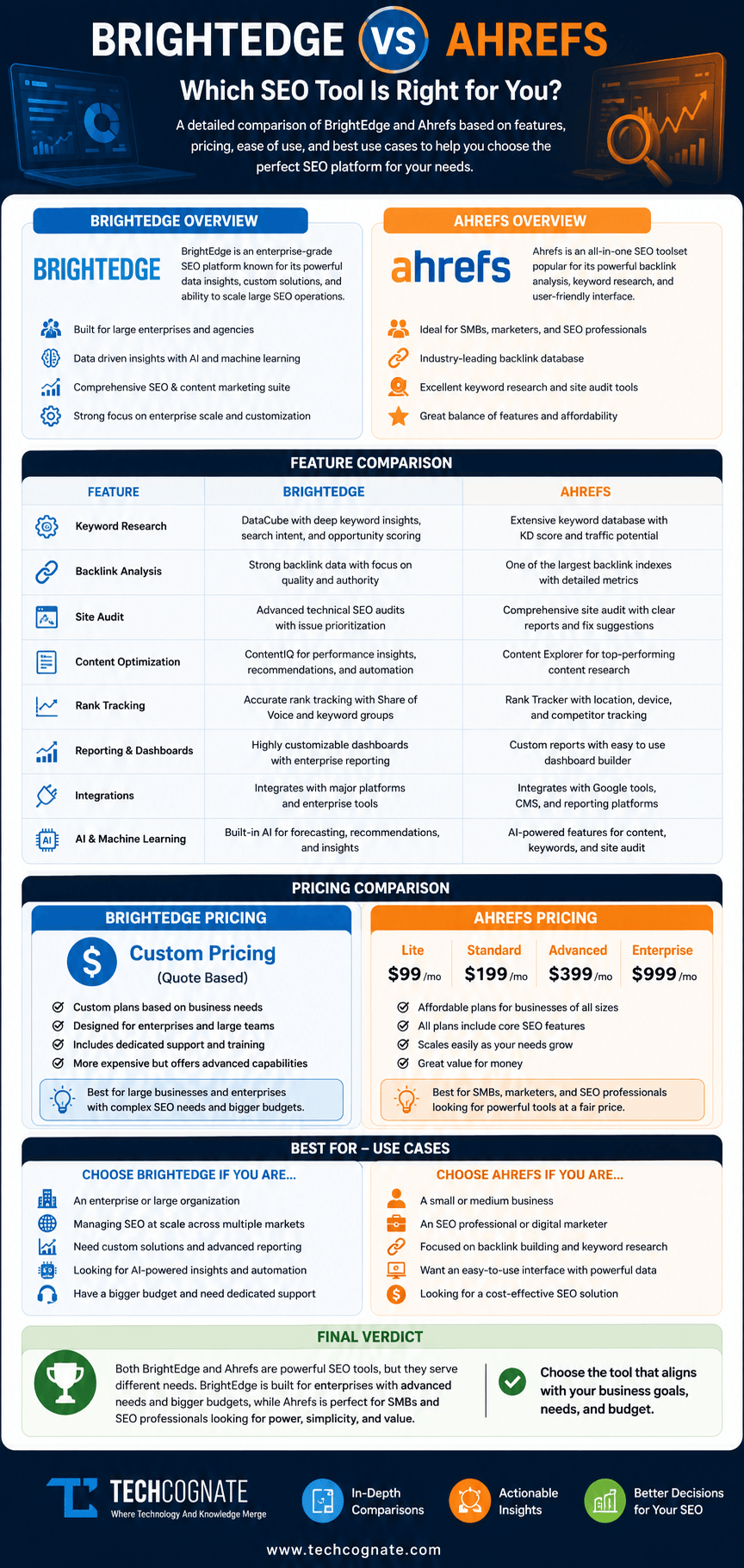
BrightEdge vs Ahrefs at a glance — save or share this summary.
What Is BrightEdge?
⚡ Quick answer: BrightEdge is an enterprise SEO and content performance platform, founded in 2007, built around its proprietary Data Cube and a deep-learning engine called DataMind. It’s used by roughly 8,500+ brands, including a majority of the Fortune 100, and is best known for AI-driven recommendations, technical site audits at massive scale, and white-glove customer support.
BrightEdge has been around since 2007, which in SEO-platform years makes it practically ancient — and that’s a compliment. It was one of the first platforms to treat SEO as a board-level data problem instead of a checklist of on-page tweaks, and that DNA still shows in how the product is built today.
The company is headquartered in Foster City, California, and has built its business almost entirely around large organizations. BrightEdge serves more than 8,500 brands, including a majority of the Fortune 100, ten of the top ten largest online retailers, and nine of the top ten hotel groups. Companies like Adobe, Marriott, Dell, 3M, and Microsoft have all run SEO programs through it at various points. That customer list tells you exactly who this platform is built for.
The Core Engine: Data Cube
Data Cube is BrightEdge’s flagship feature, and it’s genuinely the reason most enterprise teams sign the contract in the first place. It’s a massive, proprietary search dataset that lets you analyze entire domains, individual URLs, or single keywords to surface ranking opportunities, SERP feature ownership, and competitive gaps. The newer version, Data Cube X, extends that same dataset into AI Overviews and generative search, so you can see how your brand shows up in Google’s AI-generated answers, not just the traditional blue links.
What makes Data Cube different from a typical keyword tool isn’t raw size — it’s the way the data is pre-organized around your actual site structure. You’re not just pulling a list of keywords; you’re seeing keyword opportunities mapped against the pages you already own, which is exactly what a content team managing 50,000 URLs needs.
ContentIQ: Technical SEO at Enterprise Scale
ContentIQ is BrightEdge’s site auditing engine, and it’s built to crawl websites with millions of pages — including JavaScript-heavy single-page apps and progressive web apps that trip up lighter-weight crawlers. You can run scheduled crawls, segment issues by page group, and track a composite health score over time. For a site with 200 pages, this is overkill. For a site with 2 million product pages, it’s close to mandatory.
Autopilot and Instant
Autopilot is BrightEdge’s automation layer — it’s designed to implement technical optimizations (think page speed and schema markup) without waiting on an engineering sprint. In practice, it works best on well-templated sites where the same fix can be applied across thousands of pages at once. BrightEdge Instant delivers real-time keyword and trend data across more than 37,000 locations, which is the feature multi-location retailers and franchise brands lean on hardest.
AI Features: DataMind, Copilot, and AI HyperCube
BrightEdge’s AI engine, DataMind, has been powering recommendations since 2015 — long before “AI SEO” became a marketing term every vendor slapped on a landing page. Copilot generates content briefs and draft content in roughly a minute, pulling from BrightEdge’s existing search and competitive data. AI HyperCube is the newer addition built specifically for Answer Engine Optimization — it maps your brand’s presence across the AI discovery lifecycle and benchmarks you against competitors on AI citation share.
Major Customers
BrightEdge’s customer base skews heavily toward large, recognizable brands: think Fortune 100 retailers, hospitality groups, and B2B technology companies with global footprints. If you’ve worked in enterprise marketing for any length of time, you’ve probably sat in a room with someone running BrightEdge.
BrightEdge Strengths
BrightEdge Weaknesses
💡 Pro tip: If a BrightEdge sales rep tells you pricing is “customized to your needs,” that’s not a brush-off — it’s genuinely how the platform is sold. Come to that call with your domain count, keyword volume, and the specific modules (DataMind, ContentIQ, Instant) you actually need, or you’ll end up paying for capacity you’ll never use.
See how BrightEdge handles enterprise-scale SEO firsthand.
What Is Ahrefs?
⚡ Quick answer: Ahrefs is a self-serve SEO toolkit founded in 2010 in Singapore, built around one of the largest backlink indexes in the industry (35 trillion+ known links) and a keyword database that now exceeds 110 billion terms across 217 locations. It’s best known for Site Explorer, Keywords Explorer, and — as of 2026 — Brand Radar, its AI visibility tracking add-on.
Ahrefs started as a backlink checker, and if you’ve been doing SEO for more than a few years, that’s probably still how you think of it first. But the platform has expanded enormously since 2010, and in 2026 it’s a full SEO suite: keyword research, technical site audits, rank tracking, content research, and — most recently — AI search visibility tracking through Brand Radar.
What’s stayed consistent the entire time is the philosophy: give the user enormous amounts of raw, accurate data and largely get out of the way. Ahrefs doesn’t assign you a customer success manager or build you an executive dashboard. It hands you Site Explorer and trusts you to know what to do with it.
Backlink Database
This is still Ahrefs’ core strength and the reason most SEOs keep a subscription active even when they’re using other tools for everything else. The backlink index sits north of 35 trillion known links, refreshed roughly every 15 to 30 minutes for actively crawled pages, and the crawler discovers around 10 million new pages a day. If link analysis is a meaningful part of your SEO workflow — competitive link audits, disavow work, digital PR measurement — nothing else on the market matches Ahrefs’ combination of depth and freshness.
Keywords Explorer
Keywords Explorer pulls from a keyword database that’s grown past 110 billion terms across 217 countries and ten search engines, including YouTube, Amazon, Bing, and Baidu. You get search volume, keyword difficulty, traffic potential, clicks-per-search, and parent topic groupings — the standard metric set, executed at serious scale. The keyword difficulty score is backlink-weighted, which is useful but worth knowing: it tells you how hard a keyword is to rank for based on link profiles, not necessarily based on content quality or search intent alignment.
Site Explorer
Site Explorer is where most people live day-to-day. Drop in any domain or URL and you get organic traffic estimates, full backlink profiles with historical data, top pages by traffic, keyword rankings, and referring domain analysis — all built around Ahrefs’ own Domain Rating (DR) and URL Rating (UR) metrics. It’s the fastest way I know to size up a competitor in under five minutes.
Site Audit
Site Audit is Ahrefs’ technical SEO crawler. It’s fast, reasonably comprehensive, and — as of the 2026 updates — includes “Always-on Audits” with a real-time activity feed and AI-generated explanations for why a given issue matters. It also added a Patches feature that auto-fixes things like meta tags without needing a developer to push code, which is a meaningful time-saver on large sites. It’s not built to handle the multi-million-page scale that ContentIQ targets, but for the vast majority of sites under a few hundred thousand pages, it’s plenty.
Rank Tracker
Rank Tracker does what you’d expect — daily position tracking, SERP feature monitoring, and now AI Overview presence tracking baked into the base product. Project limits and tracked-keyword caps scale with your plan tier, which is the main lever that pushes growing teams from Lite up to Standard or Advanced.
Content Explorer
Content Explorer is essentially a search engine for content performance — type in a topic and you get every page in Ahrefs’ multi-billion-page content index sorted by organic traffic, referring domains, or social shares. It’s genuinely useful for finding content gaps, identifying broken pages with strong backlink profiles (classic broken-link-building targets), and scouting which authors or publications dominate a given topic.
AI Updates: Brand Radar
Brand Radar, Ahrefs’ newest major feature, tracks how a brand shows up across six AI platforms — ChatGPT, Gemini, Perplexity, Copilot, Google AI Overviews, and AI Mode — using a database of real, search-backed prompts rather than synthetic ones. It’s a genuinely useful addition, but it’s priced as a separate add-on ($199/month per platform index, or $699/month for all six) on top of your base subscription, and independent reviewers have flagged accuracy gaps in ChatGPT and Perplexity tracking specifically. Treat it as directional intelligence, not ground truth, and you’ll get real value out of it.
Ahrefs Strengths
Ahrefs Limitations
💰 Worth the money? If link data and keyword research are core to your workflow, yes — Ahrefs is close to a category standard. If you need Ahrefs primarily for AI visibility tracking, the Brand Radar add-on cost stacks up fast ($828–$1,148/month for full six-platform coverage), and you may get better accuracy from a dedicated AI-tracking tool at a similar price.
See the keyword and backlink data yourself, starting at $29/month.
BrightEdge vs Ahrefs: Core Differences
⚡ Quick answer: The core difference is philosophy: BrightEdge is a managed enterprise platform that comes with strategic support and is sold to solve organizational SEO problems. Ahrefs is a self-serve SEO toolkit that hands you industry-leading data and trusts you to build the strategy yourself.
Every comparison article will tell you BrightEdge is “enterprise” and Ahrefs is “for everyone else.” That’s technically true, but it undersells what’s actually different about how these two platforms are built and sold.
BrightEdge is sold the way enterprise software is always sold: a sales process, a custom quote, an onboarding period, a dedicated customer success manager, and quarterly business reviews. You’re not just buying software — you’re buying a relationship with a vendor that has skin in the game for your SEO outcomes. That shows up in the product itself: dashboards are built to be shown to a CMO, not just an SEO analyst, and the AI recommendations are designed to be “prioritized actions” rather than raw data dumps you have to interpret yourself.
Ahrefs is sold the way most SaaS tools are sold: self-serve signup, published pricing, no sales call required until you hit Enterprise. The product reflects that too — it’s built for someone who already knows SEO and wants the fastest path to good data. There’s no one holding your hand through a quarterly roadmap, and there’s no executive dashboard generator baked in. You get Site Explorer, Keywords Explorer, and Rank Tracker, and it’s on you to turn that into a strategy.
A Real-World Example
Picture two companies evaluating both tools in the same week.
The first is a Fortune 500 retailer with 40,000 product pages across 12 regional domains, a content team of 15, and a CMO who wants a monthly SEO performance readout tied to revenue. For this team, BrightEdge’s Data Cube X, multi-domain support, and StoryBuilder reporting solve real organizational problems — the platform is built around exactly this use case, and the dedicated CSM relationship pays for itself in saved internal headcount.
The second is a 12-person SaaS company with one marketing site, a lean content team, and a need to win backlinks and rank for competitive B2B keywords. For this team, BrightEdge would be enormous overkill — they’d be paying enterprise pricing for multi-domain and local-SEO features they’ll never touch. Ahrefs’ Site Explorer and Keywords Explorer get them the competitive intelligence they actually need at a fraction of the cost, with a UI their two-person SEO team can be productive in by the end of the week.
🎯 Best for… BrightEdge: large, multi-domain organizations that need to justify SEO spend to a C-suite and want strategic support bundled in. Ahrefs: agencies, SaaS companies, and lean in-house teams that already know SEO and want the best raw data at a transparent price.
Feature-by-Feature Comparison
This is the meat of the guide. I’m going through every category that actually moves the needle on a buying decision, with a clear winner (or honest tie) for each one. For each feature, I’ll give you the practical difference, not just a list of bullet points pulled from a spec sheet.
Keyword Research
Both platforms can find keywords. The difference is in database size, how the data is organized around your site, and how much manual digging it takes to get to an actionable list.
| BrightEdge | Ahrefs |
| Data Cube ties keyword opportunities directly to your existing page groups, which speeds up prioritization for large content teams managing thousands of URLs. | Keywords Explorer draws from a 110B+ term database across 217 locations, with deeper international and multi-search-engine coverage (including YouTube, Amazon, and Bing). |
Best use case: Use Ahrefs when you need maximum keyword coverage and international depth. Use BrightEdge when you need keyword opportunities pre-mapped to specific page groups across a large site.
“I’ve never found a keyword Ahrefs couldn’t find. But for a 50,000-page enterprise site, Data Cube’s page-group mapping saves real hours that raw database size doesn’t replace.”
Backlink Analysis
This isn’t close. Backlink data is Ahrefs’ founding feature and the reason most SEOs keep a license active no matter what else they’re using.
| BrightEdge | Ahrefs |
| Limited backlink reporting; not a core focus of the platform, and most BrightEdge customers pair it with a dedicated link tool. | 35 trillion+ known links, refreshed every 15-30 minutes on actively crawled pages, with up to 5 years of historical data on higher tiers. |
Best use case: Any workflow involving link audits, disavow files, digital PR measurement, or competitive link gap analysis.
“If link building or link auditing is part of your job, you need Ahrefs (or a comparable link tool) regardless of what else you’re running. This isn’t a debate.”
Technical SEO
Both platforms crawl sites and flag technical issues, but they’re optimized for different scales of problem.
| BrightEdge | Ahrefs |
| ContentIQ is purpose-built for enterprise scale — millions of pages, JS-heavy SPAs, and PWAs, with crawls segmented by page group. | Site Audit is fast, developer-friendly, and now includes Patches (auto-fix meta tags without a dev ticket) and AI-generated explanations for why issues matter. |
Best use case: BrightEdge for multi-million-page enterprise sites; Ahrefs for everything from small sites up through a few hundred thousand pages.
“Don’t pay for ContentIQ’s scale if you don’t need it. Most mid-market sites are well served by Ahrefs Site Audit, and the Patches feature alone saves real developer time.”
Rank Tracking
Both tools track rankings reliably, including AI Overview presence as of 2026. The real differences show up in location granularity and reporting polish.
| BrightEdge | Ahrefs |
| BrightEdge Instant delivers real-time tracking across 37,000+ locations, which is a meaningful edge for multi-location retail and franchise brands. | Unlimited tracked keywords on Standard and above, with SERP feature and AI Overview tracking built into the base Rank Tracker product. |
Best use case: BrightEdge for hyper-local, multi-location tracking at scale; Ahrefs for straightforward, unlimited keyword tracking without local-market complexity.
“For a single-location business, this category is a wash. For a 500-store retail chain, BrightEdge Instant’s location depth genuinely matters.”
Content Optimization
This is one of BrightEdge’s stronger categories. ContentIQ and Copilot work together to generate prioritized, AI-driven content recommendations rather than a static checklist.
| BrightEdge | Ahrefs |
| AI-prioritized content recommendations tied to business outcomes; Copilot generates content briefs and drafts in roughly a minute. | AI Content Helper grades content against top-ranking pages, detects multiple search intents per keyword, and color-codes subtopic coverage — strong, but more manual to act on. |
Best use case: BrightEdge for teams that want recommendations automatically prioritized by likely business impact; Ahrefs for teams that want raw competitive content data and prefer to build their own prioritization logic.
“Ahrefs’ AI Content Helper is a genuinely good grading tool, but BrightEdge’s recommendations feel more like a finished strategy and less like a homework assignment.”
AI SEO
Both companies have made AI search visibility a flagship 2026 priority, approaching it from different angles.
| BrightEdge | Ahrefs |
| Data Cube X and AI HyperCube track brand presence in Google AI Overviews and map the full AI discovery lifecycle, integrated natively into the core platform. | Brand Radar tracks visibility across six AI platforms (ChatGPT, Gemini, Perplexity, Copilot, Google AI Overviews, AI Mode) using 320M+ real search-backed prompts, sold as a separate add-on. |
Best use case: BrightEdge for Google AI Overview tracking bundled into your core platform cost; Ahrefs Brand Radar for the broadest multi-platform AI coverage if you’re willing to pay for the add-on.
“Brand Radar covers more AI platforms, but independent reviews flag real accuracy gaps in its ChatGPT and Perplexity data. BrightEdge’s AI tracking is narrower (Google-centric) but more tightly integrated with the rest of your SEO data.”
Entity SEO
Entity SEO — optimizing for how search engines and AI models understand the relationships between topics, brands, and concepts — is an emerging category for both platforms.
| BrightEdge | Ahrefs |
| DataMind’s deep-learning foundation naturally surfaces topical and entity relationships within Data Cube’s keyword clustering. | Keyword clustering groups by semantic similarity and SERP overlap, which approximates entity relationships but isn’t a dedicated entity-mapping feature. |
Best use case: Large content teams building topical authority across hundreds of related pages.
“Neither platform has a true “entity graph” feature the way some specialized tools do. This category will likely matter more in 2027 than it does today for either platform.”
Competitive Research
Both platforms let you benchmark against named competitors, but the framing is different — BrightEdge talks in Share of Voice, Ahrefs talks in keyword and content gaps.
| BrightEdge | Ahrefs |
| Share of Voice reporting is frequently cited by users as the most accurate they’ve used, especially useful for visualizing market position to non-SEO stakeholders. | Content Gap and Competing Domains reports surface keyword and backlink opportunities competitors are capturing that you aren’t. |
Best use case: BrightEdge Share of Voice for executive-facing competitive positioning; Ahrefs Content Gap for tactical, page-level opportunity hunting.
“I’d genuinely keep both running side by side here if budget allowed — they answer different questions well.”
SERP Analysis
Understanding what’s actually showing up on the results page — SERP features, ranking volatility, and AI Overview presence — matters more every year.
| BrightEdge | Ahrefs |
| Tracks SERP feature ownership at scale across BrightEdge Instant’s location network. | Keywords Explorer shows top-ranking pages, backlink counts, domain strength, position history, and SERP volatility in a single view. |
Best use case: Quick competitive SERP snapshots before committing content resources to a keyword.
“Ahrefs’ SERP overview inside Keywords Explorer is one of the fastest ways in the industry to size up ranking difficulty before you write a word of content.”
Link Building
Closely related to backlink analysis, but specifically about finding and prioritizing new link opportunities.
| BrightEdge | Ahrefs |
| Not a core workflow; BrightEdge customers typically use a dedicated outreach or link-building tool alongside it. | Link Intersect finds sites linking to multiple competitors but not you; Content Explorer surfaces broken-link-building targets with strong existing authority. |
Best use case: Any active link-building or digital PR program.
“This category leans so heavily on backlink data that it’s really an extension of the backlink analysis comparison above. Ahrefs wins by a wide margin.”
Keyword Gap Analysis
Finding keywords competitors rank for that you don’t is a staple SEO workflow, and both platforms handle it, with different visualization styles.
| BrightEdge | Ahrefs |
| Data Cube’s competitive views surface gaps mapped against your existing page groups. | Content Gap tool is purpose-built for this exact workflow and is one of the most-used features among working SEOs. |
Best use case: Quarterly content planning sessions where you need a fast list of gap opportunities ranked by traffic potential.
“Ahrefs’ Content Gap tool is simple, fast, and exactly the right shape for this specific task.”
Site Audit
Already covered under Technical SEO above, but worth calling out separately given how often it’s the deciding factor for technical SEO-heavy teams.
| BrightEdge | Ahrefs |
| ContentIQ scales to multi-million-page crawls with JS rendering and accessibility checks built in. | Site Audit’s Always-on Audits and Patches feature reduce the manual cleanup burden for mid-sized sites. |
Best use case: See Technical SEO above — the deciding factor is your page count, not feature depth.
“Don’t let a vendor talk you into ContentIQ’s enterprise scale if your site doesn’t need it; you’ll pay for crawl capacity that sits idle.”
Core Web Vitals
Both platforms surface Core Web Vitals data, but neither is a substitute for a dedicated performance tool like PageSpeed Insights or a real-user-monitoring solution.
| BrightEdge | Ahrefs |
| Autopilot can implement certain page-speed fixes automatically across templated pages without an engineering ticket. | Site Audit reports Core Web Vitals issues but relies on you (or your dev team) to implement fixes manually. |
Best use case: Large, templated sites where the same performance fix needs to roll out across thousands of pages at once.
“Autopilot’s automated implementation is a genuine time-saver here, assuming your site is templated enough for it to work cleanly.”
Content Performance
Tracking how published content actually performs over time — not just where it ranks, but how it contributes to traffic and revenue.
| BrightEdge | Ahrefs |
| Page Reporting ties content performance directly to business outcomes, a workflow several enterprise reviewers specifically praise. | Site Explorer’s Top Pages and organic traffic reports show performance trends but stop short of revenue attribution. |
Best use case: Teams that need to report content ROI in revenue terms to non-SEO stakeholders.
“This is where BrightEdge’s “enterprise platform” positioning earns its keep — closing the loop from content change to business outcome is genuinely harder to do manually in Ahrefs.”
Reporting
How easily can you turn platform data into something a non-SEO stakeholder will actually read?
| BrightEdge | Ahrefs |
| StoryBuilder is purpose-built for this — narrative, executive-ready dashboards that translate Share of Voice and Page Reporting into business language. | Looker Studio connectors (Advanced and Enterprise plans) let you build custom dashboards, but you’re doing the translation work yourself. |
Best use case: Quarterly business reviews and board-level SEO reporting.
“If you regularly have to justify SEO budget to a CMO or CFO, StoryBuilder alone might be worth the price difference.”
Dashboards
Day-to-day working dashboards, as distinct from formal executive reporting above.
| BrightEdge | Ahrefs |
| Highly customizable, though several reviewers note the dashboard UI can feel cluttered without deliberate configuration. | Clean, fast Overview dashboards in Site Explorer and Rank Tracker — less customizable, but easier to scan at a glance. |
Best use case: BrightEdge once configured properly; Ahrefs out of the box.
“BrightEdge’s dashboards are more powerful once tuned, but Ahrefs’ defaults are usable from day one with zero setup.”
Automation
How much of the optimization work can the platform actually do without a human pushing every button?
| BrightEdge | Ahrefs |
| Autopilot implements certain technical fixes directly; Copilot drafts content automatically based on briefs. | Patches auto-fixes meta tag issues; Always-on Audits flag and explain issues as they happen, but implementation is still manual. |
Best use case: Large, templated sites with limited engineering bandwidth.
“BrightEdge goes further toward true automation, though several user reviews note Autopilot reliability issues worth testing carefully in a pilot before full rollout.”
Workflow Management
Managing content and SEO tasks across a team, with approvals and accountability built in.
| BrightEdge | Ahrefs |
| Built-in workflow and content modules, though some reviewers find the contractor/external-collaborator experience clunky. | Portfolios (Standard+) help organize multiple sites and projects, but Ahrefs isn’t built as a task-management tool. |
Best use case: Large in-house teams managing approvals across multiple content owners.
“Neither platform replaces a dedicated project management tool, but BrightEdge goes further toward supporting structured editorial workflows.”
User Permissions
Granular access control matters more as team size and stakeholder count grow.
| BrightEdge | Ahrefs |
| Enterprise-grade permission structures built for large, multi-team organizations with varying access needs. | Seat-based access scales with plan tier; SSO and Audit Log are Enterprise-only. |
Best use case: Large organizations with distinct content, engineering, and leadership stakeholders needing different access levels.
“Smaller teams won’t notice much difference here. Large, multi-department organizations will appreciate BrightEdge’s more granular controls.”
API
Programmatic access to platform data for custom reporting or internal tool-building.
| BrightEdge | Ahrefs |
| Connect API exists but is typically gated behind enterprise contracts, with less public documentation than Ahrefs. | Usage-based API included starting at Standard (150,000 units/month), with a 2026-launched MCP Server enabling AI assistants to query SEO data directly. |
Best use case: Teams building custom internal dashboards or automating SEO data pulls into other systems.
“Ahrefs’ API is more accessible and better documented at lower price tiers. The new MCP Server is a genuinely forward-looking addition for teams already working with AI coding assistants.”
Integrations
How well each platform connects to the rest of your marketing and analytics stack.
| BrightEdge | Ahrefs |
| Integrates with GA4, Adobe Analytics, Google Search Console, and a small catalog of analytics partners — reviewers note the integration catalog feels limited for an enterprise tool. | GA4, GSC, Looker Studio, and a broader self-serve integration ecosystem, including Zapier-style connections for smaller teams. |
Best use case: Teams that want to plug SEO data into an existing marketing stack without heavy custom development.
“Surprising given BrightEdge’s enterprise focus, but Ahrefs’ integration catalog is genuinely broader and easier to self-serve.”
Local SEO
Tracking and optimizing visibility across many physical locations or franchise markets.
| BrightEdge | Ahrefs |
| BrightEdge Instant is purpose-built for this — 37,000+ locations, designed for multi-location retail and franchise brands. | Rank Tracker supports location-based tracking, but it’s not built with the same multi-location depth. |
Best use case: Retail chains, franchise brands, and any business managing visibility across dozens or hundreds of physical locations.
“If local SEO at scale is core to your business, this category alone can justify BrightEdge’s price premium.”
International SEO
Managing SEO across multiple countries, languages, and search engines.
| BrightEdge | Ahrefs |
| Multi-domain and multi-region support is built into the enterprise architecture, with dedicated reporting per market. | 217 locations and 10 search engines in the keyword database, including Yandex and Baidu, give genuinely global keyword coverage. |
Best use case: BrightEdge for managing the operational complexity of many regional domains under one organization; Ahrefs for raw international keyword research depth.
“Both platforms take international SEO seriously, just from different angles — operational management versus raw data coverage.”
Enterprise SEO
The catch-all category: scalability, governance, and fit for large, complex organizations.
| BrightEdge | Ahrefs |
| Purpose-built for this exact use case from the ground up — this is BrightEdge’s whole reason for existing. | Enterprise tier adds SSO, audit logs, unlimited seats, and custom limits, but the platform’s DNA is still self-serve. |
Best use case: Large, multi-stakeholder organizations with complex complex governance and reporting needs.
“This is the category BrightEdge was built to win, and it does.”
Agency Features
Managing SEO across many client accounts, with white-label or client-facing reporting needs.
| BrightEdge | Ahrefs |
| Not a primary use case; BrightEdge’s pricing and onboarding model don’t fit most agency client-portfolio workflows. | Portfolios, Batch Analysis, and tiered project limits (5 to 50+ projects) are explicitly built around managing multiple client sites. |
Best use case: Agencies managing 5 to 50+ client accounts that need fast, repeatable reporting.
“I haven’t met an agency running BrightEdge as its primary tool, and the product isn’t really built for that workflow.”
Content Marketing (Platform-Level)
Beyond keyword research — supporting the full editorial process from topic research through publication.
| BrightEdge | Ahrefs |
| ContentIQ, Copilot, and the content workflow modules form a more complete editorial system end to end. | Content Explorer and AI Content Helper support research and grading, but editorial workflow itself isn’t a core feature. |
Best use case: Large content teams that want one platform covering research, briefs, optimization, and performance tracking.
“Ahrefs gives you better raw research tools; BrightEdge gives you more of the actual content production workflow.”
Ease of Use
How quickly a new team member can become productive in the platform.
| BrightEdge | Ahrefs |
| Reviewers consistently describe a steep learning curve — the breadth of tools and menus can overwhelm new or infrequent users. | Cleaner, more intuitive interface; most users report becoming productive within days. |
Best use case: Lean teams that don’t have bandwidth for formal platform training.
“This is one of the most consistent findings across every review platform I checked — Ahrefs is simply easier to pick up.”
Learning Curve
Closely tied to ease of use, but specifically about time-to-proficiency for power features.
| BrightEdge | Ahrefs |
| Often requires formal onboarding (roughly two months for full enterprise deployment) and certification programs to use effectively. | Most power features (Content Gap, Batch Analysis, Brand Radar) are learnable through in-product guidance and the free Ahrefs Academy. |
Best use case: Teams without dedicated SEO training budget or time.
“BrightEdge’s learning curve is real, but it’s somewhat offset by the dedicated CSM relationship that comes with enterprise contracts.”
Customer Support
What happens when something breaks or you need strategic guidance, not just a help article.
| BrightEdge | Ahrefs |
| Dedicated Customer Success Manager, bi-weekly strategy syncs, and a large (80+ person) global success team — consistently the single most-praised aspect of BrightEdge across review platforms. | Standard support channels (help docs, email/chat support); no dedicated account manager outside Enterprise. |
Best use case: Teams that want strategic guidance bundled into their SEO tooling, not just software.
“Even BrightEdge’s harshest critics tend to praise the support team. This is the single most consistent strength across every review I read.”
Training
Formal education resources for getting a team up to speed.
| BrightEdge | Ahrefs |
| Certification programs and structured onboarding are part of the standard enterprise deployment. | Ahrefs Academy offers free, well-regarded video courses covering the full platform. |
Best use case: BrightEdge for guided, white-glove onboarding; Ahrefs Academy for self-paced learning at no extra cost.
“Both are genuinely good; the difference is whether you want a person walking you through it or a free course library.”
Documentation
Self-service help resources for day-to-day questions.
| BrightEdge | Ahrefs |
| Documentation exists but is less extensive and less frequently cited by users compared to Ahrefs’ resources. | Extensive, well-maintained help center plus a highly regarded public blog that doubles as ongoing SEO education. |
Best use case: Self-directed troubleshooting without waiting on a support ticket.
“Ahrefs’ blog and documentation are genuinely some of the best educational SEO content on the internet, full stop — independent of the tool itself.”
Community
Peer support, user groups, and shared knowledge outside official vendor channels.
| BrightEdge | Ahrefs |
| Smaller public community footprint, partly a function of its enterprise, NDA-heavy customer base. | Large, active community across SEO Twitter/X, Reddit, and independent SEO forums, given its dominant mid-market and agency user base. |
Best use case: Crowd-sourced troubleshooting and staying current on platform changes.
“You’ll find ten times more public discussion, tips, and workaround threads about Ahrefs than BrightEdge — simply a function of user base size.”
Security
Data handling, access controls, and compliance posture for the platform itself.
| BrightEdge | Ahrefs |
| Enterprise-grade security practices expected at this customer tier, including SSO support for large deployments. | SSO and Audit Log are available on Enterprise; standard security practices on lower tiers. |
Best use case: Both are appropriate for handling standard business SEO data; neither processes especially sensitive data by nature of the product.
“Security posture is roughly comparable once you’re on each platform’s top tier — the gap shows up more in lower Ahrefs tiers lacking SSO.”
Compliance
Whether each vendor can meet the procurement and compliance requirements large organizations typically require.
| BrightEdge | Ahrefs |
| Built around enterprise procurement processes from the outset — vendor security reviews, custom contracts, and SLAs are standard practice. | Enterprise tier supports the typical large-organization procurement requirements, though this is a newer muscle for a historically self-serve product. |
Best use case: Highly regulated industries or organizations with strict vendor compliance requirements.
“If your legal and procurement teams need extensive vendor documentation, BrightEdge’s enterprise sales process is built to handle that from day one.”
Scalability
How well each platform holds up as your site, team, and data needs grow dramatically.
| BrightEdge | Ahrefs |
| Built from the ground up for multi-million-page, multi-domain, multi-region scale. | Scales well up through large mid-market and agency use cases; Enterprise tier extends further, but it’s not the platform’s original design center. |
Best use case: Organizations that already know they’ll need multi-domain, multi-region scale within the next year or two.
“If you’re choosing a platform you expect to outgrow Ahrefs’ upper tiers within 18 months, it may be worth starting the BrightEdge conversation now rather than migrating later.”
AI Capabilities Comparison
⚡ Quick answer: BrightEdge integrates AI more deeply into core workflows (automated recommendations, content generation, technical fixes), while Ahrefs has added AI as a layered set of features on top of its existing data — most notably Brand Radar for AI search visibility, sold as a separate add-on.
Generative AI and Content Generation
BrightEdge Copilot generates content briefs and full drafts in roughly a minute, pulling directly from the platform’s existing competitive and search intent data. Ahrefs’ AI Content Helper takes a different approach — it grades your draft against top-ranking pages and color-codes subtopic coverage rather than generating content outright. If you want a tool that writes a starting draft for you, BrightEdge’s approach goes further. If you want a tool that makes your own writing sharper, Ahrefs’ grading-first approach fits better.
Content Briefs
Both platforms generate content briefs, but BrightEdge’s are more automated and tied to Data Cube’s keyword and intent data, while Ahrefs leans on Content Explorer and Keywords Explorer data that you assemble more manually into a brief format.
AI Recommendations and Predictive SEO
This is where BrightEdge’s “prioritized actions” framing really shows up. DataMind doesn’t just hand you data — it ranks recommendations by likely business impact, which is the single feature enterprise reviewers cite most often as the reason they stay. Ahrefs doesn’t have a direct equivalent; its AI features (like AI Detector and intent classification) are analytical rather than prescriptive.
SEO Copilot Features
BrightEdge’s Copilot is explicitly positioned as an “intelligent assistant” baked into the core workflow — generating localized briefs and surfacing intent signals automatically. Ahrefs doesn’t currently have a direct Copilot-style assistant; its AI features are more modular and tool-specific.
Automation
Autopilot is BrightEdge’s clearest automation win — implementing certain technical fixes (page speed, schema) directly without an engineering ticket. Ahrefs’ Patches feature does something similar for meta tags specifically, but the scope is narrower. For broader automated implementation, BrightEdge currently goes further, with the caveat that several user reviews flag Autopilot reliability issues worth testing in a pilot first.
Entity Optimization and Topical Authority
Neither platform has a dedicated, named “entity graph” feature as of 2026. Both approximate entity and topical relationships through keyword clustering (Ahrefs) and DataMind’s semantic understanding (BrightEdge). This is a category likely to mature significantly on both platforms over the next year or two as AI search makes entity relationships more commercially important.
Future Roadmap
Both companies are investing heavily and publicly in AI search visibility — BrightEdge through Data Cube X and AI HyperCube, Ahrefs through Brand Radar and its new MCP Server for AI assistant integration. Expect both platforms’ AI feature sets to look meaningfully different a year from now, which is worth keeping in mind if you’re locking into a multi-year BrightEdge contract today.
⚠️ Common mistake: Treating either platform’s AI visibility data as ground truth. Both BrightEdge’s AI HyperCube and Ahrefs’ Brand Radar are modeled, sampled estimates of how AI engines respond to prompts — useful for spotting trends, risky to use as the sole input for a major strategic decision.
Enterprise SEO Comparison
⚡ Quick answer: For large organizations, BrightEdge wins on workflow approvals, executive dashboards, and dedicated support. Ahrefs Enterprise narrows the gap on access controls and data limits, but still lacks the strategic-partner layer BrightEdge bundles into every enterprise contract.
Large Organizations
If your organization has more than a handful of stakeholders touching SEO data — content, engineering, product, and marketing leadership all wanting visibility — BrightEdge’s platform architecture is simply built for that reality in a way Ahrefs, fundamentally a self-serve toolkit, is not.
Workflow Approvals
BrightEdge’s content and workflow modules support multi-stage approval processes natively, though a few reviewers note the experience can get clunky when working with external contractors. Ahrefs has no comparable native approval workflow — you’d need a separate project management tool layered on top.
Executive Dashboards
StoryBuilder is the clear differentiator here. It’s purpose-built to turn technical SEO metrics into a narrative a CMO or CFO will actually engage with, tying SEO performance to revenue and traffic outcomes. Ahrefs’ Looker Studio connectors (Advanced and Enterprise) can get you most of the way there, but you’re building the narrative yourself rather than starting from a pre-built executive template.
User Permissions and Collaboration
BrightEdge’s permission structure is built for organizations with dozens of distinct stakeholders needing different access levels. Ahrefs’ seat-based model (1 to 10+ seats depending on tier, unlimited on Enterprise) is simpler and works fine for smaller teams, but doesn’t offer the same granularity for large, multi-department organizations.
Enterprise Integrations
BrightEdge integrates with GA4, Adobe Analytics, and Google Search Console — solid, but a narrower catalog than you might expect for an enterprise platform. Ahrefs’ integration ecosystem, while built for a different (more self-serve) audience, is actually broader, which is worth knowing if you have a lot of existing marketing stack tooling you need to connect.
Scalability
Already covered above, but worth repeating in this context: BrightEdge is purpose-built for multi-domain, multi-region scale. If you’re a genuine enterprise organization, this category alone often justifies the price gap.
Content Marketing Comparison
⚡ Quick answer: BrightEdge offers a more complete end-to-end content workflow — research, briefs, optimization, and performance tracking in one system. Ahrefs offers stronger standalone research tools (Content Explorer, AI Content Helper) but expects you to manage the editorial workflow elsewhere.
Content Optimization
Already covered in detail above. BrightEdge’s automated, prioritized recommendations edge out Ahrefs’ more manual, grading-first approach for teams that want a faster path from data to published content.
Topic Research
Ahrefs’ Content Explorer is arguably the better pure research tool — searching a multi-billion-page index by topic, sorted by traffic, referring domains, or social shares, makes it fast to spot content gaps and high-performing formats in any niche.
Content Scoring
Ahrefs’ AI Content Helper grades drafts against top-ranking competitors with genuinely useful subtopic-level color-coding. BrightEdge’s ContentIQ scoring is more focused on technical health than on-page content quality scoring specifically.
Keyword Recommendations
Both platforms surface keyword recommendations well, with BrightEdge’s tied more directly to existing page groups and Ahrefs’ offering broader raw coverage through Keywords Explorer.
Content Briefs
Covered above under AI Capabilities — BrightEdge’s Copilot-generated briefs are faster to produce; Ahrefs requires more manual assembly from Keywords Explorer and Content Explorer data.
Editorial Workflow
BrightEdge’s built-in workflow modules support a more complete editorial process inside the platform itself. Most Ahrefs users manage editorial workflow in a separate tool (Asana, Notion, or similar) and pull data from Ahrefs as an input rather than a system of record.
Performance Tracking
BrightEdge’s Page Reporting closes the loop from content change to business outcome more directly than anything in Ahrefs, which is a meaningful advantage for content teams who need to prove ROI.
Pricing Comparison
⚡ Quick answer: Ahrefs publishes transparent pricing from $29/month (Starter) up to $1,499/month (Enterprise). BrightEdge does not publish pricing at all — expect a custom quote, with industry benchmarks suggesting roughly $30,000/year for SMB-scale deployments and $127,000+/year for enterprise deployments, before negotiation.
BrightEdge Pricing
BrightEdge has never published a public pricing page, and that’s not going to change. Pricing is quote-based, tied to the number of domains, tracked keywords, user seats, and which modules (DataMind, ContentIQ, Instant) you license. Contracts typically run 12 to 36 months with annual prepayment common.
Industry pricing benchmarks based on real contract data put average SMB-tier BrightEdge spend around $29,800/year, with enterprise-tier spend averaging roughly $127,000/year. Some reviewers cite annual contracts well above $55,000 even at mid-market scale. BrightEdge’s credit-based pricing model (one credit per keyword per SERP) is worth scrutinizing closely if you’re tracking keywords across many countries — costs can climb quickly for global brands.
Ahrefs Pricing
| Plan | Monthly Price | Annual (per mo.) | Best For |
|---|---|---|---|
| Starter | $29/mo | — | Light research, no rank tracking |
| Lite | $129/mo | $108/mo | Solo SEOs, up to 5 projects |
| Standard | $249/mo | $208/mo | Agencies, content teams, up to 20 projects |
| Advanced | $449/mo | $374/mo | Larger teams, 50 projects, Looker Studio |
| Enterprise | From $1,499/mo | Custom | SSO, API, unlimited seats, audit logs |
Ahrefs raised prices roughly 30% in 2023 and has held rates steady since, while adding the new $29/month Starter tier in January 2026 to lower the entry barrier. Annual billing saves about 16.67% across all tiers. Watch for add-on costs: Brand Radar runs $199 to $699/month depending on AI platform coverage, AI Content Helper is $99/month (or $299/month for the higher-volume Content Kit), and API access beyond what’s bundled into your plan can cost an additional $500 to $10,000/month depending on usage.
Hidden Costs
Enterprise Pricing and Negotiation
Both platforms’ enterprise tiers are negotiable. BrightEdge sales teams respond well to structured deals backed by competitive market data — coming in with a clear sense of comparable Conductor or seoClarity quotes gives you real leverage. Ahrefs Enterprise pricing (from $1,499/month) is also negotiable for multi-year commitments, and buyers frequently report pricing below list when bundling seats or committing to longer terms.
ROI and Value
The honest answer on ROI depends entirely on whether you’ll actually use what you’re paying for. I’ve seen BrightEdge deliver clear ROI for enterprise teams that lean hard into StoryBuilder reporting and Autopilot automation — and I’ve seen the exact same contract value sit mostly unused at companies that bought it for the brand name and never trained the team properly. Ahrefs’ ROI math is more straightforward because the price-to-data ratio is so transparent: you know exactly what you’re paying for backlink and keyword data, and that data holds its value whether or not you use every feature.
💵 Budget under $500/month: Ahrefs Standard ($249/mo) or Advanced ($449/mo) will cover the vast majority of mid-market and agency SEO needs. BrightEdge isn’t realistically available at this budget.
💵 Budget over $2,000/month: This is BrightEdge territory, or Ahrefs Enterprise plus Brand Radar’s full six-platform coverage. At this spend level, the deciding factor is whether you need BrightEdge’s managed-platform support or Ahrefs’ raw data depth with more team autonomy.
Ready to see the data for yourself?
Pros and Cons
Pulled together from everything above, here’s the condensed scorecard for each platform.
BrightEdge Pros and Cons
| Pros | Cons |
| ✓Best-in-class customer success and dedicated CSM support | ✕Pricing is opaque and consistently described as expensive |
| ✓StoryBuilder turns SEO data into executive-ready reporting | ✕Steep learning curve; often needs formal onboarding |
| ✓ContentIQ scales to multi-million-page enterprise crawls | ✕Some flagship features (Autopilot, forecasting) have reported bugs |
| ✓Strong multi-location and multi-region support (37,000+ locations) | ✕Backlink data is not a core strength |
| ✓Automated, prioritized AI recommendations (DataMind) | ✕Long onboarding — full deployment can take ~2 months |
| ✓Deep AI Overview / AI search tracking via Data Cube X | ✕Limited integration catalog relative to its enterprise positioning |
Ahrefs Pros and Cons
| Pros | Cons |
| ✓Largest, freshest backlink database in the industry (35T+ links) | ✕No dedicated account manager outside Enterprise |
| ✓Massive keyword database (110B+ terms, 217 locations) | ✕Lower tiers run on a credit system that’s easy to burn through |
| ✓Transparent, published pricing from $29 to $1,499+/month | ✕No free trial as of 2026 |
| ✓Fast, intuitive UI; productive within days | ✕API access requires Enterprise or a separate paid add-on |
| ✓Strong agency-friendly features (Portfolios, Batch Analysis) | ✕Brand Radar AI accuracy is inconsistent across platforms |
| ✓No long-term contract required on self-serve tiers | ✕Less built-in support for executive-level reporting |
Who Should Choose BrightEdge?
⚡ Quick answer: Choose BrightEdge if you’re a large, multi-domain enterprise with a dedicated SEO team, a need for executive-ready reporting, and a budget that supports custom enterprise pricing — typically $30,000 to $130,000+ per year.
BrightEdge makes the most sense for:
🚫 Avoid if… You’re a small or mid-market business, a solo SEO, or a team without budget above roughly $30,000/year for SEO tooling alone. BrightEdge’s pricing, onboarding time, and feature breadth will be wasted on a smaller operation.
Who Should Choose Ahrefs?
⚡ Quick answer: Choose Ahrefs if you’re an agency, a growing SaaS company, an ecommerce brand, or an in-house team that wants best-in-class backlink and keyword data at a transparent, scalable price without a long sales cycle.
Ahrefs makes the most sense for:
🚫 Avoid if… You’re a large, multi-domain enterprise that needs dedicated account management, executive-ready reporting built for you, or complex multi-stakeholder workflow approvals — Ahrefs will require you to build a lot of that scaffolding yourself.
Best Alternatives
BrightEdge and Ahrefs aren’t the only two options on the table. Here’s how the next tier of SEO platforms stacks up, in case neither of these is quite the right fit.
Semrush →
Best for: Teams that want an all-in-one marketing suite covering SEO, PPC, and social in one subscription.
Strengths: Broadest feature set of any major SEO platform; strong competitive PPC and advertising research alongside organic SEO.
Weaknesses: Can feel like a jack-of-all-trades; some users report the SEO-specific tools are slightly less deep than Ahrefs’ dedicated equivalents.
Pricing: Pro starts at $139/month, roughly matching Ahrefs Lite.
Moz Pro →
Best for: Teams that want a simpler, more beginner-friendly interface and pioneered SEO metrics.
Strengths: Domain Authority is a widely recognized (if imperfect) metric; genuinely approachable for SEO beginners; strong community resources.
Weaknesses: Smaller backlink index than Ahrefs; fewer enterprise-grade features.
Pricing: Starts at $49/month.
SE Ranking →
Best for: Budget-conscious teams that want an all-in-one platform with white-label reporting included.
Strengths: Strong value for the price; includes AI search tracking across ChatGPT, Perplexity, and Google AI at no extra cost; offers a 14-day free trial.
Weaknesses: Smaller brand recognition and community than Ahrefs or Semrush; data depth doesn’t quite match Ahrefs at the top end.
Pricing: Starts around $103/month.
Mangools →
Best for: Solo SEOs and very small teams on a tight budget who need core keyword and rank tracking tools.
Strengths: Extremely affordable and genuinely easy to use; clean, simple interface.
Weaknesses: Narrower toolset overall; not built for agency or enterprise scale.
Pricing: Among the most affordable options in the category.
Conductor
Best for: Enterprise teams evaluating BrightEdge who want a comparable managed-platform experience.
Strengths: Strong content intelligence and competitive benchmarking; positioned similarly to BrightEdge in the enterprise market.
Weaknesses: Similarly opaque, custom-quoted pricing; comparable learning curve to BrightEdge.
Pricing: Custom enterprise pricing, comparable to BrightEdge.
seoClarity
Best for: Enterprise teams that want an AI-driven alternative to BrightEdge with a comparable feature set.
Strengths: Clarity AI is a direct analog to BrightEdge’s DataMind; strong technical SEO and content optimization tools.
Weaknesses: Same enterprise pricing opacity and learning curve trade-offs as BrightEdge.
Pricing: Custom enterprise pricing, module-based like BrightEdge.
Surfer SEO →
Best for: Content teams that want best-in-class, fast on-page content optimization without a full SEO suite.
Strengths: Excellent content editor with real-time optimization scoring; fast and genuinely loved by content writers.
Weaknesses: Not a full SEO platform — no real backlink analysis, technical auditing, or rank tracking depth.
Pricing: Plans typically start in the $89–$129/month range.
Screaming Frog
Best for: Technical SEOs who want a powerful, one-time-purchase desktop crawler for site audits.
Strengths: Extremely thorough technical crawling; widely considered an industry standard for manual technical audits.
Weaknesses: Desktop software, not a cloud platform; no keyword research, backlink data, or rank tracking.
Pricing: Free for crawls under 500 URLs; paid license is a flat annual fee, not a subscription tier.
Google Search Console
Best for: Every website owner, regardless of budget — this should be running alongside whatever paid tool you choose.
Strengths: Free, direct-from-Google data on impressions, clicks, and indexing status; no substitute for this even at the enterprise level.
Weaknesses: No competitor data, no keyword research beyond your own site, limited historical data window.
Pricing: Free.
Real-World Use Cases
Feature tables only tell part of the story. Here’s how this decision actually plays out across five common scenarios I’ve seen repeatedly over the years.
Scenario 1: Enterprise Ecommerce
A national ecommerce retailer with 80,000 product pages across three regional domains, a 10-person SEO and content team, and quarterly board reporting requirements.
This is closer to BrightEdge’s design center than almost any other scenario. ContentIQ can handle the page volume, Data Cube X tracks AI Overview presence across product categories, and StoryBuilder turns SEO performance into the kind of revenue-framed reporting a retail board actually wants to see. The multi-domain support also matters here in a way it wouldn’t for a single-site business.
the scale and reporting needs align almost perfectly with what the platform is built for.
Scenario 2: Marketing Agency
A 25-person digital marketing agency managing SEO for 18 client accounts, ranging from local businesses to mid-market B2B companies, with client-facing monthly reporting.
BrightEdge’s pricing model and onboarding process simply don’t fit an agency managing many smaller client accounts. Ahrefs’ Portfolios feature and tiered project limits (Standard’s 20 projects, Advanced’s 50) are explicitly built for exactly this workflow, and the Looker Studio connectors on Advanced make client reporting straightforward.
purpose-built for multi-client agency workflows at a price point that scales with the agency’s own growth.
Scenario 3: Local Business
A regional HVAC company with one website, a handful of service-area pages, and a marketing budget under $1,000/month total.
Neither platform’s top tiers fit here, but if we’re choosing between the two, it isn’t close. Ahrefs Lite at $129/month (or even Starter at $29/month for very light research) covers the keyword research and rank tracking a local service business actually needs. BrightEdge’s pricing floor alone rules it out.
and honestly, a tool like SE Ranking or Mangools might be an even better fit at this budget level.
Scenario 4: SaaS Startup
A Series A SaaS company with one marketing site, competitive B2B keywords, and a lean two-person growth marketing team trying to build topical authority fast.
This team needs to move fast, understand competitor backlink strategies, and find content gaps without spending weeks in onboarding. Ahrefs’ Content Explorer and Content Gap tools are exactly the right shape for this kind of aggressive, resource-constrained content strategy, and the transparent pricing means no budget surprises as the team scales.
speed, transparent pricing, and best-in-class competitive research win for a lean, fast-moving team.
Scenario 5: Fortune 500 Company
A global consumer brand with dozens of regional domains, an internal SEO team of 20+, dedicated engineering resources, and a CMO who needs quarterly SEO ROI reporting tied to revenue.
This is the textbook BrightEdge buyer. The multi-region, multi-domain architecture, the dedicated CSM relationship, and StoryBuilder’s executive reporting solve real organizational problems at this scale that Ahrefs simply wasn’t built to address. The price premium is justified by the scale of the operation it’s supporting.
at true Fortune 500 scale, the managed-platform model pays for itself.
Migration Considerations
⚡ Quick answer: Migrating to BrightEdge typically takes about two months and involves a structured onboarding process with a dedicated CSM. Migrating to Ahrefs is largely self-serve and can be operational within a day, though rebuilding historical rank-tracking data takes a few weeks to accumulate.
Switching to BrightEdge
Expect a structured sales and onboarding process. After signing, BrightEdge’s enterprise deployment typically takes around two months to fully configure — connecting your domains, setting up page groups, integrating GA4 and Adobe Analytics, and configuring StoryBuilder dashboards. Your dedicated CSM will run this process with you, which is part of what you’re paying for, but it does mean you shouldn’t expect to be fully operational on day one.
Switching to Ahrefs
This is largely self-serve. You can sign up, verify your site, and start pulling Site Explorer and Keywords Explorer data within minutes. The one piece that takes genuine time is Rank Tracker — position history only starts accumulating from the day you add a keyword, so if you’re switching from another platform, budget a few weeks before you have meaningful trend data inside Ahrefs.
Data Migration
Neither platform offers a clean, automated “import your history from Competitor X” tool. In practice, most teams export historical rank and traffic data from their old platform as CSVs for reference, while letting both new platforms start building fresh historical data from the switch date forward.
Training
BrightEdge bundles structured onboarding and certification programs into enterprise contracts — budget time for your team to actually attend these sessions, since the platform’s learning curve is real. Ahrefs Academy is free and self-paced; budget a few hours per team member in the first two weeks to get comfortable with the core tools.
Costs
BrightEdge migration costs are mostly time, not additional fees — onboarding is typically included in the enterprise contract. Ahrefs migration has effectively no direct cost beyond the subscription itself, though you may want to budget for overlap with your previous tool for a month or two to validate data consistency before fully cutting over.
Timeline
| Stage | BrightEdge | Ahrefs |
|---|---|---|
| Sign-up to first login | 1–3 weeks (sales process) | Same day |
| Core setup complete | 4–8 weeks | 1–2 days |
| Team trained and productive | 8–10 weeks | 1–2 weeks |
| Full historical data available | Varies by data import scope | Builds from day 1 forward |
Common Mistakes
Expert Buying Advice
Here’s the condensed version of advice I’d actually give a client in a 30-minute call, organized by the situation you’re most likely in.
| Situation | Recommendation |
|---|---|
| Budget under $500/month | Ahrefs Lite or Standard. BrightEdge isn’t realistically available at this price point. |
| Budget over $2,000/month | Either platform’s top tier becomes viable here — the decision shifts from “can I afford it” to “do I need managed support (BrightEdge) or raw data depth (Ahrefs Enterprise + Brand Radar).” |
| Agency | Ahrefs Standard or Advanced, built around Portfolios and Batch Analysis for multi-client management. |
| Enterprise | BrightEdge, if you have the budget and a genuine multi-domain, multi-stakeholder reporting need. Otherwise Ahrefs Enterprise. |
| Local SEO | BrightEdge Instant if you’re managing dozens or hundreds of locations; Ahrefs Rank Tracker location tags for simpler single-location needs. |
| Content team | BrightEdge for automated, prioritized content recommendations; Ahrefs Content Explorer plus AI Content Helper for research-driven teams that prefer to build their own process. |
| Technical SEO | Ahrefs Site Audit for most sites; BrightEdge ContentIQ specifically for multi-million-page enterprise crawls. |
| Link building | Ahrefs, without question — this isn’t BrightEdge’s strength. |
| International SEO | Ahrefs for raw international keyword and search engine coverage; BrightEdge for managing the operational complexity of many regional domains under one org. |
Final Verdict
⚡ Quick answer: Neither platform is universally “better.” BrightEdge wins for large enterprises that need managed support and executive reporting. Ahrefs wins for everyone else who wants transparent pricing and best-in-class keyword and backlink data. The right choice depends entirely on your organization’s size, budget, and how much strategic hand-holding you actually want.
After putting both platforms through their paces across dozens of client engagements, here’s where I’ve landed: this isn’t really a “which tool is better” question. It’s a “which tool matches how your organization actually operates” question, and the honest answer changes depending on company size, internal SEO expertise, and whether you need software or a software-plus-strategic-partner relationship.
BrightEdge earns its premium price tag for large, multi-domain enterprises that need to report SEO performance to a board, manage hundreds of local markets, or coordinate dozens of stakeholders across content, engineering, and leadership. The dedicated CSM relationship and StoryBuilder reporting genuinely solve organizational problems that no amount of raw data access fixes on its own.
Ahrefs earns its place as close to a default recommendation for everyone else — agencies, SaaS companies, ecommerce brands, and lean in-house teams who already understand SEO and want the best data available at a price that scales sensibly with the business. The backlink and keyword database depth alone justifies the subscription for most working SEOs, independent of anything else the platform does.
Decision Matrix
| Your Situation | Recommended Platform |
|---|---|
| Fortune 500 or large multi-domain enterprise | BrightEdge |
| Mid-market business with a lean SEO team | Ahrefs |
| Marketing or SEO agency | Ahrefs |
| Multi-location retail or franchise brand | BrightEdge (for local SEO depth) or Ahrefs (for budget) |
| SaaS company under $10M ARR | Ahrefs |
| Need link-building or backlink analysis as a core workflow | Ahrefs |
| Need board-level, revenue-framed SEO reporting | BrightEdge |
| Limited internal SEO expertise, want a managed partner | BrightEdge |
| Experienced in-house SEO team, want maximum data control | Ahrefs |
✅ Bottom line: If you’re still unsure after reading this whole guide, that’s usually a sign your budget — not your feature requirements — should make the call. Under roughly $30,000/year in available SEO tooling budget, go with Ahrefs. Above that, with a genuine enterprise reporting and support need, BrightEdge becomes worth a serious look.
Ready to see the data for yourself?
Frequently Asked Questions
Quick, direct answers to the questions I get asked most often when clients are deciding between these two platforms.
Q. Is BrightEdge better than Ahrefs?
Neither is universally better — they solve different problems. BrightEdge is better for large enterprises needing managed support and executive reporting. Ahrefs is better for agencies, SaaS companies, and in-house teams that want transparent pricing and best-in-class keyword and backlink data.
Q. Which tool has better keyword research?
Ahrefs has the larger raw database (110B+ keywords across 217 locations), while BrightEdge’s Data Cube ties keyword opportunities more directly to your existing site structure. For sheer data volume and international coverage, Ahrefs wins.
Q. Which has better backlink data?
Ahrefs, by a wide margin. Its 35 trillion-plus link index, refreshed every 15 to 30 minutes, is one of the largest and freshest in the industry. Backlink analysis isn’t a core BrightEdge strength.
Q. Which is better for enterprise SEO?
BrightEdge. It’s purpose-built for multi-domain, multi-region organizations with executive reporting and dedicated support needs that Ahrefs doesn’t directly address.
Q. Can agencies use BrightEdge?
Technically yes, but it’s not built for typical agency workflows managing many smaller client accounts. BrightEdge’s pricing model and onboarding process fit single large organizations better than multi-client agency portfolios.
Q. Is Ahrefs enough for enterprise SEO?
For many mid-market and even some large organizations, yes — especially on the Enterprise tier with SSO and API access. But for true Fortune 500-scale multi-domain operations needing executive reporting and dedicated support, BrightEdge’s purpose-built enterprise architecture goes further.
Q. Does BrightEdge include AI?
Yes — extensively. DataMind powers AI-driven recommendations, Copilot generates content briefs and drafts, Autopilot automates certain technical fixes, and Data Cube X / AI HyperCube track AI Overview and AI search visibility.
Q. Which tool offers better reporting?
BrightEdge, specifically for executive and board-level reporting through StoryBuilder. Ahrefs offers solid working dashboards and Looker Studio connectors on Advanced and Enterprise plans, but expects you to build the executive narrative yourself.
Q. Which is easier to learn?
Ahrefs. Reviewers consistently describe a faster learning curve and more intuitive interface, with most users becoming productive within days rather than weeks.
Q. Which has better customer support?
BrightEdge, decisively. The dedicated Customer Success Manager relationship is the single most consistently praised aspect of the platform across nearly every review I’ve read, even from otherwise critical reviewers.
Q. Which has better ROI?
It depends on whether you’ll actually use what you’re paying for. Ahrefs’ ROI math is more straightforward given its transparent, lower price point. BrightEdge can deliver strong ROI for enterprise teams that fully utilize StoryBuilder and Autopilot, but underused contracts are a real risk given the price tag.
Q. Which platform scales better?
BrightEdge scales further for true enterprise complexity — multi-domain, multi-region, thousands of stakeholders. Ahrefs scales well through large mid-market and agency use, with its Enterprise tier extending further, but multi-domain enterprise architecture isn’t its original design center.
Q. Which tool is best for ecommerce?
Depends on scale. A large, multi-region ecommerce enterprise benefits from BrightEdge’s ContentIQ and multi-domain support. A mid-market or growing ecommerce brand is typically better served by Ahrefs’ more affordable, data-rich toolkit.
Q. Which is better for SaaS?
Ahrefs, for most SaaS companies. Backlink authority and competitive keyword research — both Ahrefs strengths — are usually more central to SaaS SEO strategy than the multi-location or multi-domain features BrightEdge specializes in.
Q. Can you use both together?
Some enterprise teams do, typically running BrightEdge as the primary platform for reporting and content workflow while keeping an Ahrefs subscription active specifically for its superior backlink data. It’s not unusual, though it does mean paying for two tools.
Q. How much does BrightEdge cost?
BrightEdge doesn’t publish pricing. Based on industry benchmarks, SMB-tier deployments average around $29,800/year and enterprise-tier deployments average around $127,000/year, though actual contracts vary widely based on domains, keywords tracked, and modules licensed.
Q. How much does Ahrefs cost?
Ahrefs publishes pricing from $29/month (Starter) up to $1,499+/month (Enterprise), with Lite, Standard, and Advanced tiers in between at $129, $249, and $449/month respectively. Annual billing saves about 16.67%.
Q. Does Ahrefs offer a free trial?
No. As of 2026, Ahrefs does not offer a traditional free trial. The lowest-cost way to test the platform is the $29/month Starter plan, or the free Ahrefs Webmaster Tools for your own verified site.
Q. Does BrightEdge offer a free trial or demo?
BrightEdge doesn’t offer a public self-serve free trial; you’ll typically need to request a demo through their sales team, which is consistent with its enterprise, quote-based sales model.
Q. What is BrightEdge’s Data Cube?
Data Cube is BrightEdge’s proprietary search dataset and flagship feature, letting users analyze domains, URLs, or keywords for ranking opportunities and competitive gaps. Data Cube X extends this into AI Overview and generative search visibility.
Q. What is Ahrefs’ Brand Radar?
Brand Radar is Ahrefs’ AI visibility tracking add-on, monitoring brand mentions across six AI platforms (ChatGPT, Gemini, Perplexity, Copilot, Google AI Overviews, and AI Mode) using real, search-backed prompts. It’s priced separately from the base Ahrefs subscription.
Q. Is BrightEdge good for local SEO?
Yes — BrightEdge Instant delivers real-time keyword and trend data across more than 37,000 locations, making it one of the strongest options on the market for multi-location retail and franchise SEO.
Q. Does Ahrefs have an API?
Yes. Ahrefs offers a usage-based API included starting at the Standard plan (150,000 units/month), with higher allocations on Advanced and Enterprise. A new MCP Server, launched in 2026, also lets AI assistants query Ahrefs data directly.
Q. What’s the biggest difference between BrightEdge and Ahrefs?
Philosophy. BrightEdge is a managed enterprise platform sold with dedicated strategic support. Ahrefs is a self-serve SEO toolkit that hands you industry-leading data and expects you to build the strategy yourself.
Q. Which tool is better for technical SEO audits?
It depends on site scale. BrightEdge’s ContentIQ is built for multi-million-page enterprise crawls. Ahrefs’ Site Audit is faster and more developer-friendly for the vast majority of sites under a few hundred thousand pages.
Q. Can small businesses use BrightEdge?
Technically yes, but it’s generally not a good fit. BrightEdge’s pricing floor, onboarding time, and feature breadth are built for large organizations, and most small businesses get far better ROI from a tool like Ahrefs, SE Ranking, or Mangools.
Q. Is BrightEdge worth the price?
For the right buyer — a large, multi-domain enterprise that will actually use StoryBuilder, ContentIQ, and Autopilot — yes. For a smaller team buying it for the brand name without a plan to use the full platform, the ROI is much harder to justify.
Q. How long does it take to onboard each platform?
BrightEdge enterprise deployments typically take around two months for full configuration. Ahrefs is largely self-serve and operational within a day, though Rank Tracker historical data takes a few weeks to accumulate from scratch.
Q. Which platform has better AI Overview tracking?
Both track AI Overview presence, but from different angles. BrightEdge’s Data Cube X is tightly integrated with the rest of your SEO data. Ahrefs’ Brand Radar covers more AI platforms (six, versus BrightEdge’s Google-centric focus) but has documented accuracy gaps on some platforms.
Q. Should I switch from BrightEdge to Ahrefs, or vice versa?
Only if your organization’s needs have genuinely changed — outgrowing Ahrefs’ self-serve model as you scale into true enterprise complexity, or finding BrightEdge’s enterprise overhead unjustified after downsizing. Switching either direction involves real onboarding time, so don’t do it on price alone without confirming the feature fit has actually changed.
Disclosure: TechCognate may earn a commission when you purchase through links on this page, at no additional cost to you. Our comparisons are based on independent research, published vendor documentation, and hands-on platform experience — never on which vendor pays the highest commission.

Jaykishan Panchal
Founder, TechCognate · SEO Strategist & WordPress Expert
Jaykishan Panchal is the founder of TechCognate and an SEO strategist with 15+ years of hands-on experience driving organic growth for businesses worldwide. He specialises in technical SEO, content strategy and GEO (Generative Engine Optimisation), helping brands stay visible in both traditional search and AI-driven discovery.
- Technical SEO
- Content Strategy
- AI & GEO
- Google Ads
- E-Commerce SEO