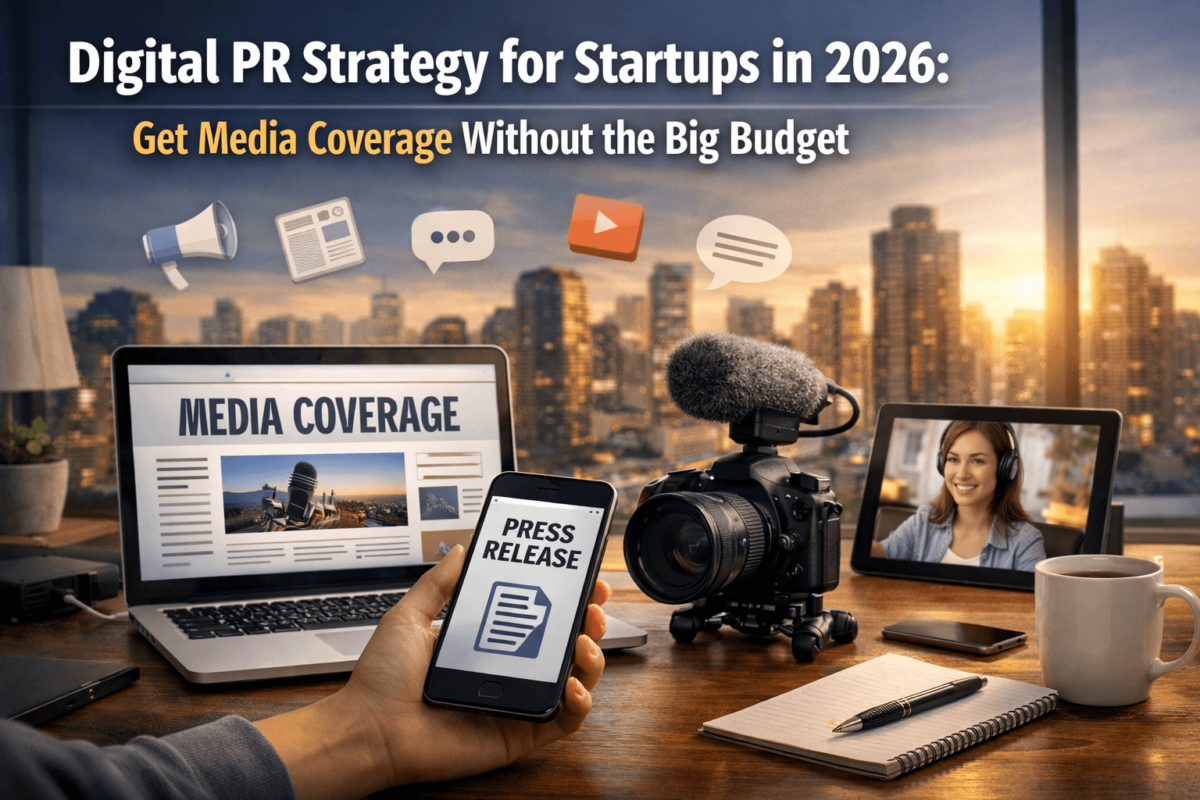
Most startups think PR is something you do after you ‘make it.’ That’s backwards.
Here’s the reality: the startups that get traction early — before the funding rounds, before the product launches, before any of the fancy stuff — are the ones who figured out how to get talked about. Not just by anyone. By the right people, in the right places.
And no, you don’t need a $10,000/month PR agency to pull it off.
This guide is for founders who are building something real and need people to know about it. It’s practical. It’s honest. And it’s based on what’s actually working in 2026 — not the PR playbook from five years ago.
Let’s get into it.
What Digital PR Actually Is (And Why You’re Probably Thinking About It Wrong)
Quick definition, because this matters: digital PR is about earning online visibility through editorial mentions, backlinks, features, podcast appearances, and social proof — not paying for ads or sponsored posts.
It’s PR that lives on the internet. And unlike traditional PR, it has an SEO benefit on top of the brand credibility. When a respected site links to you, Google notices. Your domain authority grows. People find you. That’s compounding value over time.
Here’s what nobody tells you about PR for startups:
- It’s not about press releases. Nobody cares about your press release.
- It’s not about landing TechCrunch on day one. That’s a vanity goal for most startups.
- It’s not about ‘going viral.’ That’s luck. Strategy is what you build.
What it actually is? Relationship-building. Storytelling. Being consistently useful to people who write, speak, and create content in your space.
A mention from a niche newsletter with 8,000 hyper-relevant subscribers will do more for your business than a passing mention in a Forbes roundup that no one from your market reads.
Build Your PR Foundation Before You Pitch Anything
Before you send a single pitch email, you need to get three things in order. Skip this, and you’re going to waste a lot of time getting ignored.
Know Your Story — Really Know It
What’s your origin? What problem are you solving? Why now? Why you? Journalists ask these questions. If your answers are vague or corporate-sounding, you’re done before you start.
Write a one-paragraph startup story that sounds like a human being wrote it. Test it: read it out loud. If it sounds like a LinkedIn post, rewrite it.
Nail Your Positioning
Who are you for? Journalists love specificity. ‘We help small businesses’ is weak. ‘We help independent restaurant owners in Tier-2 cities manage supplier invoices without accounting software’ — that’s a story.
Create a Simple PR Kit
You don’t need a fancy press kit. You need:
- A clean one-paragraph company description
- Founder bio (50 words, not your LinkedIn summary)
- High-resolution logo and founder headshot
- 2–3 key stats or milestones you can actually share
- A direct contact email
Keep it on a simple page or a shared Google Drive folder. When a journalist asks for more info, you can send it in 30 seconds.
Use a tool like Notion or a basic website page for your press kit. It looks professional and it’s free.
Start Small — Niche Media Is Your Best Friend
Here’s where most founders go wrong: they aim for the top-tier press from day one. TechCrunch. Forbes. Wired. It’s not that those are bad goals — it’s that they’re not realistic early on, and chasing them makes you ignore the coverage that can actually move the needle.
Niche media — industry newsletters, vertical blogs, community podcasts — reaches the exact people you want to reach. And they’re infinitely easier to get into.
How to Find Niche Media in Your Space
- Search ‘[your industry] newsletter’ on Substack and Beehiiv
- Look at what your target customers actually read — ask them directly
- Search podcasts on Spotify or Apple Podcasts with keywords from your niche
- Check who your competitors have been featured in (use a backlink checker like Ahrefs or Semrush)
One founder I know runs a B2B SaaS for logistics companies. She skipped all the big tech blogs and went straight to FreightWaves and a handful of supply chain newsletters. Three features later, she had 400 trial signups in a week. None of those publications have millions of readers. But the readers they have? Perfect fit.
Set up Google Alerts for your niche keywords. When you see who’s writing about your space regularly, those are your people to build relationships with.
HARO, Qwoted, and Media Request Platforms — How to Use Them Right
If you haven’t heard of HARO (Help a Reporter Out), it’s a platform where journalists post requests for sources — and you respond as an expert. It’s free, and it works. But most people use it badly.
Note: HARO was acquired and rebranded under Cision. The platform has evolved, and there are now solid alternatives including Qwoted, SourceBottle, and Featured.com. The concept is the same: journalists need sources, you provide them.
The Right Way to Respond to Media Requests
Most HARO responses get ignored because they’re too long, too generic, or too slow. Here’s the formula that actually works:
📝 The Winning Response Formula
- Subject line: Lead with your credibility. ‘SaaS Founder with 3 years in [niche] — Source for [Topic]’
- First line: One sentence that directly answers their question.
- Middle: 2–3 sentences of context or evidence. Data helps.
- End: Your name, title, company, and a link to your website or LinkedIn.
- Length: Keep it under 200 words. That’s it.
Journalists are on deadline and they’re reading dozens of pitches. The shorter and more useful you are, the better.
Seriously. One founder I worked with landed 3 backlinks in a single month just by replying to journalist requests within the first hour of receiving them. Speed matters almost as much as quality.
You’ll get ignored a lot. That’s normal. A 10–20% hit rate on well-crafted responses is actually solid. Don’t quit after five tries.
Founder-Led PR: Your Face Is Your Brand
In 2026, personal branding isn’t optional for startup founders. It’s one of the highest-leverage PR activities you can do — and it costs nothing but time.
When journalists write about your space, they want to quote real people. When podcasts need guests, they look for founders who have something to say. When newsletters feature interesting voices, they link to individuals, not just companies.
This is founder-led PR. And it’s one of the most underused tools in the startup toolkit.
Where to Build Your Founder Brand
- LinkedIn: Consistent, honest posts about what you’re building, what you’re learning, and what you’ve gotten wrong. Vulnerability + insight = traction.
- X (Twitter): Great for real-time takes on your industry. Build in public. Share what you know.
- Substack/Newsletter: Write a newsletter in your niche. Even 200 subscribers can get you on journalists’ radars.
- Podcast guesting: Pitch yourself to shows in your space. Even small shows build credibility and often come with backlinks.
What to Actually Post About
Here’s the thing — you don’t need to post about your product all the time. In fact, don’t. Talk about the industry. Share data. Give takes. Tell stories. People follow founders who teach them something, not founders who constantly pitch them.
One rule that works: for every post about your startup, make five posts about your industry or the problems your customers face. That ratio builds trust. Trust builds an audience. An audience gets you media coverage.
Take your best LinkedIn post from the past month and turn it into a pitch to a relevant newsletter. ‘I wrote something my audience loved about [topic] — would this be a fit for your readers?’ That’s a warm pitch.
The Data-Driven Story: Your Shortcut to Media Coverage
Here’s a PR secret that most agencies won’t tell you, because it would make their jobs too easy: journalists love data.
If you can create original data — from a survey, from your product, from customer interviews — you have something journalists can actually use. Unique data is a hook. It’s a reason to write about you.
How to Create Data Stories as a Startup
- Survey your audience. Even 50 responses can produce interesting insights. Tools like Typeform or Tally make this quick and cheap.
- Mine your product data. Are your users doing something surprising? Interesting usage patterns are stories.
- Run an industry poll on LinkedIn. Even 200 votes on a relevant question can give you something to write about and pitch.
- Partner with another startup to do a joint survey. You split the work, double the reach.
Let’s be realistic: you’re not going to make headlines with ‘We surveyed 50 people and here’s what we found.’ But you can make headlines in niche publications, newsletters, and community spaces. And that’s often more than enough.
One B2B startup I followed published a ‘State of [Industry]’ report based on 120 survey responses. It was nothing fancy. But it got picked up by two industry blogs, shared by a handful of LinkedIn influencers in their niche, and drove backlinks that improved their search rankings for months afterward.
Name your report something simple and searchable: ‘The 2026 State of [Your Industry] Report.’ Update it annually. After two editions, you’re the source people cite.
How to Actually Pitch Journalists (Without Being Annoying)
Most founder pitches fail because they’re written for the founder, not for the journalist. Let’s fix that.
Research Before You Pitch
Never pitch a journalist without reading their last 5–10 articles. Know their beat. Know what they like to cover. Know what they don’t. If they write about enterprise SaaS, don’t pitch them your consumer app.
This sounds obvious. Most people skip it anyway.
The Anatomy of a Good Pitch Email
Keep it under 7 words. Be specific. Make it about them, not you.
Reference their work. ‘Loved your piece on [X]’ — but only if it’s true.
Two sentences max. What’s the story? Why should their readers care?
What makes you a credible, interesting source? One sentence.
Clear and low-commitment. ‘Would you be open to a 15-minute call?’ or ‘Happy to send more if useful.’ Total pitch length: under 150 words.
Timing Matters
Pitch on Tuesday, Wednesday, or Thursday mornings. Monday journalists are catching up. Friday journalists are winding down. Never pitch a deadline-sensitive story on a Friday afternoon.
And if you don’t hear back in a week, one follow-up is fine. Just one.
Even a great pitch gets ignored sometimes. It’s not always personal. Journalists are busy, editors change direction, stories fall through. Build a list of 20–30 relevant contacts and pitch consistently over time.
Thought Leadership: Become the Person Journalists Quote
The long game in digital PR isn’t pitching — it’s becoming the person people call when they need a quote, a source, or an opinion on your industry.
That’s thought leadership. And in 2026, it’s more accessible than ever.
How to Build Thought Leadership From Scratch
- Pick one very specific topic you can speak to with genuine expertise
- Write about it consistently — blog posts, LinkedIn content, newsletter issues
- Guest post in industry publications, even small ones
- Comment thoughtfully on articles in your space (journalists notice this)
- Show up in community discussions — Slack groups, Reddit threads, Discord servers in your niche
If you’re thinking ‘this sounds like a lot’ — you’re not wrong. It takes time. But here’s the payoff: once you’re known as the person who knows your topic, PR comes to you. Journalists find your content, reach out, and ask for quotes. That’s when PR stops feeling like work.
One founder in the HR tech space spent six months writing detailed LinkedIn posts about hiring trends. Not about her product. About the market. Within a year, she was quoted in two major publications and invited onto four podcasts — without pitching a single one.
Tools like SparkToro can show you where your audience actually hangs out online — which podcasts they listen to, which websites they visit. Use that data to find the thought leadership venues that actually matter for your market.
AI-Assisted PR in 2026: What Actually Helps vs. What Wastes Your Time
AI has changed PR, and there are ways to use it that genuinely save time — and ways that make your pitches worse. Let’s be honest about both.
Where AI Helps
- Drafting pitch templates: AI is great at generating first drafts. Heavily personalize before sending.
- Research: Use AI tools to quickly summarize what a journalist covers or to identify relevant topics.
- Content creation: AI can help you turn survey data into a readable report faster.
- Media list building: AI-powered tools can surface relevant contacts faster than manual searches.
Where AI Hurts
- AI-generated pitches sound like AI. Journalists can tell. The generic, over-structured email that opens with ‘I hope this message finds you well’ gets deleted immediately.
- AI doesn’t know your story. It can write around it, but it can’t replace the authentic voice that makes a pitch worth reading.
Use AI as a starting point, not a shortcut. The founder who reads, edits, and personalizes an AI draft will always out-pitch the founder who sends it as-is.
This connects directly to how AI and human content work together in SEO — the principle is the same: AI drafts, humans make it real.
Tools like Prowly, Muck Rack, and Cision’s updated platform use AI to help with media list building and pitch optimization. They’re not cheap, but if you’re doing PR at any scale, they save hours. Prowly in particular has a solid entry-level plan worth looking at for bootstrapped founders.
Community-Led PR: The Channel Most Startups Ignore
Here’s one of the most underrated PR tactics in 2026: getting talked about inside communities.
Niche Slack groups. Discord servers. Facebook groups. Subreddits. Indie Hackers. Product Hunt communities. These aren’t traditional media — but they’re where your potential customers, early adopters, and future advocates actually hang out.
A positive mention inside a 500-person Slack group of startup CTOs can drive more qualified signups than a feature in a publication with 50,000 passive readers.
How to Build Community Presence (Without Being Spammy)
- Join communities where your target customers are active. Observe first.
- Contribute genuinely — answer questions, share resources, help people
- Mention your startup only when it’s directly relevant and helpful
- Ask for feedback, not promotion. ‘We built a tool for this exact problem — would love brutal feedback’ is very different from ‘Check out our product!’
The rule is simple: give more than you take. If you’re known in three or four niche communities as the person who genuinely helps, your startup naturally gets associated with that. That’s PR that money can’t buy.
And don’t underestimate Product Hunt. A well-executed Product Hunt launch — with a good story, community support, and a solid product — can generate hundreds of backlinks, trial signups, and media mentions in 24 hours. It’s not magic, but it works.
Before launching on Product Hunt, spend two weeks being active and helpful in the community. Your launch will perform significantly better if people already know your name.
Tools & Resources That Actually Help (Honest Takes)
Let’s talk about tools. This is where affiliate links usually show up in a suspiciously enthusiastic way. I’ll try to be more useful than that.
Media Database & Outreach Tools
Probably the best media database out there. Expensive, but if you’re serious about PR, it pays for itself. Search journalists by beat, see their recent work, track your pitches.
More affordable than Muck Rack, solid for startups just getting started with outreach. Good pitch management tools. Worth the trial.
For finding journalist email addresses. Free tier covers most early-stage needs. Pair it with a manual research process.
Cleaner interface than old HARO, with better filtering. Free for sources. A great starting point for media request monitoring.
Great for positioning yourself as an expert source. Journalists actively search for sources here.
More international coverage than others, useful if you’re not just targeting US media.
SEO & Backlink Research
Both are excellent for seeing who links to your competitors and identifying media opportunities. Semrush has a more accessible entry plan for bootstrapped founders.
Underrated tool for finding where your audience actually spends time online. Essential for targeting thought leadership efforts.
Content & Survey Tools
For creating surveys that generate data-driven PR stories. Tally has a generous free plan.
For organizing your PR outreach, tracking pitches, and building your press kit. Free and flexible.
One honest note: I didn’t want to pay for most of these tools when I first started. But after wasting hours manually searching for journalist contacts and following up with a spreadsheet, the time savings of a proper tool were obvious. Start with free tiers where possible, and upgrade when the volume justifies it.
Common Mistakes Startups Make With PR (And How to Avoid Them)
Let’s be real about what doesn’t work, because founders make these mistakes constantly.
PR is not a campaign. It’s not something you ‘do’ before a launch and then forget. The startups that get consistent coverage are the ones doing consistent outreach, content creation, and relationship-building — week after week.
Nobody wants to write about your product features. They want to write about problems, solutions, people, trends, and ideas. Your product can be part of that story, but it can’t be the whole story.
Pitching 50 generic journalists with a one-size-fits-all email is almost always worse than pitching 10 journalists with highly personalized, researched messages. Quality over quantity. Every time.
Getting ignored is part of the process. Seriously. Even experienced PR professionals get ignored constantly. The founders who get coverage are the ones who keep showing up, keep refining their pitches, and keep building relationships over time.
A gentle follow-up email after one week can double your response rate. Not spammy. Not aggressive. Just: ‘Hey, wanted to make sure this didn’t get buried — happy to chat if useful.’
Realistic timeframe for seeing real PR results: 3–6 months of consistent effort. Anyone promising faster results is probably selling you something.
Building a PR System That Runs Even When You’re Slammed
The problem with founder-led PR is that it competes with every other thing you’re trying to do. Product. Sales. Hiring. Support. PR gets deprioritized — and then you wonder why you’re invisible.
The fix is building a simple system so PR doesn’t require a ton of activation energy each week.
A Minimal PR System for Time-Strapped Founders
That’s roughly 90 minutes a week. Not nothing, but not overwhelming. Over three months, that’s consistent effort — and consistent effort beats sporadic intensity every time in PR.
Use a simple Notion board or Airtable to track: who you pitched, when, what the response was, and what follow-up is needed. Nothing fancy. Just enough to stay organized.
Batch your PR activities into blocks rather than trying to squeeze them into random gaps. Treat your Wednesday afternoon as ‘media time.’ Block it. Protect it.
Measuring What’s Actually Working
Don’t just send pitches into the void and hope for the best. Track what matters — and be realistic about what those metrics mean.
✅ Metrics Worth Tracking
- Media mentions: Use Google Alerts (free) or a tool like Mention to track when you’re written about.
- Backlinks earned: Check Ahrefs or Semrush monthly to see new backlinks. PR-driven links are some of the highest quality you can get.
- Referral traffic: Google Analytics will show you if a feature drove actual visitors to your site.
- Response rates: Track how many pitches you send vs. how many get a response. If it’s under 5%, your pitch needs work.
⚠️ Vanity Metrics to Ignore
- Social shares of a feature
- Total page views of the publication (not relevant if the audience doesn’t match)
- Being ‘mentioned’ without a link (nice, but limited SEO value)
Focus on coverage that reaches your actual audience and builds domain authority. Those are the metrics that compound over time.
Final Thoughts: PR is a Long Game Worth Playing
If you’ve made it this far, here’s what I want you to take away:
Digital PR for startups is not about finding some secret hack to get into Forbes. It’s about consistently building visibility, credibility, and relationships — in the right places, for the right people.
Start small. Build your story. Pitch with specificity. Show up in communities. Create content that teaches. Use the tools that save you time. And don’t quit after the first wave of silence.
The founders who figure out PR early are the ones who never have to explain what their company does, because the market already knows.
You’ve got something worth talking about. Start talking about it — strategically.
Ready to Scale Your Startup’s Visibility?
Explore our guides on AI SEO strategy, ranking in AI search engines, and SEO audits to build your digital presence from the ground up.
Browse All Resources →