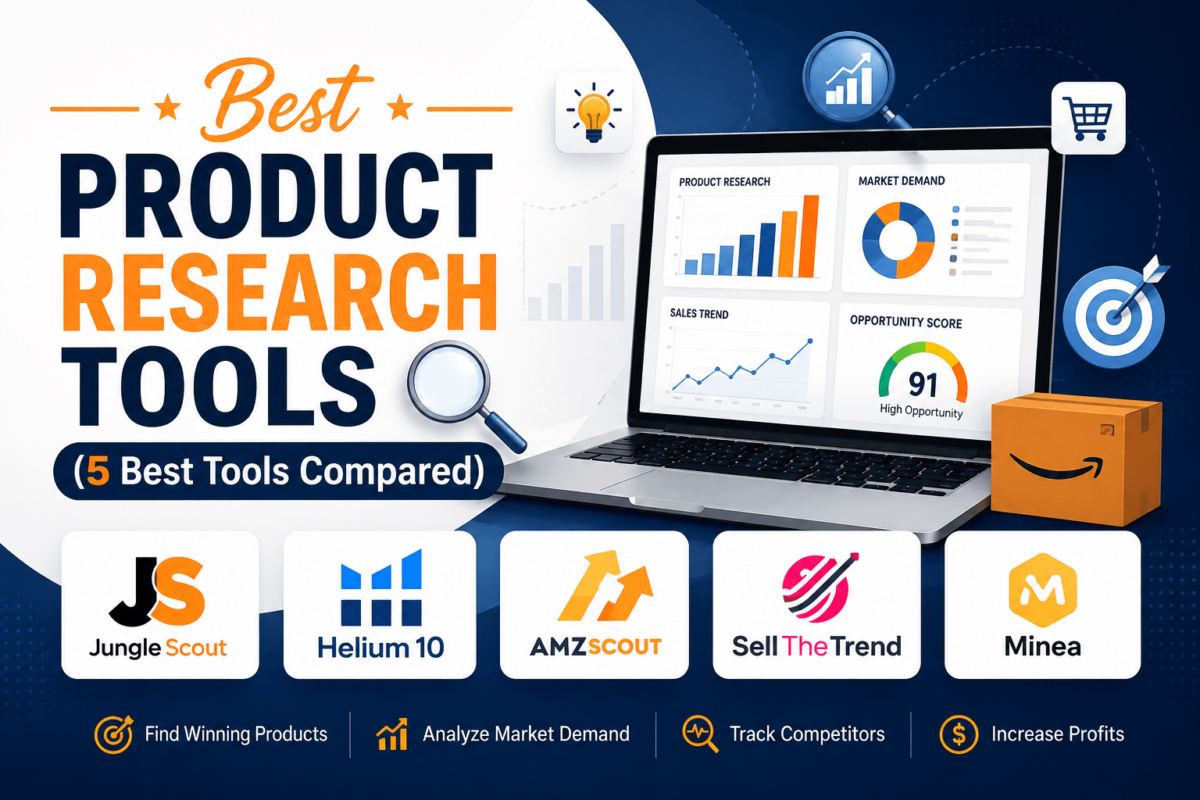
Best Product Research Tools in 2026: 5 Tools Real Sellers Actually Pay For
Jungle Scout, Helium 10, AMZScout, Sell The Trend, and Minea — compared on data accuracy, pricing, and who each one is actually built for, so you stop guessing and start validating.
Quick Answer
The best overall product research tool is Jungle Scout — it has the most accurate Amazon sales estimates, the deepest supplier and keyword data, and a workflow built for sellers who want to go from idea to launch inside one platform.
- Best for Amazon sellers overall: Jungle Scout
- Best all-in-one Amazon toolkit: Helium 10
- Best budget-friendly Amazon option: AMZScout
- Best for Shopify & dropshipping: Sell The Trend
- Best for ad and creative research: Minea
If you’ve ever launched a product that seemed obvious in your head and then watched it sit with zero sales, you already know why this list exists. Product research isn’t the fun part of ecommerce. It’s not the part people post about on social media. But it’s the single biggest reason some sellers scale past six figures while others quietly shut down their store within a year.
I’ve spent the last several years testing product research software for Amazon FBA sellers, Shopify store owners, and dropshippers — the kind of tools that separate a guess from a validated decision. Below, I’m breaking down the five product research tools worth your money in 2026, what each one is genuinely good at, where it falls short, and who should (and shouldn’t) buy it.
What you’ll walk away with by the end of this guide: a clear pricing breakdown for each tool, a full pros-and-cons list, a side-by-side feature comparison table, a category-by-category recommendation (best for beginners, best for agencies, best for dropshipping, and more), plus a buying guide and FAQ section that covers the questions sellers ask most before they subscribe to anything.
Quick Comparison: Best Product Research Tools
| Tool | Best For | Starting Price | Free Trial | Rating |
|---|---|---|---|---|
| Jungle Scout | Amazon sellers wanting the most accurate data | $49/mo (Starter) | 7-day money-back guarantee | 4.7/5 |
| Helium 10 | Amazon/Walmart sellers wanting an all-in-one suite | Free plan; Platinum from $99/mo (annual) | Free plan available | 4.6/5 |
| AMZScout | Beginners on a tight budget | From ~$33/mo (annual) | Unlimited free trial, no card | 4.5/5 |
| Sell The Trend | Shopify stores and dropshippers | $29.97/mo (Lite) | 14-day free trial | 4.4/5 |
| Minea | Ad spying and trending-product discovery | Free (200 credits); paid from $49/mo | Free plan available | 4.4/5 |
Pricing changes often — always confirm current rates on each vendor’s pricing page before you buy.
What Is a Product Research Tool?
A product research tool is software that pulls real marketplace data — search volume, sales estimates, pricing history, competition levels, and reviews — into one dashboard so you can decide whether a product idea is actually worth pursuing before you spend money on inventory or ads.
Instead of guessing based on what “feels” trendy, these tools work backward from demand signals that already exist in the market:
- Marketplace data: Amazon, Walmart, Shopify, TikTok Shop, and supplier platforms like Alibaba and AliExpress all get scraped or connected via API.
- AI-powered scoring: Most tools now run an “opportunity score” that blends demand, competition, and profitability into a single number.
- Demand estimation: Algorithms translate signals like Best Seller Rank or ad engagement into estimated monthly sales and revenue.
- Competitor tracking: You can watch a specific ASIN, store, or ad account over time to see what’s actually working for someone else.
The goal is the same across every tool on this list: replace intuition with evidence, before you commit real capital.
Why Product Research Matters
Ecommerce looks easy from the outside. Low overhead, global reach, platforms like Shopify that let you launch a store in an afternoon. The failure numbers tell a different story. Depending on the business model and data source, studies on new online stores consistently put first-couple-years failure rates somewhere between 60% and 90%, with dropshipping specifically running toward the higher end of that range. Most of that failure doesn’t come from a lack of shoppers — global ecommerce keeps growing every year. It comes from weak product-market fit, underestimated costs, and sellers competing in categories that were already saturated before they arrived.
The picture on Amazon specifically is just as sobering. A large share of new Amazon FBA sellers never make it past the first year, largely because of poor product selection and underestimated fees, while sellers who validate demand first tend to reach profitability far faster — often within their first year rather than never. Amazon alone now has well over two million active sellers competing for the same buy boxes, and third-party sellers account for the majority of everything sold on the platform. That’s not a market where “I think this will sell” is a strategy.
On the Shopify side, merchant volume keeps climbing too, which is good news for demand but bad news for anyone launching a generic product with no differentiation. The tools in this guide exist to close that gap — turning “I think” into “the data shows.” For more context on where ecommerce is heading this year, our ecommerce statistics roundup is worth a look.
There’s also a competition angle that’s easy to underestimate. Amazon’s average conversion rate runs several times higher than the typical standalone ecommerce site, which is exactly why so many sellers flock there — and exactly why categories fill up fast once a niche gets discovered. The sellers who stay profitable long-term are rarely the ones who found a product first; they’re the ones who correctly judged demand, competition, and margin together, then moved before a niche saturated. That’s the entire job a product research tool is built to do, and it’s why treating this step as optional is one of the most expensive shortcuts a new seller can take.
💡 The core idea
Product research tools don’t guarantee a winning product. What they do is eliminate the obviously bad ideas fast, so you spend your validation time and ad budget only on products with real, measurable demand behind them.
1. Jungle Scout — Best Overall Product Research Tool
Jungle Scout
Editor’s PickOverview
Jungle Scout has been one of the most recognizable names in Amazon seller software since it launched back in 2015, founded by Greg Mercer. What started as a simple product-tracking Chrome extension has grown into a full ecommerce intelligence platform, and it’s now organized around a Catalyst suite for individual and growing sellers, plus a custom-priced Cobalt tier for larger brands doing serious enterprise-level volume. Its core audience is Amazon FBA sellers, from someone launching their first private-label product to established brand owners who need competitive intelligence layered on top of product research.
Best Features
- Product Database: Filter hundreds of millions of Amazon products by revenue, review count, weight, price, and dozens of other variables to surface untapped niches.
- Opportunity Score: A single 1–10 score blending demand, competition, and profitability so you can shortlist ideas fast.
- Keyword Scout: Reverse-engineers competitor listings to show you exactly which search terms are driving their traffic.
- Supplier Database: Cross-references Amazon listings with import/customs data so you can find who’s actually supplying a competitor’s product.
- Chrome Extension: Pulls estimated sales, revenue, and fees for any product directly on the Amazon search results page.
- Review Automation & Inventory Manager: Available on higher tiers, useful once you’re managing live listings rather than just researching them.
Pros
- Long track record of refining sales-estimate accuracy
- Deep supplier and keyword research in one platform
- Clean, beginner-friendly interface despite the depth of data
- Strong Academy training included on every plan
- 7-day money-back guarantee on all self-serve plans
Cons
- Entry-level Starter plan limits historical data to one month
- No CSV export or Supplier Database access on the cheapest tier
- Amazon-only — no native Shopify, TikTok Shop, or dropshipping research
- Competitive Intelligence is locked to the top self-serve plan
Pricing
Jungle Scout’s Catalyst suite runs three self-serve tiers: Starter at $49/month (or $348/year billed annually), Growth Accelerator at $79/month (or $588/year billed annually), and a top Brand Owner + CI tier that unlocks Competitive Intelligence, priced above that. Larger brands doing more than roughly $5M in annual Amazon revenue are routed to the custom-quoted Cobalt platform. Every self-serve plan carries a 7-day money-back guarantee rather than a traditional free trial — verify exact current pricing on Jungle Scout’s site, since tiers and figures shift periodically.
Real-World Use Case
Picture a seller who’s found a promising kitchen gadget in the Product Database with strong revenue and manageable review counts. Instead of stopping there, they run Keyword Scout against the top three competing listings, discover a high-volume search term none of them are targeting in their title, and use Supplier Database to identify the factory already shipping a near-identical product to a competitor. That’s the workflow Jungle Scout is actually built around — research, keyword gap, and sourcing, without switching tools.
Best For
New and scaling Amazon FBA sellers who want one platform to handle product research, keyword research, and supplier sourcing without stitching together three separate tools.
Why We Recommend It
If you’re only going to buy one Amazon research tool, Jungle Scout is the safest default. The sales-estimate accuracy is consistently rated among the best in the category, and the Supplier Database genuinely saves hours versus manually digging through Alibaba. It’s not the cheapest option here, but for sellers who plan to actually launch and manage a product — not just browse ideas — the depth pays for itself.
Final Verdict
Jungle Scout is the best all-around pick for anyone serious about selling on Amazon in 2026. Beginners on a strict budget or sellers who need multi-platform (Shopify/TikTok) research should look at AMZScout or Sell The Trend instead.
2. Helium 10 — Best All-in-One Amazon & Walmart Toolkit
Helium 10
Most ToolsOverview
Helium 10 is the closest thing to an operating system for Amazon sellers. Rather than a handful of research features, it bundles 30+ individual tools covering product research, keyword research, listing optimization, PPC management, and financial analytics, all under one login. It’s built for sellers who want to manage the entire seller lifecycle — not just the “should I sell this” decision — inside a single subscription, and it now supports Walmart and TikTok Shop alongside Amazon.
Best Features
- Black Box: A heavily-filterable product database for uncovering niche opportunities across Amazon and Walmart.
- Cerebro & Magnet: Reverse-ASIN and forward keyword research tools that map out exactly how shoppers find a product.
- Xray Chrome Extension: On-page sales, revenue, and competition estimates as you browse Amazon search results.
- Market Tracker: Monitors organic and sponsored keyword rank changes over time with a heat-map view.
- Adtomic: Built-in PPC management and bid automation, useful once you’re actually running ads on a live listing.
- Free plan: A genuinely no-cost entry point for testing the interface before committing.
Pros
- Broadest tool set of any option on this list — research, listing, PPC, and finance in one place
- Free tier lets you test core functionality with zero cost
- Strong keyword and rank-tracking suite (Cerebro/Magnet/Market Tracker)
- Now supports Walmart and TikTok Shop, not just Amazon
Cons
- 2026 pricing update removed the old low-cost Starter tier, raising the entry price for new users
- 30+ tools can feel overwhelming if you only need basic product research
- Some tool usage limits stay flat between the two paid tiers
- Higher-tier Diamond plan is a meaningful jump in cost for solo sellers
Pricing
Helium 10 offers a limited Free plan with no credit card required. Paid plans start at Platinum, priced around $99/month on annual billing (roughly $129/month paid monthly), scaling up to Diamond at around $279/month annually (about $359/month paid monthly). An Enterprise tier with custom pricing is available for agencies and larger brands. Confirm current tiers directly with Helium 10, since it restructured pricing in 2026 and retired its former entry-level plan.
Real-World Use Case
An agency managing five different Amazon brands doesn’t just need product ideas — they need rank tracking across dozens of ASINs, PPC bid adjustments happening daily, and financial reporting that rolls up cleanly per client. Helium 10’s Market Tracker, Adtomic, and Black Box covering that entire workflow in one login is exactly why agencies gravitate toward it over single-purpose research tools; it turns five separate subscriptions and five separate logins into one.
Best For
Sellers who want research, listing optimization, and PPC management under one roof, and agencies managing multiple Amazon or Walmart brands who benefit from tool consolidation.
Why We Recommend It
Helium 10 earns its place through sheer breadth. Once you outgrow “just tell me if this product is good” and start actually optimizing listings and running ads, having Cerebro, Magnet, and Adtomic in the same subscription avoids paying for three separate tools. The free plan also makes it one of the lowest-risk ways to get a feel for professional-grade Amazon research software.
Final Verdict
Helium 10 is the strongest pick if you want one platform for the entire Amazon seller journey, not just the research phase. If your budget is tight or you only need core product research, AMZScout or Jungle Scout’s Starter plan will feel less bloated.
3. AMZScout — Best Budget Option for Beginners
AMZScout
Best ValueOverview
AMZScout takes the opposite approach from Helium 10 — rather than 30 tools, it focuses on a tight, purpose-built bundle for Amazon product research: a product database, a Chrome extension, keyword research, and supplier discovery via Alibaba, wrapped in one clean interface. It’s marketed heavily toward beginner and mid-level sellers who want research power without the learning curve of a sprawling dashboard.
Best Features
- Product Database: Searches a catalog of hundreds of millions of Amazon products to surface low-competition, high-demand niches.
- PRO AI Extension: Shows sales estimates, competition, and profit data directly on Amazon search and product pages.
- Alibaba Integration: One-click supplier lookup for any product you find, without leaving the AMZScout interface.
- AI-Generated Product Ideas: A weekly curated list of trending, high-potential products picked from its database.
- Sales Estimator & Fees Calculator: Several core calculators are available completely free, even without a paid plan.
Pros
- One of the lowest entry price points of any tool in this category
- Unlimited-length free trial with no credit card required
- Simple, single-plan structure — no confusing tier comparisons
- Solid library of beginner-friendly tutorials and guided setup
- Rare lifetime-access option for sellers who hate recurring subscriptions
Cons
- Smaller feature set than Jungle Scout or Helium 10 — no PPC or listing tools
- Sales estimate accuracy is generally rated a notch below the two market leaders
- Lifetime plan requires a large upfront payment
- Fewer advanced filters in the Product Database than higher-priced competitors
Pricing
AMZScout’s Seller’s Bundle runs roughly $59.99/month billed monthly, or around $33–$34/month when billed annually (about $400/year). A one-time lifetime access option is also available for sellers who’d rather pay once than subscribe indefinitely. An unlimited-time free trial requiring no credit card is available to test the platform first — always confirm current figures on AMZScout’s own pricing page.
Real-World Use Case
Someone testing their very first product idea with a few hundred dollars set aside for inventory doesn’t need PPC automation or Competitive Intelligence — they need to know, quickly and cheaply, whether an idea has real demand. AMZScout’s free trial plus the weekly AI-generated product ideas list is enough to validate or kill three or four concepts before spending a dollar on a paid plan, which is exactly the low-risk starting point most first-time sellers actually need.
Best For
New sellers who are price-sensitive, want a simple one-plan structure, and don’t yet need PPC management, listing optimization, or review automation baked into the same subscription.
Why We Recommend It
For a brand-new seller trying to validate a first product idea without a big monthly commitment, AMZScout removes a lot of the decision fatigue that comes with comparing five different tiers on other platforms. The Alibaba integration is genuinely handy for going from “found a product” to “found a supplier” in a few clicks.
Final Verdict
AMZScout is the best entry point if budget is your main constraint and you want core research without paying for tools you won’t use yet. Sellers who need deeper competitive intelligence or PPC tools will eventually outgrow it and should start with Jungle Scout or Helium 10 instead.
4. Sell The Trend — Best for Shopify & Dropshipping
Sell The Trend
Best for DropshippingOverview
Sell The Trend is built for a completely different seller than the three tools above — dropshippers and Shopify store owners sourcing from AliExpress and CJdropshipping rather than launching private-label products on Amazon. Its NEXUS engine scans trending products across AliExpress, CJdropshipping, Shopify stores, and TikTok, then layers in store automation tools like a Chrome import extension, ad creative builders, and an audience builder for Meta campaigns.
Best Features
- NEXUS Product Research: AI-ranked trending products pulled from live AliExpress, CJdropshipping, TikTok, and Shopify store data.
- Chrome Extension: One-click product import from AliExpress/CJdropshipping directly into your Shopify store, with automatic lowest-shipping detection.
- TikTok Explorer: Surfaces products currently going viral on TikTok before they hit saturation on other platforms.
- Facebook Audience Builder & Video Ads Creator: Turns a validated product idea straight into ad-ready creative and targeting.
- Store Intelligence: Lets you peek at what’s selling well across other live Shopify stores in a given niche.
Pros
- Purpose-built for dropshipping and Shopify, not retrofitted from an Amazon tool
- Combines research with store automation and ad-creative tools in one subscription
- 14-day free trial available across all plans
- TikTok Explorer catches trends earlier than most Amazon-first tools
Cons
- Because thousands of users see the same “winning” products, niches can saturate quickly
- Profit-margin estimates are surface-level and don’t fully account for real shipping or ad costs
- Full feature set has a learning curve if you only want the product-finder piece
- Useless for Amazon-specific research — it’s Shopify/dropshipping focused only
Pricing
Sell The Trend runs four tiers — Lite from about $29.97/month, Essential around $49.97/month, Pro around $99.97/month, and a top Pro+ tier above that. Annual billing typically saves close to a third off the monthly rate, and every tier includes a 14-day free trial. As always, double-check current tier names and pricing before checkout, since dropshipping tools tend to iterate pricing frequently.
Real-World Use Case
A dropshipper scrolling TikTok Explorer spots a gadget racking up engagement days before it shows up on mainstream trend lists. One click imports it from AliExpress straight into their Shopify store with pricing and shipping already calculated, and the Facebook Audience Builder spins up a starter targeting list for their first test campaign — idea to live ad, in one afternoon, inside one tool.
Best For
Dropshippers and Shopify sellers who want product discovery, supplier import, and basic ad-creative tools bundled together rather than buying separate software for each step.
Why We Recommend It
If you’re building a Shopify store rather than an Amazon listing, none of the three Amazon-first tools above will actually help you — they don’t touch AliExpress, CJdropshipping, or TikTok Shop discovery. Sell The Trend fills that gap directly, and the built-in Facebook Audience Builder means you’re not jumping to a fourth tool just to launch your first ad set.
Final Verdict
Sell The Trend is the clear pick for dropshipping and Shopify-first sellers. If you’re validating dropshipping products purely through ad performance rather than product-finder databases, pair it with Minea below for the strongest combination.
5. Minea — Best for Ad Spying & Competitor Research
Minea
Best Ad IntelligenceOverview
Minea approaches product research from the advertising side rather than the marketplace-listing side. It’s an “AdSpy” tool at its core, scanning a database of well over 200 million ads and shop pages across Facebook, TikTok, and Pinterest, updated multiple times a day, so you can see exactly which creatives, products, and offers are currently getting engagement from real shoppers before you spend a dollar on your own ad account.
Best Features
- Multi-Platform AdSpy: Search live and historical ads across Facebook, TikTok, and Pinterest by keyword, niche, or engagement level.
- Shop Analysis: Reverse-engineer a competitor’s entire Shopify store, including estimated traffic and product catalog.
- Winning Products AI: AI-driven scoring that surfaces products with rising ad spend and engagement before they peak.
- Creative AI: Generates ad creative variations based on top-performing ads already in the database.
- Chrome Extension: Included on every paid plan for quick on-page research without switching tabs.
Pros
- Massive, frequently-updated ad database spanning three major platforms
- Free Lite plan with 200 credits requires no credit card to test
- Shop Analysis gives a genuinely useful window into competitor store performance
- Strong complement to Sell The Trend for a full research-plus-ads workflow
Cons
- Credit-based system means heavy researchers can burn through allowances quickly
- No standard refunds once a subscription is purchased
- Business tier pricing is a significant jump for solo sellers
- Best used alongside a store or fulfillment tool — it doesn’t handle product import itself
Pricing
Minea offers a free Lite plan with 200 research credits and no card required. Paid tiers include Starter around $49/month (roughly $34/month billed annually), Premium around $99/month (roughly $69/month billed annually), and Business around $399/month (roughly $299/month billed annually). Annual billing typically saves close to 30% across every tier — confirm exact current credit allowances and pricing directly with Minea before subscribing.
Real-World Use Case
Before committing ad spend to a new product, a marketer searches Minea’s database for similar products already running Facebook and TikTok ads, filters by ads that have been live the longest (a strong signal they’re actually profitable, not just tested and abandoned), and studies the top three creatives for hooks and angles worth adapting — turning weeks of trial-and-error ad testing into a single afternoon of research.
Best For
Dropshippers and ecommerce marketers who want to validate products by watching real ad performance and competitor creative, rather than relying purely on marketplace sales-rank estimates.
Why We Recommend It
Sales-rank-based tools tell you what’s already selling on a marketplace. Minea tells you what’s currently working in paid ads — often the earliest signal available, especially for TikTok- and Facebook-driven dropshipping products. The Shop Analysis feature alone is worth the Starter plan if you’re regularly reverse-engineering competitor stores.
Final Verdict
Minea is the strongest choice specifically for ad-based product validation and competitor creative research. It’s not a replacement for a full product database like Jungle Scout or Sell The Trend — think of it as the tool you add once you’re ready to actually run ads.
Feature-by-Feature Comparison
Every tool above says it does “product research,” but the underlying data source and workflow are genuinely different. Here’s how they stack up on the features that actually matter day to day.
| Feature | Jungle Scout | Helium 10 | AMZScout | Sell The Trend | Minea |
|---|---|---|---|---|---|
| Primary marketplace | Amazon | Amazon, Walmart, TikTok Shop | Amazon | Shopify, AliExpress, CJdropshipping | Facebook, TikTok, Pinterest ads |
| Chrome extension | Yes | Yes (Xray) | Yes (PRO AI) | Yes | Yes |
| AI opportunity/product scoring | Yes | Yes | Yes | Yes (NEXUS) | Yes (Winning Products AI) |
| Supplier database | Yes | Limited | Alibaba integration | AliExpress/CJ integration | No |
| Keyword research | Yes (Keyword Scout) | Yes (Cerebro/Magnet) | Yes | Basic | No |
| PPC / ad management | No | Yes (Adtomic) | No | Basic ad tools | No (spy only) |
| Ad creative spying | No | No | No | Limited | Yes (core feature) |
| Free plan / trial | Money-back guarantee | Free plan | Unlimited free trial | 14-day trial | Free plan |
| Entry price (approx.) | $49/mo | Free / $99/mo | ~$33–60/mo | $29.97/mo | Free / $49/mo |
Best Tool by Category
Do You Really Need a Paid Tool? (Free Methods, Compared)
Before you subscribe to anything, it’s fair to ask whether free methods get you close enough. They can, for a very early stage — but they top out fast.
- Amazon’s own Best Sellers and Movers & Shakers pages show you what’s already selling well, but by the time a product appears there, competition has usually caught up too.
- Google Trends is genuinely useful for spotting seasonality and long-term interest curves, but it can’t tell you actual sales volume, competition depth, or profit margin on a specific marketplace.
- Manually scrolling TikTok or Instagram can surface early trends, but it doesn’t scale, and you have no way to verify whether what looks viral is actually converting to sales.
- Free calculators (like AMZScout’s FBA fee calculator) are fine for spot-checking margin on one product, but you’ll still be doing demand research by hand.
The honest answer: free methods are a fine way to build initial intuition, but every one of them is missing at least one of the three things that actually matter — verified demand, competition depth, and profit margin — together in one place. That’s the gap the five paid tools above are built to close.
Buying Guide: How to Choose the Right Product Research Tool
Before you subscribe to anything, run your decision through these factors. The “best” tool is different depending on what platform you sell on and how far along your business already is.
Accuracy
Sales estimates are educated guesses built from public signals like Best Seller Rank, not exact figures pulled from Amazon’s internal systems. Jungle Scout and Helium 10 both have long track records of refining their estimation models — treat any tool’s numbers as directional, not gospel, and cross-check big decisions with a second data point where you can.
Database Size
A bigger product or ad database means more raw opportunities to filter through, but only if the filters are good enough to make that size usable. Minea’s 200-million-plus ad library is a strength specifically because you can filter by platform, engagement, and date.
Ease of Use
Helium 10’s 30+ tools are powerful, but a first-time seller can genuinely get lost in the interface. If you’re brand new, prioritize a tool with a narrower, simpler workflow — AMZScout is built with exactly that beginner path in mind.
Pricing
Match the plan to your revenue stage, not your ambition. Paying for Jungle Scout’s Brand Owner + CI tier before you’ve launched your first product means paying for Competitive Intelligence you don’t need yet. Start at the entry tier and upgrade once the tool’s limits actually become a bottleneck.
Support
Look for tools with active help centers, video tutorials, and responsive live chat — you’ll lean on this more than you expect during your first few weeks of research.
Integrations
If you’re on Shopify, an Amazon-only tool is close to useless. Match the tool’s supported marketplaces to where you actually sell before comparing anything else.
Automation
Features like review automation, inventory alerts, and rank tracking save real time once you’re managing live listings, not just researching ideas.
AI Features
AI scoring (Opportunity Score, Winning Products AI, NEXUS) speeds up shortlisting, but it should narrow your list, not make the final call for you.
Historical Data
Entry-level plans often cap historical data at a single month. If you want to see whether a product’s demand is seasonal or a genuine year-round trend, you’ll need a plan with longer lookback windows.
Chrome Extension
A good extension turns hours of tab-switching into seconds of on-page research. All five tools here include one — test it directly on a few real product pages before you commit to a paid plan.
Supplier Data
If you’re private-labeling on Amazon, supplier/Alibaba integration (Jungle Scout, AMZScout) meaningfully shortens the path from “found a product” to “found a factory.” Dropshippers get this natively through Sell The Trend’s AliExpress/CJdropshipping connection.
Opportunity Scoring
Treat any single score as a first filter, not a final answer — always sanity-check the top candidates manually against reviews, seasonality, and your own margin math.
Export Options
If you plan to build spreadsheets or share research with a team, confirm CSV export is included — it’s often gated behind a plan’s mid-tier or higher.
Scalability
Pick a tool with a clear upgrade path (Starter → Growth → Brand Owner, or Lite → Pro+) so you’re not migrating platforms — and re-learning a new interface — the moment your business actually starts scaling.
Mistakes to Avoid When Choosing a Product Research Tool
Frequently Asked Questions
What is a product research tool?
It’s software that analyzes marketplace and advertising data — sales estimates, search volume, competition, and pricing history — to help you decide whether a product idea is worth pursuing before you invest in inventory or ads.
Which product research tool is best overall?
Jungle Scout is the best overall pick for most Amazon sellers thanks to its data accuracy, supplier database, and beginner-friendly interface. Shopify-first sellers should look at Sell The Trend instead.
Are free product research tools good enough?
Free tiers (like Helium 10’s Free plan or Minea’s 200-credit Lite plan) are fine for testing a handful of ideas, but usage caps mean you’ll hit limits fast once you’re doing serious research. Most sellers upgrade to a paid tier within the first few weeks.
Which tool works best with Amazon?
Jungle Scout, Helium 10, and AMZScout are all built specifically for Amazon sellers, with sales estimation, keyword research, and supplier tools tailored to the platform.
Which tool works best with Shopify?
Sell The Trend is purpose-built for Shopify and dropshipping, with direct AliExpress and CJdropshipping product import. Minea complements it well for ad-based validation.
Do these tools estimate sales accurately?
They estimate, not guarantee. Estimates are built from public signals like Best Seller Rank and historical trends, so treat them as directional guidance rather than exact figures, and cross-check high-stakes decisions manually.
Can complete beginners use these tools?
Yes. AMZScout and Jungle Scout’s Starter plan are both designed with new sellers in mind, with guided onboarding and simpler interfaces than the full Helium 10 suite.
How much do product research tools cost?
Entry pricing ranges from free (Helium 10, Minea) to around $30–60/month for most beginner plans, scaling up to $150–400/month for advanced or enterprise-level tiers.
Do these tools have Chrome extensions?
Yes, all five tools in this guide include a Chrome extension that overlays sales, competition, or ad data directly on the pages you’re already browsing.
Can they find trending products before competitors?
Sell The Trend’s TikTok Explorer and Minea’s ad-spy database are both built to catch products while ad spend is rising rather than after they’ve already saturated the market.
Are product research tools worth the investment?
For most sellers, yes — a $50–100/month tool that helps you avoid one bad $2,000 inventory order has already paid for itself many times over.
Can I use more than one product research tool at once?
Many experienced sellers do, often pairing a database tool (Jungle Scout, Sell The Trend) with an ad-intelligence tool (Minea) for a fuller demand picture from two different angles.
Do I need a product research tool if I’m dropshipping?
Yes — dropshipping succeeds or fails on product-market fit even more than Amazon FBA does, since there’s no brand loyalty yet. Sell The Trend and Minea are both built around exactly this use case.
What’s the difference between Jungle Scout and Helium 10?
Jungle Scout leans toward research and supplier sourcing with a cleaner interface. Helium 10 covers the full seller lifecycle — research, listing optimization, and PPC management — inside one broader (and steeper-learning-curve) platform.
Is AMZScout accurate enough for serious sellers?
It’s solid for initial validation and budget-conscious sellers, though its estimation depth and advanced filters trail Jungle Scout and Helium 10 slightly. Many sellers start with AMZScout and upgrade once they’re scaling.
Does Minea replace a product database tool?
No — Minea shows you what’s working in ads right now, not a searchable marketplace product database. It’s best used alongside a tool like Sell The Trend, not instead of one.
What is an Opportunity Score?
It’s an AI-generated score (used by Jungle Scout, Helium 10, and others) that blends demand, competition, and profitability into a single number to help you shortlist product ideas faster.
Can these tools help with keyword research too?
Yes — Jungle Scout’s Keyword Scout and Helium 10’s Cerebro/Magnet both double as full keyword research tools for optimizing Amazon listings, not just for product discovery.
Do I need a supplier database, or can I just search Alibaba manually?
You can search manually, but a built-in supplier database (Jungle Scout, AMZScout) cross-references actual competitor listings against import data, which is far faster than searching Alibaba blind.
Which tool has the best free trial?
AMZScout’s unlimited-time free trial and Helium 10’s genuinely free tier are the two most generous no-cost entry points on this list.
How often should I re-run product research?
Treat it as ongoing, not a one-time step. Trends, competition levels, and ad costs shift constantly — most active sellers re-check their top niches at least monthly.
Conclusion: Which Product Research Tool Should You Choose?
There’s no single “best” tool here — there’s a best tool for your specific situation. If you’re selling private-label on Amazon and want the most trusted, best-rounded option, Jungle Scout is the safe first move. If you want the entire seller toolkit — research, keywords, listings, and PPC — under one login, go with Helium 10. If your budget is tight and you just need to validate a first product idea, start with AMZScout. If you’re building a Shopify store and sourcing from AliExpress or CJdropshipping, Sell The Trend is purpose-built for exactly that. And if you want to see what’s actually working in paid ads before you spend your own budget, Minea fills a gap none of the others cover.
Whichever tool you pick, remember what it’s actually for: replacing a guess with evidence. None of these platforms will hand you a guaranteed winning product — but they’ll stop you from launching an obviously bad one, and in a market where most new ecommerce businesses don’t make it past their first couple of years, that alone is worth the subscription.
Building out your broader stack? Check our guides on the best inventory management software, best email marketing software, and best affiliate marketing software to round out your ecommerce toolkit.