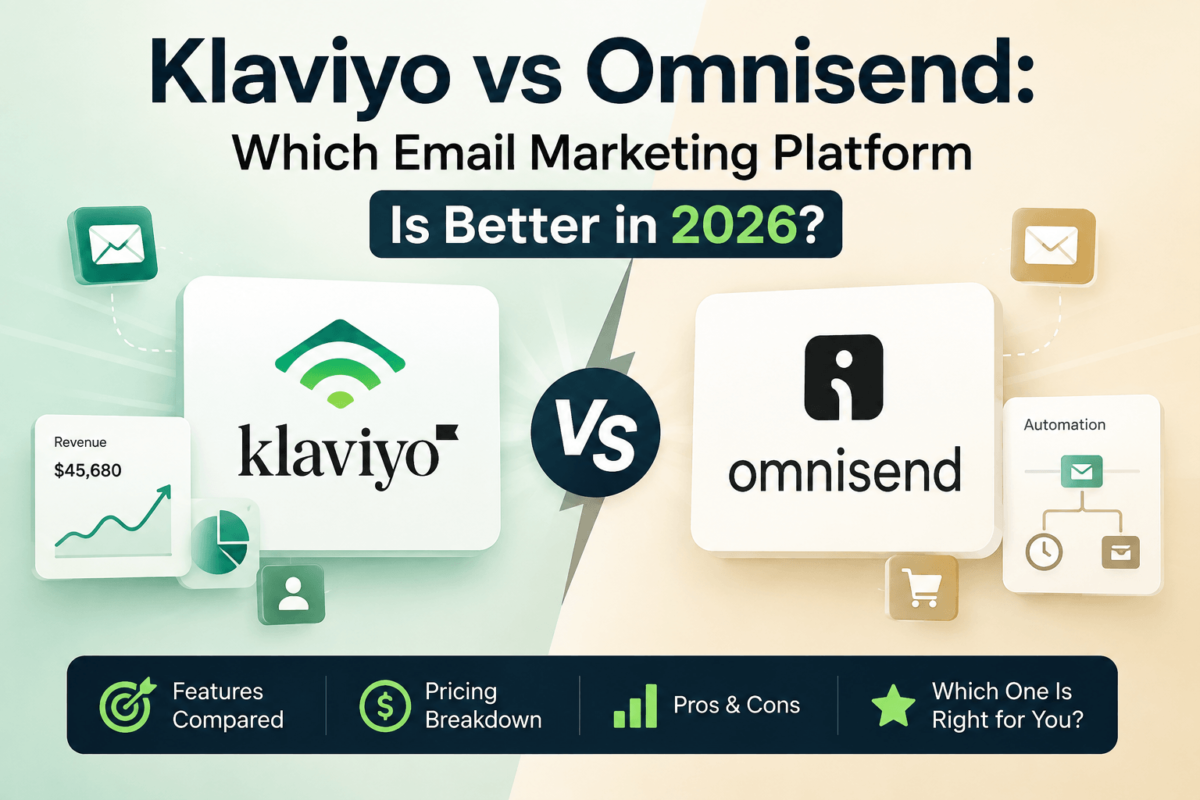
Klaviyo vs Omnisend: Which Email Marketing Platform Is Better in 2026?
By Jaykishan Panchal · Updated August 2026 · 17 min read
Quick Answer
If you’re a small to mid-size Shopify store watching your budget, Omnisend is the better pick. It costs less at every list size, bundles email, SMS, and push notifications into one plan, and G2 reviewers consistently rate it easier to set up and support. If you’re a fast-growing or high-AOV ecommerce brand that lives and dies by predictive analytics and deep customer segmentation, Klaviyo is worth the higher price — you’re paying for depth, not just email sends. Neither platform is “wrong.” The right one depends on your list size, your budget, and how much automation complexity you actually need.
Quick Verdict
| Category | Winner |
|---|---|
| Best overall for most stores | Omnisend |
| Best for beginners | Omnisend |
| Best pricing / value | Omnisend |
| Best free plan | Omnisend |
| Best for predictive analytics | Klaviyo |
| Best automation depth | Klaviyo |
| Best SMS marketing | Klaviyo |
| Best for high-AOV / enterprise brands | Klaviyo |
| Best customer support | Omnisend |
| Best review ratings overall | Omnisend |
Who Should Buy Which
Choose Omnisend if: you’re under 5,000 contacts, you want email and SMS bundled into one bill, you’re new to marketing automation, or you’re running a lean Shopify or WooCommerce store where every dollar of software spend needs to earn its keep.
Choose Klaviyo if: your store does $500K+ in annual revenue, you rely heavily on predictive analytics (customer lifetime value, churn prediction, product recommendations), you run complex multi-branch automation flows, or SMS is a core revenue channel and you need best-in-class deliverability and segmentation for it.
Avoid Klaviyo if: you’re extremely budget-conscious and your list is growing fast — the active-profile billing model means your bill can jump sharply even if your engaged list stays flat.
Avoid Omnisend if: you need enterprise-grade data infrastructure, a dedicated Customer Data Platform, or SMS as a primary channel below the Pro plan’s 2,500-contact minimum.
What Is Klaviyo?
Klaviyo is an ecommerce-first marketing platform built around a single idea: your customer profile is the product. Instead of treating email as a list of addresses, Klaviyo unifies every touchpoint — purchases, browsing behavior, SMS replies, support tickets — into one customer record, then uses that data to power AI-generated segments, predictive analytics, and automated flows.
It’s a Shopify-favorite for a reason: Klaviyo connects to 400+ tools including Shopify, WooCommerce, BigCommerce, Magento, and Salesforce Commerce Cloud, and powers roughly 170,000+ brands worldwide. It also offers a growing set of AI marketing features, including an AI-generated campaign and flow assistant (Klaviyo’s “Marketing Agent”), predictive send-time optimization, and CLV modeling that flags your highest-value customers automatically.
Every paid Klaviyo tier includes the same feature set — you’re not unlocking new capabilities as you spend more, you’re paying for a bigger contact list. That’s a meaningfully different pricing philosophy than Omnisend’s, and it matters when you’re budgeting for growth.
What Is Omnisend?
Omnisend is an omnichannel marketing automation platform built specifically for ecommerce, combining email, SMS, and web push notifications in a single workflow builder. Where Klaviyo leans into depth, Omnisend leans into speed: pre-built automation templates for welcome series, cart recovery, and win-back campaigns are ready to activate in a few clicks, and nearly the entire feature set is available even on the free plan.
Omnisend integrates natively with Shopify, WooCommerce, BigCommerce, Wix, and most major ecommerce platforms, and its Shopify App Store rating (4.8/5) consistently edges out Klaviyo’s. It’s a common landing spot for stores that outgrow tools like basic newsletter platforms but aren’t ready for Klaviyo’s price tag or learning curve.
All three Omnisend tiers — Free, Standard, and Pro — share the same core automation and segmentation engine. The differences come down to sending volume, SMS access, and AI-powered personalization features, not a fundamentally different product at each tier.
Feature Comparison: Klaviyo vs Omnisend
| Feature | Klaviyo | Omnisend | Winner |
|---|---|---|---|
| Email builder | Drag-and-drop, advanced blocks | Drag-and-drop, simpler UI | Tie |
| Prebuilt automation templates | Extensive | Extensive, ready faster | Omnisend |
| AI content / campaign generation | Marketing Agent (all paid tiers) | Personalization add-on / Pro | Klaviyo |
| Predictive analytics (CLV, churn) | Included on all paid plans | Limited | Klaviyo |
| Segmentation | Deep, behavior + predictive | Strong, more template-driven | Klaviyo |
| SMS marketing | From $35/mo, included credits | Pro plan add-on, volume-based | Klaviyo |
| Push notifications | Not native | Unlimited on every paid tier | Omnisend |
| Forms, popups, landing pages | Yes | Yes, plus Wheel of Fortune gamified popups | Omnisend |
| A/B testing | All plans | Standard & Pro | Klaviyo |
| Reporting & revenue attribution | Very detailed, add-on for advanced | Solid, simpler dashboards | Klaviyo |
| Native integrations | 400+ | 40+ core, growing app market | Klaviyo |
| Shopify integration | Native, deep data sync | Native, higher app store rating | Tie |
| WooCommerce integration | Yes | Yes, simpler setup | Omnisend |
| Mobile app | Yes | Yes | Tie |
| Free plan feature access | Core features, 150 SMS credits | Nearly the full feature set | Omnisend |
Pricing Comparison: Klaviyo vs Omnisend in 2026
Both platforms bill by contact count and automatically move you up a tier as your list grows. Here’s where they genuinely differ:
Klaviyo bills on “active profiles” — every contact your account could message, whether you’ve emailed them recently or not. This model, introduced in a February 2025 billing change, means cold or suppressed-but-still-active contacts can quietly push you into a higher tier. Every paid tier unlocks the identical feature set; you’re paying purely for list size and send volume (roughly 10x your profile count).
Omnisend bills on “billable contacts” — subscribers plus non-subscribers who can still receive automated order-related messages. Its Free and Standard plans share nearly the same feature set as Pro; the Pro plan mainly adds unlimited sends, SMS access, and AI personalization.
| Contacts | Klaviyo (Email plan) | Omnisend (Standard/Pro) |
|---|---|---|
| Up to 250 | Free | Free |
| 500 | ~$20/mo (Email) · ~$35/mo (Email+SMS) | $16/mo (Standard) |
| 1,000 | ~$30/mo | ~$20/mo (Standard) |
| 2,500 | ~$60/mo | $59/mo (Pro minimum tier) |
| 5,000 | ~$100/mo | ~$85–100/mo (Standard) or Pro equivalent |
| 10,000 | ~$150/mo | ~$140–155/mo (Standard/Pro) |
| 25,000 | ~$400/mo | Lower — check live calculator |
| 50,000 | ~$720/mo | Lower — check live calculator |
Pricing changes often on both sides. These figures are verified against Klaviyo’s and Omnisend’s official pricing and help center pages as of August 2026 — always confirm current tiers on klaviyo.com/pricing and omnisend.com/pricing before subscribing.
Two pricing quirks worth knowing before you commit. Klaviyo caps any single tier-jump price increase at 25%, but that cap shrinks every time you downgrade. Omnisend offers a 30% discount on your first three months if you pay upfront ($11.20/mo effective on Standard, $41.30/mo on Pro) — but neither platform offers an ongoing annual discount on self-serve plans. If your budget is the deciding factor, our best email marketing software roundup covers cheaper options too.
Ease of Use
This is where the two platforms diverge the most in real-world reviews. On G2, Omnisend outscores Klaviyo on every usability metric: ease of use (9.1 vs 8.6), ease of setup (9.0 vs 8.5), and ease of admin (9.2 vs 8.9). Klaviyo only pulls ahead on “meets requirements” (9.0 vs 8.9), which tracks with its reputation as the more feature-dense tool.
In practice, that means Klaviyo’s dashboard rewards power users willing to dig into flow logic, conditional splits, and custom properties — but it’s genuinely more to learn. Omnisend’s workflow builder, template library, and Shopify sync are built to get a first campaign live in under an hour, which is why it’s a common recommendation for teams migrating off tools like Constant Contact or Mailchimp.
Winner: Omnisend, especially for solo founders or small teams without a dedicated email marketer.
Email Automation Comparison
Both platforms cover the core ecommerce flows out of the box: welcome series, abandoned cart, browse abandonment, post-purchase, win-back, birthday, and VIP customer flows. The difference shows up in flexibility.
Klaviyo’s flow builder supports deeper conditional branching, custom trigger logic based on any tracked event, and the ability to combine email, SMS, and (via integration) push into a single cross-channel flow. Top-performing Klaviyo stores typically run 12 to 16 active automated flows simultaneously, layering welcome, cart recovery, browse abandonment, post-purchase, and win-back sequences on top of each other.
Omnisend’s automation library leans on ready-made workflows you can activate with minimal editing — genuinely fast to launch, though with fewer branching options than Klaviyo once you get into complex, multi-condition logic. For most stores under a few thousand contacts, Omnisend’s automation depth is more than sufficient. If your business needs the kind of sophisticated, multi-channel sequencing covered in our marketing automation software comparison, Klaviyo’s flow builder scales further.
Winner: Klaviyo, for automation flexibility and branching logic. Omnisend wins on speed to launch.
SMS Marketing Comparison
SMS is where Klaviyo’s ecommerce focus really shows. Its Email + SMS plan starts around $35/month with 1,250 included SMS/MMS credits, and G2 reviewers specifically flag Klaviyo’s SMS tooling — compliance management, two-way messaging, keyword automation, and revenue attribution — as more mature than Omnisend’s.
Omnisend’s SMS access changed meaningfully in May 2026: new subscribers can only add SMS on the Pro plan (a 2,500-contact minimum, $59/month), with volume-based pricing starting at $0.007 per message and no included credits by default. Legacy Omnisend accounts that subscribed before May 4, 2026 keep bundled SMS credits equal to their subscription price. If SMS is central to your strategy and you’re a smaller list, this pricing change makes Klaviyo comparatively more accessible than it used to be.
Winner: Klaviyo, for SMS depth and lower-list-size accessibility.
AI Features Comparison
Klaviyo bundles AI into every paid tier: a Marketing Agent that drafts campaigns and flows from a prompt, AI-generated segments, predictive send-time optimization, and product recommendation blocks that pull from purchase history automatically.
Omnisend’s AI tools — personalized product recommendations, conditional content, and AI-optimized send time — come standard on Pro, and are available to Standard-plan users as a paid add-on. If AI-assisted campaign creation is a priority for your broader marketing stack, Klaviyo gives you more out of the box without an extra line item.
Winner: Klaviyo, for AI features included at lower list sizes.
Segmentation & Customer Data
Klaviyo’s segmentation engine is arguably its single strongest feature: predictive customer lifetime value, churn risk scoring, purchase-pattern-based dynamic segments, and a unified customer profile that blends email, SMS, and store data into one record.
Omnisend covers behavior-based and purchase-history segmentation well — enough for most stores to build meaningful VIP, repeat-customer, and win-back segments — but it doesn’t match Klaviyo’s predictive layer. If your team makes decisions based on projected CLV or churn probability, that gap matters.
Winner: Klaviyo.
Ecommerce Integrations (Shopify, WooCommerce & More)
Both platforms treat Shopify as a first-class citizen. Klaviyo is a Shopify-favored partner with deep two-way data sync (order history, product catalog, customer tags), while Omnisend holds a higher Shopify App Store rating (4.8/5 vs Klaviyo’s 4.5/5) thanks to its faster setup and cleaner UI. If you’re evaluating your broader app stack, our best Shopify apps guide and best Shopify SEO apps roundup are worth a look alongside your email platform choice.
Both integrate with WooCommerce, BigCommerce, and Wix. Klaviyo adds Magento and Salesforce Commerce Cloud support, which matters if you’re running a larger, multi-platform operation. For WooCommerce specifically, Omnisend’s setup wizard is generally considered the faster path to your first automation.
Winner: Tie on Shopify. Omnisend for WooCommerce ease of setup. Klaviyo for platform breadth (Magento, Salesforce Commerce Cloud).
Analytics & Reporting
Klaviyo’s reporting goes deep: revenue attribution by flow and campaign, customer journey mapping, and an optional Marketing Analytics add-on (from $100/month) for cohort analysis and peer benchmarking. Omnisend’s dashboards are more streamlined — revenue per campaign, channel performance, and automation performance — which is genuinely enough for most small-to-mid stores but won’t satisfy a data team wanting granular cohort views.
Winner: Klaviyo, for reporting depth.
Customer Support Comparison
Support is another area where the review data tells a consistent story. G2’s Quality of Support score favors Omnisend, 9.1 versus Klaviyo’s 8.4. On Trustpilot, the gap is stark: Omnisend sits around 4.4/5 while Klaviyo hovers near 1.8–2.0/5, with reviews there skewing heavily toward billing and support frustration — a pattern that doesn’t show up nearly as much on G2 or Capterra, where Klaviyo’s power users rate it well.
Neither platform offers phone support. Klaviyo provides email and live chat on paid plans, with free-plan support limited to the first 60 days. Omnisend offers live chat on Standard and Pro, with a dedicated Account Expert for any plan spending $400+/month. If migration help matters to you, both offer hands-on onboarding at that spend level, and Omnisend additionally offers a general migration request form for smaller accounts.
Winner: Omnisend.
Want the Easier, Lower-Cost Option?
Omnisend’s free plan unlocks nearly every feature — automation, segmentation, forms, and popups — with no credit card required. It’s the fastest way to see if omnichannel automation actually moves revenue for your store before you commit to a paid plan.
Try Omnisend Free →This link may earn TechCognate a commission at no extra cost to you.
Klaviyo Pros and Cons
|
Pros
|
Cons
|
Omnisend Pros and Cons
|
Pros
|
Cons
|
Which Platform Fits Your Business?
Small Shopify stores (under 2,500 contacts): Omnisend. The free plan and low-cost Standard tier cover everything a new store needs, and you won’t outgrow the feature set for a while.
Large ecommerce brands / high-AOV DTC: Klaviyo. The predictive analytics and deep segmentation pay for themselves once your average order value and list size justify the spend.
Agencies managing multiple client stores: Klaviyo, for its broader integration ecosystem and reporting depth across accounts — though Omnisend’s lower per-client cost is worth weighing if your clients are smaller stores.
Subscription brands: Klaviyo’s flow branching handles complex renewal, churn-prevention, and win-back logic more gracefully.
Fashion and beauty brands: Both work well; Omnisend’s gamified popups (Wheel of Fortune) tend to perform especially well for impulse-driven categories.
B2B ecommerce: Klaviyo, for its more sophisticated segmentation around longer, multi-touch buying cycles.
International stores: Both support multi-currency and multi-language sends; check current SMS rates by country before committing, since per-message pricing varies significantly by destination on both platforms.
Not Sure Which Fits Your Store?
Both platforms offer a free plan or free trial, so the lowest-risk move is testing both against a live segment of your list before committing budget. Set up one welcome flow on each and compare open rates after two weeks.
Start with Klaviyo → Start with Omnisend →These links may earn TechCognate a commission at no extra cost to you.
Switching Platforms: Migration Notes
Moving your email program is more about list hygiene than technical difficulty. Both platforms can import contacts via CSV or direct integration with Shopify/WooCommerce, and both preserve subscriber consent status during import.
- From Mailchimp: export your audience with tags intact; rebuild automations manually, since flow logic doesn’t transfer automatically. See our Mailchimp comparison if you’re still evaluating whether to leave.
- From ActiveCampaign or HubSpot: map your existing tags to segments before importing; both are compared in depth in our ActiveCampaign vs HubSpot guide.
- Between Klaviyo and Omnisend: both support direct Shopify/WooCommerce re-sync, which is faster than a CSV migration since it rebuilds customer and order history natively.
- Any migration $400/month plan or above: both platforms assign a dedicated onboarding contact to help move templates and flows — ask for it before you sign.
Alternatives to Klaviyo and Omnisend
If neither platform feels right, a few other tools are worth a look. ActiveCampaign brings stronger native CRM features if sales pipeline tracking matters as much as email. Kit (formerly ConvertKit) is a better fit for creator-led brands selling digital products rather than physical inventory. GetResponse and AWeber are worth a look for simpler, budget newsletter-first sending. For a broader view of the whole category, our best email marketing software and best newsletter platforms roundups compare the full field side by side.
If your store needs more than email — a unified CRM, lead scoring, or sales automation — it’s also worth reviewing our best CRM for email marketing and best lead generation software guides before deciding.
Email Marketing Statistics Worth Knowing
- Email marketing returns $36–$42 for every $1 spent globally; US ecommerce brands see up to $72 per $1 invested. (Omnisend, 2026)
- Automated flows generate up to 30x more revenue per recipient than one-off broadcast campaigns. (Klaviyo, 2024 Email Benchmarks Report, 325B+ emails analyzed)
- Automated emails drove 37% of all email-generated sales in 2024 despite making up just 2% of total send volume. (Omnisend, 2025 Ecommerce Marketing Statistics)
- Abandoned cart flows generate the highest average revenue per recipient of any automation, at $3.65, with top performers reaching $28.89. (Klaviyo/EmailVendorSelection, 2026)
- Welcome emails average an 83.6% open rate — the highest of any automated flow. (GetResponse, 2026)
- Segmented email campaigns generate 760% more revenue than non-segmented sends. (Campaign Monitor)
- Personalized subject lines lift open rates by an additional 20–26%. (Adobe for Business)
- Abandoned cart emails convert at 3.33% on average, with top performers reaching 7.69%. (Wiser Review, 2026)
- Top-performing Klaviyo stores run 12–16 active automated flows simultaneously. (Darkroom, Ecommerce Email Benchmarks 2026)
- Birthday emails generate an average order value over 4x the campaign average, at roughly $744 per order. (Omnisend, 2026 Ecommerce Marketing Statistics)
- The global email marketing market is valued at $13.72 billion in 2026, growing about 10.8% annually. (Ringly/Wiser Review, 2026)
- Stores running fewer than four automated flows leave an estimated 30–45% of potential email revenue on the table. (Ecommerce email audit data, 2026)
- 61.3% of consumers prefer email for promotional messages; 75.1% prefer it for transactional updates like shipping confirmations. (Omnisend, 2026)
For a deeper dive into the numbers behind these benchmarks, see our full email marketing statistics and ecommerce statistics pages.
Ready to Put These Numbers to Work?
Automated flows are where the real revenue lives. Whichever platform you choose, start with a welcome series and an abandoned cart flow — together they typically account for the majority of automation-driven revenue in a new account.
Compare Plans and Start Free →This link may earn TechCognate a commission at no extra cost to you.
Frequently Asked Questions
Is Klaviyo better than Omnisend?
Klaviyo has more depth in analytics, segmentation, and SMS. Omnisend is cheaper, easier to learn, and rated higher for support. “Better” depends on your list size and how much you need predictive analytics.
Which is cheaper, Klaviyo or Omnisend?
Omnisend is cheaper at nearly every list size. Its Standard plan starts at $16/month versus Klaviyo’s Email plan at roughly $20/month, and the gap widens as your list grows.
Which platform has better automation?
Klaviyo offers deeper conditional branching and more complex multi-step flows. Omnisend’s prebuilt automation templates are faster to launch but less flexible for advanced logic.
Which is best for Shopify?
Both integrate natively. Klaviyo offers deeper data sync; Omnisend has a higher Shopify App Store rating (4.8/5 vs 4.5/5) and a faster setup process.
Does Omnisend include SMS marketing?
Yes, but as of May 2026, SMS for new subscribers is only available on the Pro plan (2,500-contact minimum), with volume-based pricing starting at $0.007 per message. Legacy accounts keep bundled SMS credits.
Is Klaviyo worth the price for a small store?
For a store under 1,000 contacts without complex segmentation needs, probably not — Omnisend delivers similar core functionality for less. Klaviyo’s value becomes clearer as your list and AOV grow.
Which platform has better email deliverability?
Both maintain strong sender reputations for authenticated senders. Deliverability depends more on your list hygiene and sending practices than the platform itself.
Which is easier to learn for beginners?
Omnisend. G2 reviewers consistently rate it higher on ease of use, ease of setup, and ease of admin.
Can I migrate from Mailchimp to either platform?
Yes. Both support CSV import and direct Shopify/WooCommerce sync; you’ll need to rebuild your automation flows manually since flow logic doesn’t transfer between platforms.
Which platform scales better for large lists?
Klaviyo’s feature-parity-across-tiers model and deeper integrations (Magento, Salesforce Commerce Cloud) make it the more common choice for large or enterprise ecommerce brands.
Which has better reporting and analytics?
Klaviyo, with more granular revenue attribution and an optional advanced analytics add-on. Omnisend’s reporting is solid but less detailed.
Does Klaviyo offer predictive analytics?
Yes, included on every paid plan — customer lifetime value prediction, churn risk scoring, and AI-generated segments.
Is Omnisend good for very small businesses?
Yes. Its free plan includes nearly the entire feature set, making it one of the more capable free tiers in the category.
Which platform is best for WooCommerce?
Both integrate well; Omnisend’s setup process is generally considered faster and simpler for WooCommerce stores.
Which has better email templates?
Both offer solid drag-and-drop template libraries. Klaviyo’s are slightly more advanced for complex, block-heavy layouts; Omnisend’s are quicker to customize for standard campaigns.
Can I use email and SMS together on both platforms?
Yes on Klaviyo at any paid tier. On Omnisend, SMS for new subscribers requires the Pro plan.
What’s the single biggest difference between them?
Pricing philosophy. Klaviyo charges the same features at every tier and scales price with list size. Omnisend gates some features (SMS, advanced AI) behind its Pro plan, but its base tiers cost less.
Does either platform offer a free trial or free plan?
Both offer genuine free plans (not just trials) — Klaviyo up to 250 profiles, Omnisend up to 250 contacts — so you can test real automation before paying anything.
Which platform is better for a growing DTC brand?
Start with Omnisend if you’re under 2,500 contacts. Plan to evaluate Klaviyo once your list, AOV, and automation complexity grow past what Omnisend’s Standard plan comfortably covers.
Can I switch from Klaviyo to Omnisend (or vice versa) without losing data?
Your contact list and consent status transfer via CSV or store re-sync. Flow logic, templates, and historical analytics do not transfer automatically and need to be rebuilt on the new platform.
Final Verdict: Klaviyo vs Omnisend
Neither platform is the “wrong” choice — they’re built for slightly different stages of the same journey. Omnisend is the confident recommendation for stores under roughly 2,500–5,000 contacts, teams without a dedicated email marketer, and anyone prioritizing cost and ease of use. It’s also the platform reviewers trust more once things go wrong — its support ratings aren’t close.
Klaviyo earns its higher price tag once your list, AOV, and automation complexity outgrow what a template-driven builder can handle. Its predictive analytics, SMS depth, and integration breadth make it the platform most large ecommerce brands eventually land on — the question is really about when, not if, your store gets there.
If you’re still deciding, start free on Omnisend today, and revisit Klaviyo once your list crosses a few thousand engaged contacts or your automation needs outgrow simple templates.

|
Jaykishan Panchal Founder of TechCognate with 15+ years of SEO and digital marketing experience. Jay tests and compares marketing software so ecommerce teams can make faster, better-informed buying decisions. |
Affiliate Disclosure: TechCognate may earn a commission when you sign up for Klaviyo, Omnisend, or other tools linked in this article, at no additional cost to you. We only recommend platforms we’ve researched and tested. Pricing and features were verified against official sources as of August 2026 and are subject to change — always confirm current details directly with the provider before purchasing.