Email Marketing & Automation · Head-to-Head Comparison · 2026 Edition
ActiveCampaign vs Mailchimp: Which Email Marketing Platform Is Better in 2026?
A Complete Comparison of Features, Pricing, Automation, CRM, AI Tools & More
You’re ready to grow your email list, automate customer follow-ups, and increase sales — but you’re stuck choosing between ActiveCampaign and Mailchimp. One promises powerful automation and a built-in CRM; the other has built its reputation on simplicity and a generous free plan. Which one actually delivers better value for your business?
That’s exactly what this guide answers. I’ve spent considerable time testing both platforms, comparing their automation builders, pricing structures, deliverability rates, CRM capabilities, and new AI features for 2026. This isn’t a fluffy list of features — it’s a real-world verdict designed to help you make the right decision before you commit. If you’re also refining your broader outreach strategy, our guide to email marketing for SEO pairs well with this comparison.
🔗 Transparency: Some links in this guide are affiliate links. If you sign up through them, we may earn a commission at no extra cost to you — this never affects our rankings or opinions.
Each block is one section, sized by how long it is. The orange block is the longest: Feature-by-Feature Comparison (about 7 min). Tap a block to jump.
Quick Verdict
Here’s where each platform wins at a glance:
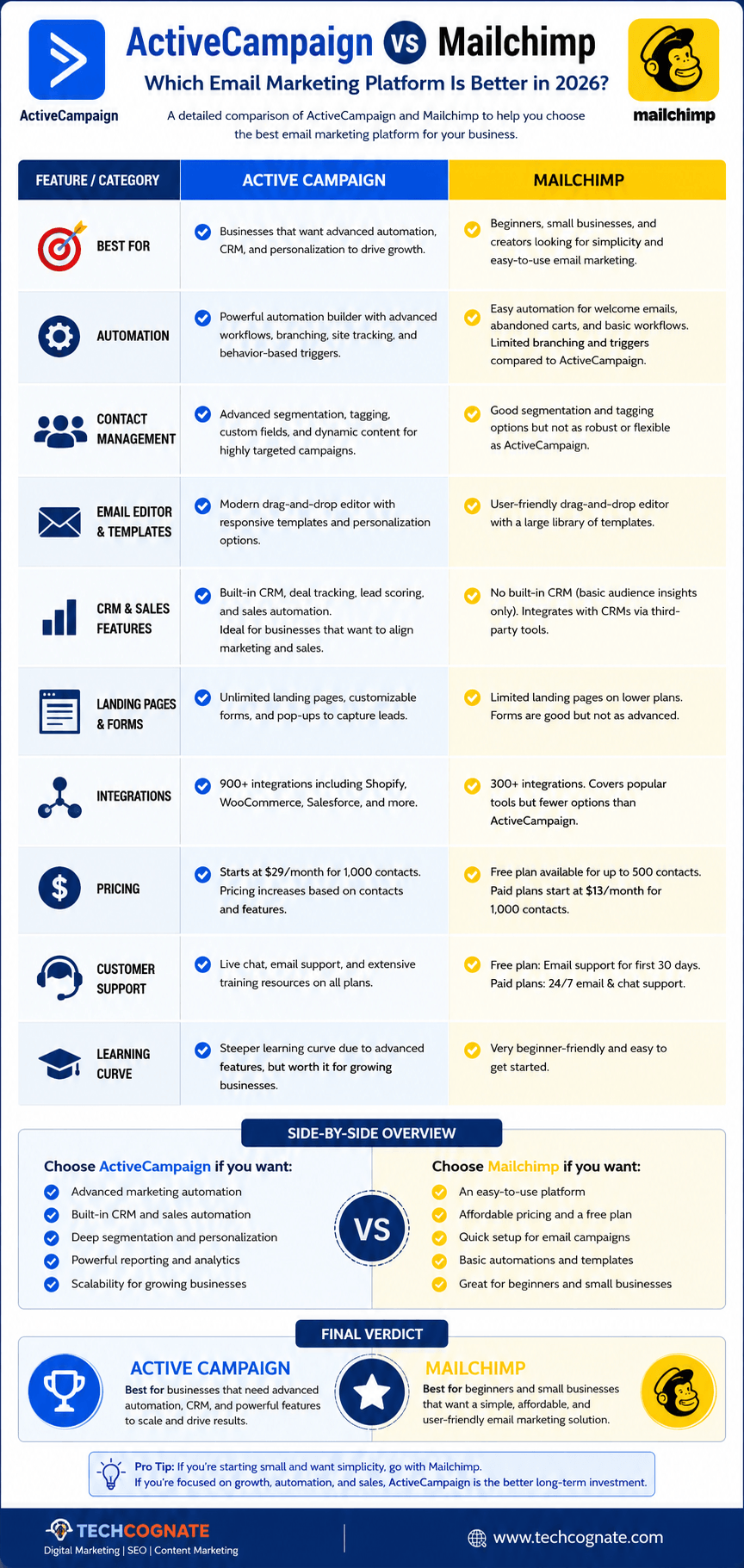
| Category | ActiveCampaign | Mailchimp | Winner |
|---|---|---|---|
| Best Overall | Advanced automation, CRM, and full lifecycle marketing | Simpler, beginner-friendly, solid free plan | ActiveCampaign |
| Best for Beginners | Steeper learning curve but comprehensive docs | Drag-and-drop simplicity, minimal setup | Mailchimp |
| Best Automation | Visual workflows, conditional logic, split paths, goals | Basic journey builder, limited branching | ActiveCampaign |
| Best CRM | Built-in sales CRM with pipeline, deal tracking, lead scoring | Audience-only CRM, no deal pipeline | ActiveCampaign |
| Best Ecommerce | Deep Shopify, WooCommerce, BigCommerce sync | Native Shopify integration, product blocks | ActiveCampaign |
| Best AI Features | Predictive sending, AI segmentation, content suggestions | AI writing assistant, subject line generator | ActiveCampaign |
| Best Templates | 600+ templates, good variety | 100+ templates, highly polished designs | Tie |
| Best Value (Budget) | Starts at $15/mo, no free plan | Free plan for up to 500 contacts | Mailchimp |
| Best Small Business | Powerful, but can feel like overkill early on | Perfect entry point for under 500 contacts | Mailchimp |
| Best Enterprise | Multi-user, advanced reporting, enterprise contracts | Scalable but automation limits show at scale | ActiveCampaign |
TL;DR — 60-Second Summary
What Is ActiveCampaign?
Founded in 2003 and headquartered in Chicago, ActiveCampaign started as an email marketing tool but has evolved into one of the most comprehensive customer experience automation platforms available. With over 180,000 customers across 170+ countries, it serves a wide range of industries — from SaaS companies to ecommerce brands, agencies, and coaches.
At its core, ActiveCampaign combines email marketing, marketing automation, CRM, and sales automation in a single platform. Its visual automation builder is widely considered the gold standard in the industry, allowing you to create multi-branch workflows that respond to almost any customer action — whether that’s clicking a link, visiting a page, purchasing a product, or going silent for 30 days.
ActiveCampaign Core Products
★ Expert Take
ActiveCampaign’s real competitive advantage isn’t any single feature — it’s how everything connects. Your CRM data feeds your automation triggers, your automation triggers update deals, and your deals inform your segmentation. It’s a genuinely integrated system, not bolted-together tools.
What Is Mailchimp?
Mailchimp was founded in 2001 in Atlanta and quickly became the world’s most recognized email marketing brand — largely because of its famous free plan and approachable design. Acquired by Intuit in 2021, Mailchimp now has over 13 million active users worldwide and serves everyone from solo bloggers to mid-market retail brands.
In recent years, Mailchimp has expanded well beyond email — adding landing pages, websites, social media scheduling, and a fairly capable Customer Journey builder. Its 2026 AI features, powered by Intuit Assist, now include an AI email writer, subject line generator, and smart scheduling recommendations.
Mailchimp Core Products
★ Expert Take
Mailchimp’s biggest strength is accessibility. The interface is clean, the templates are beautiful, and you can go from account creation to sending your first campaign in under 30 minutes. For businesses that just need reliable, attractive email communication — not complex automation — Mailchimp delivers real value.
ActiveCampaign vs Mailchimp: At a Glance
| Category | ActiveCampaign | Mailchimp | Notes |
|---|---|---|---|
| Founded | 2003 | 2001 | Both well-established |
| Headquarters | Chicago, IL | Atlanta, GA | Both US-based |
| Customers | 180,000+ | 13 million+ | MC has wider reach |
| Free Plan | No | Yes (500 contacts) | MC wins |
| Starting Price | $15/mo (annual) | $13/mo (annual) | Similar entry price |
| CRM | Full built-in CRM | Basic audience only | AC wins |
| Automation | Advanced visual builder | Basic journey builder | AC wins |
| AI Features | Predictive sending, AI segmentation | Intuit Assist (content) | AC wins |
| Landing Pages | Yes (native) | Yes (native) | Tie |
| SMS | Yes (Plus+ plans) | No | AC wins |
| Ecommerce | Deep integrations | Native Shopify, basic | AC wins |
| A/B Testing | Extensive (content, send time) | Standard (subject, content) | AC wins |
| Reporting | Advanced revenue attribution | Standard analytics | AC wins |
| API | REST API, webhooks | REST API, webhooks | Tie |
| Mobile App | Yes (iOS & Android) | Yes (iOS & Android) | Tie |
| Support | Email, chat, phone (Pro+) | Email, chat (paid), AI bot | AC wins (Pro) |
| Integrations | 900+ | 300+ | AC wins |
| Deliverability | ~90–93% | ~87–91% | AC edge |
| Ease of Use | Moderate learning curve | Very beginner friendly | MC wins |
| Templates | 600+ templates | 100+ templates | AC wins on quantity |
Who Should Choose Which?
Before we get into the granular feature comparisons, here’s a straightforward decision guide based on your actual situation:
| Choose ActiveCampaign If… | Choose Mailchimp If… |
|---|---|
| You need multi-step, conditional automation with branching logic | You want a simple drag-and-drop email builder with minimal setup |
| Your team manages a sales pipeline alongside marketing | You’re just getting started and want a free or low-cost entry point |
| You run an ecommerce store with complex abandoned cart and win-back sequences | You send regular newsletters to a small-to-medium audience |
| You need lead scoring, contact timelines, and CRM deal tracking | You want polished, beautiful templates without design experience |
| You have 1,000+ contacts and need deep segmentation | You need a simple form embed or pop-up for your site |
| You’re a SaaS company tracking user behavior triggers | You run a blog, podcast, or creative project with occasional campaigns |
| You manage multiple clients as a marketing agency | You have fewer than 500 contacts and want to avoid paying anything |
| You need SMS, site tracking, or custom attribution | You value simplicity over power and features |
Feature-by-Feature Comparison
Email Campaign Builder
Both platforms give you a visual drag-and-drop email editor, but the experience feels noticeably different. ActiveCampaign’s editor is block-based and moderately easy to use, with good options for conditional content blocks that show different content to different contact segments. Mailchimp’s editor is arguably cleaner and faster — you can build a campaign in minutes, and the design output tends to look more polished out of the box.
| ActiveCampaign | Mailchimp | Winner |
|---|---|---|
| Visual drag-and-drop editor | Visual drag-and-drop editor | Tie |
| Conditional content blocks | Basic dynamic content | ActiveCampaign |
| AI email writing assistant | Intuit Assist AI writing | Tie |
| Extensive A/B test options (content, time, subject) | Standard A/B (subject, content) | ActiveCampaign |
| 600+ email templates | 100+ templates, more polished | Mailchimp (design) |
| Preview across devices and clients | Preview + inbox test (paid) | Tie |
| Transactional email support | Transactional via Mandrill (addon) | ActiveCampaign |
💡 Real-World Example
If you’re an ecommerce brand sending a promotional campaign with different content for VIP customers vs. first-time buyers, ActiveCampaign’s conditional content blocks let you handle this in one email. Mailchimp requires separate campaigns or paid plan features.
Automation Builder
This is where the gap between the two platforms becomes most apparent. ActiveCampaign’s automation builder is genuinely in a class of its own for most mid-market use cases. You can build complex multi-branch workflows with wait conditions, goals, split testing, and nested logic. Mailchimp’s Customer Journey builder is functional but limited — it’s more suited for simple drip sequences than multi-touchpoint lifecycle automation.
| ActiveCampaign | Mailchimp | Winner |
|---|---|---|
| Visual canvas automation builder | Customer Journey Map (visual) | Tie (on surface) |
| Conditional branch logic (if/else paths) | Basic branching, limited conditions | ActiveCampaign |
| Split (A/B) test within automation | No split testing in journeys | ActiveCampaign |
| Automation goals (exit when met) | No built-in goal tracking | ActiveCampaign |
| Wait steps (time-based or action-based) | Wait steps (time-based only) | ActiveCampaign |
| Site and event tracking triggers | Limited behavioral triggers | ActiveCampaign |
| Automation library (850+ pre-built recipes) | Basic pre-built journey templates | ActiveCampaign |
| Reusable automation blocks | Not available | ActiveCampaign |
| Automation reporting (opens, conversions, revenue) | Basic journey analytics | ActiveCampaign |
Imagine you’re running a SaaS product. With ActiveCampaign, you can trigger an automation when someone signs up, send a welcome sequence, wait 7 days, check if they’ve logged in using your site tracking, and then branch — sending power-user tips to those who have and a re-engagement sequence to those who haven’t. Mailchimp simply doesn’t have the behavioral trigger depth to handle this gracefully.
CRM Comparison
ActiveCampaign includes a genuine sales CRM, while Mailchimp’s ‘CRM’ capabilities are really just audience management with tags and segments. If you have a sales team that needs pipeline visibility, this is a critical difference.
| ActiveCampaign | Mailchimp | Winner |
|---|---|---|
| Dedicated sales pipeline (Kanban-style) | No sales pipeline | ActiveCampaign |
| Deal stages and deal tracking | Not available | ActiveCampaign |
| Lead scoring (predictive + manual) | Basic tags only | ActiveCampaign |
| Full contact timeline (all touchpoints) | Activity history, limited | ActiveCampaign |
| Task and note management | No task management | ActiveCampaign |
| Sales automation (auto-create deals, alerts) | Not available | ActiveCampaign |
| Win probability scoring | Not available | ActiveCampaign |
| Team collaboration on contacts | Limited | ActiveCampaign |
💼 Bottom Line on CRM
If your business has any B2B component or if your sales and marketing teams need to operate from the same data, ActiveCampaign’s CRM is a meaningful advantage. Mailchimp treats contacts as an audience; ActiveCampaign treats them as prospects and customers across their entire lifecycle.
AI Features Comparison (2026)
Both platforms have accelerated their AI investments in 2025 and 2026, but their approaches differ significantly. ActiveCampaign’s AI is embedded more deeply into the automation and segmentation engine, while Mailchimp’s Intuit Assist focuses primarily on content generation.
| ActiveCampaign | Mailchimp | Winner |
|---|---|---|
| Predictive sending (optimal send time) | Send time optimization | Tie |
| AI-powered segmentation (win probability) | Basic predictive segments (paid) | ActiveCampaign |
| Predictive content (personalized blocks) | Not available | ActiveCampaign |
| AI email writing assistant | Intuit Assist AI writer | Tie |
| AI subject line generator | AI subject line suggestions | Tie |
| Recommended automations (AI-based) | Not available in 2026 | ActiveCampaign |
| Churn prediction signals | Not available | ActiveCampaign |
| AI reporting insights | Basic AI-generated insights | Tie |
Mailchimp’s Intuit Assist is genuinely useful for creating first-draft emails quickly. But ActiveCampaign’s predictive AI — particularly its win probability scoring and predictive segmentation — gives marketers a more strategic advantage. If content speed is your priority, Mailchimp’s AI is solid. If strategic automation intelligence matters more, ActiveCampaign leads.
Segmentation
Sophisticated segmentation is the backbone of modern email marketing. Both tools support tags and lists, but ActiveCampaign’s segmentation depth is considerably greater — especially when combined with site tracking data, CRM fields, and automation behavior.
| ActiveCampaign | Mailchimp | Winner |
|---|---|---|
| Tags-based contact organization | Tags and groups | Tie |
| Behavioral triggers (page visits, link clicks) | Limited behavioral segments | ActiveCampaign |
| Purchase history segmentation | Basic purchase data (Mailchimp Stores) | ActiveCampaign |
| Custom fields (unlimited) | Custom fields (paid plans) | ActiveCampaign |
| Predictive AI segmentation | Predictive segments (Standard+) | ActiveCampaign |
| Geographic segmentation | Yes | Tie |
| Engagement-based segments | Yes (Essentials+) | Tie |
Ecommerce Features
Both platforms have built ecommerce-specific features, but ActiveCampaign’s integrations run deeper, and its automation builder allows more sophisticated post-purchase and win-back sequences. If ecommerce SEO is also on your roadmap, our WooCommerce SEO guide and Shopify SEO guide cover the technical side of things.
| ActiveCampaign | Mailchimp | Winner |
|---|---|---|
| Shopify integration | Deep native integration | Both solid; AC more triggers |
| WooCommerce integration | Available via plugin | ActiveCampaign |
| BigCommerce integration | Via third-party | ActiveCampaign |
| Abandoned cart automation | Yes (Journey builder) | Tie (AC more customizable) |
| Product recommendation blocks | Available (paid plans) | Tie |
| Revenue attribution reporting | Basic revenue tracking | ActiveCampaign |
| Post-purchase sequences | Available in Journey builder | ActiveCampaign (more conditions) |
| Customer lifetime value tracking | Not available natively | ActiveCampaign |
Reporting & Analytics
ActiveCampaign’s reporting goes further down the funnel — connecting email performance to deal revenue and automation goal completion. Mailchimp’s reporting is clean, easy to read, and sufficient for newsletter-style use cases, but it lacks attribution depth.
| ActiveCampaign | Mailchimp | Winner |
|---|---|---|
| Open rates, CTR, unsubscribe rates | Open rates, CTR, unsubscribes | Tie |
| Revenue tracking per campaign | Basic e-commerce revenue tracking | ActiveCampaign |
| Automation conversion reporting | Journey analytics | ActiveCampaign |
| Custom report builder | Not available | ActiveCampaign |
| Goal completion tracking | Not available in Mailchimp | ActiveCampaign |
| Contact-level activity reports | Contact activity feed | ActiveCampaign |
| Comparison reports (campaigns) | Campaign comparison | Tie |
Deliverability
Deliverability is the percentage of emails that land in the inbox rather than spam. Both platforms perform well, but ActiveCampaign consistently earns higher deliverability scores in independent benchmark studies, likely due to stricter list hygiene enforcement and dedicated IP options on higher plans.
| Metric | ActiveCampaign | Mailchimp |
|---|---|---|
| Average inbox placement | ~90–93% | ~87–91% |
| DKIM and SPF authentication | Yes | Yes |
| DMARC support | Yes | Yes |
| Dedicated IP (Enterprise) | Yes (Pro/Enterprise) | Yes (Legacy High Volume) |
| Spam testing tools | Native + integrations | Inbox preview (paid) |
| List hygiene enforcement | Stricter bounce/unsubscribe rules | Standard rules |
It’s worth noting that deliverability is heavily influenced by your own sending practices — list quality, engagement rates, and email content matter more than the platform. Both tools will perform well with a clean, engaged list.
Integrations
ActiveCampaign connects with 900+ apps via native integrations and webhooks, compared to Mailchimp’s 300+. Both platforms support Zapier for additional connectivity, but ActiveCampaign’s native ecosystem is broader — especially for CRM, ecommerce, and analytics tools.
| ActiveCampaign Integrations | Mailchimp Integrations |
|---|---|
| HubSpot (bidirectional contact sync) | HubSpot (limited sync) |
| Salesforce native integration | Salesforce via Zapier |
| Shopify (deep sync) | Shopify (native, solid) |
| WooCommerce plugin | WooCommerce (limited) |
| Stripe | Stripe |
| Calendly | Calendly |
| Slack notifications | Slack notifications |
| Google Analytics 4 | Google Analytics 4 |
| Meta Ads (Custom Audiences) | Meta Ads (Custom Audiences) |
| WordPress forms plugin | WordPress embed |
| Zapier (for everything else) | Zapier (for everything else) |
Ease of Use
Mailchimp wins this category, and it’s not close. If you’re setting up your first email campaign, Mailchimp’s onboarding flow is genuinely impressive — you can connect your website, import contacts, pick a template, and send in under an hour. ActiveCampaign has a steeper learning curve, especially around automation setup, CRM configuration, and the contacts/deals structure.
That said, ActiveCampaign’s documentation and onboarding help have improved significantly. The platform now offers guided setup wizards, an automation recipe library, and a training academy (ActiveCampaign University) that dramatically reduces the learning curve for new users.
Customer Support
Support quality varies significantly by plan level on both platforms:
| Category | ActiveCampaign | Mailchimp | Winner |
|---|---|---|---|
| Email support | All plans | Paid plans only | Tie |
| Live chat | All plans | Standard+ plans | ActiveCampaign |
| Phone support | Professional+ plans | Not available (general) | ActiveCampaign |
| Knowledge base | Extensive documentation | Extensive, beginner-friendly | Tie |
| Community forum | ActiveCampaign Community | Mailchimp Community | Tie |
| Onboarding help | 1-on-1 onboarding (Pro) | Basic guided setup | ActiveCampaign |
| Response time | Under 4 hours (typical) | Varies by plan | ActiveCampaign |
Pricing Comparison
Pricing is one of the most important factors in this decision — and both platforms have nuances worth understanding before you commit.
ActiveCampaign Pricing (2026, Annual, 1,000 contacts)
| Plan | Price/mo | Contacts | Key Feature |
|---|---|---|---|
| Starter | $15/mo | 1,000 | Email + basic automation |
| Plus | $49/mo | 1,000 | CRM, landing pages, SMS |
| Professional | $79/mo | 1,000 | Predictive sending, split automations |
| Enterprise | Custom | Custom | Custom reporting, SSO, SLA |
Mailchimp Pricing (2026, Annual, 1,000 contacts)
| Plan | Price/mo | Contacts | Key Feature |
|---|---|---|---|
| Free | $0/mo | 500 | Basic email, 1,000 sends/mo |
| Essentials | $13/mo | 500 | A/B testing, 24/7 email support |
| Standard | $20/mo | 500 | Journey builder, custom templates |
| Premium | $350/mo | 10,000 | Advanced segmentation, multivariate |
📈 Pricing Watch
Both platforms scale pricing by contact count, and costs can grow quickly. At 10,000 contacts, ActiveCampaign Professional runs ~$174/mo while Mailchimp Standard is ~$100/mo. At 50,000 contacts, ActiveCampaign becomes significantly pricier — but includes CRM features Mailchimp doesn’t offer at any price tier.
Hidden cost alert: Mailchimp counts unsubscribed contacts toward your billing total. If you import a large old list, you may be paying for contacts who will never engage. ActiveCampaign only counts active contacts — a meaningful difference at scale.
Ready to Test-Drive Either Platform?
Both offer a risk-free way to explore the full feature set before you commit a dollar.
|
Try ActiveCampaign → 14-day free trial · no credit card required |
Try Mailchimp → Free forever · up to 500 contacts |
Pros and Cons
ActiveCampaign
| ActiveCampaign Pros ✓ | ActiveCampaign Cons ✗ |
|---|---|
| Industry-leading automation builder | Steeper learning curve |
| Full built-in sales CRM with deal tracking | No free plan — minimum $15/mo |
| Deep ecommerce and B2B integrations (900+) | Can feel complex for simple newsletter use |
| Superior deliverability rates | Mobile app is functional but not polished |
| Predictive AI features (sending, segmentation) | Costs scale quickly with contact growth |
| SMS, site tracking, custom attribution | UI is improving but not as polished as Mailchimp |
| Revenue reporting tied to automation goals | Enterprise features require higher plans |
Mailchimp
| Mailchimp Pros ✓ | Mailchimp Cons ✗ |
|---|---|
| Genuinely free plan (500 contacts, 1,000 sends/mo) | Automation is limited beyond basic journeys |
| Fastest, cleanest email builder on the market | No built-in CRM or sales pipeline |
| Beautiful, polished template library | Counts unsubscribed contacts in billing |
| Excellent onboarding for beginners | Deliverability slightly lower than AC |
| Intuit Assist AI for fast email creation | Advanced segmentation locked to Premium ($350+/mo) |
| Website builder included | Phone support not available on any plan |
| Social media scheduling built in | Limited integration ecosystem (300+) |
What Real Users Say
To keep this honest, here’s what users consistently report across G2, Capterra, and Trustpilot:
ActiveCampaign — User Sentiment
G2 rating: 4.5/5 (10,000+ reviews) · Capterra: 4.6/5
Mailchimp — User Sentiment
G2 rating: 4.3/5 (12,000+ reviews) · Capterra: 4.5/5
Which Platform Is Better For…
Small Business
If you’re a small business owner with under 500 contacts who just wants to send monthly newsletters and the occasional promotion, Mailchimp’s free plan is genuinely hard to beat. You’ll be up and running in an hour with no credit card required. Once you cross 1,000 contacts and start needing automation, the value proposition shifts toward ActiveCampaign.
Ecommerce Brands
ActiveCampaign. The platform’s deep Shopify and WooCommerce integrations, combined with the ability to trigger complex automation sequences based on purchase behavior, cart value, and product categories, make it the more powerful choice for ecommerce. Mailchimp’s native Shopify integration is solid for basic abandoned cart recovery, but lacks the conditional logic depth for multi-touch ecommerce sequences. Pairing either platform with a solid ecommerce SEO strategy will compound your results.
SaaS Companies
ActiveCampaign. The ability to trigger automations based on in-app behavior via API or site tracking, combined with the CRM for managing trial-to-paid conversion pipelines, makes it better suited for SaaS growth workflows.
Bloggers and Content Creators
Mailchimp. A content creator sending a weekly newsletter to a few thousand subscribers doesn’t need a CRM or a 30-step automation workflow. Mailchimp’s template quality and ease of use make it the faster, lower-friction option.
Marketing Agencies
ActiveCampaign. Multi-client management, white-labeling options on higher plans, and the depth of the automation and reporting suite make it the agency-preferred choice. Mailchimp doesn’t offer multi-account management in the same way. Agencies juggling client SEO work alongside email might also find our AI SEO toolkit for agencies useful.
Nonprofits
Both platforms offer nonprofit discounts. Mailchimp’s free plan is a great starting point for small nonprofits. As donor journey complexity increases, ActiveCampaign’s automation becomes more useful.
Enterprise
ActiveCampaign’s Enterprise plan includes custom reporting, dedicated account management, SSO, and SLA guarantees. Mailchimp’s Premium plan is capable but doesn’t match the CRM depth or customization of ActiveCampaign at the enterprise level.
Startups
It depends on stage. Pre-product-market-fit, Mailchimp’s free plan covers your needs. Once you’re building a growth funnel with product trials, onboarding sequences, and lead nurturing, transition to ActiveCampaign.
Coaches and Consultants
Mailchimp for pure list building and newsletters. ActiveCampaign if you’re selling courses, running webinar sequences, or want to track client journey stages in a pipeline.
Migration Guide
Moving from Mailchimp to ActiveCampaign
Thousands of businesses make this transition annually as their automation needs outgrow Mailchimp. Here’s how to do it without losing data or momentum:
⚠ Common Mistake to Avoid
Don’t try to migrate automations one-to-one. Use the migration as an opportunity to rebuild your sequences with ActiveCampaign’s more powerful conditional logic. Many migrating businesses end up replacing 5 Mailchimp automations with 2 more efficient ActiveCampaign workflows.
Moving from ActiveCampaign to Mailchimp
Security & Compliance
| ActiveCampaign | Mailchimp | Winner |
|---|---|---|
| GDPR compliant | GDPR compliant | Tie |
| CCPA compliant | CCPA compliant | Tie |
| SOC 2 Type II certified | SOC 2 Type II certified | Tie |
| Data encryption at rest and in transit | Encryption at rest and in transit | Tie |
| Two-factor authentication (2FA) | 2FA available | Tie |
| User permissions and roles | User roles (limited on lower plans) | ActiveCampaign |
| Audit logs (Enterprise) | Not available (Standard plans) | ActiveCampaign |
| Single Sign-On (SSO) | Not natively available | ActiveCampaign |
| Data residency options | US and EU | ActiveCampaign edge |
ActiveCampaign vs Mailchimp Alternatives
If neither platform quite fits your needs, here’s how the competitive landscape looks in 2026. And if your evaluation extends into the broader marketing-tool stack, our Semrush review and Ahrefs review cover the SEO side of that decision:
| Category | ActiveCampaign | Mailchimp | Notes |
|---|---|---|---|
| Brevo (Sendinblue) | Unlimited contacts, pay per email sent | Strong value, good automation | Better for high-volume, cost-conscious teams |
| Klaviyo | Deep ecommerce focus, Shopify-native | Best-in-class for DTC brands | Expensive; best for $1M+ revenue ecommerce |
| Kit (ConvertKit) | Creator-first platform, simple sequences | Best for solo creators and bloggers | Limited CRM; no ecommerce depth |
| Constant Contact | Simple email + event marketing | Good for local businesses | Lacks automation depth of either platform |
| GetResponse | Email + webinar + landing pages | All-in-one at lower cost | Less polished; webinar feature is unique |
| HubSpot | Full inbound marketing suite + CRM | Enterprise-grade, free CRM tier | Expensive; better for B2B full-funnel teams |
| Omnisend | Ecommerce-first with SMS + push | Best for SMS + email combined | Narrower use case; strong Shopify fit |
| Drip | Ecommerce CRM + email | Strong purchase behavior automation | Smaller ecosystem than AC or Mailchimp |
Comparison Scorecard
| Category | ActiveCampaign | Mailchimp | Verdict |
|---|---|---|---|
| Ease of Use | 7/10 | 9/10 | Mailchimp wins |
| Automation | 10/10 | 5/10 | ActiveCampaign wins |
| CRM | 9/10 | 3/10 | ActiveCampaign wins |
| AI Features | 8/10 | 7/10 | ActiveCampaign wins |
| Ecommerce | 9/10 | 7/10 | ActiveCampaign wins |
| Templates | 8/10 | 9/10 | Mailchimp wins |
| Integrations | 9/10 | 7/10 | ActiveCampaign wins |
| Reporting | 9/10 | 6/10 | ActiveCampaign wins |
| Pricing (Value) | 7/10 | 9/10 | Mailchimp wins |
| Support | 8/10 | 6/10 | ActiveCampaign wins |
| Deliverability | 9/10 | 8/10 | ActiveCampaign wins |
| Overall | 8.5/10 | 7.0/10 | ActiveCampaign wins |
Frequently Asked Questions
Is ActiveCampaign better than Mailchimp?
For most growing businesses that need automation, CRM, and ecommerce depth, yes — ActiveCampaign is the more powerful platform. But Mailchimp is better for beginners, budget-conscious users, and anyone who values simplicity over power.
Is Mailchimp easier to use than ActiveCampaign?
Significantly. Mailchimp’s onboarding, template selection, and email builder are consistently rated more beginner-friendly. ActiveCampaign’s learning curve is steeper, especially for the automation builder and CRM configuration.
Which has better automation — ActiveCampaign or Mailchimp?
ActiveCampaign, by a wide margin. Its visual automation builder supports conditional branching, split testing, goals, reusable blocks, and hundreds of trigger/action combinations. Mailchimp’s Customer Journey builder is functional but suited only for simple drip sequences.
Which platform has a better CRM?
ActiveCampaign. It includes a full sales CRM with deal pipelines, lead scoring, contact timelines, and sales automation. Mailchimp doesn’t offer a sales pipeline at any price tier.
Is ActiveCampaign cheaper than Mailchimp?
Not exactly. Mailchimp’s free plan (500 contacts) makes it cheaper at the entry level. At 1,000+ contacts, both start at similar monthly prices. ActiveCampaign becomes more expensive at scale but includes CRM features that would otherwise require a separate paid tool.
Which has higher email deliverability?
ActiveCampaign consistently scores slightly higher in independent deliverability benchmarks (~90–93% vs. Mailchimp’s ~87–91%). However, both are solid performers, and your list quality matters more than the platform choice.
Can I migrate from Mailchimp to ActiveCampaign?
Yes. ActiveCampaign has a dedicated Mailchimp import tool that migrates contacts and basic list structure. Automation workflows must be rebuilt manually, which is the most time-intensive part of migration.
Which is better for Shopify?
Both integrate natively with Shopify, but ActiveCampaign’s integration is deeper — supporting more purchase trigger types, product-level segmentation, and revenue attribution across the full automation workflow. Mailchimp’s Shopify integration is solid for abandoned cart and product emails but has fewer conditional options.
Which is better for agencies managing multiple clients?
ActiveCampaign. It offers multi-account management, white-labeling on higher plans, and deeper reporting that agencies need for client reporting. Mailchimp doesn’t offer true multi-account management in the same way.
Which platform has better AI features in 2026?
ActiveCampaign’s AI is more deeply integrated into its automation and segmentation engine — with predictive sending, AI-powered segmentation, and churn signals. Mailchimp’s Intuit Assist is useful for content generation and subject line suggestions. For strategic marketing intelligence, ActiveCampaign leads; for content creation speed, it’s a closer race.
Does Mailchimp have a free plan in 2026?
Yes. Mailchimp’s free plan supports up to 500 contacts and 1,000 email sends per month. It includes basic email templates, a landing page, and signup forms — enough to get started without paying anything.
Does ActiveCampaign have a free trial?
ActiveCampaign offers a 14-day free trial on all plans. There’s no ongoing free tier, but the trial gives you full access to test the automation builder, CRM, and email tools before committing.
Which is better for B2B marketing?
ActiveCampaign. Its CRM, lead scoring, deal pipeline, and ability to track long sales cycles with behavior-based automation make it better suited for B2B. Mailchimp’s audience model is designed more for B2C broadcasting than B2B lifecycle marketing.
Can ActiveCampaign replace a standalone CRM like HubSpot?
For small to mid-sized businesses, yes — ActiveCampaign’s built-in CRM handles deal tracking, pipeline management, and contact lifecycle management well. For enterprise-scale CRM needs (complex custom objects, advanced forecasting, or large sales team collaboration), a dedicated CRM like HubSpot or Salesforce may still be warranted.
Which has better customer support?
ActiveCampaign. It offers email support on all plans, live chat on all plans, and phone support on Professional and Enterprise plans. Mailchimp restricts support access on free and lower-tier plans and doesn’t offer phone support at any level.
Which is better for real estate?
ActiveCampaign. Real estate professionals benefit from the CRM pipeline for tracking leads through property inquiry, showing, offer, and close stages. Combined with automated follow-up sequences based on contact behavior, it’s a more complete solution than Mailchimp for real estate use cases.
Is Mailchimp good for newsletters?
Mailchimp is excellent for newsletters. Its clean template library, simple audience management, and intuitive editor make it one of the best options for creators, bloggers, and businesses that primarily communicate through regular newsletters.
What is ActiveCampaign’s best plan for a small business?
The Starter plan at $15/mo covers email marketing and basic automation for most small businesses. Upgrade to Plus ($49/mo) when you need CRM, SMS, or landing pages. Most growing businesses find the Plus plan covers their needs for several years.
Does Mailchimp have SMS marketing?
Mailchimp launched SMS in select markets but it’s not broadly available across all plans or regions as of 2026. ActiveCampaign includes SMS on Plus and higher plans with more mature feature support.
Which is better for a nonprofit?
Both offer nonprofit discounts. For a nonprofit sending monthly donor updates to under 500 contacts, Mailchimp’s free plan is ideal. For nonprofits with complex donor journeys, event automation, or fundraising pipelines, ActiveCampaign’s automation and CRM add real value.
Final Verdict
After testing both platforms extensively, the answer isn’t that one is universally better — but the distinction is clearer than most comparison guides admit.
If you’re a creator, blogger, or small business owner who wants to send beautiful emails, grow a list, and not think too hard about software, Mailchimp is the right choice. It’s genuinely good at what it does, and the free plan gives you real runway to grow before spending a dollar.
If you’re a growing ecommerce brand, SaaS company, B2B team, or any business that needs automation to do the heavy lifting in your customer journey — if you want your marketing platform to know your customers, move deals forward, and fire off the right message at exactly the right moment — ActiveCampaign is the more powerful, more strategic platform. The learning curve is real, but so is the return.
The businesses that outgrow Mailchimp don’t usually regret switching to ActiveCampaign. They usually regret not switching earlier.
🎯 Our Recommendation
Start with Mailchimp if you have fewer than 500 contacts or limited technical bandwidth. Upgrade to ActiveCampaign when your automation needs, CRM requirements, or ecommerce complexity outgrow what Mailchimp can handle. Most businesses reach that point between 1,000 and 5,000 contacts.
Ready to Choose?
Here’s what to do next — both platforms let you test the full feature set before paying anything:
Best for Power & Automation ActiveCampaign ✓ 14-day free trial — no credit card required ✓ Full automation builder, CRM & all plan features included ✓ Best for: growing businesses, ecommerce, B2B, agencies, SaaS | Best for Simplicity & Budget Mailchimp ✓ Free forever — up to 500 contacts, no credit card needed ✓ Email builder, 1 landing page & basic automation included ✓ Best for: beginners, bloggers, creators, small businesses |

Jaykishan Panchal
Founder, TechCognate · SEO Strategist & WordPress Expert
Jaykishan Panchal is the founder of TechCognate and an SEO strategist with 15+ years of hands-on experience driving organic growth for businesses worldwide. He specialises in technical SEO, content strategy and GEO (Generative Engine Optimisation), helping brands stay visible in both traditional search and AI-driven discovery.
- Technical SEO
- Content Strategy
- AI & GEO
- Google Ads
- E-Commerce SEO