Best AEO Tools (2026): 5 Answer Engine Optimization Tools We Actually Recommend
By Jaykishan Panchal | Updated August 2026 | 14 min read
Type a question into ChatGPT, Google AI Overviews, or Perplexity today, and there’s a good chance you won’t click a single blue link. The answer just appears — fully formed, sourced, and pulled together from a handful of pages the AI decided were worth trusting.
That’s the shift nobody’s slowing down for. In 2026, a huge share of searches never make it to a traditional results page at all — they get resolved inside an AI answer, on Google, on ChatGPT, on Copilot, wherever the person happened to ask. And if your content isn’t one of the sources the AI pulled from, you don’t just rank lower. You disappear from that conversation entirely.
This is where Answer Engine Optimization (AEO) comes in. It’s not a replacement for SEO — think of it as SEO’s more demanding sibling, one that cares less about ranking #1 and more about getting quoted, cited, and trusted by the AI systems people now ask instead of Google.
So which tools actually help with that? Here’s what we found after testing and researching five that combine real AEO/GEO capability with a track record you can trust.
Quick answer
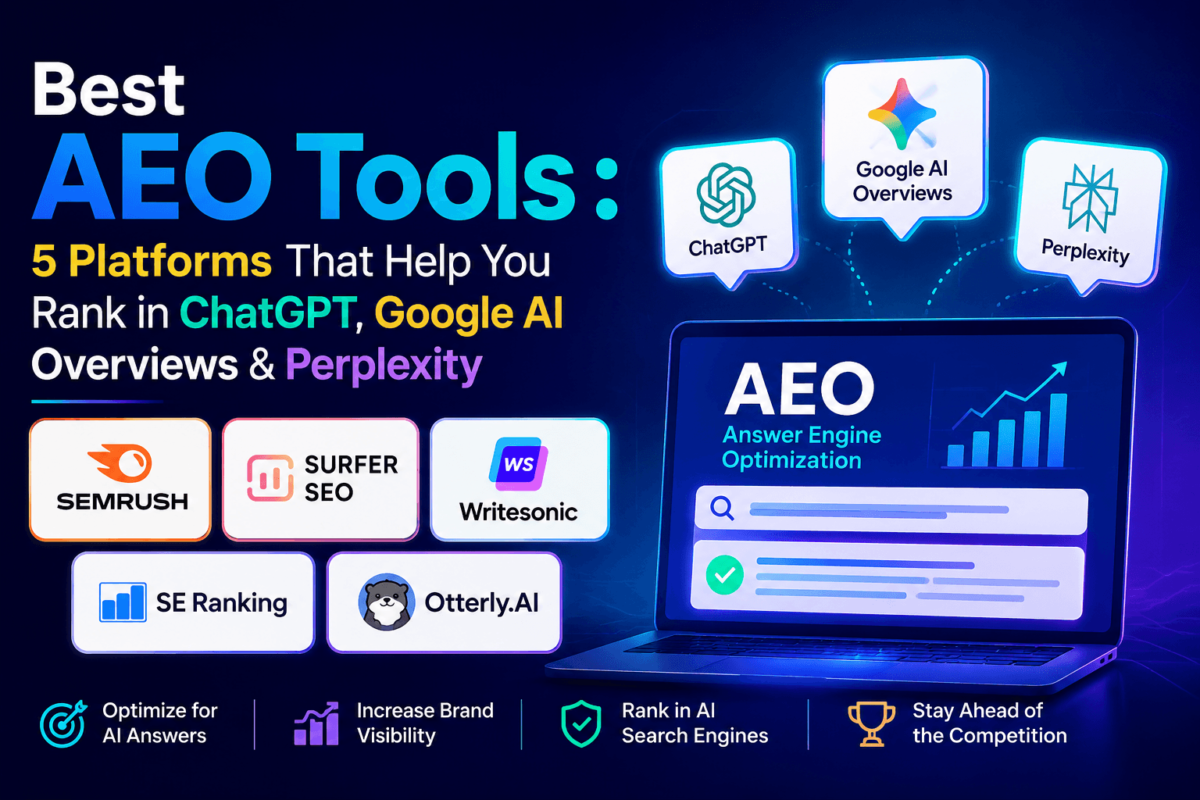
If you only read one section, read this one. Semrush is the best all-around pick for teams that want traditional SEO and AI visibility tracking in one dashboard. Surfer SEO wins for content teams optimizing pages to actually get cited. Writesonic is the strongest option if you want AI content creation and GEO tracking bundled together. SE Ranking is the best budget-friendly all-in-one pick. And Otterly AI is the best dedicated AI search visibility tracker if you already have an SEO tool and just need citation monitoring.
| Tool | Best For | Starting Price | Standout AEO Feature |
|---|---|---|---|
| Semrush | Full SEO + AI visibility in one platform | ~$139.95/mo | AI Toolkit tracks citations across ChatGPT, Gemini, AI Overviews |
| Surfer SEO | Content optimized to get cited | ~$99/mo | NLP-based entity scoring against top-cited pages |
| Writesonic | AI content creation + GEO tracking | ~$39/mo | Built-in GEO dashboard alongside AI Article Writer |
| SE Ranking | Budget-friendly all-in-one SEO/AEO | ~$65/mo | AI Overview tracking + white-label reporting |
| Otterly AI | Dedicated AI search visibility tracking | ~$29/mo | Brand Visibility Index across 6 AI engines |
Pricing shown is starting price at time of writing and changes periodically — check each provider’s site for current plans.
What Is Answer Engine Optimization (AEO)?
Answer Engine Optimization is the practice of structuring and positioning your content so AI-powered systems — ChatGPT, Google AI Overviews, Gemini, Perplexity, Microsoft Copilot — choose to cite it when answering a user’s question directly.
Here’s where things get interesting: a traditional search engine matches keywords to pages, ranks those pages by hundreds of signals, and hands the user a list of links to click through. An answer engine works differently. It reads a question, pulls information from multiple sources, synthesizes those sources into a single response, and — if it’s doing its job well — tells the user where that information came from.
That “where it came from” part is everything. Answer engines rely on large language models (LLMs) that lean heavily on structured data, clear entity relationships, and content that answers a question in the first sentence rather than burying it under three paragraphs of throat-clearing. Schema markup, semantic SEO, and knowledge graphs all feed into how confidently an AI system can identify what your page is actually about — and whether it’s safe to quote.
Why does this matter in 2026 specifically? AI Overviews now appear on a majority of Google searches, ChatGPT has hundreds of millions of weekly users treating it like a search engine, and Perplexity built its entire product around citation-based answers. If AEO isn’t part of your content strategy yet, you’re optimizing for a search landscape that’s already shrinking. We cover the mechanics of this in more depth in our full guide to Answer Engine Optimization — but the short version is this: rankings still matter, but citations matter more.
How AEO Differs From Traditional SEO
Traditional SEO and AEO aren’t rivals — they’re overlapping disciplines with different scorecards. SEO is still about earning visibility in search results. AEO is about earning a mention inside the answer itself, whether or not the user ever clicks through to your URL. Here’s the shift, side by side:
| Traditional SEO | AEO |
|---|---|
| Rankings | Answers |
| Keywords | Intent |
| SERPs | AI responses |
| Backlinks | Citations |
| Web pages | Entities |
Notice the pattern? Traditional SEO optimizes for a list. AEO optimizes for a single, synthesized answer — which means the bar for “good enough” content just got a lot higher. For a deeper breakdown of how these approaches (and GEO, and LLMO) differ in practice, our SEO vs GEO vs AEO vs LLMO comparison walks through each one.
How We Chose the Best AEO Tools
We didn’t just grab five popular SEO brands and slap “AEO” on the title. Every tool on this list had to clear a specific bar:
- Tracks visibility inside AI answers — ChatGPT, Gemini, AI Overviews, Perplexity, Copilot — not just traditional rankings
- Supports schema and structured data recommendations that help AI systems parse content correctly
- Offers entity-level optimization, not just keyword matching
- Gives content recommendations built around what actually gets cited, not just what ranks
- Is genuinely established, with a real reputation in the SEO industry — no unproven six-month-old startups
- Has an active, verifiable affiliate program as of August 2026
Five tools met every criterion. Here they are.
Best AEO Tools (2026)
1. Semrush — Best Overall for SEO + AI Visibility in One Platform
Semrush needs no introduction if you’ve spent any time in SEO — it’s the closest thing the industry has to a standard platform. What’s changed is that Semrush has folded AI visibility tracking directly into its core toolkit, so you can watch traditional rankings and AI citations from the same dashboard, without stitching together two subscriptions and two reporting workflows.
Who should use it: agencies and in-house teams that want one platform covering keyword research, competitor analysis, technical audits, and AI visibility, and who don’t mind the learning curve that comes with a tool this deep. If you’re weighing it against the competition, our Semrush vs Ahrefs comparison covers where each one wins — and Semrush is currently the stronger pick specifically for AEO/GEO work.
Best features:
- AI visibility tracking across ChatGPT, Gemini, Google AI Overviews, and Perplexity
- Position Tracking that now includes AI Overview appearances alongside traditional rankings
- Schema markup recommendations built into Site Audit
- Entity and topic research tools for building topical authority
- SEO Writing Assistant for content optimization against live SERP/AI data
- Competitor AI-citation gap analysis
| Pros | Cons |
|---|---|
|
|
Pricing: Plans start around $139.95/month for the Pro tier, with AI visibility and advanced GEO features layered into the higher Guru and Business tiers (or bundled through Semrush’s newer Semrush One offering). Pricing shifts periodically, so check current plans before committing.
Why we recommend it: If you can only afford one tool and want it to cover both worlds — rankings and AI citations — Semrush is the safest bet. It’s the platform most likely to still be relevant to AEO two years from now, simply because it has the resources to keep building.
2. Surfer SEO — Best for Content Optimized to Get Cited
Surfer SEO takes a different angle than Semrush. It’s not trying to be your whole SEO command center — it’s laser-focused on one job: telling you exactly what a page needs to include, structurally and semantically, to compete with what’s already ranking and getting cited. That’s a genuinely AEO-relevant skill, because AI systems tend to pull from pages that cover a topic completely, use clear headers, and answer the question early.
Who should use it: content writers, editors, and SEO teams who already have a keyword strategy and need help turning briefs into pages that actually get quoted. Our Surfer SEO review goes deeper into how the Content Editor scoring model works.
Best features:
- Content Editor with NLP-based entity and keyword scoring
- SERP Analyzer showing what top-ranking and top-cited pages have in common
- Surfer AI for generating full drafts against a target content score
- Audit tool that flags optimization gaps in already-published content
- Google Docs, WordPress, and Jasper integrations
| Pros | Cons |
|---|---|
|
|
Pricing: Plans start around $99/month for the Essential tier, priced by article credits rather than flat access.
Why we recommend it: Tracking your AI visibility is only half the job — you also need pages worth citing in the first place. Surfer is the tool most focused on that second half.
3. Writesonic — Best for AI Content Creation With Built-In GEO Tracking
Writesonic sits at the intersection of two things AEO strategy needs: content built to be cited, and a way to check whether it’s actually working. Alongside its AI Article Writer, Writesonic has leaned into generative engine optimization features that track how often your brand shows up inside ChatGPT and other AI answers — a smart bundle if you’re publishing at volume and don’t want a third subscription just to monitor it.
Who should use it: content teams and solo creators who need to publish frequently and want visibility tracking included rather than bolted on separately. Our best AI writing tools roundup covers where Writesonic fits against alternatives like Jasper.
Best features:
- AI Article Writer with built-in SEO/AEO scoring
- GEO dashboard tracking brand mentions across ChatGPT, Perplexity, and Gemini
- Chatsonic AI research assistant for fact-gathering during drafting
- Bulk content workflows for programmatic and scaled publishing
- Brand voice controls to keep AI drafts on-brand
| Pros | Cons |
|---|---|
|
|
Pricing: Plans start around $39/month on the lower tiers, with AI visibility/GEO features included on mid-to-higher plans.
Why we recommend it: If your bottleneck is producing enough AEO-ready content rather than monitoring what you already have, Writesonic solves the production problem and gives you basic visibility tracking as a bonus.
4. SE Ranking — Best Budget-Friendly All-in-One Pick
SE Ranking has built a reputation as the tool that gives you most of what the bigger platforms offer at a fraction of the price, and that holds true for its AEO features too. It’s added AI Overview tracking, structured data checks, and AI-assisted content tools without abandoning the affordability that made it popular with small agencies and solo SEOs in the first place.
Who should use it: small businesses, freelancers, and small agencies that want SEO plus basic AEO capability without Semrush-level pricing. We break down exactly how it stacks up in SE Ranking vs Semrush, and go deeper on the tool itself in our SE Ranking review.
Best features:
- Rank tracking that includes AI Overview and featured snippet appearances
- Site Audit with structured data/schema checks
- AI-assisted content editor for on-page optimization
- Competitive research and backlink monitoring
- White-label reporting built for agency client work
| Pros | Cons |
|---|---|
|
|
Pricing: Plans start around $65/month, with AI tracking and content tools available on most paid tiers.
Why we recommend it: For teams that found Semrush’s price tag hard to justify, SE Ranking is the closest thing to a like-for-like alternative that still takes AEO seriously.
5. Otterly AI — Best Dedicated AI Search Visibility Tracker
Otterly AI doesn’t try to be an SEO suite, and that’s kind of the point. It’s a purpose-built AI search visibility tool that tracks how often your brand — and your competitors — get mentioned or cited across ChatGPT, Google AI Overviews, Google AI Mode, Perplexity, Gemini, and Microsoft Copilot. If you already have Semrush or SE Ranking for traditional SEO and just want a dedicated lens on AI citations, this is the cleanest way to get one.
Who should use it: marketers and agencies whose main question is “are we actually showing up in AI answers?” rather than “where do we rank on Google?” It pairs naturally with our GEO scorecard for AI visibility framework for interpreting the numbers once you’re tracking them.
Best features:
- Daily citation tracking across six major AI search engines
- Brand Visibility Index scoring your presence over time
- Competitor citation comparison
- GEO content audits identifying why you are (or aren’t) getting cited
- Looker Studio connector for custom reporting
| Pros | Cons |
|---|---|
|
|
Pricing: Plans start around $29/month for the Lite tier, scaling up based on how many engines and brands you’re tracking. The affiliate/referral program is application-based (20% commission for the first 12 months).
Why we recommend it: Otterly is the tool for the moment you stop wondering whether AEO matters and start needing hard numbers to prove it’s working.
How to Choose the Right AEO Tool
Five good tools, five different strengths — so which one’s actually right for you? Here’s how we’d sort it by situation:
| Your Situation | Best Pick | Why |
|---|---|---|
| Running an agency serving multiple clients | Semrush or SE Ranking | White-label reporting + dashboard consolidation |
| Solo blogger or small content site | SE Ranking or Writesonic | Budget-friendly, easy to learn |
| Enterprise team, large content operation | Semrush | Database scale and resourcing |
| Just getting started with AEO | Writesonic or SE Ranking | Lower learning curve, bundled features |
| Need to prove AI visibility ROI | Otterly AI | Dedicated tracking, clean reporting |
| Optimizing existing content for citations | Surfer SEO | Content Editor scoring model |
One more thing worth saying: none of these tools replace strategy. They surface data and speed up execution, but the actual work — writing content that fully answers a question, marking it up with clean schema, building topical authority — is still on you. If you want the step-by-step version of that work, our AI SEO checklist and AI brand visibility strategies guides are good next reads. Starting from a brand-new site with zero AI visibility yet? How to rank a new website in AI search is worth bookmarking too.
Frequently Asked Questions
What is an AEO tool?
An AEO tool tracks and improves how often your content gets cited inside AI-generated answers from platforms like ChatGPT, Google AI Overviews, Gemini, and Perplexity. Most combine visibility monitoring — are you being cited? — with content recommendations for what would make you more citable.
What’s the difference between SEO and AEO?
SEO optimizes for ranking in a list of search results. AEO optimizes for being cited inside a single, AI-synthesized answer. They share a foundation — quality content, clear structure, technical health — but AEO puts more weight on entities, schema, and direct answers than on backlinks alone.
Can AEO improve ChatGPT visibility?
Yes, indirectly. AEO tools can’t buy or guarantee a citation, but they show you what content is currently getting cited for related queries, flag structural or schema gaps, and let you track whether the changes you make actually move your citation rate over time.
Which AEO tool is best for small businesses?
SE Ranking is generally the best fit for small businesses — it covers traditional SEO and basic AI visibility tracking without Semrush-level pricing. Otterly AI is a good add-on once you specifically need deeper AI citation tracking.
Is schema markup important for Answer Engine Optimization?
Yes. Schema markup and structured data help AI systems understand what your page is about, who wrote it, and how it relates to other entities — all of which make it easier, and safer, for an answer engine to cite you with confidence.
Can traditional SEO tools improve AI visibility?
Partially. Traditional SEO fundamentals — clean structure, fast pages, strong topical coverage — genuinely help with AI visibility too. But most traditional tools don’t track AI citations directly, which is why dedicated AEO features or a tool like Otterly AI still add real value.
How do AI search engines select which sources to cite?
Most answer engines favor sources that answer the question clearly and early, carry credible entity signals such as author and publisher data and structured data, and show up consistently across multiple related queries rather than a single lucky ranking.
Are AEO tools worth the investment?
For any business getting meaningful traffic from search, yes. AI-generated answers already resolve a large share of queries without a click-through, and that share is growing. Tools that show whether you’re part of those answers are quickly becoming as standard as rank trackers.
Do I need both a GEO tool and an SEO tool?
Not always, but it helps. An all-in-one platform like Semrush or SE Ranking covers both reasonably well. If you want deeper AI-citation data specifically, pairing your SEO tool with a dedicated tracker like Otterly AI gives you the fullest picture.
How long does it take to see AEO results?
Similar to SEO — expect weeks, not days. AI systems re-crawl and re-index content on their own schedules, and citation patterns can take a few content cycles to shift. Consistent, well-structured publishing tends to compound faster than one-off optimization pushes.
Can I do AEO without a dedicated tool?
Technically yes — you can manually query ChatGPT, Perplexity, and Google AI Overviews to see if you’re cited. But that doesn’t scale past a handful of queries, which is exactly the gap AEO tracking tools are built to close.
Which tool is best for tracking Google AI Overviews specifically?
Semrush and SE Ranking both fold AI Overview tracking into their standard rank-tracking features, making them the more efficient choice if AI Overviews specifically are your priority rather than the full spread of AI chat platforms.
Final Verdict
So, what’s the real takeaway? AI search isn’t a future problem — it’s already reshaping how a meaningful share of your audience finds, or doesn’t find, you. The tools on this list won’t write your strategy for you, but they’ll tell you, in hard numbers, whether that strategy is actually working.
If you want one platform to run point on everything, start with Semrush. If content quality is your bottleneck, Surfer SEO earns its keep fast. Need to produce more AEO-ready content without adding headcount? Writesonic. Working with a tighter budget? SE Ranking gets you most of the way there. And if you already have your SEO tool sorted and just need a dedicated lens on AI citations, Otterly AI is the cleanest option available right now.
Disclosure: This post contains affiliate links. If you sign up for a tool through one of these links, we may earn a commission at no extra cost to you. We only recommend tools we’ve researched and would use ourselves.