SE Ranking vs Semrush (2026): Which SEO Tool Actually Deserves Your Budget?
A complete, no-fluff comparison for marketers, agencies, freelancers, and business owners deciding where to put their SEO budget.
✅ Quick Answer
If you only read one section, read this one. Semrush is the bigger, more comprehensive platform with the largest databases and deepest feature set — and it costs roughly 1.5–2x more for an equivalent tier. SE Ranking covers most of the same ground at a noticeably lower price, with a smaller database that’s plenty good for the vast majority of everyday SEO work.
| Category | Winner | Why |
|---|---|---|
| Best Overall | Semrush | Bigger database, broader toolset, more mature AI visibility suite |
| Best Budget Choice | SE Ranking | Roughly 25–45% cheaper at comparable tiers, with most core features included |
| Best for Agencies | Depends on size | SE Ranking for 1–15 clients; Semrush Business for larger, PPC-heavy agencies |
| Best for Beginners | SE Ranking | Simpler dashboard, faster onboarding, lower learning curve |
| Best Enterprise Choice | Semrush | API access, Share of Voice, custom Enterprise contracts, deeper data |
| Best AI Search Features | Tie, different strengths | SE Ranking bundles AI tracking free at entry; Semrush’s AI Visibility Toolkit is deeper but costs extra |
| Best Value for Money | SE Ranking | Delivers an estimated 80–90% of Semrush’s practical functionality at 40–60% of the cost |
Notice that “best overall” and “best value” are different rows with different winners. That’s not an accident — it’s the whole point of this article. Semrush wins on raw capability. SE Ranking wins on capability-per-dollar. Which one matters more depends entirely on your situation, which is exactly what the rest of this guide breaks down.
I’ve lost count of how many times someone has messaged me asking the same basic question: “I’m about to pay for an SEO tool. Which one should it be?” Usually they’ve already spent a weekend reading ten different “best SEO tools” roundups, and they’re more confused than when they started.
Here’s the thing nobody tells you upfront: picking the wrong SEO platform doesn’t just waste a subscription fee. It wastes your time, because you build your whole workflow around a tool, train your team on it, build client reports off it, and then six months later realize it can’t do the one thing you actually needed. Switching after that point is genuinely painful.
So let’s settle this properly. SE Ranking and Semrush get compared constantly because they sit in a similar lane — both are all-in-one SEO platforms covering keyword research, rank tracking, site audits, backlink analysis, and increasingly, AI search visibility. But they’re built for different budgets and, in a lot of ways, different types of users.
The short version: Semrush is the bigger, more comprehensive platform with the biggest databases and the deepest feature set, and it costs roughly 1.5–2x more for an equivalent tier. SE Ranking covers most of the same ground at a noticeably lower price, with a database that’s smaller but, for the vast majority of everyday SEO work, plenty good.
One more thing worth knowing before you read any further: Semrush is no longer an independent company. Adobe completed its acquisition of Semrush in April 2026. That’s not a minor footnote — it changes how you should think about long-term pricing stability, and I’ll come back to it later in this guide.
“The biggest mistake I see people make isn’t choosing the ‘wrong’ tool — it’s choosing a tool before they know what they’re actually going to do with it.”
Who is this guide for? Freelancers comparing their first paid SEO subscription. Agency owners trying to work out if Semrush’s price tag is justified for client work. In-house marketers building a business case to their boss. Bloggers and affiliate site owners trying to squeeze the most value out of a tight budget. Ecommerce and Shopify store owners who need rank tracking and audits without enterprise pricing. If that’s you, keep reading — by the end you’ll know exactly which one to buy, and why.
TL;DR: If You’re a… Choose…
| If you’re a… | Choose… | Why |
|---|---|---|
| Small business owner | SE Ranking | Lower cost, covers the essentials without a learning curve |
| Freelancer | SE Ranking | Core plan handles 5–10 clients comfortably at a fair price |
| Agency (under 15 clients) | SE Ranking | Agency Pack add-on gives white-label reporting at a fraction of Semrush Business cost |
| Agency (15+ clients, full-service) | Semrush | Business plan’s API access and Share of Voice matter more at scale |
| Enterprise SEO team | Semrush | Custom Enterprise contracts, deepest data, established integrations |
| Blogger | SE Ranking | Content tools and rank tracking without enterprise pricing |
| Shopify store owner | SE Ranking | Solid product-page audits and keyword tracking at accessible pricing |
| Amazon seller | Semrush | Stronger marketplace and PPC research tools, though neither tool is Amazon-native |
| Local business | Either, lean SE Ranking | Both offer local tracking; SE Ranking’s is included at lower tiers |
| Content creator | SE Ranking | Bundled AI Writer and Content Editor without extra toolkit fees |
| Affiliate marketer | SE Ranking | Budget-friendly with enough keyword depth for most niches |
What Is SE Ranking?
SE Ranking launched in 2013, originally as a straightforward rank tracker. Over the past decade it’s grown into a full SEO suite, and the company is now genuinely sizable — it reports serving over a million users across roughly 190 countries. It’s headquartered with European roots, which shows up in small ways: a UK-friendly interface, broad international keyword coverage, and a price-conscious approach that European SaaS companies tend to favor over Silicon Valley-style premium pricing.
Who SE Ranking Is For
- Freelancers and solo consultants who need professional-grade tools without enterprise pricing.
- Small-to-mid agencies managing somewhere between 5 and 30 client accounts.
- Bloggers and content creators who want rank tracking and content optimization bundled together.
- Local businesses needing multi-location rank tracking and Google Business Profile management.
- Budget-conscious teams who don’t need the biggest keyword database in the world — just a reliable one.
SE Ranking Strengths
- Price-to-feature ratio. This is the single most repeated phrase across every review site I checked. G2 reviewers specifically call out SE Ranking’s value relative to Semrush, Ahrefs, and Moz.
- AI search visibility included early and cheap. SE Ranking’s AI Search Toolkit, covering ChatGPT, Google AI Overviews, AI Mode, Perplexity, and Gemini, is bundled into the Core plan rather than sold as a $99+/month add-on the way Semrush prices it.
- Genuinely fast customer support. Multiple review platforms rate SE Ranking’s support extremely highly, with G2 showing strong support scores and reviewers specifically noting real human responses rather than canned scripts.
- Simple, approachable interface. New users get productive faster. There’s less of the “where on earth is that feature” frustration that comes up with Semrush’s sprawling 50+ tool menu.
- Generous trial. 14 days, no credit card required, full feature access on the selected plan.
SE Ranking Weaknesses
- Smaller databases. SE Ranking’s keyword database sits around 5.4 billion keywords across 188 geographic markets, with a backlink index of roughly 2.7–2.9 trillion links. That’s solid, but it’s meaningfully smaller than Semrush’s keyword index and noticeably behind Ahrefs on backlinks.
- Add-ons add up. Agency Pack, AI Search expansion, and API access are all separate paid add-ons. The headline price is genuinely fair, but agencies scaling past the included limits will pay more than the sticker suggests.
- Less depth for enterprise-scale competitor research. If you’re researching competitors with hundreds of thousands of referring domains, SE Ranking’s index won’t show you everything Ahrefs or Semrush would.
- No PPC research depth. SE Ranking is SEO-first. If paid search competitive intelligence is a core part of your job, it’s not built for that the way Semrush is.
Best Use Cases for SE Ranking
If I were paying with my own money and running a single blog, a small ecommerce store, or an agency with a modest client roster, SE Ranking is where I’d start. The Core plan covers rank tracking, unlimited keyword and competitor research, full site audits, and backlink monitoring — essentially everything a solo operator or small team touches daily.
Start Your Free SE Ranking Trial →
What Is Semrush?
Semrush started in 2008 with exactly two tools. Today it has more than 55, spanning SEO, PPC, content marketing, social media, competitive intelligence, and — as of late 2025 — AI visibility tracking. It’s the closest thing the SEO industry has to a household name; if you’ve read more than three “best SEO tools” articles, you’ve seen Semrush mentioned in all of them.
The single biggest piece of news affecting Semrush in 2026: Adobe announced its acquisition of Semrush for $1.9 billion in November 2025, and the deal closed in April 2026. Semrush is now a wholly owned Adobe subsidiary. This matters for buyers because Adobe has a well-documented history of restructuring pricing toward enterprise accounts after acquisitions. There’s no guarantee current plans or pricing will look the same in 12–24 months, and if you’re locking into an annual contract, that’s worth factoring into your decision.
Who Semrush Is For
- Mid-market and enterprise marketing teams running integrated SEO, PPC, and content programs.
- Agencies with full-service client needs, especially those doing paid search alongside organic SEO.
- Content marketing teams that lean heavily on the Content Marketing Toolkit, Topic Finder, and AI writing tools.
- Teams that need the largest possible keyword and backlink databases for competitive research across many verticals.
- Organizations already tracking AI search visibility as a strategic priority, since Semrush’s AI Visibility Toolkit is one of the most mature on the market.
Semrush Strengths
- Database size and breadth. Semrush’s Keyword Magic Tool holds roughly 26–28 billion keywords across 142+ geographic databases, with a backlink index north of 43 trillion links from around 390 million referring domains. For sheer scale, very few competitors come close.
- All-in-one breadth beyond SEO. PPC research, social media tools, content marketing, advertising intelligence, and local SEO sit inside the same platform. Agencies juggling multiple service lines genuinely benefit from not switching tools.
- Mature AI Visibility Toolkit. Launched in October 2025, it tracks brand mentions and citations across ChatGPT, Google AI Overviews, AI Mode, Perplexity, and Gemini, with prompt monitoring and a 0–100 AI Visibility Score. It’s one of the more developed offerings in this fast-moving category.
- Semrush MCP and AI assistant integration. Semrush ships an MCP (Model Context Protocol) server, letting tools like Claude and ChatGPT query live Semrush data directly. This is a genuinely forward-looking feature for teams building AI-assisted workflows.
- Transparent published pricing. Unlike some enterprise SEO platforms that hide everything behind a “contact sales” wall, Semrush’s Pro, Guru, and Business tiers are public and predictable — right up until you start adding seats and toolkits.
Semrush Weaknesses
- Expensive, and the real cost is higher than the sticker price. Additional user seats run $45–$80/month each depending on the tier. Add-on toolkits (Local SEO, Content Marketing, AI Visibility, Advertising) each carry separate monthly fees. A team that thinks they’re paying $249.95/month for Guru can easily end up paying $600+/month once seats and toolkits are factored in.
- Steep learning curve. With 55+ tools spread across multiple toolkits, new users frequently report feeling overwhelmed in the first few weeks.
- No self-serve cancellation. You have to contact support, submit a cancellation form, and confirm by email. This shows up repeatedly in negative reviews and billing complaints.
- Adobe acquisition uncertainty. As covered above — pricing and product direction could shift now that Semrush operates under Adobe.
- Single-user accounts by default. Every Semrush account starts with one seat; adding teammates costs extra on every tier, including Business.
Best Use Cases for Semrush
Semrush earns its premium when you genuinely need the breadth: an agency running SEO and PPC for the same clients, an enterprise team that needs Share of Voice and API access, or a content operation that wants topic research, AI writing, and optimization scoring all under one login. If your work touches multiple marketing channels and your budget can absorb the per-seat and toolkit costs, Semrush justifies the price tag more often than not.
Start Your Free Semrush Trial →
Feature Comparison: Head-to-Head
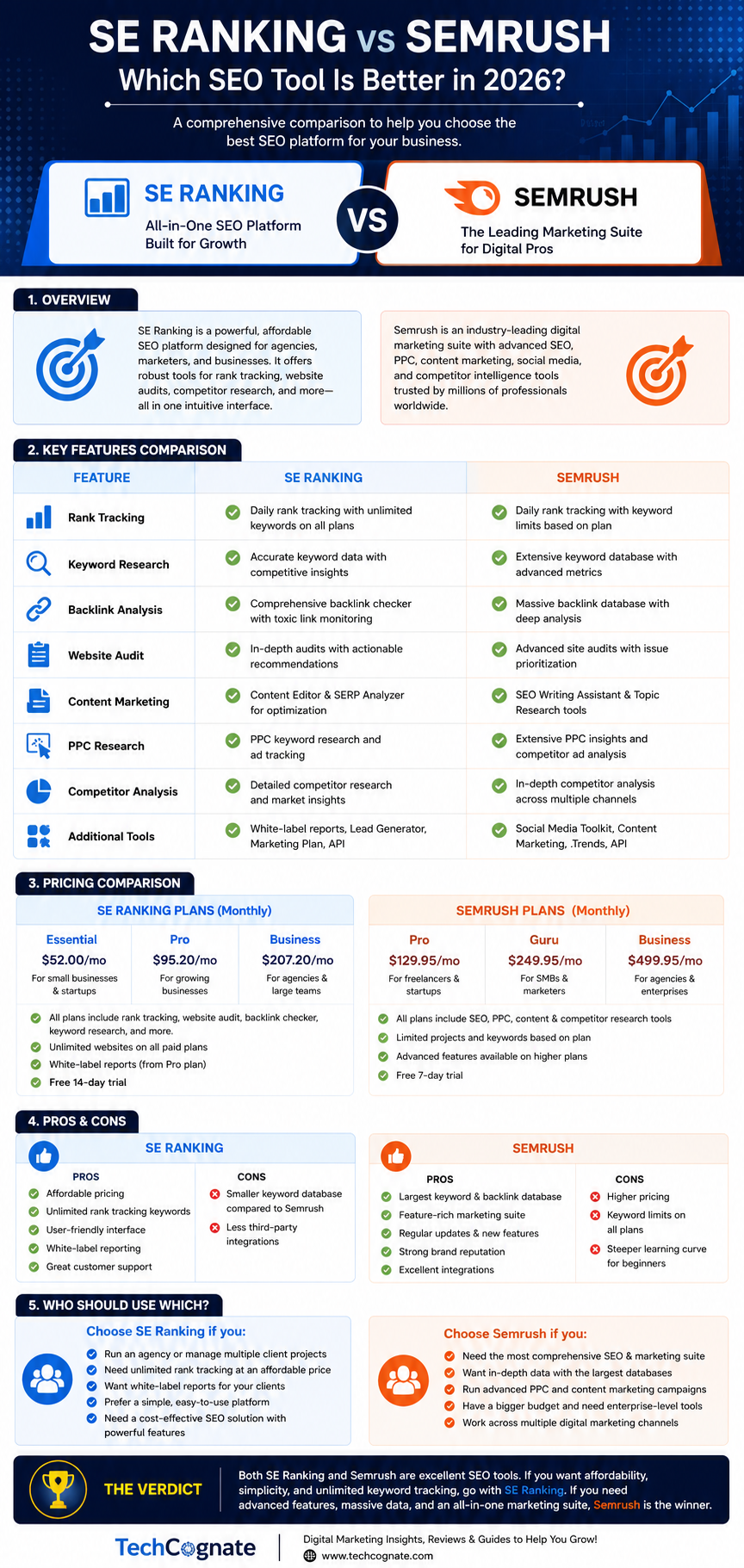
This is the part most people skip straight to, so let’s get into it properly. I’m going through ten categories, comparing the two platforms feature-by-feature, and calling a winner for each with my reasoning. No hedging.
Keyword Research
Keyword research is where database size actually matters, because it determines how many ideas you’ll see and how confident you can be in volume and difficulty estimates.
| Factor | SE Ranking | Semrush |
|---|---|---|
| Database size | ~5.4 billion keywords, 188 markets | ~26–28 billion keywords, 142+ databases |
| Keyword difficulty | Well-calibrated for content planning | Industry benchmark, very granular |
| Search intent labels | Yes, basic classification | Yes, more refined intent breakdown |
| SERP analysis | Included, solid depth | Included, deeper historical SERP data |
| Related & long-tail keywords | Strong for mainstream niches | Stronger for ultra-niche and non-English terms |
| Question keywords | Yes | Yes, plus Topic Research tool |
| Trend data | Included | Included, plus Trends add-on for deeper analysis |
| Local keyword data | Strong, 1,500 local keywords on local plans | Strong, gated behind Guru+ for multi-location |
Winner: Semrush, on raw database size and depth.
Here’s the catch though: for mainstream niches — finance, health, tech, travel, ecommerce — independent testing has found SE Ranking surfaces 85–95% of what Semrush or Ahrefs find. The gap only really opens up once you’re working in ultra-long-tail territory or non-English markets with thinner data. If you’re a niche blogger or run a small ecommerce shop, you probably won’t feel the difference day-to-day. If you’re an agency researching enterprise clients across a dozen industries, you will. Our free keyword research tools guide is worth a look if you’re validating ideas before committing to either platform.
Rank Tracking
| Factor | SE Ranking | Semrush |
|---|---|---|
| Daily updates | Yes, daily across all plans | Yes, daily on Pro+ |
| Tracking accuracy | Independently tested around 94% match vs AccuRanker | Industry-leading, very high accuracy |
| Local tracking | Strong, included at lower tiers | Strong, but multi-location gated to Guru+ |
| Mobile/Desktop split | Yes | Yes |
| Competitor tracking | Included | Included, deeper Share of Voice on Business |
| Google Maps / local pack | Yes, Local Marketing module | Yes, via Local SEO add-on |
| White label reporting | Included with Agency Pack add-on | Included on Business, limited lower tiers |
Winner: Tie, leaning SE Ranking for value.
Both tools track rankings reliably. The real difference is where local and white-label features sit in the pricing ladder — SE Ranking includes more of this at its entry tier, while Semrush reserves multi-location tracking and white-label depth for Guru and Business.
Website Audit
| Factor | SE Ranking | Semrush |
|---|---|---|
| Technical issue checks | 115+ checks | 130+ checks across Site Audit |
| Core Web Vitals | Included | Included |
| Schema markup detection | Included | Included |
| HTTPS / security checks | Included | Included |
| Redirects & broken links | Included | Included |
| Duplicate content | Included | Included |
| JavaScript rendering | Supported | Supported, slightly more configurable |
| Crawl speed/limits | Up to 2M pages/month on Growth | Up to 100,000+ pages/project on Pro, scales higher |
Winner: Tie.
This is where most people get confused thinking one tool is dramatically better than the other for technical SEO. In practice, both site audit tools catch the same core technical issues — broken links, missing meta tags, slow pages, duplicate content, indexability problems. Unless you’re auditing genuinely massive sites where crawl limits matter, you won’t notice a meaningful quality gap. Our technical SEO checklist covers the core issues both tools will flag.
Backlink Analysis
| Factor | SE Ranking | Semrush |
|---|---|---|
| Backlink database | ~2.7–2.9 trillion links, 420M domains | ~43+ trillion links, ~390M referring domains |
| Lost/new link alerts | Included | Included |
| Toxic link detection | Included, spam score per link | Included, AI-assisted toxic scoring |
| Anchor text analysis | Included | Included, more granular breakdowns |
| Referring domain depth | Solid for small/mid sites | Stronger for large or enterprise sites |
| Link-building opportunity tools | Included | Included, more competitor gap features |
Winner: Semrush, with an asterisk.
Semrush’s backlink index is dramatically larger on paper. But this matters most when you’re researching enterprise-scale competitors with hundreds of thousands of referring domains. For most small business and niche-site competitor research, SE Ranking tracks roughly 70% of the referring domains a bigger index would surface — enough for the vast majority of link-building decisions. And worth noting: neither tool’s backlink index actually beats Ahrefs, which remains the specialist choice if backlink research is your primary job. See our best link-building tools roundup for more specialist options.
Competitor Research
| Factor | SE Ranking | Semrush |
|---|---|---|
| Organic competitor analysis | Included | Included, deeper historical trend data |
| Paid/PPC competitor research | Limited | Strong, this is a Semrush specialty |
| Traffic estimates | Included | Included, backed by 200M+ user clickstream panel |
| Top pages analysis | Included | Included |
| Keyword gap analysis | Included | Included, more refined filtering |
| Backlink gap analysis | Included | Included |
| Advertising research | Not a focus area | Strong, includes display and shopping ad data |
Winner: Semrush, clearly.
This is one of the more lopsided categories. If competitor PPC research, ad intelligence, or traffic estimation depth matters to your work, Semrush’s clickstream-powered Traffic & Market toolkit is in a different league. SE Ranking covers the organic side well but isn’t built to compete here.
Content Marketing
| Factor | SE Ranking | Semrush |
|---|---|---|
| AI writing assistant | Included on all paid plans | Included via Content Marketing Toolkit (Guru+) |
| Content optimization/scoring | Included, AI Score feature | Included, Content Optimizer |
| Topic/idea generation | Content Idea Finder | Topic Research tool |
| SEO content briefs | Included | Included, more detailed competitor benchmarking |
| Article allowance | 25–50 articles/month depending on tier | Usage-based within Content Marketing Toolkit |
| Gating | Bundled into Core/Growth | Locked behind Guru tier minimum |
Winner: SE Ranking, on value.
This matters because Semrush’s content tools are genuinely good — but you can’t access the full Content Marketing Toolkit until you’re on Guru at $249.95/month ($208.33 annual). SE Ranking bundles a comparable workflow into its much cheaper Core plan. If you’re a content-first operation comparing dedicated tools like Surfer SEO, neither bundled option quite matches a specialist, but SE Ranking gets you 70% of the way there for free as part of your subscription.
Local SEO
| Factor | SE Ranking | Semrush |
|---|---|---|
| Google Business Profile management | Included, GBP posting tools | Included via Local SEO add-on |
| Maps rank tracking | 1,500 local keywords included | Included via Local toolkit, priced per location |
| Citation monitoring | 100+ directories worldwide | Included via Local toolkit |
| Local rank tracking granularity | City/neighborhood level | City level, per-location add-on pricing |
| Pricing model | Bundled, 3 locations included, extras from $18.40/mo | Separate toolkit, $30–$60/location/month |
Winner: SE Ranking.
This is where most people get confused thinking Semrush has local SEO baked in the way SE Ranking does. It doesn’t — it’s a genuinely separate paid toolkit on top of your plan. If you’re serving local businesses or running a multi-location brand, SE Ranking’s bundled approach is simpler and considerably cheaper at scale. See our local SEO strategies guide and Google Business Profile optimization guide for more on this.
Reporting
| Factor | SE Ranking | Semrush |
|---|---|---|
| PDF/branded reports | Included | Included |
| Looker Studio integration | Included on all plans | Included on Guru+ |
| White label | Agency Pack add-on | Included on Business tier |
| Scheduled reports | Included, unlimited on Agency Pack | Included |
| Client dashboards | Included via Agency Pack | Included, more polish on Business |
Winner: Tie, depends on scale.
For a handful of clients, SE Ranking plus the Agency Pack add-on gets you white-label reporting cheaper than Semrush Business. For larger agencies already paying for Business-tier limits anyway, Semrush’s reporting comes bundled rather than as a separate line item.
Ease of Use
| Factor | SE Ranking | Semrush |
|---|---|---|
| Dashboard clarity | Clean, fewer menus | Dense, more menus to navigate |
| Learning curve | Shorter, most users productive within a day | Longer, several weeks to feel fluent across toolkits |
| Onboarding | Live group sessions, personalized on Growth | Semrush Academy plus self-serve guides |
| Mobile app | iOS and Android apps available | Limited mobile experience |
Winner: SE Ranking.
This one’s not close. SE Ranking’s review site feedback consistently calls out a cluttered interface as a downside relative to simpler tools — and yet, compared to Semrush’s 55+ tool sprawl, it still feels notably more approachable. New SEO hires get up to speed faster on SE Ranking. Semrush rewards the time investment once you know where everything lives, but that investment is real.
Integrations
| Factor | SE Ranking | Semrush |
|---|---|---|
| Google Analytics 4 | Yes | Yes |
| Google Search Console | Yes | Yes |
| WordPress | Yes, plugin available | Yes, plugin available |
| Shopify | Via API/manual setup | Via API/manual setup |
| Zapier | Yes | Yes |
| API access | Add-on or Growth+ | Business tier only (no API on Pro/Guru) |
| Looker Studio | Yes, all plans | Yes, Guru+ |
| MCP (AI assistant access) | Included, all plans | Included on Semrush One / Pro+ |
Winner: SE Ranking, on accessibility.
This matters because Semrush gates API access entirely behind its most expensive Business tier — there’s no API on Pro or Guru at all. SE Ranking offers API access as a more attainable add-on. If you’re building custom dashboards or automating reporting and don’t need Business-tier everything else, that’s a meaningful cost difference. If you’re on WordPress or WooCommerce, both connect via plugin without much friction either way.
AI Features
| Factor | SE Ranking | Semrush |
|---|---|---|
| AI keyword/content ideas | Included | Included |
| AI content writing | AI Writer bundled | AI Article Generator (Guru+) |
| AI search visibility tracking | Included from Core, 5 LLMs tracked | Separate AI Visibility Toolkit, $99+/mo add-on |
| Workflow automation / MCP | Included, all plans | Included on Semrush One / Pro+ and Business |
| Future-readiness for AEO/GEO | Strong, built in early and cheaply | Strong, more mature analytics depth |
Winner: Depends on budget.
This is where most people get confused thinking one is simply “better” at AI. They’re solving the same problem differently. SE Ranking includes AI Overview, AI Mode, ChatGPT, Perplexity, and Gemini tracking inside its base subscription — no upsell needed. Semrush’s AI Visibility Toolkit is more analytically mature, with a clearer AI Visibility Score and deeper competitive benchmarking, but it’s priced as a separate $99–$289/month toolkit, or bundled into the newer Semrush One plans starting at $199/month. If AI visibility tracking is a nice-to-have, SE Ranking gives it to you for free. If it’s becoming core to your strategy, Semrush’s depth may be worth the extra spend. See our guide to ranking in AI search engines for more on this shift.
Pricing Comparison
This is the section where most comparison articles just copy the pricing page and call it done. I’m not doing that, because the sticker price is almost never what you actually pay. Let’s go through both platforms properly, including the parts that aren’t on the homepage.
SE Ranking Pricing (2026)
| Plan | Monthly | Annual (per mo) | Key limits |
|---|---|---|---|
| Core | $129.00 | $103.20 | 10 projects, 1 seat, 2,000 keywords/day, 100 AI prompts/day, 250K audit pages/mo |
| Growth | $279.00 | $223.20 | 30 projects, 3 seats, 5,000 keywords/day, 250 AI prompts/day, 2M audit pages/mo |
| Enterprise | Custom | Custom | Flexible limits, full API, advanced integrations |
Add-ons worth knowing about:
- Agency Pack: +$69/month (annual billing only) — white-label reporting, client seats, Agency Catalog placement, Lead Generator
- AI Search expansion: +$71.20–$89/month — more prompts and AI competitive research domains beyond what’s included
- API access: +$45/month and up — 3M to 60M credits depending on tier, or a standalone API plan from $179/month
- Extra manager seats: from $16/month each
- Extra keywords: from $22.40–$32/month depending on plan
Annual billing saves 20% across the board, and there’s no permanent free plan — just a genuinely full-featured 14-day free trial with no credit card required.
Real-world SE Ranking cost example
A solo freelancer on the Core annual plan pays $103.20/month with no add-ons needed for most solo workflows. A small agency on Growth annual, with the Agency Pack add-on for white-label client reporting, lands around $292/month — still well under a comparable Semrush Guru setup with extra seats.
Semrush Pricing (2026)
| Plan | Monthly | Annual (per mo) | Key limits |
|---|---|---|---|
| Pro | $139.95 | $117.33 | 5 projects, 1 seat, 500 keywords tracked, 10,000 results/report |
| Guru | $249.95 | $208.33 | 15 projects, 3 seats, 1,500 keywords, historical data, Content Marketing Toolkit |
| Business | $499.95 | $416.66 | 40 projects, 5,000 keywords, API access, Share of Voice, 50,000 results/report |
| Enterprise | Custom | Custom | Negotiated limits, dedicated account management |
Semrush also runs a parallel pricing track called Semrush One, which bundles the SEO Classic toolkit with the AI Visibility Toolkit:
| Semrush One Plan | Monthly | What it adds over Classic |
|---|---|---|
| Starter | $199.00 | AI visibility tracking on 1 domain (100 prompts/day) plus MCP access |
| Pro+ | $299.00 | Most popular tier; broader AI Visibility coverage, historical data, cannibalization analysis |
| Advanced | $549.00 | Direct API access, the only Semrush One tier with it |
Add-ons worth knowing about:
- Extra user seats: $45–$80/month per seat depending on plan
- Local SEO toolkit: $30/location/month (Base), $60/location/month (Pro)
- Content Marketing Toolkit (standalone): $60/month
- Social Media Toolkit: $20–$40/month
- Advertising Toolkit: $99/month
- AI Visibility Toolkit (standalone): $99/month per domain, scaling to $289/month for Traffic & Market Trends-level depth
- Base/Pro Report add-ons for integrations: $10–$20/month
Real-world Semrush cost example
A five-person team on Guru doesn’t pay $2,499.40/year. After adding four extra seats at roughly $80/month each, the real annual cost lands closer to $6,340/year — over $3,800/year in seat costs alone, before a single toolkit add-on. A small agency that assumes Guru “does everything” often discovers it needs the Content Marketing Toolkit, AI Visibility, or extra seats, turning a $249.95/month plan into $600+/month with no dramatic capability jump — just quiet add-ons.
Free Trials, Refunds, and Hidden Costs
| SE Ranking | Semrush | |
|---|---|---|
| Free trial | 14 days, no credit card | 7 days, credit card required |
| Free plan | None | Very limited free tier (1 site, 10 tracked keywords) |
| Refund policy | Non-refundable except service failures | 7-day money-back guarantee on new subscriptions |
| Self-serve cancellation | Yes, via account billing settings | No — requires contacting support and a cancellation form |
| User limits before extra cost | 1 seat (Core), 3 seats (Growth) | 1 seat (Pro), 3 seats (Guru), 5 seats (Business) |
| API access included? | Add-on from $45/mo, or Growth+ limits | Business tier only — none on Pro or Guru |
Best value verdict
For solo users and small teams, SE Ranking’s Core plan beats Semrush Pro on price while matching or exceeding it on keyword tracking volume and AI search visibility. For agencies needing API access and Share of Voice at scale, Semrush Business is the more complete (if pricier) package. The one area where Semrush’s pricing logic genuinely makes sense is if you already need its PPC and advertising research — SE Ranking simply doesn’t compete there, regardless of price.
Pros and Cons
✓ SE Ranking Pros
- Significantly cheaper than Semrush at every comparable tier
- AI search visibility tracking included from the entry plan, not sold separately
- Clean, approachable interface with a short learning curve
- Strong, fast customer support (9.4/10 on G2 in recent reviews)
- Generous 14-day trial with no credit card required
- Local SEO and content marketing tools bundled rather than sold as add-ons
- Self-serve cancellation, no support ticket required
✗ SE Ranking Cons
- Keyword and backlink databases are meaningfully smaller than Semrush and Ahrefs
- Weak on PPC and advertising competitive research
- Add-ons (Agency Pack, AI Search expansion, API) can add up for scaling agencies
- Less depth for enterprise-scale, multi-vertical competitor research
- Smaller brand recognition than Semrush, which can matter when justifying a tool choice to clients
✓ Semrush Pros
- Largest keyword and backlink databases among mainstream all-in-one tools
- Genuinely all-in-one: SEO, PPC, content, social, and advertising research in one platform
- Mature AI Visibility Toolkit with detailed scoring and competitive benchmarking
- MCP support and an official ChatGPT app, ahead of most competitors on AI orchestration
- Transparent, publicly listed pricing tiers
- Strong brand recognition, useful when presenting tool choices to enterprise clients or stakeholders
✗ Semrush Cons
- Expensive, and the real cost is often 2–4x the advertised tier price once seats and add-ons are included
- No API access at all on Pro or Guru — Business tier only
- Steep learning curve across 55+ tools
- No self-serve cancellation — requires contacting support
- Recently acquired by Adobe, introducing pricing and roadmap uncertainty
- AI Visibility Toolkit, while mature, is priced as a separate $99+/month add-on outside Semrush One bundles
Performance Testing: Realistic Scenarios
Feature tables only tell you so much. Here’s how each tool actually performs across the situations I get asked about most.
Scenario 1: Freelancer Managing 5–8 Clients
This is squarely SE Ranking territory. The Core plan’s 10 projects and 1 manager seat fit comfortably, keyword tracking at 2,000/day across 5–8 clients rarely gets tight, and the bundled content tools mean you’re not paying separately for a writing assistant. Semrush Pro technically covers this too, but at a higher price with a tighter 500-keyword tracking limit — a real constraint once you’re tracking meaningful keyword sets across multiple sites.
Scenario 2: Agency Managing 15–30 Clients
This is where it gets genuinely close. SE Ranking Growth, with the Agency Pack add-on, lands around $292/month annual and covers 30 projects with white-label reporting. Semrush Guru at $208.33/month annual sounds cheaper on paper, but the 3-seat limit means most agencies this size need extra seats immediately, and white-label reporting isn’t even included until Business at $416.66/month. For pure cost efficiency at this scale, SE Ranking wins. For agencies that also handle PPC for these same clients, Semrush’s broader toolkit starts to pull ahead despite the higher cost.
Scenario 3: Large Ecommerce Site (10,000+ SKUs)
Neither tool is purpose-built for ecommerce SEO the way a dedicated platform might be, but between the two, Semrush’s larger crawl limits and traffic estimation depth (powered by its 200M+ user clickstream panel) give a clearer picture of where organic traffic is actually coming from at scale. SE Ranking’s audit tools work fine technically, but its traffic estimates are less robust for sites with this much product-page churn.
Scenario 4: Local Service Business (Single Location)
SE Ranking, without much hesitation. Local rank tracking, Google Business Profile management, and citation monitoring across 100+ directories are bundled into the base plan with 3 locations included. Semrush’s equivalent Local SEO toolkit is a genuinely separate purchase starting at $30/month per location on top of whatever core plan you’re already paying for.
Scenario 5: Affiliate Site Builder
This is where I noticed the biggest surprise testing both tools side by side: for content-driven affiliate sites in mainstream niches, SE Ranking’s content tools plus rank tracking covered nearly everything I needed at a fraction of Semrush’s cost. The keyword database gap only became noticeable when researching extremely competitive, saturated niches where Semrush’s deeper long-tail coverage found opportunities SE Ranking missed.
Scenario 6: Enterprise Content Publisher
Semrush, mainly because of the Content Marketing Toolkit’s depth combined with historical data going back to January 2012. If your editorial team needs to understand how content performance has trended over years, not months, Semrush’s historical archive (unavailable on its own Pro tier, but included from Guru up) is a real advantage that SE Ranking’s all-time historical data on its Growth plan only partially matches in depth, despite technically being included.
Which Tool Is Better For…?
| Business Type | Recommended Tool | Reason |
|---|---|---|
| Agency (small) | SE Ranking | Better price-to-feature ratio for under 15 clients |
| Agency (large, full-service) | Semrush | API access, Share of Voice, PPC research depth |
| Blogger | SE Ranking | Bundled content tools, lower cost |
| Freelancer | SE Ranking | Core plan fits most solo workflows comfortably |
| Enterprise | Semrush | Custom contracts, largest databases, deepest integrations |
| Startup | SE Ranking | Lower cost while validating SEO strategy |
| SaaS company | Semrush | Stronger competitive and content research for crowded markets |
| Shopify store | SE Ranking | Affordable audits and tracking for product-page SEO |
| Amazon seller | Semrush | Better PPC and advertising research, though neither is Amazon-native |
| Healthcare practice | SE Ranking | Local SEO bundled, lower cost for single-location practices |
| Law firm | SE Ranking | Local tracking plus content tools for practice-area pages |
| Local SEO specialist | SE Ranking | Local Marketing module included, not a paid add-on |
| YouTube creator | Semrush | Broader keyword and trend research across video-adjacent terms |
| Affiliate marketer | SE Ranking | Budget-friendly with sufficient keyword depth for most niches |
| Marketing team (multi-channel) | Semrush | PPC, social, and content tools alongside SEO in one place |
| Content team | SE Ranking | Bundled AI writer and content scoring without toolkit upsells |
Real-World Use Cases
“I run a local plumbing business and do my own marketing.”
SE Ranking. You need local rank tracking, a Google Business Profile manager, and an occasional site audit — not a 55-tool marketing suite. The Core plan covers this with room to spare, and the Local Marketing module means you’re not paying a separate toolkit fee just to track your map pack ranking.
“I manage 50 client websites across a mid-size agency.”
This is genuinely close, and the honest answer is “it depends on your services.” If you’re doing pure SEO across 50 sites, SE Ranking’s Enterprise tier (custom-priced) or a heavily-stacked Growth setup can work out cheaper. If you’re also running PPC, social, or advertising research for those same clients, Semrush Business starts to make more sense purely because you’re not paying for two separate platforms.
“I’m launching my first blog and have no SEO budget to speak of.”
Start with SE Ranking’s 14-day trial, and honestly, consider whether you need a paid tool at all in month one. Google Search Console plus Rank Math (free) covers maybe 80% of what a brand-new blogger needs before traffic exists to optimize. Once you’re publishing consistently and want keyword research depth, SE Ranking’s Core plan is the more affordable entry point.
“I own a Shopify store and want better organic traffic.”
SE Ranking. Product-page audits, keyword tracking for category and product terms, and competitor research at a price that doesn’t eat into margin. If your store scales into the tens of thousands of SKUs with complex international SEO, Semrush’s traffic estimation and crawl depth become more relevant, but that’s a “cross that bridge later” problem for most stores.
“I run an enterprise SaaS company with a dedicated SEO team.”
Semrush. At this scale, the cost difference per seat matters less than database depth, Share of Voice tracking, and API access for pulling data into internal BI tools. This is exactly the buyer profile Semrush Business and Enterprise tiers are built for.
Customer Reviews: What Real Users Say
I pulled sentiment from G2, Capterra, Trustpilot, and Reddit threads to see how the marketing copy holds up against actual user experience.
SE Ranking: Overall Sentiment
Positive: G2 reviewers consistently praise affordability, ease of use, and rank tracking accuracy. Phrases like “best price-quality ratio” and “fraction of the cost” show up repeatedly when reviewers compare it to Semrush and Ahrefs. Customer support is a standout, scoring around 9.4/10 in recent G2 data.
Negative: The most consistent complaint, by far, is database size relative to Semrush and Ahrefs. Some reviewers also flag a cluttered interface for managing large keyword lists across many projects, and note that pricing has crept up over the past few years as new features moved to paid add-ons.
Semrush: Overall Sentiment
Positive: Reviewers consistently praise the breadth of data and the comprehensiveness of the toolset — “everything in one place” is the most common phrase. The AI Visibility Toolkit and MCP integration get specific praise from more advanced or AI-forward users.
Negative: Billing complaints are the most consistent theme: the lack of self-serve cancellation, the free trial requiring a credit card with auto-renewal, and the way add-on costs compound at scale. Several reviewers report being surprised by their actual monthly bill once seats and toolkits were added.
“This matters because the marketing page price and the invoice price are two different numbers for both tools — but the gap is consistently wider on Semrush once you scale past a single user.”
Expert Opinion: Where Each Tool Actually Wins
Where Semrush Dominates
Raw data depth. If your work depends on finding the absolute largest pool of keyword ideas, the deepest backlink index among all-in-one platforms, or detailed PPC and advertising intelligence, Semrush’s scale advantage is real and it shows up in day-to-day research quality, not just in marketing copy.
Where SE Ranking Surprises People
The AI search visibility tracking. This is the feature I see catch people off guard the most. SE Ranking includes AI Overview, AI Mode, ChatGPT, Perplexity, and Gemini tracking starting from its entry-level Core plan, while Semrush prices the equivalent capability as a $99–$289/month add-on (or folds it into the pricier Semrush One bundles starting at $199/month). For a tool that’s often dismissed as “the budget option,” that’s a genuinely forward-looking feature included for free.
Where Spending Extra Is Worth It
If you’re running PPC alongside SEO for the same clients, or you’re an enterprise team that needs API access on every tier (not just the most expensive one), Semrush’s higher price reflects real capability you’d otherwise need a second tool to replace. The math changes once you account for not paying for two subscriptions.
Where It Isn’t
If your actual day-to-day SEO work is rank tracking, site audits, on-page optimization, and keyword research for mainstream niches — which describes the overwhelming majority of freelancers, small agencies, and content sites — paying Semrush’s premium mostly buys you a bigger number on a database you’ll rarely max out. This is where most people get confused thinking bigger databases always mean better results. They mean better results only when your specific niche or scale actually needs that depth.
Where SE Ranking and Semrush Fit Alongside Other Tools
Neither SE Ranking nor Semrush exists in a vacuum. Most real SEO workflows stitch together a handful of tools, and understanding where each one fits — and where it overlaps with things you might already use — makes the buying decision clearer.
Free Tools You Should Already Be Using
- Google Search Console: free, direct-from-Google data on impressions, clicks, and indexing issues. Neither SE Ranking nor Semrush replaces this — both integrate with it instead.
- Google Analytics 4 (GA4): tracks what happens after someone clicks through from search. Both platforms offer GA4 integration, pulling traffic data alongside rank and keyword metrics.
- Google Ads: useful for validating keyword intent with real auction data, especially before committing content budget to a topic. Semrush’s PPC research tools lean on this more directly than SE Ranking’s.
- Bing Webmaster Tools: worth connecting if any meaningful share of your traffic comes from Bing or its AI-powered Copilot integration, which is increasingly relevant for AI search visibility tracking.
- Microsoft Clarity: free heatmaps and session recordings. Neither SE Ranking nor Semrush offers genuine UX behavior tracking, so this fills a real gap in both stacks.
Where Other Paid Tools Beat Both
- Ahrefs: still the specialist choice for pure backlink research depth. Its referring domain index outpaces both SE Ranking and Semrush, and its crawler (AhrefsBot) is among the most active on the web. If link building is your core job function, Ahrefs deserves a serious look alongside whichever all-in-one platform you choose.
- Moz: less comprehensive than either platform today, but its Domain Authority metric remains widely recognized, and its interface still appeals to beginners who find Semrush overwhelming.
- Mangools: the genuinely budget option, starting well under either SE Ranking or Semrush. It covers keyword research, rank tracking, and basic backlink data adequately for very early-stage bloggers, but it doesn’t approach the depth of either tool covered in this guide.
- Serpstat: a lesser-known but capable all-in-one alternative, often priced close to SE Ranking, with particular strength in PPC keyword research for markets outside the US. See how it stacks up in our Serpstat vs Semrush vs Ahrefs comparison.
- SpyFu: narrowly focused on competitor PPC and keyword history. If your primary need is understanding exactly what a competitor has bid on and ranked for over time, SpyFu’s specialization can outperform the PPC modules in both SE Ranking and Semrush.
- Screaming Frog: the standard for deep, manual technical crawls. Both SE Ranking and Semrush’s site audit tools are good for ongoing monitoring, but agencies doing one-off technical SEO audits for new clients often still reach for Screaming Frog’s desktop crawler for full control over crawl settings.
Platform-Specific Considerations
If your site runs on WordPress, both tools integrate via plugin or API, and neither requires you to change your CMS workflow. WooCommerce stores get the same audit and tracking capability as any other site, since both platforms treat ecommerce pages like any other crawlable URL rather than offering WooCommerce-specific modules. Shopify stores are in the same position — neither tool has deep, native Shopify-specific reporting, so you’re connecting via API or simply auditing your storefront URL like any other website.
For Amazon SEO specifically, neither platform is built for marketplace-specific ranking factors (Amazon’s A9/A10 algorithm works very differently from Google’s). Semrush’s broader keyword and PPC research tools translate slightly better to Amazon strategy than SE Ranking’s, but dedicated Amazon SEO tools will outperform both for that specific use case. The same logic applies to YouTube SEO: useful for the keyword research component, but neither tool is YouTube-native.
How This Fits Broader SEO Strategy
Whichever platform you choose, remember it’s a data and monitoring layer, not a replacement for SEO strategy fundamentals. Both tools will show you keyword cannibalization issues if you’re targeting the same term across multiple pages, but fixing that requires a content and internal linking strategy, not just better software. Both will flag technical issues, but resolving Core Web Vitals problems usually means developer time, not a tool subscription. And neither platform writes genuinely original, expert-level content for you — their AI writing tools speed up drafting, but EEAT (Experience, Expertise, Authoritativeness, Trustworthiness) signals still come from real expertise and editorial judgment, not automated output.
Topic clusters and internal linking architecture — grouping related content around pillar pages and linking them deliberately — remain something you plan manually, informed by the keyword and competitor data either tool provides. Think of SE Ranking and Semrush as the instruments that tell you what to build and how well it’s performing, not the construction crew.
Frequently Asked Questions
These are the questions I get asked most often when people are stuck deciding between the two. Answers are deliberately direct.
Is SE Ranking better than Semrush?
It depends entirely on what “better” means for your situation. Semrush has larger keyword and backlink databases, broader PPC research, and more mature AI visibility analytics. SE Ranking is significantly cheaper, easier to learn, and bundles AI search tracking and content tools that Semrush sells as separate add-ons. For most freelancers, small agencies, and content sites, SE Ranking delivers comparable practical results at a noticeably lower cost. For enterprise teams or agencies doing heavy PPC work, Semrush’s extra capability tends to justify its higher price.
Why is Semrush expensive?
Semrush prices for breadth: it covers SEO, PPC, content marketing, social media, and AI visibility under one platform, backed by a 26–28 billion keyword database and 43+ trillion backlink index. That scale costs money to maintain, and Semrush passes that cost on through per-seat fees (every account starts with one seat) and a growing list of toolkit add-ons. The base plan price is also rarely your real cost once you add team members or unlock features gated behind Guru or Business tiers.
Can beginners use Semrush?
Yes, but expect a learning curve. Semrush’s Pro plan covers the essentials — keyword research, site audits, rank tracking, competitor analysis — but the platform’s 55+ tools spread across multiple toolkits can feel overwhelming in the first few weeks. Semrush Academy offers free training and certification to help, but most beginners report needing several weeks before they feel fluent navigating the interface.
Which tool has better keyword research?
Semrush, on raw database size: roughly 26–28 billion keywords versus SE Ranking’s approximately 5.4 billion. In practice, the gap narrows significantly for mainstream niches like finance, health, and ecommerce, where SE Ranking surfaces 85–95% of what larger databases find. The difference becomes more noticeable for ultra-niche topics, non-English markets, or extremely long-tail research.
Which has better backlinks?
Semrush’s backlink index (43+ trillion links, ~390 million referring domains) is considerably larger than SE Ranking’s (roughly 2.7–2.9 trillion links, ~420 million domains). That said, neither tool actually leads the category on backlinks — Ahrefs remains the specialist choice if link research is your primary focus. For day-to-day competitor backlink audits on small-to-mid sites, SE Ranking covers around 70% of what a larger index would show.
Which is better for agencies?
It splits by agency size. Smaller agencies (roughly 1–15 clients) generally get more value from SE Ranking’s Growth plan plus the Agency Pack add-on, which delivers white-label reporting at a lower total cost than Semrush. Larger, full-service agencies running PPC alongside SEO for the same clients tend to find Semrush Business’s broader toolset and API access worth the higher price.
Which is better for local SEO?
SE Ranking. Local rank tracking, Google Business Profile management, and citation monitoring across 100+ directories are bundled into the core subscription with three locations included. Semrush handles local SEO through a genuinely separate Local SEO toolkit priced per location starting at $30/month, on top of whatever core plan you’re already paying for.
Which has better AI search visibility tracking?
Both track AI Overviews, AI Mode, ChatGPT, Perplexity, and Gemini, but they’re priced very differently. SE Ranking includes AI search tracking starting from its entry Core plan at no extra cost. Semrush’s AI Visibility Toolkit is more analytically mature, with a clearer 0–100 visibility score and deeper competitive benchmarking, but it costs $99–$289/month as a standalone add-on, or requires moving to the Semrush One bundle starting at $199/month.
Can I switch later if I choose wrong?
Yes, and it’s more common than you’d think. Both platforms offer assisted migration — SE Ranking includes free migration with annual subscriptions, and Semrush supports importing project data when you move between plans or tools. The bigger cost of switching isn’t technical, it’s rebuilding historical ranking data and retraining your team on a new interface, so it’s worth getting the choice right upfront rather than relying on switching later.
Do SEO professionals actually use SE Ranking, or is it just for beginners?
Plenty of experienced professionals use it specifically because of the price-to-feature ratio, not despite it. G2 reviews show a strong base of agency owners, SEO managers, and consultants with years of experience choosing SE Ranking deliberately, particularly once they’ve already used Semrush or Ahrefs and decided the extra database depth wasn’t worth the extra cost for their specific workload.
Which tool is faster to learn?
SE Ranking, by a clear margin. Its dashboard has fewer menus and a more linear workflow, and most new users report feeling productive within a day. Semrush’s breadth — 55+ tools across SEO, PPC, content, and social — means a genuinely longer ramp-up period, often several weeks, before users feel confident navigating the full platform.
Which offers better customer support?
SE Ranking scores notably well here, with G2 data showing around 9.4/10 for support and reviewers specifically praising fast, human responses rather than scripted replies. Semrush offers solid documentation and Academy training resources, but its support experience gets criticized more often, particularly around billing issues and the lack of self-serve cancellation.
Does SE Ranking have historical ranking data?
Yes. SE Ranking’s Growth plan includes all-time historical data for the life of your project. The Core plan limits historical data to the most recent 6 months. Semrush’s equivalent historical data goes back to January 2012, but it’s only available from the Guru tier upward — Pro users get no historical data access at all.
Is Semrush worth it for bloggers?
For most individual bloggers, no, not at the Pro tier price point. The database size advantage rarely matters for a single content site, and the features that would justify the cost — PPC research, advanced content marketing tools, multi-location tracking — sit behind the pricier Guru tier. SE Ranking’s Core plan covers blogger-relevant needs at roughly half the cost.
Can I use SE Ranking and Semrush together?
Some agencies and serious affiliate marketers do exactly this: SE Ranking for day-to-day rank tracking, audits, and client reporting, with occasional Semrush access (via a lower tier or trial) for deeper one-off backlink or PPC competitor research on specific high-value projects. It’s not necessary for most users, but it’s a reasonable middle ground if budget allows and your work genuinely spans both strengths.
What’s the real difference between SE Ranking Core and Growth?
Growth roughly triples your keyword tracking (2,000 to 5,000 daily), triples project capacity (10 to 30), adds two extra manager seats, unlocks all-time historical data instead of 6 months, and adds page-change monitoring and dedicated customer support. Most solo users and very small teams are fine on Core; agencies juggling more than 10 client projects typically need Growth.
What’s the real difference between Semrush Pro and Guru?
Guru adds historical data back to 2012, the full Content Marketing Toolkit (Topic Finder, AI Article Generator, Content Optimizer), multi-location tracking, and triples project and keyword limits. It’s a meaningful jump, and Semrush itself positions Guru as the tier where the platform starts to feel like a complete professional toolkit rather than a starter subscription.
Does either tool offer a permanent free plan?
Semrush offers a limited free tier (1 website, 10 tracked keywords, 10 daily Analytics requests) that’s useful for testing but not for real work. SE Ranking has no permanent free plan, only a fully-featured 14-day free trial requiring no credit card. If you want to actually test real workflows before paying, SE Ranking’s trial gives you more genuine access.
Which tool is better for technical SEO audits?
They’re close enough that this rarely decides the choice on its own. Both cover Core Web Vitals, schema detection, redirects, duplicate content, and JavaScript rendering. Semrush’s Site Audit checks slightly more issue types and scales to larger crawl volumes on higher tiers; SE Ranking’s audit is comparably thorough for small-to-mid-sized sites and included at a lower price point.
How accurate is SE Ranking’s rank tracking?
Independent testing against AccuRanker has found SE Ranking’s rank tracking accuracy around 94%, which is competitive with industry leaders. For day-to-day position monitoring, most users don’t notice meaningful discrepancies between SE Ranking, Semrush, and dedicated rank trackers.
Does Semrush have an API on every plan?
No, and this catches people out. API access is exclusive to the Business tier ($499.95/month, or $416.66/month annual) — there is no API access on Pro or Guru at any price. If API access matters to your workflow, factor that into which tier you actually need, not just which features sound appealing.
Is SE Ranking good for ecommerce SEO?
It’s solid for small-to-mid-sized ecommerce sites, covering product-page audits, category keyword tracking, and competitor research at an accessible price. For very large catalogs (tens of thousands of SKUs) needing deep traffic estimation and high-volume crawling, Semrush’s larger infrastructure and clickstream-powered traffic data offer more depth, though at meaningfully higher cost.
What happened with Semrush and Adobe?
Adobe announced its acquisition of Semrush for $1.9 billion in November 2025, and the deal closed in April 2026, making Semrush a wholly owned Adobe subsidiary. There’s no public guarantee that current pricing, plans, or feature structures will stay the same long-term. Adobe has historically leaned toward enterprise-focused pricing after acquisitions, so buyers signing annual contracts should keep an eye on renewal terms.
Which tool has more affordable add-ons for small teams?
SE Ranking, generally. Its Agency Pack ($69/month) and AI Search expansion ($71.20–$89/month) are priced for small-to-mid agencies. Semrush’s add-ons — Local SEO at $30–$60 per location, AI Visibility at $99+/month, Advertising Toolkit at $99/month — add up faster and are positioned more for teams already committed to a higher base tier.
Can I get a refund if I don’t like the tool I picked?
Semrush offers a 7-day money-back guarantee on new paid subscriptions, separate from its trial. SE Ranking’s payments are generally non-refundable except in cases where the service wasn’t delivered as promised, though it offsets this with a longer, more genuinely functional 14-day free trial upfront, reducing the odds you’ll need a refund in the first place.
Is SE Ranking’s content tool as good as Surfer SEO?
Independent testing puts SE Ranking’s content editor at roughly 70% as capable as Surfer SEO’s dedicated optimization engine, with Surfer offering a more refined term-frequency recommendation system. SE Ranking’s advantage is that it’s bundled into your existing subscription and integrates directly with your keyword and rank data, where Surfer is a separate cost with no rank tracking of its own.
Do I need Semrush if I already use Google Search Console and Analytics?
Not necessarily, especially early on. GSC and GA4 are free and cover a meaningful chunk of basic SEO monitoring. Where Semrush (or SE Ranking) add value is in keyword research before you rank, competitor analysis, automated audits, and reporting that doesn’t require manually exporting and combining multiple free tools.
Which tool is better for SaaS companies?
Semrush tends to fit SaaS companies slightly better, mainly because of its stronger content marketing and competitive research tools for crowded, content-heavy markets, plus PPC research relevant to SaaS acquisition strategies. SE Ranking is a perfectly capable alternative for early-stage or budget-conscious SaaS teams not yet running paid acquisition at scale.
How many keywords can I realistically track on each platform’s entry plan?
SE Ranking Core tracks up to 2,000 keywords per day across up to 10 projects. Semrush Pro tracks up to 500 keywords across up to 5 projects. For context, a solo consultant managing five clients at 30 keywords each only uses 150 of SE Ranking’s 2,000 daily slots, while the same workload would use 150 of Semrush Pro’s tighter 500-keyword limit — still fine, but with far less headroom to grow.
Does either platform help with AI Overviews specifically?
Yes, both do. SE Ranking flags when a tracked keyword triggers an AI Overview and tracks your visibility within it, included from the Core plan. Semrush’s AI Visibility Toolkit covers AI Overviews as part of its broader AI tracking suite across ChatGPT, Perplexity, and Gemini, but as a separate paid toolkit rather than a bundled feature.
What’s the single biggest factor in choosing between these two tools?
Your budget relative to your actual usage, not the feature list. If you’ll realistically use PPC research, enterprise-scale databases, and API access regularly, Semrush’s cost is justified. If your day-to-day work is rank tracking, audits, content optimization, and keyword research for mainstream niches — which covers most freelancers, small agencies, and content sites — SE Ranking delivers comparable practical results for meaningfully less money.
Final Verdict
I’m not going to pretend there’s one universal winner here, because there genuinely isn’t. What I will do is give you a straight answer based on priority, the same way I’d talk a client through this decision.
If your priority is keeping costs down while still getting professional-grade SEO tools, choose SE Ranking. It covers rank tracking, site audits, keyword research, content tools, and AI search visibility at a price that doesn’t force you to justify the spend every month.
If your priority is the absolute largest databases and a single platform covering SEO, PPC, content, and social, choose Semrush. The premium buys you real capability, particularly if your work touches paid search or enterprise-scale competitive research.
If your priority is local SEO for a single-location or multi-location business, choose SE Ranking. Local tracking and Google Business Profile management are bundled in, not sold as an extra toolkit.
If your priority is API access and custom data integration, be aware Semrush only offers this on its most expensive Business tier, while SE Ranking offers it as a more attainable add-on or includes higher limits on Growth.
Choose SE Ranking If…
- You’re a freelancer, solo consultant, or small agency managing under 15–20 clients
- Budget efficiency matters as much as raw feature depth
- You want AI search visibility tracking without paying a separate toolkit fee
- You run local SEO for single or multi-location businesses
- You’re new to SEO tools and want a shorter learning curve
- You don’t need PPC or advertising competitive research
Choose Semrush If…
- You run PPC alongside SEO and want both under one platform
- You need the largest possible keyword and backlink databases for enterprise-scale research
- API access on a flexible tier matters to your workflow (though note it’s Business-only)
- Your team needs Share of Voice tracking and deep historical data back to 2012
- Your budget can comfortably absorb per-seat and toolkit add-on costs without strain
- Brand recognition with clients or stakeholders carries real weight in your decision
Choose Both If…
- You’re a larger agency or in-house team where SE Ranking handles daily rank tracking and reporting for the bulk of your client base, while a Semrush trial or lower tier gets pulled out specifically for deep backlink research or PPC competitive intelligence on high-value accounts
- You’re still validating which tool fits your long-term workflow and can afford to run both trials side by side before committing to an annual plan
One last honest note: pricing, plans, and feature gating in this category change often — both platforms have adjusted their tiers multiple times in the past 18 months, and Semrush’s Adobe acquisition adds a layer of uncertainty that didn’t exist a year ago. Before you commit to an annual plan on either platform, it’s worth a quick check of the current pricing page to confirm nothing has shifted since this guide was last updated.
If you take one thing away from this entire comparison: buy based on what you’ll actually use every week, not the longest feature list. A $103/month tool you use fully beats a $250/month tool where half the toolkit sits untouched.