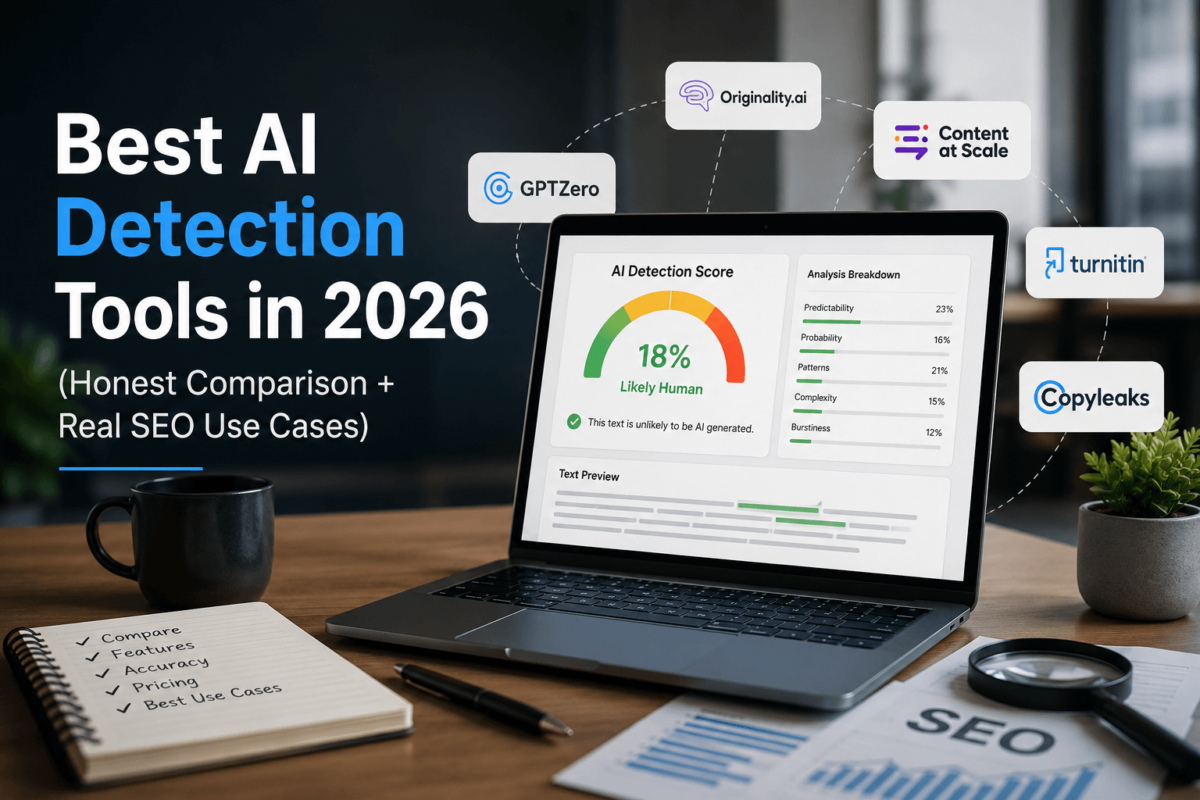
Best AI Detection Tools in 2026 (Honest Comparison + Real SEO Use Cases)
We tested the top AI content detectors to see which actually works for SEO teams, publishers, bloggers, and agencies.
Two years ago, most AI-generated content was easy to spot. Today? Not so much. With tools like GPT-4o and Claude producing polished, nuanced writing, the line between human and machine content has become genuinely blurry — and that matters a lot if you run a blog, manage a content team, or publish at scale.
Publishers are worried about brand trust. SEO agencies are fielding client questions about Google penalties. Educators are dealing with assignment integrity issues. And freelance content buyers? They’re trying to figure out whether they’re getting what they paid for.
Here’s the thing: no AI detector is perfect. Not a single one. They work on probability, and they get things wrong in both directions — flagging real human writing and missing heavily edited AI content. That context matters before you put any tool on a pedestal.
This guide covers the best AI detection tools in 2026, how they actually work, which ones perform best for specific use cases, and what AI detection really means for your SEO strategy.
What Is the Best AI Detection Tool in 2026?
Short answer — it depends on what you need. Here’s a quick breakdown:
🏆 Quick Best Picks
- Best overall: Originality.ai
- Best free option: GPTZero
- Best for enterprise teams: Copyleaks
- Best for publishers: Winston AI
- Best for educators: Turnitin
- Best budget tool: ZeroGPT
Quick Summary
At a Glance
- Best accuracy: Originality.ai and Winston AI
- Best free plan: GPTZero and ZeroGPT
- Best for SEO agencies: Originality.ai and Quetext
- Best for students: GPTZero and Scribbr
- Best for affiliate marketers: Originality.ai
- Best for large-scale publishing: Copyleaks
No AI detector is 100% accurate. Use them as a guide, not a verdict.
AI Detection Tools: Full Comparison Table
| Tool | Best For | Accuracy | False Positives | Pricing | SEO Friendly | Free Plan |
|---|---|---|---|---|---|---|
| Originality.ai | Publishers & SEO | High | Low | From $0.01/credit | Yes | No |
| GPTZero | Educators | High | Medium | Free / $10/mo | Partial | Yes |
| Copyleaks | Enterprise | High | Low–Medium | From $10.99/mo | Yes | Limited |
| Winston AI | Publishers | Very High | Low | From $18/mo | Yes | No |
| ZeroGPT | Students | Medium | High | Free / $9.99/mo | Limited | Yes |
| Quetext | Agencies | Medium–High | Medium | From $9.99/mo | Yes | Yes |
| Sapling | Developers | Medium | Medium | Free / $25/mo | Partial | Yes |
| Scribbr | Students / Writers | Medium–High | Medium | Pay-per-use | Partial | Yes |
Accuracy ratings reflect general performance on standard AI-generated content. Results vary significantly for humanized or heavily edited material.
How AI Detection Tools Actually Work
Most reviews skip this part. Understanding the mechanics helps you interpret results more intelligently.
AI detection tools analyze text for patterns that language models tend to produce. There are two core signals they rely on:
🔮 Perplexity
How predictable or surprising each word choice is. AI models tend to choose highly predictable words — human writers naturally vary more.
📊 Burstiness
Humans write in uneven rhythms — short punchy sentences followed by longer complex ones. AI output tends to be more uniform in sentence structure and length.
Think of it this way: if you asked a hundred people to continue a sentence, an AI would probably pick the statistically safest next word every time. A human would occasionally surprise you. Detectors look for that predictability gap.
The problem? Edited AI content, ESL writing, and even some formal human writing can score as ‘likely AI’ because these patterns overlap. That’s where false positives become a real issue — more on that shortly.
Best AI Detection Tools Reviewed
Originality.ai has become a go-to for content teams that need to process volume. It combines AI detection with plagiarism checking, which makes it efficient for editorial workflows — you’re running two checks in one pass.
In real-world use, we noticed it performs well on ChatGPT-heavy output and catches lightly edited AI content that other tools miss. It also detects content from multiple AI models including GPT-4, Claude, and Gemini.
The most reliable option for commercial publishing. Not perfect, but consistently better than the free alternatives. Worth the cost if you’re paying for content at scale.
GPTZero was built specifically to detect ChatGPT output and has grown into a solid multi-model detector. It’s the most widely recognized name in AI detection, largely because educators adopted it early.
For SEO teams, it works well as a sanity-check tool. We noticed it performs reliably on straightforward ChatGPT content but can struggle with heavily edited text or content that’s been processed through a humanizer. Short-form content (under 300 words) also tends to produce unreliable results.
The best free option and a solid first-line check. Don’t rely on it alone for high-stakes editorial decisions.
Copyleaks has enterprise-level infrastructure — API access, LMS integrations, white-labeling, and multi-language support. If you’re running a large content operation or managing submissions across a platform, it’s the most scalable option.
The false positive rate is generally low, which matters when you’re making decisions about freelancer payments or content approvals.
Overkill for individual bloggers, but the right choice for teams managing content at enterprise scale.
Winston AI has quietly become one of the most accurate detectors available. Publishers like it because it provides sentence-level highlighting — you can see exactly which parts of a piece it flagged, which is useful for editorial review rather than just getting a blanket score.
Premium feel, premium accuracy. The best option for publishing teams that want actionable output, not just a percentage.
ZeroGPT is the easiest entry point for AI detection — free, simple, and fast. The trade-off is accuracy. It produces more false positives than the paid options and can be inconsistent with shorter content.
Fine for personal use or quick checks. Not reliable enough for commercial content decisions.
Quetext started as a plagiarism checker and added AI detection. The combination is useful for agencies that already use it for originality checks — you can run both in one workflow.
Good mid-tier option, especially if plagiarism detection is already part of your workflow.
Scribbr is primarily an academic tool, but its AI detector has grown into a capable option for content teams checking blog drafts. The pay-per-use model makes it flexible for low-volume needs.
Best suited to academic contexts. Works for blog content but isn’t optimized for SEO publishing workflows.
Sapling offers an API-first approach that makes it useful for developers building AI detection into their own workflows or applications. Accuracy is decent but trails the top-tier tools.
Great if you need to build detection into a custom pipeline. For standard editorial use, there are better options.
Which AI Detector Is Most Accurate?
That’s where most reviews miss the bigger picture. There’s no single definitive accuracy ranking because performance varies significantly based on:
What Affects Accuracy
- Content type: Long-form articles score more reliably than short social posts
- AI model used: Content from older GPT-3.5 is easier to flag than GPT-4o output
- Editing level: Heavily edited or humanized AI content often bypasses detection entirely
- Writer style: ESL writers and people with formal writing styles can be incorrectly flagged
Winston AI and Originality.ai consistently score highest in independent testing. But even they make mistakes — particularly with content that’s been significantly edited by a human after AI generation.
One important reality check: AI detection should support human editorial judgment, not replace it. A score of 85% AI doesn’t automatically mean the content is bad or that a human didn’t contribute meaningfully. Use these tools as one input, not as a final verdict.
Best AI Detection Tool by Use Case
For Bloggers
Bloggers need a quick check that doesn’t slow down publishing — both offer clean interfaces and fast results. Pair with a light editorial pass before publishing.
For SEO Agencies
It handles bulk content efficiently, detects across multiple AI models, and includes plagiarism checking. The most practical option for reviewing freelancer submissions at volume.
For Publishers
Sentence-level highlighting gives editors actionable data rather than just a score. You can see exactly where reviewers should focus their attention.
For Students
Both are free and straightforward. Students using AI to assist drafts should understand that even edited AI content may flag — knowing this distinction matters.
For Affiliate Marketers
Affiliate content needs to feel credible and personal. Checking and editing anything that reads robotic helps protect your brand reputation and reader trust.
For Enterprise Teams
Enterprise-grade API access, multi-language support, LMS integration, and white-label options make it the only real choice at organizational scale.
AI Detection & SEO — What Actually Matters
Let’s settle this clearly: Google does not automatically penalize AI-generated content. What Google penalizes is low-quality, thin, or spammy content — regardless of who or what wrote it.
The helpful content system evaluates whether a page genuinely helps users. A well-researched, accurate, useful article generated with AI assistance can rank perfectly well. A bland, generic, AI-produced listicle that adds nothing new probably won’t — and that’s true whether or not it gets flagged by a detector.
What Actually Matters for SEO
- Original insights and real-world experience (EEAT)
- Factual accuracy and up-to-date information
- Content that satisfies the reader’s actual search intent
- Human editing to catch robotic phrasing and add nuance
- Proper fact-checking, especially for statistics and claims
In real-world publishing workflows, the strongest approach is treating AI as a drafting and research assistant — not a replacement for editorial judgment. Add your own examples, observations, and perspective. That’s what separates content that ranks from content that sits.
How to Check AI Content Properly (Step-by-Step)
What We Learned Testing AI Detection Tools
We noticed something interesting while running content through multiple tools: they disagree a lot more than the marketing suggests. The same article can score 82% AI on one tool and 34% on another.
Patterns That Held Across Most Tools
- Short paragraphs and varied sentence lengths consistently confused detectors
- Human-edited AI content slipped through most tools, especially after two rounds of editing
- Over-editing can backfire — aggressively humanized content sometimes sounds unnatural in a way that’s just as obvious as robotic AI output
- Formal human writing — think legal copy, academic papers, technical documentation — gets flagged surprisingly often
- Content with lots of lists and structured formatting tends to score higher for AI probability, even when written entirely by humans
The takeaway: treat detector scores as a signal, not a sentence. Context, editorial judgment, and reader experience matter more than a percentage.
Frequently Asked Questions
Final Thoughts
The smartest approach to AI content in 2026 isn’t obsessing over detector scores — it’s building an editorial workflow that produces content worth reading. Use AI detection as one checkpoint in a broader process that includes human editing, fact-checking, and genuine subject-matter input.
Originality.ai leads for commercial teams. GPTZero is the best free starting point. Winston AI earns its premium price for serious publishers. And all of them have blind spots.
Want better rankings with AI-assisted content? Focus less on “beating AI detectors” and more on creating genuinely useful, experience-driven content that your audience can’t find anywhere else. That’s what Google actually rewards — and what readers actually share.
More on AI & SEO Strategy
Explore how leading content teams are using AI tools to build authority and rank in 2026.