Local Citations & NAP Consistency: The Complete 2026 Local SEO Guide
Quick Answer: What Are Local Citations and Why Do They Matter?
A local citation is any online mention of your business’s name, address, and phone number (NAP). These mentions appear on directories like Yelp, Google Business Profile, Apple Maps, and thousands of industry-specific and local sites. Search engines use them to verify that your business is real, legitimate, and located where you say it is.
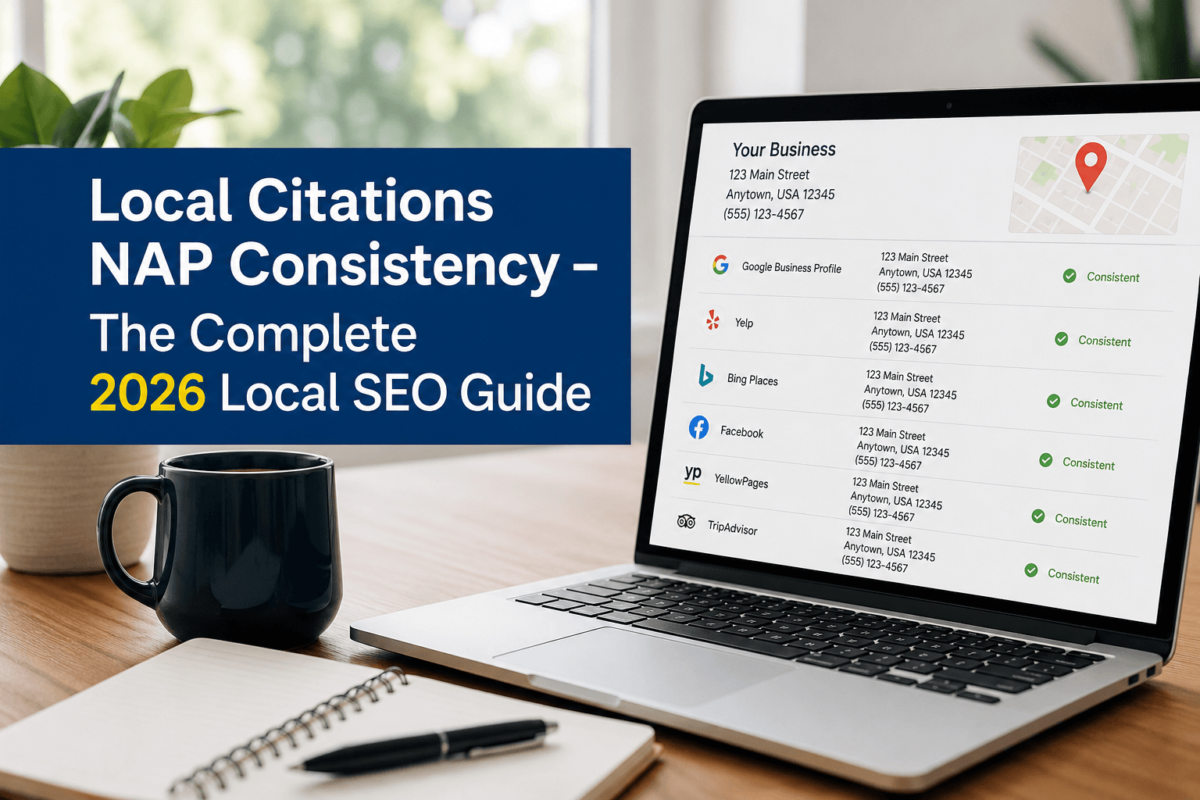
NAP consistency means that your business name, address, and phone number appear exactly the same across every listing on the internet. Even small differences — like “123 Main Street” on one site and “123 Main St.” on another — can create doubt in Google’s algorithm about which version to trust. That doubt translates directly into lower local rankings.
Here’s the key insight for 2026: it’s no longer about how many citations you have. Google evaluates citation quality, accuracy, and relevance. Ten perfect listings on authoritative platforms beat a hundred sloppy ones every single time.
⚡ Quick Summary
- Local citations = online mentions of your business NAP
- NAP = Name, Address, Phone Number
- Consistent NAP builds Google trust and improves Local Pack visibility
- Most local businesses need 20–40 quality citations
- Top platforms: Google Business Profile, Yelp, Apple Maps, Bing Places, BBB
- Best audit tools: BrightLocal, Whitespark, Moz Local
- Biggest mistakes: duplicate listings, old addresses, inconsistent phone numbers
Key Facts at a Glance
| Topic | Key Fact |
|---|---|
| Definition | Any online mention of your business Name, Address, Phone Number |
| Why NAP matters | Inconsistencies create entity confusion that suppresses Local Pack rankings |
| Citations needed (new business) | 10–20 core citations to start |
| Citations needed (established) | 20–40 quality, relevant citations |
| Competitive metros | 40–75+ with emphasis on relevance |
| Top platforms | Google Business Profile, Yelp, Apple Business Connect, Bing Places, BBB |
| Best audit tools | BrightLocal, Whitespark, Moz Local, Yext |
| Biggest mistakes | Duplicate listings, old addresses, call tracking numbers, name variations |
What Is a Local Citation and Why Does It Matter in 2026?
Think of a local citation as a digital reference. Every time another website publishes your business name alongside your address and phone number, that’s a citation. It could be a Yelp profile, a mention in your city’s business directory, a review on a niche industry platform, or even a blog post from a local chamber of commerce.
In the early days of local SEO, the game was simple: the more citations you had, the better you ranked. Those days are over. Google’s algorithms have grown significantly smarter. In 2026, the search engine evaluates citation quality, topical relevance, and data accuracy — not raw volume. For a deeper look at how this fits into the bigger picture, see our complete guide to local SEO strategies.
How Citations Have Evolved
Early local SEO was citation-stuffing: submit everywhere, rank well. Then Google started weighing authority. Now it triangulates your citation signals — looking for cross-platform agreement on your NAP — to make a trust determination about your business entity.
This matters because local search is now heavily tied to entity understanding. Google isn’t just matching keywords; it’s asking, “Is this business real, where is it, and does the internet agree on those facts?” Citations are the votes that answer those questions.
How Citations Influence Local Pack Rankings
The Local Pack — those three business listings that appear in a map box near the top of Google search results — is prime real estate for any local business. Studies consistently show that citation signals are among the top local ranking factors, alongside Google Business Profile optimization, reviews, and proximity.
Here’s a real-world illustration: imagine two HVAC companies competing in Dallas. Company A has 60 low-quality citations scattered across spammy directories with three different phone numbers listed. Company B has 30 consistent citations on authoritative platforms, all with identical NAP. Company B wins the Local Pack — almost every time.
💡 Pro Insight
Google increasingly evaluates citation quality, relevance, and accuracy rather than raw quantity. A business with 25 accurate citations on relevant, high-authority sites will typically outrank a competitor with 100 inconsistent listings across low-quality directories.
Structured vs. Unstructured Citations: What Google Values More
Not all citations look the same. There are two main types, and understanding the difference helps you build a smarter citation strategy.
Structured Citations
Structured citations appear on directory or listing platforms where there’s a formal profile or business record. The NAP information is submitted in defined fields — name, address, phone — and the platform stores and displays it in a consistent format.
Examples of structured citation platforms include:
- Google Business Profile — the single most important citation for any U.S. local business
- Yelp — trusted by consumers and widely scraped by other directories
- Apple Business Connect — feeds Apple Maps, Siri, and increasingly AI assistant results
- Bing Places for Business — often overlooked, but Bing still powers meaningful traffic
- Better Business Bureau (BBB) — carries authority and trust signals beyond just citations
These platforms are where you control your data. You create the profile, you verify it, and you update it when things change. That control is powerful — it means accuracy is fully in your hands.
Unstructured Citations
Unstructured citations are NAP mentions that appear naturally within content rather than in a formatted directory profile. A local newspaper article that mentions your restaurant’s name and address. A blog post from a community organization that references your business. A Chamber of Commerce news post that lists your phone number.
Examples include:
- Local news articles and press coverage
- Chamber of Commerce event pages and member directories
- Community and neighborhood blogs
- Industry publications and trade association mentions
- Podcast show notes, event listings, and sponsor pages
Which Type Matters More?
Both matter — but they do different jobs. Structured citations create consistency and form the data backbone of your local presence. Unstructured citations create authority, topical relevance, and natural link equity.
Think of structured citations as the foundation of a house. Without them, nothing else stands. Unstructured citations are the walls and rooms that give the structure depth and character.
A strong local SEO strategy requires both. Start with structured citations for accuracy and coverage, then layer in unstructured citations for topical relevance and local authority.
Table 1: Structured vs. Unstructured Citations
| Feature | Structured | Unstructured | Best Use |
|---|---|---|---|
| Format | Directory/profile fields | Embedded in content | — |
| Control | High (you submit) | Low (earned/organic) | — |
| NAP accuracy | Exact match required | Context-dependent | Structured for NAP |
| Authority signal | Moderate | High (editorial) | Unstructured for authority |
| Ease of getting | Easy (self-submit) | Hard (must be earned) | Structured to start |
| Google trust | Baseline trust | Strong relevance signal | Both together |
NAP Consistency: Why Even Small Differences Can Hurt Rankings
NAP stands for Name, Address, and Phone Number. These three data points are the core of your local business identity online. When they appear consistently across every platform, Google gains confidence in your business data. When they conflict, Google gets confused — and a confused algorithm doesn’t rank you prominently.
The Trust Signal Problem
Think about it from Google’s perspective. If one website says your business is at “123 Main Street” and another says you’re at “123 Main Ave,” which one should it trust? What if one listing shows a local number and another shows a call tracking number? What if your business name is “Smith Plumbing LLC” in one place and just “Smith Plumbing” in another?
Each inconsistency introduces a fragment of doubt. Individually, these fragments may seem trivial. Collectively, they erode the confidence Google needs to rank you prominently in local results.
💡 Relatable Analogy
Imagine applying for a mortgage with three different addresses on your application. The lender wouldn’t just pick one — they’d flag your application, ask questions, and delay the process. That’s exactly what Google does when it finds conflicting NAP data.
Entity Confusion and Duplicate Listings
When your NAP data is inconsistent across the web, Google may actually treat your listings as separate business entities. Instead of consolidating the signals from all your citations into one strong local presence, the algorithm splits your authority across multiple conflicting records. This is called entity confusion — and it can devastate your local rankings.
Duplicate listings compound this problem. If you’ve moved locations, changed phone numbers, or rebranded, old listings don’t just disappear. They sit on directories sending wrong signals for years.
Ranking Suppression
The practical outcome of NAP inconsistency is ranking suppression. Your business might appear in local results but rank lower than its relevance, authority, and review count would otherwise suggest. Worse, you can lose Local Pack visibility entirely to competitors whose citation profiles are cleaner and more consistent.
The Acceptable Variation Rule: What Counts as Inconsistency?
Here’s where it gets nuanced. Not every formatting variation hurts you. Google’s algorithm is sophisticated enough to understand common address abbreviations. The key is understanding the difference between formatting variations (usually fine) and data discrepancies (always problematic).
✓ Usually Acceptable
- Street vs. St. — Google understands these as equivalent
- Suite vs. Ste. — Standard abbreviation, generally fine
- Road vs. Rd. — Recognized abbreviation
- Avenue vs. Ave. — Safe abbreviation
- Boulevard vs. Blvd. — Acceptable shortening
- Inc. / LLC inclusion — Adding or omitting a legal suffix is usually tolerated
✗ Usually Problematic
- Different phone numbers — tracking vs. real number
- Old addresses — previous location still listed
- Missing suite numbers — creates ambiguity
- Different business names — name variations across listings
- Incorrect call tracking numbers — dynamic numbers confuse aggregators
- Toll-free vs. local numbers — mixing 800s with local numbers
Table 2: Acceptable vs. Problematic NAP Variations
| Variation Type | Example | Risk Level |
|---|---|---|
| Street vs. St. | 123 Main Street / 123 Main St. | Low — Generally safe |
| Suite vs. Ste. | Suite 200 / Ste. 200 | Low — Standard abbreviation |
| Missing suite number | 123 Main St. vs. 123 Main St., Ste. 200 | HIGH — Creates ambiguity |
| Different phone numbers | 555-100-2000 vs. 800-555-0100 | HIGH — Major trust issue |
| Old address still listed | Previous location still showing | HIGH — Entity confusion |
| Name with/without ‘LLC’ | Smith Plumbing vs. Smith Plumbing LLC | Low — Usually tolerated |
| Different business names | Smith Plumbing vs. Smith’s Plumbing | HIGH — Major inconsistency |
| Tracking number used | Dynamic tracking # on directories | HIGH — Never use on citations |
⚠ Important Rule
Never use call tracking numbers on directory listings or citations. Dynamic tracking numbers change per session and will destroy your NAP consistency overnight. If you use call tracking for ads or analytics, use static tracking numbers only, and keep your primary local number consistent across all citation platforms.
Priority 1: Core Universal Citations (Mandatory for Every Business)
These are the citation platforms that every U.S. local business absolutely must have — verified, accurate, and complete. Think of these as your citation foundation. Without them, nothing else matters.
Google Business Profile
Google Business Profile (GBP) is not just your most important citation — it IS your local search presence. It feeds the Local Pack, Google Maps, and increasingly, Google’s AI-powered search features. Getting this profile 100% complete and accurate is the single highest-leverage action you can take in local SEO.
- Why it matters: Directly powers Local Pack rankings and Google Maps visibility
- Trust level: Highest — Google’s own platform
- Best practices: Verify your listing, fill every field, use your exact legal business name, add photos, keep hours current
Yelp
Yelp is scraped heavily by other directories and aggregators, which means an incorrect Yelp listing can propagate bad data across the web. It’s also one of the most-visited review and business discovery platforms, especially for restaurants, service businesses, and health/beauty.
- Why it matters: High consumer traffic and heavy scraping by other directories
- Trust level: Very High
- Best practices: Claim your listing, ensure exact NAP match, respond to reviews
Apple Business Connect
Apple Business Connect feeds Apple Maps, Siri, Safari searches, and an increasing number of AI assistant integrations. With the growing iPhone market share and AI-powered voice search, this listing is more important than ever and still overlooked by a majority of small businesses.
- Why it matters: Powers Siri, Apple Maps, and AI search on all Apple devices
- Trust level: High
- Best practices: Verify ownership, complete all fields, upload quality photos
Bing Places for Business
Bing isn’t Google, but it’s still the default search engine in many enterprise Windows environments and powers searches within Microsoft products, including Cortana and Microsoft Edge. Bing Places is often the most neglected top-tier citation — which means claiming and optimizing it is a quick competitive win.
- Why it matters: Default search in many enterprise and Microsoft environments
- Trust level: High
- Best practices: Import from GBP when available, verify, keep updated
Better Business Bureau (BBB)
The BBB carries significant trust authority, especially for service-based businesses where consumer trust is a purchase driver. A BBB listing also tends to rank well in branded searches and appears frequently in Google’s knowledge panels.
- Why it matters: High-trust authority site, ranks well in branded searches, influences knowledge panels
- Trust level: Very High
- Best practices: Claim your profile, ensure NAP accuracy, consider accreditation for additional trust signals
Priority 2: Industry-Specific Citations
Once your core universal citations are solid, the next layer is industry-specific directories. These carry outsized relevance because Google understands topical context. A citation from Healthgrades tells Google you’re in healthcare. A citation from Houzz tells Google you’re in home improvement. That topical confirmation matters for both rankings and AI search citations.
🏭 Why Niche Relevance Matters
A citation from Healthgrades is worth far more to a medical practice than 20 citations from generic directories. Google’s entity understanding reads these niche citations as topical confirmation: “This business is in healthcare.” That context reinforces your category relevance and can significantly influence ranking position in industry-specific queries.
💊 Medical & Healthcare
- Healthgrades — Primary medical directory
- Vitals.com — Doctor and healthcare provider directory
- WebMD Health Directory — High domain authority
- ZocDoc — Appointment booking with strong local signal
⚖ Legal Services
- Avvo — Dominant legal directory
- FindLaw — Authoritative legal resource
- Justia — Free directory with high domain authority
- Martindale-Hubbell — Long-standing legal ratings platform
🔨 Home Services & Contractors
- Angi (formerly Angie’s List) — Major home services marketplace
- HomeAdvisor — High consumer traffic
- Houzz — Interior design and home improvement
- Thumbtack — Service marketplace with local profiles
🍳 Restaurants & Food Service
- TripAdvisor — Critical for restaurants; high global authority
- OpenTable — Reservation platform and citation source
- Zomato — Restaurant-specific directory
- Grubhub / DoorDash — Delivery platforms as citation sources
Priority 3: Local Citations
Local citations are the most underutilized layer of citation building — and often the most impactful for competitive local markets. These are citations from sources that are geographically relevant to your specific city or region.
Types of Local Citation Sources
- Chamber of Commerce — Your local Chamber directory is a citation source with genuine geographic authority and often a strong domain rating
- Local Business Associations — Trade groups, merchant associations, and BNI chapters often maintain online directories
- City and County Websites — Many municipalities maintain business directories for their residents
- Regional Blogs and News Sites — A mention in the local newspaper or a community blog is an unstructured citation with both local and editorial authority
- Neighborhood Apps and Platforms — Nextdoor business listings, community Facebook groups, and local event calendars all count
Why Local Relevance Often Beats National Volume
Here’s something that surprises a lot of business owners: a citation from your city’s Chamber of Commerce website can carry more local SEO weight than a citation from a national directory with millions of listings. Why? Because Google reads geographic context. A Dallas Chamber citation tells Google your business is genuinely connected to Dallas — not just listed there.
Consider this example: two competing coffee shops in Austin, Texas. Shop A has 80 citations across national directories. Shop B has 40 citations, including ones from the Austin Chamber, Austin Monthly, and three local food blogs. Shop B’s local citation profile gives Google a clear geographic signal that Shop A’s national listings simply can’t replicate.
This is why “local citation building” shouldn’t just mean submitting to big directories. It means earning and building genuine connections to your local online ecosystem.
How to Audit Your Existing Citations
Before you build new citations, you need to know what’s already out there. A citation audit is the foundation of any serious local SEO cleanup effort. Here’s the step-by-step framework for client audits.
Document Your Official NAP
Before you look at a single directory, write down exactly how your business name, address, and phone number should appear on every listing. Be precise. Decide: Is it “Suite 400” or “Ste. 400”? This becomes your master NAP — the single source of truth you’ll use to evaluate every citation you find.
Search Google Manually
Start with targeted Google searches to surface your existing listings. Try: “[Business Name]” + “[City]”, “[Business Name]” + “[Phone Number]”, and “[Business Name]” + “[Old Address]” if you’ve moved. This surfaces the most authoritative listings quickly and reveals any obvious NAP conflicts.
Review the Major Directories
Manually visit and review your listings on Google Business Profile, Yelp, Apple Maps, Bing Places, BBB, and any major industry-specific directories relevant to your vertical. Record every NAP detail you find and compare it against your master NAP.
Identify Duplicates
Duplicate listings are extremely common, especially after a business move or rebrand. Search for variations of your business name and look for multiple listings on the same platform. Flag every duplicate — you’ll need to either claim and merge them or request removal.
Track All Inconsistencies
Build a simple spreadsheet with columns for: Platform Name, URL, Current Name, Current Address, Current Phone, Correct? (Y/N), and Action Needed. This gives you a prioritized cleanup list.
Prioritize High-Authority Sites
Not all citation errors are equally urgent. Focus first on platforms with the highest domain authority and consumer traffic: Google Business Profile, Yelp, Apple Maps, Bing Places, BBB, and any major industry directories. Fix these first before worrying about smaller directories.
✅ Audit Checklist: Your Official NAP
- Business Name (exact legal name): _______________
- Address Line 1: _______________
- Address Line 2 (Suite/Unit): _______________
- City, State, ZIP: _______________
- Primary Phone (no tracking number): _______________
- Website URL: _______________
- Primary Business Category: _______________
How to Fix NAP Inconsistencies Efficiently
Once your audit is complete, you have a prioritized list of citations to fix. Here’s the workflow that keeps the process manageable.
Fix High-Authority Listings First
Start with Google Business Profile, Yelp, Apple Business Connect, and Bing Places. These have the highest impact on rankings and the highest volume of scraping by other directories. Fixing them can trigger automatic correction of downstream citations.
Correct the Major Aggregators
Data aggregators distribute business information to hundreds of smaller directories. Fixing your data at the aggregator level creates a ripple effect that updates many listings simultaneously — often more efficient than manually correcting dozens of small directory listings.
Remove or Merge Duplicates
For duplicate listings, you generally have two options: claim the duplicate and merge it with your primary listing, or contact the directory to request removal. Don’t skip this step — duplicate listings actively hurt your rankings.
Standardize Formatting
As you correct listings, use your master NAP document as the single source of truth. Don’t improvise. Every listing should match exactly, character for character, including punctuation and capitalization.
Recheck Quarterly
Citation data degrades over time. Aggregators push new data, third parties scrape and republish old information, and new duplicate listings can appear. Schedule a quarterly citation check — it takes about an hour once your initial cleanup is done.
Realistic Timeline Expectations
- 1–4 weeks: Manual corrections to major platforms typically reflect
- 4–8 weeks: Aggregator updates propagate across their distribution networks
- 2–3 months: Full cleanup of a messy citation profile with 50+ listings
Don’t expect overnight results, but do expect meaningful improvement. Patience is key.
Citation Building Tools Comparison
If you’re managing citations for more than a handful of locations, doing everything manually isn’t realistic. For those also using Ahrefs for broader SEO tracking, pairing it with a dedicated citation tool gives you full visibility across your local presence.
Table 3: Citation Tool Comparison
| Tool | Pros | Cons | Best For | Pricing |
|---|---|---|---|---|
| BrightLocal | All-in-one local SEO; strong reporting dashboard | Citation builder is add-on cost | Agencies, multi-location, SMBs | $39–$49/mo+ |
| Whitespark | Excellent manual citation building; strong NAP accuracy | More manual; time investment required | Agencies prioritizing quality | $17–$150/mo+ |
| Moz Local | Easy automated sync; good aggregator coverage | Limited to core directories; less control | Small businesses, automated management | $14–$20/loc/mo |
| Yext | Very broad distribution; real-time sync; enterprise-grade | Expensive; listings revert if subscription lapses | Enterprises, franchise brands | $199–$499+/yr/loc |
| Manual | Full control; no ongoing cost; highest accuracy | Very time-intensive; not scalable | New businesses, 1–2 locations | $0 (time cost) |
⚠ Unbiased Recommendations
- Solo small business owners: Start manually with the five core universal citations, then consider Moz Local for ongoing management.
- Agencies and multi-location brands: BrightLocal or Whitespark are the industry standards.
- Yext caveat: The “subscription trap” is real. If you stop paying, your listings can revert to their pre-Yext state. Factor this into your long-term budget planning.
How Many Citations Do You Need in 2026?
This is the question that comes up most often, and the answer is: fewer than you think, if they’re the right ones.
Quality Beats Quantity — Every Time
Businesses have been audited with 200+ citations struggling to rank in the Local Pack, while competitors with 30 clean, accurate citations dominated their market. The difference wasn’t volume — it was accuracy, relevance, and consistency.
Citation Benchmarks by Business Stage
| Business Stage | Recommended Citations | Notes |
|---|---|---|
| New Local Business | 10–20 | Focus exclusively on core universal + 1–2 industry-specific |
| Established Local Business | 20–40 | Core + industry + 5–10 local citations |
| Competitive Metro Market | 40–75+ | Full tier coverage; emphasize quality and relevance |
| Multi-Location Brand | Location-specific | Each location needs its own citation profile |
| Franchise Network | Standardized + local | Core national + unique local citations per location |
Remember: these are starting benchmarks, not targets to hit mechanically. Always prioritize relevance. Ten perfectly accurate citations on high-authority platforms will serve you better than 50 citations on low-quality, spammy directories.
Data Aggregators: What They Are and Why They Matter
Data aggregators are companies that collect business information from various sources and distribute it to hundreds of directories, apps, GPS systems, and search engines. Understanding how they work is essential for managing your citation health efficiently.
How Data Aggregation Works
Think of data aggregators as wholesalers of business information. They maintain massive databases of business NAP data and license that information to directories, navigation systems, voice assistants, and local search platforms. When your business information gets into aggregator databases accurately, it propagates to dozens or hundreds of downstream sites automatically.
The major U.S. data aggregators include:
- Data Axle (formerly Infogroup) — One of the largest U.S. business data sources
- Neustar Localeze — Powers many local directory and navigation platforms
- Foursquare — Powers location data for many apps and platforms beyond its own app
Benefits and Limitations of Aggregators
The benefit of fixing your data at the aggregator level is efficiency — one correction ripples across hundreds of sites. The limitation is timing. Aggregator updates can take 4–8 weeks to fully propagate, and not every directory pulls from aggregators on the same schedule.
⚠ Important
Aggregators can also introduce new errors. If an aggregator picks up an old or incorrect data source, it can push bad NAP information to directories you thought were accurate. This is why quarterly citation audits matter — aggregator-driven errors can appear on clean listings seemingly out of nowhere.
Citations for Multi-Location Businesses
Managing citations for a business with multiple locations requires a fundamentally different approach than managing a single-location business. The core principle: each location needs to be treated as its own distinct local entity.
Key Rules for Multi-Location Citation Strategy
- Separate location pages: Each location needs its own dedicated page on your website with a unique NAP
- Unique NAP per location: Never list a corporate/central number across all locations — use local numbers
- Individual GBP listings: Every physical location needs its own verified Google Business Profile
- Location-specific citations: Build local citations for each location in its specific geographic market
- Consistent brand name: Use the same business name format across all locations (e.g., “Brand Name – City Name”)
Franchise Example
Consider a national sandwich franchise with 15 locations across three states. The mistake seen most often: the corporate office sets up a single Yelp account with a general address and a 1-800 number, then lists all locations as “additional locations.” That’s a citation disaster.
The right approach: each of those 15 locations has its own Yelp profile, its own Google Business Profile, its own Apple Maps listing — each with the specific address and local phone number for that location. The business name follows a consistent format: “FreshBite Subs – Austin TX” or “FreshBite Subs – Nashville TN.” This way, local signals stay local, and each location competes independently in its market.
Real-World Examples
Local HVAC Contractor
Metro HVAC Pros, a Dallas-based HVAC company, was struggling to rank in the Local Pack despite excellent reviews and a well-optimized Google Business Profile. A citation audit revealed the problem: during a business restructuring two years prior, the company had changed its name from “Metro HVAC” to “Metro HVAC Pros.” But 60% of their existing citations still showed the old name. Yelp had the old tracking phone number. BBB had the original address from before a suite move.
The fix: a full citation audit, standardization to the new business name and current NAP across all platforms, and removal of the tracking number from directory listings.
Law Firm with Duplicate Listings
Anderson & Morris Law had 11 duplicate Google Business Profile listings — one for each attorney, two for different old office addresses, and several that appeared to have been auto-generated from Yellow Pages data. Every search for their firm produced a confusing scatter of listings, diluting their reviews across multiple profiles and sending wildly inconsistent NAP signals to Google.
Cleaning this up required submitting removal requests for unauthorized listings, merging duplicates where possible, and consolidating all reviews and authority signals into a single, fully verified profile.
Restaurant Changing Locations
Basilico Trattoria, a family-owned Italian restaurant in Chicago, moved locations after ten years at the same address. The owners updated their Google Business Profile immediately — but that was all they did. Over the following six months, customers kept showing up at the old address, Yelp showed the old location with 300+ reviews, Apple Maps directed drivers to the wrong building, and dozens of food blogs still listed the original address.
The lesson: updating your GBP is just the beginning. A location change requires a systematic citation audit and update campaign across every major directory, every aggregator, every blog that’s ever mentioned your business. It’s a multi-week project.
30-Day Citation Cleanup Action Plan
About This Plan
This standalone action plan gives you a week-by-week roadmap to audit, fix, and build your local citations. Use it as a checklist you can check off in order. Each week builds on the last.
Citation Priority Table
Table 4: Citation Priorities — Priority, Type, Examples, Impact, and Effort
| Priority | Citation Type | Examples | Impact | Effort |
|---|---|---|---|---|
| 1 — Critical | Core Universal | GBP, Yelp, Apple, Bing, BBB | Very High | Low–Medium |
| 2 — High | Industry-Specific | Healthgrades, Avvo, Angi, TripAdvisor | High | Medium |
| 3 — Important | Local Geographic | Chamber, local news, city directories | High (local) | Medium–High |
| 4 — Supporting | Data Aggregators | Data Axle, Neustar Localeze, Foursquare | Medium (cascading) | Low (via tool) |
| 5 — Additional | General Directories | Yellow Pages, Hotfrog, Manta | Low–Medium | Low |
Frequently Asked Questions
Does “Street” vs. “St.” count as a NAP inconsistency?
Generally, no. Google’s algorithm understands common address abbreviations like Street/St., Avenue/Ave., and Boulevard/Blvd. as equivalent. These formatting variations rarely cause ranking problems. What does matter is that the actual data (the street name, house number, city, ZIP) is identical. If you want to be absolutely safe, choose one format and use it consistently everywhere.
How many local citations do I need to rank in the Local Pack?
There’s no magic number, but here are practical benchmarks: new businesses should aim for 10–20 core citations; established local businesses typically need 20–40 quality citations; competitive metro markets may require 40–75+. More important than quantity is accuracy. Ten perfectly consistent citations on authoritative platforms beat 100 sloppy ones. Focus on quality, then build volume strategically.
What are the most important citation sites for local SEO?
The five non-negotiables for every U.S. local business are: Google Business Profile, Yelp, Apple Business Connect, Bing Places for Business, and the Better Business Bureau. After these, prioritize the top 3–5 industry-specific directories for your vertical, then layer in local citation sources like your Chamber of Commerce.
Can I remove bad citations from directories?
Yes, but it takes effort. For most directories, you claim the listing and correct the information directly. For listings you can’t claim, most platforms have a contact form or support email for removal requests. Duplicate listings on Google Business Profile require submitting a claim and requesting merging or removal. Data aggregator corrections take 4–8 weeks to propagate. Patience is required.
Is Yext worth it for citation management?
It depends on your situation. Yext is excellent for enterprise businesses, franchise networks, and multi-location brands that need real-time data sync across 80+ directories. It’s expensive — often $200–500+ per location per year — and comes with a critical caveat: if you cancel, listings can revert. For small businesses with 1–2 locations, Moz Local or BrightLocal offer more cost-effective alternatives.
Do citations still matter in 2026?
Absolutely. While citations are no longer the dominant ranking factor they once were, they remain an important trust and verification signal, especially for businesses competing in the Local Pack. The shift is from quantity to quality — Google now looks for accurate, consistent, and relevant citations rather than raw citation count. Every competitive local business should maintain a clean, consistent citation profile.
How often should I audit my citations?
A full citation audit should be done at least once per year for stable businesses and once per quarter if you’re in a competitive market, have recently moved, changed phone numbers, or rebranded. Set up a Google Alert for your business name to catch new or changed listings between audits. Most citation management tools also offer monitoring features that alert you to new mentions.
What is a citation audit?
A citation audit is a systematic review of all online mentions of your business’s NAP to identify inconsistencies, duplicate listings, and missing citations. The process involves documenting your official NAP, searching for all existing listings, comparing them against your master NAP, and creating a prioritized action list of corrections needed. Tools like BrightLocal and Whitespark can automate much of this process.
Are free citation sites worth using?
It depends on the site. Free listings on high-authority platforms like Google Business Profile, Yelp, and Bing Places are absolutely worth pursuing. Free listings on low-quality, spammy directories are not — they can actually hurt your citation profile by adding inconsistent data and diluting your authority signals. Evaluate each directory by its domain authority, traffic, and relevance to your industry before submitting.
Can duplicate listings hurt rankings?
Yes, significantly. Duplicate listings split your review count across multiple profiles, diluting your social proof. They also confuse Google’s entity understanding, making it harder for the algorithm to consolidate your authority signals into a single strong profile. If you have duplicate listings — especially on Google Business Profile — removing or merging them should be your first citation cleanup priority.
Conclusion: The Businesses That Win Are the Most Accurate
Local citations aren’t glamorous. They don’t generate the headlines that AI search, voice optimization, or content strategy do. But they are the unglamorous infrastructure that determines whether everything else you do in local SEO actually works.
Here’s what the data and real-world experience consistently confirm: citations remain important; accuracy beats volume; and consistency builds the trust that drives rankings. A business with 30 perfectly consistent, relevant citations will outperform a competitor with 150 messy ones almost every time.
The shift in 2026 is from citation building as a volume game to citation management as a quality discipline. That means auditing regularly, fixing inconsistencies proactively, building niche-relevant and local citations strategically, and never treating your NAP data as a set-and-forget task.
Start with the 30-day action plan in this guide. Get your core citations right. Build the industry-specific and local layer. Set up quarterly monitoring. If you need hands-on help, explore TechCognate’s local SEO services — then watch what happens to your Local Pack visibility.
Final Takeaway
In local SEO, the businesses that win aren’t always the ones with the most citations — they’re the ones with the most accurate and trustworthy citations.
Invest in accuracy, consistency, and relevance. That’s the citation strategy that wins in 2026 and beyond.