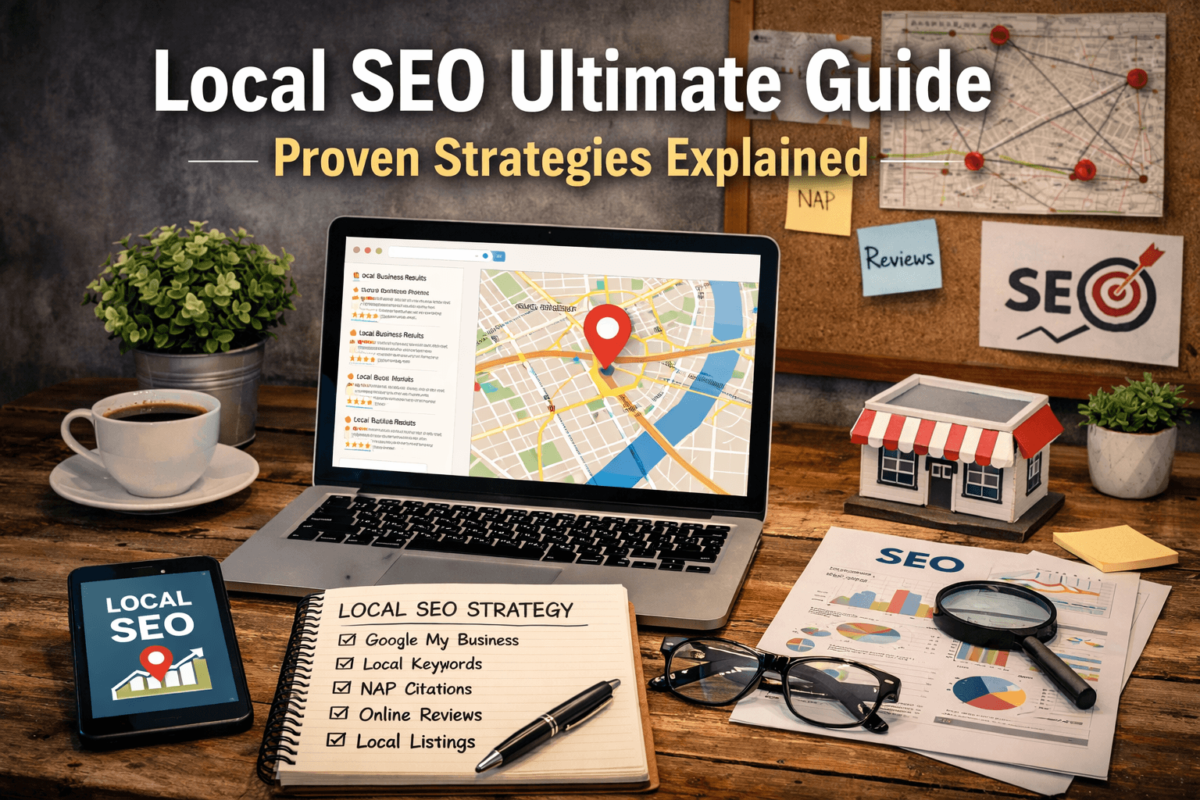
Every single day, millions of people pull out their phones and search for “plumber near me,” “best dentist in Chicago,” or “emergency HVAC repair Dallas.” The businesses that pop up at the top of those results get the calls. The businesses that don’t show up? Invisible — even if they’re right around the corner.
Here’s the thing: showing up in local search isn’t magic. It’s a repeatable process called Local SEO, and it works incredibly well for small and medium businesses. Businesses that invest in Local SEO consistently outperform competitors who ignore it.
1 What is Local SEO? (Simple Explanation)
Local SEO is the process of optimizing your business’s online presence so that it shows up when people nearby search for what you offer. It’s different from general SEO, which targets broad, national audiences. Local SEO is laser-focused on geography.
If you own a pizza restaurant in Denver, you don’t care if someone in Miami finds your website. You care that when someone in Denver types “best pizza near me,” your restaurant shows up first. That’s Local SEO in a nutshell.
The Three Types of Local Search Results
| Result Type | What It Is |
|---|---|
| Google Local Pack | The box of 3 businesses that appears at the top of search results, usually with a map. This is prime real estate. |
| Google Maps Results | When someone opens Google Maps and searches, businesses are ranked based on location and profile quality. |
| Organic Results | The traditional blue links below the Local Pack. A well-optimized website with local content can rank here too. |
The Google Local Pack (the 3-pack) drives a huge share of clicks. Getting into that box should be your #1 Local SEO goal.
2 Why Local SEO Matters More in 2026
Local SEO isn’t a trend. It’s the reality of how people find businesses today. Here’s what the data tells us:
Voice search is booming too. Queries like “Hey Google, find an electrician near me” are now commonplace — and they almost always trigger local results. A plumber in Dallas doesn’t need traffic from New York. They need calls from people within 10 miles. Local SEO makes that happen.
How Customers Actually Search for Local Businesses
3 How Google Ranks Local Businesses
Google uses three core factors to decide which businesses show up in the Local Pack. Understanding these is the foundation of everything else in this guide.
1. Relevance
Relevance is how well your business matches what someone searched for. If someone searches “emergency plumber Austin,” Google wants to show businesses that: (a) are plumbers, (b) offer emergency services, and (c) serve Austin. Your Google Business Profile categories, description, and website content all influence relevance.
A roofing company that only lists “contractor” as their category will lose to one that lists “roofing contractor” as their primary category. Specificity wins.
2. Distance
Google tries to show businesses physically close to the searcher. You can’t control your physical location, but you can control how clearly you signal your service area, address, and the neighborhoods you serve.
3. Prominence
This is where the real differentiation happens. Prominence refers to how well-known and trusted your business is online. Google measures it through:
A small roofing company in suburban Atlanta jumped from page 3 to the Local Pack in just 60 days. The fix? Fixing their GBP categories and building 15 local citations. Simple changes, massive impact.
4 Google Business Profile Optimization
Your Google Business Profile (GBP) — formerly Google My Business — is the single most important Local SEO asset you have. It controls your Local Pack listing, your Google Maps presence, and a huge chunk of how customers perceive you before visiting your website.
Do NOT skip verification. An unverified profile has zero Local Pack ranking power.
Claim and Verify Your Profile
Go to Google Business Profile and search for your business. Claim it, choose your category carefully, and complete verification — usually via a postcard, phone, or email.
Choose the Right Categories
Your primary category is the most important field in your entire GBP. Be specific: “Dentist” beats “Healthcare provider.” A dental office can also add secondary categories like Cosmetic Dentist, Emergency Dental Service, and Teeth Whitening Service.
Write an Optimized Business Description
Naturally include your primary service, location, and a compelling reason to choose you. You have 750 characters — use them well. Write for humans first, Google second.
Add Services and Products (Massively Underutilized)
List every service you offer with keyword-rich descriptions. Instead of just “Plumbing,” add: “Emergency Plumbing Repair — Available 24/7 in Dallas and surrounding areas.” Each service becomes a relevance signal for matching searches.
Upload High-Quality Photos (and Keep Adding Them)
Upload exterior, interior, team, before-and-after, and product photos. Aim for 10–15 to start and add new ones monthly. Activity signals matter to Google.
Use Google Business Posts Weekly
Post at least once a week — seasonal offers, new services, blog content, customer stories. It takes 5 minutes and keeps your profile fresh.
Optimize the Q&A Section
Most businesses ignore this. Add common customer questions and answer them yourself: “Do you offer free estimates?” → “Yes! We offer free, no-obligation estimates for all projects over $500.”
5 Local Keyword Research
Local keyword research is about finding the exact phrases your potential customers type into Google — then building your content around them.
The Three Types of Local Keywords
| Keyword Type | Examples | Priority |
|---|---|---|
| Service + City | “roof repair Dallas,” “plumber Austin TX,” “best pediatric dentist Chicago” | Highest |
| “Near Me” | Google figures out location automatically — optimize GBP & website to surface you | High |
| Comparison & Intent | “best roofing company in Phoenix,” “affordable family dentist Miami” | Medium |
How to Find Local Keywords
Look at competitor GBP listings and websites. What categories are they using? What services are they listing? This tells you exactly what keywords are working in your market.
6 On-Page SEO for Local Businesses
Your website is your second-most-important Local SEO asset (after your GBP). Here’s how to optimize it for local search:
Optimize Title Tags
Primary Service + Location | Brand Name
e.g., “Best Plumber in Phoenix | FastFix Plumbing Services”
Create Location-Specific Pages
If you serve multiple cities, create a dedicated page for each. A roofing company in Dallas might have pages for /roof-repair-dallas, /roof-repair-plano, and /roof-repair-frisco. Each page needs unique content: local service descriptions, local testimonials, local FAQs, and an embedded Google Map.
Don’t just duplicate the same page with the city name swapped out. Google detects thin, duplicate content and it can hurt your rankings.
NAP Consistency
NAP stands for Name, Address, and Phone Number. These three pieces of information must be 100% identical everywhere they appear online — your website, GBP, Yelp, Facebook, directories, everything. Even small inconsistencies like “St.” vs “Street” can confuse Google and hurt your rankings.
Add Local Schema Markup
Schema markup is structured data code that helps Google better understand your business. Use LocalBusiness schema to mark up your business name, address, phone number, hours, and services. You can generate it free at Schema.org.
7 Local Citations (Still Important in 2026)
A citation is any online mention of your business’s name, address, and phone number. Citations are the internet’s way of confirming your business is real and located where you say it is.
Essential Citations
Industry-Specific Citations
NAP must be identical on every citation. Inconsistencies across directories confuse Google and can suppress your rankings. Tools like BrightLocal and Whitespark make citation building and auditing much faster.
8 Reviews Strategy — Your Secret Weapon
Reviews are one of the most powerful Local SEO ranking factors, and most businesses are completely blowing this. More than 90% of consumers read reviews before choosing a local business — and Google uses the quantity, quality, and recency of your reviews as a major signal for Local Pack rankings.
“A roofing company went from 12 reviews to 89 reviews in 4 months just by texting every customer a review link after job completion. Their Local Pack visibility doubled.”
How to Get More Google Reviews (Ethically)
How to Respond to Reviews
| Review Type | Response Approach | Timeline |
|---|---|---|
| Positive Reviews | Thank the customer by name, mention the specific service, invite them back. Keep it genuine, not robotic. | Within 24–48 hours |
| Negative Reviews | Respond calmly and professionally. Acknowledge the issue, apologize, and offer to resolve it offline. Never argue publicly. | Within 24 hours |
9 Local Link Building Strategies
For local SEO specifically, links from local, relevant websites carry extra weight. Here’s how to build them:
10 Multi-Location Local SEO Strategy
If your business operates in more than one location, you need a specific strategy to rank in each market.
11 Advanced Local SEO Strategies for 2026
Voice Search Optimization
Voice search queries are longer and more conversational. Instead of typing “dentist Chicago,” someone says “Hey Google, find a dentist near me that’s open on Saturdays.”
Entity SEO and Brand Signals
Google increasingly thinks about businesses as “entities” — real-world things it understands and recognizes. Build entity signals by being consistent with your business name across ALL platforms, getting mentioned in authoritative local publications, and using structured data (schema) on your website.
AI Search Results and Local SEO
Google’s AI-powered features (like AI Overviews) are changing search results. But the fundamentals of Local SEO haven’t changed — Google still needs accurate, verified, authoritative information about local businesses to power its AI responses. Businesses with well-optimized GBP listings and strong review profiles are more likely to be featured in AI-generated local summaries.
E-E-A-T Signals for Local Businesses
Google’s quality guidelines emphasize Experience, Expertise, Authoritativeness, and Trustworthiness. Demonstrate E-E-A-T by featuring your team’s credentials and certifications prominently, publishing helpful expert content, displaying licenses and awards, and having a detailed About page.
12 Common Local SEO Mistakes to Avoid
| Mistake | Why It Hurts |
|---|---|
| Keyword stuffing GBP description | Google detects unnatural language and can suppress your listing |
| Inconsistent NAP across directories | Confuses Google, dilutes citation value, hurts rankings |
| Using a fake or virtual office address | Violates Google’s guidelines; listing can be suspended |
| Ignoring negative reviews | Signals poor customer service; hurts conversion rate |
| Duplicate GBP listings | Splits ranking power; can confuse customers |
| Neglecting photo updates | Stale profiles signal inactivity to Google |
| Not building local backlinks | Weakens authority compared to competitors who do |
| Zero location-specific website content | Misses ranking opportunities for city + service searches |
13 Local SEO Checklist for 2026
Use this checklist to audit your current Local SEO and identify gaps.
Google Business Profile
Website Optimization
Citations, Reviews & Links
14 Best Local SEO Tools for 2026
| Tool | Best For | Pricing |
|---|---|---|
| BrightLocal | Citation building, rank tracking, GBP audit | From $39/mo |
| Whitespark | Citation building, local rank tracker | From $20/mo |
| Google Business Profile Insights | Tracking GBP performance, views, searches | Free |
| Google Search Console | Organic search performance, indexing issues | Free |
| Google Keyword Planner | Keyword research with local search volumes | Free |
| Ahrefs | Full-suite SEO: keywords, backlinks, content | From $129/mo |
| SEMrush | Competitive analysis, local keyword tracking | From $139/mo |
| Moz Local | Citation cleanup and consistency monitoring | From $14/mo |
15 Real Local SEO Success Story
HVAC Company in Tampa, FL — 90-Day Transformation
Starting Point (Jan 2025)
- GBP incomplete — missing services, no photos
- 11 Google reviews, average 3.8 stars
- Ranked on page 3–4 for “HVAC repair Tampa”
- No local citations outside of Yelp
What We Did (Jan–Apr 2025)
- Fully optimized GBP — 10 services, 25 photos, weekly posts
- Built citations on 35 major and niche directories
- Implemented SMS review request system after every service call
- Created 4 location-specific pages (Tampa, St. Pete, Clearwater, Brandon)
- Added LocalBusiness schema to all location pages
? Local SEO FAQs
What is local SEO?
Local SEO is the process of optimizing your online presence — including your website and Google Business Profile — so your business appears prominently when people nearby search for your products or services on Google, Google Maps, and other search engines.
How long does local SEO take to work?
Most businesses start seeing measurable improvements in 60–90 days, especially after GBP optimization and citation building. More competitive markets may take 4–6 months to see significant Local Pack movement. Reviews and link building produce compounding results over time.
How do I rank in Google Maps?
Ranking in Google Maps is primarily about three factors: (1) having a fully optimized Google Business Profile with the right categories and complete information, (2) building a strong review profile with consistent, recent reviews, and (3) building local citations and backlinks to establish prominence.
Is local SEO free?
The core activities — claiming your GBP, optimizing your website, asking for reviews, and building some citations — are free. Paid tools like BrightLocal or Ahrefs can speed up the process and provide better data, but you can absolutely start Local SEO with zero budget.
What are local citations?
Citations are online mentions of your business’s name, address, and phone number (NAP). They appear on directories, review sites, and local websites. Consistent citations across authoritative sites help Google verify your business information and improve your local rankings.
Do reviews affect local SEO rankings?
Yes, significantly. Google considers review quantity, average rating, and the recency and consistency of new reviews when ranking businesses in the Local Pack. Getting a steady flow of genuine positive reviews is one of the highest-impact Local SEO actions you can take.
What’s the difference between local SEO and regular SEO?
Traditional SEO focuses on ranking for broad keywords without a geographic component. Local SEO specifically targets searchers in a defined geographic area and includes optimizing for the Google Local Pack, Google Maps, and location-specific queries. Local SEO relies heavily on Google Business Profile, which is not a factor in traditional SEO.
Ready to Start? Do These 4 Things Today
Local SEO rewards consistency and patience. Commit to it for 90 days and you’ll be amazed at what happens to your phone.