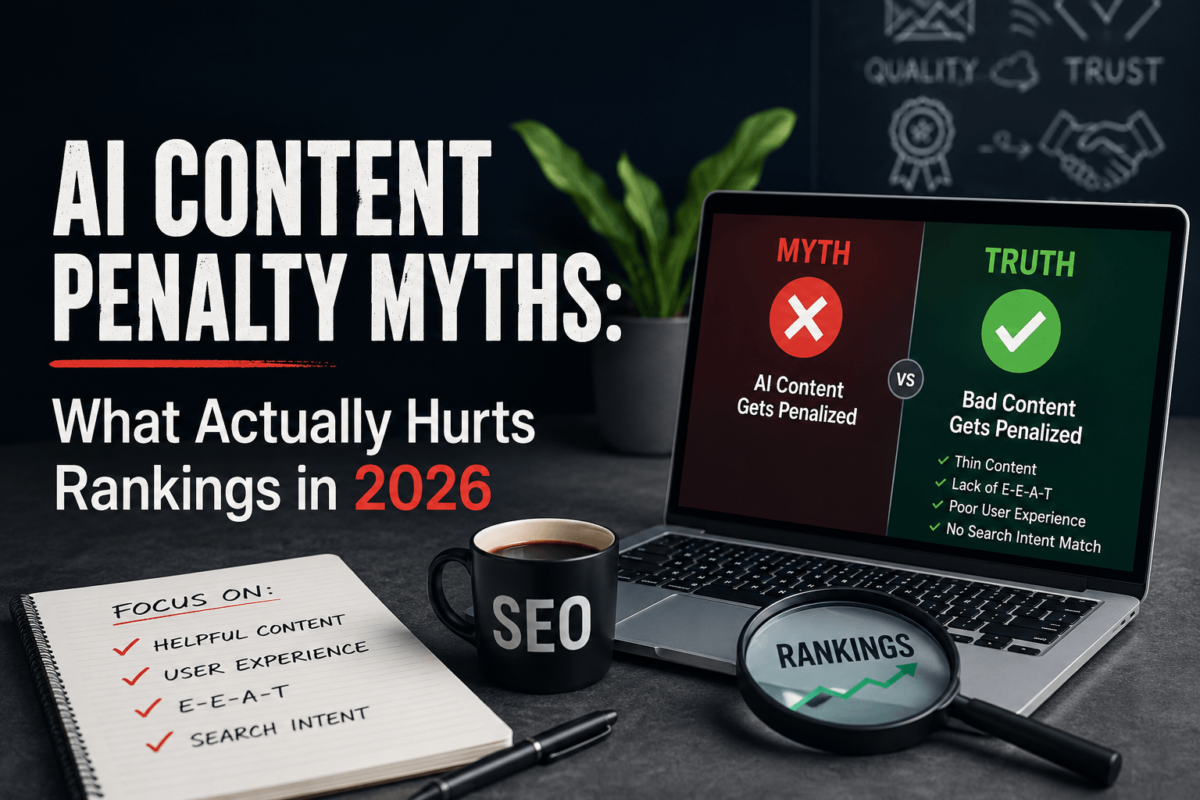
Google does not penalize content simply because AI helped create it. Google penalizes low-quality, spammy, unhelpful, or manipulative content — regardless of who (or what) wrote it. In 2026, the sites winning in search combine AI efficiency with genuine human expertise, real-world experience, and original insights.
At a Glance
- AI content itself is not against Google’s guidelines
- Low-quality, scaled content is what gets you penalized
- EEAT signals matter far more than AI detection scores
- Third-party AI detectors are unreliable and not ranking factors
- Human editing transforms average AI drafts into rankable content
- Affiliate sites can use AI strategically — with the right approach
- Firsthand experience is becoming more valuable in the AI search era
Ever since ChatGPT went mainstream, website owners have been asking the same nervous question: will Google penalize my content if AI helped write it?
Bloggers started second-guessing every sentence. Agencies began running content through AI detectors before publishing. Some site owners paused entire content strategies out of fear. And honestly? A lot of that panic was driven by misinformation.
The reality is more nuanced — and more forgiving — than the doomsayers suggest. Google’s issue has never been with AI. It’s with bad content. Here’s what’s actually going on.
Google Automatically Penalizes AI Content
This one gets repeated constantly. It’s also wrong.
Google’s official stance has been consistent: the search engine evaluates content on quality and helpfulness, not production method. Their documentation explicitly states that using AI to generate content isn’t a violation of their policies — as long as that content isn’t designed to manipulate search rankings with low-quality, mass-produced pages.
Think about it this way: a human can write terrible, unhelpful, keyword-stuffed garbage. An AI can help produce a well-structured, accurate, genuinely useful article. Google’s algorithm is chasing quality signals, not AI fingerprints.
The confusion often stems from Google’s March 2024 core update, which hit a lot of AI-heavy sites. But those sites weren’t penalized for using AI. They were penalized for publishing thin, repetitive, low-value content at scale. The AI was just the tool.
AI Content Can’t Rank on Google
Walk through any competitive niche right now and you’ll find AI-assisted content ranking in top positions. The tool doesn’t prevent ranking. The quality of execution does.
Semrush research and industry reporting consistently show that AI-assisted workflows are now standard practice among high-performing content teams. Writers use AI to structure outlines, generate first drafts, and accelerate research — then layer in expert insights, original perspectives, and editorial polish.
What doesn’t rank? Pure AI output that adds nothing new. Generic listicles with no original examples. “Best of” roundups that read like they were scraped from five other articles. The tool isn’t the problem. The lack of effort is.
See how quality AI content is structured: AI Content Optimization: The Complete Guide
AI Detection Scores Hurt Your SEO
This might be the most damaging myth of all, because it’s driving a lot of counterproductive behavior.
Tools like Originality.ai, GPTZero, and ZeroGPT are not connected to Google’s ranking systems. At all. Google does not use these scores as ranking signals. Passing or failing a detector test has zero direct impact on where your content shows up in search results.
Here’s the kicker: these tools are also notoriously unreliable. Human-written content regularly gets flagged as AI-generated — especially if you write concisely, use plain language, or follow consistent formatting patterns. The false positive rate is significant. Want to understand why? Here’s a detailed breakdown of how AI content detectors actually work — and why their accuracy is so limited.
So when site owners obsess over “humanizing” content to fool detectors, they’re optimizing for the wrong thing entirely. Write for the human reading your page. Google’s signals (engagement, dwell time, return visits, backlinks) reward content that actually helps people — detector scores don’t enter the equation.
Read more: AI Content Detection and SEO — What You Actually Need to Know
Human-Written Content Always Outranks AI Content
Here’s an uncomfortable truth: plenty of human-written content is terrible. Lazy, uninspired, padded-out articles that exist solely to hit a word count aren’t winning rankings just because a person typed them.
Compare a rushed 1,500-word human-written article that rehashes the same information as 40 other pages, to a well-structured AI-assisted article that was carefully edited by a subject matter expert, includes original examples, and answers the search intent precisely.
The second one wins. Almost every time.
What Google actually rewards is helpfulness, expertise, and user satisfaction — regardless of how the content was produced. The authorship method is irrelevant. The output quality is everything.
For a real-world look at this: AI vs. Human Content: SEO Case Study
More AI Content Equals More Traffic
This is where a lot of niche site owners have walked into trouble. The logic seems sound: AI makes content cheap and fast, so publish as much as possible.
The problem is what Google calls scaled content abuse — a specific pattern they target that involves mass-producing pages designed to rank rather than genuinely help users. Publishing 300 thin, AI-generated articles in a month is a fast track to a manual action or an algorithmic demotion.
There’s also the topical cannibalization issue. Churning out similar articles targeting overlapping keywords dilutes your authority instead of building it. Google starts seeing your site as a low-quality content farm, not a trusted resource.
The sites that scale successfully use AI to produce more quality content per writer — not to replace editorial standards entirely. The metric that matters isn’t articles published per month. It’s ranking pages.
Learn how to scale smartly: Programmatic SEO with AI — Done Right
“Humanizing” AI Means Swapping Words Around
Real humanization isn’t running your draft through a paraphrasing tool or manually replacing “utilize” with “use.” Those tricks change the surface-level text while leaving the underlying blandness completely intact. Detectors aside, readers can feel generic content immediately — and they leave.
Genuine humanization looks like this:
- Adding a real opinion — take an actual stance, even a contrarian one
- Including specific examples from experience, not fabricated scenarios
- Using natural sentence rhythm — mix short punchy lines with longer explanations
- Acknowledging nuance — things that are complicated should sound complicated
- Sharing observations that only come from actually using a product or tactic
- Writing a headline that a person would click, not a keyword formula would generate
The difference between AI-flavored content and genuinely good content isn’t vocabulary. It’s perspective, specificity, and the presence of a real point of view.
See what good AI-optimized blog content actually looks like in practice.
AI Will Replace SEO Writers
AI has changed what SEO writers do. It hasn’t replaced the need for them.
What AI is genuinely good at: first drafts, outlines, topic clustering, FAQ generation, meta descriptions, and internal linking suggestions. It’s a productivity tool that removes the blank page problem.
What still requires humans: strategic thinking, brand voice, original research, building topical authority, relationship-based link acquisition, and creating content that earns citations in AI Overviews and generative search results.
If anything, writers who know how to direct and edit AI output are more valuable now than writers who work without it. The skill set has expanded, not shrunk.
Understand the bigger picture: The Complete Guide to AI SEO in 2026
How to Use AI Content Safely for SEO in 2026
There’s no mystery here. The sites thriving right now follow a consistent workflow:
- Use AI for drafting, not final publishing. AI generates the structure and fills in the bones. That’s it.
- Add firsthand experience. Include a specific example, a real result, a personal observation. Something no AI could invent.
- Strengthen your EEAT signals. Author bios, credentials, citations, and demonstrable expertise matter — especially in YMYL niches.
- Include original data or examples. Screenshots, case studies, stats from your own analytics — anything that can’t be scraped.
- Edit for flow and readability. Vary sentence length. Remove repetitive phrasing. Make it sound like a person.
- Match the search intent precisely. Read the top five ranking pages. Understand what the searcher actually wants.
- Update content regularly. Stale information is a trust signal in the wrong direction. Refresh key posts every six to twelve months.
For hands-on SEO tools that support this workflow: Best AI SEO Tools in 2026
Myth vs. Reality: Quick Reference
| The Myth | The Reality |
|---|---|
| Google penalizes all AI content | Google penalizes low-quality content, regardless of origin |
| AI content cannot rank | AI-assisted content ranks daily across every niche |
| AI detector scores affect rankings | Detector scores are not Google ranking signals |
| Human content always wins | Helpful, well-executed content wins — AI or human |
| More AI articles = more traffic | Quality and genuine usefulness determine traffic growth |
| ‘Humanizing’ means word swaps | Real humanization means perspective, examples, and voice |
| AI will replace SEO writers | AI expands writer productivity; strategy stays human |
Can Affiliate Marketers Safely Use AI Content?
Yes — but with an important caveat. Affiliate content has higher EEAT stakes than most content types, because Google’s quality raters are trained to scrutinize product reviews and buying guides closely.
- Product reviews that include your own testing notes, photos, and honest drawbacks
- Comparison posts built on direct side-by-side experience, not spec sheet rewrites
- Buying guides that reflect genuine category expertise and specific recommendations
- Personal recommendations backed by reasoning — not “it depends” copouts
- Generic Amazon-style summaries with no original perspective
- Thin comparison tables with zero context or insight
- Programmatic pages targeting hundreds of product variants with identical templates
The affiliate sites that are surviving algorithm updates aren’t the ones publishing the most. They’re the ones proving they’ve actually used the products they review.
What Changes in 2026 and Beyond
The shift toward AI-powered search (Google’s AI Overviews, Perplexity, and similar tools) is changing what “ranking” even means. Traffic from traditional blue links is declining for informational queries. Citations in AI-generated answers are the new game.
What earns those citations? Exactly what’s always mattered in SEO — just more intensely:
- Brand authority built across multiple platforms (YouTube, Reddit, industry publications)
- Firsthand expertise that AI can’t replicate or hallucinate away
- Original data, research, and observations that get referenced by other sources
- Strong EEAT signals that make your site a trustworthy entity in your niche
- Genuine user satisfaction signals — low bounce rates, high time-on-page, return visits
GEO (Generative Engine Optimization) is emerging as a real discipline alongside traditional SEO. The core principle is the same as it’s always been: be the most credible, useful, authoritative source on your topic. AI tools just raise the stakes for doing that well.
Go deeper: What is Generative Engine Optimization (GEO)? and GEO vs SEO — What’s the Difference?
Frequently Asked Questions
Does Google penalize AI-generated content?
No. Google penalizes low-quality, unhelpful, or manipulative content — not AI content specifically. The production method is irrelevant to Google’s evaluation.
Can AI-written blogs rank on Google?
Yes. AI-assisted content ranks every day across every topic. The key is that it needs to be genuinely useful, accurate, and edited to meet EEAT standards.
Are AI detectors accurate?
No. Tools like GPTZero and Originality.ai have significant false positive rates. Human-written content gets flagged regularly. These tools are not connected to Google’s ranking systems. See our full comparison of the best AI detection tools to understand how they differ in accuracy and methodology.
Is ChatGPT content bad for SEO?
Only if published without editing, expertise, or original insight. Raw ChatGPT output that adds nothing new to a topic will struggle. Edited, expert-reviewed AI-assisted content can rank well.
What is scaled content abuse?
Scaled content abuse is Google’s term for mass-producing low-quality pages designed to manipulate search rankings. Publishing hundreds of thin AI articles targeting similar keywords is a classic example.
Can affiliate marketers use AI content?
Yes, strategically. Product reviews and buying guides need firsthand experience and original insight layered on top of any AI draft. Generic AI-only affiliate content is high-risk.
Does Google know if content is AI-generated?
Google has said they can detect some AI patterns, but they’ve also confirmed that detection isn’t the goal. Their systems target unhelpful content, not AI-produced content. The distinction matters. For a deep dive into this topic, read: Can Google Detect AI Content?
Can AI content pass EEAT?
EEAT (Experience, Expertise, Authoritativeness, Trustworthiness) is about demonstrable real-world expertise and credibility — signals that AI alone can’t generate. AI-drafted content can pass EEAT when a genuine expert edits, supplements, and is clearly credited for it.
Final Thoughts
The real danger in 2026 isn’t AI. It’s publishing forgettable content that adds nothing new to a topic — whether a human wrote it, an AI generated it, or some combination of both.
The sites winning in search right now are the ones treating AI as a productivity layer, not a content replacement. They’re using it to work faster, then investing that saved time into the things AI genuinely can’t do: developing real expertise, building brand authority, creating content that earns trust from both humans and search engines.
AI isn’t replacing smart SEO strategy. It’s rewarding the people who know how to use it properly.
Related reading: Advanced SEO Strategies for 2026 · SEO Copywriting That Ranks · Biggest SEO Mistakes to Avoid
Want to make sure your AI content strategy is built to rank? An SEO audit can identify exactly where your content needs expert input, stronger EEAT signals, or a strategic overhaul. Get in touch to find out where the real opportunities are.
Book a Free SEO Audit →