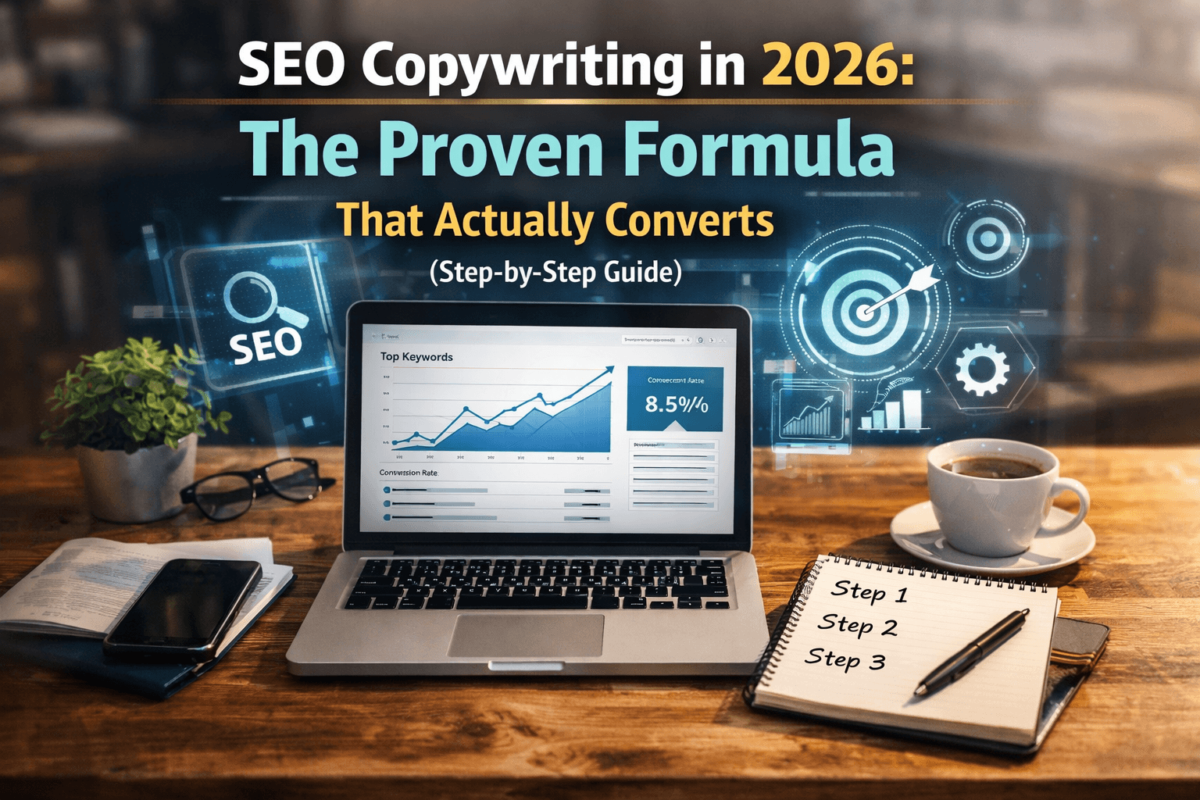
SEO Copywriting in 2026: The Proven Formula That Actually Converts
Struggling to rank and convert? This 2026 SEO copywriting guide breaks down the exact step-by-step formula that drives traffic, keeps readers hooked, and turns clicks into real revenue.
Most SEO advice sounds good… until you actually try it.
You follow the steps. You write the post. You hit publish. And then… nothing. No rankings. No traffic. No sales.
I’ve been there. I spent months writing content that nobody read, wondering what I was doing wrong. Turns out, I wasn’t doing SEO copywriting — I was just writing stuff and hoping Google would notice.
There’s a difference. A big one.
SEO copywriting in 2026 isn’t about stuffing keywords into paragraphs or hitting some magic word count. It’s about understanding what people actually want, giving it to them better than anyone else, and structuring it in a way that makes Google say, “Yeah, this one deserves to rank.”
That’s exactly what this guide covers. By the time you’re done reading, you’ll have a complete, step-by-step system you can apply to every piece of content you write — whether you’re running a personal blog, an affiliate site, or a full-on content marketing operation.
Let’s get into it.
- What Is SEO Copywriting?
- Why It Matters More in 2026
- Step 1: Start With Search Intent
- Step 2: Build a Smart Keyword Strategy
- Step 3: Write Headlines That Get Clicks
- Step 4: Hook Your Reader in 3 Lines
- Step 5: Write for Skimmers First
- Step 6: Add Real Value — Not Filler
- Step 7: Use Internal Linking Strategically
- Step 8: Optimize for Conversions
- What I Got Wrong at First
- What Actually Worked
- What Nobody Tells You
- Affiliate Marketing Without Selling Out
- On-Page SEO Checklist
- Tools That Actually Help
- How Long Should Content Be?
- Can AI Content Rank in 2026?
- FAQ
- The Bottom Line
What Is SEO Copywriting? (The Simple Version)
Here’s the thing — most people overcomplicate this.
SEO copywriting is writing content that both Google and humans love. That’s it. When you do it right, you show up in search results AND you keep people reading long enough to take action.
It’s not just writing. And it’s not just SEO. It’s the intersection of both.
Think of it this way: Regular writing is like opening a beautiful restaurant in the middle of the desert. Great food, zero customers. SEO without good copy is like putting up a billboard on a busy highway — lots of traffic, nobody stops. SEO copywriting is building the restaurant right on that highway, with a sign that makes people slam on the brakes.
In practice, that means:
- Writing content that ranks for searches your audience is already making
- Keeping readers engaged so they actually read what you wrote
- Driving action — whether that’s clicking a link, signing up for something, or buying a product
Why SEO Copywriting Matters More Than Ever in 2026
Here’s the honest truth: the internet is drowning in content right now.
AI tools have made it incredibly easy to produce articles at scale. Some people are pumping out hundreds of posts a month using automation. And for a while, some of that stuff ranked. But Google caught on.
In 2026, Google’s algorithm is laser-focused on a few things that AI-generated, low-effort content almost never delivers:
1. Helpful Content Signals
Google wants to surface content that actually helps people. Not content that looks like it helps. That means demonstrating real knowledge, providing accurate information, and covering a topic in a way that leaves the reader better off than when they arrived.
2. User Engagement Metrics
Google is watching what happens after someone clicks your link. Do they immediately bounce back to search results? Or do they scroll, click around, and stay on your page? Long dwell time and low bounce rates signal that your content is delivering value. Short sessions signal the opposite.
3. E-E-A-T (Experience, Expertise, Authoritativeness, Trustworthiness)
This one has been growing in importance for years and it’s now a major ranking factor. Google wants to know: does this content come from someone who actually knows what they’re talking about? Content that shows first-hand experience and genuine expertise consistently outranks generic, surface-level articles.
4. The AI Saturation Problem
Most guides won’t tell you this — but the biggest opportunity in content marketing right now is simply being human. Because so much content is robotic, generic, and devoid of personality, content that feels real absolutely stands out. Readers notice it. Google notices it.
That’s your edge if you use it correctly.
The Core SEO Copywriting Formula (Step-by-Step)
This is where most people fail — they treat SEO and writing as two separate tasks. First write the content, then “optimize” it. That’s backwards. Great SEO copywriting starts with strategy, before you type a single word.
Here’s the exact process I use for every piece of content:
Start With Search Intent — Not Keywords
Keywords matter, but they’re a symptom. Search intent is the cause.
Before you worry about which keywords to target, ask yourself: What does someone actually want when they type this into Google? What problem are they trying to solve? What question are they trying to answer?
There are four main types of search intent:
- Informational — They want to learn something. (“how does SEO work”)
- Navigational — They’re looking for a specific site. (“Ahrefs login”)
- Commercial — They’re researching before buying. (“best SEO tools 2026”)
- Transactional — They’re ready to act. (“buy SEMrush subscription”)
For affiliate content and monetized blogs, commercial and transactional intent is where the money lives. But you can rank for informational intent and then guide readers toward commercial content through smart internal linking.
Here’s the mistake I made early on: I was writing “informational” articles about topics where the searcher actually wanted a product recommendation. They wanted a list of tools. I was giving them a history lesson. Mismatched intent = zero conversions, even with good rankings.
Before you write anything, open Google in incognito mode and search your target keyword. Look at what’s ranking. Is it listicles? Deep guides? Product reviews? That tells you exactly what format Google and searchers expect.
Build a Smart Keyword Strategy
Modern keyword strategy isn’t about finding one magic keyword and hammering it 27 times. That approach hasn’t worked in years.
Here’s what actually works:
Primary Keyword
This is the main term you’re targeting. Use it naturally in your title, your first 100 words, and at least one H2 heading. Don’t force it — just make sure it appears.
Supporting (LSI) Keywords
These are related terms and phrases that provide context for your topic. Google doesn’t just look at your primary keyword — it reads your whole article to understand what it’s actually about. Supporting keywords help establish that context.
For example, if your primary keyword is “email marketing,” supporting terms might include: email sequences, open rates, subject lines, click-through rate, list segmentation. These naturally belong in a thorough article on email marketing.
A simple way to find them: scroll to the bottom of Google’s search results page. Those “related searches” are a goldmine.
Natural Usage — No Stuffing
If you’re counting how many times you’ve used your keyword, you’re already doing it wrong. Write naturally. If your keyword fits, great. If it doesn’t, skip it. Over-optimization is a real penalty and it makes your writing sound robotic.
Write Headlines That Get Clicks
Your title is the first impression. On Google, it’s often the only impression. If your title doesn’t earn the click, nothing else matters.
The best headlines share a few traits:
- They promise a specific, tangible benefit
- They create curiosity or urgency
- They’re clear, not clever — people need to understand exactly what they’ll get
- They often include numbers, years, or power words
Some headline structures that consistently work:
- “How to [Do X] Without [Common Problem]”
- “[Number] Ways to [Achieve Outcome] in [Timeframe]”
- “The [Adjective] Guide to [Topic] for [Audience]”
- “Why Your [Thing] Isn’t Working (And How to Fix It)”
One more thing: match your headline to the search intent. An informational searcher wants a guide. A commercial searcher wants a comparison or review. Write the title accordingly.
Hook Your Reader in the First 3 Lines
This is where most good articles fail.
The first three lines of your post have one job: convince the reader to keep reading. That’s it. You don’t need to summarize the entire article. You don’t need to say “In this post, I’ll cover…” (please don’t do that). You need to make them feel like leaving would be a mistake.
Here’s what works:
- Call out the problem they’re experiencing right now
- Ask a question they’re silently asking themselves
- Make a bold, counterintuitive statement
- Start with a story or scenario they immediately recognize
What doesn’t work: starting with “In today’s digital landscape…” or “As we all know, SEO is important…” I’ve seen this opener on approximately ten thousand blog posts. It signals immediately that this article is going to be generic, and people bounce.
Think about it: you’ve been competing for someone’s attention against Netflix, Instagram, and a thousand other websites. The first sentence has to earn the second. The second has to earn the third. There’s no room for warmup.
Write for Skimmers First, Readers Second
Here’s an uncomfortable truth: most people don’t read your content. They scan it.
They’re looking for the parts that apply to them. They’re skimming for answers. And if they can’t find what they need quickly, they leave.
This isn’t laziness — it’s how humans consume information online. Work with it, not against it.
Skimmable content uses:
- Short paragraphs (1-3 lines maximum)
- Clear H2 and H3 subheadings that tell the story on their own
- Bullet points and numbered lists for grouped information
- Bold text to highlight key takeaways
- Callout sections for important warnings or insights
Here’s a useful test: read only your subheadings. Do they tell a coherent story on their own? If someone skims just the headers, do they get the main point of your article? If not, restructure.
Skimmers who find value become readers. Readers become clickers. Clickers become customers.
Add Real Value — Not Filler
“Value” is one of those words that gets thrown around so much it’s lost all meaning. So let me be specific.
Real value means your reader finishes the article knowing something they didn’t know before — or knowing HOW to do something they couldn’t do before. It means the article changes their understanding or their behavior in some way.
Filler is the opposite. Filler is explaining what SEO is in an article about advanced SEO tactics. Filler is padding your word count with generic definitions. Filler is writing three paragraphs when two sentences would do.
Google has gotten very good at identifying thin content. But more importantly, humans are extremely good at identifying it. People can feel the difference between an article written to help them and an article written to hit a word count.
“Does this serve the reader, or does it serve my word count?” Delete anything that serves your word count.
The irony? When you cut the filler, your articles often become more comprehensive, not less. Because you make room for the specific, actionable details that actually matter.
Use Internal Linking Strategically
Internal linking is one of the most underrated SEO tactics. Most people do it randomly — they just link to whatever seems related. That’s leaving a huge opportunity on the table.
Here’s how to approach it strategically:
Build Topic Clusters
Create a pillar page that covers a broad topic comprehensively, then build supporting posts that dive deep into specific subtopics. Link from the supporting posts back to the pillar, and from the pillar to the supporting posts. This architecture helps Google understand what your site is about and distributes authority across your content.
Anchor Text Matters
The clickable text in your links gives Google signals about what the linked page covers. Use descriptive anchor text — not “click here” or “read this post.” Something like “here’s a full guide to email marketing” is much more useful.
Keep Links Relevant
Only link to content that genuinely helps the reader in context. Don’t stuff links in just to boost internal linking metrics. One well-placed link that readers actually click is worth more than five they ignore.
Optimize for Conversions
Traffic without conversions is just an ego metric. The whole point of SEO copywriting — especially for affiliate sites and monetized blogs — is to turn readers into revenue.
Here’s how to integrate conversions without being pushy:
Place CTAs at Natural Moments
The best time to offer a solution is right after you’ve defined the problem. Once you’ve explained why someone’s current approach isn’t working, that’s when they’re most receptive to an alternative. That’s when you introduce your recommendation.
Natural Affiliate Placements
Nobody likes feeling sold to. The most effective affiliate mentions are genuinely useful recommendations inside the content — not banner ads, not “sponsored” disclaimers, not heavy sales language.
Something like: “I’ve been using [Tool X] for about a year now, and it’s genuinely cut my keyword research time in half. It’s not free, but if you’re serious about scaling content, it’s one of those tools that pays for itself.”
That’s it. No hard sell. Just a real recommendation from someone who uses the product.
The Follow-Up CTA
At the end of every article, tell the reader what to do next. Whether that’s reading a related post, downloading a resource, trying a tool, or joining an email list — make the next step obvious. Don’t just let them drift away.
What I Got Wrong at First (Real Lessons)
Let me save you some time.
When I first started doing SEO content, I made every mistake in the book. Some of them cost me months of wasted effort. Here’s what I wish I’d known:
Writing for Google Instead of People. My early articles read like they were written by a robot trying to impersonate a human while also inserting a keyword every 150 words. They weren’t helpful. They were optimized. There’s a difference, and humans feel it immediately.
The fix: write the article first for a real person. Optimize it second. Never the other way around.
Ignoring Search Intent. I targeted keywords without understanding what people actually wanted when they searched them. I’d write a 3,000-word deep dive on a topic where Google was ranking quick listicles — because that’s what searchers wanted. Intent mismatch is silent and deadly.
No Clear Structure. My early posts were walls of text. Long paragraphs, no subheadings, no bullet points. I thought it looked more professional. Instead, people bounced within 30 seconds.
The fix: structure first, content second. Outline before you write. Your headers are a promise to the reader about what they’ll find in each section.
Burying the Value. I used to bury my best insights near the end of articles. By the time I got to the good stuff, most readers had already left. Now I lead with value. The hook promises something useful, and I deliver it early.
What Actually Worked (And Still Does)
Here’s what consistently moved the needle for me:
- Writing to ONE specific person, not a general audience. Before I write anything, I picture the exact person who would search this keyword — their situation, their frustrations, their goals.
- Spending more time on the headline than most people spend on the intro. A great headline is traffic. A bad one is invisibility.
- Using first-person perspective and personal examples. Not because they made me look good, but because they made the content feel real. Readers trust specifics.
- Publishing less, but making each piece genuinely exceptional. One article that truly ranks is worth more than fifty that don’t.
- Updating old content. Refreshing a post that’s ranking on page 2 is often faster than writing a new one — and it works.
What Nobody Tells You About SEO Copywriting
Alright, here’s where it gets interesting.
Everyone will tell you about keywords, meta descriptions, and word count. Here are the things that actually separate good SEO copywriters from great ones:
The “One Big Idea” Principle
Every great piece of content is built around one central idea. Not three. Not five. One. If you can’t summarize your article in a single sentence, it’s probably trying to do too many things at once. Tight focus means clearer writing, better rankings, and higher engagement.
Emotion Drives Clicks
People click on content that makes them feel something — curiosity, urgency, FOMO, inspiration. Pure information rarely goes viral. Information wrapped in a compelling narrative or emotional hook does.
Your Second Draft Is Your First Draft
Nobody writes great SEO copy on the first try. The first draft exists to get your ideas out of your head. The second draft is where you actually write. Cut the warmup paragraphs. Tighten every sentence. Replace vague language with specific details.
Distribution Is Half the Battle
A great article that nobody links to rarely ranks. Once you publish, spend serious time promoting it — share it in relevant communities, reach out for backlinks, post about it on social. Especially for new sites, building initial authority through backlinks is non-negotiable.
The Compound Effect Is Real
SEO is slow. If you’re expecting results in two weeks, you’ll quit. The sites that win are the ones that published consistently for 12, 18, 24 months. Month 3 feels pointless. Month 14 feels like a breakthrough. Stay in the game long enough to see the compounding work.
How to Integrate Affiliate Marketing Without Selling Out
Here’s the truth about affiliate marketing and SEO content: the approach that feels least “salesy” performs best. Always.
People can smell a hard sell from miles away. When your content feels like an extended infomercial, readers disengage and Google eventually notices the bounce signals.
The best affiliate content does three things:
- Genuinely solves a problem the reader has
- Mentions tools or products as part of the solution — because they actually help, not because they pay the most commission
- Makes it easy for readers to take the next step without feeling pressured
Here’s a placement structure that works:
After Problem Definition
You’ve just explained a problem in detail. Your reader is nodding along, feeling understood. This is the exact right moment to say: “Here’s the tool/approach I use to fix this.”
Inside Tutorial Steps
If you’re walking readers through a process and a specific tool makes that process easier, mention it there. In context. With a genuine explanation of how it helps.
In Comparison Sections
“I tried X and Y — here’s what I found” type comparisons are incredibly effective for affiliate content. They feel like real research, because they are. Name the pros and cons. Don’t pretend your recommendation is perfect. Honest evaluations build trust.
One important rule: only recommend things you’d actually use or have used. Readers can tell when a recommendation is genuine vs. driven purely by commission rates. Your reputation with your audience is worth more than any single affiliate payment.
On-Page SEO Checklist for Every Article
Before you hit publish, run through this list:
- Primary keyword appears in the title tag
- Primary keyword appears in the first 100 words
- Primary keyword appears in at least one H2 heading
- LSI/supporting keywords used naturally throughout
- Meta description written for clicks, not just keywords (under 160 characters)
- URL slug is short and includes primary keyword
- Internal links to relevant content on your site
- Images have descriptive alt text
- Article has a clear structure with H1, H2, H3 hierarchy
- No keyword stuffing — reads naturally
- CTA is clear and placed at natural conversion moments
- Mobile-friendly formatting (short paragraphs, plenty of white space)
Tools That Actually Help With SEO Copywriting
You don’t need ten tools. You need a few that you actually use consistently.
For Keyword Research
You need a tool that shows you search volume, keyword difficulty, and related terms. There are several solid options in the market — some are free with limits, some are paid with more depth. The most important thing is consistency: pick one and learn it well rather than jumping between tools constantly.
For Content Optimization
Once you’ve written a draft, content optimization tools analyze how well you’ve covered a topic by looking at what top-ranking articles include. They give you a list of topics, questions, and terms to cover. These are especially helpful if you’re writing in a niche where you don’t have deep subject matter expertise.
For Readability
Hemingway App (free, browser-based) is excellent for identifying long, complex sentences that slow readers down. Paste your draft in and it’ll show you exactly where you’re losing people.
For SERP Research
Your browser in incognito mode is honestly the best research tool you have. Search your target keyword before writing anything. Look at what’s ranking, what format they use, what questions they answer, and what they miss. That gap is your opportunity.
How Long Should Your Content Be in 2026?
This is one of the most common questions I get, and the most honest answer is: as long as it needs to be.
I know that’s not the specific number you were hoping for. But here’s why it’s the right answer:
Google doesn’t rank long articles. It ranks comprehensive ones. Sometimes those are 800 words. Sometimes they’re 4,000 words. It depends entirely on the topic and what searchers need.
Some practical guidelines:
- For quick, factual queries: 500-800 words is often enough
- For competitive informational topics: 1,500-2,500 words tends to perform well
- For comprehensive guides and tutorials: 2,500-5,000 words is common
- For highly competitive, broad topics: sometimes 5,000+ is appropriate
The real test: search your keyword, look at what’s ranking, and gauge the depth of the top 3-5 results. Match that depth, then try to exceed it in quality and specificity.
A 1,200-word article that answers the question completely will always outperform a 4,000-word article padded with fluff. Length is a proxy for comprehensiveness. Don’t confuse the two.
Can AI Content Rank on Google in 2026?
Short answer: yes. But not the way most people are using it.
Google’s official position is that it doesn’t penalize AI-generated content inherently — it penalizes low-quality content. The problem is that most AI-generated content is low quality. Not because AI is bad, but because most people use it as a shortcut to publish more with less effort, which almost always produces generic, thin content.
Brainstorming angles and headline ideas · Generating a first-draft outline · Rewriting sections that feel clunky · Creating meta descriptions and title tag variations
Providing genuine first-hand experience · Generating specific, non-generic examples · Demonstrating real subject matter expertise · Expressing a genuine, distinct voice and perspective
The content that consistently ranks in 2026 has a human fingerprint on it — even if AI tools were part of the process. Original insights, personal experiences, and genuine opinions are things AI can simulate but not replicate authentically.
Use AI as a tool, not as the author. The difference in results is significant.
Frequently Asked Questions
SEO copywriting is writing content that shows up in search engine results and compels people to read, engage, and take action. It combines strategic keyword use with compelling, human-focused writing to serve both algorithms and real readers.
Regular content writing focuses primarily on engaging readers. SEO copywriting does that AND optimizes for search engines — through keyword strategy, search intent alignment, on-page optimization, and content structure that signals relevance to Google.
There’s no universal answer. Write as long as the topic requires to fully satisfy the searcher’s intent. Check what’s ranking for your target keyword and match that depth. Quality and completeness matter far more than raw word count.
Yes, but the bar is whether the content is helpful and high-quality — not whether a human or AI wrote it. In practice, pure AI content without human insight, experience, and editing tends to underperform. Use AI as a writing assistant, not a replacement for genuine expertise.
Focus on search intent first, place your recommendations after solving a problem, use natural language rather than sales-speak, and always include a clear next step for the reader. Trust is the foundation of conversion — build that first.
You need a keyword research tool (to find opportunities), a content optimization tool (to cover topics comprehensively), and a readability checker (to tighten your writing). Many professionals also use rank trackers to monitor results. A handful of well-chosen tools used consistently beats a pile of tools used sporadically.
Review your top-performing articles every 6-12 months. Update statistics, add new sections, improve accuracy, and freshen the angle. Refreshed content often sees ranking improvements quickly, especially for posts sitting on page 2 or 3.
The Bottom Line
SEO copywriting isn’t about tricking Google. It never really was.
It’s about understanding people — what they’re searching for, what they need, what would genuinely help them — and delivering that better than anyone else does.
Google’s whole job is to find content that serves its users. When you write content that truly serves users, you and Google are on the same team.
Here’s what to focus on if you’re starting from scratch or rebuilding your approach:
- Pick one keyword with clear commercial or informational intent
- Understand exactly what the searcher wants when they search it
- Write a headline that earns the click
- Hook the reader in the first three lines
- Structure the content for skimmers
- Fill every section with specific, actionable insight — no filler
- Place your recommendation at the natural conversion moment
- Check your on-page basics before publishing
Do that consistently, across ten articles, then twenty, then fifty — and the rankings follow.
It’s not magic. It’s not a hack. It’s just writing for humans, done well, done strategically, done consistently.
That’s what wins in 2026. And probably for a long time after.
Ready to Build Your SEO Content Strategy?
Explore our complete resource library — keyword research, AI SEO, technical guides, and more. Everything you need to rank in 2026.
Explore All Guides →