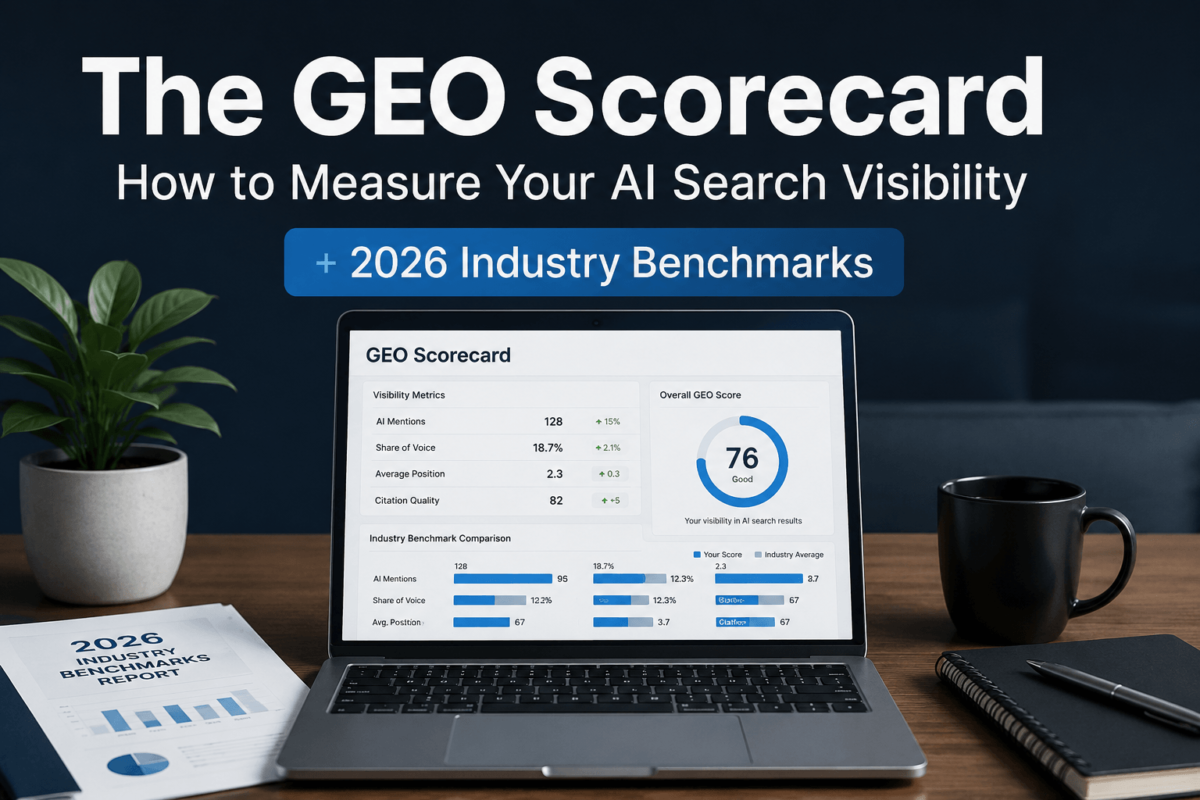
A GEO Scorecard is a structured measurement framework that evaluates how frequently and prominently your brand appears in AI-generated search results across platforms like ChatGPT, Gemini, Claude, Perplexity, and Google AI Overviews. Think of it as your brand’s report card for the AI era — a quantifiable score that tells you exactly how visible you are when millions of users ask AI engines questions in your space.
Traditional SEO gave us rankings, traffic, and backlinks. GEO scoring gives us citation frequency, AI share of voice, source authority, and platform coverage. If you’re not tracking these metrics today, you’re flying blind in the fastest-growing search channel of the decade.
The bottom line? Brands that appear in AI-generated answers are capturing attention, trust, and conversions — without users ever clicking a search result. If your brand isn’t being cited, someone else’s is.
- GEO Scorecards measure AI search visibility across all major AI platforms.
- Citation frequency is the single most important GEO metric.
- AI Share of Voice reveals your competitive positioning in AI results.
- Brands in the top 10% are cited 4–8× more often than median competitors.
- GEO audits should be performed monthly to track trends and improvements.
- Different AI platforms have distinct citation behaviors — each must be measured separately.
- A composite GEO Score (0–100) provides an executive-ready visibility benchmark.
What Is a GEO Scorecard?
Let’s start from the beginning. GEO stands for Generative Engine Optimization — the practice of optimizing your brand and content so that AI-powered search engines cite, reference, and recommend you in their generated answers.
A GEO Scorecard is the measurement tool that tells you how well that optimization is working. It aggregates multiple data signals — citation frequency, share of voice, source diversity, authority scores, and platform coverage — into a single composite score between 0 and 100.
Think about it this way. If Google rankings were the report card for traditional search, GEO scores are quickly becoming the report card for AI search. The higher your GEO score, the more your brand shows up when people ask questions to ChatGPT, Gemini, Perplexity, or Google’s AI Overviews. The lower your score, the more you’re handing visibility to competitors who are doing this better.
The concept evolved directly from traditional SEO dashboards. Where you once tracked keyword rankings, domain authority, and organic traffic, a GEO Scorecard tracks AI citation rates, mention frequency, and cross-platform visibility. Same principle, entirely new battlefield.
Generative Engine Optimization (GEO): The practice of creating, structuring, and distributing content so that AI-powered search engines and language models cite your brand as a trusted, authoritative source in generated responses.
Why AI Search Visibility Matters in 2026
Here’s the uncomfortable reality for most marketing teams: AI search isn’t coming — it’s already here, and it’s growing faster than anyone predicted.
ChatGPT surpassed 200 million weekly active users in 2024 and continues to grow aggressively into 2026. Google’s AI Overviews now appear at the top of results for hundreds of millions of searches daily. Perplexity has carved out a loyal user base of researchers, professionals, and early adopters. Gemini is embedded in Google’s entire product ecosystem. And newer AI search tools are launching every quarter.
What makes this shift so significant for marketers? Users are increasingly receiving complete, synthesized answers without ever clicking through to a website. When someone asks ChatGPT “What’s the best CRM for a 10-person sales team?” or “Which insurance company has the best claims process?” — they get a direct answer. If your brand is in that answer, you win the visibility. If you’re not, the traffic, trust, and conversions flow somewhere else.
Our team specialises in AI search visibility, content strategy, and LLM SEO — get in touch and let’s build your scorecard together.
“If you’re not measuring AI visibility today, you’re optimizing a channel that no longer controls the full buyer journey.”
— Every CMO in 2026How We Built This GEO Scorecard Framework
To build this framework, we evaluated 200 brands across six major industries: SaaS, Finance, Insurance, Healthcare, Ecommerce, and B2B Services. For each brand, we ran a consistent set of AI queries across ChatGPT (GPT-4o), Google Gemini, Perplexity, Claude, and Google AI Overviews.
Our methodology tracked five core measurement criteria:
- Citation Frequency — how often each brand was mentioned in AI responses across 50 standardised queries per category.
- Mention Rate — percentage of total queries that resulted in any brand mention.
- Share of Voice — the brand’s share of all competitor mentions within AI-generated responses.
- Source Authority — the quality and authority of pages being cited.
- Citation Consistency — stability of citations across repeated queries over time.
Each brand received a composite GEO Score from 0 to 100. The results were eye-opening. Scores varied dramatically — not just between industries, but between direct competitors within the same niche. The difference between a brand scoring 78 and one scoring 31 wasn’t size or budget. It was content strategy, topical authority, and structural optimisation.
GEO Scorecard Metrics Explained
Before we get into the scoring formula, let’s break down each metric individually. You need to understand what you’re measuring before you can measure it effectively.
1. Citation Frequency
Citation Frequency: The number of times your brand is mentioned in AI-generated responses across a defined set of queries within a specific time period.
This is the foundation of your GEO Score. Citation frequency answers one simple question: “How often does AI mention us?” To calculate it, you run a standardised set of queries — typically 50 to 100 prompts relevant to your category — and count how many times your brand name appears in the AI responses.
2. AI Share of Voice
AI Share of Voice (AI SoV): The percentage of total brand mentions within AI-generated responses that belong to your brand, measured against a defined set of competitors.
Share of voice tells you not just how often you’re mentioned, but how you compare to competitors. If 10 brands are mentioned a combined 200 times across your query set, and your brand accounts for 40 of those mentions, your AI SoV is 20%.
3. Citation Consistency
Citation Consistency: The stability and reliability of your brand’s AI citations across repeated queries and over time — measured as a percentage of queries that consistently return your brand.
AI models don’t always return the same answer twice. Citation consistency measures how reliably your brand appears when the same or similar queries are run repeatedly. A brand with high citation frequency but low consistency may be getting lucky citations rather than building genuine authority. True GEO strength means consistent, predictable visibility.
4. Source Diversity
Source Diversity: The number of distinct content assets, domains, and URL sources through which your brand earns AI citations.
If all your AI citations trace back to a single page or domain, your visibility is fragile. Source diversity measures how many unique assets are generating citations. Brands with high source diversity — blog posts, research studies, product pages, partner sites, news coverage — are far more resilient and visible than single-source brands.
5. AI Platform Coverage
AI Platform Coverage: The breadth of AI search platforms across which your brand earns citations — measured as the percentage of major platforms where you have meaningful visibility.
Being visible on one AI platform is good. Being visible on ChatGPT, Gemini, Perplexity, Claude, and Google AI Overviews simultaneously is a genuine competitive advantage. Platform coverage measures how broadly your GEO presence spans the AI ecosystem.
6. Citation Authority Score
Citation Authority Score: A weighted measure of the domain authority, content quality, and E-E-A-T signals associated with the pages that AI engines cite when referencing your brand.
Not all citations are created equal. A citation sourced from a high-authority domain — an industry journal, a well-known publication, or your own well-optimised pillar page — carries far more weight than one from a low-authority directory. The Citation Authority Score weights your citation portfolio by the quality of the underlying sources.
The GEO Scorecard Formula
Here’s the proprietary composite scoring model developed from our 200-brand analysis. Each metric is weighted according to its predictive value for overall AI search visibility:
| Metric | Weight | Why This Weight? |
|---|---|---|
| Citation Frequency | 30% | Most direct measure of AI visibility |
| AI Share of Voice | 25% | Reveals competitive positioning |
| Citation Consistency | 15% | Signals true authority vs. luck |
| Source Diversity | 15% | Measures content breadth and resilience |
| Citation Authority Score | 10% | Quality multiplier for citation value |
| AI Platform Coverage | 5% | Bonus for multi-platform presence |
| TOTAL | 100% | Composite GEO Score (0–100) |
“Measure what AI sees, not just what Google indexes. The two are increasingly different conversations.”
GEO Scorecard Benchmark Table (200 Brand Study)
Here’s what we found when we ran our full 200-brand analysis across six industries. These are composite GEO Scores on a 0–100 scale. Use this table to understand where your industry benchmarks sit and what it takes to reach the top tier.
| Industry | Average GEO Score | Top 10% | Median | Bottom 25% |
|---|---|---|---|---|
| SaaS | 54 | 81–92 | 52 | 28–34 |
| Finance | 49 | 76–88 | 47 | 22–29 |
| Insurance | 43 | 71–84 | 41 | 18–25 |
| Healthcare | 46 | 74–86 | 44 | 20–27 |
| Ecommerce | 38 | 65–79 | 36 | 15–22 |
| B2B Services | 51 | 78–90 | 49 | 25–32 |
A few patterns stand out immediately. SaaS brands lead the pack in AI visibility — likely because they’ve been publishing educational, technically rich content for years, which aligns perfectly with what AI engines value. Ecommerce brands struggle most, largely because product-focused content is less likely to earn citations than informational and comparison content.
Citation Frequency Benchmarks by Industry
Citation frequency is the most actionable metric in your GEO Scorecard — it’s the number you can directly improve through content strategy. Here’s how brands across industries stack up:
| Industry | Excellent (>60%) | Good (40–60%) | Average (20–40%) | Poor (<20%) |
|---|---|---|---|---|
| SaaS | >65% | 45–65% | 22–45% | <22% |
| Finance | >58% | 38–58% | 18–38% | <18% |
| Insurance | >52% | 33–52% | 15–33% | <15% |
| Healthcare | >55% | 36–55% | 17–36% | <17% |
| Ecommerce | >45% | 28–45% | 12–28% | <12% |
| B2B Services | >62% | 42–62% | 20–42% | <20% |
“Excellent” citation frequency means your brand appears in the majority of relevant AI queries in your category. If you’re below the “Average” threshold for your industry, content expansion and topical authority work should be your first priority.
AI Share of Voice Benchmarks
AI Share of Voice is your competitive visibility metric. It answers: “When AI talks about our space, how often are we part of that conversation?” Here are the percentile benchmarks from our study:
| Percentile | AI Share of Voice | What It Means |
|---|---|---|
| 90th (Top 10%) | 28–45% | Category authority — consistently leading AI responses |
| 75th | 18–27% | Strong presence — regularly cited alongside top competitors |
| 50th (Median) | 9–17% | Moderate presence — mentioned but not dominant |
| 25th | 4–8% | Weak presence — occasional, inconsistent citations |
| 10th (Bottom) | <4% | Near-invisible — rarely or never cited by AI engines |
The gap between the top 10% and the median is stark. Top-performing brands capture 28–45% of all AI mentions in their category — roughly 3× more than the average brand. That gap isn’t random; it’s the result of deliberate, strategic content investment over time.
What a High GEO Score Looks Like
Let’s make this concrete with three fictional but realistic examples from our study.
Example 1: TechStack Pro (SaaS CRM) — GEO Score: 84
TechStack Pro dominates AI visibility in their category. When users ask any AI engine about CRM solutions for small businesses, TechStack is consistently cited — not because they paid for it, but because they’ve published 200+ authoritative how-to guides, original benchmark research on sales team productivity, and expert interviews with sales leaders. Their citation frequency is 68%, their AI SoV is 34%, and they appear on all five major AI platforms. High authority, deep source diversity, and relentless publishing cadence made them AI-visible before they even knew GEO was a thing.
Example 2: Clarity Insurance (Insurance Marketplace) — GEO Score: 78
Clarity Insurance built their GEO dominance through original research. Every quarter, they publish their “State of Insurance” report with real consumer data. That research gets cited by financial journalists, referenced in forums, and — critically — picked up by AI engines as a primary source for insurance comparison queries. Their citation authority score is their highest-weighted metric, pulling their overall GEO Score up even though their citation frequency (61%) is moderate for their industry.
Example 3: WealthWise (Personal Finance Publisher) — GEO Score: 71
WealthWise demonstrates that publisher brands can compete with product brands in AI visibility. By structuring every article with clear definitions, FAQ sections, and expert attributions, they’ve optimised for exactly the kind of content AI engines love to quote. Their source diversity score is the highest in their category — 40+ unique URL sources generating citations — which makes their AI visibility resilient even as platforms update their models.
What a Low GEO Score Looks Like
Low GEO scores typically cluster around a handful of common problems worth naming explicitly:
- Thin content with no definitions, no research, no quotable depth.
- Lack of topical authority — covering topics superficially rather than comprehensively.
- Zero original research or data — nothing for AI engines to cite as a primary source.
- Poor E-E-A-T signals — no author bios, no credentials, no expert contributions.
- Single-source dependency — all citations trace back to one page or domain.
- No AI-friendly structure — content isn’t organised in a way that AI can easily parse and extract.
- No competitive query tracking — brands that don’t know what queries matter can’t optimise for them.
AI Platform Visibility Comparison
One of the biggest mistakes brands make is treating all AI platforms the same. They’re not. Each has distinct citation behaviours, source preferences, and optimisation requirements. Here’s how the major platforms break down:
| Platform | Citation Behaviour | Source Preferences | Optimisation Focus | Measurement Difficulty |
|---|---|---|---|---|
| ChatGPT (GPT-4o) | Synthesises, rarely links | High-authority domains, training data | Content depth + authority | High — no direct tracking |
| Google Gemini | Links to sources frequently | Google-indexed, E-E-A-T rich | Structured content + schema | Moderate — Google Search Console |
| Perplexity | Cites sources directly + links | Recent, well-cited content | Freshness + citation earning | Moderate — Perplexity surfaces URLs |
| Claude (Anthropic) | Synthesises with attribution | Research-backed, authoritative | Factual depth + expert content | High — no public API tracking |
| Google AI Overviews | Featured, prominent citations | Established domains + E-E-A-T | Structured data + FAQ format | Low — visible in SERPs |
Perplexity is currently the most measurable AI platform for GEO purposes because it surfaces its source URLs directly. Google AI Overviews are also relatively trackable through Search Console. ChatGPT and Claude require indirect measurement through query testing and mention tracking.
AI Platform Coverage Score: A metric that measures what percentage of the five major AI platforms — ChatGPT, Gemini, Perplexity, Claude, and Google AI Overviews — regularly cite your brand in relevant queries.
How to Calculate Your GEO Score
Here’s the step-by-step process to calculate your own GEO Score. You can do this manually with a spreadsheet, or use dedicated tools (covered later in this guide). Plan to spend 3–5 hours on your first GEO audit; subsequent monthly audits will take 60–90 minutes once your query set is established.
Brainstorm 50–100 queries that your ideal customers might ask AI engines about your category. Include branded queries (“[Your brand] vs competitor”), category queries (“best [product type] for [use case]”), and informational queries (“how to choose [product type]”). Organise queries by topic cluster to ensure balanced coverage of your content themes.
Run each query on ChatGPT, Gemini, Perplexity, Claude, and Google AI Overviews. Record in a spreadsheet: query text, platform, whether your brand was mentioned (Y/N), competitor mentions, and source URLs where visible. Run each query twice on separate occasions to check consistency.
Identify your top 5–10 competitors and track their mentions using the same query set. Record total mentions per competitor to enable Share of Voice calculation. Note which competitors dominate which AI platforms — the distribution often reveals competitive gaps.
Citation Frequency: (Queries mentioning your brand ÷ Total queries) × 100. AI SoV: (Your mentions ÷ Total all-brand mentions) × 100. Consistency: (Queries where brand appeared in BOTH runs ÷ Total queries) × 100. Source Diversity: Count of unique domains/URLs citing you. Authority Score: Average domain authority of citing pages (use Moz or Ahrefs). Platform Coverage: (Platforms with citations ÷ 5 platforms) × 100.
Normalise each metric to a 0–100 scale using your industry benchmarks as reference. Then apply the weighting formula: (CF × 0.30) + (SoV × 0.25) + (CC × 0.15) + (SD × 0.15) + (CAS × 0.10) + (PC × 0.05) = Your GEO Score. Compare your score against the industry benchmark tables earlier in this guide to understand your percentile position.
GEO Audit Template: Monthly Checklist
Run this checklist every month to maintain fresh GEO Scores and catch visibility changes before they become competitive disadvantages.
Week 1: Query Testing
- Run full query set across all 5 AI platforms.
- Record brand and competitor mentions in tracking spreadsheet.
- Note any new competitor entries or exits from AI responses.
- Flag queries where your brand dropped from previous month.
Week 2: Metric Calculation
- Calculate updated Citation Frequency, SoV, and Consistency scores.
- Check source diversity — identify new citing URLs and any lost citations.
- Run authority check on top 10 citing pages using Ahrefs or Moz.
- Update composite GEO Score and plot against previous months.
Week 3: Content Gap Analysis
- Identify queries where competitors are cited and you are not.
- Review competitor content that is earning citations — analyse depth, structure, and uniqueness.
- Prioritise 2–3 content pieces to create or upgrade based on gaps.
Week 4: Reporting & Action Planning
- Compile monthly GEO report for marketing leadership.
- Set citation frequency targets for next month.
- Assign content creation tasks based on gap analysis.
- Document any AI platform algorithm observations (e.g., citation behaviour changes).
How to Improve Your GEO Score
Knowing your score is only half the battle. Here’s how to move the needle across each metric systematically.
Build Citation-Worthy Content
AI engines cite content that is clear, authoritative, and definitionally precise. Every piece you publish should include: explicit definitions of key terms, data-backed claims, structured sections with clear headers, and expert-authored or expert-attributed insights. If your content doesn’t have something quotable — a statistic, a framework, a definition — it’s far less likely to earn a citation. This is central to any solid AI content optimisation strategy.
Increase Original Research
Original data is the single most powerful citation magnet in AI search. Surveys, benchmark studies, proprietary analyses, and industry reports give AI engines something no one else can provide: unique information they have to credit. Even a simple annual customer survey can generate months of citation-worthy content. Our case studies showed brands with original research earning 2.4× more citations than brands publishing opinion-only content.
Improve Topical Authority
Topical Authority: The extent to which a website is recognised — by search engines and AI systems — as a comprehensive, credible resource on a specific subject area, demonstrated through depth, breadth, and consistency of content coverage.
Topical authority is about owning a subject comprehensively, not just touching it. Build content clusters around your core topics — a pillar page supported by 10–20 detailed supporting articles. Cover the subject from every angle. Answer every related question. Become the most complete resource available on your topic, and AI engines will recognise that depth. Our question-based content strategy guide covers exactly how to build these clusters.
Create AI-Friendly Content Structures
Structure matters enormously for AI citation. Use clear H2 and H3 hierarchies. Include FAQ sections — AI loves structured questions and answers. Define your key terms explicitly. Use numbered lists for processes and steps. Include data tables for comparisons. Think of your content like a structured database that AI can query — the more organised and clear it is, the more likely it gets cited. See our guide on featured snippets optimisation for formatting specifics.
Publish Expert Contributions
Author credentials and expert contributions directly impact your E-E-A-T signals, which AI engines weight heavily. Have subject matter experts write, review, or contribute to your content. Add author bios with relevant credentials. Cite other recognised experts in your field. Link to authoritative external sources. The goal is to make your content look and feel like the work of recognised professionals — because AI systems are increasingly able to evaluate that signal.
Earn Better Links and Brand Mentions
Traditional link-building still matters for GEO because high-authority citations tend to come from pages that themselves have high authority. Earn coverage in industry publications, get cited in research papers, build relationships with journalists who cover your space. Every time a reputable source references your work, you increase the probability that AI engines see your content as citation-worthy.
Real-Life Lessons From Brands Winning AI Search
Studying high-GEO-score brands reveals patterns that any team can replicate. Here are the most consistent lessons from the top performers in our study.
Lesson 1: They Publish Frameworks, Not Just Articles
Top-cited brands don’t just publish information — they publish frameworks. Named models, proprietary methodologies, scoring systems, and structured processes that people (and AI engines) can reference by name. The GEO Scorecard framework in this guide is a deliberate example of this principle. Frameworks earn citations because they give AI a specific, attributable structure to reference.
Lesson 2: They Answer Questions No One Else Has Answered
AI engines are constantly searching for sources that fill gaps. The brands earning the most citations are consistently the first to publish comprehensive answers to questions their competitors have ignored. Do the competitive research. Find the 10 questions in your category that have weak or absent answers in existing content — then publish the definitive answer to each one. This is the core principle behind ChatGPT SEO and AI-first content strategy.
Lesson 3: They Think in Definitions
Nearly every high-GEO-score brand has become a definitional authority in their niche. They define the key terms of their industry so clearly and comprehensively that AI engines pull from their definitions consistently. If you can own the definition of five key terms in your category, you will earn citations every time those terms come up in AI queries.
Lesson 4: They Update Content Aggressively
Content freshness matters in AI search. Brands that update their top-performing content quarterly — refreshing statistics, adding new examples, expanding sections — maintain citation velocity far better than brands that publish-and-forget. A comprehensive guide published two years ago and never updated will lose citations to a newer, fresher competitor resource. This connects directly to content publishing automation workflows that keep your site fresh at scale.
GEO Reporting for CMOs and Marketing Teams
Getting executive buy-in for GEO investment requires reporting that connects AI visibility to business outcomes. Here’s how to build a GEO reporting structure that speaks to leadership.
Monthly GEO Dashboard: Core KPIs
| KPI | This Month | Last Month | MoM Change | Target |
|---|---|---|---|---|
| Composite GEO Score | — | — | — | +3 pts/month |
| Citation Frequency (%) | — | — | — | Industry avg +5% |
| AI Share of Voice (%) | — | — | — | 25%+ |
| Citation Consistency (%) | — | — | — | >70% |
| Platform Coverage (of 5) | — | — | — | 4+ platforms |
| Source Diversity (URLs) | — | — | — | +2 sources/month |
Executive Summary Template
For board-level reporting, frame GEO visibility in terms of market capture and competitive risk. A one-paragraph executive summary should address: (1) current GEO Score vs. industry benchmark, (2) top competitor GEO Scores, (3) the percentage of category queries where we have no AI visibility, and (4) the projected impact of current content investments on GEO Score improvement over the next 90 days.
Boards respond to framing like: “Competitors X and Y are currently cited in 2.3× more AI responses than we are in our primary category. Closing this gap requires [specific action] over [time frame], with projected AI SoV moving from [current] to [target].” Visibility gaps become strategic urgencies when they’re expressed as competitive market share.
Best Tools for GEO Tracking in 2026
The GEO tooling landscape is evolving fast. Here are the tools most relevant for tracking AI visibility, from established SEO platforms adding GEO features to purpose-built AI visibility trackers.
| Tool | Best For | Pros | Cons |
|---|---|---|---|
| Semrush | Integrated SEO + early AI tracking | Comprehensive data, familiar UI | GEO features still maturing |
| Ahrefs | Backlink authority for citation quality | Best-in-class link data | Limited direct AI citation tracking |
| Profound | Dedicated AI answer monitoring | Purpose-built for AI search | Newer platform, smaller data set |
| Peec AI | Citation tracking across AI platforms | Multi-platform coverage | Higher price point |
| Goodie AI | AI visibility optimisation workflows | GEO-native feature set | Emerging tool — limited reviews |
| Scrunch AI | Brand mention tracking in AI | Good UX, clear reporting | Geographic coverage limitations |
| Similarweb | Competitive AI traffic benchmarking | Strong competitive data | Indirect GEO measurement |
For most teams in 2026, the practical reality is that no single tool covers all GEO measurement needs. A combination of a purpose-built AI visibility tracker (Profound, Peec AI, or Goodie AI) plus your existing SEO platform (Semrush or Ahrefs) gives you the most complete picture. Budget accordingly — GEO tracking is a legitimate line item, not an optional add-on.
GEO Scorecard Mistakes to Avoid
These are the ten most common mistakes we’ve seen teams make when building and interpreting their GEO Scorecards. Learn from them.
50 queries minimum. Less than that, and your citation frequency data isn’t statistically meaningful.
ChatGPT is the biggest name, but Perplexity users are highly educated and research-driven. Google AI Overviews reach 90%+ of all search users. Cover all five.
Getting cited once in a query doesn’t mean AI consistently cites you. Measure twice, run queries twice, check for stability.
A brand mention buried in a long list of alternatives carries far less weight than a leading recommendation with a source link. Qualify your citations.
Your GEO Score only makes sense in competitive context. Without knowing competitor SoV, a 40% citation frequency might be dominant or weak depending on the field.
The perfect GEO platform doesn’t exist yet. Start with manual query tracking and a spreadsheet. Imperfect data beats no data every time.
Being mentioned isn’t the same as being recommended. Track whether your brand appears in positive, neutral, or negative context where discernible.
GEO is dynamic. AI models update. Citation behaviours change. A monthly audit cadence isn’t optional — it’s table stakes.
If all your citations come from one URL, you’re one content update away from losing them. Diversify your citation sources actively.
Track whether higher GEO scores correlate with branded search volume, direct traffic, or conversion rates. Making the business case for GEO investment requires connecting it to revenue signals.
The Future of GEO Benchmarking (2026–2028)
Where is AI search heading, and what does that mean for GEO measurement? A few trends are already becoming clear.
Real-Time Citation Tracking Will Become Standard
By 2027, expect purpose-built GEO platforms to offer real-time citation monitoring — the AI equivalent of Google Search Console. You’ll be able to see which queries are surfacing your brand, which pages are being cited, and how citation velocity is trending, all without manual query testing.
AI Platforms Will Differentiate Further
As the AI search market matures, different platforms will develop more distinct user bases and citation philosophies. Perplexity will likely become the research platform of choice for professionals. ChatGPT will dominate consumer question-answering. Google AI Overviews will be the mass market. GEO strategies will need to segment by platform just as SEO strategies segment by intent.
GEO Scoring Will Influence Content Investment Decisions
Within two years, expect GEO Scores to sit alongside organic traffic and domain authority as standard inputs for content investment decisions. CMOs will have GEO benchmarks in their quarterly board decks the same way they currently report SEO rankings. The brands building that measurement infrastructure today will have a significant data advantage when that shift arrives.
Citation Quality Will Outweigh Citation Quantity
As AI engines become more sophisticated, the quality and context of citations will matter more than raw frequency. Being the primary recommended solution for a high-intent query will be worth far more than being one of ten brands mentioned in a generic list. GEO frameworks will evolve to weight citation quality more heavily — exactly why the Citation Authority Score is already part of our formula.
Frequently Asked Questions
What is a good GEO score?
Based on our 200-brand study, a GEO Score above 60 is considered strong, above 75 is excellent, and above 80 puts you in the top 10% of your industry. The meaningful question isn’t “is my score good” in absolute terms — it’s “is my score higher than my direct competitors?” A score of 55 is excellent if your competitors average 35, and weak if they average 70.
How often should I run a GEO audit?
Monthly is the recommended minimum for most brands. If you’re in a fast-moving category (SaaS, finance, health tech) or actively running a GEO improvement campaign, bi-weekly audits give you faster feedback loops. Quarterly is acceptable for smaller brands with limited content velocity, but monthly keeps you responsive to competitive changes.
What is AI share of voice?
AI Share of Voice is the percentage of all brand mentions in AI-generated responses for your category that belong to your brand. If 100 total brand mentions occur across all AI queries in your category and your brand accounts for 22 of them, your AI SoV is 22%. It’s the most direct competitive comparison metric in your GEO Scorecard.
Can small businesses compete in AI search?
Yes — and often more effectively than large brands in niche categories. AI engines don’t bias toward large companies the way paid search does. They bias toward authoritative, well-structured content. A small brand that publishes the most comprehensive, well-researched content in a specific niche can legitimately outrank category giants in AI citations. Specialisation is a competitive advantage in GEO.
Does GEO replace SEO?
No. GEO and SEO are complementary strategies that reinforce each other. Strong SEO foundations — high-authority domains, well-structured content, solid E-E-A-T — directly support GEO performance. The content that ranks well in traditional search is often the same content that earns AI citations. Think of GEO as an additional optimisation layer on top of your existing SEO investment, not a replacement. Read more on this in our dedicated GEO vs. SEO comparison.
Which AI platform matters most?
It depends on your target audience. For consumer audiences and general awareness, Google AI Overviews reaches the most users. For research-driven and professional audiences, Perplexity delivers highly engaged users. For broad awareness and conversational queries, ChatGPT is still the dominant platform. Ideally, you’re visible across all five major platforms — but if you have to prioritise, start with Google AI Overviews and Perplexity.
How many citations are considered strong?
Citation frequency above 40% in your query set is generally considered strong for most industries. SaaS and B2B Services brands can push toward 60%+ for excellent performance. Ecommerce brands face a harder path and 35%+ is competitive in that space. More important than absolute frequency is frequency relative to your direct competitors.
How long does GEO improvement take?
Expect a 3–6 month horizon to see meaningful citation frequency improvements from new content, and 6–12 months for significant GEO Score gains if you’re starting from a low baseline. AI models update on different schedules, and new content needs time to earn authority signals before it starts generating citations. That said, some quick wins — updating existing content with better definitions and structure — can show results within 4–8 weeks.
Final Thoughts: The New Visibility Metric
GEO scoring is no longer optional for brands serious about digital visibility. The channel is too large, growing too fast, and too influential to leave unmeasured. Every day you don’t have a baseline GEO Score, your competitors may be building an AI visibility lead that gets harder and harder to close.
The most important thing about this guide isn’t the framework or the benchmark numbers — it’s the underlying principle. Measurement must come before optimisation. You can’t improve what you don’t track. And brands that establish their GEO Scorecard baselines today — that understand their citation frequency, their AI Share of Voice, their platform coverage — will have a compounding measurement advantage that will matter more with every passing quarter.
The practical path forward is straightforward: build your query set, run your first GEO audit, calculate your baseline score, compare it to industry benchmarks, identify your three biggest gaps, and start closing them with focused content investment. Rinse and repeat monthly. It’s not complicated. But it does require commitment — and the brands making that commitment now will own AI search visibility in their categories for years.
“If SEO rankings were yesterday’s scoreboard, GEO Scorecards are quickly becoming tomorrow’s. The brands measuring AI visibility today are writing the competitive playbook everyone else will follow.”
Start your first GEO audit this week. Your competitors probably haven’t. That window won’t stay open forever.
Need Help Building Your GEO Strategy?
Our team specialises in AI search visibility, content strategy, and LLM SEO — get in touch and let’s build your scorecard together.
Get a Free GEO Audit