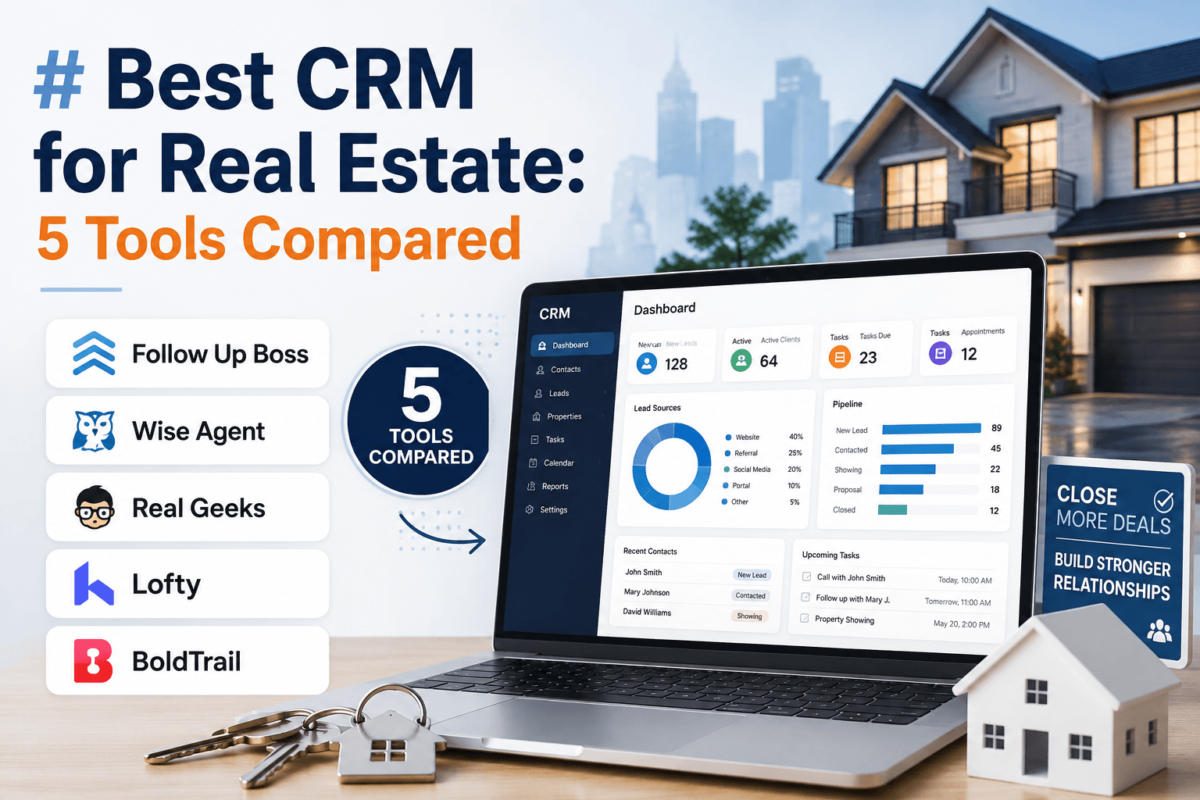
Best CRM for Real Estate: 5 Tools Compared
 By Jaykishan Panchal, Founder of TechCognate — updated for 2026
Disclosure: This post contains affiliate links. If you sign up for a CRM through one of our links, TechCognate may earn a commission at no additional cost to you. That relationship never determines our rankings — see our scoring methodology below.
A lead comes in from Zillow at 9:07 a.m. while you’re walking a buyer through a showing. Ten minutes later, a Facebook ad lead lands in your inbox. By lunch, someone from an open house texts asking about financing. You tell yourself you’ll follow up tonight. Then three more things happen, and that first lead goes cold before you ever call.
That’s the actual case for a real estate CRM. It isn’t valuable because it stores names and phone numbers — a spreadsheet does that. It’s valuable because it captures every lead the moment it arrives, routes it to the right person, and keeps nudging you (or an automated sequence) until that lead either books an appointment or tells you to stop. If you’re searching for the best CRM for real estate, you’re really asking a narrower question: which platform will actually get used, by you or your team, every single day?
This guide compares five real estate CRMs across lead management, automation, ease of use, integrations, team tools, and price, and tells you plainly who each one is built for — and who should look elsewhere.
Quick Answer: What Is the Best CRM for Real Estate?
Follow Up Boss is the best overall real estate CRM for most agents and teams in 2026. It’s a CRM-first platform — not a website or lead-gen bundle — that pulls leads in from more than 250 sources (Zillow, Realtor.com, your website, Facebook, Google Ads) into one inbox, routes them instantly, and automates the follow-up. It doesn’t lock you into buying an IDX website or paid leads you don’t need. If you already have lead sources and just need them organized and worked consistently, it’s the strongest fit. But “best” depends heavily on your business model:
- Best overall: Follow Up Boss
- Best for solo agents: Wise Agent
- Best for real estate teams: Real Geeks
- Best all-in-one platform: Lofty
- Best for brokerages or scaling: BoldTrail
Quick Comparison Table
| CRM | Best For | Starting Price* | Website/IDX | Team Tools | Our Rating |
|---|---|---|---|---|---|
| Follow Up Boss | Best overall | $69/user/mo | No (CRM-only) | Yes | 9.3/10 |
| Wise Agent | Solo agents | $49/mo flat | Landing pages only | Up to 5 users | 8.8/10 |
| Real Geeks | Growing teams | ~$299/mo | Yes, included | Yes | 8.6/10 |
| Lofty | All-in-one / AI | Custom (contact vendor) | Yes, included | Yes | 8.7/10 |
| BoldTrail | Brokerages, scaling | Custom (contact vendor) | Yes, included | Yes + back office | 8.5/10 |
*Pricing verified against each vendor’s public pricing page or official materials as of August 2026 where available; platforms with request-based pricing are marked “Custom” rather than assigned a fabricated number. Pricing changes — confirm current rates on the provider’s site before buying. Ratings are our own editorial scores (see methodology), not scores issued by the vendors.
How We Scored These CRMs
These are editorial assessments, not scores issued by the vendors. We weighted each platform across eight factors that actually affect whether a real estate agent uses a CRM daily or abandons it after a month:
- Real-estate-specific features — 20%
- Lead management — 20%
- Follow-up automation — 15%
- Ease of use — 10%
- Integrations — 10%
- Team and brokerage capabilities — 10%
- Pricing and value — 10%
- Mobile experience — 5%
We built this comparison from each vendor’s official pricing and product pages, help-center documentation, and independent review platforms, and we verified affiliate program status directly rather than assuming every listed product has one. Where we couldn’t confirm a current commission rate or program, we say so instead of inventing one.
1. Follow Up Boss — Best Overall
Why We Like It
Follow Up Boss doesn’t try to sell you a website or generate your leads — it just organizes and works whatever leads you already have, from wherever they come. Zillow acquired the company in 2023 but has kept it an open platform that still integrates with Zillow’s competitors, which tells you something about how central it’s become to how real estate teams actually operate. Instead of a single dashboard, it behaves more like an operating layer: leads from Zillow, Realtor.com, your website, and paid ads all funnel into one inbox with full context.
Key Features
- Pulls leads from 250+ real estate sources into a single inbox
- Two-way texting, calling, and email sync with Gmail and Office 365
- Smart Lists that surface the leads showing the most buying intent each day
- Action Plans for automated drip and follow-up sequences
- AI-assisted message summaries, lead prioritization, and task suggestions
- Open API and an extensive integration marketplace (lead sources, dialers, transaction tools)
- Lead routing and reporting built for teams, not just solo pipelines
What It Does Best
Speed to lead. A team lead can watch a Zillow lead land, get auto-assigned to the next available agent, and trigger a text within seconds — all without anyone touching a spreadsheet. If your team is already buying leads from multiple sources and the real problem is that nobody follows up consistently, this is precisely the gap Follow Up Boss closes.
Where It Falls Short
Follow Up Boss has no built-in IDX website or lead generation — you still need to bring your own leads and, if you want one, your own site. That’s by design, but it means the sticker price understates your real cost if you’re starting from zero. It also scales in steps rather than smoothly: Grow is priced per user, but jumping to Pro or Platform tiers to unlock team features is a bigger leap than some solo agents want to make. And as of this writing, Follow Up Boss does not run a public affiliate or referral-commission program — its own help center says the company is still considering one, so we’re not treating it as an affiliate partner in this article.
Best For
Solo agents scaling into a team, and teams of roughly 2–30 agents who already have lead sources and want one system to route, work, and report on them.
Pricing
Grow: $69/user/month (about $58/user/month billed annually). Pro: $499/month for up to 10 users. Platform: $1,000/month for up to 30 users. A 14-day free trial is available and there’s no long-term contract required. Confirm current tiers on followupboss.com, as plans and included seats can change.
Pros:
- Works with virtually any lead source you already use
- No long-term contract, transparent published pricing
- Deep team lead-routing and accountability reporting
- Large, mature integration ecosystem
Cons:
- No native website, IDX, or lead generation
- Per-user pricing adds up quickly for larger teams
- No affiliate program currently active
Our Verdict
If your team already has lead flow and the bottleneck is organization and follow-up, Follow Up Boss is the CRM to beat. Compared with an all-in-one platform like Lofty or BoldTrail, you’ll pay separately for a website and lead sources — but you also won’t be locked into a single vendor’s lead-gen engine.
2. Wise Agent — Best for Solo Agents
Why We Like It
Founded in 2002 by a working real estate agent who couldn’t find software that did what he actually needed, Wise Agent has spent more than two decades staying narrowly focused on solo agents and small teams who want one flat-rate system rather than a stack of add-ons. Compared with Follow Up Boss, it trades some polish and integration breadth for a much lower, simpler price and genuinely responsive 24/7 support — a detail reviewers mention constantly.
Key Features
- Contact management, lead automation, and transaction management in one flat-rate plan
- Built-in landing page builder for single-property and lead-capture pages
- Pre-written monthly newsletters in English, Spanish, and a Canadian edition
- AI Writing Assistant for drafting emails, texts, and auto-responses
- Shared calendars, lead assignment, and permissions for up to 5 users at the base tier
- Integrations with Zapier, DocuSign, Homes.com, MLS feeds, and major email platforms
What It Does Best
Getting a solo agent fully set up — contacts imported, drip campaigns running, transaction checklists in place — without a steep learning curve or a per-seat pricing surprise. It’s the rare CRM in this category built for one person’s whole business rather than a team’s pipeline.
Where It Falls Short
The interface reads as dated next to newer, more visual CRMs, and some longtime users say new features roll out without much warning. Text messaging isn’t included in the base plan and costs extra, and there’s no dedicated native mobile app — just a mobile-optimized website. Wise Agent runs a customer referral program (credit toward your own subscription for referring other agents) and a Brand Ambassador program, but we could not verify a public, commission-based affiliate program with a stated payout rate for content publishers, so we’re not quoting one.
Best For
Solo agents and small teams (up to 5 users) who want full CRM, transaction, and marketing functionality without per-seat fees, and who value live phone/email support over deep third-party integrations.
Pricing
$49/month flat rate, month-to-month with no contract, including up to 5 shared-login team members. A 14-day free trial is offered. Teams of 15+ agents can request Enterprise/custom pricing. Confirm current rates on wiseagent.com, since third-party listings occasionally show slightly different figures.
Pros:
- Flat monthly price with no per-user fee up to 5 users
- 24/7 U.S.-based live support, consistently praised in reviews
- Transaction management and marketing bundled in, not sold separately
- Named a top real estate CRM by Forbes Advisor multiple years running
Cons:
- Dated interface compared with newer platforms
- Texting costs extra; no native mobile app
- Lighter on advanced lead-routing than team-first platforms
Our Verdict
For a solo agent, paying $69 per user on Follow Up Boss versus $49 flat on Wise Agent for a full toolkit (transactions included) is an easy call in Wise Agent’s favor — unless you specifically need Follow Up Boss’s wider lead-source integrations.
3. Real Geeks — Best for Real Estate Teams
Why We Like It
Real Geeks bundles an IDX website, CRM, and lead generation into one mid-priced package, which makes it the natural next step for a team that’s outgrown a CRM-only tool but isn’t ready for enterprise pricing. Unlike Follow Up Boss, you’re not assembling a website and a CRM from two vendors — it’s one login, one bill, and leads that flow straight from your site into your pipeline.
Key Features
- IDX website with built-in lead capture, included at every tier
- Lead Manager CRM with automated email/text alerts on new leads
- Idle Lead Reassignment — leads an agent doesn’t engage with automatically reroute to a teammate
- Estate IQ home-valuation tool for generating seller leads, included at no extra cost
- Real Leads (Google and Facebook PPC) as an optional add-on lead-gen engine
- Team accounts and mass email marketing on Grow tier and above
What It Does Best
Keeping a growing team accountable. The idle-lead reassignment feature specifically solves the classic team-lead complaint: a lead sits untouched because it was assigned to the wrong (or wrong-availability) agent, and nobody notices until it’s cold.
Where It Falls Short
The Establish entry plan only includes 2 users before per-seat fees kick in, and the platform fee is really a floor, not a ceiling — consistent lead volume typically requires separate ad spend on top of the subscription. Real Geeks commonly asks for a 6–12 month commitment, with an early-cancellation buyout equal to remaining fees or two months, so it’s a bigger commitment than a month-to-month tool like Follow Up Boss or Wise Agent. Pricing also changed in June 2025, so treat any number you see outside the vendor’s own pricing page as approximate.
Best For
Teams handling dozens to hundreds of leads a month who want website, CRM, and lead generation under one roof, and who are comfortable committing to a multi-month term.
Pricing
The Establish plan starts around $299/month (2 users included; additional users from $25/month up to 10). Higher tiers (Grow, Expand, Conquer) add managed marketing, mass campaigns, and dedicated coaching, scaling into the $600–$1,600/month range depending on package. Real Geeks’ official pricing page now asks prospects to request a quote directly, so confirm current tier pricing before budgeting.
Pros:
- Website, CRM, and lead gen in one system and one bill
- Idle-lead reassignment keeps team follow-up honest
- Free built-in seller-lead tool (Estate IQ)
- Confirmed, currently active affiliate and referral programs
Cons:
- Multi-month contract with an early-exit buyout
- Ad spend is typically required on top of the platform fee
- Only 2 users included before add-on seat fees
Our Verdict
If you already have an IDX website and just need better follow-up, you likely don’t need Real Geeks — Follow Up Boss or Wise Agent will do the job for less. But if you’re building a team’s entire online presence from scratch, bundling saves you from stitching three vendors together.
4. Lofty — Best All-in-One Platform
Why We Like It
Lofty is the current name for Chime, which rebranded in 2023, and it’s leaned hardest into AI of any platform in this comparison. Its AI Sales Agent can autonomously engage a lead over website chat, SMS, or email — qualifying and scheduling before a human ever steps in — while a separate AI Assistant drafts messages, summarizes calls, and manages tasks. For teams that want the CRM to actually do work rather than just track it, that’s a meaningfully different pitch than Follow Up Boss or Real Geeks.
Key Features
- IDX website integrated directly with the CRM and lead scoring
- AI Sales Agent for autonomous lead engagement across chat, SMS, and email
- Smart Plans — customizable automated nurture workflows
- Social Studio for content creation, scheduling, and posting across social platforms
- 33+ built-in lead-generation methods per the vendor’s own materials
- Lead routing, performance tracking, and team management tools for brokerages
What It Does Best
Covering the widest range of day-to-day marketing tasks — website, CRM, social posting, and AI-driven first contact — without leaving the platform. For an agent who doesn’t want to manage four separate subscriptions, that consolidation has real value.
Where It Falls Short
Lofty doesn’t publish fixed pricing on its official site; it uses request-based quotes, and third-party estimates commonly place the core package between roughly $449 and $1,500 per month plus a setup fee. That opacity makes it harder to comparison-shop than Follow Up Boss or Wise Agent, both of which publish rate cards. It’s also an indivisible bundle — you can’t subscribe to just the website or just the CRM — so a team that keeps a separate CRM running in parallel effectively pays twice.
Best For
Agents and teams who want AI handling first-touch lead engagement and are comfortable with quote-based, bundled pricing in exchange for consolidating their whole marketing stack.
Pricing
Custom / contact vendor — Lofty does not publish a fixed monthly rate. Third-party estimates and reseller listings place the core package in the $449–$1,500/month range plus a one-time setup fee reported between roughly $299 and $1,499, depending on configuration. Treat these as planning estimates, not quotes, and get an itemized quote before committing.
Pros:
- Most advanced AI lead-engagement tooling in this comparison
- Genuinely all-in-one: website, CRM, social, automation
- Confirmed, published affiliate commission structure
- Scales from solo agent to brokerage on one platform
Cons:
- No public pricing; quote-based and reportedly premium-priced
- Indivisible bundle — can’t buy components separately
- AI add-ons (like the Sales Agent) can add meaningful cost on top of the base plan
Our Verdict
Lofty and its rebranded rival BoldTrail (formerly kvCORE) solve the same problem in similar ways; Lofty leans further into AI-driven engagement, while BoldTrail leans further into brokerage back-office tooling. If autonomous AI follow-up is the feature you actually want, Lofty is the more direct fit.
5. BoldTrail — Best for Brokerages and Scaling Teams
Why We Like It
BoldTrail is what kvCORE became when Inside Real Estate unified kvCORE, BoomTown, and Brokermint under one brand in mid-2024. The CRM core, IDX infrastructure, and Smart Campaign engine you may remember from kvCORE carried over intact; what’s new is BoldTrail BackOffice (commission automation, agent onboarding, billing, reporting) and BoldTrail Recruit, which means a brokerage can now run front-office lead management and back-office operations on a single vendor. RE/MAX has run an expanding partnership with the platform since 2022, which is a reasonable proxy for how it performs at real brokerage scale.
Key Features
- Smart CRM that tracks how leads interact with your IDX site (searches, saves, views)
- Smart Campaigns for behavior-triggered automated follow-up
- BoldTrail BackOffice for commission calculation, onboarding, and billing
- BoldTrail Recruit for agent recruiting and retention tracking
- A marketplace of 50+ add-on integrations (paid ads, lead gen, vanity domains, and more)
- Architecture built to scale from solo agents to national franchise brokerages
What It Does Best
Connecting front-office lead management to back-office commission and recruiting operations, which is the specific gap none of the other four platforms in this list try to close. A broker running 50+ agents gets one system instead of three.
Where It Falls Short
Pricing is entirely quote-based; the public pricing page lists Base, Plus, and Pro packages behind a “Talk to Sales” button rather than published rates, and older $499/month kvCORE figures circulating online shouldn’t be treated as current. User reviews are mixed on mobile-browser reliability and on whether some advertised features work as described out of the box, and the depth of BoldTrail’s module set means a real onboarding investment before a team sees full value. Some agents transitioning from BoomTown have also reported confusion around renewal terms during the migration to BoldTrail, so read any renewal paperwork closely.
Best For
Brokerages and larger teams that need front-office lead management and back-office commission/recruiting tools under one contract, and that have the bandwidth for a longer implementation.
Pricing
Custom / contact vendor. BoldTrail’s official pricing page uses quote-based Base, Plus, and Pro packages with no published rate card. Commonly cited third-party estimates put individual-agent pricing around $499/month, but confirm your actual quote, contract length, setup costs, and included modules directly with Inside Real Estate before budgeting.
Pros:
- Only platform here combining CRM, IDX, and true back-office tools
- Proven at franchise scale (RE/MAX partnership)
- Behavior-based lead scoring tied directly to your website activity
- Confirmed, free affiliate program with a published referral payout
Cons:
- No published pricing anywhere on the site
- Mixed user reviews on mobile performance and feature reliability
- Significant learning curve given the breadth of modules
Our Verdict
If you’re a solo agent or small team, BoldTrail is almost certainly more platform than you need — the back-office and recruiting modules only pay off once you’re managing other agents. For a brokerage owner evaluating a single system to run the whole operation, it’s one of the few real estate platforms built to do that.
What Features Should a Real Estate CRM Have?
Whichever platform you land on, these are the capabilities that actually move the needle for an agent’s day-to-day workflow:
- Contact management — rich lead and client profiles, not just a name and number
- Lead capture — forms, landing pages, and portal integrations that feed the CRM automatically
- Pipeline management — a visual stage-by-stage view of every active buyer and seller
- Automated follow-up — drip sequences that keep working a lead when you can’t
- Email and SMS — two-way messaging logged automatically against the right contact
- Calling — click-to-call or a built-in dialer with call logging
- Lead routing — automatic assignment rules so no lead sits unclaimed
- Task reminders — nothing that matters depends on your memory
- Mobile access — you’re rarely at a desk when a lead responds
- Reporting and analytics — which sources actually convert, and who on your team follows up
- Integrations — your MLS, email, e-signature, and lead sources shouldn’t live in silos
- Website/IDX capability — either built in, or a clean integration if you buy it elsewhere
- AI functionality — drafting, summarizing, and prioritizing, not replacing your judgment
- Team collaboration — shared visibility, permissions, and accountability for anyone beyond a solo agent
- Data export and portability — your database is your business; confirm you can leave with it
Real Estate CRM vs. Generic CRM: What’s the Difference?
A real estate CRM should ship with real-estate-specific workflows built in: property-linked contact records, MLS and portal (Zillow, Realtor.com) integrations, IDX website support, transaction/closing checklists, and drip sequences written for a buying cycle that can run six to twelve months, not six to twelve days. A general-purpose CRM like HubSpot or Salesforce can technically be configured to do most of this, but you’re building it yourself — custom fields, custom pipelines, custom automations — instead of getting it out of the box.
That configuration effort isn’t always a bad trade. A team that’s already standardized on a generic CRM like HubSpot or Pipedrive for other parts of the business — commercial real estate, property management, or a brokerage with non-residential revenue lines — may get more value from extending that one system than adding a separate real-estate-only tool. The generic option usually wins on broader third-party app ecosystems and more flexible reporting; the real-estate-specific option usually wins on speed to value, because the property and portal workflows are already built.
Do you really need a CRM with 200 features if your team only uses five? If your business is straightforward residential resale, purpose-built almost always beats generic on time-to-value. If your business spans commercial, property management, or multiple verticals, a flexible generic platform paired with real-estate-specific lead generation tools can be the smarter long-term bet.
How Much Does a Real Estate CRM Cost?
There’s no single honest number here, because the market splits into two pricing models:
- CRM-only platforms (Follow Up Boss, Wise Agent) typically run $49–$69 per user per month, published transparently, with no required ad spend or setup fee.
- All-in-one platforms (Real Geeks, Lofty, BoldTrail) run anywhere from roughly $299/month to $1,500+/month, often plus a setup fee, and frequently expect ongoing ad spend on top for consistent lead volume.
Beyond the base subscription, budget for: per-seat add-on fees once you exceed the included user count; SMS/texting charges on platforms that bill it separately; onboarding or setup fees (commonly $250–$1,500 on all-in-one platforms); paid advertising if lead generation is bundled into your plan; and premium automation or AI add-ons priced separately from the core CRM. What’s the point of buying more leads if nobody follows up on them? Price the follow-up system before you price the lead source — a $49/month CRM that actually gets used beats a $500/month platform that doesn’t.
A solo agent with existing lead sources can reasonably run a full CRM for $50–$70/month. A team that needs a website, lead generation, and CRM in one contract should plan for $300–$1,500+/month depending on package and ad budget. A multi-office brokerage evaluating back-office tools like BoldTrail should expect a custom quote in the low thousands per month.
Real Estate CRM Statistics You Should Know
These figures are drawn from the National Association of REALTORS® and NAR-sourced reporting, not from CRM vendors, so they describe the industry a CRM has to work within — not a marketing claim about any one product.
| Statistic | What It Means for Agents | Source |
|---|---|---|
| NAR membership: 1,438,569 as of June 2026 | You’re competing against well over a million licensed agents for the same buyers and sellers — consistent follow-up is a real differentiator, not a nicety. | NAR 2026 Member Profile |
| Typical agent now has 13 years of experience, up from 12 | The market is skewing toward seasoned agents with built-in referral pipelines — a CRM that nurtures your sphere matters as much as one that manages new leads. | NAR 2026 Member Profile |
| Median gross agent income: $59,200 in 2025, up from $58,100 | Small conversion-rate gains from better follow-up have an outsized effect on take-home pay at this income level. | NAR 2026 Member Profile |
| Repeat business: median 28% of volume overall; 49% for agents with 16+ years vs. 0% for agents with 2 years or less | Newer agents can’t lean on repeat clients yet — they need a CRM that converts cold and portal leads, not just one that manages a sphere. | NAR 2026 Member Profile |
| Referrals from past clients: median 22% of volume; 32% for the most experienced agents vs. 0% for the least experienced | Past-client nurture campaigns (newsletters, check-ins) are a direct revenue lever, not busywork — this is where sphere-management tools like Wise Agent’s newsletters earn their keep. | NAR 2026 Member Profile |
| 88% of buyers and 91% of sellers used an agent | Full-service representation remains the norm; the competition is between agents, not between agents and DIY platforms. | NAR 2025 Profile of Home Buyers and Sellers |
| 43% of buyers found their agent through a referral; another 18% used an agent they’d worked with before | More than 6 in 10 buyer relationships trace back to a past touchpoint your CRM should have been tracking. | NAR 2025 Profile of Home Buyers and Sellers |
| 66% of sellers found their agent through referral or repeat use | Seller lead generation leans even more heavily on relationship maintenance than buyer lead generation does. | NAR 2025 Profile of Home Buyers and Sellers |
| Affordability cited as the top factor limiting buyers, at 27% | Longer decision cycles mean leads need nurturing for months, not days — automated long-term drip sequences matter more than ever. | NAR 2026 Member Profile |
| Agent social media use for business: Facebook 76%, Instagram 57%, LinkedIn 55% | A CRM with native social scheduling (like Lofty’s Social Studio) removes a step most agents are already doing manually. | NAR 2026 Member Profile |
Put together, these numbers point to the same conclusion: referrals and repeat business make up the bulk of production for experienced agents, while newer agents depend more heavily on converting cold leads. A CRM that only does one of those two jobs well — nurturing a sphere or converting new leads — is only solving half the problem most agents actually have.
Which Real Estate CRM Should You Choose?
Choose Follow Up Boss if…
You already have a website and lead sources, and you need one system to organize, route, and automate follow-up across all of them without being locked into a single vendor’s ecosystem.
Choose Wise Agent if…
You’re a solo agent or a team of five or fewer, you want transaction management and marketing bundled in at one flat price, and you value phone support over deep integrations.
Choose Real Geeks if…
You need an IDX website and lead generation alongside your CRM, you’re building or growing a team, and you’re comfortable with a multi-month commitment.
Choose Lofty if…
You want AI actively working leads — not just tracking them — and you’d rather pay a premium, quote-based price for a fully bundled platform than assemble your own stack.
Choose BoldTrail if…
You’re running or scaling a brokerage and need commission automation, agent onboarding, and recruiting tools connected to the same system your agents use for lead follow-up.
Who Doesn’t Need a Sophisticated Real Estate CRM?
Not every agent needs the platforms in this guide. A brand-new part-time agent closing two or three deals a year, working entirely off personal referrals, can reasonably manage with a well-organized spreadsheet, a shared calendar, and a lightweight email marketing tool for the occasional newsletter. If your brokerage already provides a CRM (many franchises bundle one), evaluate whether it genuinely covers your workflow before paying for a second one out of pocket — agents sometimes pay twice for the same job.
The signal that you’ve outgrown the simple approach isn’t a specific deal count — it’s the moment a lead falls through the cracks because you forgot to follow up, or a teammate has no idea what happened on a deal you’re both working. That’s when a purpose-built CRM starts paying for itself.
Frequently Asked Questions About Real Estate CRMs
What is the best CRM for real estate agents?
For most agents and teams, Follow Up Boss is the strongest overall pick because it organizes leads from any source and automates follow-up without forcing you into a bundled website or paid-lead contract. The right answer still depends on whether you need a website and lead generation included, and whether you’re solo or managing a team.
What CRM do most real estate agents use?
There’s no single dominant platform industry-wide, but Follow Up Boss, Wise Agent, and BoldTrail (formerly kvCORE) are among the most frequently mentioned in agent communities and industry coverage, alongside brokerage-provided tools that vary by franchise.
What is the best CRM for a solo Realtor?
Wise Agent, for its flat $49/month price covering CRM, transaction management, and marketing without per-seat fees. Follow Up Boss is a strong alternative if you specifically need its broader lead-source integrations and don’t mind paying per user.
What is the best CRM for a real estate team?
Real Geeks if you need a bundled website and lead generation alongside team routing; Follow Up Boss if your team already has lead sources and just needs better organization and accountability.
What is the best free CRM for real estate?
None of the five platforms in this guide offer a permanently free tier — all provide free trials instead (typically 14 days). Agents on a strict $0 budget sometimes start with a generic free-tier CRM like HubSpot’s free plan and migrate to a real-estate-specific tool once volume justifies the cost.
Is a real estate CRM worth it?
For any agent generating more than a handful of leads a month, yes — the alternative is leads going cold in a phone or a spreadsheet. NAR’s own data shows referral and repeat business make up roughly a quarter to a third of production for experienced agents; that pipeline doesn’t maintain itself without a system tracking it.
How much does a real estate CRM cost?
CRM-only tools typically run $49–$69 per user per month. All-in-one platforms with a website and lead generation bundled in typically run $299 to $1,500+ per month, often plus a setup fee and separate ad spend.
What should a real estate CRM include?
At minimum: contact and lead management, pipeline tracking, automated follow-up, email/SMS, task reminders, mobile access, and reporting. Real-estate-specific tools should add MLS/portal integrations, transaction checklists, and ideally IDX website support.
Do real estate agents need a CRM?
Not every agent, but most. A very low-volume, referral-only agent can get by with simpler tools; anyone actively generating leads from a website, portal, or paid ads needs a system that captures and works those leads automatically.
Can a CRM generate real estate leads?
CRM-only platforms like Follow Up Boss and Wise Agent don’t generate leads themselves — they organize leads you source elsewhere. All-in-one platforms like Real Geeks, Lofty, and BoldTrail include lead-generation tools (IDX websites, PPC management, valuation tools), though most still expect separate ad spend for consistent volume.
What is the easiest real estate CRM to use?
Wise Agent is generally considered the most approachable for agents without a technical background, thanks to a simpler feature set and heavily praised live support, though some reviewers find its interface less modern than newer platforms.
Should a new real estate agent use a CRM?
Yes, ideally from day one. New agents can’t yet rely on repeat and referral business the way veteran agents do, which makes consistent, automated follow-up on cold and portal leads even more important early in a career.
What is the difference between a CRM and an IDX website?
An IDX website displays live MLS listings to visitors and captures their contact info through search and saved-property tools. A CRM is where that captured lead actually gets organized, followed up with, and moved through your pipeline. Some platforms (Real Geeks, Lofty, BoldTrail) bundle both; others (Follow Up Boss, Wise Agent) focus on the CRM side only.
Can a CRM automate real estate follow-up?
Yes — this is the core function of every platform in this comparison, through drip sequences, task reminders, and (increasingly) AI-driven first-contact messaging like Lofty’s AI Sales Agent.
Is HubSpot good for real estate?
HubSpot can work for real estate, especially for brokerages already using it for other business lines, but it lacks real-estate-specific workflows out of the box — MLS integration, transaction checklists, IDX support — that purpose-built tools include by default. See our full HubSpot vs. Salesforce comparison if you’re weighing a generic CRM for a mixed-use brokerage.
How long should real estate leads stay in a CRM?
Indefinitely, in most cases. Given that median down-funnel timelines can stretch to a year or more for buyers dealing with affordability constraints, and that a meaningful share of business comes from referrals and repeat clients years later, leads and past clients should stay in long-term nurture rather than being deleted after a few unresponsive months.
Final Verdict: Which Real Estate CRM Is Best?
- Best overall: Follow Up Boss
- Best for solo agents: Wise Agent
- Best for real estate teams: Real Geeks
- Best all-in-one: Lofty
- Best for brokerages/scaling: BoldTrail
There isn’t one universal winner, and any article that hands you one without asking about your lead sources, budget, and team size is skipping the actual decision. What we can say confidently: if you’re not sure where to start, start with the question of whether you need a website and lead generation bundled in. If you already have lead flow, Follow Up Boss (or Wise Agent, on a tighter budget) will out-earn its cost quickly just by making sure fewer leads go cold. If you’re building your online presence from nothing, Real Geeks, Lofty, or BoldTrail save you from stitching together three separate vendors.
Whichever platform you choose, the CRM itself is only half the equation. The other half is whether your team actually logs in and works it every day — and that’s a discipline question a $1,500/month platform can’t solve any better than a $49/month one.
For agents who also handle their own follow-up emails and campaigns, pairing your CRM with a dedicated marketing automation tool or landing page builder can extend what these platforms do natively, especially if you’re on a CRM-only tool like Follow Up Boss or Wise Agent that doesn’t include a website.
Real Estate CRM Buying Checklist
- Lead capture from every source you currently use
- Automatic lead routing if you’re on a team
- Automated follow-up sequences that run without you
- Two-way email and SMS logged automatically
- Click-to-call or built-in dialer
- A mobile app or genuinely usable mobile web experience
- Visual pipeline management
- Reporting on source performance and team follow-up
- Integrations with your MLS, email, and e-signature tools
- IDX/website support, if you need it bundled
- Team permissions if you manage other agents
- A clear data-export path if you ever switch platforms
- Pricing that fits your actual budget, including setup and ad spend
- A learning curve your whole team will actually get past
Sources & Research
- National Association of REALTORS®, “2026 Member Profile,” June 2026
- National Association of REALTORS®, “2025 Profile of Home Buyers and Sellers,” November 2025
- Follow Up Boss, official pricing page and Help Center (followupboss.com), accessed August 2026
- Wise Agent, official pricing page (wiseagent.com/pricing.asp), accessed August 2026
- Real Geeks, official pricing and referral/affiliate pages (realgeeks.com), accessed August 2026
- Lofty, official product, pricing, and affiliate pages (lofty.com), accessed August 2026
- BoldTrail / Inside Real Estate, official product and affiliate program pages (boldtrail.com), accessed August 2026
Affiliate Disclosure: TechCognate may earn a commission when you sign up for a product through links on this page, at no extra cost to you. We only recommend tools we believe deliver real value, and where we couldn’t verify an active affiliate program or current pricing, we said so directly rather than guessing. Pricing and features were accurate as of August 2026 and are subject to change — always confirm current details on the provider’s official site before purchasing.