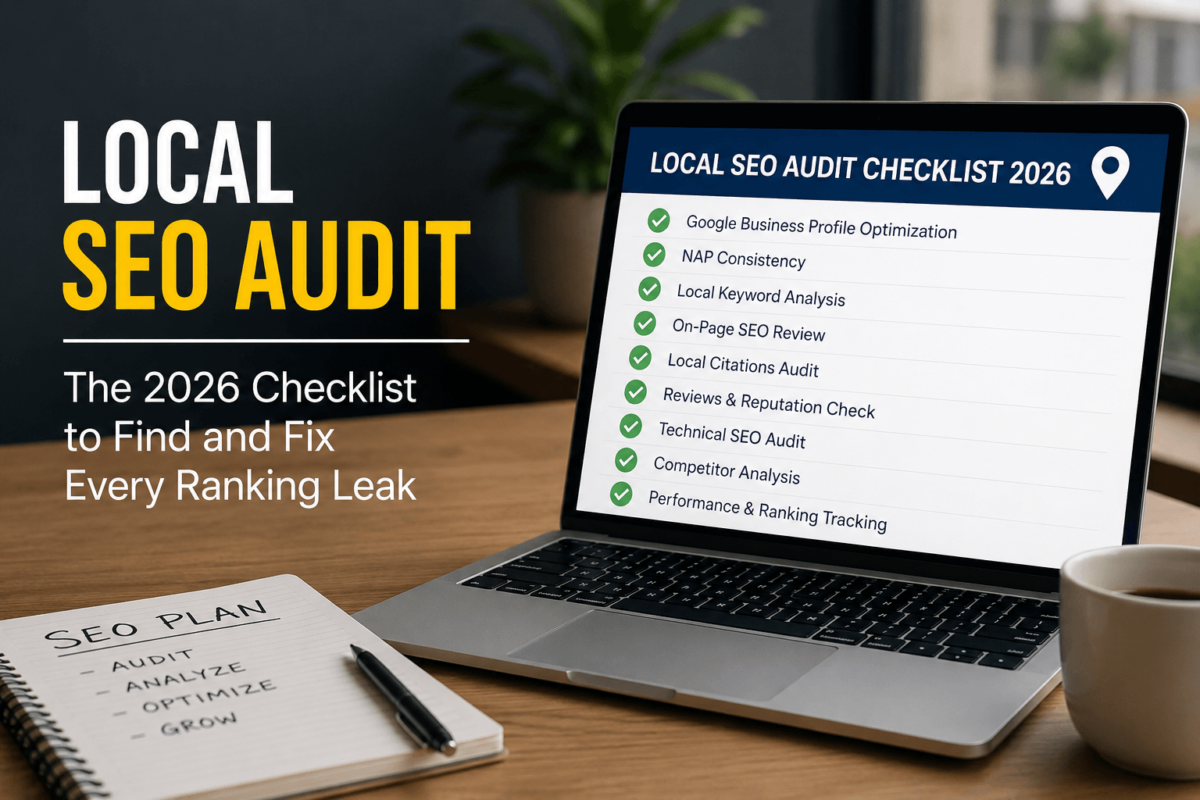
A local SEO audit is a systematic review of everything that impacts your local search visibility — from your Google Business Profile and citations to website performance, reviews, backlinks, and AI search visibility. In 2026, businesses that run regular local SEO audits consistently outperform competitors by catching issues early, improving customer trust signals, and staying aligned with Google’s evolving ranking factors.
Quick Summary
- A local SEO audit uncovers visibility, ranking, and conversion issues.
- Start with your Google Business Profile (GBP).
- Check NAP consistency across directories.
- Audit local landing pages, schema markup, and content.
- Review technical SEO issues including speed and indexing.
- Analyse reviews and online reputation.
- Evaluate local backlinks and authority signals.
- Audit AI search visibility for ChatGPT, Gemini, Perplexity, and Google AI Overviews.
- Prioritise fixes based on impact and effort.
- Run audits quarterly for best results.
What Is a Local SEO Audit and When Should You Run One?
Think of a local SEO audit like a full health check-up for your online presence. You might have an excellent service, a beautiful website, and happy customers — but if your local SEO foundation has cracks, potential customers may never find you.
A local SEO audit helps answer critical business questions such as:
- Why did rankings drop?
- Why aren’t phone calls increasing?
- Why is a competitor outranking us?
- Why are we not appearing in Google Maps?
Run a Local SEO Audit When:
- Rankings suddenly decline
- Traffic drops unexpectedly
- You change business location
- You redesign your website
- You launch a new location
- Every quarter as preventative maintenance
Many business owners only investigate SEO when something goes wrong. The best-performing local businesses audit proactively — before issues impact revenue.
Part 1: Google Business Profile Audit
Your Google Business Profile remains the most important local ranking asset. Use this 15-point checklist to identify and fix every gap.
GBP Audit Checklist
- Verify Business Name, Address, Phone Number, Website URL, and Hours
- Primary Category Optimisation — choose the most specific category (e.g. “Personal Injury Attorney”, not “Law Firm”)
- Secondary Categories — add relevant supporting categories without overdoing it
- Business Description — keyword-relevant, naturally written, compelling
- Services Section — list all major services
- Products Section — add products with descriptions and images (if applicable)
- Photos — upload team, office, exterior, and service photos
- Videos — short videos often outperform photos for engagement
- Q&A Section — monitor and answer all questions
- Review Responses — respond to every review, positive or negative
- Booking Links — verify functionality
- Appointment URLs — confirm accuracy
- Messaging — test response times
- Posts — publish updates regularly
- Local Pack Rankings — track visibility for target keywords
A dental clinic in Texas discovered that Google automatically changed its primary category. Rankings dropped for three months before anyone noticed. A simple category correction restored Local Pack visibility within weeks.
Part 2: NAP Consistency and Citation Audit
NAP stands for Name, Address, Phone Number. Google relies on consistency across the web to validate business legitimacy.
Common Citation Problems
- Old phone numbers still listed
- Suite number inconsistencies
- Different abbreviations (St vs Street, Ave vs Avenue)
- Duplicate listings
- Closed location records still active
Major Citation Sources to Audit
- Google Business Profile
- Yelp
- Bing Places
- Apple Maps
- Yellow Pages
- Better Business Bureau
- Industry-specific directories
Prioritise high-authority directories before tackling smaller niche sites. A wrong phone number on Yelp causes more harm than the same issue on a low-traffic directory.
Part 3: On-Page Local SEO Audit
Even a perfect Google Business Profile can’t overcome a poorly optimised website. Pair this section with a full technical SEO checklist to make sure nothing slips through.
Title Tag Audit
Every location page should have a unique, descriptive title tag.
On-Page Checklist
- Meta Descriptions — focus on clicks and relevance
- Local Keyword Optimisation — city names, neighbourhood names, service keywords
- Local Landing Pages — each service area should have a dedicated page
- Internal Linking — help Google understand location relevance
- Schema Markup — LocalBusiness, Review, FAQ, and Service schema verified
- Content Audit — is it unique, does it answer customer questions, is it better than competitors?
Thin location pages remain one of the biggest local SEO problems in 2026. Generic pages with minimal unique content rarely rank in competitive local markets.
Part 4: Technical SEO Audit
Technical issues quietly destroy rankings. Even a well-optimised site can lose visibility if foundational technical elements are broken. If you haven’t run one recently, start with our SEO audit template for a step-by-step framework.
Core Areas to Review
Page Speed
Slow websites lose customers. Aim for under 2.5 seconds LCP, fast interaction times, and stable visual loading. Our Core Web Vitals guide breaks down exactly how to hit these targets.
Mobile Friendliness
Most local searches happen on mobile devices. Review navigation, buttons, forms, and click-to-call functionality.
Indexing Issues
- Check indexed pages and crawl errors
- Identify duplicate content
- Review Robots.txt settings
If pages aren’t showing up in search at all, see our guide on how to fix website indexing issues.
Core Web Vitals
- LCP (Largest Contentful Paint) — target under 2.5 seconds
- INP (Interaction to Next Paint) — target under 200ms
- CLS (Cumulative Layout Shift) — target under 0.1
Quick Technical Wins
- Compress images
- Remove unused plugins
- Enable caching
- Optimise JavaScript loading
- Upgrade hosting if needed
- Ensure HTTPS on every page
Part 5: Review and Reputation Audit
Reviews influence both rankings and conversions. A strong review profile is one of the most powerful local ranking signals available — see exactly how Google reviews help SEO rankings for the full breakdown.
Review Audit Checklist
- Review Volume — are competitors receiving more reviews?
- Review Velocity — are new reviews arriving consistently?
- Average Rating — aim for 4.5 stars or higher
- Review Responses — respond professionally to all reviews
- Keyword Mentions — customers naturally mentioning services reinforce relevance
A roofing company improved local rankings after implementing a review acquisition process that generated 8–12 reviews monthly. Nothing else changed. Consistent review velocity was the deciding factor.
Part 6: Local Backlink Profile Audit
Backlinks remain one of the strongest local ranking signals. Focus on local relevance and quality over raw quantity.
What to Evaluate
- Local Relevance — links from local newspapers, chambers of commerce, community organisations, local blogs
- Authority — focus on quality over quantity
- Toxic Links — identify spam directories, link farms, and irrelevant foreign domains
Easy Local Link Opportunities
- Sponsor community events
- Join local business organisations
- Participate in charity events
- Publish local studies or area guides
- Create neighbourhood resource content
Part 7: AI Search Visibility Audit (New for 2026)
Traditional rankings are no longer the entire story. Customers increasingly discover businesses through ChatGPT, Google AI Overviews, Perplexity, Gemini, and voice assistants. Businesses appearing in AI-generated recommendations often gain visibility even when traditional rankings fluctuate.
Ask these questions to evaluate your AI search presence — and read our full guide to ranking in Google’s AI Overviews for deeper tactics:
AI Visibility Checklist
- Is Your Brand Mentioned? — search “Best [service] in [city]” in ChatGPT, Perplexity, and Gemini. Do AI systems mention your business?
- Are Your Citations Consistent? — AI systems rely heavily on trusted, authoritative sources
- Do You Have Expert Content? — authoritative content improves citation likelihood in AI results
- Is Schema Implemented Correctly? — structured data helps AI systems understand your business. Our schema markup for AI search guide covers exactly what to implement
- Are Reviews Strong? — AI systems frequently incorporate review sentiment into recommendations
Best Local SEO Audit Tools in 2026
Free Tools
| Tool | Best For | Cost |
|---|---|---|
| Google Search Console | Technical SEO | Free |
| Google Business Profile Manager | GBP Audits | Free |
| Google PageSpeed Insights | Speed Testing | Free |
| Google Rich Results Test | Schema Validation | Free |
| Bing Webmaster Tools | Search Insights | Free |
| Screaming Frog (Limited) | Site Crawling | Free |
| Google Analytics 4 | User Behavior | Free |
Paid Tools
| Tool | Best Use Case |
|---|---|
| BrightLocal | Citation & Local SEO Audits |
| Whitespark | Citation Tracking |
| Semrush | Complete SEO Audits |
| Ahrefs | Backlink Analysis |
| Local Falcon | Local Rank Tracking |
| Moz Local | Citation Management |
| GeoRanker | Local Visibility Monitoring |
How to Prioritise Audit Findings
Not all issues deserve equal attention. Fix issues affecting visibility before tackling optimisation improvements.
| Priority | Issue Type | Impact |
|---|---|---|
| 🔴 Critical | GBP Suspension | Very High |
| 🔴 Critical | Wrong Phone Number | Very High |
| 🔴 Critical | Indexing Problems | Very High |
| 🔴 Critical | Major NAP Errors | Very High |
| 🟠 High | Slow Site Speed | High |
| 🟠 High | Missing Reviews | High |
| 🟡 Medium | Missing Schema Markup | Moderate |
| 🟡 Medium | Internal Linking Gaps | Moderate |
| 🟢 Low | Minor Meta Description Issues | Low |
Step-by-Step Local SEO Improvement Guide
- 1Audit and optimise your Google Business Profile
- 2Fix NAP inconsistencies across all major directories
- 3Improve title tags, content, and local landing pages
- 4Resolve technical SEO issues — speed, indexing, Core Web Vitals
- 5Implement and validate schema markup
- 6Develop a consistent review acquisition process
- 7Remove toxic backlinks and earn local authority links
- 8Audit AI search visibility across ChatGPT, Gemini, and Perplexity
- 9Track rankings, traffic, and conversions
- 10Repeat the full audit every quarter
Local SEO Audit Report Template
A professional audit report should include each of the following sections — or use our ready-made SEO audit report structure as a starting point:
- Executive Summary — key findings and opportunities
- Google Business Profile Review — issues and recommendations
- Citation Analysis — consistency score and correction plan
- Website Audit — on-page and technical findings
- Review Analysis — reputation strengths and weaknesses
- Backlink Review — authority opportunities and risks
- AI Search Visibility Assessment — presence across AI platforms
- Action Plan — prioritised implementation roadmap with timelines
How Often Should You Run a Local SEO Audit?
| Business Type | Recommended Audit Frequency |
|---|---|
| Small Businesses | Every 6 months minimum |
| Competitive Industries | Quarterly |
| Multi-Location Businesses | Monthly monitoring with quarterly deep audits |
| Agencies | Quarterly audits for every client |
FAQ: Local SEO Audit
Q: How long does a local SEO audit take?
A: A basic audit typically takes 2–4 hours. A comprehensive professional audit can require 10–30 hours depending on website size, number of locations, and level of competition.
Q: What tools do I need for a local SEO audit?
A: At minimum, use Google Search Console, Google Business Profile Manager, Google Analytics, PageSpeed Insights, and Screaming Frog. Advanced audits often include BrightLocal, Whitespark, Ahrefs, and Semrush.
Q: How much does a professional local SEO audit cost?
A: Professional local SEO audits typically range from $500 to $5,000+, depending on business size, industry competitiveness, and depth of analysis required.
Q: What are the most common local SEO problems found in audits?
A: The most frequent issues include incorrect Google Business Profile settings, inconsistent citations, thin location pages, slow websites, missing schema markup, and weak review profiles.
Q: Can I do a local SEO audit myself or do I need an agency?
A: You can absolutely perform a basic audit yourself using free tools. However, agencies often uncover technical, strategic, and competitive issues that business owners may overlook — particularly around schema and AI visibility.
Q: Does a local SEO audit improve rankings immediately?
A: An audit itself does not improve rankings. The improvements come from implementing the fixes identified during the audit. Most businesses see meaningful movement within 4–12 weeks of implementing recommendations.
Q: How often should Google Business Profile information be reviewed?
A: At least once per month. Google occasionally updates categories, attributes, or listing information automatically, making regular reviews essential to prevent unexpected ranking drops.
Final Thoughts
Local SEO success in 2026 is not about finding a secret ranking trick. It is about eliminating dozens of small problems that quietly hold your business back.
The businesses dominating Google’s Local Pack usually are not perfect — they are simply better at identifying and fixing ranking leaks before competitors do.
A thorough local SEO audit gives you that advantage. Start with your Google Business Profile, work through citations, optimise your website, strengthen your reviews, improve local authority signals, and do not ignore AI search visibility.
The businesses that win local search in 2026 won’t be the ones doing SEO once a year. They’ll be the ones auditing, improving, and adapting every quarter.