Serpstat vs Ahrefs: Which SEO Tool Is Better in 2026?
A hands-on, no-fluff comparison of pricing, data, AI features, and real workflows—so you can pick the right platform for your SEO work in 2026.
Shopping for an SEO platform in 2026 feels a lot like shopping for a new laptop. Every vendor promises the fastest performance, the smartest AI features, and the biggest database. The spec sheets all look impressive. Then you commit to a monthly plan, build three months of workflows and saved projects around it, and realize switching later means re-learning everything and re-exporting your data. So the decision matters more than the marketing copy suggests.
Serpstat and Ahrefs are two of the most recognizable names in SEO software, but they were not built for the same person. Ahrefs grew up as the backlink-data tool of choice for SEOs who needed the deepest possible index of the link graph, and it has spent over a decade defending that reputation. Serpstat started as a more affordable, all-in-one alternative aimed at agencies and in-house teams who needed keyword research, rank tracking, site audits, and PPC competitor data without paying enterprise prices for each one.
Both companies have closed a lot of the gap since then. Ahrefs has built out content tools and an AI-assisted workflow. Serpstat has invested heavily in its own backlink index and added AI features of its own. The honest answer to “which one is better” depends entirely on what you do every day, how many people need seats, and what you’re willing to pay for marginal gains in data freshness or database size.
We spent dozens of hours running the same keyword research, backlink, rank tracking, and site audit tasks through both platforms to see where the real differences show up—not just in feature lists, but in day-to-day use. This comparison covers pricing, keyword databases, backlink data, rank tracking, AI capabilities, reporting, ease of use, customer support, and overall value, with specific recommendations for different budgets and team sizes.
Here’s what you’ll learn in this comparison: which tool wins on raw data size, which one is easier to pick up if you’re new to SEO, which one agencies tend to standardize on, where the AI features actually save time versus just sound good in a sales demo, and which platform gives you more for your money depending on whether you’re a freelancer, a growing agency, or an enterprise marketing team. If you’re weighing other options too, our Serpstat vs Semrush vs Ahrefs breakdown covers a three-way angle on this same decision.
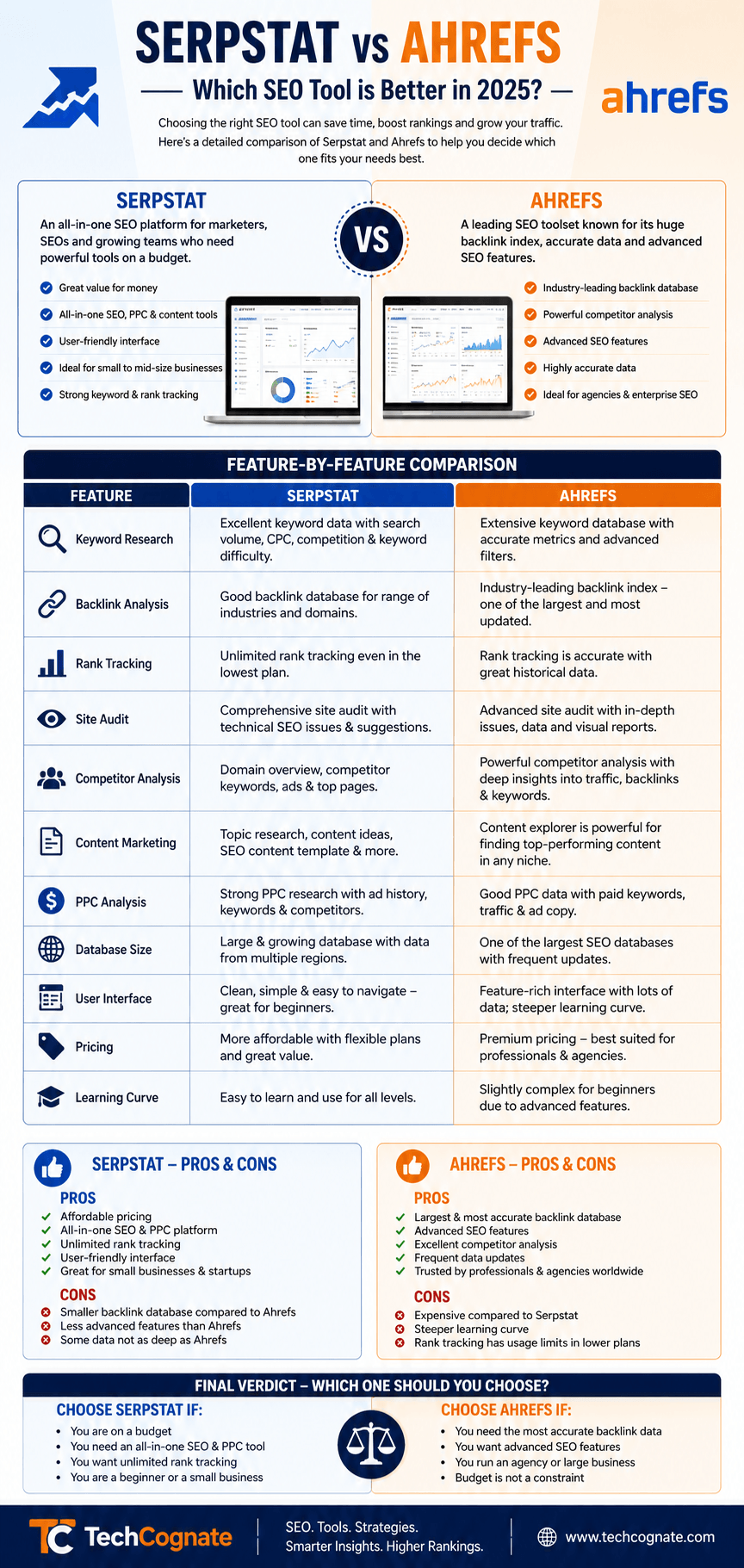
Serpstat vs Ahrefs at a glance — pricing, data, and feature differences for 2026
⚡Quick Verdict
If you only read one section, read this one. Here’s the short version before we get into the details.
| Category | Winner | Why |
|---|---|---|
| Best Overall | Ahrefs | Deeper backlink index and more polished workflow across the board |
| Best for Beginners | Serpstat | Simpler interface and a real free plan to learn on |
| Best for Agencies | Serpstat | Lower per-seat cost and stronger multi-project management at scale |
| Best Budget Option | Serpstat | Entry plans cost a fraction of Ahrefs for comparable core features |
| Best Enterprise Choice | Ahrefs | Data depth, API limits, and brand recognition clients expect |
| Best Keyword Research | Ahrefs | Larger keyword database and more reliable search volume estimates |
| Best Backlink Analysis | Ahrefs | Larger, fresher backlink index with the most trusted historical data |
| Best Site Audit | Serpstat | Faster crawls on mid-size sites and a more actionable issue list |
| Best Rank Tracking | Tie | Both offer daily tracking; Serpstat is cheaper per tracked keyword |
| Best AI Features | Ahrefs | More mature AI-assisted content and keyword workflows as of 2026 |
| Best Value for Money | Serpstat | Most features per dollar, especially for small teams and solo SEOs |
Bottom Line
Need the one-line answer? Choose Ahrefs if backlink data quality and brand recognition with clients matter more than price. Choose Serpstat if you want the best all-around value and you’re managing a tighter budget or multiple smaller projects.
What Is Serpstat?
Serpstat launched in 2013 out of Ukraine and grew into an all-in-one SEO, PPC, and content marketing platform used by agencies and in-house teams worldwide. It was built around a simple pitch: give marketers most of what they need—keyword research, rank tracking, backlink analysis, site audits, and competitor research—in a single subscription rather than forcing them to stitch together several specialized tools.
The company has stayed focused on accessibility. Pricing tiers start low enough for solo freelancers and bloggers, and the interface is designed so a marketer with no formal SEO training can get a usable answer within a few minutes of logging in. That doesn’t mean it’s a lightweight tool—Serpstat’s keyword database now covers dozens of search engines and regions, and its own backlink index has grown substantially over the past few years to compete more directly with the established players.
Company Background and History
Serpstat started as a keyword research tool and expanded methodically: rank tracking came next, then site audit, then backlink analysis, then PPC research, then content marketing and AI tools. That step-by-step build-out is still visible in the product today—each module feels purpose-built rather than bolted on, though the overall navigation has needed a few redesigns to keep up with all the added functionality.
Main Products and Features
Who Serpstat Is Built For
Serpstat’s natural audience is agencies juggling many smaller client accounts, in-house marketers who need one tool to cover several SEO and PPC tasks, and freelancers or small business owners who can’t justify a premium-tier subscription for backlink data alone. It’s also a common landing spot for people switching tools mid-career—the learning curve is gentle enough that a marketer coming from Google Search Console and not much else can be productive within a day.
Strengths
Weaknesses
What Is Ahrefs?
Ahrefs launched in 2010 with a singular focus: build the most comprehensive backlink index in the industry. That focus paid off. For most of the 2010s, “check it in Ahrefs” became shorthand for verifying backlink data across the SEO industry, and that reputation still drives a large share of new signups today.
Since then, Ahrefs has expanded into a full SEO suite—keyword research, rank tracking, site audits, content explorer, and more—while keeping its backlink database as the centerpiece. The company has also built one of the most respected SEO blogs and YouTube channels in the industry, which has the side effect of generating enormous organic trust before a prospect ever opens the product.
Company Overview and Market Reputation
Ahrefs is privately held and has historically avoided outside funding, which the company has said gives it more freedom to invest in long-term data infrastructure rather than short-term growth metrics. Among professional and enterprise SEOs, it’s frequently treated as the default reference tool—the one whose numbers get cited in client reports because clients have usually heard of it.
Core Tools and Database Size
Who Ahrefs Is Built For
Ahrefs fits best with experienced SEOs, content-driven publishers, link builders, and agencies serving larger clients who expect to see Ahrefs metrics in a report. It’s also the more common choice for enterprise marketing departments that have the budget to pay for the deepest data available and don’t want to spend internal political capital justifying a less recognized tool.
Strengths
Weaknesses
Serpstat vs Ahrefs: Feature Comparison at a Glance
Before diving into the details, here’s a side-by-side look at how the two platforms stack up across the features that matter most for day-to-day SEO work.
| Feature | Serpstat | Ahrefs |
|---|---|---|
| Keyword Database Size | Very large, 200+ search engines | Very large, broad country coverage |
| Countries Covered | 190+ | 150+ (varies by data type) |
| Search Engine Coverage | Google, Bing, Yahoo, and regional engines | Primarily Google, with some Bing data |
| Backlink Database | Large and growing, own crawler | Among the largest in the industry |
| Backlink Refresh Rate | Frequent, improving | Very frequent, industry-leading |
| Rank Tracker | Daily, desktop and mobile | Daily, desktop and mobile |
| Site Audit | Fast crawls, clear prioritization | Thorough, slightly slower on large sites |
| Core Web Vitals Data | Yes, integrated | Yes, integrated |
| JavaScript Rendering | Supported | Supported |
| AI Features | AI content assistant, AI clustering | AI keyword and content assistance |
| Content Tools | Topic research, content marketing module | Content Explorer, content grading |
| PPC Research | Strong, dedicated module | Limited compared to Serpstat |
| Competitor Research | Keyword gap, traffic share | Domain comparison, content gap |
| API Access | Available on paid plans | Available, usage-based pricing |
| Team Collaboration | Strong multi-project tools | Solid, fewer agency-specific tools |
| Custom Reporting | Available on higher tiers | Available, polished templates |
| White Label Reports | Available on agency plans | Limited white-label options |
| Third-Party Integrations | Google Search Console, Analytics, Looker | Google Search Console, Analytics, Looker |
| Local SEO Tools | Yes, with geo rank tracking | Yes, with geo rank tracking |
| Technical SEO Depth | Strong, beginner-friendly issue grouping | Strong, more granular detail |
| Learning Curve | Gentle | Moderate |
| Customer Support | Live chat, email, knowledge base | Email, extensive knowledge base |
| Free Plan / Trial | Functional free plan | Limited free lookups only |
| Starting Price | Lower | Higher |
User Interface & Ease of Use
This is one of the first things you’ll notice, and it shapes how much you actually use a tool versus letting the subscription quietly renew while you avoid logging in.
Dashboard and Navigation
Serpstat organizes its dashboard around projects, which works well if most of your work is client-based. You pick a project, and the relevant keyword, backlink, audit, and rank data for that domain surfaces together. Ahrefs leans more on its individual tools—Site Explorer, Keywords Explorer, Site Audit—as separate destinations you jump between, which feels closer to a toolbox than a single dashboard.
Learning Curve
New users tend to get comfortable with Serpstat faster. The terminology is more plain-language, and the platform nudges you toward next steps rather than assuming you already know what a content gap report is for. Ahrefs assumes a bit more SEO literacy out of the gate, though its documentation and video tutorials are genuinely excellent once you know what you’re looking for.
Workflow
One thing you’ll notice after using both tools for a few weeks: Serpstat’s project-based structure makes it faster to switch between client accounts without losing your place, while Ahrefs rewards you for staying deep in one domain at a time—it’s built for thorough single-site analysis rather than rapid context-switching.
Mobile Responsiveness and Workspace Organization
Neither tool is designed primarily for mobile use, and both expect you to be at a desktop for serious work. Workspace organization favors Serpstat for agencies managing many small projects, and favors Ahrefs for teams doing deep work on a handful of larger domains.
Keyword Research Comparison
Keyword research is where most people spend the bulk of their time in either tool, so small differences in data quality compound fast. If you’re evaluating other keyword-focused tools too, see how Ahrefs stacks up against a dedicated keyword tool in our Ahrefs vs KWFinder comparison.
Search Volume and Difficulty
Both platforms estimate search volume using clickstream and search data, and neither is perfectly accurate—no third-party tool can be, since only Google has the real numbers. In side-by-side checks against Google Keyword Planner ranges, Ahrefs volumes tended to land slightly closer to Planner’s reported ranges on competitive commercial terms, while Serpstat performed comparably on long-tail and informational queries.
Search Intent and Question Keywords
Ahrefs tags intent (informational, commercial, navigational, transactional) directly in its keyword results, which saves a manual classification step. Serpstat surfaces question-based and related keywords clearly but requires a bit more manual judgment on intent.
Long-Tail and Related Keywords
Serpstat’s keyword clustering is a genuine time-saver here—it groups semantically related long-tail terms automatically, which is useful when building out topic clusters for content briefs. Ahrefs offers similar groupings inside Keywords Explorer but leans more on manual filtering.
Trend Accuracy and Historical Data
Both tools show historical trend lines, and both are reasonably reliable for spotting seasonality. Ahrefs’ historical keyword data tends to go back further for high-volume terms, which matters if you’re doing multi-year content planning.
AI Assistance in Keyword Research
Ahrefs has pushed further into AI-assisted keyword ideation and clustering as of 2026, with suggestions that read more like a researcher’s shorthand than a raw export. Serpstat’s AI clustering is solid for grouping but less developed for generative suggestions.
A Real-World Example
Running the same seed term through both tools for a mid-competition home services niche, Ahrefs returned a tighter, more intent-sorted list with fewer irrelevant matches, while Serpstat returned a larger raw list that needed more manual trimming but surfaced a few genuinely useful long-tail variants Ahrefs missed entirely.
Backlink Analysis
This is Ahrefs’ home turf, and it shows. But the gap has narrowed more than most comparison articles give Serpstat credit for.
Database Freshness and Size
Ahrefs crawls the web on its own schedule and has historically prioritized recrawling known link sources quickly, which means newly acquired or lost links tend to show up faster. Serpstat’s own backlink index has grown substantially and catches the large majority of links Ahrefs finds, but spot checks on niche or smaller sites still occasionally surface links in Ahrefs that haven’t yet appeared in Serpstat.
Referring Domains and Anchor Text
Both tools report referring domains clearly, with filtering by domain rating, traffic, and follow status. Anchor text reporting is comparable, though Ahrefs’ anchor cloud visualization is a small but genuinely useful touch for spotting over-optimization patterns at a glance.
Broken and Lost Backlinks
This is a feature agencies use constantly for link reclamation outreach. Both platforms flag broken and lost backlinks reliably; Serpstat’s lost-link reporting is a bit more aggressive about flagging links that may just be temporarily down, which means more false positives to sort through.
Link Intersect and Competitor Backlinks
Ahrefs’ link intersect tool—finding domains that link to several competitors but not to you—remains one of the most useful link-building research features in the industry. Serpstat has a comparable tool that gets the job done but with a less refined filtering interface. If link-building tools are a priority for you, our Ahrefs vs Majestic guide digs deeper into specialist backlink metrics.
Spam Detection and Link Quality
Both tools provide a spam or toxicity score for backlinks, and neither should be treated as gospel—spam scoring is inherently approximate. Ahrefs’ domain rating metric is more widely recognized by clients, which matters more than people expect when you’re trying to explain a number in a report.
Rank Tracking
Rank tracking is one of the more commoditized features between the two platforms, so the differences come down to depth and cost per tracked keyword rather than core functionality.
Update Frequency and Device Coverage
Historical Ranking and SERP Features
Ahrefs presents historical ranking trends with slightly cleaner visualizations and flags SERP feature wins and losses (featured snippets, People Also Ask boxes, and so on) clearly inside the same view. Serpstat tracks the same SERP features but the reporting takes a couple more clicks to get to.
Competitor Tracking and Keyword Grouping
Serpstat makes it easy to group tracked keywords by tag or topic cluster, which agencies managing many client keyword sets will appreciate. Ahrefs supports tagging too, but Serpstat’s interface for this specific task feels a notch more efficient.
Cost Per Tracked Keyword
This is where Serpstat pulls ahead for budget-conscious teams. Entry and mid-tier Serpstat plans include more tracked keywords per dollar than the equivalent Ahrefs tier, which matters a lot if you’re tracking keyword sets in the thousands across multiple client sites. A dedicated tracker like AccuRanker vs Ahrefs is also worth a look if rank tracking is your primary use case.
Site Audit Comparison
Site audits are where a lot of first-time users get overwhelmed, because both tools can return hundreds of flagged issues on a messy site. The real test is how well each platform helps you figure out what actually matters.
Crawl Speed
On a 5,000-page test crawl, Serpstat consistently finished noticeably faster than Ahrefs under comparable settings. Ahrefs’ crawler is thorough but takes its time, particularly on sites with heavy JavaScript rendering or large media libraries.
Issue Detection and Prioritization
Both tools catch the standard technical issues: broken links, duplicate content, missing meta tags, redirect chains, and crawl errors. Serpstat’s issue list groups problems by severity in a way that’s easier to hand off to a junior team member or a client who isn’t deeply technical. Ahrefs gives you more granular detail per issue, which power users will prefer but which can feel like more noise to a beginner.
Core Web Vitals and JavaScript Rendering
Both platforms pull Core Web Vitals signals and can render JavaScript-heavy pages, though neither replaces a dedicated tool like PageSpeed Insights or Chrome DevTools for deep performance debugging. They’re useful for flagging that a problem exists, not for fully diagnosing it.
Internal Links, Duplicate Content, and Redirects
Schema, XML Sitemap, and Robots.txt
Schema validation, sitemap checks, and robots.txt analysis are present in both tools and cover the basics well. Neither is a substitute for Google’s own Rich Results Test when you need to debug a specific schema implementation. For a deeper dive into structured data, see our Local Business Schema Markup guide.
A common mistake first-time users make with either tool: treating every flagged issue as equally urgent. A 5,000-page audit will almost always return some low-priority warnings that aren’t worth fixing immediately. Sort by severity first, and resist the urge to chase every yellow flag before the red ones are handled.
Competitor Analysis
Competitor research is where both tools genuinely shine, just from slightly different angles.
Organic and Paid Competitors
Both platforms identify organic competitors based on keyword overlap, and both surface paid search competitors using ad copy and landing page data. Serpstat’s PPC competitor module is more developed here, which makes sense given the company’s broader investment in paid search research.
Keyword Gap and Content Gap
Keyword gap analysis—finding terms competitors rank for that you don’t—works well in both tools. Ahrefs’ Content Gap tool inside Site Explorer is a particularly clean implementation of this, letting you compare up to several competing domains at once.
Traffic Estimation and Top Pages
Traffic estimates from any third-party tool should be treated as directional, not exact, since neither company has access to a site’s actual analytics. Ahrefs’ traffic estimates have a slightly better reputation for directional accuracy on larger sites, based on community discussion and informal comparisons against known analytics data.
Historical Growth and Market Share
Both tools let you track a competitor’s estimated organic traffic and visibility over time, which is useful for spotting when a competitor made a content push or recovered from an algorithm update.
Content Marketing Features
Content tools have become a bigger part of both platforms’ pitch over the past few years, as SEO and content strategy have merged into a single discipline for most teams.
Content Ideas and Topic Research
Serpstat’s content marketing module generates topic ideas from keyword clusters, which is a fast way to build out a content calendar from a single seed term. Ahrefs’ Content Explorer takes a different approach, surfacing already-published high-performing content on a topic so you can study what’s working before you write.
AI Writing Assistance and Content Optimization
Neither tool is trying to be a full AI writing platform, and treating either as one will produce generic output. Where they’re genuinely useful is content optimization: both offer NLP-based recommendations for terms and entities to include based on what’s already ranking, which helps avoid writing content that’s technically about the right topic but missing the specific subtopics search engines associate with it.
Content Score and Entity Optimization
Serpstat provides a content score that updates as you edit, comparing your draft against top-ranking pages for the target keyword. Ahrefs offers similar guidance within its content grading tools, with a slight edge in how clearly it surfaces missing entities and related terms.
AI Features Comparison
AI features are the fastest-moving part of both platforms right now, and what’s true in early 2026 may look different by the end of the year. Here’s where things stand as of this writing.
AI Keyword Clustering
Both platforms use AI-assisted clustering to group keywords by topic and intent, cutting down the manual work of building content silos. Serpstat’s clustering has been part of the product longer and feels more refined for this specific task. If you want a broader look at how AI is reshaping this workflow, see our guide on AI-powered behavior tracking.
AI Content Ideas and Recommendations
Ahrefs has invested more visibly in AI-assisted content recommendations, including suggested angles and gaps based on what’s ranking. The output reads less like a raw data dump and more like a starting brief, which saves a step for content teams.
Automation and Workflow Improvements
Neither platform has gone all-in on full workflow automation (think auto-generated reports sent on a schedule with AI commentary), though both have pieces of this in earlier stages. Expect more development here from both vendors through the rest of 2026.
Predictive Insights
Predictive ranking or traffic forecasting remains more marketing language than mature feature in both tools. Treat any forward-looking projection from either platform as a rough estimate, not a guarantee.
Future Roadmap
Both companies have publicly signaled continued AI investment. Ahrefs has leaned into AI-assisted research and writing support; Serpstat has emphasized AI-assisted automation for agency workflows. Neither roadmap is fully public, so specifics should be checked directly with each vendor before making a purchasing decision based on promised future features.
Reporting & Dashboards
If you’re billing clients or reporting to leadership, this section matters as much as the data itself.
PDF and Custom Reports
Both platforms generate PDF reports, and both allow some level of customization. Serpstat’s white-label reporting is more accessible at lower price tiers, which matters for smaller agencies that want to present polished, client-ready reports without paying for an enterprise plan.
Scheduling and Dashboards
Scheduled report delivery is available in both tools. Ahrefs’ dashboard visualizations are generally considered more polished out of the box, while Serpstat’s are more configurable if you’re willing to spend time customizing them.
Agency Reporting and Exports
Serpstat’s multi-client structure makes it slightly faster to generate consistent reports across many projects at once. Both tools support CSV and similar export formats for pulling data into your own reporting stack.
API & Integrations
For teams building their own dashboards or pulling SEO data into a broader reporting stack, API access and native integrations matter as much as the in-app features.
If API access is a hard requirement for your workflow, check current rate limits and pricing directly with each vendor before committing, since these terms change more frequently than core product features.
Pricing Comparison
Exact prices change often enough that printing specific dollar figures here would be out of date within a few months. Instead, here’s how the tiers compare structurally, along with the value pattern that’s held steady across both platforms for years.
Serpstat Pricing Structure
| Plan | Approx. Monthly Price | Key Limits |
|---|---|---|
| Free | $0 | Limited daily searches, no rank tracking or audit projects |
| Individual | Entry-level tier | Lower keyword/domain limits, single user |
| Team | Mid-tier | More projects, multiple users, higher limits |
| Agency / Enterprise | Highest tier | Highest limits, white-label reports, priority support |
Ahrefs Pricing Structure
| Plan | Approx. Monthly Price | Key Limits |
|---|---|---|
| Lite | Entry-level, higher than Serpstat’s equivalent | Limited tracked keywords, limited crawl credits |
| Standard | Mid-tier | More tracked keywords, more crawl credits, more users |
| Advanced | Premium tier | Higher limits across the board, more API access |
| Enterprise | Custom pricing | Custom limits, dedicated support, highest API access |
Annual Discounts
Both companies offer a meaningful discount for paying annually instead of monthly, typically in the range of two to three months free. If you’re confident you’ll stick with a platform for the year, annual billing is close to a no-brainer on either side.
Credits, Limits, and Extra Users
This is where the real cost difference shows up. Serpstat’s lower tiers include a generous allotment of tracked keywords, audit credits, and search queries relative to price. Ahrefs’ lower tiers are more restrictive, and many users find themselves needing to upgrade sooner than expected once they’re running real client work rather than a single small site.
Cost Per Feature and Value Analysis
If you map dollars spent against tracked keywords, audit credits, and keyword lookups, Serpstat comes out ahead at every comparable tier. Ahrefs’ value case rests on the quality and freshness of its backlink data and the brand recognition that comes with it—which is a real factor, just not one that shows up on a strict cost-per-feature spreadsheet.
Experience Note
A situation where paying more actually saves money: if you’re an agency whose clients specifically expect to see Ahrefs metrics in reports, the higher price may pay for itself in client retention and perceived credibility, even if Serpstat would technically get the same SEO work done for less.
Pros & Cons
Serpstat Pros
Serpstat Cons
Ahrefs Pros
Ahrefs Cons
Customer Support
Support quality rarely shows up in a feature comparison, but it matters the moment a crawl breaks or a billing question comes up at an inconvenient time.
For complex technical questions, both companies’ support teams are generally knowledgeable, though resolution time can vary depending on ticket volume and the complexity of the issue.
Real User Reviews
Rather than cherry-picking a handful of glowing or scathing reviews, here’s a summary of the patterns that show up repeatedly across G2, Capterra, Trustpilot, and Reddit discussions.
What Users Consistently Praise About Serpstat
What Users Consistently Criticize About Serpstat
What Users Consistently Praise About Ahrefs
What Users Consistently Criticize About Ahrefs
Across all four platforms, sentiment toward both tools is broadly positive—the complaints are mostly about price and limits rather than core functionality, which is a reasonable sign that both products do what they claim to do.
Performance Testing
Feature lists only tell you so much. Here’s how both platforms performed on practical SEO tasks run side by side.
| Test | Serpstat | Ahrefs |
|---|---|---|
| Finding low-competition keywords | Good results, more manual filtering needed | Tighter results, less filtering needed |
| Auditing a 5,000-page website | Faster completion, clear severity grouping | Slower completion, more granular detail |
| Tracking 1,000 keywords | Lower cost per keyword, comparable accuracy | Comparable accuracy, higher cost per keyword |
| Finding competitor backlinks | Solid coverage, occasional gaps vs Ahrefs | More comprehensive coverage |
| Broken link opportunities | Good detection, some false positives | Reliable detection, fewer false positives |
| Finding content gaps | Useful clustering-based approach | Cleaner side-by-side comparison tool |
The pattern that emerges across these tests: Serpstat tends to be faster and cheaper for routine, high-volume tasks like large-site audits and bulk rank tracking, while Ahrefs tends to return cleaner, more refined results for tasks that depend heavily on backlink data depth, like competitor backlink research and content gap analysis.
Best Use Cases
Here’s a matrix view of which platform tends to fit better depending on who you are and what you do.
| User Type | Better Fit | Why |
|---|---|---|
| Bloggers | Serpstat | Lower cost and a free plan that covers basic keyword research |
| Affiliate Marketers | Serpstat | Strong keyword clustering and PPC competitor data on a budget |
| Agencies | Serpstat | Lower per-seat cost and better multi-client project management |
| Local SEO | Tie | Both offer comparable local rank tracking and geo data |
| Ecommerce | Ahrefs | Stronger content gap and competitor traffic estimation for product pages |
| SaaS | Ahrefs | Content Explorer and backlink depth suit SaaS content marketing |
| Startups | Serpstat | Lower entry cost while testing SEO strategy on a limited budget |
| Enterprises | Ahrefs | Data depth and brand recognition expected at this scale |
| Freelancers | Serpstat | Best value per dollar for solo operators |
| Beginners | Serpstat | Gentler learning curve and a real free plan to practice on |
| Advanced SEOs | Ahrefs | Deeper backlink data and more granular technical detail |
When to Choose Serpstat
When to Choose Ahrefs
Alternatives to Consider
Serpstat and Ahrefs aren’t the only two options, and depending on your situation, one of these might actually be a better fit than either of them.
Semrush
Semrush is the closest direct competitor to both tools combined—a large all-in-one suite with strong keyword, backlink, and PPC data. It tends to cost more than Serpstat but offers a broader feature set than either tool reviewed here. Worth considering if budget allows and you want the broadest possible toolset in one subscription. See our Ahrefs vs Semrush and Ahrefs vs Semrush vs Moz comparisons for the full picture.
Moz Pro
Moz Pro is a longtime player known for Domain Authority and a clean, beginner-friendly interface. Its keyword and backlink databases are smaller than either Serpstat’s or Ahrefs’, making it a better fit for smaller sites than for serious competitive research. Our Ahrefs vs Moz comparison covers this matchup in detail.
SE Ranking
SE Ranking sits in a similar price bracket to Serpstat and offers comparable all-in-one functionality, with a particular strength in white-label reporting for agencies. Worth a look if Serpstat’s reporting tier limits are a sticking point—our Ahrefs vs SE Ranking guide and SE Ranking review go deeper on this option.
Mangools
Mangools (KWFinder, SERPWatcher, and related tools) is built for simplicity and affordability, making it a solid choice for bloggers or very small businesses that find even Serpstat’s interface more than they need. See Ahrefs vs KWFinder and Long Tail Pro vs Ahrefs for closer looks at similar lightweight keyword tools.
SEO PowerSuite
SEO PowerSuite is a desktop-based alternative with a one-time or annual license model rather than a monthly subscription, which can appeal to budget-conscious freelancers who don’t need cloud collaboration features.
Raven Tools
Raven Tools focuses heavily on agency reporting and client management, making it worth considering if reporting polish matters more to you than raw data depth.
Ubersuggest
Ubersuggest is a low-cost entry point built by Neil Patel’s team, useful for very basic keyword research but lacking the depth either Serpstat or Ahrefs offers for backlink or technical audit work.
Majestic
Majestic remains a specialist backlink analysis tool with its own Trust Flow and Citation Flow metrics. Worth pairing with either Serpstat or Ahrefs if you want a second data source for cross-checking backlink quality. Read more in our Ahrefs vs Majestic comparison.
SpyFu
SpyFu specializes in competitor PPC and historical ad data, making it a useful supplement if paid search competitive research is more important to you than organic SEO features. See Ahrefs vs SpyFu for more.
AccuRanker
AccuRanker is a dedicated rank tracking specialist known for speed and accuracy at scale, often used alongside a broader tool like Serpstat or Ahrefs rather than as a replacement for one. Our AccuRanker vs Ahrefs comparison breaks this down further.
ROI Comparison
Return on investment for an SEO tool is never guaranteed—it depends entirely on how consistently you act on the data. The table below outlines the general cost-efficiency pattern for each scenario, based on typical pricing tiers and feature allowances rather than promised outcomes.
| Scenario | Serpstat ROI Pattern | Ahrefs ROI Pattern |
|---|---|---|
| Freelancer | Lower fixed cost makes break-even faster on a single client retainer | Higher cost requires a larger retainer or multiple clients to justify |
| Agency | Lower per-seat cost scales better across many small accounts | Higher cost per seat, offset by easier upsell using brand recognition |
| Ecommerce | Useful for cost-efficient ongoing tracking across many product pages | Stronger competitive content data can support higher-value campaigns |
| Enterprise | Cost savings less significant relative to overall marketing budget | Data depth and brand trust often outweigh the price difference |
| Content Publisher | Solid for high-volume content planning on a budget | Content Explorer and historical data support deeper editorial strategy |
| Small Business | Likely the more sustainable long-term cost for a single-site budget | Harder to justify unless backlink-focused outreach is a core strategy |
A Break-Even Example
Consider a solo freelancer charging a single client a modest monthly retainer for ongoing SEO work. If that retainer needs to cover software costs alongside time spent, a lower-cost platform reaches break-even with less of the retainer consumed by tooling. The same logic flips for an agency that can point to Ahrefs brand recognition as a justification for a higher service fee—in that case, the tool’s cost becomes easier to absorb because it supports a premium positioning rather than working against it.
These are illustrative patterns, not guarantees. Actual ROI depends on your traffic goals, competition level, content output, and how effectively you act on the data either tool provides.
Frequently Asked Questions
Is Serpstat better than Ahrefs?
It depends on your priorities. Serpstat offers better value for money, an easier learning curve, and stronger agency tools. Ahrefs offers deeper backlink data and stronger brand recognition. Neither is universally “better”—the right choice depends on your budget and workflow.
Why is Ahrefs more expensive?
Ahrefs prices itself around the size and freshness of its backlink index, which is widely regarded as one of the largest in the industry, along with strong brand trust built over more than a decade. That data infrastructure and reputation come at a higher subscription cost.
Does Serpstat have a free plan?
Yes. Serpstat offers a functional free plan with limited daily searches, which is enough to learn the basics of keyword research, though it doesn’t include rank tracking or full audit projects.
Does Ahrefs have a free plan?
Ahrefs offers limited free lookups rather than a full free plan. It’s enough to test the interface but not enough for ongoing project work.
Which tool has the biggest backlink database?
Ahrefs is widely regarded as having one of the largest and most frequently refreshed backlink databases in the industry, though Serpstat’s own index has grown substantially in recent years and covers most of the same link landscape.
Which is better for keyword research?
Ahrefs tends to edge ahead on search volume accuracy and built-in intent tagging. Serpstat’s keyword clustering is excellent for quickly organizing large keyword lists into content topics.
Which tool is best for beginners?
Serpstat. Its interface uses more plain-language terminology, the project-based dashboard is intuitive, and the free plan gives new users room to learn before paying for anything.
Which platform is better for agencies?
Serpstat generally fits agencies better due to lower per-seat costs, stronger multi-project management, and more accessible white-label reporting at lower price tiers.
Which tool is more accurate?
Accuracy varies by data type. Ahrefs tends to have a slight edge on backlink and traffic estimate accuracy, while keyword volume accuracy is comparable between the two, since both rely on similar underlying data sources.
Is Ahrefs worth the money?
For SEOs and agencies whose work depends heavily on backlink data quality and client-facing brand recognition, yes. For smaller teams or budget-conscious freelancers, Serpstat often delivers comparable practical results at a lower cost.
Can Serpstat replace Ahrefs?
For most day-to-day SEO tasks—keyword research, rank tracking, site audits, competitor research—yes. If your work depends on having the absolute deepest backlink index available, Serpstat comes close but doesn’t fully match Ahrefs’ coverage.
Which tool offers better rank tracking?
Both offer daily rank tracking with comparable accuracy. Serpstat is the more cost-efficient option per tracked keyword, while Ahrefs offers a slightly cleaner SERP feature view.
Which one is better for ecommerce SEO?
Ahrefs has a slight edge for ecommerce due to stronger content gap analysis and competitor traffic estimation, which helps when optimizing category and product pages against competitors.
Does either tool support AI workflows?
Yes, both have added AI-assisted features for keyword clustering and content recommendations. As of 2026, Ahrefs’ AI-assisted content workflow is somewhat more developed, though both companies are actively investing in this area.
Which platform is better for local SEO?
Both offer comparable local SEO tools, including geo-targeted rank tracking down to the city or zip-code level. Neither has a clear advantage here.
Can I migrate projects easily between the two?
There’s no direct one-click migration between platforms. You can export keyword lists, tracked rankings, and backlink data as CSV files from either tool and re-import or recreate projects manually in the other.
Which tool is cheaper overall?
Serpstat is cheaper at every comparable pricing tier, and its lower tiers include more generous usage allowances for tracked keywords and audit credits.
Does Serpstat have an API?
Yes, Serpstat offers API access on its paid plans, with usage limits that scale by tier.
Does Ahrefs have an API?
Yes, Ahrefs offers API access with usage-based pricing and limits that vary depending on your subscription tier.
Which tool has better customer support?
Serpstat offers live chat support, which tends to resolve simple questions faster. Ahrefs relies on email support backed by an extensive self-serve knowledge base and educational content library.
Is Serpstat as reliable as Ahrefs for client reporting?
Serpstat’s data is reliable for day-to-day SEO decisions, but Ahrefs carries more brand recognition with clients, which can matter as much as raw data accuracy when presenting results.
Which tool is better for link building?
Ahrefs, primarily due to its larger backlink index and more refined link intersect and competitor backlink research tools.
Do both tools track competitor PPC campaigns?
Serpstat has a more developed PPC research module. Ahrefs offers some competitor ad data but is comparatively limited in this area.
Which tool is better for content marketing teams?
It depends on the task. Serpstat is faster for generating a content calendar from keyword clusters. Ahrefs’ Content Explorer is stronger for researching what’s already performing well on a topic.
Can small businesses afford Ahrefs?
Small businesses can afford Ahrefs’ lower tiers, but the usage limits at that level are restrictive. Many small businesses find Serpstat’s equivalent tier offers more usable allowance for the price.
Which tool should enterprises choose?
Ahrefs is generally the safer choice for enterprise teams, given its data depth, established brand trust, and the higher API limits available on enterprise plans.
Are the keyword databases the same size?
Both maintain very large keyword databases covering most major search engines and countries. Neither company publishes directly comparable methodology, so exact size comparisons should be treated cautiously.
Which tool updates its data more often?
Ahrefs has historically prioritized frequent recrawling, particularly for backlink data, giving it a slight edge in data freshness across most categories.
Is there a meaningful difference in site audit speed?
Yes. In testing, Serpstat completed comparable site audits noticeably faster than Ahrefs, particularly on mid-size sites in the thousands of pages.
Which tool is the safer long-term choice?
There isn’t a universally safer choice—it depends on whether your priority is cost efficiency and ease of use (Serpstat) or data depth and brand trust (Ahrefs).
Final Verdict
There’s no single winner here, and any comparison that tells you otherwise is oversimplifying to make a sale. Both platforms are mature, well-built tools used successfully by thousands of SEOs, agencies, and in-house teams every day.
If you’re a beginner just getting your footing in SEO, choose Serpstat. The interface won’t overwhelm you, and the free plan gives you room to learn before you spend anything.
If you’re an agency managing a roster of smaller clients, choose Serpstat. The per-seat economics and multi-project workflow are built for exactly that situation.
If you’re an enterprise team with the budget to prioritize data depth above all else, choose Ahrefs. The backlink index and brand trust justify the premium at that scale.
If budget matters more than anything else right now, choose Serpstat. It delivers the most usable feature set per dollar of any tool in this comparison.
If backlink data and link building are the core of your work, choose Ahrefs. There’s a reason the phrase “check it in Ahrefs” became industry shorthand.
If content marketing and competitive content research drive most of your strategy, choose Ahrefs. Content Explorer and the broader content tooling are genuinely strong.
Recommendation Matrix
| Your Situation | Recommended Tool |
|---|---|
| You’re a beginner learning SEO fundamentals | Serpstat |
| You’re a freelancer on a tight budget | Serpstat |
| You’re an agency managing many smaller client accounts | Serpstat |
| You’re an enterprise team with budget to prioritize data depth | Ahrefs |
| Budget is your primary constraint | Serpstat |
| Backlink data quality and link building are central to your work | Ahrefs |
| Content marketing and competitive research are a major focus | Ahrefs |
| You need the most cost-efficient rank tracking at scale | Serpstat |
| Client-facing brand recognition matters for your reporting | Ahrefs |
Final Tip
Still not sure? Start with whichever platform offers a free trial or free plan that matches your actual workflow, run your real keyword and backlink research through it for two weeks, and judge based on what you actually used—not the feature list.