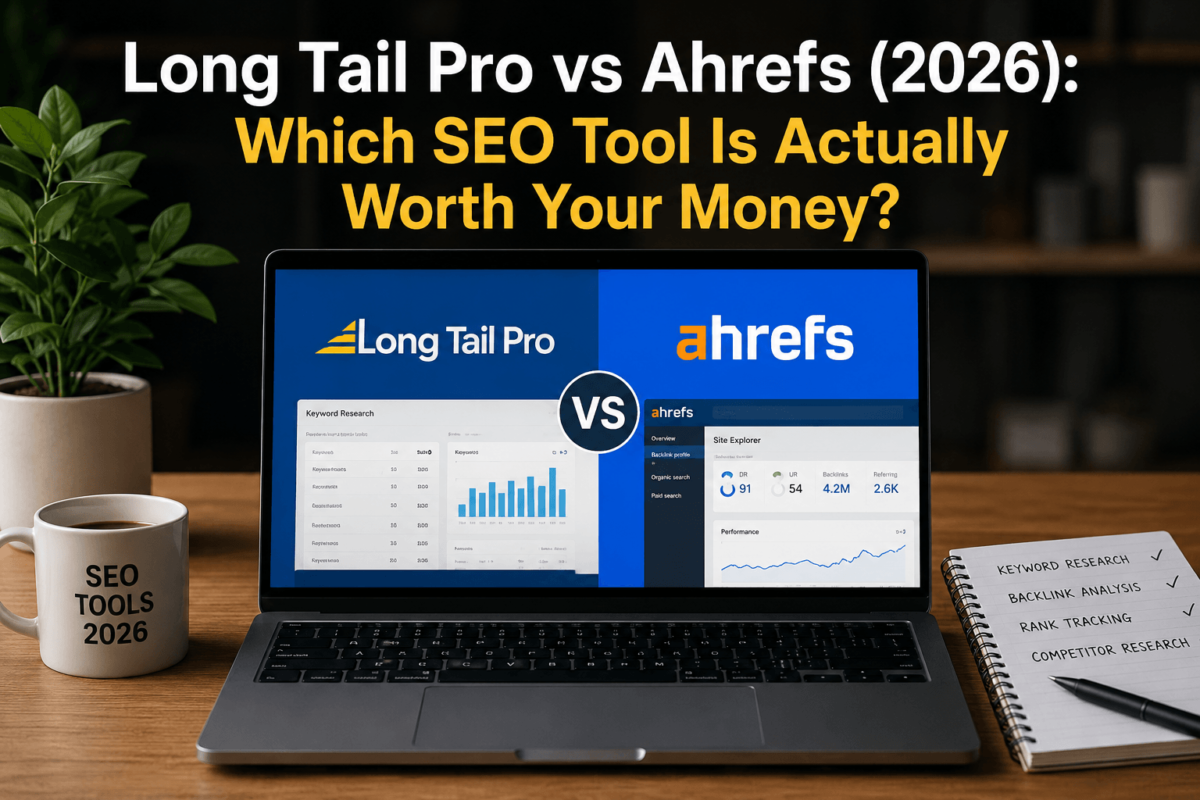
Long Tail Pro vs Ahrefs (2026): Which SEO Tool Is Actually Worth Your Money?
Quick Answer
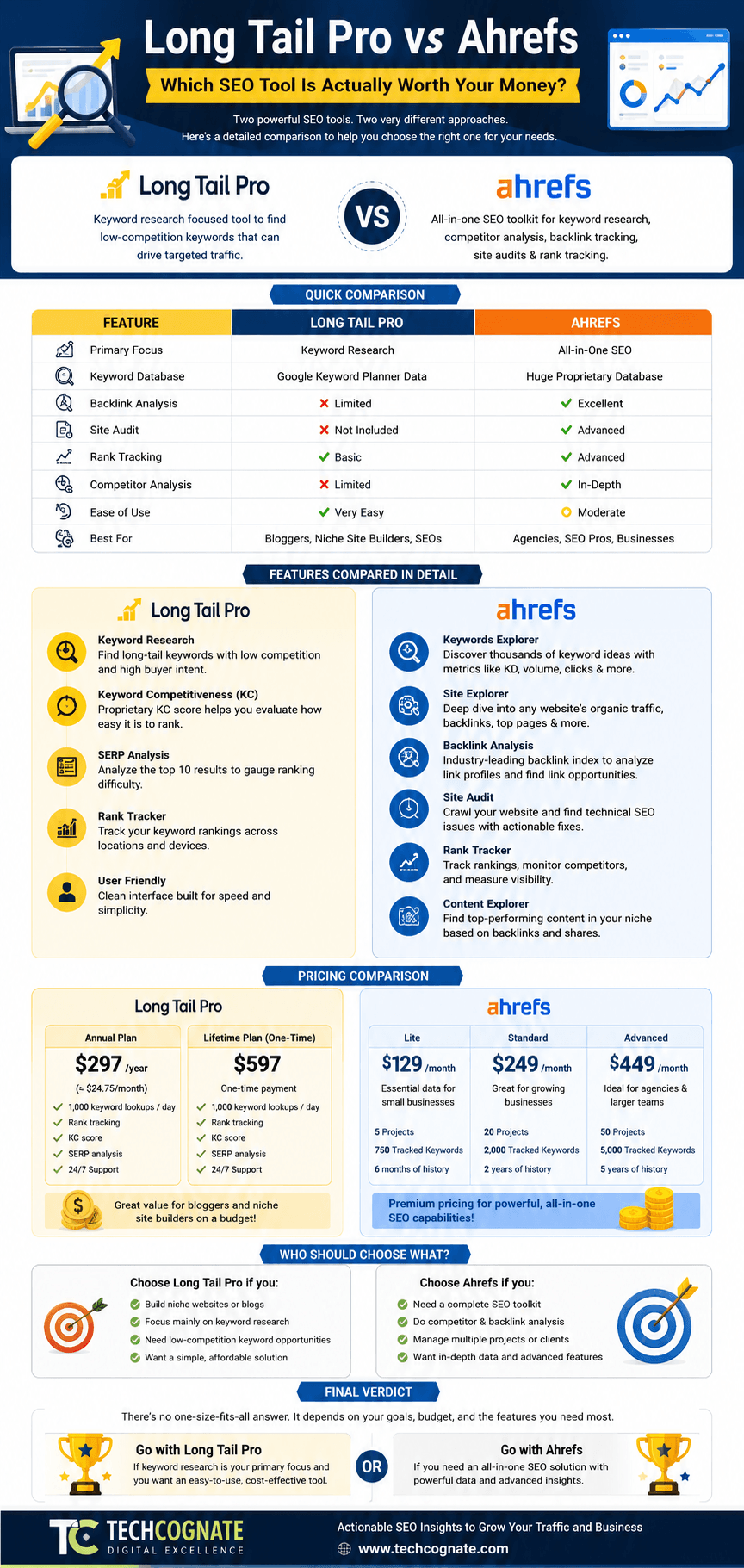
Short on time? Here’s the verdict before we get into the details. Ahrefs wins on raw data, backlink depth, and all-around capability. Long Tail Pro wins on price and simplicity for people who only need keyword research.
🏆 Best Overall: Ahrefs. It covers keyword research, backlinks, technical audits, rank tracking, and content research in one platform.
🎓 Best for Beginners: Long Tail Pro. The interface is simpler and the learning curve is shorter, though Ahrefs’ Starter plan is closing that gap.
🏢 Best for Agencies: Ahrefs. Better reporting, white-label-friendly exports, multi-project management, and a far larger data set for client work.
✍️ Best for Bloggers: Long Tail Pro for pure keyword brainstorming on a tight budget. Ahrefs Starter if you also want to track rankings and check backlinks.
💰 Best Value: Ahrefs Starter at $29/month. You get real backlink and keyword data instead of a single-purpose tool.
🔍 Best Keyword Research: Ahrefs, thanks to Clicks and Traffic Potential metrics layered on top of raw search volume. Long Tail Pro is still solid for fast long-tail brainstorming.
🔗 Best Backlink Analysis: Ahrefs, by a wide margin. Long Tail Pro’s link data is thin compared to a dedicated backlink index.
💵 Best Budget Option: Long Tail Pro’s Starter tier if backlinks and technical audits aren’t part of your workflow.
Comparison Table
Here’s the side-by-side breakdown most people are looking for. Use it as a quick reference, then read the sections below for the reasoning.
| Category | Long Tail Pro | Ahrefs |
|---|---|---|
| Overall Rating | 3.5 / 5 | 4.7 / 5 |
| Ease of Use | Simple, beginner-friendly | Moderate, more screens to learn |
| Keyword Research | Good for long-tail brainstorming | Excellent — Clicks & Traffic Potential |
| Backlink Analysis | Basic, limited index | Industry-leading, near real-time index |
| Site Audit | Basic technical checks | Deep crawler, prioritized issue lists |
| Rank Tracking | Included on all plans | Included with SERP feature tracking |
| Content Tools | Minimal | Content Explorer, AI Content Grader, briefs |
| Competitor Analysis | Domain-level overview | Granular — page and domain level |
| Local SEO | Limited | Supported via Rank Tracker locations |
| AI Search / GEO Features | None | Brand Radar, prompt tracking across AI platforms |
| Data Accuracy | Moderate, smaller index | High — frequently cited as industry benchmark |
| Database Size | Millions of keywords (smaller) | Billions of keywords, trillions of backlinks |
| Speed | Fast for its scope | Fast despite larger data sets |
| Reporting | Basic exports | Looker Studio integration, white-label exports |
| API Access | Not standard | Available on Standard tier and above |
| Integrations | Limited | Google Search Console, Analytics, Slack, Looker Studio |
| Customer Support | Email support, mixed reviews | Live chat, extensive documentation |
| Learning Curve | Low | Moderate to high for full feature set |
| Pricing — entry tier | ~$37/month | $29/month (Starter) |
| Free Trial | Limited trial windows periodically | No standard free trial; free tools for verified owners |
| Best For | Solo bloggers, niche site builders on a budget | Agencies, in-house teams, serious affiliate & SaaS SEO |
Pricing figures reflect publicly listed rates as of mid-2026. Both vendors adjust pricing periodically — confirm current rates on their official sites before purchasing.
What Is Long Tail Pro?
Long Tail Pro is a cloud-based keyword research tool built around one core idea: help you find long-tail keywords with low competition that you can actually rank for. It was created by Spencer Haws, founder of the niche site blog NichePursuits.com, who built the tool to solve his own keyword research headaches before turning it into a standalone product. It later changed ownership but is still actively sold and used today.
The tool’s signature feature is its Keyword Competitiveness (KC) score — a single number from 1 to 100 that estimates how hard a keyword will be to rank for organically. For niche site builders and affiliate marketers, that one metric became the foundation of an entire content strategy: find keywords with high search volume and a low KC score, then build content around them.
Core features: Long Tail Pro centers on keyword generation from a seed keyword (pulling up to several hundred related terms), the KC scoring system, basic SERP analysis, rank tracking, and lighter add-ons like backlink checking and a basic site audit that were bolted on over the years as the platform matured.
Where it shines is speed and simplicity. You type in a seed keyword, and within seconds you get a list of related long-tail variations along with search volume, CPC, and a competitiveness score. There’s no steep learning curve and no overwhelming dashboard full of modules you’ll never open.
Pros
Cons
Who should use it: Bloggers, niche site builders, and affiliate marketers who mainly need fast keyword ideas and don’t require deep backlink or technical audit data.
Who shouldn’t: Agencies managing multiple clients, ecommerce brands needing technical audits, or anyone who needs serious backlink intelligence for link building or competitor research.
What Is Ahrefs?
Ahrefs started as a backlink checker back in 2010 and grew into one of the most complete SEO platforms on the market. Today it bundles Site Explorer, Keywords Explorer, Site Audit, Rank Tracker, and Content Explorer into a single subscription, backed by what the company describes as the second-most active web crawler after Google’s own.
That crawler is the secret sauce. Ahrefs refreshes its backlink index roughly every 15 to 30 minutes, which is dramatically faster than most competitors that update daily or weekly. If you do any kind of link building, outreach, or competitor monitoring, that freshness matters more than it sounds like it would.
Major features: Site Explorer for backlink and traffic analysis, Keywords Explorer for search volume and difficulty data across more than 170 countries, Site Audit for technical crawls, Rank Tracker for position monitoring, Content Explorer for content and link-building research, and newer additions like Brand Radar, which tracks how often a brand or domain gets cited inside AI search answers and chatbot responses.
Ahrefs isn’t cheap, and it isn’t trying to be. The platform is built for people who treat SEO as a serious revenue channel, not a side hobby. That shows up in the pricing, the data depth, and the sheer number of reports you can pull.
Pros
Cons
Ideal users: Agencies, in-house SEO teams, SaaS and ecommerce companies, content marketing teams, and serious affiliate marketers who need backlink data, technical audits, content research, and AI search visibility in one platform.
Long Tail Pro vs Ahrefs: Feature-by-Feature Comparison
This is the meat of the comparison. We’ll go category by category so you can see exactly where each tool pulls ahead, and where the gap barely matters for your situation.
Keyword Research and Keyword Difficulty
Long Tail Pro generates keyword ideas from a seed term and scores each one with its KC (Keyword Competitiveness) metric — a single number from 1–100. It’s quick to read and easy to explain to a client or a beginner.
Ahrefs’ Keywords Explorer pulls from a much larger index covering 170+ countries, and its Keyword Difficulty (KD) score factors in the backlink profiles of ranking pages rather than a simplified competition estimate. Ahrefs also layers in Clicks and Traffic Potential, which estimate how much organic traffic a keyword could realistically send once you account for SERP features eating up clicks.
Winner: Ahrefs. The data set is bigger, the difficulty scoring accounts for more ranking factors, and Traffic Potential prevents you from chasing keywords that look good on paper but send almost no clicks. Best for: anyone doing keyword research at scale or for client work
Search Volume and SERP Analysis
Both tools show monthly search volume, but they source and model that data differently — which is why numbers for the same keyword rarely match exactly between any two SEO tools, including these two.
Ahrefs’ SERP overview shows the top-ranking pages along with their estimated traffic, referring domains, word count, and more — all without leaving the keyword report. Long Tail Pro’s SERP analysis is lighter, showing competing domains and basic authority metrics, which is enough for a quick gut check but not for deep competitive research.
Winner: Ahrefs. The SERP overview gives you a far more complete picture of why pages rank, not just that they rank. Best for: competitive research and content strategy work
Competitor Research and Content Gap Analysis
Ahrefs’ Content Gap tool shows you keywords that competing domains rank for that your site doesn’t — one of the fastest ways to build a content calendar around real opportunities. Read more about SEO competitor analysis workflows to see how this fits a broader strategy.
Long Tail Pro lets you pull keyword ideas based on a competitor’s URL, which works for basic competitor mining but doesn’t offer true gap analysis across multiple competitors at once.
Winner: Ahrefs. Multi-competitor gap analysis surfaces opportunities Long Tail Pro’s single-URL approach simply can’t see. Best for: content marketers building a competitive content calendar
Backlink Analysis and Broken Link Building
This isn’t close. Ahrefs built its reputation on backlink data, and its Site Explorer remains one of the largest and most frequently refreshed link indexes in the industry. You can filter by anchor text, link type, domain rating, and dozens of other variables.
Long Tail Pro added backlink checking as a supplementary feature, and it covers the basics — total backlinks, referring domains, and link type — but the index is noticeably smaller and updates less frequently. Broken link building, a popular outreach tactic, works far better with Ahrefs’ larger crawl footprint, since you’re more likely to actually find broken pages worth replacing.
Winner: Ahrefs. A bigger, fresher index means more accurate link audits and more outreach opportunities surfaced. Best for: link building, digital PR, and competitor backlink audits
Rank Tracking
Both tools include rank tracking on every plan, which is worth noting since some competitors charge extra for it. Long Tail Pro’s tracker is straightforward: add keywords, pick a location, and watch position changes over time.
Ahrefs’ Rank Tracker adds SERP feature tracking (featured snippets, People Also Ask, local packs), competitor position comparisons, and visibility scoring across an entire keyword list — which makes it more useful for reporting trends rather than just checking individual positions.
Winner: Ahrefs. SERP feature and visibility tracking turn rank data into a trend story, not just a list of positions. Best for: agencies reporting on ranking trends to clients
Site Audit and Technical SEO
Ahrefs’ Site Audit crawls your site and flags technical issues by priority — broken links, duplicate content, slow pages, crawlability problems, and dozens of other checks — then explains why each issue matters and how to fix it.
Long Tail Pro’s audit feature covers core checks like load speed, broken links, and basic crawlability, which is fine for a quick health check but won’t replace a dedicated technical SEO tool for larger or more complex sites.
Winner: Ahrefs. The depth and prioritization of issues makes it genuinely useful for fixing problems, not just listing them. Best for: ecommerce sites, larger blogs, and anyone doing serious technical SEO
Content Explorer and Content Tools
Ahrefs’ Content Explorer searches a database of billions of pages to find top-performing content on any topic, filterable by traffic, social shares, referring domains, and publish date. Pair it with the AI Content Grader and Content Helper, and you get real guidance on what to cover before you even start writing.
Long Tail Pro doesn’t have an equivalent. It’s built for finding keywords, not researching or grading content.
Winner: Ahrefs. It’s not really a contest here. Content Explorer fills a gap Long Tail Pro never tried to fill. Best for: content marketers and bloggers planning new articles
Local SEO and International SEO
Ahrefs supports rank tracking and keyword data across 170+ countries and allows location-specific tracking down to the city level in many markets — making it workable for local SEO and multi-region campaigns.
Long Tail Pro supports basic location targeting for rank tracking but doesn’t offer the same depth of localized keyword data or international search volume coverage.
Winner: Ahrefs. Broader country and city-level coverage makes it the safer pick for local or multi-market SEO. Best for: local businesses and brands targeting more than one country
AI Capabilities and Generative Engine Optimization (GEO)
This is one of the newer battlegrounds in SEO, and it’s not a close one yet. Ahrefs has rolled out Brand Radar, which tracks how often a brand or domain gets cited inside AI Overviews, ChatGPT, and other AI search answers across millions of tracked prompts. For anyone optimizing for generative engine optimization (GEO), that’s a genuinely useful data point you can’t get from Long Tail Pro.
Long Tail Pro currently has no AI search visibility or prompt-tracking features. Its scope is still firmly rooted in traditional keyword research.
Winner: Ahrefs. It’s the only one of the two actively building tools for the AI search era. Best for: anyone tracking visibility in ChatGPT, Perplexity, and AI Overviews
Reporting and Automation
Ahrefs connects to Google Looker Studio for custom dashboards, supports white-label-friendly exports, and includes scheduled reporting on higher tiers — which agencies rely on for client check-ins without manually pulling data every week. See how this pairs with a proper SEO reporting workflow.
Long Tail Pro’s reporting is limited to basic CSV exports. There’s no native dashboard builder or scheduled reporting automation.
Winner: Ahrefs. Looker Studio integration alone saves agencies hours of manual reporting work every month. Best for: agencies and teams reporting to clients or stakeholders regularly
Ease of Use, Learning Curve, and Dashboard
Long Tail Pro wins this one honestly. The dashboard is clean, the workflow is linear (enter a keyword, get results, save to a project), and new users are productive within minutes.
Ahrefs’ dashboard is more powerful but also more crowded. Between Site Explorer, Keywords Explorer, Site Audit, Rank Tracker, and Content Explorer, there’s a real learning curve before you’re using the platform efficiently. Ahrefs has invested heavily in tutorials and an academy to flatten that curve, but it’s still steeper than Long Tail Pro out of the box.
Winner: Long Tail Pro. Fewer features means less to learn, which matters if you just want quick answers without training time. Best for: solo bloggers and total SEO beginners
Speed and Chrome Extension
Both tools load reports quickly given how much data they’re pulling. Ahrefs’ free SEO Toolbar (Chrome extension) overlays domain rating, backlink counts, and on-page data directly on Google search results and any page you visit — which is genuinely handy for quick competitive checks while browsing.
Long Tail Pro doesn’t offer a comparable browser extension, so most research happens inside the dashboard itself.
Winner: Ahrefs. The free toolbar extends research into everyday browsing, which Long Tail Pro can’t match. Best for: anyone doing on-the-fly competitive research while browsing
Integrations and API
Ahrefs integrates with Google Search Console, Google Analytics 4, Slack, and Looker Studio, and offers API access starting on its Standard plan (with a separate usage-based API subscription also available for developers building custom data pipelines). This makes it a solid complement to any AI SEO dashboard or custom reporting stack.
Long Tail Pro offers limited native integrations and doesn’t provide a standard public API — which can be a dealbreaker if you’re building custom internal SEO tooling.
Winner: Ahrefs. More integrations and real API access make it the better fit for teams building custom workflows. Best for: developers and teams integrating SEO data into other systems
Customer Support, Knowledge Base, and Community
Ahrefs offers live chat support, a deep knowledge base, video tutorials through Ahrefs Academy, and an active user community. Response times are generally solid for a SaaS platform at this scale.
Long Tail Pro relies primarily on email support. Reviews on third-party platforms are mixed, with some users praising quick responses and others reporting slow turnaround on billing or technical issues.
Winner: Ahrefs. More support channels and more consistent reviews make it the safer bet if you expect to need help. Best for: anyone who values fast, reliable support
Mobile Experience and Data Freshness
Neither tool has a dedicated mobile app, but both work reasonably well in a mobile browser for quick checks. Where they really differ is data freshness: Ahrefs refreshes its backlink index roughly every 15 to 30 minutes, while Long Tail Pro’s data updates on a slower cycle.
Winner: Ahrefs. Near real-time data freshness matters most for active link building and competitor monitoring. Best for: anyone tracking fast-moving link or ranking changes
Scalability and Security
Ahrefs scales cleanly from a single freelancer on Starter all the way up to enterprise teams managing dozens of domains, with SSO and audit logs available at the Enterprise tier.
Long Tail Pro is built primarily for individual users and small teams managing a handful of sites. It’s not designed — and isn’t priced — for enterprise-scale deployment.
Winner: Ahrefs. It’s the only one of the two built to scale with an agency or enterprise’s growth. Best for: growing teams and agencies that expect to scale up
Keyword Research Test: Long Tail Pro vs Ahrefs Head-to-Head
Numbers in a feature table only tell you so much. So let’s run both tools through the same seed keyword and compare what comes back: “best running shoes for beginners.”
Keyword difficulty: Long Tail Pro returned a KC score in the low-to-moderate range, suggesting a realistic ranking opportunity for a newer site with a handful of supporting backlinks. Ahrefs’ KD score landed in a similar band but came with more context: the top-ranking pages had a wide range of Domain Ratings, which signals the SERP is genuinely winnable for a well-optimized page — not just numerically “easy.”
Search volume: Both tools reported similar ballpark monthly search volume for the exact-match phrase, within a normal range of variance you’d expect between any two keyword tools.
Related and long-tail keywords: Long Tail Pro generated a solid list of long-tail variations quickly — exactly what it’s built for. Ahrefs returned a larger related-terms list and grouped many of them into clusters automatically, which saved a manual step Long Tail Pro doesn’t handle.
Search intent: Ahrefs labeled the keyword’s likely intent (informational, with commercial undertones) directly in the report. Long Tail Pro doesn’t label intent automatically, so you have to infer it from the SERP yourself.
SERP analysis: Ahrefs’ SERP overview showed estimated organic traffic, word count, and referring domains for every ranking page in one screen. Long Tail Pro’s SERP view covered the basics but required more manual digging to get the same level of competitive insight.
Winner: Ahrefs. Same ballpark data, but with more context, clustering, and intent labeling baked in — which saves real research time. Best for: anyone doing keyword research more than occasionally
Backlink Database Comparison
If link building or competitor backlink audits are part of your SEO workflow, this section matters more than almost anything else in this guide.
Index size: Ahrefs maintains one of the largest backlink indexes in the industry, built on a crawler the company describes as the second-most active after Google’s. Long Tail Pro’s backlink data is supplementary to its core keyword tool and covers a noticeably smaller index.
Freshness: Ahrefs refreshes backlink data roughly every 15 to 30 minutes. Long Tail Pro updates on a slower cycle, which means newly acquired or lost links may not show up for some time.
Accuracy: Both tools can undercount links compared to Google Search Console for your own verified domains, which is normal across every third-party SEO tool. Ahrefs’ larger crawl footprint generally gets closer to a complete picture.
Speed: Ahrefs returns backlink reports for even high-authority domains quickly despite the size of its index.
Filtering: Ahrefs lets you filter by link type (dofollow/nofollow), anchor text, language, platform, and more. Long Tail Pro’s filtering options are more limited.
Historical data: Ahrefs retains historical backlink and ranking data going back years on higher tiers, which is valuable for tracking link velocity over time. Long Tail Pro’s historical depth is shallower.
Winner: Ahrefs. A larger, fresher, more filterable index wins for any serious link building or competitive backlink work. Best for: link builders, digital PR teams, and competitor researchers
Accuracy Comparison: Whose Numbers Should You Trust?
Here’s something every SEO eventually learns: no two tools will ever show identical numbers for the same keyword or domain — and that’s not necessarily a sign either tool is wrong.
Search volume: Both tools estimate volume from clickstream and search data, but the underlying data sources and modeling methods differ, which produces different numbers for the same term. Treat both as directional estimates, not gospel.
Keyword difficulty: Ahrefs’ KD score factors in the backlink profiles of ranking pages, while Long Tail Pro’s KC score uses a more simplified competition model. Ahrefs’ approach tends to better reflect real-world ranking difficulty, especially in competitive niches. Our guide on keyword difficulty explains how to interpret these scores across different tools.
Traffic estimates: Ahrefs’ Traffic Potential metric accounts for the fact that a single page often ranks for hundreds of related keywords, giving a more realistic picture of total traffic opportunity than raw search volume alone. Long Tail Pro doesn’t offer an equivalent metric.
Backlinks and referring domains: Ahrefs’ larger, fresher index generally produces counts closer to what you’d see in Google Search Console for your own site, though some gap is normal with every tool.
Rank tracking: Both tools pull live or near-live SERP positions, so accuracy here depends more on tracking frequency and location settings than on the underlying database.
Why the numbers differ comes down to three things: crawl frequency, index size, and the statistical models each company uses to estimate metrics like volume and difficulty. Bigger, more frequently refreshed indexes (Ahrefs) tend to produce more stable, defensible numbers — especially for competitive or fast-moving niches.
Winner: Ahrefs. A larger, fresher data set and more sophisticated metrics like Traffic Potential generally produce more reliable numbers. Best for: anyone making budget or strategy decisions based on keyword data
Pricing Comparison: Long Tail Pro vs Ahrefs
Let’s talk numbers — because price is usually what tips the decision once the feature gap is clear in your head.
| Plan | Long Tail Pro | Ahrefs |
|---|---|---|
| Entry tier | Starter, around $37/month | Starter, $29/month |
| Mid tier | Pro, around $67/month | Lite, $129/month ($108/mo annual) |
| Upper tier | Agency, around $147/month | Standard, $249/month ($208/mo annual) |
| Top self-serve tier | Not offered | Advanced, $449/month ($374/mo annual) |
| Enterprise | Not offered | Custom quote, typically starting ~$1,200–1,500/month |
| Annual discount | Roughly 20% off monthly rate | Roughly 17–20% off monthly rate |
| Free trial | Limited-time trials offered periodically | No standard free trial |
| Free tier | Not available | Ahrefs Free / Webmaster Tools for verified site owners |
| Refund policy | Varies — check current terms before purchasing | Generally no refunds once the service has been used |
A quick note on these figures: both companies adjust pricing, plan names, and promotions periodically. Always confirm current pricing on each company’s official site before you buy.
Hidden costs: Ahrefs uses a credit and row-limit system on every tier. Heavy users can hit overage charges for extra crawl credits, report rows, or API usage if they exceed their plan’s monthly allowance. Long Tail Pro’s pricing is more predictable since it doesn’t run on the same credit-metering model — but you’ll hit a wall faster if you need backlink or technical audit depth it simply doesn’t offer.
Refund policy: Ahrefs generally doesn’t issue refunds once a subscription has seen meaningful use. Long Tail Pro’s refund terms have varied over time and across promotions, so read the fine print on whatever offer you’re considering.
Free trial: Neither tool offers a standard no-strings 30-day free trial right now. Ahrefs’ free option is limited to verified site owners checking their own domain. Long Tail Pro has run limited-time trial promotions periodically — worth checking their current offer.
Value for money: If you only need keyword ideas, Long Tail Pro’s entry tier is cheaper and gets you there faster. But Ahrefs Starter, at $29/month, undercuts Long Tail Pro’s Starter plan on price while delivering backlink data, a real keyword index, and a basic site audit — which is a stronger value proposition for most people in 2026.
ROI: For a single niche site, either tool can pay for itself with one well-ranked, monetized post. For agencies billing multiple clients, Ahrefs’ deeper data and reporting tools justify the higher price tag through time saved and stronger client results.
💰 Best Value: Ahrefs Starter at $29/month. It’s cheaper than Long Tail Pro’s entry tier and includes far more than keyword research alone.
Ease of Use
We touched on this in the feature comparison, but it deserves its own section since it’s often the deciding factor for beginners.
Setup: Both tools get you to your first keyword report within a couple of minutes of signing up. Neither requires technical setup beyond entering a domain or seed keyword.
Learning curve: Long Tail Pro’s single-purpose design means there’s genuinely less to learn. Ahrefs takes longer to feel fluent in simply because there’s more surface area — five major modules instead of one.
Dashboard and navigation: Long Tail Pro’s dashboard is linear and uncluttered. Ahrefs’ dashboard is denser, with more tabs, filters, and metrics visible at once — which power users appreciate and beginners sometimes find overwhelming at first.
Reports: Ahrefs’ reports are more customizable, letting you choose which metrics to display and export. Long Tail Pro’s reports are simpler and faster to generate, with less customization.
Training resources: Ahrefs Academy offers structured video courses covering everything from beginner keyword research to advanced technical SEO — all free with a subscription. Long Tail Pro offers some guided tutorials but nothing as extensive as Ahrefs’ training library.
Winner: Long Tail Pro. Less to learn means faster time-to-value if your needs are simple. Best for: true beginners who want to start finding keywords today, not next week
Performance
Speed: Both platforms return keyword reports in a few seconds. Ahrefs holds up well even when pulling reports on massive sites with millions of backlinks — a genuine engineering feat given the size of its index.
Crawling: Ahrefs’ Site Audit crawler handles large sites efficiently, with crawl speed and frequency scaling by plan tier. Long Tail Pro’s crawler is adequate for smaller sites but isn’t built for large-scale technical audits.
Exports: Both tools export to CSV. Ahrefs adds more export flexibility through its Looker Studio connector, useful for building live dashboards instead of static spreadsheets.
Data refresh: Ahrefs refreshes backlink data every 15–30 minutes and keyword data on a regular ongoing cycle. Long Tail Pro’s refresh cycle is slower across the board.
Cloud performance and reliability: Both are cloud-based SaaS platforms with generally solid uptime. Ahrefs, given its scale and enterprise client base, has more redundancy built into its infrastructure.
Winner: Ahrefs. Faster data refresh and infrastructure built to handle enterprise-scale crawling. Best for: larger sites and teams running frequent audits
Customer Support
Live chat: Ahrefs offers live chat support to paying subscribers. Long Tail Pro does not offer live chat as a standard support channel.
Email: Both tools offer email support. Response times for Long Tail Pro vary based on third-party reviews, with some users reporting fast resolutions and others reporting delays — particularly around billing issues.
Documentation: Ahrefs maintains an extensive, searchable knowledge base covering every feature in depth. Long Tail Pro’s documentation is lighter but covers the core workflow adequately.
Video tutorials: Ahrefs Academy offers a full library of structured video courses. Long Tail Pro offers some how-to videos but nothing as comprehensive.
Community: Ahrefs has an active user base and a strong presence in SEO communities and forums — meaning you can often find answers from other users, not just official support. Long Tail Pro has a smaller, quieter community footprint.
Response time: Ahrefs’ live chat typically gets you a response within minutes during business hours. Long Tail Pro’s email-only support generally takes longer, and reviews suggest response time can be inconsistent.
Winner: Ahrefs. More support channels and a larger community make it easier to get unstuck quickly. Best for: anyone who wants reliable support if something goes wrong
Pros and Cons
| Long Tail Pro | |
|---|---|
| Pros | Cons |
| ✓Simple, beginner-friendly interface with almost no learning curve | ✗Smaller backlink and keyword index |
| ✓Fast long-tail keyword generation from a single seed term | ✗Basic site audit and technical SEO tools |
| ✓Lower entry-tier price | ✗No content research or topic clustering |
| ✓Rank tracking included on all plans | ✗Mixed customer support reviews |
| ✓Easy-to-read KC difficulty score | ✗No API or major third-party integrations |
| Ahrefs | |
|---|---|
| Pros | Cons |
| ✓Massive, frequently refreshed data index | ✗Pricing climbs quickly past the entry tier |
| ✓Best-in-class Site Audit and Site Explorer | ✗No standard free trial |
| ✓Content Explorer and AI Content Grader | ✗Steeper learning curve at first |
| ✓Strong reporting with Looker Studio support | ✗API access requires a higher-tier plan |
| ✓Growing AI search visibility tools (Brand Radar) | ✗Credit-based limits can cause overage costs |
Who Should Buy Long Tail Pro?
Ideal users: Bloggers and niche site builders who mostly need fast keyword ideas, freelancers on a tight tool budget, and SEO beginners who want a gentle introduction to long-tail keyword research without a steep learning curve.
Not recommended for
Who Should Buy Ahrefs?
Ideal users: Agencies, in-house SEO teams, SaaS and ecommerce companies, content marketing teams, and serious affiliate marketers who need backlink data, technical audits, content research, and AI search visibility in one platform.
Not recommended for
Best Use Cases
Different workflows have different needs. Here’s how each tool fits the most common SEO use cases.
Blogging: Long Tail Pro works well for solo bloggers focused purely on keyword brainstorming. Ahrefs is better once you start tracking rankings and building backlinks seriously.
Affiliate marketing: Long Tail Pro’s KC score is genuinely useful for fast niche site validation. Ahrefs’ Traffic Potential and Content Gap tools help scale a site once it’s past the validation stage.
Local SEO: Ahrefs’ location-level rank tracking and broader keyword coverage make it the stronger choice for local businesses competing in specific cities or regions.
Enterprise SEO: Ahrefs Advanced or Enterprise — full stop. Long Tail Pro isn’t built for enterprise-scale SEO.
Agencies: Ahrefs’ reporting, multi-project management, and data depth make it the practical choice for managing multiple client accounts.
Freelancers: This depends on services offered. Freelancers doing pure content writing can get by with Long Tail Pro. Freelancers offering technical audits or link building need Ahrefs.
Ecommerce: Ahrefs’ Site Audit and Content Gap tools help ecommerce sites fix technical issues and find product or category page opportunities competitors are capturing.
YouTube SEO: Neither tool specializes in YouTube keyword research specifically, though Ahrefs’ Keywords Explorer does include a YouTube search volume filter that Long Tail Pro lacks.
Amazon SEO: Neither tool is built for Amazon-specific keyword research. Both are better suited to Google organic search.
SaaS companies: Ahrefs’ Content Explorer and Content Gap tools are well suited to the content-heavy SEO strategies most SaaS companies run.
Startups: Budget-conscious startups validating an idea can start with Long Tail Pro or Ahrefs Starter. Once content and link building ramp up, Ahrefs becomes the better long-term fit.
Real-World Scenarios: Which Tool Fits Your Situation?
Sometimes it’s easier to see yourself in a scenario than to read another feature list. Here are six common situations and the tool that fits each one.
| Your Situation | Recommended Tool | Why |
|---|---|---|
| “I have a brand-new affiliate website.” | Long Tail Pro | You need fast, low-competition keyword ideas on a tight budget before you’ve proven the niche works. |
| “I run an SEO agency with 8 clients.” | Ahrefs | You need multi-project management, white-label-friendly reporting, and data depth across very different niches. |
| “I run a small local business website.” | Ahrefs | Location-level rank tracking and broader keyword coverage matter more than they would for a single-niche blog. |
| “I’m a solo content creator writing one blog.” | Long Tail Pro (or Ahrefs Starter) | Either works, but Long Tail Pro’s simplicity is appealing if keyword research is genuinely your only need. |
| “I’m an independent SEO consultant.” | Ahrefs | Clients expect technical audits, backlink data, and professional reporting — all things Long Tail Pro can’t fully deliver. |
| “I manage a large ecommerce brand’s SEO.” | Ahrefs | Technical audits at scale, Content Gap analysis, and backlink monitoring are essential at this size, and Long Tail Pro isn’t built for it. |
Where These Tools Fit Your Stack
Neither tool exists in a vacuum. Here’s how Long Tail Pro and Ahrefs typically fit alongside the other platforms you’re probably already using.
Google Search Console and Google Analytics 4: Ahrefs integrates directly with both, pulling your real click and impression data into its reports for comparison against its own estimates. Long Tail Pro doesn’t offer this kind of native integration, so you’ll be checking Search Console separately.
WordPress and Shopify: Both tools work fine alongside any CMS or ecommerce platform since they research keywords independently of where you publish. Once you’ve found your target keywords, you’re back to optimizing pages in WordPress or Shopify.
Bing Webmaster Tools: Ahrefs’ keyword and SERP data is primarily Google-focused, same as Long Tail Pro. If Bing traffic matters to your business, Bing Webmaster Tools remains a useful free companion to either tool.
YouTube and Amazon: Ahrefs’ Keywords Explorer includes a YouTube search volume filter, giving it a slight edge if video SEO is part of your strategy. Neither tool is built for Amazon’s internal search algorithm, so a dedicated Amazon keyword tool is still worth using for product listings.
Screaming Frog and dedicated technical crawlers: Agencies running deep technical audits on large or complex sites often pair Ahrefs’ Site Audit with Screaming Frog for an extra layer of crawl detail. Learn more about our full technical SEO checklist to see how these tools work together.
Surfer SEO and Clearscope: If on-page content scoring and optimization matter to your workflow, both of these pair naturally with Ahrefs’ keyword and Content Explorer data to build complete content briefs.
Customer Reviews Summary
Beyond hands-on testing, it’s worth looking at what real users say across review platforms like G2, Capterra, and Trustpilot. Here are the recurring themes for each tool.
Long Tail Pro: Common Themes
Ease of use: Reviewers consistently mention how quick and approachable the tool is, especially for finding long-tail keyword variations fast.
Data quality: Some users appreciate the focus on long-tail, low-competition terms, while others note the data feels thinner compared to larger platforms.
Pricing: Generally seen as reasonable for what it offers, though a few reviewers feel the value gap has narrowed as competitors added more features at similar price points.
Customer support: This is the most polarizing theme. Some reviewers report fine experiences, while others — including a notable cluster of complaints on Trustpilot — describe frustration with billing issues, account holds, and slow support responses. Worth weighing seriously before subscribing.
Feature depth and learning curve: Reviewers like that there’s little to learn, but several also note they eventually needed a second tool for backlinks or technical audits.
Ahrefs: Common Themes
Ease of use: Mixed but generally positive once past the initial learning curve. New users often mention feeling overwhelmed at first, then satisfied once they find their workflow.
Data quality: Consistently praised as one of the most trusted data sets in the industry, particularly for backlinks.
Pricing: The most common complaint. Reviewers frequently note that costs add up quickly with extra seats, projects, or credit overages.
Customer support: Generally well-reviewed, with live chat cited as a strong point compared to email-only competitors.
Feature depth: Reviewers consistently highlight the breadth of tools as the main reason they stick with Ahrefs despite the price.
Long Tail Pro Alternatives
If Long Tail Pro doesn’t quite fit, here’s when each major alternative makes more sense.
Semrush: Choose Semrush if you want an all-in-one platform that also covers PPC research and social media tools alongside SEO — something neither Long Tail Pro nor a single-purpose tool offers.
SE Ranking: A strong middle-ground pick if you want white-label reporting and AI search visibility tracking at a lower price point than Ahrefs, while still getting more depth than Long Tail Pro.
Mangools (KWFinder): Choose Mangools if you love Long Tail Pro’s simplicity but want a more polished interface and a slightly larger keyword database at a similar price.
Moz Pro: A solid choice if Domain Authority — an industry-recognized metric — matters specifically to your reporting or client communication.
Ubersuggest: The better pick for absolute beginners on the tightest possible budget, including a usable free tier.
Serpstat: Choose Serpstat if you want generous project limits and broader feature coverage (including some PPC data) without paying Ahrefs-level prices.
KeywordTool.io: A good fit if you specifically need keyword data pulled from YouTube, Amazon, Bing, or App Store search instead of just Google.
SpyFu: Choose SpyFu if competitor PPC and ad history research matters as much to you as organic keyword research.
LowFruits: A close cousin to Long Tail Pro philosophically. Choose LowFruits if you specifically want a tool built around finding weak, beatable SERPs for low-authority sites.
KWFinder: Now part of the Mangools suite. Choose it for the same reasons as Mangools above — a clean interface paired with reliable keyword and SERP data.
Ahrefs Alternatives
Ahrefs is powerful, but it’s not the only serious option. Here’s when each alternative is worth considering instead.
Semrush: Choose Semrush over Ahrefs if PPC research, social media tools, and a broader marketing toolkit matter as much to you as organic SEO data.
SE Ranking: The strongest budget alternative for teams that want white-label reporting and AI search tracking without paying Ahrefs’ premium pricing.
Mangools: Choose Mangools if you want a simpler, friendlier interface and don’t need Ahrefs’ full enterprise-level data depth.
Moz Pro: A reasonable choice if your team or clients are already anchored to Domain Authority as a reporting metric.
Ubersuggest: The better pick for solo creators and small businesses who need core SEO data without an enterprise price tag.
SpyFu: Choose SpyFu specifically for deep competitor PPC and ad spend research that Ahrefs doesn’t focus on as heavily.
Serpstat: A capable, more affordable all-in-one alternative for teams that don’t need Ahrefs’ absolute top-tier data depth.
Majestic: If backlink analysis is your only need and you want a second opinion, Majestic remains a respected specialist tool.
Screaming Frog: Pair this with Ahrefs’ Site Audit for deep, customizable technical crawls — especially on larger or more complex sites.
Surfer SEO and Clearscope: If on-page content optimization and scoring matter more to you than backlink or technical data, these specialized content tools can complement or substitute for Ahrefs’ content features.
Frequently Asked Questions
Quick, direct answers to the questions people ask most often about Long Tail Pro and Ahrefs.
Is Ahrefs worth the price in 2026?
For agencies, in-house teams, and serious affiliate marketers, yes. The data depth and feature set justify the cost. For a hobbyist with one small blog, the Starter plan at $29/month is still a reasonable entry point, but the higher tiers may be overkill.
Does Long Tail Pro still work in 2026?
Yes, Long Tail Pro remains an active, purchasable tool. It changed ownership over the years but continues to operate and update its core keyword research features.
Which tool is more accurate — Long Tail Pro or Ahrefs?
Ahrefs is generally considered more accurate, largely because of its larger, more frequently refreshed data index and more sophisticated difficulty and traffic modeling.
Can beginners use Ahrefs?
Yes, though expect a short learning curve. Ahrefs Academy offers free training to help new users get comfortable with the platform’s full feature set.
Which tool is better for blogging?
Long Tail Pro is simpler for pure keyword brainstorming on a budget. Ahrefs is better once you also want to track rankings, audit your site, and analyze backlinks.
Which tool is better for affiliate marketing?
Long Tail Pro’s KC score is a fast way to validate niche site ideas early. Ahrefs becomes more valuable once you’re scaling content and building backlinks.
Can Long Tail Pro replace Ahrefs?
Only if your needs are limited to basic keyword research. Long Tail Pro can’t replace Ahrefs for backlink analysis, technical audits, or content research.
Does Ahrefs have a free version?
Ahrefs offers a free plan (Ahrefs Free / Webmaster Tools) for verified site owners, covering limited Site Explorer and Site Audit access for your own domain only. It doesn’t include competitor research.
Can both tools track keyword rankings?
Yes — both Long Tail Pro and Ahrefs include rank tracking on all their plans.
Which tool has better keyword research overall?
Ahrefs, primarily because of its larger index, Clicks and Traffic Potential metrics, and automatic keyword clustering.
Is Long Tail Pro good for SEO agencies?
Generally no. Agencies typically need multi-project management, deeper reporting, and backlink data that Long Tail Pro doesn’t fully provide.
What is the Keyword Competitiveness (KC) score in Long Tail Pro?
It’s a single score from 1–100 estimating how difficult a keyword will be to rank for organically, based on competing pages’ authority signals.
What is Ahrefs’ Domain Rating (DR)?
Domain Rating is Ahrefs’ proprietary 0–100 metric estimating the overall backlink strength of a domain compared to others in its index. It’s similar in concept to Moz’s Domain Authority but calculated differently.
Does Ahrefs offer a free trial?
Not a standard free trial as of 2026. New users can test the platform through the free Ahrefs Free plan for verified sites or by starting with the lower-cost Starter plan.
Is Long Tail Pro cheaper than Ahrefs?
Long Tail Pro’s entry tier is typically priced higher than Ahrefs’ $29/month Starter plan, though Long Tail Pro’s mid and upper tiers can come in below Ahrefs’ equivalent plans depending on current pricing.
Which tool is better for local SEO?
Ahrefs, thanks to broader country and city-level rank tracking coverage. Our local SEO strategies guide covers how to use these features effectively.
Can I use Long Tail Pro and Ahrefs together?
Yes, and some users do exactly that — using Long Tail Pro for fast keyword brainstorming and Ahrefs for backlinks, audits, and deeper research. Just be sure the combined cost still makes sense for your budget.
Does Ahrefs track AI search visibility like ChatGPT or AI Overviews?
Yes, through its Brand Radar feature, which tracks brand and domain citations across AI-generated answers. Long Tail Pro doesn’t offer an equivalent feature.
Is Ahrefs good for small businesses?
Yes, particularly the Starter and Lite tiers, which cover core keyword research, backlink checking, and basic site audits at a manageable price.
What is keyword difficulty and why do tools score it differently?
Keyword difficulty estimates how hard it is to rank on page one for a given term. Tools score it differently because they use different data sources, index sizes, and weighting for factors like backlinks and content quality.
Does Long Tail Pro include a Chrome extension?
No, Long Tail Pro doesn’t offer a dedicated browser extension. Research happens within its web dashboard.
Which tool is easier to learn?
Long Tail Pro, by a clear margin. Its single-purpose design means there’s simply less to learn compared to Ahrefs’ five major modules.
Is Ahrefs better than Semrush?
Both are strong, full-featured platforms. Ahrefs is generally considered stronger for backlink data; Semrush is often preferred for its broader marketing toolkit including PPC. The better fit depends on your specific workflow.
How often does Ahrefs update its backlink data?
Roughly every 15 to 30 minutes for actively crawled pages — notably faster than most competing tools that refresh daily or weekly.
Can Long Tail Pro do technical SEO audits?
It offers basic checks like load speed and broken links, but it’s not a substitute for a dedicated technical audit tool like Ahrefs Site Audit or Screaming Frog for larger or more complex sites.
Does either tool offer a money-back guarantee?
Ahrefs generally doesn’t issue refunds once a subscription shows usage. Long Tail Pro’s refund terms have varied across promotions and plans, so always check the current policy before purchasing.
Final Verdict: Long Tail Pro vs Ahrefs
There’s no universal winner here — and honestly, be skeptical of any guide that tells you otherwise. The right tool depends entirely on what you’re trying to accomplish and what you’re willing to pay for it.
Choose Long Tail Pro if: you’re a beginner or solo blogger who mainly needs fast, low-competition keyword ideas, you’re working with a tight budget, and you don’t need backlink analysis, technical audits, or content research.
Choose Ahrefs if: you need a complete SEO platform covering keyword research, backlinks, technical audits, content research, and AI search visibility — and you’re managing client work, an agency, or a site where SEO is a real revenue driver.
Choose another tool if: you need PPC and social media research alongside SEO (Semrush), you want white-label reporting at a lower price (SE Ranking), or you’re a total beginner who wants a free tier with no financial commitment (Ubersuggest).
My honest, practical recommendation: if you’re brand new to SEO and not yet earning revenue from your site, start with Long Tail Pro or Ahrefs Starter to keep costs low while you learn. The moment you start treating SEO as a real channel — whether that’s for client work, an affiliate business, or a growing brand — Ahrefs becomes the tool that scales with you. It costs more, but it replaces two or three single-purpose tools, and that math works out in its favor for almost anyone doing this seriously.