Semrush vs Moz: Which SEO Tool Is Better in 2026?
A hands-on comparison of keyword research, backlinks, site audits, rank tracking, reporting, and pricing
By Jaykishan Panchal
⚡ Quick Answer Semrush is the broader, more powerful, and more expensive platform, built for agencies, in-house teams, and anyone running PPC, content, and competitor research alongside SEO. Moz is the simpler, friendlier, and more affordable platform, built for solo marketers, small businesses, and people who want core SEO tools without a 40-tool learning curve.
|
If you’ve spent any time at all researching SEO software, you already know the drill. Every comparison article promises an honest answer, then spends three thousand words hedging before telling you to “try both and see what fits.” That’s not particularly useful when you’re staring at a $250-a-month invoice and trying to decide if it’s worth it.
Semrush and Moz are two of the longest-running names in SEO software, and both have earned loyal followings for good reason. They’re not the same tool wearing different branding, though. Semrush built itself into a sprawling marketing suite that happens to include SEO. Moz stayed closer to its roots: an SEO-first platform built around keyword research, link data, and the Domain Authority metric that an entire generation of SEOs grew up citing in client reports.
This guide walks through both platforms across the tasks that actually matter day to day: keyword research, competitor analysis, backlink auditing, site audits, rank tracking, content tools, reporting, and pricing. Instead of declaring one tool the universal winner, the goal is to match each platform to the type of user it actually serves well, because the freelance blogger, the in-house ecommerce marketer, and the multi-client agency are not shopping for the same thing.
By the end, you should know exactly which tool fits your situation, what each one will actually cost you once add-ons are factored in, and where each platform’s data falls short. Let’s get into it.
Quick Verdict: Semrush vs Moz at a Glance
In short: Semrush is the broader, more powerful, and more expensive platform, built for agencies, in-house teams, and anyone running PPC, content, and competitor research alongside SEO. Moz is the simpler, friendlier, and more affordable platform, built for solo marketers, small businesses, and people who want core SEO tools without a 40-tool learning curve.
🏆 Bottom Line Choose Semrush if you need an all-in-one marketing platform with deep competitor data, PPC research, and content tools, and you have the budget to support it. Choose Moz if you want straightforward keyword research, link data, and site audits without paying for features you’ll never open. |
Who Should Choose Semrush?
| • | Agencies managing multiple client accounts that need white-label reporting and deep competitor intelligence |
| • | In-house marketing teams running SEO, PPC, content, and social from one dashboard |
| • | Affiliate marketers and content sites that lean on the Content Marketing Toolkit and historical data |
| • | Ecommerce brands that need to track large keyword sets across multiple markets |
Who Should Choose Moz?
| • | Solo consultants, freelancers, and small business owners who want core SEO tools without enterprise pricing |
| • | Beginners who find Semrush’s interface overwhelming and want a gentler learning curve |
| • | Teams that already report on Domain Authority and don’t want to retrain stakeholders on a new metric |
| • | Anyone who mainly needs keyword research, link data, and a clean site audit, not a full marketing suite |
Who Should Avoid Each?
| • | Avoid Semrush if: you’re a solo blogger or just starting out. The Pro plan alone runs about $140 a month, and the features that make Semrush worth the premium, like the Content Marketing Toolkit and historical data, sit behind the pricier Guru tier. |
| • | Avoid Moz if: you need PPC research, deep backlink data at scale, or you’re running an agency with more than a handful of client sites. Moz’s keyword and backlink databases are smaller than Semrush’s, and several SEO professionals report its data lagging behind on freshness. |
Best Overall, Best Budget, Best Agency, Best Beginner, Best Enterprise
| Category | Winner | Why |
|---|---|---|
| Best Overall | Semrush | Broadest toolset across SEO, PPC, content, and competitor research |
| Best Budget Choice | Moz | Starter plan costs a fraction of Semrush’s entry tier |
| Best Agency Choice | Semrush | White-label reporting, API access, and Share of Voice tracking at the Business tier |
| Best Beginner Tool | Moz | Simpler interface and a gentler learning curve |
| Best Enterprise Tool | Semrush | Custom enterprise plans, deeper data, and broader integrations |
Semrush vs Moz: Full Comparison Table
Here’s the side-by-side breakdown before we dig into each category in detail.
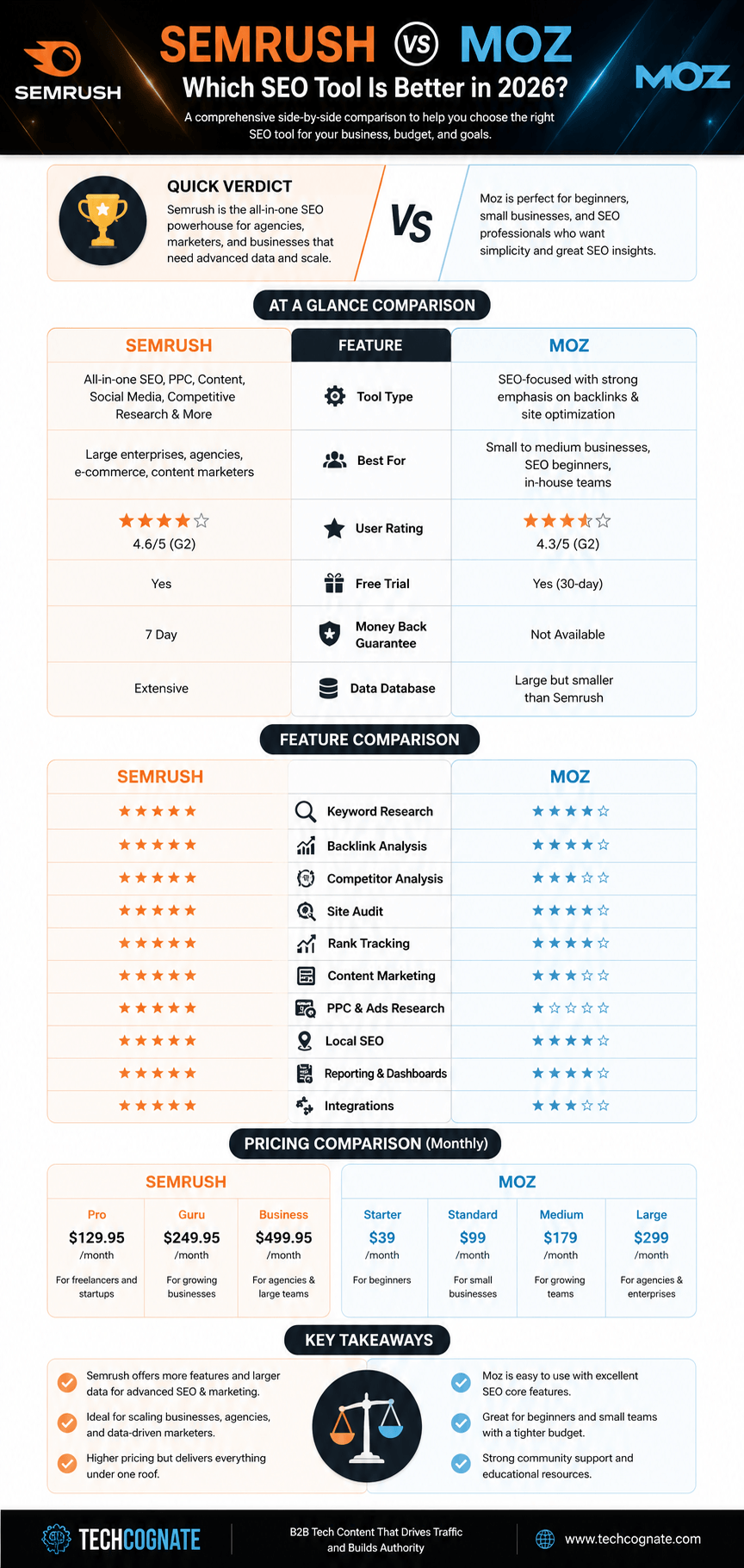
| Feature | Semrush | Moz |
|---|---|---|
| Overall Rating | Strong across nearly every category | Solid for core SEO, narrower scope |
| Ease of Use | Steeper learning curve, dense interface | Cleaner, more beginner-friendly |
| Keyword Database | Larger, broader international coverage | Smaller but accurate for core markets |
| Backlink Database | Larger index, frequent crawling | Smaller index, slower refresh reported by users |
| Rank Tracking | Daily updates, desktop and mobile | Daily updates, desktop and mobile |
| Site Audit | Deep technical checks, Core Web Vitals | Solid technical checks, fewer advanced diagnostics |
| Technical SEO | Extensive crawl diagnostics | Covers fundamentals well |
| Local SEO | Add-on toolkit, priced per location | Moz Local, a separate product |
| AI Features | AI Visibility Toolkit, AI Article Generator | AI Overviews tracking, Brand Authority Score |
| Content Marketing | Full Content Marketing Toolkit (Guru+) | Limited; not a core focus |
| Competitor Analysis | Deep gap analysis, Market Explorer | Basic competitor comparison in Keyword Explorer |
| PPC Tools | Extensive PPC and ad research | Not a focus area |
| Reporting | White-label, Looker Studio integration | Branded reports, simpler templates |
| API | Business plan only | Available even on lower tiers, low-cost add-on |
| Pricing | From about $140/month (Pro) | From about $49/month (Starter) |
| Free Trial | 7 days, card required | 7 to 30 days depending on plan |
| Customer Support | Live chat, extensive help docs | Responsive support, strong educational content |
| Learning Curve | Moderate to steep | Gentle |
| Best For | Agencies, in-house teams, content-heavy sites | Solo consultants, small businesses, beginners |
| Overall Winner | Winner for power and breadth | Winner for simplicity and value |
Why Trust This Comparison?
Most Semrush vs Moz articles are built the same way: pull the feature list off each pricing page, restate it in a table, and call it a review. That approach tells you what’s technically included in a plan. It doesn’t tell you what it’s actually like to use the tool on a Tuesday afternoon when you’ve got a client audit due and a content calendar to fill.
This comparison is built around real SEO workflows: researching keywords for a new content cluster, running a technical audit on a client site, pulling competitor gap reports, checking which backlinks are worth chasing, and tracking how rankings move week over week. Pricing, plan limits, and feature sets shift constantly on both platforms, so every figure here reflects current published pricing as of 2026, cross-checked against multiple sources, with a clear note wherever a number is likely to change soon (Semrush’s pending Adobe acquisition, for one).
No tool gets a free pass here. Semrush’s per-seat pricing and add-on sprawl get called out. Moz’s smaller backlink index and reported data freshness gaps get called out too. The goal is a comparison you can actually act on, not a marketing recap.
Meet the Contenders
What Is Semrush?
Semrush launched in 2008 as a keyword research and competitive analysis tool and has since grown into one of the largest all-in-one marketing platforms on the market, serving SEO, PPC, content marketing, social media, and market research from a single login. In a notable shift for the platform, Adobe announced its planned acquisition of Semrush in late 2025 for roughly $1.9 billion, with the deal expected to close sometime in 2026. That’s worth knowing if you’re signing an annual contract, since acquisitions by larger companies often bring pricing and product changes down the line.
History
Founded in 2008, Semrush started as a backlink and keyword research tool for SEO professionals before expanding into a full marketing suite over the following decade. It’s publicly traded and reports tens of millions of users worldwide.
Features
| • | Keyword Magic Tool with one of the larger keyword databases on the market |
| • | Site Audit with deep technical and Core Web Vitals diagnostics |
| • | Backlink Analytics and Backlink Audit for toxic link detection |
| • | Position Tracking with daily desktop and mobile rank updates |
| • | Content Marketing Toolkit, including an AI Article Generator and Content Optimizer (Guru tier and above) |
| • | Advertising Toolkit for PPC and PLA research |
| • | Market Explorer and competitor gap analysis tools |
| • | AI Visibility Toolkit for tracking brand mentions across AI search platforms |
Who It’s For
Agencies, in-house marketing teams, content-heavy publishers, ecommerce brands, and anyone who wants SEO, PPC, and content research under one roof rather than stitching together multiple tools.
Strengths
| • | Larger keyword and backlink databases than most competitors |
| • | Genuinely all-in-one: SEO, PPC, content, and social in one platform |
| • | Strong competitor and market intelligence tools |
| • | Frequent feature updates and an active AI Visibility roadmap |
Weaknesses
| • | Expensive, and the real cost climbs fast once seats and add-ons enter the picture |
| • | Steeper learning curve thanks to sheer feature density |
| • | No API access below the Business plan |
| • | Pending Adobe acquisition adds uncertainty to long-term pricing |
What Is Moz?
Moz was founded in 2004 by Rand Fishkin and Gillian Muessig, originally as an SEO blog and community before evolving into Moz Pro, the software platform most people mean today when they say “Moz.” Moz popularized Domain Authority, a third-party metric that became an industry shorthand for site strength, even though Google has never used it directly in ranking algorithms.
History
Moz has operated continuously since 2004 and built one of the most active SEO communities and educational resources in the industry, including the long-running Whiteboard Friday video series and the Moz Blog.
Features
| • | Keyword Explorer with a Priority Score that blends volume, difficulty, and opportunity |
| • | Link Explorer, Moz’s backlink research tool, built around Domain Authority and Page Authority |
| • | Site Crawl for automated technical SEO audits on a weekly cadence |
| • | Rank Tracking with daily position updates |
| • | On-Page Grader for page-level optimization recommendations |
| • | MozBar, a free browser extension for on-the-fly SEO metrics |
| • | Moz Local, a separate product for managing business listings and citations |
Who It’s For
Solo SEO consultants, freelancers, small business owners, and small-to-midsize agencies who want dependable core SEO tools without the cost or complexity of a full marketing suite.
Strengths
| • | Lower starting price, with a Starter plan well under Semrush’s entry tier |
| • | Cleaner, more approachable interface for SEO newcomers |
| • | Strong educational content and community reputation |
| • | API access available even at lower tiers |
Weaknesses
| • | Smaller keyword and backlink databases than Semrush or Ahrefs |
| • | Users frequently report data freshness lagging behind competitors |
| • | Domain Authority is widely viewed as a less reliable proxy for ranking strength than it once was |
| • | No dedicated PPC, social, or full content marketing suite |
Semrush vs Moz: Head-to-Head Comparison
This is where the rubber meets the road. Each section below covers a specific workflow, what each platform does well, where it falls short, and which tool wins for that particular task.
User Interface
In short: Moz’s interface is cleaner and easier to learn. Semrush packs in far more, which means more value but also more clicking around before things feel intuitive.
Navigation
Semrush organizes everything into toolkits, SEO, Advertising, Content Marketing, Social Media, and so on, which makes sense once you know the structure but can feel like a maze on day one. Moz keeps things flatter: Keyword Explorer, Link Explorer, Site Crawl, and Rank Tracking sit right on the main nav with very little nesting.
Learning Curve
New users tend to get productive in Moz within a single session. Semrush takes longer to click around, mostly because there’s simply more in there. If you’re training a junior team member or a client on self-service reporting, Moz is the gentler onboarding.
Dashboard
Semrush’s Projects dashboard surfaces a lot at once, Site Audit health score, traffic trends, position changes, backlink alerts, which is genuinely useful once you know where to look. Moz’s Campaign dashboard is sparser but easier to scan at a glance.
Customization
Both platforms let you build custom reports and widgets. Semrush’s reporting builder has more granular control; Moz’s is faster to set up if you just need something serviceable.
🏆 Winner: User Interface Moz, for ease of use and a shorter learning curve. Semrush wins on depth once you’ve climbed it. |
Keyword Research
In short: Semrush’s Keyword Magic Tool has a larger database and more filtering depth. Moz’s Keyword Explorer is smaller in scope but its Priority Score is a genuinely useful shortcut for deciding what to target first.
Database Size
Semrush’s keyword database covers more countries and returns more keyword variations per seed term, which matters most for international SEO or large content operations. Moz’s database is smaller but still solid for English-language, US-focused work.
Keyword Accuracy
Both tools pull from clickstream and search engine data, and neither is going to give you Google’s exact internal numbers (nobody outside Google has that). In practice, Semrush’s volume estimates tend to track slightly closer to Google Search Console data for higher-volume terms; Moz holds up fine for everyday content keywords.
Intent Analysis
Semrush tags keywords with intent labels, informational, commercial, transactional, navigational, directly in the Keyword Magic Tool results, which speeds up content planning. Moz doesn’t break out intent as explicitly within Keyword Explorer.
Long-Tail Keywords
Semrush’s broader match and related keyword filters surface more long-tail variations per seed keyword. Moz’s keyword suggestions are useful but the volume of long-tail results is noticeably smaller.
Keyword Clustering
Semrush offers keyword clustering inside its Content Marketing Toolkit (Guru tier and above), which groups related terms into content clusters automatically. Moz doesn’t have a dedicated clustering feature, so you’re grouping keywords manually or in a spreadsheet.
Trend Analysis
Semrush’s historical data, available from the Guru plan up, lets you see how a keyword’s volume and difficulty has shifted over time, useful for seasonal planning. Moz’s Keyword Explorer doesn’t surface historical trend charts in the same way.
International Keywords
Semrush supports keyword research across a much larger number of country and language databases. Moz’s coverage is comparatively limited, which matters if you’re doing multi-market SEO.
🏆 Winner: Keyword Research Semrush, on the strength of database size, intent tagging, and clustering. Moz’s Priority Score is a nice touch, but it doesn’t close the data gap. |
Competitor Analysis
In short: this is one of the widest gaps in the entire comparison. Semrush’s competitor research tools are significantly deeper than anything in Moz Pro.
Organic Competitors
Semrush’s Organic Research tool identifies competing domains automatically and shows shared keyword overlap, estimated traffic, and ranking distribution. Moz surfaces competitor data primarily within Keyword Explorer’s SERP analysis, which is useful but far less comprehensive.
Paid Competitors
Semrush’s Advertising Research shows which competitors are running paid search ads, what keywords they’re bidding on, and sample ad copy. Moz has no equivalent feature; it isn’t built for PPC research at all.
Traffic Estimates
Semrush provides estimated organic and paid traffic for any domain you search, broken down by country and device. Moz doesn’t offer a comparable traffic estimation tool.
Keyword Gaps
Semrush’s Keyword Gap tool compares up to five domains side by side and shows exactly which keywords competitors rank for that you don’t, segmented by shared, missing, weak, and untapped opportunities. This is one of Semrush’s strongest features for content planning.
Market Explorer
Semrush’s Market Explorer maps an entire competitive landscape, useful for industry research beyond just your direct competitors. Moz has no equivalent.
Competitive Benchmarking
Semrush lets you benchmark Domain Authority-equivalent metrics, traffic, and keyword counts against a defined competitor set inside Projects. Moz’s benchmarking is limited to whatever you manually pull into a campaign comparison.
🏆 Winner: Competitor Analysis Semrush, by a wide margin. If competitor intelligence is a core part of your workflow, this category alone may settle the decision. |
Backlink Analysis
In short: Semrush’s backlink index is larger and refreshes more frequently. Moz’s Link Explorer is dependable for core link auditing, but several users report its data lagging behind competitors on freshness.
Index Size
Semrush maintains one of the larger third-party backlink indexes available, alongside Ahrefs. Moz’s link index is smaller, which can mean missing newer or smaller-domain backlinks that Semrush picks up.
Freshness
This is a recurring criticism of Moz: several reviewers and community discussions describe its link data updating less frequently than Semrush or Ahrefs, which matters if you need to confirm a link went live this week, not last month.
Toxic Links
Semrush’s Backlink Audit tool flags potentially toxic links with a toxicity score and lets you build a disavow file directly from the results. Moz’s Spam Score serves a similar purpose at the domain level but isn’t built around a disavow workflow in the same way.
Anchor Analysis
Both tools break down anchor text distribution for a given domain. Semrush’s anchor reports are slightly more granular, with branded versus non-branded segmentation built in.
Referring Domains
Both platforms show referring domain counts and authority metrics. Semrush adds a Domain Score; Moz uses its long-standing Domain Authority and Page Authority metrics, which remain widely recognized even as their predictive power has been increasingly questioned by SEO professionals.
Link Intersect
Semrush’s Backlink Gap (link intersect) tool shows which domains link to your competitors but not to you, a direct path to outreach targets. Moz doesn’t offer a dedicated multi-domain link intersect tool.
Lost Links and New Links
Both tools track new and lost backlinks over time. Semrush’s alerts and historical link tracking are more detailed; Moz covers the basics adequately for most small-site monitoring.
🏆 Winner: Backlink Analysis Semrush, on index size, freshness, and the link intersect workflow. Moz remains usable for straightforward link audits, just with a smaller net. |
Site Audit
In short: both tools run dependable technical audits. Semrush goes deeper on advanced diagnostics like JavaScript rendering and crawl budget; Moz covers the fundamentals cleanly with less configuration.
Technical SEO
Semrush’s Site Audit checks well over a hundred technical issues, from broken links to hreflang errors to crawlability problems, and groups them by priority. Moz’s Site Crawl covers the core technical checks most sites actually need, with a simpler issue list.
Core Web Vitals
Semrush integrates Core Web Vitals data directly into Site Audit, flagging pages with LCP, CLS, or INP issues. Moz doesn’t fold Core Web Vitals reporting into Site Crawl in the same depth.
Broken Links and Redirects
Both tools flag broken internal and external links and redirect chains reliably. This is table-stakes functionality and neither platform has a meaningful edge here.
Duplicate Content
Semrush flags duplicate title tags, meta descriptions, and content blocks across a crawled site. Moz also flags duplicate content but with somewhat less granular reporting on partial duplication.
Crawl Budget
Semrush’s crawl reports break down how crawl budget is being spent across a site, useful for larger ecommerce catalogs. Moz’s crawl reporting is more straightforward and less suited to very large sites.
Internal Linking
Semrush visualizes internal link distribution and flags orphan pages within Site Audit. Moz’s internal link reporting is more basic.
JavaScript SEO
Semrush can render JavaScript during a crawl, which matters increasingly for sites built on modern frontend frameworks. Moz’s crawler has more limited JavaScript rendering support.
🏆 Winner: Site Audit Semrush, for depth and advanced diagnostics, particularly on larger or JavaScript-heavy sites. Moz is perfectly fine for straightforward sites that don’t need that level of detail. |
Rank Tracking
In short: both platforms offer daily rank tracking with desktop and mobile segmentation. The real difference is in scale and how the data rolls up into broader visibility metrics.
Daily Updates
Both Semrush’s Position Tracking and Moz’s Rank Tracking update daily, which is the standard most professional SEO work expects at this point.
Local Rankings
Semrush supports rank tracking by city, zip code, and even specific addresses through its Local toolkit add-on. Moz handles local rank tracking through Moz Local as a separate product rather than a built-in Moz Pro feature.
Mobile and Desktop Rankings
Both tools track mobile and desktop rankings separately, which is essential given how often the two diverge.
Share of Voice
Semrush’s Share of Voice metric (Business plan) aggregates visibility across an entire keyword set into a single competitive score, useful for executive reporting. Moz doesn’t offer a directly comparable share-of-voice metric.
Visibility Score
Both platforms calculate a visibility score based on tracked keyword positions, though the underlying formulas differ and the two scores aren’t directly comparable across tools.
Historical Data
Semrush retains historical position data going back further, particularly on Guru and Business plans, which helps when a client asks “where were we ranking before the redesign?” Moz’s historical depth is more limited.
🏆 Winner: Rank Tracking A near tie for day-to-day use, but Semrush pulls ahead for agencies that need local rank tracking at scale and longer historical records. |
Content Marketing Tools
In short: this category isn’t close. Semrush built a full Content Marketing Toolkit; Moz never positioned itself as a content tool in the first place.
Content Ideas
Semrush’s Topic Research tool generates content ideas, subtopics, and questions around a seed topic, pulling from real search data. Moz doesn’t have a dedicated content ideation tool.
Topic Research
Semrush groups related subtopics and headline ideas automatically. This is genuinely useful for building content briefs at scale, which is part of why agencies lean on it.
SEO Writing and AI Assistance
Semrush’s AI Article Generator and Content Optimizer help draft and refine content against on-page SEO recommendations. Moz has no comparable AI writing assistant inside Moz Pro.
Optimization and Content Scoring
Semrush’s Content Optimizer gives a content score against top-ranking pages for a target keyword. Moz’s On-Page Grader does something similar at a page level, but it’s narrower in scope and doesn’t tie into a broader content strategy workflow.
🏆 Winner: Content Marketing Tools Semrush, decisively. If content production is a meaningful part of your SEO strategy, Moz simply doesn’t compete here. |
Local SEO
In short: both platforms route local SEO into add-on products rather than baking it fully into the core plan, but Semrush’s Local toolkit and Moz Local serve slightly different needs.
Google Business Profile
Both Semrush’s Local toolkit and Moz Local support Google Business Profile management and optimization recommendations.
Citation Tracking
Moz Local has historically built a stronger reputation specifically for citation building and distribution across directories. Semrush’s Local toolkit covers citations too, but Moz’s local-specific focus gives it a slight edge here.
Listings and Local Rankings
Both tools support local rank tracking by geography. Semrush’s Local toolkit is priced per location ($30/month and up); Moz Local runs as a separate subscription, also priced per location, often discussed alongside BrightLocal as a point of comparison.
🏆 Winner: Local SEO Roughly even, leaning slightly toward Moz Local for citation-heavy work, though neither tool’s local features are bundled into the core SEO plan price. |
PPC Features
In short: Semrush has a dedicated PPC research suite. Moz doesn’t, and isn’t trying to.
Google Ads and PLA Research
Semrush’s Advertising Toolkit covers Google Ads keyword research, ad copy analysis, and product listing ad (PLA) research. There’s no Moz equivalent.
Ad Copies and Competitor Ads
Semrush shows historical ad copy variations competitors have run, useful for competitive messaging research. Moz doesn’t track paid ad creative at all.
CPC Research
Semrush provides estimated CPC data alongside keyword volume, useful for budgeting paid campaigns. Moz’s keyword data is focused on organic search and doesn’t include CPC estimates in the same way.
🏆 Winner: PPC Features Semrush, by default, since Moz doesn’t compete in this category at all. |
AI Features
In short: both platforms have leaned into AI over the past two years, but in different directions. Semrush built a dedicated AI Visibility Toolkit for tracking brand presence in AI-generated answers; Moz added AI Overview tracking and a Brand Authority Score.
AI Writing
Semrush’s AI Article Generator drafts content from a brief. Moz doesn’t offer a comparable AI writing tool.
AI Recommendations and Automation
Semrush surfaces AI-driven recommendations throughout Site Audit and Content Optimizer. Moz’s AI features are more centered on monitoring how a brand appears across AI search results rather than generating content or technical fixes.
Predictive Insights
Semrush’s AI Visibility Toolkit, now foundational to the Semrush One bundle, tracks how a brand and its content are represented across AI-driven platforms like ChatGPT and Google’s AI Overviews. Moz’s AI Overviews tracking covers similar ground at a narrower scope, integrated alongside its Brand Authority Score.
🏆 Winner: AI Features Semrush, on breadth and integration depth, though Moz’s AI Overview tracking is a reasonable lighter-weight alternative if AI visibility monitoring is a secondary concern rather than a primary one. |
Reporting
In short: Semrush’s reporting is more powerful and more white-label friendly. Moz’s reporting is simpler but easier to hand off to a client without much setup.
White-Label Reporting
Semrush supports fully white-labeled PDF and dashboard reports, particularly valuable for agencies presenting under their own brand. Moz also offers branded reports, but with fewer customization options.
Dashboards
Semrush’s My Reports builder lets you mix and match widgets from different toolkits into a single custom dashboard. Moz’s reporting is more template-driven.
PDF Exports and Looker Studio
Both platforms support scheduled PDF exports. Semrush integrates directly with Looker Studio for teams that want to build custom dashboards outside the platform; Moz’s external BI integrations are more limited.
🏆 Winner: Reporting Semrush, for agencies and teams that need deep customization. Moz wins on simplicity for anyone who just wants a clean report without building it from scratch. |
Integrations
In short: Semrush connects to more of the marketing stack. Moz covers the essentials.
| Integration | Semrush | Moz |
|---|---|---|
| Google Analytics 4 | Yes | Yes |
| Google Search Console | Yes | Yes |
| Looker Studio | Yes | Limited |
| WordPress | Yes, via plugin | Limited |
| Google Ads | Yes | No |
| Social Media Platforms | Yes, via Social Toolkit | No |
| CRM Tools | Limited, via API/Zapier | Limited, via API/Zapier |
🏆 Winner: Integrations Semrush, for breadth, particularly around Google Ads and social platforms. Moz covers the SEO fundamentals (GA4, Search Console) without much beyond that. |
Pricing Comparison
This is where most buying decisions actually get made, so let’s be precise about it. Both platforms publish list prices, but the real number you’ll pay often differs once seats, add-ons, and billing cadence factor in.
Semrush Pricing
Semrush’s core SEO Toolkit comes in three tiers: Pro, Guru, and Business. As of 2026, Pro runs $139.95 per month billed monthly, or $117.33 per month billed annually. Guru runs $249.95 per month, or $208.33 annually. Business runs $499.95 per month, or $416.66 annually. Annual billing saves roughly 17% across all three tiers.
Semrush also offers Semrush One, a newer bundle that pairs the traditional SEO Toolkit with the AI Visibility Toolkit, starting around $199 per month for the Starter tier, with Pro+ and Advanced tiers above that. If AI visibility tracking matters to your strategy, it’s worth comparing Semrush One against buying the SEO and AI toolkits separately, since bundling can save a meaningful amount per month.
Each Semrush account includes a single user seat by default. Additional seats run roughly $80 per month each on the standard plans, which is the single biggest factor in Semrush’s real-world cost. A five-person team on Guru, for example, isn’t paying the advertised $249.95; once four extra seats are added, the realistic monthly cost climbs well past $600.
| Plan | Monthly | Annual (per mo.) | Best For |
|---|---|---|---|
| Pro | $139.95 | $117.33 | Freelancers, solo marketers, small sites |
| Guru | $249.95 | $208.33 | Growing teams, content-heavy strategies |
| Business | $499.95 | $416.66 | Agencies, larger teams, API needs |
| Semrush One (Starter) | ~$199 | Lower with annual billing | Teams adding AI visibility tracking |
| Enterprise | Custom | Custom | Large organizations with complex needs |
Moz Pricing
Moz Pro runs four tiers: Starter, Standard, Medium, and Large. As of 2026, Starter is $49 per month ($39 billed annually), Standard is $99 per month ($79 annually), Medium is $179 per month ($143 annually), and Large is $299 per month ($239 annually). Annual billing saves about 20% across all tiers, slightly more generous than Semrush’s annual discount.
Moz includes more in its base limits at each price point than you might expect, and several reviewers note that API access is available as a low-cost add-on even on lower tiers, something Semrush reserves exclusively for its top Business plan. That’s a meaningful difference if you’re piping SEO data into your own dashboards or internal tools.
| Plan | Monthly | Annual (per mo.) | Best For |
|---|---|---|---|
| Starter | $49 | $39 | Solo practitioners, single-site owners |
| Standard | $99 | $79 | Small businesses managing a few sites |
| Medium | $179 | $143 | Growing teams, most popular plan |
| Large | $299 | $239 | Agencies and larger in-house teams |
Agency Pricing
Neither platform offers a dedicated “agency” tier by that name. In practice, agencies land on Semrush Business or Moz Large/Premium tiers depending on how many client sites and seats they need. Semrush’s Business plan supports more projects (up to 40) and includes API access; Moz’s higher tiers add more campaigns and seats but stay further from Semrush’s ceiling on raw data volume.
Enterprise Pricing
Both platforms offer custom enterprise pricing for organizations with needs beyond the published tiers. Semrush’s enterprise solutions typically bundle AI visibility tracking, large-scale auditing, and dedicated account management. Moz’s enterprise tier is less publicly documented but follows a similar custom-quote model.
Value for Money
Dollar for dollar, Moz is cheaper at every tier, and its entry price is roughly a third of Semrush’s. But “cheaper” and “better value” aren’t always the same thing. If you only need keyword research, basic link data, and a clean site audit, Moz’s lower tiers deliver solid value. If you need competitor intelligence, PPC research, or content tools, Semrush’s higher price reflects genuinely more capability, not just a bigger logo.
🏆 Bottom Line on Pricing Moz wins on affordability. Semrush wins on value per dollar if you actually use the extra tools. The mistake to avoid is paying for Semrush Guru or Business and only ever opening the keyword research tab, that’s money better spent on Moz. |
Ready to pick your tool? Try Semrush Free →Try Moz Free → |
Feature-by-Feature Winner Table
A simple recap of who won each category covered above.
| Category | Winner |
|---|---|
| User Interface | Moz |
| Keyword Research | Semrush |
| Competitor Analysis | Semrush |
| Backlink Analysis | Semrush |
| Site Audit | Semrush |
| Rank Tracking | Tie, slight edge to Semrush |
| Content Marketing Tools | Semrush |
| Local SEO | Tie, slight edge to Moz |
| PPC Features | Semrush |
| AI Features | Semrush |
| Reporting | Semrush |
| Integrations | Semrush |
| Pricing | Moz |
Real Testing Results
Numbers on a spec sheet only tell you so much. Here’s how each platform actually behaves when you put it through a normal week of SEO work.
Researching Keywords for a New Content Cluster
Starting from a single seed keyword, Semrush’s Keyword Magic Tool returns a noticeably larger results list, and the built-in intent filters make it faster to separate informational topics from commercial ones without manually checking SERPs. Moz’s Keyword Explorer is faster to scan because there’s less on screen, and the Priority Score does a good job surfacing a shortlist of “start here” keywords. For a quick content brief, Moz gets you to a usable list faster. For building out a full topic cluster with dozens of supporting articles, Semrush’s depth wins out.
Auditing a Client Site
Running Site Audit in Semrush on a mid-sized site surfaces more granular issues, down to specific JavaScript rendering problems and Core Web Vitals flags, which is genuinely useful for technical retainers. Moz’s Site Crawl finishes with a cleaner, shorter issue list that’s easier to hand to a non-technical client without overwhelming them. Neither approach is wrong; it depends on whether your audience is a developer or a business owner.
Analyzing Competitors
This is where the gap is most obvious in practice. Pulling a Keyword Gap report in Semrush against three competitor domains takes one search and returns an organized breakdown of shared, missing, and untapped keywords. Trying to replicate that workflow in Moz means piecing together SERP comparisons manually, since there’s no dedicated multi-domain gap tool. If competitor research is a weekly task, this difference compounds fast.
Finding Backlink Opportunities
Semrush’s Backlink Gap tool surfaces linking domains that point to competitors but not to you, which is a direct, actionable outreach list. Moz’s Link Explorer gives solid data on your own backlink profile and Domain Authority, but doesn’t offer the same head-to-head gap workflow, so building an outreach list takes more manual cross-referencing.
Tracking Rankings Over Time
Both platforms handle the basics of daily rank tracking smoothly, and the dashboards look fairly similar at a glance: position changes, visibility trends, winners and losers. The difference shows up over months, not days. Semrush’s longer historical retention on Guru and Business plans makes it easier to show a client “here’s where we started” a year into an engagement. Moz’s shorter historical window is fine for active campaigns but less useful for long-term trend storytelling.
💡 Which Feels Faster? For single, narrow tasks, like checking one keyword’s difficulty or one domain’s Authority score, Moz feels faster simply because there’s less interface to navigate. For connected workflows that span keyword research, competitor data, and content planning, Semrush feels faster overall because the tools are designed to hand data between each other. |
Pros and Cons
Semrush Pros
| • | Largest, most comprehensive all-in-one marketing toolset of the two |
| • | Deep competitor and market intelligence, including paid search data |
| • | Strong Content Marketing Toolkit with AI-assisted writing and optimization |
| • | Larger keyword and backlink databases with broader international coverage |
| • | Active AI Visibility roadmap as search shifts toward AI-driven answers |
Semrush Cons
| • | Expensive, especially once additional seats and toolkit add-ons are factored in |
| • | API access locked behind the top Business tier |
| • | Steeper learning curve for new users |
| • | Pending Adobe acquisition introduces some uncertainty around future pricing and product direction |
Moz Pros
| • | Significantly lower entry price, with Starter well under a third of Semrush Pro |
| • | Cleaner, faster-to-learn interface |
| • | API access available even at lower tiers |
| • | Strong educational resources and long-standing community reputation |
| • | Domain Authority remains a widely recognized metric in client reporting, even with its limitations |
Moz Cons
| • | Smaller keyword and backlink databases than Semrush or Ahrefs |
| • | Users report link data freshness lagging behind competitors |
| • | No PPC research, social tools, or dedicated content marketing suite |
| • | Local SEO and citation management require a separate Moz Local subscription |
Best for Different Users
| User Type | Better Fit | Why |
|---|---|---|
| Bloggers | Moz | Core keyword research and tracking without paying for unused PPC and content tools |
| Affiliate Marketers | Semrush | Keyword clustering, content gap analysis, and a larger long-tail keyword database |
| SEO Agencies | Semrush | White-label reporting, API access, and deep multi-client competitor intelligence |
| Local Businesses | Moz | Moz Local’s citation focus, paired with a lower overall cost |
| Freelancers | Moz | Lower starting price and faster onboarding for solo workflows |
| Enterprises | Semrush | Custom enterprise plans, broader integrations, deeper historical data |
| Ecommerce | Semrush | Larger crawl budgets and Core Web Vitals diagnostics for big catalogs |
| Content Marketers | Semrush | Full Content Marketing Toolkit with topic research and AI assistance |
| Startups | Moz | Lower fixed cost while testing whether SEO investment is paying off |
| Beginners | Moz | Simpler interface, gentler learning curve |
| Students | Moz | Lower price point for learning core SEO concepts without enterprise pricing |
Customer Reviews Summary
Across review platforms and community discussions, a few patterns show up consistently for each tool, worth noting as general trends rather than specific endorsements.
What People Like About Semrush
| • | The sheer breadth of tools, often described as a replacement for multiple separate subscriptions |
| • | Depth and reliability of competitor and backlink data |
| • | Frequent feature updates and an active product roadmap |
What People Criticize About Semrush
| • | Pricing, particularly once seats and add-ons are factored in |
| • | A learning curve that can overwhelm new users early on |
| • | Billing practices around free trials and cancellation, a recurring theme in user complaints |
What People Like About Moz
| • | Ease of use and a clean, approachable interface |
| • | Strong educational content and a long-standing, trusted brand in SEO |
| • | Reasonable pricing relative to the core feature set |
What People Criticize About Moz
| • | Data freshness and database size compared to Semrush and Ahrefs |
| • | Credit-based limits on features like site crawls, with no way to purchase extra credits mid-cycle |
| • | Growing skepticism around Domain Authority as a meaningful ranking signal |
These are general patterns drawn from publicly available reviews and community discussion, not a survey conducted for this guide, and individual experiences vary by use case, team size, and how each platform is configured.
Semrush vs Moz Alternatives
Semrush and Moz aren’t the only two names in this space. If neither feels like the right fit, here’s a quick rundown of where else to look.
Semrush vs Ahrefs
Ahrefs is Semrush’s closest rival on raw backlink data and is frequently cited as having the largest, freshest link index of any major SEO tool. Semrush counters with a broader feature set beyond just SEO, including PPC and content tools that Ahrefs doesn’t prioritize as heavily.
SE Ranking
A frequently cited budget-friendly alternative, SE Ranking covers core SEO tasks, keyword research, rank tracking, site audits, at a noticeably lower price point than Semrush, often positioned as covering a large share of Semrush’s functionality for a fraction of the cost.
Mangools
Mangools (KWFinder, SERPWatcher, and related tools) is a budget pick aimed at solo marketers and small businesses who want clean, simple keyword and rank tracking tools without the complexity of either Semrush or Moz.
Serpstat
An all-in-one SEO platform similar in spirit to Semrush, with keyword research, rank tracking, and site audit tools, generally priced below Semrush’s tiers.
SpyFu
SpyFu specializes in competitor PPC and keyword research, with a focus on historical ad and keyword data for a given domain. It’s narrower than Semrush but can be a cheaper option if competitor PPC history is your main use case.
Majestic
A backlink-data specialist, Majestic is often used alongside other tools specifically for its Trust Flow and Citation Flow metrics, rather than as a full SEO suite replacement.
Raven Tools
An agency-focused reporting and SEO platform, Raven Tools leans heavily into white-label client reporting, an area where it competes more directly with Semrush’s reporting suite than with Moz.
SEO PowerSuite
A desktop-based SEO toolset (rather than purely cloud-based), SEO PowerSuite appeals to users who prefer a one-time license model over an ongoing subscription.
Ubersuggest
A budget-friendly tool from Neil Patel’s team, Ubersuggest covers basic keyword research and site audit functionality at an entry price well below Semrush or Moz, suited to solo bloggers and small sites.
AccuRanker
A rank-tracking specialist known for speed and accuracy at scale, AccuRanker is often used by larger teams specifically for rank tracking, sometimes alongside Semrush or Moz for the rest of their SEO stack.
BrightLocal
The go-to specialist tool for local SEO and citation management, frequently compared against Moz Local specifically rather than against Moz Pro or Semrush as a whole.
Frequently Asked Questions
Is Semrush better than Moz?
Semrush offers a broader, deeper toolset across SEO, PPC, content, and competitor research, while Moz offers a simpler, more affordable platform focused on core SEO tasks. “Better” depends on whether you need that extra breadth or would rather not pay for it.
Why is Semrush expensive?
Semrush’s pricing reflects its scope: it bundles SEO, PPC, content marketing, and social tools into one platform, and its keyword and backlink databases are among the largest available. Costs climb further once you add extra user seats and specialized toolkits like Local or AI Visibility.
Can Moz replace Semrush?
For core SEO tasks, keyword research, rank tracking, basic backlink auditing, and site audits, yes. For PPC research, deep competitor intelligence, or a full content marketing workflow, Moz doesn’t cover the same ground.
Which tool has better backlinks?
Semrush generally maintains a larger, more frequently refreshed backlink index than Moz, based on user reports and third-party comparisons. Moz’s Link Explorer is dependable for core link audits but covers less ground.
Which tool has better keyword research?
Semrush’s Keyword Magic Tool has a larger database, broader international coverage, and built-in intent tagging. Moz’s Keyword Explorer is smaller in scope but its Priority Score is a useful shortcut for prioritization.
Which is easier for beginners?
Moz. Its interface is flatter and less dense, and new users typically get comfortable with it faster than with Semrush’s more feature-packed layout.
Which has better reporting?
Semrush offers deeper white-label customization and Looker Studio integration. Moz’s reporting is simpler and faster to set up but less customizable.
Which is better for agencies?
Semrush, primarily because of its Business-tier API access, Share of Voice tracking, and white-label reporting, all of which matter more as client count grows.
Which tool has a free version?
Neither offers a permanent full-featured free plan. Semrush has a limited free tier with significant restrictions; Moz offers free trials (typically 7 to 30 days depending on the plan and current promotion) rather than an ongoing free tier.
Can I use both?
Some agencies and consultants do run both tools side by side, often using Moz for quick Domain Authority checks and Semrush for deeper competitor and content work. Whether that’s worth the combined cost depends on your workload and client base.
Is Moz still worth it?
For solo marketers, small businesses, and beginners who want core SEO tools at a lower price, yes. For agencies or teams that need deep competitor and PPC data, Moz’s narrower scope becomes a limitation.
Does Semrush include local SEO?
Semrush offers a Local toolkit as an add-on, priced per location, rather than bundling it fully into the core SEO plan.
Which tool is more accurate?
Neither tool has access to Google’s actual internal search data, so all keyword volume and traffic estimates are modeled approximations. In practice, Semrush’s larger data sample tends to track slightly closer to Google Search Console figures for higher-volume terms.
Which tool is better for ecommerce?
Semrush, mainly due to its larger crawl budgets, Core Web Vitals diagnostics, and ability to handle large product catalogs during a technical audit.
Does Semrush offer a money-back guarantee?
Semrush offers a 7-day money-back guarantee on new subscriptions if canceled within the first 7 days, separate from its standard free trial.
How many user seats come with each plan?
Semrush includes one seat by default on Pro and Guru, with additional seats priced separately (commonly cited around $80/month each). Moz’s tiers include varying seat counts depending on the plan, with extra seats also priced separately.
Does Moz offer an API?
Yes, and notably, Moz makes API access available even on lower-tier plans as a low-cost add-on, whereas Semrush restricts API access to its top Business tier.
What is Domain Authority and is it still relevant?
Domain Authority is a third-party metric Moz created to estimate a site’s likelihood of ranking well, scored 0 to 100. It’s widely recognized in the industry, though many SEO professionals now view it as a less reliable predictor of actual Google rankings than it once was.
Does Semrush have a Domain Authority equivalent?
Semrush uses its own Domain Score (sometimes referenced as Authority Score) rather than Moz’s Domain Authority. The two scores are calculated differently and aren’t directly comparable.
Which tool updates rank tracking more often?
Both Semrush and Moz update tracked keyword rankings daily on their standard plans.
Is Semrush good for PPC?
Yes. Semrush’s Advertising Toolkit covers keyword research, competitor ad analysis, and CPC data, making it a reasonable single platform for teams running both SEO and paid search.
Does Moz have an AI writing tool?
No. Moz doesn’t currently offer an AI content generation tool comparable to Semrush’s AI Article Generator.
What happens to Semrush pricing after the Adobe acquisition?
Adobe announced its planned acquisition of Semrush in late 2025, expected to close sometime in 2026. There’s no public guarantee that current pricing or plan structures will remain unchanged once the deal closes, so teams signing annual contracts should confirm renewal terms.
Which tool is better for content marketing teams?
Semrush, by a clear margin, thanks to its Content Marketing Toolkit covering topic research, content scoring, and AI-assisted drafting.
Can small businesses afford Semrush?
It’s possible, but the entry-level Pro plan at roughly $140/month is a meaningfully larger commitment than Moz’s $49/month Starter plan, and small businesses without dedicated SEO staff may not use enough of Semrush’s broader toolset to justify the premium.
Does Moz support multiple languages or countries?
Moz’s keyword and SERP data coverage is more limited internationally compared to Semrush, which supports a much larger number of country and language databases.
Which tool is better for link building outreach?
Semrush, mainly due to its Backlink Gap (link intersect) tool, which directly surfaces domains linking to competitors but not to you, a more actionable starting point for outreach than Moz’s standard link reports.
Do either tool offer white-label client portals?
Semrush’s reporting suite supports white-label PDF and dashboard reports for agencies. Moz offers branded reports as well, though with fewer customization options than Semrush.
Is there a significant difference in customer support?
Both platforms offer responsive support and extensive help documentation. Moz is particularly well regarded for its broader educational content, like its blog and video resources, beyond just support tickets.
Still deciding? Compare both free before you commit. Start Semrush Trial →Start Moz Trial → |
Final Verdict
There isn’t a single winner here, and that’s the honest answer rather than a hedge. Semrush is the more powerful, more expensive platform built for teams that need competitor intelligence, PPC research, and content tools alongside core SEO. Moz is the simpler, more affordable platform built for people who want dependable keyword research, link data, and site audits without paying for a suite of tools they’ll never touch.
| User Type | Recommendation |
|---|---|
| Budget users | Moz, for the lower entry price and gentler learning curve |
| Agencies | Semrush, for white-label reporting, API access, and multi-client scale |
| Freelancers | Moz, unless PPC or deep competitor research is a regular need |
| Bloggers | Moz, for straightforward keyword research and tracking |
| Businesses (general) | Semrush, if budget allows and the broader toolset will get used |
| Enterprise | Semrush, for custom plans, deeper data, and broader integrations |
| Local SEO | Moz Local for citations, paired with either platform’s core SEO tools |
| Content marketers | Semrush, for the Content Marketing Toolkit and AI writing tools |
What to Do Next
Both Semrush and Moz offer free trials, which is the most reliable way to find out how a tool feels in your own workflow rather than taking anyone’s word for it, including this guide’s. If your priority is breadth, competitor data, and content tools, start a Semrush trial and put it through your actual weekly tasks. If your priority is a lower cost and a gentler learning curve, do the same with Moz.
Whichever you land on, choose based on the tasks you’ll actually do every week, not the longest feature list. If you’re still weighing options, it’s worth looking at how Semrush compares to Ahrefs and SE Ranking as well, since both come up often as alternatives depending on budget and use case.
|
Affiliate Disclosure: This post contains affiliate links. If you sign up through them, we may earn a commission at no extra cost to you. Pricing and plan details reflect published rates as of 2026 and are subject to change by Semrush and Moz. |