Ranktracker vs Ahrefs: Which SEO Tool Is Better in 2026?
A complete, practitioner-level comparison covering pricing, features, data accuracy, and which tool fits which kind of SEO work — written for readers deciding where to spend their SEO software budget.
By Jaykishan Panchal · SEO Strategist, TechCognate · Updated July 2026
⚡QUICK ANSWER
Quick Verdict
Choose Ranktracker if you want an affordable, easy-to-learn, all-in-one SEO toolkit for rank tracking, keyword research, and site audits — ideal for freelancers, small businesses, and lean in-house teams on a tight budget.
Choose Ahrefs if you need the deepest backlink index in the industry, near-real-time data refresh, and serious competitive research capability — ideal for agencies, content teams, and enterprises that can absorb a higher price for better data depth.
Avoid Ranktracker if you need a massive backlink index, Content Explorer-style content research, or enterprise-grade security and audit logs.
Avoid Ahrefs if your budget is under $100/month, you only need basic rank tracking, or you don’t want to manage a credit-based usage system.
Editor’s recommendation: Start with Ranktracker if cost matters more than data depth. Add or move to Ahrefs once backlink research and competitive intelligence become core to your revenue, not a nice-to-have.
| Try Ranktracker Free → | Try Ahrefs → |
Most comparison articles about SEO software read like spec sheets. This one doesn’t. After spending real budget on both platforms across agency, freelance, and in-house contexts, the goal here is to tell you plainly which tool fits which kind of work — and to be upfront about where each one falls short.
Ranktracker and Ahrefs both promise to help you rank higher in search. That’s where the similarity ends. Ranktracker is built as an affordable, all-in-one toolkit centered on rank tracking, keyword research, and SERP monitoring, bundled into a small number of simple plans. Ahrefs is a deeper, more expensive research platform built around one of the largest backlink and crawl databases in the industry, with a credit-based system that rewards heavy, sustained usage.
Neither is “better” in the abstract. A solo blogger evaluating a $39-a-month tool against a $129-a-month one isn’t having the same conversation as an agency director weighing client reporting workflows. By the end of this guide, you’ll know exactly where you sit — and which tool earns your money.
Quick Verdict Table
A fast side-by-side before we go deep. Full detail on every row follows in the sections below.
| Category | Ranktracker | Ahrefs |
|---|---|---|
| Best for | Budget-conscious freelancers, small businesses, lean teams | Agencies, enterprises, serious content/link-building teams |
| Starting price | $39/mo (Launch, ~$31/mo billed annually) | $129/mo (Lite, ~$108/mo billed annually) |
| Ease of use | Very easy, minimal learning curve | Moderate; deep feature set takes longer to master |
| Keyword research | Solid, 3.5B+ keyword database | Excellent, AI suggestions, clustering, search intents |
| Rank tracking | Strong, flexible frequency, included in every plan | Solid, weekly updates by default, scales with plan |
| Site audit | Good, 100+ data points per crawl | Very strong, scales to millions of pages via crawl credits |
| Backlink analysis | Large database (2.6 trillion+ links) | Industry-leading depth and near-real-time refresh |
| Competitor research | Basic to moderate | Best-in-class (Site Explorer, Content Gap, Batch Analysis) |
| AI features | AI Article Writer included on every plan | Brand Radar, AI Content Helper, AI suggestions |
| Local SEO | Google Business Profile and Maps tracking included | GBP Monitor available (beta feature) |
| Agency features | Unlimited users on every plan, white-label Marketplace | Multi-seat, Report Builder, agency directory (Standard+) |
| Reporting | On-demand PDF / Excel / CSV exports | Report Builder add-on, Looker Studio (Advanced+) |
| Free trial | 7-day free trial, no card required | No general free trial; free Ahrefs Free / Webmaster Tools tier |
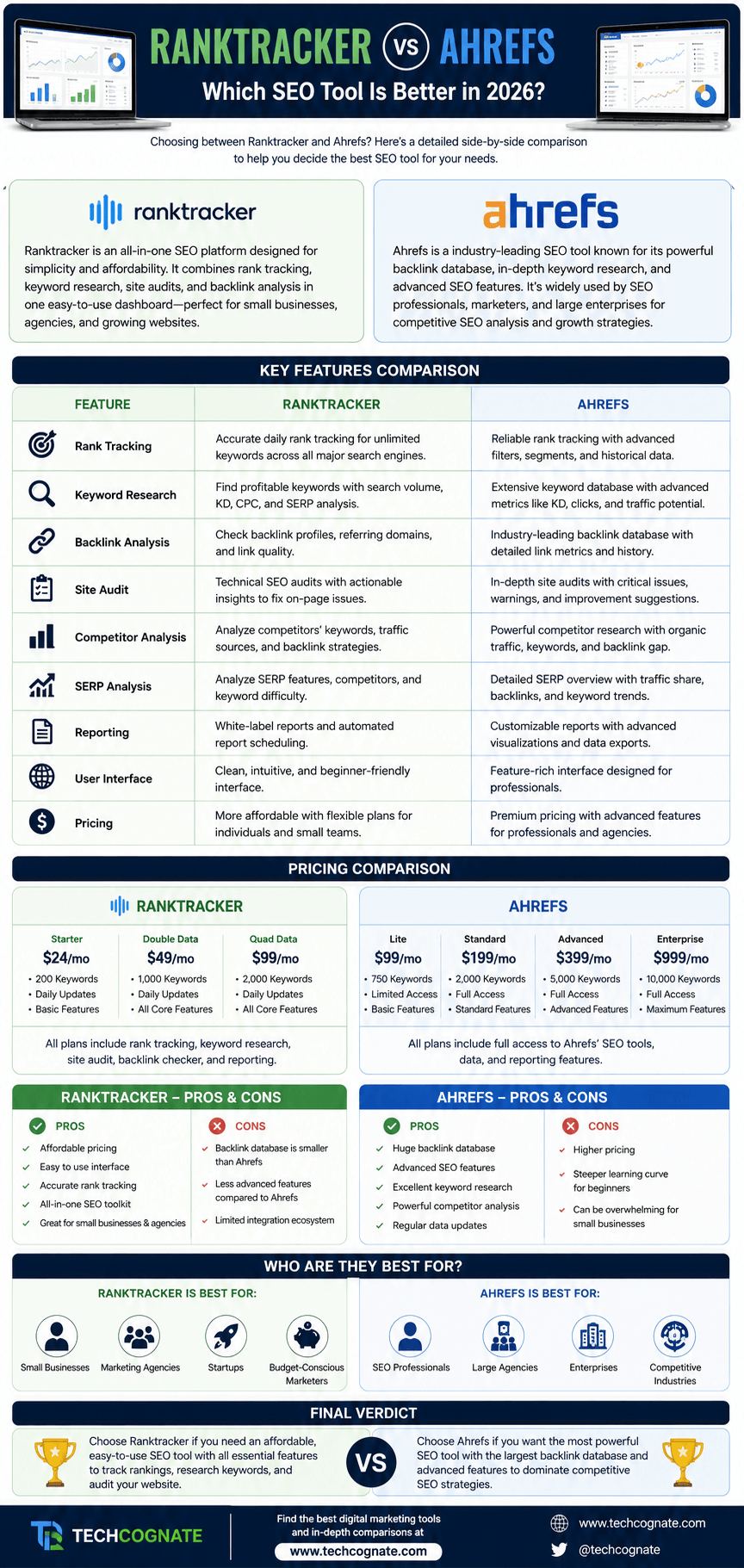
Ranktracker vs Ahrefs at a glance — save or share this comparison.
What Is Ranktracker?
IN SHORT
Ranktracker is a UK-based, all-in-one SEO platform combining rank tracking, keyword research, SERP analysis, backlink monitoring, site auditing, and AI content generation into a single subscription, priced from $39/month.
Company Overview
Ranktracker is operated by Ranktracker Ltd, headquartered in London, United Kingdom. The company positions itself as a budget-friendly, all-in-one SEO toolkit rather than a specialist tool, bundling rank tracking, keyword research, SERP checking, backlink analysis, site auditing, and AI content generation into one subscription. The company states it serves more than 140,000 users, with particularly strong traction among solo operators, freelancers, and small agencies who want one tool instead of three or four.
Core Features
Who Uses It
Ranktracker’s customer base leans heavily toward freelance SEOs, small business owners managing their own marketing, and small agencies serving a handful of clients. The unlimited-users and unlimited-projects policy on every plan makes it unusually agency-friendly at the low end — a two- or three-person shop can run multiple client projects without paying per-seat fees, which is a meaningfully different model from most competitors, including Ahrefs.
Pros
Cons
Ideal Customers
Freelance SEO consultants, solo bloggers and affiliate marketers, small e-commerce stores, and small-to-mid agencies that need to track and report on multiple client sites without per-seat costs.
Pricing Overview
Ranktracker offers four tiers — Launch, Growth, Scale, and Authority — priced from $39 to $299 per month, with a 20% discount for annual billing. Every plan includes the full toolset; the differences between tiers are entirely about usage volume (keywords tracked, competitors per project, data rows, and so on), not feature access. Full numbers are in the Pricing Comparison section below.
Learning Curve
Low. Ranktracker’s dashboard is deliberately simplified, and independent reviewers frequently note that even users with no prior SEO tool experience can set up tracking and pull a usable report within their first session.
Unique Strengths
What Is Ahrefs?
IN SHORT
Ahrefs is a Singapore-based, research-grade SEO platform built around one of the industry’s largest web crawlers and backlink indexes, offering deep tools for keyword research, competitor analysis, site auditing, content research, and AI visibility tracking, priced from $29/month for a limited Starter plan and $129/month for the full Lite tier.
Company History
Ahrefs was founded in 2010 by Dmitry Gerasimenko, who built the company’s web crawler before turning it into a commercial link-analysis service in 2011. Gerasimenko bootstrapped the business entirely with his own funds, reinvesting profits rather than raising outside investment, and relocated the company to Singapore in 2012. Ahrefs remains privately held and headquartered in Singapore today, operating with a fully remote, globally distributed team. The company’s crawler, AhrefsBot, is frequently cited as the second-most active web crawler after Googlebot, which underpins the size and freshness of Ahrefs’ backlink and content databases.
Core Products
Why Marketers Trust It
Ahrefs’ core reputation rests on data quality and refresh speed. Independent reviewers and long-time users consistently point to its backlink data refreshing within roughly 15 to 30 minutes of a new link being found — a meaningfully faster cycle than most competitors, who update on daily or weekly schedules. For link-building, competitive research, and content-gap work where outdated data leads to wasted outreach, this speed advantage compounds over time.
Best Use Cases
Pricing Overview
Ahrefs runs five tiers: a free Ahrefs Free / Webmaster Tools plan for verified site owners, a limited $29/month Starter plan, and three full-featured paid tiers — Lite ($129/mo), Standard ($249/mo), and Advanced ($449/mo) — plus custom-quoted Enterprise pricing starting around $1,499/month with an annual commitment. Annual billing saves up to 17%. Unlike Ranktracker, additional users and additional usage (API calls, export rows, crawl credits) are billed separately on a pay-as-you-go basis once included limits are exceeded.
Pros
Cons
Ideal Users
SEO agencies managing multiple clients, in-house teams at funded companies, enterprise technical SEO departments, and content marketers whose work depends on deep backlink and content research rather than rank tracking alone.
Ranktracker vs Ahrefs at a Glance
Before diving into feature-by-feature detail, here’s how the two companies and platforms stack up structurally.
| Attribute | Ranktracker | Ahrefs |
|---|---|---|
| Founded | 2015 | 2010 (paid service launched 2011) |
| Headquarters | London, United Kingdom | Singapore |
| Ownership | Privately held | Privately held, bootstrapped |
| Search engines tracked | Google, Bing, Yahoo, Yandex | Primarily Google, with GSC integration |
| Trackable locations | 107,000+ | Global, location-level via Rank Tracker |
| Keyword database | 3.5 billion+ keywords, 67 countries | Billions of keywords across 170+ countries |
| Backlink database | 2.6 trillion+ links (company-stated) | Industry-leading index via AhrefsBot, ~300B+ pages crawled |
| Crawler | Third-party data partnerships | Proprietary AhrefsBot, the web’s 2nd most active crawler |
| Mobile app | No dedicated app | No dedicated app |
| Chrome extension | No | Yes (Ahrefs SEO Toolbar) |
| API | Available via add-ons | Included from Lite, scales by tier |
| MCP Server (AI agent access) | Not offered | Included from Lite tier |
| AI visibility tracking | Not a dedicated feature | Brand Radar, Custom Prompts |
| Support channels | Live chat, email, help center | Help center, email; no live chat on lower tiers |
| Starting price | $39/month | $29/month (limited) or $129/month (full) |
| Free tools | Free SERP Simulator | Backlink Checker, Keyword Generator, and more |
Feature-by-Feature Comparison
This is the core of the guide. Each section below covers what the feature does, how each tool actually performs in practice, and which one wins for that specific job — because the honest answer is rarely the same tool twice.
Keyword Research
Keyword research tools help you find search terms worth targeting, by surfacing search volume, ranking difficulty, search intent, and related or long-tail variations.
How Ranktracker Performs
Ranktracker’s Keyword Finder draws on a database the company describes as over 3.5 billion keywords across 67 countries, with keyword difficulty available on roughly 95% of keywords by country. It supports global search, expandable keyword discovery, CPC and PPC data, and on-demand real-time difficulty checks. For day-to-day keyword discovery and validating a content idea, it does the job cleanly without overwhelming a beginner.
✓ Advantages
⚠ Weaknesses
Solo marketers and small teams who need solid keyword data without a steep learning curve.
How Ahrefs Performs
Ahrefs’ Keywords Explorer is widely regarded as one of the strongest keyword research tools on the market. It includes AI-generated keyword suggestions, automatic keyword clustering, search-intent classification, parent topic identification, and SERP-level click data showing how many searchers actually click through versus stay on the results page. Multi-language translation features extend research across markets without restarting from scratch.
✓ Advantages
⚠ Weaknesses
Content teams and agencies doing systematic topic research and content planning at scale.
🏆 Winner: Ahrefs
Ahrefs’ clustering, intent classification, and click data give it a clear research-depth edge. Ranktracker remains entirely adequate for straightforward keyword discovery on a budget.
Rank Tracking
Rank tracking monitors where your target keywords rank in search results over time, across devices, locations, and search engines, so you can measure whether your SEO work is actually moving the needle.
How Ranktracker Performs
Rank tracking is arguably Ranktracker’s core competency — it’s the feature the company is named for. It tracks Google, Bing, Yahoo, and Yandex, across desktop and mobile, with flexible update frequency (daily, weekly, bi-weekly, or monthly) that directly affects how many keywords your plan allowance covers. It supports local Google Business Profile and Google Maps tracking, competitor tracking (up to 50 competitors per project on the top tier), and historical ranking data with shareable tracking links.
✓ Advantages
⚠ Weaknesses
Anyone whose primary job is monitoring keyword position changes day to day.
How Ahrefs Performs
Ahrefs’ Rank Tracker covers a smaller raw number of keywords per plan (750 on Lite, scaling to 5,000+ on Advanced) but integrates tightly with Site Explorer and Keywords Explorer, so you can pivot from a ranking drop straight into competitor or backlink analysis without switching tools. Update frequency is weekly across all tiers, including Enterprise, which is a meaningful difference from Ranktracker’s daily option.
✓ Advantages
⚠ Weaknesses
Teams who treat rank tracking as one input into a broader research workflow rather than the main event.
🏆 Winner: Ranktracker
For tracking frequency and sheer keyword volume per dollar, Ranktracker wins. Ahrefs wins on integration depth if you’re already living inside its ecosystem.
Backlink Analysis
Backlink analysis tools show which sites link to a domain, how strong those links are, which ones were recently gained or lost, and whether a link profile looks natural or spammy.
How Ranktracker Performs
Ranktracker’s Backlink Checker and Backlink Monitor pull from a link index the company describes as exceeding 2.6 trillion links, returning Domain Rating, URL Rating, and first/last-seen data, along with historical and new/lost link tracking. It’s a credible, usable backlink tool for monitoring your own site and doing light competitive snooping.
✓ Advantages
⚠ Weaknesses
Monitoring your own backlink profile and doing basic competitor link checks.
How Ahrefs Performs
Ahrefs built its entire reputation on backlink data, and it remains the benchmark the rest of the industry is measured against. New links are typically reflected within roughly 15–30 minutes of AhrefsBot finding them, a refresh cycle most competitors can’t match. Site Explorer adds broken-backlink discovery, link intersect (find domains linking to competitors but not you), anchor text distribution, and referring-domain trend charts.
✓ Advantages
⚠ Weaknesses
Active link builders, agencies doing competitive gap analysis, and anyone whose SEO strategy depends on outreach.
🏆 Winner: Ahrefs
This isn’t close. Backlink data is Ahrefs’ founding strength, and it shows in refresh speed, completeness, and the depth of analysis tools layered on top.
Site Audit
Site audit tools crawl your website to surface technical SEO problems — broken links, duplicate content, slow pages, crawlability issues, and more — that can silently cap your rankings regardless of how good your content is.
How Ranktracker Performs
Ranktracker’s Web Audit scans a site’s pages and evaluates more than 100 data points, with the ability to compare previous scans to track progress and share results via a link. It’s positioned as fast and straightforward rather than exhaustive.
✓ Advantages
⚠ Weaknesses
Small to mid-size sites needing a clear, actionable technical health check.
How Ahrefs Performs
Ahrefs’ Site Audit is built on a crawl-credit model that scales from 100,000 credits and 25,000 max pages on Lite up to millions of pages on Enterprise, with optional always-on auditing and instant recrawl through the Project Boost add-ons. It checks Core Web Vitals, JavaScript rendering, redirects, duplicate content, sitemap and robots.txt issues, and more, with an AI-assisted “Ask AI” feature in Site Audit for explaining flagged issues.
✓ Advantages
⚠ Weaknesses
Large or technically complex sites, and teams running frequent audits across many projects.
🏆 Winner: Ahrefs
Ahrefs wins on scale and technical depth. Ranktracker wins on simplicity for sites that don’t need enterprise-level crawling.
Competitor Research
Competitor research tools let you see what’s working for other sites in your space — their top pages, the keywords they rank for that you don’t, and where their traffic is coming from — so you can find gaps and opportunities.
How Ranktracker Performs
Ranktracker allows competitor tracking within the Rank Tracker (up to 50 competitors per project on Authority) and surfaces some competitive context inside SERP Insights, but it does not offer a dedicated competitor-research module comparable to Site Explorer.
✓ Advantages
⚠ Weaknesses
Keeping an eye on a known, fixed set of competitors’ rankings over time.
How Ahrefs Performs
Competitor research is one of Ahrefs’ strongest areas. Site Explorer lets you analyze any domain’s organic and paid keywords, top pages, and estimated traffic, while Content Gap and Batch Analysis surface keywords competitors rank for that you don’t, across up to 1,000 target URLs per report on Advanced.
✓ Advantages
⚠ Weaknesses
Agencies and in-house teams doing systematic competitive gap analysis as a core part of strategy.
🏆 Winner: Ahrefs
Ahrefs offers a dedicated, purpose-built competitor research suite. Ranktracker only partially covers this need through rank tracking.
Content Research
Content research tools help identify what content is already performing well on a topic, find link-worthy pages, and spot content gaps and trending angles before you start writing.
How Ranktracker Performs
Ranktracker doesn’t offer a dedicated content research database. Content planning here leans on Keyword Finder data and the AI Article Writer’s topic and outline generation rather than a searchable content index.
✓ Advantages
⚠ Weaknesses
Teams happy to combine keyword data with AI-assisted topic generation rather than browsing a content index.
How Ahrefs Performs
Content Explorer, available from the Standard plan, is a searchable index of web content used to find top-performing pages, trending content, and outreach-worthy link targets by topic, with filtering by organic traffic, referring domains, publish date, and word count.
✓ Advantages
⚠ Weaknesses
Content marketers and link builders who research extensively before writing.
🏆 Winner: Ahrefs
Content Explorer has no real equivalent in Ranktracker’s toolset. This is a clean win for Ahrefs, gated behind its higher-priced tiers.
AI SEO Features
AI SEO features cover everything from AI-assisted content creation to tracking how a brand appears inside AI chatbot answers and AI Overviews — an increasingly important part of visibility as search shifts beyond the traditional ten blue links.
How Ranktracker Performs
Ranktracker’s standout AI feature is its AI Article Writer, which generates unlimited topics and outlines and produces full articles (at incremental per-article cost) with translation into 28 languages. It’s a content-production tool first, not a brand-monitoring one.
✓ Advantages
⚠ Weaknesses
Teams who want to scale content output without buying a separate AI writing tool.
How Ahrefs Performs
Ahrefs has moved AI features in a different direction: Brand Radar and Custom Prompts track how a brand is mentioned across more than 271 million organic prompts and let you monitor your own custom prompts across AI platforms. Separately, AI Content Helper and AI Content Grader (paid add-ons) help align content with search intent and benchmark it against top-ranking competitors.
✓ Advantages
⚠ Weaknesses
Brands that need to understand and influence how they’re represented in AI search results, not just classic SERPs.
🏆 Winner: Tie, depending on need
If you need AI content generation, Ranktracker bundles it for free. If you need AI-search brand visibility tracking, Ahrefs’ Brand Radar is the more purpose-built (if separately priced) option. Neither tool’s roadmap here is static, so revisit this comparison periodically.
Reporting
Reporting tools turn raw SEO data into client-ready or stakeholder-ready documents — PDFs, dashboards, or scheduled exports — without manual copy-pasting.
How Ranktracker Performs
Ranktracker offers unlimited on-demand reports in PDF, Excel, and CSV format across every tool, with shareable tracking links for live dashboards. There’s no dedicated white-label report builder beyond what’s built into the standard export options.
✓ Advantages
⚠ Weaknesses
Teams that need straightforward, frequent reporting without configuring a separate reporting product.
How Ahrefs Performs
Ahrefs offers Report Builder as a paid add-on ($99/month, with higher allowances on Advanced) that aggregates data across tools into customizable, schedulable dashboards with up to 25 reports and 250 widgets at the top tier. Advanced and Enterprise also add Looker Studio integration for fully custom dashboards.
✓ Advantages
⚠ Weaknesses
Agencies that need polished, recurring, white-labeled client reporting at scale.
🏆 Winner: Ahrefs
Ahrefs’ Report Builder and Looker Studio integration offer more depth, though Ranktracker’s unlimited, no-extra-cost exports are perfectly serviceable for simpler reporting needs.
Ease of Use
This covers how quickly a new user can become productive: dashboard clarity, navigation logic, onboarding flow, and the quality of available documentation.
How Ranktracker Performs
Ranktracker is consistently described by independent reviewers as one of the easier SEO platforms to pick up, with a clean dashboard and minimal jargon. Several reviewers note they were able to start tracking keywords within minutes of signing up.
✓ Advantages
⚠ Weaknesses
First-time SEO tool users and small business owners managing their own SEO.
How Ahrefs Performs
Ahrefs’ interface is well-designed but inherently denser, given the breadth of its toolset. New users typically need more time to understand how Site Explorer, Keywords Explorer, and Content Explorer relate to one another, and how credits are consumed across the platform.
✓ Advantages
⚠ Weaknesses
Users willing to invest a few hours upfront in exchange for more powerful workflows long-term.
🏆 Winner: Ranktracker
For raw ease of onboarding, Ranktracker wins clearly. Ahrefs rewards the learning investment but does require one.
Integrations
Integrations connect your SEO tool to the other software you already use — Google Search Console, Google Analytics, reporting dashboards, content platforms — so data flows without manual exports.
How Ranktracker Performs
Ranktracker offers integrations and API access as part of its toolset, though the public integration ecosystem is smaller than Ahrefs’. There’s no dedicated Looker Studio connector or MCP server for AI-agent access at the time of writing.
✓ Advantages
⚠ Weaknesses
Teams whose reporting stack doesn’t depend heavily on third-party dashboard tools.
How Ahrefs Performs
Ahrefs integrates with Google Search Console (with dedicated GSC Insights and site-structure data), supports direct API access from the Lite tier up, and added an MCP Server — letting AI agents and assistants query Ahrefs data directly, a forward-looking integration most competitors don’t yet offer. Looker Studio integration is available from Advanced.
✓ Advantages
⚠ Weaknesses
Technical teams building custom data pipelines or AI-agent workflows around SEO data.
🏆 Winner: Ahrefs
Ahrefs’ integration ecosystem, including its early MCP Server support, is broader and more forward-looking.
Customer Support
Support quality determines how quickly you get unblocked when something doesn’t work — a billing issue, a data discrepancy, or a feature you can’t figure out.
How Ranktracker Performs
Ranktracker advertises live chat support and states it responds quickly even outside standard UK business hours. That said, independent review aggregators (Capterra, GetApp, G2) also show a recurring cluster of complaints, concentrated among legacy AppSumo lifetime-deal customers, describing slow responses, account access gated behind paid support add-ons, and difficulty obtaining refunds.
✓ Advantages
⚠ Weaknesses
Standard subscribers with routine support needs; approach with more caution if evaluating a lifetime or heavily discounted legacy deal.
How Ahrefs Performs
Ahrefs offers an extensive self-serve Help Center, an active Academy, and email-based support, but does not offer live chat to lower tiers. Independent reviews are generally more positive on support quality, though wait times for email support can vary by tier and ticket volume.
✓ Advantages
⚠ Weaknesses
Users comfortable self-serving via documentation, with occasional email escalation.
🏆 Winner: Ahrefs
Ahrefs’ support reputation is more consistent, though neither company offers a generous refund policy, and both warrant reading the fine print before committing to annual billing.
Pricing Comparison
Pricing is where the two tools diverge most sharply, and it’s worth looking at the real numbers rather than marketing taglines.
Ranktracker Pricing
| Plan | Monthly | Annual (per mo) | Daily keyword tracking | Competitors per project |
|---|---|---|---|---|
| Launch | $39 | $31 | 500 | 5 |
| Growth | $89 | $71 | 1,000 | 10 |
| Scale | $149 | $119 | 2,000 | 20 |
| Authority | $299 | $239 | 5,000 | 50 |
Every Ranktracker plan includes the full toolset — Rank Tracker, Keyword Finder, SERP Analyzer, Backlink Monitor and Checker, Web Audit, SEO Checklist, AI Article Writer, and reporting. Tiers differ only in usage volume. There are no contracts, no setup fees, and a 20% discount for annual billing, plus a 7-day free trial that doesn’t require a credit card.
Ahrefs Pricing
| Plan | Monthly | Annual (per mo, approx.) | Tracked keywords | Projects | Users included |
|---|---|---|---|---|---|
| Starter | $29 | N/A (monthly only) | Limited | 1 | 1 |
| Lite | $129 | ~$108 | 750 | 5 | 1 |
| Standard | $249 | ~$208 | 2,000 | 20 | 1 |
| Advanced | $449 | ~$374 | 5,000 | 50 | 1 |
| Enterprise | $1,499 | Annual commitment required | 10,000+ | 100 | 3+ |
Ahrefs charges separately for additional users ($40/mo on Lite, $60/mo on Standard, $80/mo on Advanced, $100/mo on Enterprise), and overage charges apply automatically once you exceed included crawl credits, export rows, or API units — though unused pay-as-you-go credits carry over for three billing months. Annual billing saves up to 17%. There is no general free trial; the entry points are the limited $29 Starter plan or the free Ahrefs Free / Webmaster Tools tier for verified site owners.
⚠ Hidden costs to watch for
Ranktracker: data add-ons for extra keywords, competitors, or backlinks beyond plan limits; no refunds during discount promotions.
Ahrefs: per-seat charges for additional users; pay-as-you-go overage on crawl credits, export rows, and API units; Report Builder ($99/mo), Content Kit (from $99/mo), and Project Boost ($20–$200/mo per project) are all separate add-ons layered on top of the base plan.
Best Value
For pure dollar-for-feature value at the entry level, Ranktracker is the clear winner: $39/month buys the entire toolset with no per-seat or per-credit anxiety. Ahrefs’ value proposition improves the more intensively you use it — a single agency seat doing heavy competitive research and link building can extract far more raw data value per dollar from Ahrefs Standard than the same spend on Ranktracker, but only if that depth is actually being used.
🏆 Winner: Pricing
Ranktracker wins on affordability and predictability. Ahrefs wins on value-per-dollar only for teams that will genuinely exploit its deeper datasets and credit allowances.
Database Comparison
| Metric | Ranktracker | Ahrefs |
|---|---|---|
| Keyword database | 3.5 billion+ keywords, 67 countries | Billions of keywords, 170+ countries |
| Backlink database | 2.6 trillion+ links (company-stated) | Industry-leading, refreshed every 15–30 min |
| Update frequency | Varies by tool; daily options on rank tracking | Near-real-time for backlinks; weekly for rank tracking |
| Crawler | Third-party data partnerships | Proprietary AhrefsBot |
| Historical data depth | Available, depth varies by plan | 6 months (Lite) to unlimited (Enterprise) |
Speed and Accuracy Comparison
Speed:
Ranktracker users occasionally report SERP lookups taking up to 30 seconds, since results are scraped and aggregated live rather than served from a constantly warm cache. Ahrefs’ dashboard and report loading are generally fast given the scale of its underlying index, though Site Audit crawl speed depends on your plan’s crawl-credit allocation and whether Project Boost add-ons are active.
Accuracy:
Both tools’ keyword search volumes and traffic estimates are modeled approximations, not exact figures — this is true industry-wide, including for Ahrefs and Semrush. Ahrefs’ backlink discovery is generally regarded as the most complete and fastest-updating in independent comparisons, which matters most for time-sensitive link-building and outreach work. Ranktracker’s rank-tracking accuracy is well-regarded by users for straightforward position monitoring, though it does not undergo the same level of independent benchmarking as Ahrefs.
🏆 Winner: Speed and Accuracy
Ahrefs wins on backlink data freshness and completeness. Ranktracker is perfectly accurate for its core use case — rank tracking — but doesn’t carry the same independent benchmarking pedigree as Ahrefs for broader data accuracy claims.
Local SEO Comparison
Local SEO needs — tracking Google Business Profile visibility, local pack rankings, and city- or zip-level position data — are handled differently by each tool.
Ranktracker bundles Google Business Profile, Organic, and Absolute position tracking, plus dedicated Local GMB Tracking and Google Maps Tracking, into every plan with no extra cost. This makes it a strong, low-friction choice for local businesses and the agencies that serve them.
Ahrefs offers GBP Monitor, currently in beta, for managing Google Business Profiles at scale, alongside its standard Rank Tracker’s location-level tracking. It’s a newer addition and not yet as mature or as deeply bundled as Ranktracker’s local tracking.
🏆 Winner: Local SEO
Ranktracker, for now. Its local and Maps tracking are mature, included in every plan, and require no separate beta sign-up.
Agency Comparison
Agencies have a distinct set of needs: managing multiple clients, white-labeling reports, controlling user permissions, and scaling without per-seat costs eating into margins.
| Need | Ranktracker | Ahrefs |
|---|---|---|
| Multiple client projects | Unlimited on every plan | Capped by tier (5–100), unverified project limits |
| Unlimited team members | Yes, on every plan | No — each extra user costs $40–$100/mo |
| White-label reporting | Standard exports, no dedicated white-label builder | Report Builder add-on, more customizable |
| Permissions / access control | Basic | More granular at Advanced/Enterprise (SSO at Enterprise) |
| Agency directory / discoverability | Marketplace (backlink opportunities) | Agency Directory listing from Standard tier |
For agencies running many small accounts on tight margins, Ranktracker’s unlimited-seats, unlimited-projects model is a genuine structural advantage — you don’t pay more to add a junior team member or a new client. For agencies serving fewer, larger clients who expect polished, branded reporting and deeper research, Ahrefs’ Report Builder and research depth tend to justify the higher per-seat economics.
🏆 Winner: Agencies
Depends on agency model. High-volume, low-ARPU agencies: Ranktracker. Boutique agencies with fewer, higher-value clients needing deep research and polished reporting: Ahrefs.
Freelancer Comparison
Freelancers feel pricing most acutely, since the subscription comes straight out of personal margin rather than a client retainer.
At $39/month, Ranktracker’s Launch plan covers a freelancer’s entire toolkit — rank tracking, keyword research, audits, and backlink checks — in one low-friction bill. Ahrefs’ equivalent entry point for full functionality, Lite at $129/month, is more than three times the cost, though the $29/month Starter plan offers a lighter-weight option for those who mainly need keyword and competitor research without full rank tracking.
The breakeven question for freelancers is simple: does Ahrefs’ deeper backlink and content research translate into work you can bill for? If client work depends on link-building strategy or content-gap analysis, Ahrefs Lite earns back its cost quickly. If most engagements are on-page optimization, local SEO, and rank monitoring, Ranktracker covers the job at a third of the price.
🏆 Winner: Freelancers
Ranktracker, for cost-to-value ratio on typical freelance workloads. Ahrefs only pulls ahead once backlink-heavy or content-research-heavy work becomes a regular part of the freelancer’s billable mix.
Small Business Comparison
Small business owners managing their own SEO — without a dedicated marketing hire — typically prioritize a simple interface, a tight budget, and the handful of features that actually move the needle: rank tracking, basic keyword research, and a periodic site health check.
Ranktracker’s Launch or Growth tiers map closely onto this need, bundling everything a small business requires without forcing a purchase decision between modules. Ahrefs’ Starter plan ($29/month) can work for businesses that mainly want to research competitors and keywords, but full rank tracking requires stepping up to Lite at $129/month — a bigger jump than many small business budgets are built for.
🏆 Winner: Small Business
Ranktracker. The bundled pricing and low learning curve match how small business owners actually want to consume an SEO tool: one bill, one dashboard, no module-shopping.
Enterprise Comparison
Enterprise SEO is a different sport: sites with millions of URLs, large cross-functional teams, strict security requirements, and the need for API access that can support custom internal tooling.
Ahrefs Enterprise, at $1,499/month on an annual commitment, is purpose-built for this: uncapped API access, SSO and enterprise-grade security, access management and audit logs, unlimited historical data, and crawl limits that scale into the millions of pages. Ranktracker does not currently publish an equivalent enterprise tier with comparable security and governance controls, positioning it more for SMB and mid-market use even at its top Authority tier.
🏆 Winner: Enterprise
Ahrefs, decisively. Its Enterprise tier is purpose-built for large-scale, security-conscious organizations in a way Ranktracker’s product line does not currently address.
E-Commerce SEO Comparison
E-commerce stores on Shopify, WooCommerce, BigCommerce, or Magento have specific SEO needs: product and category page optimization, large-scale technical audits across thousands of SKUs, and keyword research tuned to commercial and transactional intent.
Ranktracker’s Web Audit and Keyword Finder cover the basics well for small-to-mid catalogs, and its affordability suits stores still proving out their SEO investment. For larger catalogs with thousands of product and category pages, Ahrefs’ Site Audit scales more comfortably, and Content Gap analysis is useful for identifying category and product-page keyword opportunities competitors have captured.
🏆 Winner: E-Commerce
Depends on catalog size. Smaller stores (under a few thousand SKUs): Ranktracker. Larger catalogs needing deep technical audits and competitive gap analysis: Ahrefs.
International SEO Comparison
Multi-country, multi-language SEO requires accurate regional search data and the ability to track rankings across many locales without the tool becoming unwieldy.
Ranktracker supports 67 searchable countries for keyword data and tracking across more than 107,000 locations, which covers most international SEO needs for small and mid-size sites. Ahrefs supports keyword data across more than 170 countries, a meaningfully broader footprint that matters more as the number of target markets grows into double digits.
🏆 Winner: International SEO
Ahrefs, on sheer country coverage breadth, though Ranktracker’s 67-country support is more than sufficient for most businesses operating in fewer than a dozen markets.
Who Each Tool Is Built For
Beyond company size, the type of SEO work you do day-to-day matters just as much. Here’s how the two tools serve a few common roles.
Affiliate Marketers
Affiliate sites live or die on finding low-competition, high-intent keywords before competitors do, and on building enough authority through content and links to rank. Ranktracker’s Keyword Finder is well-suited to discovering low-competition opportunities affordably, while Ahrefs’ Content Explorer and Keywords Explorer give a sharper edge for competitive niches where every keyword opportunity is contested.
Start with Ranktracker for keyword discovery and rank tracking. Add Ahrefs (or upgrade) once a niche is established and competitive gap analysis becomes worth the spend.
Bloggers
Bloggers prioritize topic research, content planning, and internal linking over deep technical SEO or backlink analysis. Ranktracker’s AI Article Writer and Keyword Finder cover topic generation and validation; Ahrefs’ Content Explorer is more powerful for finding proven content angles but is gated behind the Standard tier.
Ranktracker is the more cost-effective starting point for most independent bloggers.
Agencies
Already covered in detail above — see the Agency Comparison section. In short: high-volume, low-ARPU agencies tend to favor Ranktracker’s flat, unlimited-seat pricing; boutique agencies serving fewer, larger clients tend to favor Ahrefs’ research depth and reporting polish.
In-House SEO Teams
In-house teams managing a single large website (or a small portfolio of brand sites) typically need collaboration features, integration with existing analytics stacks, and the ability to run deep technical audits on a recurring basis. Ahrefs’ multi-user plans, GSC integration, and Looker Studio connector serve this workflow more completely, particularly once the team grows past two or three people.
Pros and Cons
A consolidated summary, gathering the advantages and drawbacks discussed throughout this guide into one place.
Ranktracker Pros
Ranktracker Cons
Ahrefs Pros
Ahrefs Cons
Real-Life Scenarios
Sometimes the clearest way to decide is to see your own situation reflected back. Here are eight common scenarios and what we’d recommend in each.
1New Blogger
You’re three months into a niche blog, doing all your own SEO, and your monthly tool budget is under $50. You need keyword ideas, basic rank tracking, and the occasional technical check.
Ranktracker’s Launch plan ($39/month) covers everything you need in one bill, with room to grow into Growth as the blog scales.
2SEO Agency
You run a 6-person agency serving 15 small-business clients, mostly local service businesses needing rank tracking, basic audits, and monthly reports.
Ranktracker’s Scale or Authority tier, given the unlimited-seats and unlimited-projects structure — adding clients and team members doesn’t increase your bill. Revisit Ahrefs only if clients start requesting deep competitive or content-gap analysis.
3Local Business
You own a multi-location service business and need to track Google Business Profile visibility, local pack rankings, and basic keyword performance across each location.
Ranktracker, for its bundled GMB and Maps tracking at no extra cost, paired with flexible per-location rank tracking.
4Enterprise
You’re the SEO lead at a company with a 50,000-page website, a five-person team, and strict security and compliance requirements for any new vendor.
Ahrefs Enterprise. SSO, audit logs, uncapped API access, and crawl limits that scale to millions of pages make it the only realistic option between the two for this scale.
5Shopify Store
You run a mid-size Shopify store with around 800 SKUs and want to improve category-page rankings against two or three established competitors.
Either tool can work; start with Ranktracker for cost efficiency, and consider Ahrefs Standard if competitive content-gap analysis becomes a recurring need as the catalog grows.
6Affiliate Website
You’re building a comparison-style affiliate site in a moderately competitive niche and need to find keyword gaps before bigger sites claim them.
Ranktracker to start (cheap, fast keyword discovery); upgrade to or add Ahrefs once the niche proves out and you’re competing for harder keywords that require content-gap and backlink intelligence.
7Marketing Team
You’re part of a 4-person in-house marketing team at a funded SaaS company, juggling content strategy, technical SEO, and competitive intelligence against three well-funded competitors.
Ahrefs Standard or Advanced. The combination of Content Explorer, Content Gap, and Looker Studio integration (at Advanced) matches the breadth of an in-house marketing team’s needs better than Ranktracker’s leaner toolset.
8Freelancer
You’re a solo SEO consultant with four to six retainer clients, mostly doing on-page optimization, basic technical fixes, and monthly rank reports.
Ranktracker. The per-client economics (unlimited projects, one flat fee) make it the more sustainable choice unless your services specifically include heavy link-building or content-gap research.
Decision Matrix
If you want a single, scannable answer to “which tool for X,” this is it.
| If you want… | Best Tool |
|---|---|
| The lowest possible budget | Ranktracker |
| The best backlink data | Ahrefs |
| The best keyword research depth | Ahrefs |
| The fastest learning curve | Ranktracker |
| The largest, fastest-refreshing database | Ahrefs |
| The best built-in reporting for the price | Ranktracker |
| The best fit for high-volume, low-ARPU agencies | Ranktracker |
| The best fit for boutique agencies with deep client needs | Ahrefs |
| The best local SEO support out of the box | Ranktracker |
| The best e-commerce SEO for large catalogs | Ahrefs |
| The best AI content generation bundled in | Ranktracker |
| The best AI-search brand visibility tracking | Ahrefs |
| The best fit for enterprise security and scale | Ahrefs |
| The best fit for freelancers on tight margins | Ranktracker |
Customer Reviews Summary
Rather than cherry-pick glowing testimonials, here’s an honest synthesis of recurring themes across G2, Capterra, GetApp, Software Advice, and broader SEO community discussion.
Ranktracker: What Reviewers Praise
Ranktracker: Recurring Complaints
Ahrefs: What Reviewers Praise
Ahrefs: Recurring Complaints
Common Mistakes When Choosing an SEO Tool
A few patterns show up again and again in how people pick (and later regret) an SEO tool purchase.
Alternatives Worth Considering
Ranktracker and Ahrefs aren’t the only two options. Here’s a brief look at where other established tools fit, in case neither is quite right for your situation.
Related comparisons worth reading if you’re still evaluating: Semrush vs Ahrefs, Mangools vs Ahrefs, SE Ranking vs Ahrefs, Moz Pro vs Ahrefs, Serpstat vs Ahrefs, SEO PowerSuite vs Ahrefs, AccuRanker vs Ahrefs, SpyFu vs Ahrefs, Screaming Frog vs Ahrefs, BrightEdge vs Ahrefs, Long Tail Pro vs Ahrefs, and SISTRIX vs Ahrefs.
Frequently Asked Questions
Quick, direct answers to the questions readers ask most often when comparing these two tools.
Final Verdict
Choose Ranktracker If…
Choose Ahrefs If…
Our Recommendation
There is no universal winner here, and any guide that tells you otherwise is oversimplifying. The right choice depends on three things: your budget, your workflow, and how mature your SEO program already is.
If you’re early in your SEO journey, working solo or in a small team, and need to track rankings, research keywords, and run periodic audits without burning through budget, Ranktracker delivers genuine, well-rounded value at a price that doesn’t force trade-offs elsewhere in your marketing spend.
If your SEO program has matured to the point where backlink strategy, content-gap analysis, and competitive intelligence directly drive revenue — or you’re operating at a scale where enterprise security and crawl capacity matter — Ahrefs’ higher price reflects genuinely deeper capability, not just brand premium.
Many experienced SEO professionals eventually use a version of both: an affordable, always-on tracking tool for daily monitoring, and a deeper research platform for periodic strategic work. There’s no shame in starting lean and adding depth only once you can point to the specific workflow that justifies it.
What to do next
Try the tool that matches your current stage — Ranktracker’s 7-day free trial or Ahrefs’ $29 Starter plan are both low-risk ways to get hands-on before committing further.
If you’re between two tiers on either platform, start one level lower than you think you need; both companies make upgrading painless, and downgrading or canceling is far easier before annual billing locks you in.
Explore the related comparison guides linked above if you’re still weighing alternatives like Semrush, SE Ranking, or Moz Pro.
Ready To Choose?
Start with the tool that matches where you are today — Ranktracker’s 7-day free trial or Ahrefs’ $29 Starter plan are both low-risk ways to get hands-on before committing further.
| Try Ranktracker Free → | Try Ahrefs → |
Pricing, plan limits, and features for both platforms change periodically. The figures in this guide reflect each company’s published pricing pages as of mid-2026; always confirm current details directly on ranktracker.com/pricing and ahrefs.com/pricing before purchasing.
Advertising disclosure: Some links on this page are affiliate links. If you sign up through them, TechCognate may earn a commission at no extra cost to you. This never affects which tool we recommend — our verdicts are based on independent hands-on evaluation.
Related Reading