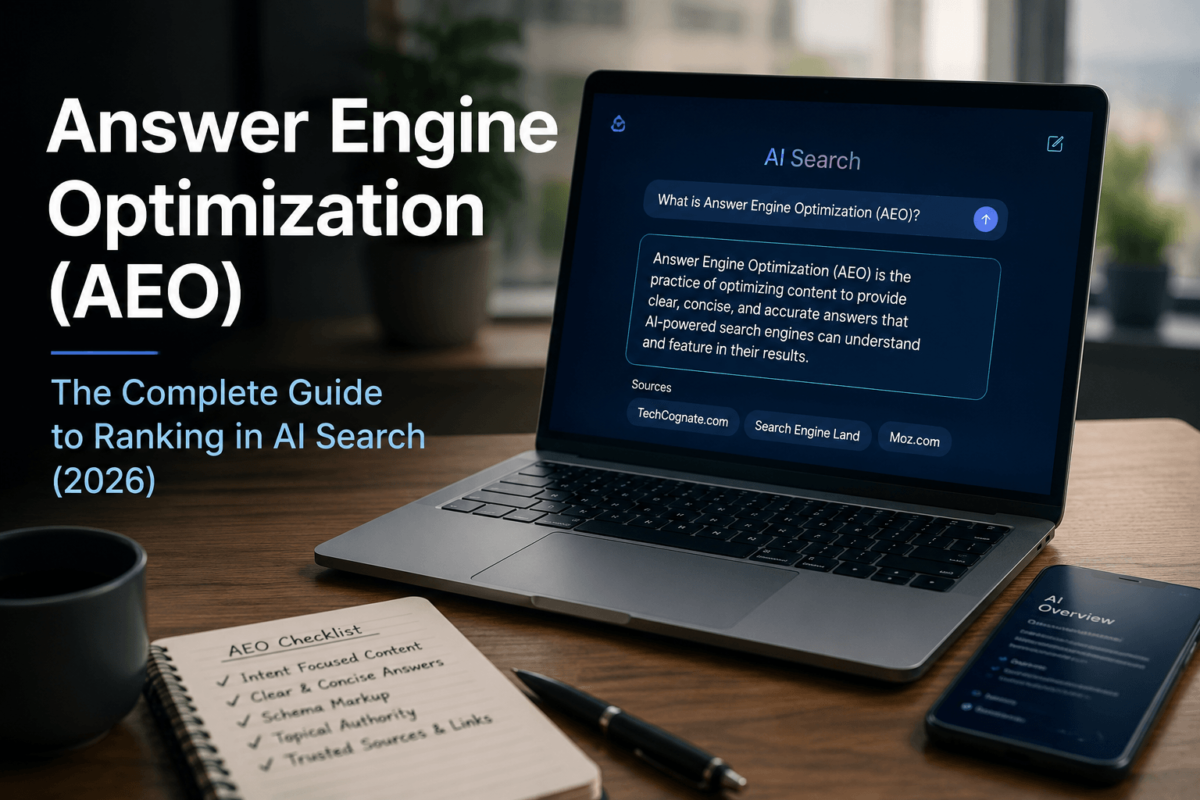
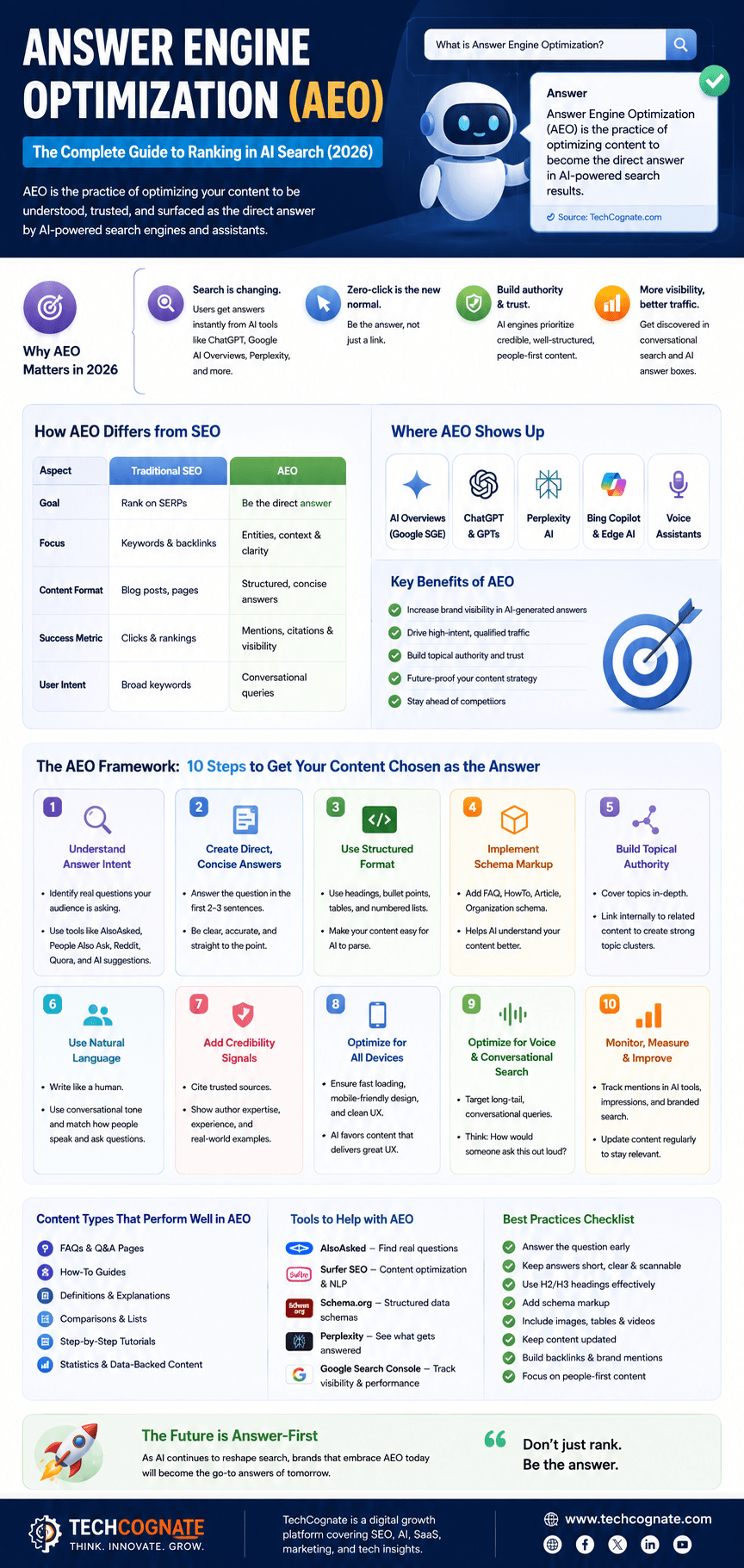
Answer Engine Optimization (AEO) is the practice of structuring, writing, and signaling your content so that AI systems — including Google AI Overviews, ChatGPT, Perplexity, Claude, Gemini, and voice assistants — select it as a trusted source when generating answers to user queries. It builds on traditional SEO but shifts the goal from ranking in a list of links to earning citation inside an AI-generated response.
Here is a number that should fundamentally change how you think about search: close to 60% of all Google searches now end without a single click. No website visit. No traffic. No conversion opportunity. Just an AI-generated answer sitting at the top of the page, doing the job your content used to do.
I have been in SEO for over two decades. I have watched Google move from ten blue links to featured snippets to knowledge panels to rich snippets. Each evolution required us to adapt. But none of them felt as seismic as what is happening right now, in 2026, with the rise of AI-powered answer engines.
Google now shows AI Overviews on more than half of all search queries. ChatGPT Search has tens of millions of active users who treat it as their primary research tool. Perplexity has quietly become the go-to search engine for a huge segment of knowledge workers. Claude and Gemini are embedded in workflows where people never open a traditional browser at all. Voice assistants have matured to the point where a single spoken answer is all most users ever get.
The businesses showing up inside those AI-generated answers are capturing attention, building authority, and earning trust at the very top of the funnel. The ones that are not showing up are slowly becoming invisible, even if they rank well in traditional organic results.
This is where Answer Engine Optimization comes in.
AEO is not a replacement for SEO. It is SEO evolved for a world where AI systems, not just algorithms, decide what information gets surfaced, synthesized, and delivered to users. Getting it right requires you to think differently about content strategy, entity authority, structured data, and what it actually means to be a credible source.
This guide is your complete roadmap. Whether you are brand new to the concept or you have already been experimenting, by the time you finish reading you will know exactly what to do, why it matters, and how to measure whether it is working. Let’s get into it.
1. What Is Answer Engine Optimization?
Definition
Answer Engine Optimization (AEO) is the practice of structuring, writing, and signaling your content so that AI systems — including Google AI Overviews, ChatGPT, Perplexity, Claude, Gemini, and voice assistants — select it as a trusted source when generating answers to user queries.
The easiest way to understand AEO is to think about what has changed with the people handing out information.
Imagine a library. In the old model, a librarian pointed you toward the right shelf, handed you a few books, and let you find your own answer. Traditional SEO worked the same way: Google pointed users toward the best-ranked pages and let them read for themselves.
Now imagine a librarian who has read every book in the building and just tells you the answer directly. That is what modern AI search engines do. They synthesize information from multiple sources, generate a coherent response, and sometimes mention where they got their information. Sometimes they do not mention a source at all.
AEO is about making sure that when the AI librarian reads the books to form its answer, yours is one of the books it reads, cites, and trusts.
The concept did not emerge out of nowhere. It grew logically from the evolution of search.
In 2014 and 2015, Google began showing featured snippets: boxed answers pulled from a single webpage. Smart SEOs learned to write in a way that made it easy for Google to extract a clean answer from their content. They discovered that formatting mattered, that question-and-answer structures worked well, and that being the source of the snippet was often more valuable than ranking first.
AEO takes that logic and extends it across an entirely new generation of AI-powered systems that do not just pull a single snippet but synthesize information from dozens of sources, apply their own reasoning, and deliver a personalized, conversational response. The optimization principles are similar but the stakes are higher, the competition is broader, and the systems doing the selecting are far more sophisticated.
A key thing to understand: AEO is not just about getting mentioned in AI answers. It is about becoming the source those AI systems consistently trust enough to draw from. That requires building the kind of content, authority, and entity presence that signals to an AI that your information is accurate, current, and worth citing.
2. Why Answer Engine Optimization Matters
Let me give you the plain version: AI search is not coming. It is already here, it is already large, and it is already affecting your traffic whether you realize it or not.
Google AI Overviews, which launched broadly in mid-2024, now appear for a majority of informational and navigational searches. Early data suggested that pages cited in AI Overviews see mixed traffic effects: some earn more clicks from users wanting deeper information, while others see sharp declines because the AI answered the question completely. The pattern is clear: visibility inside the answer is more important than position below it.
ChatGPT launched its search feature in late 2024 and crossed 200 million weekly active users in early 2025. A significant portion of those users are now conducting research-style queries inside ChatGPT rather than opening a browser. The content it surfaces comes from the web, but the selection process is not the same as traditional search ranking.
Perplexity AI has established itself as the preferred research tool for a technically sophisticated audience. Its citation model is transparent: it shows users exactly which sources it drew from, making those citations extremely valuable from a brand visibility standpoint.
Claude and Gemini are embedded in enterprise workflows, productivity software, and consumer apps in ways that make them invisible in analytics but highly influential in decision-making. If someone asks their AI assistant which email marketing tool to use or which accounting software is best for freelancers, the answer they get shapes buying behavior without ever appearing in your traffic data.
Voice assistants add another layer. Smart speakers, in-car systems, and mobile voice search all rely on AI to produce a single spoken answer. There is no second result. No alternative link to click. Just one answer, and whoever is cited wins.
Zero-click search, which has been growing for years, is now accelerating. Users are increasingly satisfied with the answer they get on the page, which means they never visit the source. For businesses that rely on top-of-funnel content to drive awareness, this is a serious structural shift — the kind of shift we break down in our enterprise SEO guide for larger sites. AEO is the response: instead of trying to get users to click through from an AI answer, you optimize to be the source inside it, so your brand name and your expertise are what the user hears.
The bottom line is simple: your customers are using AI to make decisions, and most of them are not explicitly aware they are doing it. AEO ensures that when those decisions are being shaped, your brand is part of the conversation.
3. Traditional Search vs. AI Search
Before you can optimize for AI search, you need to understand what makes it genuinely different from what you already know. This is not just a cosmetic change in how results look. The entire retrieval and ranking logic has shifted.
| Dimension | Traditional Search → AI Search |
|---|---|
| Query format | Keywords and short phrases → Natural language questions and conversational prompts |
| Results format | A list of ranked links → A synthesized, conversational answer with optional citations |
| User intent | Find a page that might help → Get a direct, complete answer |
| Click behavior | User clicks to visit page → User reads the answer in-place (zero-click) |
| Ranking factors | Backlinks, on-page SEO, domain authority → Entity authority, topical depth, semantic accuracy, citation signals |
| Content format | Keywords in headings and body → Clear definitions, structured answers, question-first writing |
| Trust signals | PageRank and domain authority → E-E-A-T, entity recognition, brand consistency |
| Traffic model | Click-through to website → Brand visibility inside answers, assisted conversions |
| Optimization target | Search engine algorithm → AI reasoning and synthesis process |
| Speed of results | Millisecond ranking from index → Real-time RAG retrieval + synthesis |
| Personalization | Minimal (location, history) → High (context, prior conversation, user profile) |
The shift from keyword-optimized pages to semantically rich, entity-aware, question-answering content is the central strategic challenge of AEO. It does not mean abandoning what you know about SEO. It means layering a new set of signals on top of the foundation you have already built.
4. How Answer Engines Work
If you want to optimize for AI systems, you need at least a working understanding of how they actually process and retrieve information. You do not need a computer science degree, but you do need to understand the basic mechanics.
Large Language Models (LLMs)
An LLM is a neural network trained on an enormous amount of text. It learns statistical patterns: which words tend to follow other words, which concepts cluster together, what makes a definition accurate, what makes an explanation clear. When you ask it a question, it generates a response by predicting what a high-quality answer looks like based on everything it was trained on.
The critical thing to understand is that LLMs do not retrieve information the way a search engine does. They generate it. This is why they can make things up (hallucinate) and why they benefit enormously from being paired with real-time retrieval systems.
Retrieval-Augmented Generation (RAG)
RAG is the architecture that makes modern AI search engines accurate. Instead of relying purely on training data, a RAG system first retrieves relevant documents from the web or a curated index, then feeds those documents into the LLM as additional context for generating its answer. Think of it as giving the AI a stack of research notes before asking it to write a report.
This is why your content can be cited by an AI search engine even if it was published after the AI’s training cutoff. As long as your page is crawlable and relevant, a RAG-based system can pull it in.
Embeddings and Vector Search
When AI systems search for relevant content, they do not just match keywords. They convert text into numerical vectors called embeddings that capture semantic meaning. Two sentences that use completely different words but mean the same thing will have similar vector representations. This is how AI search can find your content when a user asks a question phrased nothing like your headings.
For AEO, this means that semantic coverage of a topic matters more than exact keyword density. If your content thoroughly addresses the concepts around a topic, not just the primary keyword, it has a higher chance of matching a wide range of related queries.
Knowledge Graphs and Entity Recognition
Knowledge graphs are structured databases of entities and relationships. Google’s Knowledge Graph, for example, knows that Salesforce is a company, that Marc Benioff is its CEO, that it competes with HubSpot and Microsoft Dynamics, and that it operates in the CRM software category. AI search engines use these entity relationships to understand context and verify accuracy.
When your content consistently and accurately discusses real-world entities (people, companies, products, places, concepts) in ways that align with what the Knowledge Graph knows, AI systems develop higher confidence in your accuracy. This entity-based trust is a major AEO ranking signal that does not have a direct equivalent in traditional SEO.
Confidence and Citation Logic
AI systems do not just choose the first relevant source they find. They evaluate confidence: how likely is this source to be accurate? Signals that increase confidence include domain authority, corroboration across multiple sources, freshness, explicit authorship credentials, structured data markup, and alignment with established knowledge graph facts. Consistently meeting these signals is what earns you repeated citations over time.
5. Types of Answer Engines
Not all answer engines work the same way, and not all of them should be approached with an identical strategy. Here is a quick map of the current landscape.
| Answer Engine | What to Know for AEO |
|---|---|
| Google AI Overviews | Powered by Gemini. Appears above organic results. Pulls from pages Google already indexes. Strong E-E-A-T signals and structured content increase citation likelihood. |
| ChatGPT Search | Powered by GPT-4o with Bing-backed web retrieval. Favors authoritative, well-structured pages. Cites sources inline with links. |
| Perplexity AI | Aggressively crawls the web in near real-time. Provides numbered citations. Highly transparent sourcing model. Content freshness matters a lot. |
| Claude (Anthropic) | Used via Claude.ai and API integrations. Web search is available. Favors well-reasoned, clearly structured, expertly written content. |
| Google Gemini | Deeply integrated into Google products. Benefits from the same signals as Google AI Overviews plus strong Knowledge Graph alignment. |
| Microsoft Copilot | Powered by OpenAI models with Bing search integration. Follows similar optimization principles to ChatGPT Search. |
| Voice Assistants | Siri, Alexa, Google Assistant. Single-answer format. Heavily favors featured snippet-style content with clear, short definitions and factual answers. |
| Enterprise AI Search | Internal tools from Glean, Guru, and others. Optimized via internal knowledge base structuring, not public SEO. |
Most content optimization decisions should be made with Google AI Overviews, ChatGPT Search, and Perplexity as the primary targets, since these have the largest user bases and the most transparent retrieval mechanisms. Content that performs well across these three will generally perform well across the entire ecosystem.
6. Answer Engine Optimization vs. SEO
This is the question I get asked most often: is AEO replacing SEO? The short answer is no. The longer answer is that SEO remains the foundation, but AEO is the next floor you need to build on top of it.
Here is the comparison in detail:
| Factor | Traditional SEO | Answer Engine Optimization |
|---|---|---|
| Primary goal | Rank on page one of Google | Get cited inside AI-generated answers |
| Success metric | Rankings, organic traffic, CTR | AI citations, brand mentions, featured snippets, assisted conversions |
| Content strategy | Keyword-first, topic coverage | Question-first, entity-dense, answer-structured |
| Trust signals | Backlinks, domain authority | E-E-A-T, entity recognition, Knowledge Graph presence |
| Technical focus | Crawlability, site speed, Core Web Vitals | Structured data, semantic HTML, schema markup |
| Content format | Long-form articles with keyword density | Answer boxes, FAQs, definitions, step-by-step formats |
| Authority model | Link equity | Topical authority + entity authority |
| Freshness | Important for news, helpful for all | Critical across all content types |
| User intent | Primarily keyword intent | Conversational, nuanced, multi-turn intent |
| Brand role | Important but secondary | Central: brand entity must be established and consistent |
| Timeline | 3–6 months typical | 6–12 months for consistent citation patterns |
The strategic implication: if your SEO foundation is weak, AEO will be even harder. AI search engines do not cite low-authority, thin, or poorly structured content — the same fundamentals covered in our SEO audit report framework are the prerequisite. Strong traditional SEO creates the conditions for AEO to succeed.
7. AEO vs. GEO vs. AI SEO: What Is the Difference?
The terminology around AI search optimization is genuinely confusing right now, with different practitioners and tools using different terms for overlapping concepts. Here is how I define each one.
| Term | Definition | Primary Focus |
|---|---|---|
| AEO | Answer Engine Optimization: optimizing to appear inside AI-generated answers | Citation and sourcing by AI systems |
| GEO | Generative Engine Optimization: specifically targeting generative AI search engines (ChatGPT, Perplexity, Gemini) | Content retrieved and synthesized by LLMs |
| AI SEO | Broader umbrella: using AI tools to improve SEO + optimizing for AI search surfaces | AI as both tool and channel |
| LLM Optimization | Optimizing content so LLMs understand, recall, and cite it accurately | Model comprehension and recall |
| Voice Search SEO | Optimizing specifically for spoken-query, single-answer voice results | Voice assistant responses |
In practice, AEO and GEO are nearly synonymous and are often used interchangeably. AI SEO is the broadest category and contains both — we track the measurement side of this in our GEO Scorecard framework. If someone asks me which term to use in a pitch deck, I typically go with AEO because it is the most search-friendly, has the clearest definition, and is increasingly how clients are searching for this type of expertise.
For the rest of this guide, I will use AEO as the primary term, but everything here applies equally to GEO and AI SEO contexts.
8. How AI Chooses Sources
This is arguably the most important section in this entire guide, because understanding why AI systems cite some content and ignore other content tells you exactly what to optimize for.
AI systems do not have a published ranking algorithm the way Google does, but through analysis of citation patterns across platforms, we can identify the signals that consistently predict whether your content gets cited.
Authority and Credibility
AI systems weight source authority heavily. Pages from well-established domains with strong backlink profiles and long track records of accurate information are cited far more frequently than newer or lower-authority sources. This is why your traditional SEO investment still matters enormously for AEO.
Topical Depth and Coverage
AI search engines are not looking for the shortest answer. They are looking for the most accurate and comprehensive one. Pages that thoroughly cover a topic, address related questions, and demonstrate genuine expertise consistently outperform thin content in citation frequency. Topical authority, built by covering an entire subject cluster rather than single pages, is a major predictor of AEO success.
Entity Recognition and Accuracy
When your content accurately discusses real-world entities and their relationships in ways that align with Knowledge Graph data, AI systems develop higher confidence in your accuracy. Inaccurate entity associations are a strong signal to suppress a source.
Content Structure
AI systems are extracting specific passages, not entire articles. Pages with clear structure, informative headings, defined answer blocks, FAQ sections, and tables are dramatically easier for AI to parse and extract from. This is not just a writing preference. It is a technical requirement.
Freshness and Accuracy
Perplexity in particular prioritizes fresh content. Google AI Overviews will surface recent sources for time-sensitive queries. Keeping your content updated, adding publication and update dates, and publishing new research regularly all contribute to freshness signals.
Brand Consistency and Mentions
If your brand is mentioned across multiple authoritative sources on the web, AI systems pick up on those mentions and develop a model of your entity. Consistent brand messaging, accurate NAP data for local businesses, and regular mentions in press coverage or third-party content all strengthen your entity signal.
Schema Markup
Structured data does not directly cause a citation, but it dramatically improves the ability of AI systems to understand what your content is about, who authored it, what organization it comes from, and what specific questions it answers — see our local business schema markup guide for a full implementation walkthrough. Think of schema as translation: it converts your content into a language AI can process with confidence.
Original Research and Data
This is the single biggest advantage independent publishers and brands have over large generic sites. Original data, proprietary studies, first-hand case studies, and unique perspectives are extremely valuable to AI systems because they cannot be found anywhere else. Synthesizing information from existing sources is fine, but publishing something genuinely new puts you in a category that AI systems are motivated to cite.
9. Ranking Factors for Answer Engine Optimization
Based on citation pattern analysis across Google AI Overviews, ChatGPT Search, and Perplexity, these are the factors that most reliably predict AEO performance, roughly ordered by impact.
The AEO Ranking Factors Pyramid: how technical health, authority, content, signals, and optimization stack to earn AI citations.
AEO Ranking Factors Pyramid
Foundation (required): Technical health, crawlability, Core Web Vitals, mobile usability. Authority layer: Domain authority, topical authority, E-E-A-T signals, author credibility. Content layer: Semantic coverage, question-first structure, entity density, answer clarity. Signal layer: Schema markup, Knowledge Graph presence, brand mentions, original research. Optimization layer: Content freshness, internal linking, FAQ sections, structured definitions.
Technical Foundation
Fast page load speed (Core Web Vitals passing)
Mobile-first responsive design — see UX signals and rankings
Clean HTML structure with semantic elements (our JavaScript SEO guide covers common rendering pitfalls)
Proper canonicalization and no duplicate content issues
Accessible to search engine crawlers (no accidental noindex)
Content Quality
Comprehensive topical coverage with no major gaps
Question-first structure with immediate answer paragraphs
Short, clear definitions at the start of concept explanations
Original research, data, or first-hand examples
Regular updates with accurate publication and update timestamps
Clear, conversational writing that prioritizes clarity over keyword density
Authority Signals
Domain authority (DA/DR) and quality backlink profile
Author credentials with detailed bio and expertise signals
Organizational credibility (About page, contact info, business registration)
External citations and mentions from authoritative sources
Knowledge Graph entity establishment
Structured Data
Article, FAQPage, HowTo, Organization, Person, BreadcrumbList schema
Speakable schema for voice-friendly content
Review and Rating schema for product and service content
10. The Complete AEO Framework
Over the past several years I have refined a 10-step AEO implementation process that I use with every new client. It is designed to be sequential, which matters: skipping steps early in the process consistently produces weaker results. Here it is.
Step 1: Audience and Query Research
Before you write a single word, you need to understand the questions your target audience is actually asking AI systems. This is different from traditional keyword research. You are not looking for high-volume head terms. You are mapping conversational questions, how-to queries, definition requests, comparison questions, and product/service recommendation queries.
Tools like AlsoAsked, AnswerThePublic, and Perplexity itself are useful here. Type your core topics into ChatGPT and Claude and note what clarifying questions they ask before they answer. Those clarifying questions are often the same questions your audience has. Build a master query map organized by topic cluster.
Step 2: Entity Mapping
Make a list of every entity your brand needs to be associated with: competitor names, product categories, technology names, industry terms, key people, locations, and organizations. Then audit whether your current content accurately and consistently discusses those entities. Run a gap analysis: which entities are you under-covering or misrepresenting?
Use Google’s entity home search (entity:yourdomain.com) and the Google Knowledge Panel to see how Google currently understands your brand entity. If there is no panel or if the panel is incomplete, you have entity establishment work to do.
Step 3: Topic Cluster Architecture
AEO rewards topical authority, and topical authority is built through content clusters. For each core topic area, create a pillar page that provides a comprehensive overview, then create supporting cluster pages that go deep on specific sub-topics and questions.
Your pillar page on a topic like CRM Software should answer the core question (what is it, who needs it, how does it work) while linking to cluster pages on subcategories like CRM for small businesses, CRM integrations, CRM pricing, and CRM comparison guides. This cluster structure signals to AI systems that you have authoritative, comprehensive coverage of the topic.
Step 4: Search Intent Mapping
Every piece of content you create for AEO needs to map to a specific intent type. Use this four-type framework: informational (what is, how does, why does), navigational (find a specific thing), commercial investigation (compare, best, review), and transactional (buy, sign up, get) — see our full breakdown of the four types of keywords. AI search engines handle each of these intent types differently, and your content structure should match the intent.
Informational queries need clean definitions and direct answers. Commercial investigation queries need comparison tables and balanced analysis. Transactional queries need clear CTAs and product schema. Do not mix intent types in a single piece of content without a clear structure that addresses each separately.
Step 5: Content Creation with AEO Structure
Every piece of AEO-optimized content should follow this structure: question-based heading, immediate direct answer (the answer box paragraph), expanded explanation with examples, supporting data or evidence, FAQ section addressing related questions, and a summary or key takeaways section.
The answer box paragraph is the most important element: a two-to-four sentence direct answer immediately below the heading that an AI could extract and use verbatim as a response to that question. Write it as if you are answering a voice search query. Then expand with the detail and nuance that makes the content valuable for readers who want more.
Step 6: Schema Markup Implementation
After creating your content, implement the appropriate schema markup. At minimum, every piece of content should have Article schema (or BlogPosting), Author schema, Organization schema, and BreadcrumbList. For FAQ content, add FAQPage schema. For how-to content, add HowTo schema. For product pages, add Product and Review schema.
Validate every schema implementation with Google’s Rich Results Test before publishing. Broken or invalid schema is worse than no schema because it can create conflicting signals about your content.
Step 7: Internal Linking for Semantic Context
Internal links are not just for crawlability. In the context of AEO, they signal topical relationships between your pages and help AI systems understand the structure of your content cluster. When you link from your pillar page to cluster pages using descriptive anchor text, you are telling AI: these pages are related and together they represent comprehensive coverage of this topic.
Audit your internal links quarterly. Every orphan page (no internal links pointing to it) is a page that exists in isolation from your authority signals — our guide on fixing website indexing issues covers how to find and fix these. Fix orphans before adding new content.
Step 8: Authority Building
For AEO, authority building means two parallel tracks: traditional link acquisition (guest posts, PR, digital PR, partnerships — see our link building strategies guide and HARO alternatives roundup) and brand entity building (press mentions, Knowledge Graph optimization, consistent NAP data, robust author profiles). Both tracks matter. Links build domain authority that AI systems use as a trust proxy. Brand mentions build entity recognition that AI systems use to confirm your identity and expertise.
Step 9: Platform-Specific Optimization
Once your content foundation is solid, apply platform-specific optimizations for each major answer engine. Google AI Overviews, ChatGPT, Perplexity, Claude, and Gemini each have slightly different retrieval characteristics. The subsequent sections of this guide cover each platform in detail.
Step 10: Monitoring, Measurement, and Iteration
AEO performance is not visible in your standard Google Search Console report. You need a combination of tools: AI search monitoring platforms like Profound or Semrush AI Overview tracking, manual citation checks across each major platform, branded search trend tracking, and conversion attribution modeling that accounts for assisted conversions where someone discovered your brand through an AI answer and then converted through a different channel later. Our GEO Scorecard framework walks through building this measurement system step by step.
Treat your AEO strategy like a content product: review performance quarterly, identify which content pieces are being cited most frequently, understand why those pieces work, and systematically replicate those patterns across new content.
11. Content Optimization for AEO
The way you write for AEO is meaningfully different from how you write for traditional SEO, even though the underlying goal is the same: be the most useful, accurate, trusted source on a topic.
Question-First Writing
Every major section of your content should begin with a clear question as a heading. This is not just a stylistic preference. AI search systems are trying to match content to specific questions users ask. If your headings are questions, the matching process becomes trivially easy. Use natural language questions, not keyword-stuffed headings.
The Answer Box Paragraph
Immediately below every question heading, write a short, direct answer: two to four sentences that completely answer the question without requiring the reader to scroll. This is what AI extracts for featured snippets and AI Overview responses. Write it as if you are answering a friend who asked you this question verbally. Clear, complete, no hedging, no unnecessary preamble.
Simple Language with Depth
AEO content should be readable at roughly an eighth-grade level in terms of sentence construction, but it should cover concepts with genuine depth. Short sentences. Active voice. No jargon unless you immediately define it. Use examples constantly. Analogies are your best friend.
Content Formats That AI Loves
Definition boxes: What is [term]? followed by a clean two-sentence definition.
Step-by-step numbered lists: How do I [accomplish task]? followed by clear numbered steps.
Comparison tables: [Tool A] vs [Tool B] with consistent criteria rows.
FAQ sections: clusters of related questions with individual direct-answer paragraphs.
Statistic callouts: specific data points sourced and formatted for easy extraction.
Expert summaries: key takeaways at the end of long sections.
Summaries and Key Takeaways
Adding a brief summary or key takeaways section at the end of each major content section significantly increases the chance of AI extraction. AI systems often pull from summary-style passages because they are pre-synthesized, which reduces the chance of the AI introducing errors by summarizing on its own.
Avoid These Content Mistakes
Writing introductions that delay the answer for multiple paragraphs.
Hiding key definitions inside dense body paragraphs.
Using jargon without defining it at first use.
Creating content that comprehensively covers a topic but never directly answers specific questions.
Updating content without refreshing the publication date and updating any outdated statistics or claims.
12. Entity SEO for AEO
If AEO is the destination, entity SEO is one of the most important roads to get there. AI search engines are fundamentally entity-based systems: they understand the world as a network of things (entities) and relationships, not just a collection of keywords.
What Is an Entity?
In SEO terms, an entity is any real-world object, person, place, concept, or product that has a distinct, well-defined existence. Salesforce is an entity. Marc Benioff is an entity. CRM software is an entity. Your brand, your products, your founders, and your key concepts should all be established as entities that AI systems can recognize and correctly categorize.
Establishing Your Brand Entity
Create and optimize your Google Business Profile.
Build a detailed Wikipedia article (if warranted) or Wikidata entry.
Ensure your About page clearly describes your organization, its history, and its expertise.
Get your brand mentioned in credible third-party publications.
Use Organization and Person schema on your site to formally declare entity information.
Maintain consistent brand name, description, and categorization across all platforms.
Entity Salience
When AI systems read your content, they measure entity salience: how prominently and consistently does a given entity appear in relation to the overall topic of the content? High entity salience means your content is clearly, deeply relevant to that entity. Low salience means your content mentions the entity in passing but does not demonstrate deep knowledge of it.
For AEO, write content where your primary entities appear consistently throughout the piece, are explained in depth, and are connected to related entities that help AI systems understand the full context.
Entity Relationships
Every entity exists in relationship to other entities. Google is related to Alphabet, to Android, to search, to advertising, to Sundar Pichai. When your content accurately describes these relationships, it builds AI confidence in your accuracy. When your content misrepresents an entity relationship, it can suppress your citations.
Run an entity relationship audit on your key content: for every entity you mention, check that the relationships you describe are accurate and current. This is particularly important for competitive comparison content, where inaccurate claims about a competitor’s features or positioning can create entity accuracy problems.
13. Schema Markup for Answer Engines
Schema markup is structured data that you add to your HTML to help search engines and AI systems understand exactly what your content is about. Think of it as adding a machine-readable layer on top of your human-readable content.
For AEO, schema markup is not optional. AI systems use it to confirm content type, authorship, organizational affiliation, review status, and question-answer relationships — our local business schema markup guide covers implementation in full detail. Here are the schema types you need to prioritize.
| Schema Type | Use Case and AEO Benefit |
|---|---|
| Article / BlogPosting | Base schema for all editorial content. Establishes headline, author, publisher, and publication date for AI context. |
| FAQPage | Marks up question-and-answer pairs. Directly feeds into featured snippets and AI Overview extraction. High-priority for AEO. |
| HowTo | Structured step-by-step instructions. Optimized for how-to queries in Google AI Overviews and voice search. |
| Organization | Declares your brand entity: name, URL, logo, description, contact info. Essential for entity establishment. |
| Person | Author and founder credentials. Supports E-E-A-T signals that AI systems use to evaluate source trustworthiness. |
| Product | Product name, description, price, availability, reviews. Required for e-commerce AEO. |
| Review / AggregateRating | Review data signals quality and trustworthiness. Helps AI systems evaluate whether your product or service is credible. |
| BreadcrumbList | Site structure and topic hierarchy. Helps AI understand where this content sits in your overall topic architecture. |
| Speakable | Explicitly marks content suitable for voice reading. Directly targets voice assistant responses. |
| DefinedTerm | Formal definitions within content. Excellent for glossary pages and concept explanations. |
| QAPage | Community Q&A format. Different from FAQPage: the answers can come from multiple contributors. |
| LocalBusiness | Name, address, phone, hours, category. Critical for local AEO and voice search. |
| VideoObject | Video content metadata. Helps AI surfaces video responses for tutorial-style queries. |
Implement schema in JSON-LD format, which Google recommends and which is significantly easier to maintain than inline microdata. Place your JSON-LD blocks in the head section of your HTML and validate them with the Google Rich Results Test before publishing.
14. Writing Content AI Loves to Cite
There is a difference between content that answers questions and content that AI wants to cite. The latter requires something additional: credibility signals that make an AI system confident that choosing your content as a source is a good decision.
Original Research and Data
If you publish a study, survey, or original dataset that no one else has, you become the primary source. Every AI that encounters that data needs to cite you to use it. This is why original research is one of the highest-ROI AEO investments you can make. Even small surveys of your customer base, analyzed and published with clear methodology, create unique data that AI systems will cite.
Clear Expert Authorship
AI systems are increasingly evaluating the credibility of the individual who wrote the content, not just the domain it lives on. A detailed author bio with verifiable credentials, a link to the author’s professional profile or personal website, and a record of accurate expert content on the topic significantly increases citation likelihood.
Unique Frameworks and Terminology
When you create a named framework, methodology, or proprietary concept, you give AI systems something they can only attribute to you. It is the same reason that Brian Dean’s Skyscraper Technique became ubiquitous: once a memorable term is attached to an original idea, every discussion of that idea cites the originator. Create your own frameworks, name them, and use them consistently.
First-Hand Experience Signals
Google’s E-E-A-T framework explicitly values first-hand experience, and AI systems have internalized this. Content that demonstrates hands-on, practical experience is inherently more trustworthy than synthesized summaries of other content. Write from real projects. Use specific examples with real numbers. Describe what actually happened, not just what the theory predicts should happen.
15. Optimizing for Google AI Overviews
Key Insight
Google AI Overviews pull almost exclusively from pages that Google already indexes and trusts. Strong traditional SEO performance is the prerequisite. The incremental AEO work on top of it is about structured content and E-E-A-T signals.
Google AI Overviews are generated by Gemini and are triggered primarily by informational and commercial investigation queries. They tend to synthesize multiple sources rather than citing a single one, which means you are competing to be one of several citations rather than needing to be the single best source.
For Google AI Overviews specifically, here is what drives citation:
Strong organic ranking for the target query: if you are not in the top 10, your chance of AI Overview citation drops significantly.
Structured content with clear question-and-answer formatting at the section level.
FAQPage schema that mirrors the questions users are actually asking.
Author authority: Google checks the author entity and their credentials before citing expert-opinion content.
Content recency: for any query with a time-sensitive element, recently updated content is preferred.
Alignment with established facts: content that contradicts well-established knowledge graph facts is almost never cited.
Monitor your Google AI Overview visibility using Google Search Console AI Overview reports (available in the Search results section) and third-party tools like Semrush’s AI Overview tracking feature. Note which of your pages are being cited and identify the common structural characteristics those pages share.
16. Optimizing for ChatGPT
Key Insight
ChatGPT Search uses a combination of Bing index data and OpenAI model preferences. The Bing index weights similar signals to Google but has a slightly different authority model. ChatGPT also draws on training data for answers when web search is not enabled.
ChatGPT Search, the web-connected version of ChatGPT, retrieves real-time information using a Bing-backed search integration. To get cited in ChatGPT Search responses, you need your content to be indexed in the Bing index (which is often but not always aligned with Google’s index) and to meet the authority and structure signals ChatGPT’s retrieval system uses.
Claim and optimize your Bing Webmaster Tools presence. This is the most overlooked technical step in ChatGPT AEO.
Ensure your site is crawlable by BingBot. Check your robots.txt for any accidental BingBot blocks.
Prioritize content with clear inline citations and sourced statistics, since ChatGPT favors content that itself demonstrates evidence-based reasoning.
Use descriptive meta titles and descriptions that clearly signal content type and expertise. ChatGPT’s retrieval layer uses these as triage signals.
Create content that answers multi-part questions in a single structured piece. ChatGPT often uses one citation per major point in its response, so comprehensive content earns more placement.
Check ChatGPT citations manually by running target queries in ChatGPT with web search enabled. Note which competitors are being cited. Analyze their content structure and identify gaps in your own coverage that might explain why they were chosen over you.
17. Optimizing for Perplexity
Key Insight
Perplexity crawls the web aggressively and in near-real-time. It favors fresh, specific, well-cited content and surfaces citations very transparently. It is one of the most valuable AEO citation opportunities because users can see and click your citation directly.
Perplexity is built around showing its sources explicitly. Every response includes numbered citations with direct links to the source pages. This makes being cited in Perplexity extremely valuable for both brand visibility and referral traffic.
Content freshness is critical: Perplexity indexes and retrieves content that is often published within hours. Maintaining a regular publishing cadence keeps you in the pool.
Write content that is highly specific and factual. Perplexity favors pages with concrete data points, specific numbers, and well-attributed claims over general overviews.
Include a clear, accessible crawling policy in your robots.txt. Block PerplexityBot if you want to opt out, but if you want citations, make sure PerplexityBot is allowed.
Use PerplexityBot’s behavior to your advantage: since it crawls fresh content quickly, publishing timely analysis of industry news can get you cited in Perplexity responses before traditional SEO competitors catch up.
Structure long-form content with clear section headings and answer paragraphs. Perplexity tends to pull specific sections rather than summarizing entire articles.
18. Optimizing for Claude
Key Insight
Claude (Anthropic) uses web search when integrated into workflows via Claude.ai. It particularly values well-reasoned, clearly structured, and expertly written content that demonstrates genuine expertise rather than surface-level keyword coverage.
Claude-powered workflows are used extensively by knowledge workers, developers, and business analysts. Being cited by Claude builds authority with a highly educated, high-intent audience that is often making consequential decisions.
Write with depth and precision. Claude’s preference for well-reasoned content means that thin, generic overviews are unlikely to be selected over carefully structured expert analysis.
Avoid content that over-hedges or qualifies every statement. Claude values decisive, accurate, well-supported claims over wishy-washy content full of caveats.
Use clear hierarchical structure: H2 for main sections, H3 for subsections, with each level representing a meaningful step down in scope.
Include explicit definitions for technical terms. Claude users are often researching complex topics and content that clearly defines its terminology is more useful to them.
Demonstrate first-hand experience and original analysis. Claude’s synthesis process values unique insights over repackaged common knowledge.
19. Optimizing for Gemini
Key Insight
Gemini is deeply integrated into Google’s ecosystem including Google Workspace, Android, and Google Search. Optimization signals that work for Google AI Overviews largely apply to Gemini as well, since both are powered by the same underlying model.
Gemini is Google’s flagship LLM and powers both Google AI Overviews and the standalone Gemini assistant. Because it draws from Google’s search index and Knowledge Graph, your traditional Google SEO signals directly impact your Gemini citation likelihood.
Knowledge Graph establishment is more important for Gemini than for any other platform. Ensure your brand entity has a complete Google Knowledge Graph presence.
Google’s E-E-A-T guidelines are applied most strictly by Gemini. Author pages, organizational credibility, and factual accuracy are weighted heavily.
Multimedia content (video, images) indexed by Google may be cited by Gemini in multimodal responses. Ensure your video content has proper VideoObject schema and your images have descriptive alt text and captions.
Google Workspace integrations (Gemini in Gmail, Docs, Sheets) may pull from the web to answer professional queries. Business-focused content that addresses professional use cases is increasingly valuable.
20. AEO for E-commerce
E-commerce AEO is one of the highest-stakes applications of this discipline because AI search is increasingly mediating product discovery. When someone asks ChatGPT for the best noise-canceling headphones under 200 dollars, or asks Perplexity to compare two competing laptops, the brands that appear in those answers have a significant commercial advantage.
Product Pages
Write product descriptions that directly answer common questions: what problem does this solve, who is it for, how does it compare to alternatives?
Implement complete Product schema including name, description, price, availability, brand, and AggregateRating.
Include genuine customer review excerpts (with Review schema) that address real use cases and concerns.
Buying Guides and Comparison Pages
These are the highest-value content types for e-commerce AEO. A well-structured buying guide that answers the key questions in a category (what features matter, what are the price tiers, who needs which tier) is exactly the type of content AI systems synthesize for commercial investigation queries.
Structure buying guides with consistent evaluation criteria as headings.
Use comparison tables with clear product names (entity identifiers) and specific feature claims.
Include FAQPage schema that mirrors the real questions people ask about this product category.
FAQ and Support Content
Product FAQs and support documentation are often overlooked AEO opportunities. Questions like how to install, how to use, how to troubleshoot, and what the warranty covers are asked in AI systems constantly. Well-structured support content with FAQPage schema gets cited in these queries and builds brand authority in post-purchase situations.
21. Local AEO
Local businesses face a distinctive AEO challenge: AI systems are increasingly answering where-to-go and who-to-hire queries that used to require a Google Maps search or a local search results page. Winning these answers requires a combination of local SEO foundations and entity-based trust signals.
Google Business Profile
Your Google Business Profile is the single most important local entity signal. Keep it completely filled out: business name, address, phone, hours, categories, description, attributes, photos, and products or services. Respond to reviews (both positive and negative). Post regular updates. Accuracy and completeness directly affect how confidently AI systems cite your business.
NAP Consistency
NAP stands for Name, Address, Phone number. Inconsistent NAP data across the web creates entity confusion for AI systems. If your business is listed as Main Street on your website and Main St on Yelp and Main Street North on Google, AI systems cannot confidently match these to a single entity. Audit your NAP data across all directories and correct inconsistencies — our local business schema markup guide covers the full implementation.
Local Content
Create content that addresses hyper-local questions: neighborhood guides, local event coverage, local industry insights. This establishes your brand as an entity that belongs to a specific geographic context, which AI systems use when answering location-specific queries.
Voice Search and Local AEO
Voice searches are disproportionately local: what restaurants are near me, what time does the hardware store close, where can I get my car serviced in [city]. Optimizing for voice requires very short, definitive answer content, complete structured data, and strong local entity signals. Add Speakable schema to your most voice-query-relevant content.
22. Programmatic SEO + AEO
Programmatic SEO, the practice of generating large volumes of structured pages from a database, is one of the most powerful AEO strategies available to brands with broad product or service catalogs. Done well, it creates thousands of entity-specific, question-answering pages that can be cited across a huge range of queries — a natural pairing with the predictive SEO analytics approach of getting ahead of demand before it peaks.
What to Build Programmatically
Glossary pages: one page per key industry term, with a structured definition and related term links.
Comparison pages: X vs Y for every major pairing in your product category.
Location pages: one page per city or region if you serve multiple markets.
Integration pages: if your product integrates with other software, one page per integration.
Question-and-answer pages: one page per major FAQ in your product category, with a definitive answer.
Template and tool pages: free resources that attract links and establish entity associations.
Quality Requirements for Programmatic AEO Pages
Low-quality programmatic pages are an active liability for AEO. AI systems assess page quality at the individual URL level, and thin programmatic pages with generic content can suppress your domain’s overall citation authority. Every programmatically generated page must have a unique, specific, valuable core answer that justifies its existence. Templatized padding is easy for AI to detect and discount.
The best programmatic AEO content uses a template only for the structure and pulls genuinely unique content for each page: unique data, unique comparisons, unique examples. This is harder to build but dramatically more effective.
23. Common AEO Mistakes to Avoid
After working with dozens of clients on AEO implementation, I have seen the same mistakes come up repeatedly. Here are the 25 most common ones, in order of how much they tend to hurt performance.
Optimizing for keywords but not questions: Traditional keyword optimization does not map to how AI systems retrieve content. Shift to question-first content architecture.
Burying the answer: Starting content with long introductions before getting to the actual answer. AI systems and users both want the answer immediately.
Ignoring schema markup: Treating structured data as optional. It is not optional for AEO. Implement it on every page.
Not establishing your brand entity: Failing to create and maintain a consistent, accurate brand entity across all platforms.
Thin content on important topics: Publishing short, superficial content on high-value queries where AI expects depth and expertise.
Inconsistent entity information: Having different company descriptions, founding years, or executive names across different pages of your site.
Missing author attribution: Publishing content without clear author attribution and credentials.
Blocking crawlers: Accidentally blocking AI crawlers (GoogleBot, BingBot, PerplexityBot) via robots.txt — see our guide to fixing indexing issues.
Not optimizing for Bing: Since ChatGPT uses Bing’s index, ignoring Bing Webmaster Tools is a significant oversight for ChatGPT AEO.
Focusing only on Google AI Overviews: Different platforms have different retrieval mechanisms. A platform-specific strategy matters.
Not building topic clusters: Publishing isolated blog posts rather than interconnected topic clusters that signal comprehensive topical authority.
Outdated content: Leaving articles unupdated for years. AI systems weight freshness, and outdated information creates accuracy liability.
Poor internal linking: Not connecting related content through internal links, which weakens topical authority signals.
Generic comparison content: Writing comparison pages that simply list features without providing genuine expert analysis or recommendations.
No original research: Publishing only synthesized content without original data, studies, or unique insights.
Keyword stuffing in the AI era: Using keyword density techniques that create unnatural language. AI systems understand context, not just keyword frequency.
Ignoring Core Web Vitals: Slow, poorly performing sites are deprioritized even when their content is strong.
No FAQPage schema: Writing FAQ sections but not marking them up with FAQPage schema.
Missing Speakable schema: Not marking voice-friendly content passages for voice assistant optimization.
Not monitoring citations: Having no tracking system for which AI platforms are citing your content and which are not.
Chasing volume over authority: Publishing large amounts of low-quality content under the assumption that more pages equal more citations. Quality and authority always beat quantity in AEO.
Ignoring video and multimedia: Not creating multimedia content that AI systems can cite for visual and tutorial queries.
Neglecting review content: Not generating or showcasing customer reviews, which serve as third-party trust signals for AI systems.
No About or Trust pages: Missing an authoritative About page, team page, and contact information that establish organizational credibility.
Treating AEO as a one-time project: AEO requires continuous monitoring and iteration. Setting it and forgetting it will result in declining citation rates as competitors improve.
24. The AEO Checklist (50+ Items)
Use this checklist as a repeatable audit framework for every major piece of content you create and for your overall domain AEO health.
Technical Foundation
Core Web Vitals pass on all primary pages
Site is mobile-responsive and passes Google’s Mobile-Friendly Test
Semantic HTML structure (H1, H2, H3 used correctly and hierarchically)
Page load time under 3 seconds on mobile
No accidental noindex tags on key content pages
GoogleBot, BingBot, and PerplexityBot are allowed in robots.txt
XML sitemap is current and submitted to Google and Bing
HTTPS is implemented across the entire site
Canonical tags are implemented correctly with no self-referencing canonical conflicts
No duplicate content issues that could dilute topical authority
Content
Every major section begins with a question-based heading
An answer box paragraph (2–4 sentences) follows immediately below each question heading
Content is written at approximately an 8th-grade reading level
Key terms are defined at first use
Original research, data, or case studies are included
Content is organized into a clear cluster structure with a pillar page and supporting cluster pages
FAQs are included for each major content piece, addressing related questions
Content has a summary or key takeaways section
Publication date and most recent update date are both visible
No factual errors or inaccurate entity relationships
Content is at least 1,500 words for competitive informational topics
Comparison tables are used where applicable
Schema Markup
Article or BlogPosting schema is on all editorial content
Author (Person schema) is linked from each content piece
Organization schema is on the homepage and About page
FAQPage schema is implemented on all FAQ content
HowTo schema is implemented on all step-by-step guides
BreadcrumbList schema is implemented sitewide
Product and Review schema are implemented on product pages
LocalBusiness schema is implemented (for local businesses)
Speakable schema is implemented on voice-appropriate content
DefinedTerm schema is implemented on glossary pages
All schema validates in Google’s Rich Results Test
Entity and Authority
Google Business Profile is fully completed and verified
Brand NAP is consistent across all major directories
A detailed, credentialed author bio page exists for each content contributor
About page clearly describes the organization’s expertise, history, and mission
Trust signals are visible: team pages, contact info, physical address
Brand has been mentioned in at least five credible third-party publications
Knowledge Graph entity has been established and is accurate
Wikipedia or Wikidata entry exists if the brand meets notability criteria
Internal Linking and UX
Every cluster page links back to its pillar page
Every pillar page links to relevant cluster pages
No orphan pages exist (pages with zero internal links pointing to them)
Anchor text for internal links is descriptive and entity-relevant
Table of contents with anchor links is included on long-form content
Site navigation is logical and reflects topic cluster architecture
AI Platform Optimization
Site is indexed in Bing Webmaster Tools
Content has been manually tested in ChatGPT Search, Perplexity, and Google AI Overviews
Citation frequency across platforms is being tracked with a monitoring tool
Content is being updated on a regular schedule to maintain freshness
AI-generated answers that cite competitors have been analyzed for content gaps
New content is published in response to high-value queries where current coverage is insufficient
Monitoring and Measurement
AI Overview impressions are being tracked in Google Search Console
Branded search volume is being monitored via Google Trends and Search Console
AI search mentions are being tracked with a dedicated monitoring tool
Assisted conversion modeling accounts for AI-channel traffic that converts via other channels
Quarterly AEO audit is scheduled and has defined owner
25. Tools for Answer Engine Optimization
The AEO tool landscape is evolving quickly, with new platforms specifically designed for AI search monitoring emerging regularly. Here is the current toolkit organized by function.
| Category | Recommended Tools |
|---|---|
| SEO Platforms | Semrush (AI Overview tracking), Ahrefs (content gap analysis), Moz Pro (authority metrics), Screaming Frog (technical audit) |
| Schema Markup | Google’s Rich Results Test, Schema.org, Yoast SEO (WordPress), Rank Math (WordPress), Google Tag Manager for JSON-LD management |
| Entity Tools | Google Knowledge Graph Search API, Google Search Console (entity performance), IBM Watson NLU for entity extraction |
| AI Citation Monitoring | Profound, Semrush AI Toolkit, BrightEdge AI Search Visibility, Ahrefs AI Search monitoring |
| Content Optimization | Clearscope, Surfer SEO, MarketMuse (topical coverage), Frase (question research) |
| Question Research | AlsoAsked, AnswerThePublic, Perplexity AI (for direct question mapping), Reddit (community question mining) |
| Analytics | Google Search Console, Google Analytics 4, Bing Webmaster Tools |
| Site Auditing | Screaming Frog, Sitebulb, Ahrefs Site Audit, Semrush Site Audit |
| Structured Data | Google Rich Results Test, Schema Markup Validator, Merkle Schema Markup Generator |
| Brand Monitoring | Google Alerts, Mention.com, Brand24 (for tracking AI-mentioned citations) |
A practical note: no single tool covers the full AEO landscape yet. My current recommended stack for a mid-size brand is Semrush for platform-wide SEO and AI Overview tracking, Screaming Frog for technical auditing, AlsoAsked for question research, Profound for AI citation monitoring, and Google’s Rich Results Test for schema validation. If you are still deciding between core SEO platforms, our Ahrefs vs. Semrush vs. Moz vs. SpyFu comparison and Serpstat vs. Semrush vs. Ahrefs breakdown both cover GEO/AEO support in detail.
26. Measuring AEO Success
One of the biggest challenges in AEO is that success metrics do not neatly map to traditional SEO dashboards. Organic clicks and rankings still matter, but they capture only part of the picture. Here is the full measurement framework.
| KPI | What It Measures and How to Track |
|---|---|
| AI Overview impressions | How often your pages appear as citations in Google AI Overviews. Track via Google Search Console’s AI Overview report. |
| AI citation frequency | How often each major platform (ChatGPT, Perplexity, Claude, Gemini) cites your content. Track with Profound or manual testing logs. |
| Featured snippet count | How many featured snippets your domain owns. Track via Semrush or Ahrefs Position Tracking. |
| Branded search volume | The volume of people searching specifically for your brand name. Rising branded search often indicates AEO-driven awareness. Track via Search Console and Google Trends. |
| Organic traffic from AI referrals | Direct referral traffic from AI platforms (Perplexity, Claude.ai, ChatGPT). Track as a custom channel in GA4. |
| Entity Knowledge Panel status | Whether your brand has a Google Knowledge Panel and how complete it is. Manual check. |
| Share of voice in AI answers | What percentage of AI-generated answers in your category mention your brand. Best tracked via monthly manual sampling or an AI monitoring platform. |
| Topical authority score | Tools like MarketMuse and Semrush provide topic authority metrics that correlate with AEO performance. |
| Assisted conversions | Revenue attributed to users who encountered your brand in an AI context before converting. Model via GA4 multi-channel attribution. |
| Review and citation growth | The rate at which your brand acquires new third-party mentions. Track via Brand24 or Mention.com. |
Report on AEO metrics monthly but evaluate trends quarterly. Short-term fluctuations in AI citation rates are common and are not necessarily meaningful. What you are looking for is a consistent upward trend over six to twelve months, correlated with the content and schema improvements you are making — our GEO Scorecard benchmarks give you a starting point for what “good” looks like at each stage.
27. The Future of Answer Engine Optimization
AEO as a discipline is in its early innings. Here is what the next three to five years will likely bring, and how to position your strategy for what is coming.
Agentic AI Search
We are moving quickly toward AI agents that do not just answer questions but take actions on behalf of users. An AI agent booking a restaurant, comparing insurance quotes, or researching and shortlisting vendors for a purchase does not produce a search results page. It makes a decision, often based on a combination of training data, live retrieval, and user preferences. The brands that AI agents trust will be systematically preferred. AEO is the foundation of that trust.
Multimodal Search
Multimodal AI systems can process and generate text, images, audio, and video simultaneously. Future AEO will require optimizing not just written content but visual content, audio content, and data visualizations. Brands with strong multimedia content libraries will have a significant advantage as multimodal search grows.
Personalized AI Answers
AI systems are increasingly personalizing their responses based on user history, preferences, and context. This means that two users asking the same question may get different answers and different citations. The most robust AEO strategy positions your brand as credible across a wide range of user contexts rather than optimizing for a single generic query formulation.
AI Shopping Integration
Google’s AI-powered shopping experiences, ChatGPT’s commerce integrations, and AI-native shopping apps are beginning to mediate product discovery and purchase in ways that bypass traditional organic search entirely. Product data quality, review signals, and merchant trust scores will become AEO signals in their own right for e-commerce brands.
Voice-First and Ambient AI
Smart glasses, earbuds, and ambient home devices are creating always-available AI interfaces where voice is the primary input. Content optimized for single-answer voice responses, structured with Speakable schema and conversational phrasing, will be disproportionately valuable in this future.
Personal AI Assistants
As AI assistants become more capable and more personalized, they will increasingly act as research proxies for individuals. Someone’s AI assistant knowing which financial advisor to recommend, which software to choose, or which healthcare provider to book, is a decision that AEO-optimized content can directly influence. Earning the trust of an individual’s AI assistant is the AEO endgame.
The brands that will thrive in this future are the ones that have invested consistently in being genuinely authoritative, well-structured, and entity-established long before it becomes obvious that these signals matter. Start now, and you will be compounding an advantage that is very hard for late movers to close.
28. Frequently Asked Questions
These questions cover the most common AEO topics, from beginner-level fundamentals to more advanced implementation questions.
Q1. What exactly is Answer Engine Optimization (AEO)?
Answer Engine Optimization is the practice of structuring and writing content so that AI-powered systems — including Google AI Overviews, ChatGPT, Perplexity, Claude, and Gemini — select it as a trusted source when generating answers. Unlike traditional SEO, which optimizes for click-through from a list of links, AEO optimizes for citation inside an AI-generated response. This means writing in a question-and-answer format, implementing structured data, establishing brand entity authority, and building the kind of comprehensive topical coverage that AI systems recognize as authoritative and trustworthy.
Q2. How is AEO different from traditional SEO?
Traditional SEO focuses on ranking your pages in a list of search results so users click through to your site. AEO focuses on getting your content cited inside an AI-generated answer, which may or may not result in a click. The content strategies differ significantly: SEO rewards keyword-optimized content, while AEO rewards question-answering structure, entity authority, and schema markup. Neither replaces the other. SEO provides the domain authority foundation that makes AEO possible. But the tactical optimization work is distinct, and doing one well does not automatically mean you are doing the other well.
Q3. Do I need to abandon my current SEO strategy for AEO?
Absolutely not. Traditional SEO and AEO are complementary strategies that reinforce each other. Strong domain authority, quality backlinks, and high organic rankings increase your likelihood of being cited in AI Overviews. What you do need to add on top of your existing SEO work is a question-first content structure, FAQPage and other schema markup, comprehensive FAQ sections, entity establishment efforts, and an AI citation monitoring process. Think of AEO as the next layer on top of an SEO foundation, not a replacement for it.
Q4. What are zero-click searches and why do they matter for AEO?
A zero-click search occurs when a user gets their answer directly from the search results page without clicking through to any website. Studies suggest nearly 60% of all Google searches now end without a click. This is accelerating with AI Overviews, which provide comprehensive answers directly in the search interface. Zero-click searches matter for AEO because they represent the new reality: your content may be consumed and cited without generating any traffic. AEO shifts the success metric from generating clicks to earning citations, ensuring your brand gets credit and visibility even when users never visit your site.
Q5. How does Google AI Overviews decide which sites to cite?
Google AI Overviews, powered by Gemini, primarily pulls from pages that are already indexed and trusted by Google. The selection process favors pages with strong organic rankings for the query, comprehensive and accurate information, clear content structure with question-and-answer formatting, E-E-A-T signals (Experience, Expertise, Authoritativeness, Trustworthiness), valid schema markup, and fresh, up-to-date content. There is no separate submission or opt-in process for AI Overviews: if your page ranks well and meets these quality signals, it becomes eligible for citation. If you want to opt out, Google allows website owners to block AI Overview inclusion via a meta tag.
Q6. How does ChatGPT decide which sources to cite?
ChatGPT Search uses OpenAI’s models with a Bing-backed web retrieval system. When a user performs a search, it retrieves relevant pages from the Bing index and uses those as context for generating its response. Citation selection favors pages that are well-indexed in Bing, have clear topical relevance to the query, demonstrate authority through domain reputation and content quality, and have well-structured content that makes it easy to extract specific information. Unlike some other platforms, ChatGPT’s citation selection is not fully transparent, so the most reliable optimization approach is maintaining strong fundamentals across both Google and Bing while ensuring excellent content structure.
Q7. What is RAG and why does it matter for AEO?
Retrieval-Augmented Generation (RAG) is the architecture used by most modern AI search engines. Instead of answering purely from the model’s training data, a RAG system first retrieves relevant documents from the web and then uses those documents as additional context when generating its response. This matters enormously for AEO because it means your content can be cited by AI systems for recent information, even if it was published after the AI’s training cutoff. It also means that the quality of your page’s retrievability, its indexability, crawlability, and structural clarity, directly affects how likely it is to be pulled into the RAG process.
Q8. What is the Knowledge Graph and why does it matter for AEO?
Google’s Knowledge Graph is a large database of entities and their relationships. It knows that Apple Inc. is a technology company, that Tim Cook is its CEO, that it competes with Samsung and Microsoft, and that it is associated with products like iPhone and Mac. AI systems, especially Gemini and Google AI Overviews, use the Knowledge Graph to verify the accuracy of the content they cite. When your content aligns with what the Knowledge Graph knows about relevant entities, AI systems gain confidence in your accuracy. Establishing your own brand as a recognized entity in the Knowledge Graph, through structured data, consistent brand mentions, and accurate organizational information, is a significant AEO advantage.
Q9. What schema markup types are most important for AEO?
For most sites, the highest-priority schema types for AEO are FAQPage (for question-and-answer content), Article or BlogPosting (for all editorial content), Organization (for brand entity establishment), Person (for author credibility), HowTo (for step-by-step guides), BreadcrumbList (for site structure), and Speakable (for voice search optimization). For e-commerce sites, add Product, Review, and AggregateRating. All schema should be implemented in JSON-LD format and validated with Google’s Rich Results Test before publishing. Invalid or conflicting schema can suppress your content from AI Overview inclusion.
Q10. How can small websites compete in AEO against large brands?
Small websites can compete in AEO by out-specializing large brands. A large e-commerce platform covering everything in a product category is weaker on any single topic than a specialist site that covers one niche in extraordinary depth. Build deep topical authority in a narrow area, establish your brand entity with complete accuracy signals, publish original research that large brands do not bother creating, and get cited by credible publications in your niche. AI systems value genuine expertise over scale, which means a well-structured specialist site with real author credentials can consistently outperform a large but generic domain within its area of focus.
Q11. How do I track if my site is appearing in AI-generated answers?
Tracking AI citations requires several parallel approaches. For Google AI Overviews, use Google Search Console’s AI Overview report to see which queries triggered an Overview that included your content. For ChatGPT, Perplexity, and other platforms, use dedicated monitoring tools like Profound or Semrush’s AI search tracking features. You can also conduct manual sampling: regularly run your target queries in each AI platform and document which citations appear. Set up a tracking spreadsheet that logs citation appearances by platform, query, and page, reviewed monthly. This gives you the longitudinal data you need to identify which content improvements are driving more citations.
Q12. Does social media presence affect AEO?
Social media does not directly affect AI citation decisions the way backlinks or schema do, but it creates indirect effects that matter. Strong social presence generates brand mentions across the web, which AI systems interpret as evidence of your brand’s real-world relevance and credibility. Social platforms also drive traffic that improves behavioral signals associated with content quality. Additionally, some AI systems, when checking an entity’s credibility, may evaluate whether it has a real and active social presence as part of their trustworthiness assessment. Active, consistent, professional social profiles contribute to your overall brand entity strength.
Q13. How does E-E-A-T affect AEO performance?
E-E-A-T (Experience, Expertise, Authoritativeness, Trustworthiness) is Google’s quality framework for evaluating content credibility, and it is deeply embedded in how AI systems evaluate sources. Experience means the author has real hands-on knowledge of the topic. Expertise means they have formal or demonstrated credentials. Authoritativeness means the site is recognized as a credible source by others in the field. Trustworthiness means the information is accurate and the site is honest about its identity and intentions. For AEO, each E-E-A-T dimension corresponds to specific optimization signals: author bios with credentials, original hands-on examples, external citations from reputable sources, and accurate organizational information.
Q14. Should I use AI to write content for AEO purposes?
AI can be a useful writing assistant, but content created purely by AI without meaningful human editorial input is at a significant disadvantage for AEO. The signals that AI search systems value most, original research, first-hand experience, genuine expert perspective, and unique insight, are exactly what pure AI content lacks. Use AI to accelerate research, create outlines, draft initial structures, and improve clarity, but ensure that every piece of AEO content reflects genuine human expertise and original thought. The difference between AI-assisted and AI-generated content is significant, and increasingly detectable by the same AI systems you are trying to get cited by.
Q15. How long does it take to see AEO results?
AEO results typically take longer to materialize than traditional SEO changes because they involve building authority signals that take time to be recognized. Schema markup changes can show results in Google Search Console within weeks. Content restructuring for question-answer formats often improves featured snippet performance within one to three months. AI citation frequency typically shows meaningful improvement over a six to twelve month period of consistent content investment and authority building. Entity establishment in the Knowledge Graph can take six months to over a year. The most important thing is to start building the foundation now, because the compounding effects of AEO investment grow significantly over time.
Q16. What is topical authority and why does it matter for AEO?
Topical authority is the extent to which a website is recognized as an expert resource across an entire topic area, not just a single piece of content. AI systems evaluate topical authority by assessing how comprehensively a domain covers the full range of subtopics, questions, and nuances within a subject. A site that has one excellent article on a topic ranks lower in AI confidence than a site that has a pillar page plus twenty supporting cluster pages that collectively address every important question in that topic area. Building topical authority requires a planned content cluster strategy where each subtopic cluster is systematically developed to cover all major questions a searcher might have.
Q17. How often should I update content for AEO?
The appropriate update frequency depends on the content type. Evergreen content (definitions, foundational guides) should be reviewed and updated at least annually, with any outdated statistics or examples refreshed immediately if they become inaccurate. Time-sensitive content (market data, software feature comparisons, regulatory information) should be updated as soon as significant changes occur. As a general rule, any piece of content that has been unchanged for more than twelve months should receive a content audit. Update the publication date only if you have made substantive edits, not cosmetic changes. AI systems can detect when an update date does not correspond to meaningful content changes.
Q18. Is AEO important for e-commerce businesses?
AEO is critically important for e-commerce businesses and is becoming more urgent every month. AI systems are increasingly mediating product discovery, category research, and brand comparison decisions that used to happen through traditional search. When a user asks an AI assistant for the best running shoes for flat feet or whether Brand A or Brand B offers better customer service, the AI’s answer directly shapes purchase intent before the user ever visits a product page. E-commerce brands that invest in AEO through rich product schema, buying guide content, comparison pages, and comprehensive FAQ documentation are positioning themselves to capture demand at the AI discovery stage.
Q19. What is the difference between a featured snippet and an AI Overview?
A featured snippet is a single boxed excerpt pulled directly from one webpage and displayed above Google’s organic search results. It is a specific piece of text extracted from your content without modification. An AI Overview is a synthesized response generated by Gemini that pulls from multiple sources and creates a new, original answer. Both appear prominently at the top of the results page, and optimization strategies overlap significantly (structured content, question-answer format, schema markup), but they are distinct features. Winning a featured snippet does not guarantee appearing in an AI Overview, and vice versa. However, pages that earn featured snippets are often among those cited in AI Overviews.
Q20. How do I build entity authority for my brand?
Building entity authority requires consistent, accurate representation of your brand across all digital touchpoints. Start with your Google Business Profile and ensure it is complete, verified, and regularly updated. Implement Organization schema on your website with your full legal name, founding date, description, and key people. Create a detailed About page that clearly establishes your organization’s identity, expertise, and history. Earn mentions in credible third-party publications, even small industry trade sites count. If your brand meets Wikipedia’s notability criteria, create a Wikipedia entry. Ensure your brand name, logo, and core description are consistent across every platform where you have a presence. These signals collectively tell AI systems that your brand is a real, established, trustworthy entity.
Q21. What content formats work best for AEO?
The content formats that most reliably earn AI citations are definition boxes (concise definitions of key terms), step-by-step numbered guides (for how-to queries), comparison tables (for versus queries), FAQ sections with individual question-answer pairs, and concise summary paragraphs at the end of major sections. These formats work because they are pre-synthesized: an AI system can extract a definition or a step list and use it directly without needing to reprocess the content. Long-form narrative content is valuable for topical depth and authority building, but embedding these extractable format elements within your long-form content is what makes it AEO-optimized.
Q22. How important is domain authority for AEO?
Domain authority remains a significant predictor of AEO success, but it is not the only factor and it is not insurmountable for newer or smaller sites. AI systems use domain authority as a proxy for source credibility, so higher-DA sites are cited more frequently in general. However, for specific niche queries, a low-DA specialist site can outcompete high-DA generalist sites if its topical authority, content structure, and entity signals are stronger. The practical implication: build domain authority through quality link acquisition as part of your overall strategy, but do not let a lower DA score discourage you from pursuing AEO for your niche. Deep topical expertise can overcome a DA gap.
Q23. Can the same piece of content get cited across multiple AI platforms?
Yes, and this is one of the most efficient aspects of AEO investment. A single well-optimized piece of content, written with clear question-answer structure, implemented with the right schema, and backed by strong domain authority, can earn citations in Google AI Overviews, ChatGPT Search, Perplexity, Claude, and Gemini simultaneously. Each platform has slightly different selection criteria, but they share a common preference for structured, authoritative, accurate, and comprehensive content. The overlap in optimization signals means that building for one platform’s preferences generally improves your performance across all of them. This multiplier effect is what makes AEO investment particularly attractive compared to single-channel optimization.
Q24. What is Generative Engine Optimization (GEO)?
Generative Engine Optimization (GEO) is a term, sometimes used interchangeably with AEO, that specifically refers to optimizing content to be retrieved and cited by generative AI search engines like ChatGPT, Perplexity, Gemini, and Claude. The distinction from AEO is subtle: GEO often refers more narrowly to the retrieval-and-synthesis process specific to large language model-powered search, while AEO is sometimes used more broadly to include traditional featured snippet optimization and voice search. In practice, most practitioners use AEO and GEO interchangeably, and the optimization principles are nearly identical. Choose the term that resonates with your audience and use it consistently.
Q25. Do I need to optimize separately for voice search?
Voice search optimization overlaps significantly with AEO but has some distinct requirements. Voice responses are typically short, often a single sentence or short paragraph, so content needs to have extremely clear, direct, self-contained answer passages that can be read aloud without sounding confusing or incomplete. Adding Speakable schema to the most voice-appropriate passages of your content explicitly marks them for voice assistant extraction. Conversational phrasing matters more for voice than for text search. Local businesses should ensure their hours, location, and service information is structured for voice query extraction. While you do not need a separate strategy, building voice-specific answer passages into your AEO content is a worthwhile incremental investment.
Q26. What are embeddings and why do they matter for AEO?
Embeddings are numerical representations of text, images, or other data. In AI search, text is converted into vectors (long lists of numbers) where similar concepts end up close together in the mathematical space. When you search for what is the best CRM for startups, the embedding of your query is compared to the embeddings of indexed web pages, and the pages with the most semantically similar embeddings are retrieved. For AEO, this means you do not need to match exact keywords. Your content needs to cover the conceptual terrain of a topic comprehensively enough that its embedding is semantically similar to a wide range of related queries. This is why topical depth and coverage of related concepts is more valuable than keyword density in AEO content.
Q27. Should I create a separate AEO content strategy or integrate it with my existing strategy?
The most efficient approach is to integrate AEO into your existing content strategy rather than maintaining two separate workflows. Audit your current content and retrofit AEO optimizations (answer box paragraphs, FAQPage schema, question-based headings, summary sections) onto your highest-value existing pieces. Then apply AEO principles from the start when creating new content. The separation only makes sense if your existing content is so structured differently that retrofitting would be impractical. In that case, prioritize the pages that already have the best organic performance, since those are closest to meeting the authority threshold required for AI citation, and retrofit them first.
Q28. What is semantic SEO and how does it relate to AEO?
Semantic SEO is the practice of optimizing content based on meaning and conceptual relationships rather than keyword frequency. It focuses on covering related topics, synonyms, and conceptual entities that give a search engine a complete understanding of what your content is about. Semantic SEO is the foundation of AEO content strategy: AI search engines are fundamentally semantic systems that understand meaning, not keyword patterns. When your content covers a topic with semantic richness, addresses related questions, uses consistent entity language, and connects to related concepts, it becomes more comprehensible and trustworthy to AI systems. Every AEO optimization is, at its core, a semantic SEO optimization.
Q29. How do I optimize for AI systems that use training data rather than live retrieval?
Some AI responses come from training data rather than live web retrieval, particularly for well-established facts, definitions, and general knowledge topics. For these queries, your content needs to have been published and widely referenced before the AI model’s training cutoff. Getting cited in credible third-party content, Wikipedia, industry publications, and academic or professional resources increases the likelihood that your brand and content appear in training data. For information that was included in training data, being frequently cited and mentioned across the web prior to training cutoff is the closest equivalent to AEO optimization. For everything else, the standard real-time retrieval optimization approach applies.
Q30. What is the role of author E-E-A-T in AEO?
Author E-E-A-T is one of the most underinvested areas in AEO and one of the highest-leverage opportunities available. AI systems, particularly Google AI Overviews, are increasingly evaluating the specific person who wrote the content as part of their source selection process. An article on cybersecurity threats written by a verifiably credentialed security professional with a detailed author bio, links to their professional profiles, and a history of publishing in reputable venues will consistently outcompete an equally well-written article by an anonymous author. Create detailed author pages for every contributor, link them from every piece of content they have written, and actively build the author entity through guest contributions, media mentions, and conference participation.
Q31. How do internal links help AEO?
Internal links do two things for AEO. First, they help AI crawlers understand the topical relationships between your pages, which signals the depth and breadth of your content cluster. A pillar page with many internal links to relevant cluster pages tells AI systems that this pillar page is backed by comprehensive supporting content. Second, internal links help distribute authority signals across your site, bringing lower-authority pages closer to the citation threshold. Use descriptive, entity-relevant anchor text for internal links rather than generic phrases like click here. Audit your internal link structure quarterly and ensure that every important AEO page is well-linked from related content.
Q32. What are AI citations and how are they different from backlinks?
A backlink is a hyperlink from one website to another that serves as a vote of confidence in traditional SEO. An AI citation is when an AI search engine identifies your content as a trusted source and references it when generating a response, either explicitly (with a clickable link, as in Perplexity) or implicitly (by drawing from your content without naming it, as sometimes happens in voice responses). AI citations are valuable even without a click because they build brand authority, trust, and familiarity. Over time, brands that are consistently cited in AI answers build a halo effect where their names become associated with expertise in users’ minds. Tracking AI citations is therefore more about brand authority measurement than direct traffic attribution.
Q33. How should I structure my FAQ sections for AEO?
For maximum AEO value, each FAQ question should be formatted as a heading using H2 or H3 tags, followed immediately by a direct answer paragraph of two to four sentences. The answer paragraph should completely answer the question without requiring the reader to scroll further. Avoid answer structures that begin with context before the answer, since AI extraction systems favor immediately useful, self-contained responses. After your brief direct answer, you can expand with additional detail, examples, and related information for readers who want to go deeper. Apply FAQPage schema to the entire FAQ section, mapping each question-answer pair with the proper schema structure.
Q34. What are the biggest differences between optimizing for Google AI Overviews versus Perplexity?
Optimizing for Google AI Overviews requires strong Google organic rankings as a prerequisite, since AI Overviews primarily cite pages already trusted by Google’s ranking algorithm. E-E-A-T signals, Google Knowledge Graph alignment, and Google-specific structured data (breadcrumbs, FAQPage, HowTo) are most impactful. Perplexity, by contrast, crawls the web more independently and aggressively, prioritizes fresh content, and surfaces citations very transparently as numbered links. For Perplexity, content freshness, specific data points, and ensuring PerplexityBot is not blocked in your robots.txt are the critical variables. Both platforms share a preference for structured, authoritative, well-cited content, so the base content strategy applies to both.
Q35. How do I check if my site is indexed in Bing (for ChatGPT AEO)?
Visit Bing Webmaster Tools (bing.com/webmasters) and claim your site by adding and verifying your domain. Once verified, the URL Inspection tool lets you check whether specific pages are indexed. You can also do a site:yourdomain.com search directly on Bing to get a rough sense of your indexed page count. If significant pages are missing from the Bing index, use the Submit URLs feature in Bing Webmaster Tools to request indexing. Check your robots.txt file to ensure you have not accidentally blocked BingBot. Since ChatGPT Search relies on the Bing index for real-time web retrieval, having comprehensive Bing indexing is a direct ChatGPT AEO requirement.
Q36. What is the Speakable schema and how do I implement it?
Speakable is a schema type that explicitly marks sections of your content as well-suited for text-to-speech readback by voice assistants and audio news aggregators. It is one of the few schema types that directly targets voice search optimization. To implement it, add a Speakable object within your Article schema that uses cssSelector to point to the specific HTML elements containing your voice-optimized content. For example, if your main answer paragraph has a class of main-answer, your Speakable schema would reference that selector. Google has stated that Speakable is in beta for news-related content, but implementing it on all content with clear factual answer passages is best practice for voice AEO.
Q37. How do comparison pages perform in AEO?
Comparison pages are among the highest-value content types for AEO because commercial investigation queries (X vs Y, best alternative to X, which is better A or B) are extremely common in AI search. AI systems are asked these questions constantly by users making software, product, and service decisions. A well-structured comparison page with a clear overall recommendation, a detailed feature comparison table, honest assessment of strengths and weaknesses, and an FAQ section addressing the most common comparison questions can earn citations across all major AI platforms. Key requirements: use the actual entity names of the products or services you are comparing (not euphemisms), include specific feature comparisons with accurate data, and update pricing and feature information regularly.
Q38. What is programmatic AEO and how do I execute it?
Programmatic AEO is the strategy of generating large numbers of structured, AEO-optimized pages from a database or template, targeting the full range of long-tail queries in a topic area. Rather than manually writing individual pages for each variant, you build a template that generates unique content programmatically. Effective programmatic AEO requires each generated page to have a genuinely unique core answer, not just templated filler text. Common programmatic AEO content types include glossary terms, comparison pages, integration pages, location pages, and question-answer pages. The quality bar is non-negotiable: thin programmatic pages will suppress your domain’s citation authority rather than building it.
Q39. How do I create and maintain an author entity for AEO?
Creating an author entity requires building a consistent, accurate, and verifiable digital presence for the individual across multiple platforms. Start with a detailed author bio page on your website that includes professional credentials, expertise areas, a professional photo, and links to external profiles. Link to that author page from every piece of content the author has published. Ensure the author has a LinkedIn profile with a complete professional history. If appropriate, create a Google Scholar profile, an ORCID identifier, or profiles on industry-specific credentialing platforms. Get the author cited or quoted in reputable publications. Implement Person schema on the author bio page. The combination of these signals builds a cross-platform entity that AI systems can recognize and trust.
Q40. What is a topic cluster and how does it help AEO?
A topic cluster is a group of related content pieces organized around a central pillar page. The pillar page covers the main topic comprehensively at a high level. Surrounding cluster pages cover individual subtopics in greater depth. All cluster pages link back to the pillar page, and the pillar page links out to cluster pages. This interconnected structure creates a strong topical authority signal because AI systems can follow the internal links to assess how comprehensively your site covers a topic. A domain with a well-developed topic cluster on, say, project management software will be cited for a wider range of project management queries than a domain with only a single page on the topic, even if that single page is excellent.
Q41. Are there any content types I should avoid for AEO?
Several content types consistently underperform for AEO. Keyword-stuffed content that reads unnaturally is deprioritized by AI systems that can detect when language is optimized for ranking rather than for readability. Content with excessive hedging and qualifications (it might be, some could argue, it is possible that) lacks the confident accuracy that AI systems prefer. Content that copies or closely paraphrases other sources without adding original value has low entity differentiation and is rarely cited when the original source is available. Poorly maintained content with outdated statistics, dead links, or inaccurate product information creates accuracy liability. Very thin content, even when technically structured correctly, lacks the depth that AI systems require for confident citation.
Q42. What is the future of AEO in the next five years?
The next five years of AEO will be defined by three major shifts. First, agentic AI, where AI systems take actions on behalf of users rather than just answering questions, will make brand trust signals even more critical, since AI agents will actively prefer trusted brands when making decisions. Second, multimodal search will require optimization of visual, audio, and data content in addition to text. Third, personalized AI answers will make it harder to optimize for a single generic query and will instead require brands to be credible across a wide range of user contexts and intent states. The brands that invest in comprehensive topical authority, consistent entity establishment, and high-quality original research today are building the foundation that will compound into a durable advantage as these trends accelerate.
29. Expert Takeaways
After thousands of hours working on AEO strategy and implementation across dozens of client sites, here are the fifteen insights I keep coming back to.
AEO is not replacing SEO. It is the next layer on top of it. Domain authority, quality content, and technical health remain prerequisites for AI citation.
The answer box paragraph is the single most impactful on-page change you can make. Write a two-to-four sentence direct answer immediately below every question heading.
FAQPage schema consistently delivers outsized results relative to implementation effort. If you only have time for one schema type, start here.
Original research is the highest-ROI AEO content investment. Even a small original study creates a citation-worthy source that no amount of summarizing existing information can replicate.
Entity establishment is where most brands have the biggest gap. Most SEO programs focus entirely on links and content while leaving Knowledge Graph presence and entity consistency work undone.
Content freshness matters more for AEO than for traditional SEO. Publish an update schedule and stick to it. Stale content loses citation position faster than it loses organic ranking.
Do not block AI crawlers. PerplexityBot, GPTBot, and ClaudeBot should all be allowed in your robots.txt unless you have a specific reason to exclude them.
Bing Webmaster Tools is criminally underused. Since ChatGPT uses the Bing index, claiming and optimizing your Bing presence is a direct ChatGPT AEO tactic most competitors are ignoring.
Topic clusters consistently outperform isolated content in AI citations. Build your content architecture around clusters, not individual pages.
Author E-E-A-T is a growing differentiator. Invest in your authors as entities, not just as bylines.
AEO performance is not visible in your standard analytics dashboard. You need dedicated AI citation monitoring to understand whether your investment is working.
The brands getting cited most in AI answers share a pattern: they are the authoritative specialist in a specific domain, not a generalist trying to cover everything.
Zero-click does not mean zero value. Being cited in an AI answer builds brand familiarity even when there is no click. Measure assisted conversions and brand search volume growth alongside direct traffic.
Platform-specific optimization matters at the margin. The shared signals (authority, structure, entity accuracy) are 80% of the work. The platform-specific tweaks (Bing indexing for ChatGPT, PerplexityBot access for Perplexity) are the last 20% that separates top citation performers from the pack.
Start now. The compounding effects of consistent AEO investment are significant. Brands that started building content clusters and entity authority two years ago are earning citation rates today that are very difficult for newer entrants to replicate quickly.
30. Conclusion: Your Next Steps
Search has changed more in the past two years than in the previous ten. AI answer engines are not a niche technology experiment anymore. They are how a substantial and growing portion of your potential customers are researching, comparing, and making decisions. Every day you are not optimizing for AI citation is a day you are leaving visibility, authority, and revenue on the table.
Here is your immediate action plan. In the next two weeks, audit your most important content pages for AEO readiness: do they have question-based headings? Answer box paragraphs? FAQPage schema? If not, start retrofitting. Claim your Bing Webmaster Tools account if you have not already. Run your ten most important target queries in Perplexity, ChatGPT Search, and Google with AI Overviews enabled. Document which competitors are being cited.
In the next month, implement Organization, Article, and Author schema across your core content pages. Build or improve one topic cluster for your highest-value subject area. Update your three most important informational pages with fresh data and explicit answer formatting.
In the next quarter, establish a regular content publishing cadence, create your first piece of original research, and set up AI citation monitoring with a dedicated tool. Build out your author entity for your primary content contributors.
AEO is a long game, but it rewards consistent, disciplined effort. The brands investing in it today are building a durable competitive advantage that will compound over the next five to ten years as AI search continues to grow. The time to start is now.
Ready to Go Deeper?
Get the complete 2026 AEO Playbook PDF with implementation templates, schema code snippets, and a 90-day action plan. Or request a free AI Search Visibility Audit to see exactly where your brand stands in today’s AI search ecosystem.
Download the AEO Playbook →