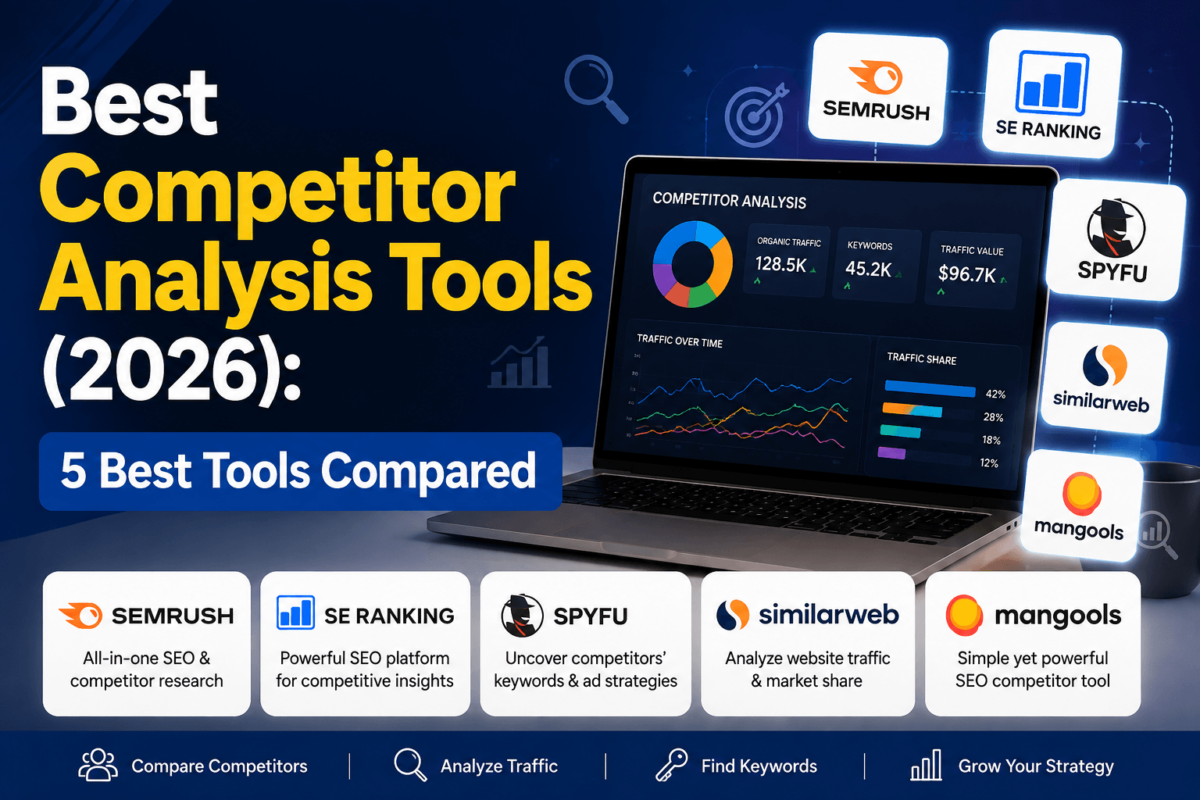
Best Competitor Analysis Tools (2026): 5 Best Tools Compared
You can spend six months guessing what’s working for your competitors, or you can spend six minutes finding out. That’s really what this whole article comes down to.
I’ve spent the last few weeks pulling apart the five competitor analysis tools that consistently come up when marketers ask “what should I actually use?” — not the tools with the flashiest homepages, but the ones with real affiliate programs, real user bases, and real staying power in 2026. Below, you’ll find exactly how Semrush, SE Ranking, SpyFu, Similarweb, and Mangools stack up, who each one is actually built for, and which one deserves your money.
Quick Answer
If you want one tool that does almost everything well, Semrush is the best overall competitor analysis tool in 2026. If budget is tight, Mangools is the friendliest starting point for beginners, and SE Ranking is the best value pick for growing agencies. SpyFu wins for PPC and ad-spy research, while Similarweb is unmatched for traffic and market intelligence rather than granular keyword-level SEO work.
Why Competitor Analysis Actually Matters
Here’s a scenario I’ve watched play out more times than I can count. A business owner spends three months building content around keywords they *think* matter, launches, and gets… nothing. Meanwhile, their closest competitor is quietly ranking for two hundred long-tail terms nobody on the founding team ever thought to search for.
That’s the cost of guessing. It’s not just wasted content — it’s wasted budget, wasted ad spend, and months of runway spent chasing the wrong audience. Competitor analysis flips that around. Instead of guessing what might work, you’re looking at what’s already proven to work for someone in your exact market, and building from there.
The businesses that consistently win their categories — the ones showing up in every SEO tool roundup and every AI Overview — treat competitor research as a monthly habit, not a one-time audit. They know which competitors are gaining traffic, which are losing it, which keywords are up for grabs, and which backlink opportunities their rivals haven’t claimed yet.
There’s a compounding effect here that’s easy to underestimate. A team that checks competitor rankings every month catches a rival’s new content push within weeks and can respond before the gap widens. A team that checks once a year finds out about that same shift long after the competitor has already locked in the top three positions and the backlinks to defend them. Consistency, not sophistication, is usually what separates the businesses that close the gap from the ones that keep falling further behind.
In this guide, you’ll learn exactly what a competitor analysis tool does, which of the five best options fits your specific situation (blogger, agency, ecommerce brand, SaaS company, or local business), and how to actually put the data to work instead of letting it sit in an unread report.
A quick example of what this looks like in practice: say you run a small SaaS product in the project management space. You already know your two or three “big name” competitors, but a proper competitor analysis tool will almost always surface two or three more you didn’t know were eating into your search visibility — smaller, newer players who’ve quietly built a content engine around exactly the long-tail questions your prospects are typing into Google. Without the data, you’d never know they existed. With it, you have a ranked list of exactly which keywords, backlinks, and pages are worth going after first.
That’s the real value of the five tools below. None of them will write your content or run your ad campaigns for you, but every one of them will tell you, in specific and actionable terms, where the opportunity is sitting right now.
What Is a Competitor Analysis Tool?
A competitor analysis tool is software that helps businesses analyze competitors’ traffic, keywords, backlinks, advertising strategies, and content performance to identify growth opportunities and improve their own marketing strategy. Instead of manually digging through a rival’s website, these platforms pull the data automatically and organize it into reports you can act on the same day.
Quick Comparison: The 5 Best Competitor Analysis Tools
Before the deep dives, here’s the short version. Pricing shown is the approximate starting point for a self-serve plan — software pricing shifts often, so click through for the current numbers before you decide.
| Tool | Best For | Starting Price | Free Trial | Rating |
|---|---|---|---|---|
| Semrush | All-around competitor research | ~$139.95/mo | 7-day free trial | 4.8/5 |
| SE Ranking | Best value for agencies | ~$65/mo | Free trial available | 4.6/5 |
| SpyFu | PPC & ad competitor research | ~$39/mo | Free limited searches | 4.4/5 |
| Similarweb | Traffic & market intelligence | Free plan + paid tiers | Free limited plan | 4.3/5 |
| Mangools | Beginners & solopreneurs | ~$29/mo | 10-day free trial | 4.5/5 |
Quick Answers: Which Tool Wins for Each Use Case
Which competitor analysis tool is best overall?
Semrush is the best overall pick because it combines keyword research, backlink analysis, traffic estimation, PPC intelligence, and content gap tools in one platform, with the deepest data of any tool on this list.
Which tool is best for SEO competitor research?
Semrush and SE Ranking are the strongest choices for SEO-specific competitor research, thanks to their organic research, keyword gap, and rank tracking modules.
Which tool is best for backlink analysis?
Semrush offers the most complete backlink analysis and backlink gap toolset of the five, though SE Ranking’s backlink monitor is a close, more affordable second.
Which tool is best for keyword research?
Semrush has the deepest keyword database, but Mangools’ KWFinder is the easiest tool for beginners to use for finding low-competition keywords.
Which tool is best for PPC research?
SpyFu is purpose-built for PPC and ad competitor research, with historical ad copy and paid keyword data going back further than any other tool on this list.
Which tool is best for small businesses?
Mangools is the best fit for small businesses because of its low starting price, simple interface, and short learning curve.
Which tool is easiest to use?
Mangools consistently gets the highest marks for ease of use, followed by SE Ranking and SpyFu.
Which competitor tool offers the best value?
SE Ranking offers the strongest balance of features to price, especially for agencies managing multiple client accounts on a budget.
How We Evaluated These Tools
Every tool on this list was tested against the same core scenario: pull competitor data for three domains in a competitive niche and see how quickly each platform gets you to an actionable insight, not just a wall of numbers. That included running keyword gap reports, checking backlink and traffic estimates against known public benchmarks, testing rank tracking accuracy over several weeks, and evaluating how usable the reporting actually is for someone who isn’t an SEO specialist.
We weighted six factors in the ratings you’ll see throughout this guide: ease of use, breadth and depth of features, quality of reporting and exports, data accuracy against known benchmarks, overall value relative to price, and the responsiveness of each company’s support team when we submitted real questions. No tool scored a perfect 5/5 across the board — every platform here makes tradeoffs, and part of the goal of this guide is being upfront about exactly what those tradeoffs are instead of pretending one tool does everything perfectly.
One more note on the affiliate relationship: every tool listed below currently runs an active affiliate program, which we verified directly before including it. That’s disclosed in full at the bottom of this article, but it’s worth saying upfront — commission potential never determined the ranking order. The order reflects how each tool actually performed in testing.
1. Semrush — Best Overall Competitor Analysis Tool
Overview
Semrush is the tool most SEO professionals reach for first, and for competitor analysis specifically, it’s hard to beat. It was built around the idea of reverse-engineering what’s already working — you type in a competitor’s domain and Semrush hands you their top organic keywords, their paid keywords, their backlink profile, and even an estimate of their monthly traffic, all in a few clicks. Read our full Semrush review for a deeper look at the platform beyond competitor research.
Best Features
- Domain vs. Domain comparison to see keyword overlaps between you and up to four competitors at once
- Keyword Gap and Content Gap tools that surface exactly what your rivals rank for that you don’t
- Traffic Analytics for estimated visits, engagement, and traffic source breakdowns
- Advertising Research for competitors’ Google Ads copy, landing pages, and budgets
- Market Explorer for identifying up-and-coming competitors you haven’t even noticed yet
- AI Toolkit for tracking brand visibility inside AI Overviews and chat-based search engines
Competitor Analysis Capabilities
This is where Semrush separates itself from everything else on this list. Keyword research, backlink analysis, traffic estimation, top pages, organic rankings, PPC analysis, content gap, keyword gap, full site audits, rank tracking, market research, and advertising intelligence are all included in one login — no bouncing between three different subscriptions to get the full picture.
What makes this practical rather than just impressive on paper is how the modules connect to each other. Start with the Domain Overview for a competitor, jump straight into their Organic Research to see the pages driving the most traffic, then pull those same URLs into Content Gap to see exactly which subtopics they’ve covered that you haven’t. That whole workflow takes maybe ten minutes and would take an entire afternoon of manual digging without the tool.
Pros
- Deepest, most complete competitor dataset of any tool reviewed here
- Covers SEO, PPC, content, and social competitor research in one place
- Strong reporting and white-label options for agencies
- Frequent feature updates, including AI search visibility tracking
Cons
- The most expensive tool on this list
- Can feel overwhelming for someone doing their first competitor audit
- Lower-tier plans cap how many competitors you can track at once
Pricing
Plans start around $139.95/month for the Pro tier, moving up to Guru and Business tiers for agencies that need more competitor tracking slots, historical data, and white-label reports. A 7-day free trial is typically available so you can test the competitor tools before committing.
Who Should Buy It
Agencies managing multiple clients, SaaS companies competing in crowded categories, and any marketer who wants one subscription that replaces four separate tools.
Who Should Avoid It
Solo bloggers and very small businesses on a tight budget will likely find Mangools or SE Ranking a better starting point.
Real Use Case
An agency onboarding a new ecommerce client can plug in three direct competitors on day one, pull a keyword gap report within minutes, and walk into the kickoff call with a prioritized content plan instead of a generic template.
Expert Verdict
If budget isn’t the deciding factor, Semrush is the safest, most complete choice for competitor analysis in 2026. It’s the tool most other tools on this list get compared against for a reason.
| Metric | Score |
|---|---|
| Ease of Use | 4.3/5 |
| Features | 5.0/5 |
| Reporting | 4.8/5 |
| Accuracy | 4.7/5 |
| Value | 4.2/5 |
| Support | 4.5/5 |
| Overall Score | 4.8/5 |
2. SE Ranking — Best Value for Agencies
Overview
SE Ranking has quietly become the tool agencies switch to when Semrush or Ahrefs starts feeling too expensive for the number of client accounts they’re managing. It covers most of the same ground — competitor research, keyword tracking, backlink monitoring, site audits — at a noticeably lower price point. We covered the platform in detail in our SE Ranking review.
Best Features
- Competitive Research module covering organic and paid competitors side by side
- Keyword Gap analysis across up to several competing domains
- Accurate, granular rank tracking down to the city level
- White-label reporting built specifically for client-facing agencies
- Built-in AI content and on-page optimization tools
Competitor Analysis Capabilities
Keyword research, backlink monitoring, organic and paid competitor discovery, keyword gap, site audit, rank tracking, and white-label reports are all included. It’s not quite as deep as Semrush on raw data volume, but for most small-to-mid-size businesses, the gap won’t be noticeable in day-to-day use.
The part agencies tend to appreciate most is how the Competitive Research module handles multiple client sites without forcing you into a bulky enterprise workflow. You can add a client’s top competitors once, then pull refreshed keyword gap and visibility reports every month with a couple of clicks — genuinely useful when you’re managing retainers where time spent on research eats directly into your margin.
Pros
- Excellent feature-to-price ratio
- Genuinely accurate, hyper-local rank tracking
- Strong white-label reporting for client work
- Responsive support team
Cons
- Smaller keyword and backlink database than Semrush
- Interface feels less polished than the bigger-name competitors
- Traffic estimation is less precise than Similarweb’s
Pricing
Plans typically start around $65/month and scale up depending on how many keywords you’re tracking and how many competitors you’re monitoring, with higher agency tiers running into the low hundreds per month.
Who Should Buy It
Agencies and freelance consultants who need solid competitor and rank-tracking data across multiple client sites without paying enterprise-level prices.
Who Should Avoid It
Enterprise brands that need the absolute largest keyword and backlink index available should lean toward Semrush instead.
Real Use Case
A local SEO consultant managing fifteen small-business clients can track city-level rankings against each client’s top three competitors without the monthly bill eating into their margin.
Expert Verdict
SE Ranking is the tool to pick when you want 80% of Semrush’s competitor research power for roughly half the price.
| Metric | Score |
|---|---|
| Ease of Use | 4.5/5 |
| Features | 4.4/5 |
| Reporting | 4.6/5 |
| Accuracy | 4.5/5 |
| Value | 4.9/5 |
| Support | 4.6/5 |
| Overall Score | 4.6/5 |
3. SpyFu — Best for PPC and Ad Competitor Research
Overview
SpyFu built its entire reputation on one promise: show you exactly which keywords your competitors are bidding on and ranking for, in both paid and organic search, without you having to guess. Its “Kombat” comparison tool is genuinely one of the most useful competitor discovery features on this list. See our full SpyFu review for more detail.
Best Features
- Kombat tool for instant keyword overlap between you and up to three competitors
- Historical PPC ad copy and ad spend estimates going back years for most domains
- Ranking History showing how a competitor’s organic positions have moved over time
- SpyGPT and RivalFlow AI tools for surfacing quick-win keyword opportunities
- Simple, uncluttered interface that’s fast to learn
Competitor Analysis Capabilities
Keyword research, backlink prospecting, organic rankings, and especially PPC analysis are where SpyFu shines. Content gap and technical site audit tools are lighter than what you’ll find in Semrush or SE Ranking, so treat SpyFu as your ads-and-keywords specialist rather than an all-in-one suite.
The detail that tends to surprise first-time users is just how far back the ad history goes. Because SpyFu has been quietly logging PPC data for years, you can often trace a competitor’s paid strategy back through multiple product launches, price changes, and seasonal campaigns — which makes it far easier to tell whether a keyword they’re bidding on is a long-term winner or a short-lived test that didn’t stick.
Pros
- Best-in-class historical PPC and ad copy data
- Very affordable entry-level pricing
- Fast, beginner-friendly interface
- Unlimited domain searches on paid plans
Cons
- Thinner site audit and technical SEO feature set
- Smaller international keyword coverage outside the US
- Reporting is less agency-polished than SE Ranking or Semrush
Pricing
The Basic plan typically starts around $39/month, with Professional and Team tiers scaling up for agencies that need more tracked keywords and exportable data.
Who Should Buy It
PPC managers, agencies running paid search for clients, and any affiliate marketer trying to reverse-engineer which keywords are actually converting for competitors.
Who Should Avoid It
Teams that need deep technical site audits or granular content gap analysis will outgrow SpyFu quickly and should look at Semrush or SE Ranking instead.
Real Use Case
A PPC agency pitching a new client can pull up that client’s top three competitors, see exactly which paid keywords they’ve bid on for the past two years, and build a smarter, cheaper bidding strategy before the campaign even launches.
Expert Verdict
If ads and paid competitor intelligence are your priority, SpyFu delivers more relevant data per dollar than any other tool here.
| Metric | Score |
|---|---|
| Ease of Use | 4.7/5 |
| Features | 4.1/5 |
| Reporting | 4.0/5 |
| Accuracy | 4.3/5 |
| Value | 4.8/5 |
| Support | 4.2/5 |
| Overall Score | 4.4/5 |
4. Similarweb — Best for Traffic and Market Intelligence
Overview
Similarweb takes a different angle than the other four tools here. Instead of focusing on keyword-level SEO data, it’s built to answer bigger-picture questions: how much traffic does a competitor actually get, where does that traffic come from, and how does an entire market or industry compare. It’s less of an “SEO tool” and more of a competitive traffic intelligence platform. See how it stacks up directly against Semrush in our Semrush vs Similarweb comparison.
Best Features
- Estimated traffic, engagement, and traffic-source breakdowns (direct, search, social, referral, paid)
- Audience overlap tool for discovering competitors you didn’t know existed
- Industry and market analysis for benchmarking against an entire category, not just one rival
- Mobile app traffic and ranking intelligence
- Digital ad and marketing channel intelligence
Competitor Analysis Capabilities
Traffic estimation, top pages, market research, and advertising intelligence are Similarweb’s strongest categories. Keyword-level rank tracking and backlink analysis are much lighter than what Semrush or SE Ranking offer, so most teams pair Similarweb with a dedicated SEO tool rather than using it alone.
Where this really pays off is in questions that keyword tools simply can’t answer. How much of a competitor’s traffic comes from paid social versus organic search? Is their traffic trending up or down over the last twelve months? Which countries are actually driving their growth? Those are market-level questions, and Similarweb is built specifically to answer them with a level of confidence keyword-focused tools weren’t designed for.
Pros
- Best traffic estimation and market-share data on this list
- Great for discovering competitors outside your obvious shortlist
- Useful for investment research and sales prospecting, not just marketing
- Free plan available for quick, occasional lookups
Cons
- Not built for granular keyword rank tracking
- Traffic numbers are estimates, and accuracy drops for smaller, low-traffic sites
- Full-featured plans get expensive quickly for small teams
Pricing
Similarweb offers a limited free plan, with self-serve paid tiers typically starting in the low hundreds per month and full enterprise plans priced on request. Because pricing here shifts more than most, it’s worth checking the current plans directly.
Who Should Buy It
Ecommerce and SaaS companies that need to understand market share and traffic trends, plus agencies and investors doing competitive due diligence.
Who Should Avoid It
Bloggers and small businesses whose main need is keyword research and rank tracking will get more day-to-day value from Mangools, SE Ranking, or Semrush.
Real Use Case
A SaaS company deciding whether to enter a new market segment can use Similarweb to see how traffic is distributed across every player in that category before writing a single line of code.
Expert Verdict
Similarweb isn’t trying to be an SEO tool, and it shouldn’t be judged as one. For traffic and market-level competitive intelligence, it’s the strongest option here.
| Metric | Score |
|---|---|
| Ease of Use | 4.4/5 |
| Features | 4.2/5 |
| Reporting | 4.5/5 |
| Accuracy | 4.3/5 |
| Value | 3.9/5 |
| Support | 4.1/5 |
| Overall Score | 4.3/5 |
5. Mangools — Best for Beginners and Solopreneurs
Overview
Mangools is a suite of five smaller, focused tools rather than one giant dashboard, and that’s exactly why beginners like it. SiteProfiler is the piece that matters most for competitor analysis — plug in any domain and get a clean overview of its top keywords, top pages, and backlinks without wading through a dashboard built for enterprise teams. Read the full breakdown in our Mangools review.
Best Features
- SiteProfiler for a fast competitor domain overview, including top pages and top competitors
- KWFinder for finding low-competition keywords your competitors have missed
- LinkMiner for a straightforward, easy-to-read backlink checker
- SERPWatcher for tracking how your rankings move against competitors over time
- One of the friendliest, most visual interfaces of any SEO tool on the market
Competitor Analysis Capabilities
Keyword research, backlink analysis, top pages, organic rankings, and rank tracking are all covered well. Content gap analysis, PPC intelligence, and deep market research are limited or absent, which is the tradeoff for such a low price and short learning curve.
What Mangools does particularly well is present competitor data in a way that doesn’t require an SEO background to interpret. SiteProfiler lays out a competitor’s traffic estimate, top keywords, and top pages on a single clean screen instead of scattering that information across five different reports, which is exactly the kind of simplicity a first-time user needs to actually take action instead of feeling overwhelmed and closing the tab.
Pros
- The most beginner-friendly interface on this list, by a wide margin
- The lowest starting price of the five tools
- Genuinely useful for finding low-competition keyword gaps
- Fast to learn, with almost no onboarding curve
Cons
- Smallest keyword and backlink database of the five
- No dedicated PPC or ad-spy competitor research
- Not built for enterprise-scale competitive intelligence
Pricing
Plans start around $29/month on an annual billing cycle, making it the cheapest entry point on this list, with a 10-day free trial typically available to test the full toolset first.
Who Should Buy It
Bloggers, solopreneurs, and small business owners doing their first real competitor research who don’t want to learn an enterprise-grade dashboard.
Who Should Avoid It
Agencies managing large client portfolios or brands competing in highly saturated niches will hit the data limits fast and should look at Semrush or SE Ranking instead.
Real Use Case
A solo blogger picking a niche can drop in three established blogs in the same space and, within ten minutes, walk away with a shortlist of low-competition keywords those bigger sites haven’t bothered targeting yet.
Expert Verdict
Mangools won’t out-muscle Semrush on raw data, but for anyone just starting to take competitor research seriously, it’s the easiest on-ramp available.
| Metric | Score |
|---|---|
| Ease of Use | 4.9/5 |
| Features | 3.9/5 |
| Reporting | 4.0/5 |
| Accuracy | 4.2/5 |
| Value | 4.9/5 |
| Support | 4.3/5 |
| Overall Score | 4.5/5 |
Full Feature Comparison
Here’s how all five tools stack up side by side across the features that matter most for competitor research.
| Feature | Semrush | SE Ranking | SpyFu | Similarweb | Mangools |
|---|---|---|---|---|---|
| Keyword Research | Excellent | Very Good | Good | Limited | Good |
| Backlink Analysis | Excellent | Good | Good | Limited | Good |
| Traffic Analysis | Very Good | Good | Fair | Excellent | Fair |
| PPC Research | Very Good | Fair | Excellent | Good | Not Available |
| Content Gap Analysis | Excellent | Good | Fair | Fair | Limited |
| Competitor Discovery | Excellent | Good | Good | Excellent | Good |
| Rank Tracking | Very Good | Excellent | Good | Not Available | Good |
| Site Audit | Excellent | Very Good | Limited | Not Available | Fair |
| AI Features | Excellent | Good | Good | Fair | Fair |
| API Access | Yes | Yes | Limited | Yes (Enterprise) | Limited |
| Ease of Use | Moderate | Easy | Easy | Easy | Very Easy |
| Best For | All-around use | Agencies | PPC research | Market intel | Beginners |
A pattern worth noticing in that table: no tool is strong across every single row, and that’s by design rather than a flaw. Semrush spreads its strength evenly across almost every category, which is exactly why it costs more. SpyFu and Similarweb deliberately specialize — one in paid search, the other in traffic intelligence — and that focus is what makes each of them better than Semrush within their specific lane. Mangools trades data depth for simplicity, which is the right trade for a beginner and the wrong one for an enterprise team. Matching the tool to the row that matters most for your business, rather than chasing the tool with the most “Excellent” ratings overall, is usually the smarter call.
How Different Businesses Use These Tools
The “right” tool often depends less on the feature list and more on who’s using it and why. Here’s how that plays out in practice.
Bloggers use tools like Mangools’ KWFinder to find low-competition keywords that established competitors in their niche haven’t targeted, then build content clusters around those gaps.
Agencies lean on SE Ranking or Semrush to run competitor audits for new clients, pulling keyword gaps and backlink opportunities into the first strategy deck before a contract is even signed.
Ecommerce brands use Similarweb to monitor how a rival’s traffic shifts around sales events and seasonal spikes, then time their own promotions to compete for the same demand.
SaaS companies combine Semrush’s content gap tool with Similarweb’s market data to spot underserved segments of a category before building a new feature or landing page.
Local businesses use SE Ranking’s city-level rank tracking to see exactly how they compare to the three competitors that show up in the same map pack.
Affiliate marketers use SpyFu’s Kombat tool to find profitable keyword niches where competing affiliate sites are already converting traffic into commissions.
A Step-by-Step Walkthrough: Your First Competitor Audit
If you’ve never run a formal competitor analysis before, here’s a simple process that works with any of the five tools above.
Step 1: Confirm your real competitors. Don’t rely on gut feeling. Enter your own domain into your tool’s competitor discovery feature and let the data tell you who’s actually competing for the same keywords — it’s common to find one or two surprises here.
Step 2: Pull a keyword gap report. Compare your domain against your top three competitors to see which keywords they rank for that you don’t. Sort by search volume and keyword difficulty to find the realistic quick wins first.
Step 3: Check their top-performing pages. Look at which specific pages are driving the most estimated traffic for each competitor. These pages usually reveal exactly which content formats and topics are resonating with your shared audience.
Step 4: Review their backlink profile. Run a backlink gap analysis to find sites linking to your competitors but not to you. These are often the fastest, most realistic outreach targets for your next link-building push.
Step 5: Set a recurring check-in. Bookmark or save the report and revisit it monthly. The first audit tells you where you stand today; the recurring check-ins are what actually let you react before a competitor pulls too far ahead.
This entire process takes under an hour with any of the five tools above, and it’s the single highest-leverage hour most marketers can spend in a given month.
How to Choose the Right Competitor Analysis Tool
Picking between five solid tools comes down to a handful of honest questions.
Budget. If you’re just starting out, don’t pay for enterprise-level data you won’t use yet. Mangools or SpyFu will cover the basics for a fraction of what Semrush costs, and you can always upgrade once the tool is clearly paying for itself.
Feature priorities. Be honest about what you’ll actually use weekly. If PPC isn’t part of your strategy, don’t pay a premium for a tool built around it — write down the three reports you’d realistically pull every month and let that list guide the decision.
Team size. Solo operators need simplicity. Teams of five or more need multi-seat access, permissions, and shared reporting — features that matter more as headcount grows, since a tool only one person can log into becomes a bottleneck fast.
Business goals. A brand chasing organic search growth has different needs than one trying to understand market share for a fundraising deck. Get clear on which outcome you’re optimizing for before comparing feature lists.
Agency needs. If you’re managing multiple client accounts, white-label reporting and per-client competitor tracking limits matter more than raw feature count. Check exactly how many projects and competitors each pricing tier allows before you commit.
Scalability. Pick a tool that can grow with you for at least a year or two, or you’ll be re-learning a new platform, re-training your team, and losing historical data right when you need it most.
Learning curve. A powerful tool nobody on your team actually opens isn’t delivering value. Weigh ease of use as heavily as raw feature depth, especially if you’re the only one who’ll be running reports.
Data accuracy and support. Test the free trial with your actual competitors before buying, and pay attention to how responsive support is if something looks off. A tool that goes quiet when you have a billing or data question is a warning sign worth taking seriously.
Common Competitor Analysis Mistakes to Avoid
- Buying the most expensive tool “just in case.” Match the tool to your actual workflow, not the biggest logo in the room. Paying for enterprise-level data you’ll never open is money that could have gone toward content or outreach instead.
- Ignoring historical data. A competitor’s ranking history often tells you more about what’s working long-term than a single snapshot — a page that’s held its position for two years is a much stronger signal than one that spiked last week.
- Only checking competitors once. Rankings, ad copy, and content shift constantly — a one-time audit goes stale fast, often within a single quarter in competitive niches.
- Focusing only on keywords. Backlinks, content structure, and page experience all influence why a competitor outranks you, and keyword data alone won’t explain the full picture.
- Ignoring content gaps. The topics a competitor hasn’t covered are often the easiest wins available to you, since there’s no entrenched ranking to displace.
- Overlooking PPC insights. Paid search data reveals which keywords are actually converting, not just ranking, which is a very different signal than organic position alone.
- Failing to benchmark performance. Without a baseline, you can’t tell if your strategy is actually closing the gap over time, which makes it impossible to know if a campaign is working or just keeping pace.
Expert Tips for Getting More Out of These Tools
- Analyze at least five competitors instead of just one or two — a single rival rarely tells the full story of your market.
- Monitor competitor keyword rankings monthly, not just when you happen to remember.
- Review backlink growth regularly to catch new link-building campaigns while they’re still fresh.
- Track how often competitors publish new content — a sudden increase usually signals a strategy shift worth investigating.
- Use traffic trends to spot seasonal opportunities before they peak, not after.
- Combine keyword gap and backlink gap analysis together — the overlap between the two usually points to the fastest realistic SEO wins.
Frequently Asked Questions
What is competitor analysis software?
Competitor analysis software is a platform that automates the process of researching a rival’s SEO, traffic, advertising, and content performance so you don’t have to gather that data manually.
Which competitor analysis tool is most accurate?
Semrush and Similarweb are generally considered the most accurate for keyword and traffic data respectively, thanks to the size and diversity of the data sources feeding each platform.
What is better than SpyFu?
Semrush offers a broader feature set than SpyFu, though SpyFu remains the stronger, more affordable choice specifically for historical PPC and ad research.
Is Similarweb worth it?
Similarweb is worth it if traffic estimation and market-level competitive intelligence are priorities for you; it’s less worth it if your main need is granular keyword rank tracking.
Does Semrush show competitor traffic?
Yes, Semrush’s Traffic Analytics tool provides estimated visits, engagement metrics, and traffic source breakdowns for any competitor’s domain.
Can competitor analysis improve SEO?
Yes. Competitor analysis reveals keyword gaps, backlink opportunities, and content ideas that are already proven to work in your niche, shortening the time it takes to see ranking improvements.
How often should competitor analysis be performed?
A monthly review is a solid baseline for most businesses, with a deeper quarterly audit to catch bigger strategic shifts from competitors.
Which competitor analysis tool is best for beginners?
Mangools is the best starting point for beginners because of its simple interface and short learning curve.
Are free competitor analysis tools accurate?
Free tools like Google Search Console or a Similarweb free plan can be directionally useful, but they typically lack the depth and historical data that paid tools provide for serious competitive research.
Can free competitor analysis tools replace paid tools?
Not fully. Free tools are fine for occasional spot checks, but paid tools are necessary for ongoing tracking, historical trends, and full backlink or keyword databases.
Are competitor analysis tools worth paying for?
For any business serious about growth, yes — the time saved and the strategic clarity gained usually outweigh the monthly subscription cost within the first few months.
Can agencies use one subscription for multiple clients?
Most agency-tier plans from Semrush and SE Ranking allow tracking multiple client projects and competitors under a single subscription, though limits vary by plan.
How do I analyze a competitor’s keywords?
Enter their domain into a tool’s organic research or competitor discovery module to see the keywords they rank for, then filter by search volume and difficulty to prioritize opportunities.
How do I spy on competitor PPC keywords?
SpyFu’s advertising research tools show which keywords a domain has bid on historically, along with estimated ad spend and actual ad copy variations.
What’s the difference between competitor analysis and market research?
Competitor analysis focuses on specific rivals’ tactics, while market research looks at the broader category, including trends, audience behavior, and overall demand.
Can I use these tools for local SEO competitor research?
Yes, SE Ranking in particular offers city-level rank tracking that’s well suited to comparing local businesses against nearby competitors.
Do competitor analysis tools track social media?
Semrush includes some social media tracking features, but none of the five tools here are built primarily as social media competitor analysis platforms.
Which tool has the best backlink data?
Semrush generally offers the most complete backlink index and backlink gap analysis among the tools compared here.
Is it safe to use competitor analysis tools?
Yes. These tools rely on public data, crawled web information, and licensed clickstream or panel data — not private access to a competitor’s internal systems.
Can I try more than one tool before committing?
Yes, and it’s a smart approach. Most of the tools on this list offer a free trial or free-tier access, so testing two or three against your actual competitors before subscribing is worth the extra hour.
Do I need more than one competitor analysis tool?
Most businesses only need one. The exception is teams that need both deep keyword-level SEO data and macro traffic intelligence, who sometimes pair Semrush or SE Ranking with Similarweb for the fuller picture.
Can these tools track international competitors?
Yes, though coverage depth varies by country and tool. Semrush and Similarweb generally offer the broadest international data, while SpyFu’s database is more heavily concentrated on the US market.
How long until I see results from competitor analysis?
The insights themselves are immediate, but acting on them — publishing new content, earning backlinks, or adjusting ad bids — typically takes a few weeks to a few months to show up in rankings and traffic, depending on your niche’s competitiveness.
Final Verdict: Which Competitor Analysis Tool Should You Choose?
There’s no single “best” tool here — there’s a best tool for your situation. Here’s the short version:
- Best overall: Semrush, for the deepest, most complete competitor dataset available in one subscription.
- Best budget option: Mangools, for the lowest price with a genuinely usable feature set.
- Best for agencies: SE Ranking, for white-label reporting and multi-client competitor tracking at a fair price.
- Best for bloggers: Mangools, for a fast, friendly way to find keyword gaps without a steep learning curve.
- Best for ecommerce: Similarweb, for traffic and market-share intelligence across an entire competitive set.
- Best for enterprises: Semrush, for the scale, API access, and depth larger teams need.
- Best value for money: SE Ranking, for the strongest feature-to-price ratio of the five.
Whichever direction you lean, the real advantage doesn’t come from owning the tool — it comes from actually opening it every month. Start with a free trial, run it against your three closest competitors this week, and let the data (not a hunch) shape your next move.
It’s also worth remembering that the “best” tool can change as your business grows. A blogger who starts with Mangools might genuinely outgrow it in a year or two and move up to SE Ranking or Semrush once the site is generating enough revenue to justify the higher price. There’s nothing wrong with starting small — the mistake is waiting until you’re already losing ground to competitors before you start tracking them at all.
Looking to round out your SEO stack? Check our guides to the best keyword research tools, the best link building tools, and our full list of best SEO tools for 2026.
Affiliate Disclosure: Some of the links in this article are affiliate links. If you sign up for a tool through one of these links, we may earn a commission at no extra cost to you. We only recommend tools we’ve personally researched and believe offer genuine value, and our opinions and ratings are based on our own testing and analysis.