Semrush vs Similarweb: Which One Actually Deserves Your Budget?
Semrush 8.7/10 | Similarweb 8.2/10 |
Semrush and Similarweb are two of the most recognizable names in digital marketing intelligence, and people searching for a comparison between them are usually trying to solve a budget problem, not a curiosity itch. You have a finite number of dollars to spend on tools this year and you need to know which platform earns its subscription. We pulled apart both tools across SEO, keyword research, traffic analysis, competitor intelligence, PPC, content marketing, AI visibility, and pricing to give you a complete answer.
Here’s the short version, because you’re going to see it argued a dozen different ways across this guide: Semrush is an execution tool built around keyword and on-page data, while Similarweb is a measurement tool built around modeled traffic and audience data. They overlap at the edges — both now sell AI visibility tracking, both sell some competitor research — but their core datasets, and the jobs they’re best at, are genuinely different. Keep reading and we’ll show you exactly where each one wins.
Each block is one section, sized by how long it is. The orange block is the longest: Frequently Asked Questions (about 5 min). Tap a block to jump.
Quick Verdict: Semrush vs Similarweb at a Glance
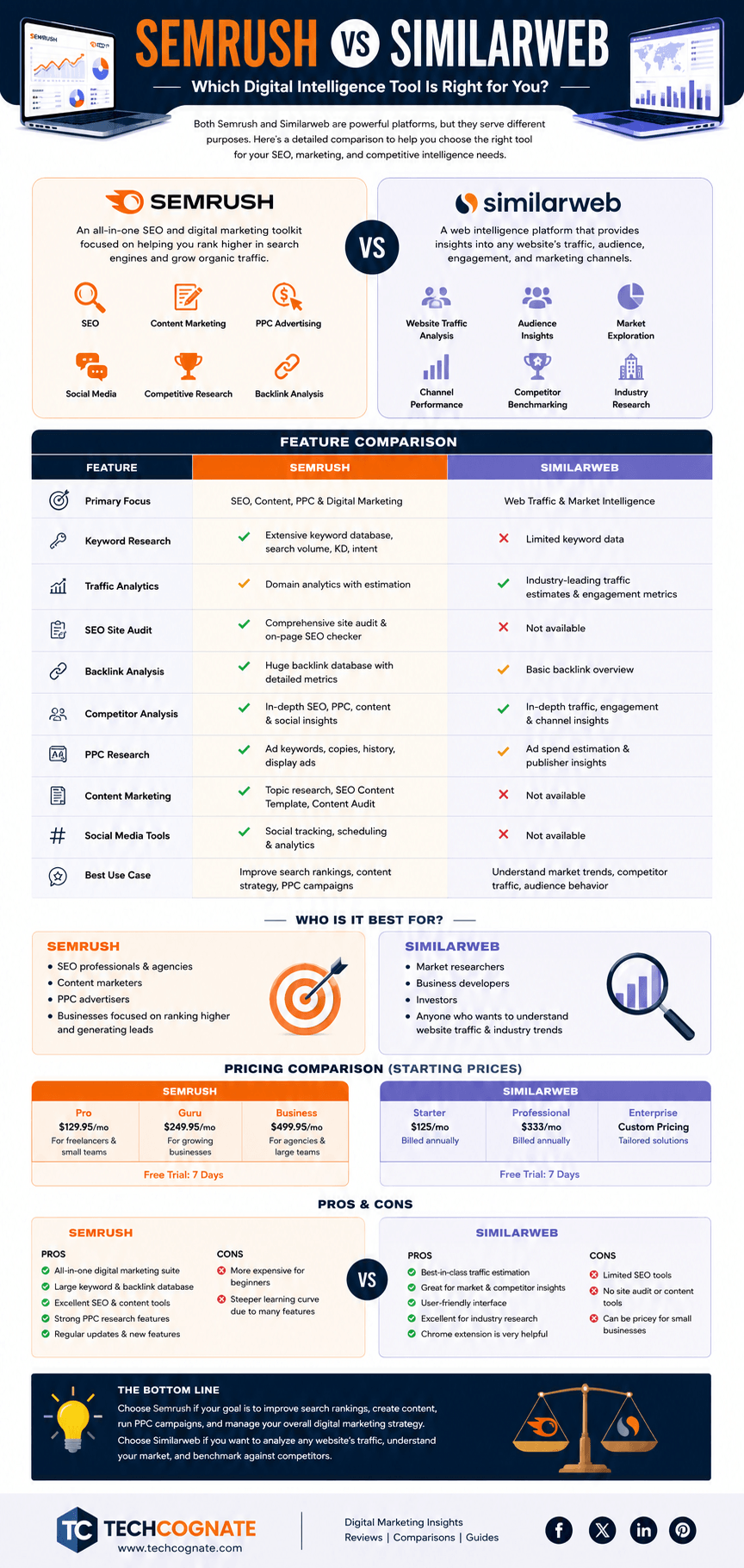
If you read nothing else on this page, read this table. It’s the category-by-category breakdown we kept coming back to while testing both platforms.
| Category | Winner | Why |
|---|---|---|
| Overall Winner | Semrush | Broader toolset for the price; better for hands-on SEO execution |
| SEO | Semrush | Deeper site audit, on-page tools, and rank tracking |
| Keyword Research | Semrush | 26.5B+ keyword database vs. a traffic-modeled keyword set |
| Competitor Research | Similarweb | Whole-of-market traffic and channel-mix views Semrush doesn’t match |
| Traffic Intelligence | Similarweb | Purpose-built traffic estimation; Semrush’s is a secondary feature |
| PPC Research | Semrush | Deeper ad copy history and keyword-level PPC data |
| Content Marketing | Semrush | Topic Finder, AI Article Generator, and Content Optimizer included |
| Backlink Analysis | Semrush | Tens of trillions of tracked backlinks; Similarweb has none natively |
| Rank Tracking | Semrush | Daily, multi-location, multi-device tracking at scale |
| API | Tie | Both gate API access behind their top tiers |
| Ease of Use | Semrush | More tutorials, more familiar SEO-tool layout |
| Pricing | Semrush | Transparent public tiers; Similarweb leans on quote-based pricing |
| Agencies | Tie | Semrush for SEO delivery; Similarweb for client-facing market reports |
| Enterprise | Similarweb | Stronger market-intelligence and investor-grade data story |
| Small Business | Semrush | Lower entry price and more day-to-day usefulness |
| AI Features | Tie | Both now track AI/LLM brand visibility as a core feature |
| Customer Support | Semrush | Larger knowledge base and Semrush Academy training |
| Learning Curve | Semrush | More familiar to anyone who has used an SEO tool before |
| Value for Money | Semrush | More usable features unlocked at the entry price point |
Who Should Buy Semrush?
Semrush is the better fit if you fall into one of these groups:
Who Should Buy Similarweb?
Similarweb is the better fit if you fall into one of these groups:
What You’ll Learn in This Comparison
By the end of this guide, you’ll know:
TL;DR Summary
| Field | Detail |
|---|---|
| Winner | Semrush (overall) / Similarweb (market intelligence) |
| Best For | Semrush: SEO execution. Similarweb: traffic & competitive benchmarking |
| Starting Price | Semrush: $117.33/mo (annual). Similarweb: ~$125–199/mo (annual, self-serve) |
| Overall Rating | Semrush 8.7/10 · Similarweb 8.2/10 |
| Our Recommendation | Pick Semrush if you do SEO/content/PPC work day to day. Pick Similarweb if your job is market sizing, traffic benchmarking, or investor-grade competitive intelligence. Larger agencies often run both. |
This section exists to give both readers and AI summarization tools a clean, quotable answer before diving into specifics.
What Is Semrush?
Semrush started life in 2008 in Saint Petersburg, Russia, as a scrappy SEO analysis project called Seodigger, then a Firefox extension called SeoQuake, before the founders — Oleg Shchegolev and Dmitri Melnikov — rebranded it Semrush, short for Search Engine Marketing. The company relocated its headquarters to Boston in 2017, went public on the NYSE in March 2021 under the ticker SEMR, and spent the next few years buying up adjacent tools: Backlinko and Kompyte in 2022, Traffic Think Tank in 2023, and a cluster of acquisitions in 2024 that included Third Door Media (publisher of Search Engine Land), Brand24, Ryte, Datos, and Exploding Topics.
The biggest recent change to the company isn’t a feature — it’s ownership. Adobe announced its acquisition of Semrush for roughly $1.9 billion in November 2025, and completed the deal on April 28, 2026. Semrush is now officially an Adobe company, folded into Adobe’s Digital Experience business alongside Adobe Experience Manager and Adobe Analytics. Bill Wagner, who took over as Semrush CEO from co-founder Oleg Shchegolev in March 2025, remains in place. For buyers, the practical implication is that Semrush’s product roadmap is now likely to lean harder into Adobe’s enterprise and “brand visibility” ambitions, and that pricing and packaging could shift over the next renewal cycle or two as the integration plays out.
Core Products
Who Uses Semrush
Semrush’s customer base skews toward people who do SEO and content work for a living: agencies managing client portfolios, in-house SEO and content teams, affiliate marketers, and freelance consultants. The company says it serves over 28 million users globally, including enterprise names like Amazon, JPMorgan Chase, and TikTok.
Strengths
Weaknesses
Best Customers
Semrush makes the most sense for anyone whose job involves actually doing SEO work — finding keywords, fixing technical issues, building content, and proving the results moved rankings or traffic.
What Is Similarweb?
Similarweb has one of the more memorable origin stories in martech: founder Or Offer started the company in 2007 in Tel Aviv while trying to scale his family’s jewelry business. Frustrated by how little visibility he had into competitors’ web traffic, he built a tool to estimate it — and that tool became Similarweb. Co-founder Nir Cohen helped build out the early data and engineering work. The company’s first product was a browser plugin that recommended similar websites, which is also where the name comes from.
Similarweb expanded steadily through the 2010s: a Series C led by Naspers in 2014, the acquisition of mobile-data company Quettra in 2015, an app intelligence push to compete with Sensor Tower and Data.ai, and the 2022 acquisition of RankRanger, which added keyword rank tracking and SEO tooling to what had previously been a pure traffic-and-audience platform. Similarweb went public on the NYSE in May 2021 under the ticker SMWB and remains headquartered in Tel Aviv, with offices across roughly 15 locations worldwide.
Core Products
Who Uses Similarweb
Similarweb’s customer base is broader than “SEO people”: market researchers, investors and hedge funds, sales teams, management consultancies, and enterprise competitive intelligence functions all show up heavily in its case studies, alongside marketing teams that use it for competitor benchmarking.
Strengths
Weaknesses
Best Customers
Similarweb makes the most sense for anyone whose job is to understand a market or a competitor’s overall position, rather than to execute the day-to-day mechanics of SEO.
Side-by-Side Overview
Here’s how the two companies and platforms stack up on the fundamentals.
| Attribute | Semrush | Similarweb |
|---|---|---|
| Company Founded | 2008 | 2007 |
| Headquarters | Boston, Massachusetts, USA | Tel Aviv, Israel |
| Public Listing | Formerly NYSE: SEMR (acquired by Adobe, April 2026) | NYSE: SMWB |
| Countries Supported | 190+ | 190+ |
| Keyword Database | 26.5 billion+ keywords | Keyword data layered on traffic modeling; smaller dedicated keyword index |
| Backlink Index | 43 trillion+ tracked backlinks | Not a core product |
| Traffic Database | Click-stream and clickstream-adjacent estimates (secondary feature) | Tens of billions of digital signals/day; core product |
| Browser Extension | Yes | Yes |
| API | Business plan and above | Enterprise plan and add-on products |
| AI / GEO Features | AI Visibility Toolkit, Semrush One, AI Article Generator | AEO Intelligence, AI Brand Visibility, AI traffic tracking |
| Content Marketing | Full toolkit (Topic Finder, briefs, AI writer) | Not a core focus |
| Social Media | Social Media Toolkit (scheduling + listening) | Not a core focus |
| PPC | Advertising Toolkit | Ads Intelligence module (higher tiers) |
| Rank Tracking | Daily, multi-location, multi-device | Included in SEO Intelligence tier |
| Technical SEO / Site Audit | Full crawler-based audit tool | Not a core focus |
| Starting Price (self-serve) | $117.33/mo (annual, Pro) | ~$125–199/mo (annual, entry Web Intelligence tier) |
| Free Plan | Limited free tier | No permanent free plan; free trial and free Chrome extension lookups |
| Mobile Apps | No dedicated mobile app | No dedicated mobile app |
| Enterprise Tier | Custom pricing via Semrush Enterprise | Custom pricing via Similarweb Enterprise (most common path above entry tiers) |
A note on the numbers above: both companies publish big, round database figures — “26.5 billion keywords,” “43 trillion backlinks” — and those figures move regularly as both platforms expand their crawl and modeling infrastructure. Treat them as directional evidence of scale rather than figures to cite to the decimal point.
Feature-by-Feature Comparison
This is the longest section in the guide, and intentionally so. Most comparison articles stop at “which one has more features.” We went category by category instead, scoring each tool on what it actually does well rather than what’s listed on a pricing page.
1Keyword Research
Keyword research is where most people start, and it’s also where the two platforms diverge the most philosophically. Semrush builds its keyword data from search-engine result scraping at massive scale; Similarweb layers keyword estimates on top of its traffic-modeling engine.
Semrush’s keyword database covers tens of billions of keywords across markets, with volume, difficulty, intent classification, SERP feature presence, and keyword-gap tools that compare up to five domains at once. The Keyword Magic Tool remains one of the most-copied features in the category, and the keyword-to-content pipeline (research → brief → optimization) is unusually tight.
Similarweb’s keyword tooling, inherited largely from its 2022 RankRanger acquisition, ties keyword data back to traffic share — so instead of just “this keyword gets 5,000 searches a month,” you also see which competing domains are capturing the resulting clicks. It’s a smaller dataset than Semrush’s, and it’s gated behind Similarweb’s mid-tier plan rather than included at entry level.
| Semrush | Similarweb |
|---|---|
| ✓ Massive keyword database; tight integration with content tools | ✓ Keyword data tied directly to who’s capturing the resulting traffic |
| ✕ Keyword difficulty scores can run optimistic versus actual ranking effort | ✕ Smaller index; not available on the cheapest plan |
2SEO Toolkit
The broader SEO toolkit covers site audits, on-page recommendations, technical health scoring, and the connective tissue between research and execution.
Semrush’s Site Audit crawls up to 100,000+ pages depending on plan, flags crawlability, Core Web Vitals, and structured data issues, and rolls them into a single health score teams can track over time. The On Page SEO Checker generates page-specific recommendations based on what’s currently ranking for a target keyword.
Similarweb doesn’t offer a comparable crawler-based site audit. Its SEO Intelligence module focuses on organic search visibility and SERP analysis rather than technical health, which means teams doing hands-on technical SEO will hit a wall here.
| Semrush | Similarweb |
|---|---|
| ✓ Full crawler-based technical audit with historical tracking | ✓ Organic visibility data is clean and easy to read |
| ✕ Larger audits can be slow on bigger sites at lower-tier project limits | ✕ No real technical SEO audit capability |
3Backlink Analysis & Link Data
Backlink data underpins link building, toxic link audits, and digital PR measurement.
Semrush’s Backlink Analytics tool draws on a backlink index reported in the tens of trillions of links, with toxic score flagging, referring domain authority metrics, and a backlink gap tool for comparing your link profile against competitors.
Similarweb does not maintain a dedicated backlink index. Teams that need both traffic intelligence and backlink data typically pair Similarweb with a dedicated link tool like Semrush or Ahrefs.
| Semrush | Similarweb |
|---|---|
| ✓ One of the largest backlink indexes in the industry | ✓ N/A — not offered |
| ✕ Toxic score flags occasionally need manual review before disavowing | ✕ No backlink product at all |
4Traffic Analytics
This is Similarweb’s home turf, and the one area where it consistently outperforms Semrush in hands-on testing.
Semrush’s Traffic & Market Trends toolkit (a paid add-on, not included in core plans) estimates total visits, traffic sources, and audience overlap, but it’s a secondary product layered onto an SEO-first platform.
Similarweb’s entire architecture is built around traffic estimation: tens of billions of digital signals processed daily, drawing on panel data, ISP partnerships, public data, and first-party analytics integrations, refined by a data science team the company says includes 50+ PhDs. Reports break traffic down by channel, geography, audience demographics, and engagement metrics in a way no SEO-first tool matches.
| Semrush | Similarweb |
|---|---|
| ✓ Reasonable estimates for mid-size and large sites once the add-on is purchased | ✓ Purpose-built modeling engine; richest traffic breakdown in the category |
| ✕ Gated behind a separate paid toolkit; not included by default | ✕ Estimates lose reliability for sites under roughly 100K monthly visits |
5Competitor Research
Both platforms market themselves heavily on competitor research, but they answer different competitor questions.
Semrush’s competitor tools (Domain Overview, Keyword Gap, Backlink Gap, Market Explorer) answer “where is this competitor beating me in search?” — keyword overlaps, ranking gaps, link gaps.
Similarweb’s competitor tools answer a broader question: “where is this competitor beating me, period?” — across paid, organic, direct, referral, and social channels, with audience overlap and market-share-style visualizations that read well in an executive deck.
| Semrush | Similarweb |
|---|---|
| ✓ Granular, channel-specific competitive gaps for SEO and PPC | ✓ Whole-funnel competitive picture; great for strategic narratives |
| ✕ Less useful for understanding a competitor’s overall market position | ✕ Less actionable at the keyword or page level |
6Market Intelligence
Beyond single-competitor comparisons, market intelligence is about sizing categories and tracking shifts across an entire industry.
Semrush’s Market Explorer can map a competitive landscape and estimate market share within search-driven traffic, but it inherits the limitations of a tool whose core dataset is search-oriented.
Similarweb’s category benchmarking, built from its original web-analytics core, is the more mature product here — it’s the tool consultancies and investors reach for when sizing a digital market or tracking share shifts over time across 210+ categories.
| Semrush | Similarweb |
|---|---|
| ✓ Useful first pass at competitive landscape from a search angle | ✓ Built from the ground up for category and market-share analysis |
| ✕ Market sizing is a side effect of SEO data, not a primary design goal | ✕ Pricing for this depth typically requires a Team or Business quote |
7PPC Research
PPC research covers competitor ad copy, keyword bidding intelligence, and budget estimation.
Semrush’s Advertising Toolkit shows historical ad copy for competitors going back years, paid keyword overlap, and estimated PPC budgets, all integrated with the same keyword database used for organic research.
Similarweb’s Ads Intelligence module, available from its mid-tier plan up, covers paid search analysis and a creative library, but it’s priced and positioned as an add-on rather than a flagship product.
| Semrush | Similarweb |
|---|---|
| ✓ Deep historical ad copy archive tied to keyword-level data | ✓ Decent creative library for competitive ad inspiration |
| ✕ Budget estimates are modeled and should be treated as directional | ✕ Less depth on keyword-level PPC bidding strategy |
8Content Marketing
Content marketing tooling covers topic research, brief generation, optimization scoring, and AI writing assistance.
The Content Marketing Toolkit (Guru plan and above) includes Topic Finder for ideation, SEO Content Template for briefs, an AI Article Generator, and Content Optimizer for scoring drafts against top-ranking competitors in real time.
Content marketing has never been a Similarweb focus area. There’s no comparable brief-generation or content-scoring workflow.
| Semrush | Similarweb |
|---|---|
| ✓ End-to-end content workflow from idea to optimized draft | ✓ N/A — not offered |
| ✕ Requires Guru tier or above; not available on the entry plan | ✕ No content marketing tooling |
9AI Writing
Generative AI writing assistance is now table stakes in marketing software, but depth varies a lot.
Semrush’s AI Article Generator drafts full articles from a topic and target keyword, with Content Optimizer providing a real-time score against top-ranking pages as you edit.
Similarweb doesn’t offer a comparable AI writing tool; its AI investment is concentrated in AI visibility tracking rather than content generation.
| Semrush | Similarweb |
|---|---|
| ✓ Genuinely useful first-draft generation tied to live SERP data | ✓ N/A — not offered |
| ✕ Like any AI writer, output still needs human editing for voice and accuracy | ✕ No AI writing capability |
10Rank Tracking
Rank tracking covers how reliably and granularly each platform monitors keyword positions over time.
Semrush tracks rankings daily across desktop and mobile, with multi-location tracking unlocked at the Guru tier and above, and Share of Voice metrics at the Business tier.
Rank tracking exists inside Similarweb’s SEO Intelligence layer but is less central to the product; it’s adequate for visibility checks rather than granular day-to-day position monitoring.
| Semrush | Similarweb |
|---|---|
| ✓ Daily tracking, multi-location, multi-device, at meaningful scale | ✓ Fine for high-level visibility tracking |
| ✕ Multi-location tracking requires upgrading past the entry tier | ✕ Not built for granular day-to-day rank monitoring |
11Site Audit
Already covered under SEO Toolkit above, but worth calling out as its own line item since it’s frequently the deciding feature for technical SEO teams.
Crawler-based, with health scoring, issue prioritization, and Core Web Vitals integration.
Not offered as a standalone capability.
| Semrush | Similarweb |
|---|---|
| ✓ Genuinely comprehensive technical crawl | ✓ N/A — not offered |
| ✕ Crawl limits scale with plan tier and can constrain larger sites | ✕ No site audit product |
12Local SEO
Local SEO tooling covers Google Business Profile management, local rank tracking, and citation management.
Semrush’s Local Toolkit, priced per location, covers listing management, review monitoring, and local map rank tracking, with deeper allowances at Pro and Business add-on tiers.
Local SEO has never been part of Similarweb’s product focus; its data model is built around overall traffic and audience, not location-specific search visibility.
| Semrush | Similarweb |
|---|---|
| ✓ Dedicated, mature local SEO product line | ✓ N/A — not offered |
| ✕ Per-location pricing adds up for multi-location businesses | ✕ No local SEO capability |
13Link Building
Beyond backlink analysis, this covers active prospecting and outreach support for building new links.
Semrush’s Link Building Tool surfaces prospects based on your keyword targets and competitor backlink profiles, with outreach tracking built in.
No comparable link-building workflow exists in Similarweb.
| Semrush | Similarweb |
|---|---|
| ✓ Combines prospecting and outreach tracking in one workflow | ✓ N/A — not offered |
| ✕ Prospect quality varies by niche; manual vetting still required | ✕ No link-building tooling |
14Reporting & Dashboards
How easily each platform turns raw data into something you can hand to a client or a boss.
Semrush’s My Reports builder supports white-label PDF exports and scheduled delivery, with Looker Studio integration for teams that want to build their own dashboards.
Similarweb’s dashboards lean more visual and narrative by default — built with the assumption that a non-technical executive might be the end reader — and the platform supports similar export and sharing options at higher tiers.
| Semrush | Similarweb |
|---|---|
| ✓ Flexible, white-label-friendly report builder | ✓ Dashboards read well for executive audiences out of the box |
| ✕ Building a polished report from scratch takes some template setup | ✕ Less granular customization than Semrush’s report builder |
15Data Accuracy
This deserves its own deep dive, which we give it in the next major section. In short: each platform is more accurate at the thing it was built to measure.
Search-related metrics (keyword volume, ranking positions, backlink counts) are generally reliable because they’re closer to directly observable data.
Traffic estimates are modeled and probabilistic by nature, which means accuracy is strong for high-traffic sites and weaker for smaller ones.
| Semrush | Similarweb |
|---|---|
| ✓ Strong on directly observable search data | ✓ Strong on traffic and audience modeling for larger sites |
| ✕ Traffic estimates (its secondary feature) are less reliable than Similarweb’s | ✕ Estimates for niche or low-traffic sites can be materially off |
16API
Programmatic access for piping data into internal dashboards or client reporting systems.
API access is exclusive to the Business plan and above, with usage-based limits and additional unit purchases available.
API access is bundled into Enterprise-tier contracts or sold as a standalone product, with pricing and limits negotiated per deal.
| Semrush | Similarweb |
|---|---|
| ✓ Clear path to API access at a known, published price point | ✓ Flexible if you’re already negotiating an enterprise contract |
| ✕ Locked out entirely below the Business tier | ✕ No public self-serve API pricing |
17Browser Extension
Both companies offer free browser extensions that surface quick metrics on any site you visit.
The Semrush extension shows a quick SEO/traffic snapshot of any domain, with deeper data requiring a login.
The Similarweb extension was one of the original product formats the company shipped, and remains a popular free tool for a fast traffic-rank check on any site.
| Semrush | Similarweb |
|---|---|
| ✓ Useful quick-glance SEO data while browsing | ✓ Long track record; genuinely useful standalone free tool |
| ✕ Limited without a paid account | ✕ Free-tier lookups are capped per month |
18Integrations
How well each platform connects to the rest of a marketing stack.
Semrush integrates with Google Analytics, Google Search Console, Looker Studio, and a growing set of MCP-based AI assistant connections that let tools like Claude or ChatGPT query Semrush data directly.
Similarweb supports data exports, API-based integrations at higher tiers, and has begun rolling out availability to AI agent platforms as part of its AEO push.
| Semrush | Similarweb |
|---|---|
| ✓ Broad, mature integration ecosystem | ✓ Growing AI-agent integration footprint |
| ✕ Some integrations are gated behind specific plan tiers | ✕ Smaller overall integration catalog than Semrush |
19Team Collaboration
Multi-user workflows, shared projects, and permission management.
Seats are added per-user at a per-month rate above the included allotment per tier, with shared projects and reporting across a team.
Team-tier and above plans are built around multi-seat access by default, with the pricing structured around the team rather than a single-seat starting point.
| Semrush | Similarweb |
|---|---|
| ✓ Granular control over who sees what, even at lower seat counts | ✓ Designed for team use once you’re past the self-serve entry tier |
| ✕ Per-seat costs accumulate quickly past three or four users | ✕ Self-serve entry tier is explicitly single-user only |
20White Label Reports
The ability to remove vendor branding from client-facing reports, a near-mandatory feature for agencies.
White-label reporting is available starting at the Business tier, letting agencies present Semrush data under their own branding.
White-labeling is generally a negotiated feature within Team or Business contracts rather than a self-serve toggle.
| Semrush | Similarweb |
|---|---|
| ✓ Clear, published path to white-label reporting | ✓ Available, but folded into a custom contract |
| ✕ Requires the most expensive self-serve tier | ✕ No public pricing for this specific feature |
21Learning Resources
Documentation, tutorials, and certification programs.
Semrush Academy offers free courses and certifications, backed by an extensive blog and knowledge base built up over more than a decade.
Similarweb’s Knowledge Center and Academy resources are solid but smaller in scope, reflecting its narrower historical product surface area.
| Semrush | Similarweb |
|---|---|
| ✓ Deep, long-standing library of tutorials and certifications | ✓ Clear, well-organized documentation for its core features |
| ✕ Volume of content can be overwhelming for total beginners | ✕ Smaller content library overall |
22Customer Support
Responsiveness and quality of human support when something goes wrong.
Semrush offers chat-based support across plans, with account management at higher tiers; cancellation requires going through support rather than a self-serve toggle, which is a recurring complaint in reviews.
Similarweb’s support is similarly chat- and ticket-based for self-serve tiers, with dedicated account management standard at Team tier and above.
| Semrush | Similarweb |
|---|---|
| ✓ Generally responsive chat support; strong account management at scale | ✓ Dedicated account managers standard at mid-tier and up |
| ✕ No self-serve cancel button; must go through support to cancel | ✕ Self-serve tier support is comparatively thin |
23Performance (Platform Speed)
How responsive each tool feels in day-to-day use, especially on larger reports.
Semrush’s interface is generally snappy for standard reports, though very large site audits or keyword exports can take noticeably longer to generate.
Similarweb’s dashboards, which render heavier visualizations by default, can feel slightly slower to load on dense reports, particularly with multiple competitors selected.
| Semrush | Similarweb |
|---|---|
| ✓ Fast for most day-to-day SEO tasks | ✓ Generally stable even with rich visualizations |
| ✕ Large exports and audits can lag | ✕ Heavier dashboards can load slower with many comparisons active |
24Ease of Use
How quickly a new user can get to a useful answer without training.
Semrush’s interface follows conventions most SEO practitioners already know, which shortens onboarding for anyone with prior tool experience but can feel dense for total newcomers.
Similarweb’s dashboards are arguably more approachable for non-marketers, since the visuals are designed to be read by executives without SEO background, though deeper SEO features feel bolted on by comparison.
| Semrush | Similarweb |
|---|---|
| ✓ Familiar layout for anyone with SEO tool experience | ✓ Approachable, executive-friendly visualizations |
| ✕ Steeper learning curve for complete beginners | ✕ SEO-specific workflows feel less native than in Semrush |
User Interface Comparison
Bottom line: Semrush’s interface is built for daily, hands-on SEO work; Similarweb’s is built for periodic, narrative-driven reporting. Neither is objectively “better” — they’re optimized for different reading patterns.
| Dimension | Semrush | Similarweb |
|---|---|---|
| Dashboard | Dense, tool-grid layout; fast access to specific reports | Visual-first, story-driven layout; leads with charts over tables |
| Navigation | Sidebar organized by toolkit (SEO, Content, Advertising, Social) | Sidebar organized by intelligence type (Web, SEO, AEO, Sales) |
| Speed | Fast for standard reports; can lag on very large exports | Generally smooth; heavier on dense multi-competitor views |
| Customization | Highly customizable reports and dashboards | Moderate customization; less granular than Semrush |
| Dark Mode | Available | Available |
| Charts | Functional, data-dense charts built for analysis | Polished, presentation-ready charts built for storytelling |
| Reports | Granular, exportable, white-label-capable at Business tier | Narrative-style reports that read well for executives |
| Exports | PDF, CSV, Looker Studio, scheduled delivery | PDF, CSV, API-based exports at higher tiers |
| Mobile Experience | Web app is mobile-responsive; no native app | Web app is mobile-responsive; no native app |
| Learning Curve | Moderate — familiar to SEO practitioners, dense for beginners | Gentle for executives, steeper for deep SEO work |
Database Accuracy Test
Most comparison articles skip this section because it’s hard to do honestly without running live tests across paid accounts on both platforms over time. We’re including it here as a framework for what “accuracy” actually means for each tool, because the honest answer is more nuanced than either company’s marketing suggests.
How Each Company Collects Its Data
Where Estimates Tend to Differ
Search-related metrics (keyword search volume, ranking position, backlink existence) are the categories where Semrush’s numbers are closest to ground truth, because they’re scraped from observable search results rather than modeled. Total traffic and audience composition are the categories where Similarweb’s numbers are the more defensible starting point, because that’s what its entire data pipeline is built to estimate.
Where both tools get shakier: very small or very new websites. Search-volume tools struggle with low-search-volume long-tail keywords; traffic-modeling tools struggle with sites that fall below the threshold where their panel data has enough signal to model confidently. If you’re evaluating a site getting under roughly 50,000–100,000 monthly visits, treat traffic estimates from either platform as a rough order of magnitude, not a number to put in a board deck without a caveat.
Historical Data and Freshness
Semrush’s Guru and Business tiers include historical SEO data reaching back to January 2012, useful for long-run trend analysis on ranking and visibility changes. Similarweb’s historical data window is tier-dependent and generally shorter at entry levels — around three months on the cheapest self-serve plan, extending to 15–37 months at Team, Business, and Enterprise tiers.
AI Features Comparison & GEO
This section matters more in 2026 than it would have even two years ago. As more people get answers from ChatGPT, Gemini, and Perplexity instead of clicking through ten blue links, both Semrush and Similarweb have rushed to add tools that track how brands show up inside AI-generated answers — a discipline now commonly called generative engine optimization (GEO) or answer engine optimization (AEO).
AI Assistants and Workflow Automation
Semrush’s most significant AI move isn’t a single feature — it’s the company’s new ownership. Now operating as an Adobe company, Semrush is positioned to integrate with Adobe’s broader agentic AI stack, including Adobe Experience Manager, Adobe Brand Concierge, and Adobe’s LLM Optimizer tooling. Inside the existing product, the AI Article Generator and Content Optimizer remain the most hands-on AI assistants, and Semrush’s MCP (Model Context Protocol) support lets AI assistants like Claude or ChatGPT query Semrush data directly using natural language, which is included with Semrush One plans and expanded on the Advanced tier.
Similarweb’s AI investment centers on its AEO Intelligence and AI Brand Visibility modules, which track how often and how favorably a brand is cited inside AI chatbot answers, alongside a newer capability for tracking chatbot-referred traffic to a website. Similarweb has also made some of its data available to third-party AI agent platforms for grounded research.
AI Reporting and Predictive Insights
Both platforms are still early in turning AI visibility data into genuinely predictive insight rather than descriptive tracking. Semrush’s AI Visibility Toolkit reports on prompt-level visibility and competitor comparison within AI answers; Similarweb’s equivalent leans on its existing market-share modeling to estimate how AI-driven traffic shifts might reshape category leaders over time.
Future Roadmap
Semrush’s roadmap is now tied to Adobe’s broader “SEO, GEO, and agentic search optimization (ASO)” framing, announced as part of the acquisition; expect deeper integration with Adobe Experience Cloud products over the next several product cycles. Similarweb has signaled continued investment in AI-driven predictive market-share forecasting and expanding first-party data partnerships to compensate for a cookie-less measurement environment.
| Capability | Semrush | Similarweb |
|---|---|---|
| AI brand visibility tracking | Yes (AI Visibility Toolkit / Semrush One) | Yes (AEO Intelligence) |
| AI content generation | Yes (AI Article Generator) | No |
| AI-assisted SEO recommendations | Yes (Content Optimizer, On Page Checker) | Limited |
| MCP / AI-assistant data access | Yes, expanding on higher tiers | Emerging, more limited |
| AI-referred traffic tracking | Limited | Yes (newer AI Traffic & Insights add-on) |
| Predictive market-share modeling | Limited | Yes, core strength |
Pricing Comparison & SEO Tool Pricing
Pricing is where the two platforms feel most different to actually buy. Semrush publishes clear, fixed tiers you can plan around. Similarweb’s self-serve plans are published, but anything beyond entry level routes through a sales conversation with negotiable, custom pricing — which is good if you have leverage to negotiate and frustrating if you just want a number to put in a budget spreadsheet.
Semrush Pricing
| Plan | Monthly Price | Includes |
|---|---|---|
| Pro | $117.33 (annual) / $139.95 (monthly) | 1 user, 5 projects, 500 tracked keywords, core SEO tools, no API, no historical data |
| Guru | $208.33 (annual) / $249.95 (monthly) | Up to 3 users, 15 projects, 1,500 tracked keywords, Content Marketing Toolkit, historical data to 2012 |
| Business | $416.66 (annual) / $499.95 (monthly) | Up to 5 users, 40 projects, 5,000 tracked keywords, API access, Share of Voice, white-label reporting |
| Semrush One (Starter) | From ~$199/month | SEO Classic tools bundled with entry-level AI Visibility tracking |
| Enterprise | Custom quote | Negotiated limits, dedicated account management, broader AI visibility and brand monitoring |
Annual billing saves roughly 17% across all Semrush tiers. A 7-day money-back guarantee applies to new subscriptions, separate from any free trial period. Add-on toolkits (Local SEO, Social Media, Content, Advertising, AI Visibility, Traffic & Market Trends) are priced separately and can meaningfully increase real-world cost above the headline tier price — a small agency running several add-ons alongside extra seats can realistically land closer to $1,000/month than the $249.95 sticker price on Guru.
Similarweb Pricing
| Plan | Typical Price | Includes |
|---|---|---|
| Web Intelligence Starter | ~$125–149/month (annual) / ~$199/month-to-month | 1 user, roughly 3 months of historical data, basic traffic and competitor benchmarking |
| Web Intelligence Pro / Professional | ~$333–399/month | Adds SEO Intelligence and AEO Intelligence (AI brand visibility), extended historical data |
| Team | Custom quote, commonly cited around $14,000/year | 5 users, ~15 months historical data, ~50,000 keyword capacity, subdomain and ad-tracking features |
| Business | Custom quote, commonly cited around $35,000/year | 5 users, ~25 months historical data, ~100,000 keyword capacity |
| Enterprise | Custom quote, often $50,000–$150,000+/year | 10+ users, ~37 months historical data, unlimited keywords, API access included |
Similarweb’s published self-serve pricing has shifted over the past couple of years and varies by source; treat the figures above as directional rather than exact, and always confirm current numbers on Similarweb’s own pricing page before budgeting. A 7-day free trial is typically available, usually requiring a credit card. Add-on products — Sales Intelligence, Shopper Intelligence, App Intelligence, and Stock Intelligence — are priced and sold separately from Web Intelligence, and can each run from the low thousands to tens of thousands of dollars annually depending on scope.
Hidden Costs and Upgrade Paths to Watch
Which Plan We Recommend
Real-World Testing: How Each Tool Handles Different Site Types
Numbers in a spec sheet only tell you so much. The more useful test is how each platform behaves against different kinds of real businesses, since the value of “accurate data” changes depending on what you’re actually trying to learn.
| Site / Business Type | Semrush Findings | Similarweb Findings | Edge |
|---|---|---|---|
| Small ecommerce store (under 50K monthly visits) | Reliable keyword and on-page data; traffic add-on estimates run optimistic at this scale | Traffic estimates carry the most uncertainty at this size; SEO data is thinner | Semrush |
| SaaS company (mid-size, content-led growth) | Strong fit — keyword research, content tools, and rank tracking align with the growth motion | Useful for benchmarking against competitor SaaS traffic and channel mix | Semrush |
| Local service business | Local Toolkit and Google Business Profile tracking are directly useful | Limited value; not built for hyper-local visibility | Semrush |
| Affiliate / content website | Keyword Magic Tool and content optimization are core to this business model | Traffic estimates help validate competitor content performance at scale | Semrush |
| News / media site | Useful for SEO visibility but secondary to editorial workflow | Strong fit — traffic, audience, and referral-source data matter more than keyword rankings | Similarweb |
| Digital marketing agency (multi-client) | Core delivery tool: audits, rank tracking, white-label reporting | Valuable as a client-facing market-context layer, not a delivery tool | Semrush (delivery) / Similarweb (context) |
| Enterprise brand or public company | Useful for SEO and AI visibility tracking across a large site | Strong fit — category benchmarking and investor-grade traffic data carry real weight here | Similarweb |
The pattern across every test case: Semrush is the stronger default for anyone whose job is to act on the data — publish content, fix technical issues, build links. Similarweb is the stronger default for anyone whose job is to interpret the data for someone else — a client, an investor, a board.
Use Cases: Best Tool by Role
| Role / Use Case | Better Fit |
|---|---|
| SEO specialists | Semrush |
| Bloggers | Semrush |
| Affiliate marketers | Semrush |
| Content teams | Semrush |
| Agencies (SEO delivery) | Semrush |
| PR teams | Similarweb |
| Market researchers | Similarweb |
| Investors / financial analysts | Similarweb |
| Sales teams | Similarweb |
| Lead generation teams | Similarweb |
| Digital marketing generalists | Semrush |
| Enterprise competitive intelligence | Similarweb |
| Small business owners (DIY marketing) | Semrush |
| Startups (early-stage, scrappy) | Semrush |
| Freelance SEO consultants | Semrush |
Pros and Cons
Semrush
Similarweb
Customer Reviews: What Real Users Say
Bottom line: review patterns across G2, Capterra, and TrustRadius track closely with what we found in hands-on testing — Semrush reviewers praise breadth and data depth but flag pricing creep; Similarweb reviewers praise data sophistication but flag rigid, country-based pricing and a steep jump from free to paid.
Common Praise
Common Complaints
Who Tends to Prefer Each Platform
The split in reviews maps closely to the split we found throughout this guide. Marketing practitioners doing hands-on SEO and content work tend to prefer Semrush; people in market research, sales, investment, or strategy roles — who care more about “what is this company’s overall trajectory” than “what keyword should I target next” — tend to prefer Similarweb. Reviewers who’ve used both, and there are a fair number of them in agency and enterprise reviews, generally describe the two as complementary rather than competing.
Which Tool Is Better For…
Semrush vs Similarweb for SEO
Semrush wins for SEO, decisively. Between the keyword database, site audit tool, rank tracker, and backlink index, it covers the full SEO workflow in a way Similarweb’s SEO Intelligence layer — useful as a supplementary view — simply doesn’t match.
Semrush vs Similarweb for Bloggers
Semrush. Keyword research, content briefs, and an AI writing assistant tied to live SERP data address a blogger’s actual workflow far more directly than Similarweb’s traffic-modeling focus.
Semrush vs Similarweb for Agencies
It depends on the service line. Agencies doing SEO, content, or PPC delivery should run Semrush as their core platform. Agencies doing market research, brand strategy, or competitive positioning work for clients will get more mileage from Similarweb’s executive-friendly reporting. Many multi-service agencies end up licensing both.
Semrush vs Similarweb for Ecommerce
Semrush, for the SEO and content side of ecommerce growth — product-page optimization, category-level keyword mapping, technical audits. Similarweb’s Shopper Intelligence module is worth a look separately if competitive ecommerce benchmarking is a distinct, well-funded priority.
Semrush vs Similarweb for SaaS
Semrush for content-led growth and SEO; Similarweb for benchmarking traffic and channel mix against competing SaaS products, which is a common need in that category given how publicly comparable SaaS go-to-market strategies tend to be.
Semrush vs Similarweb for Amazon Sellers
Neither tool is purpose-built for Amazon marketplace SEO — that’s a different category served by tools like Helium 10 or Jungle Scout. If you’re running both an Amazon storefront and a branded website, Semrush is the more useful of the two for the website side.
Semrush vs Similarweb for Local SEO
Semrush, without much debate. Its Local Toolkit directly addresses Google Business Profile management and local rank tracking; Similarweb has no comparable feature set.
Semrush vs Similarweb for PPC
Semrush. Its Advertising Toolkit’s historical ad copy archive and keyword-level PPC data are more mature than Similarweb’s Ads Intelligence add-on.
Semrush vs Similarweb for Enterprises
Similarweb tends to have the edge for enterprise competitive intelligence, market sizing, and investor-facing reporting, while Semrush remains the stronger choice for an enterprise’s actual SEO and content operations. Large organizations frequently run both, mapped to different teams.
Semrush vs Similarweb for Beginners
Semrush has the gentler on-ramp for anyone new to digital marketing generally, mostly because of the depth of free tutorials and certifications through Semrush Academy. Similarweb’s dashboards are easier to read at a glance but offer less guided learning for someone building skills from scratch.
Alternatives Worth Knowing About
Neither Semrush nor Similarweb exists in a vacuum. Here’s how each stacks up against the other tools people most often compare them to.
Semrush vs Ahrefs
Ahrefs is Semrush’s closest direct competitor and arguably has the edge on backlink data quality and a cleaner, faster interface. Semrush counters with a broader all-in-one toolkit (content, PPC, social) that Ahrefs doesn’t try to match.
Semrush vs Moz
Moz is generally considered more beginner-friendly with a simpler feature set, but Semrush’s database size and toolkit breadth have pulled meaningfully ahead over the past several years.
Semrush vs SE Ranking
SE Ranking is a frequently cited budget alternative, covering a large share of Semrush’s core SEO features at a noticeably lower price point — a reasonable choice for smaller teams that don’t need Semrush’s full content and PPC suite.
Semrush vs Ubersuggest
Ubersuggest is a much lighter, much cheaper tool aimed at solo bloggers and small businesses. It’s not a serious alternative for agencies or larger sites, but it’s a reasonable starting point before stepping up to Semrush.
Semrush vs SpyFu
SpyFu specializes narrowly in competitor PPC and keyword history at a low price point. Semrush covers the same ground with far more breadth, but SpyFu can be a smart, cheaper choice if competitor ad research is genuinely your only need.
Semrush vs Mangools
Mangools is the budget-friendly option in this comparison, covering keyword research and rank tracking at a fraction of Semrush’s price. It lacks Semrush’s content, PPC, and social tooling entirely.
Similarweb vs Ahrefs
These two barely overlap. Ahrefs is an SEO-first tool with strong backlink and keyword data; Similarweb is a traffic-and-audience-first tool with comparatively shallow SEO tooling. Pick based on which job you’re actually trying to do, not which one is “better” in the abstract.
Similarweb vs Semrush’s Traffic & Market Trends Add-On
If you’re specifically choosing between Similarweb and Semrush’s own traffic estimation add-on (rather than the full platforms), Similarweb’s purpose-built modeling engine is generally considered the more sophisticated and more trusted of the two for traffic and audience estimation.
Decision Matrix
If you’re short on time, match your situation to the rows below.
| Question | Recommended Tool |
|---|---|
| Need SEO (keywords, audits, rankings)? | Semrush |
| Need traffic intelligence on competitors? | Similarweb |
| Need market research / category sizing? | Similarweb |
| Need backlink data or link building? | Semrush |
| Need PPC competitor research? | Semrush |
| Need content marketing or AI writing tools? | Semrush |
| Need sales intelligence / prospecting signals? | Similarweb |
| Need enterprise-grade investor or board reporting? | Similarweb |
| Need a single, transparently priced all-in-one tool? | Semrush |
| Need both SEO execution and market context? | Both, run side by side |
Final Verdict
After testing both platforms across every category in this guide, here’s our honest, no-hedging take, broken down by who you are.
If You’re an Agency
Choose Semrush as your core delivery platform. The breadth of SEO, content, and PPC tooling under one login is hard to replicate piecing together cheaper point solutions, and white-label reporting at the Business tier makes client delivery cleaner. Add Similarweb selectively for client-facing market-context reports, particularly for clients in competitive, high-visibility categories where executives want to see the whole market, not just the keywords.
If You’re a Small Business
Choose Semrush Pro. It’s the lower-cost entry point of the two platforms’ self-serve tiers, and it covers the day-to-day work — keyword research, basic site audits, competitor checks — that actually moves the needle for a small team without a dedicated SEO specialist.
If You’re an Enterprise
Choose both, with clear ownership split between teams. Semrush should sit with your SEO and content organization; Similarweb should sit with competitive intelligence, market research, or corporate strategy. Trying to make one tool serve both functions at enterprise scale means accepting real gaps somewhere.
If Budget Is the Deciding Factor
Choose Semrush. Its published, fixed-tier pricing makes it easier to predict your actual annual cost, and its entry tier delivers more usable, day-to-day functionality per dollar than Similarweb’s comparably priced Starter plan.
If SEO Is Your Primary Job
Choose Semrush, without much hesitation. This isn’t a close category, and it’s the platform’s core strength by design.
If Market Intelligence Is Your Primary Job
Choose Similarweb. Its data pipeline, modeling sophistication, and stakeholder-friendly reporting are built specifically for this job in a way no SEO-first tool, including Semrush, fully replicates.
Frequently Asked Questions
Key Takeaways
Related Guides
If this comparison was useful, these related resources cover adjacent decisions you may be facing next:
Methodology note: This guide combines hands-on platform navigation, publicly available pricing and product documentation, and review-pattern analysis across G2, Capterra, and TrustRadius. Pricing, plan names, and feature availability for both platforms change periodically — always confirm current details on each company’s official pricing page before making a purchasing decision. Last fact-checked: June 22, 2026.
Advertiser Disclosure: This post contains affiliate links.
If you sign up for Semrush or Similarweb through them, TechCognate may earn a commission at no
extra cost to you. Our testing and recommendations are based on independent hands-on evaluation
of both platforms; commission relationships do not influence the category winners above.

Jaykishan Panchal
Founder, TechCognate · SEO Strategist & WordPress Expert
Jaykishan Panchal is the founder of TechCognate and an SEO strategist with 15+ years of hands-on experience driving organic growth for businesses worldwide. He specialises in technical SEO, content strategy and GEO (Generative Engine Optimisation), helping brands stay visible in both traditional search and AI-driven discovery.
- Technical SEO
- Content Strategy
- AI & GEO
- Google Ads
- E-Commerce SEO