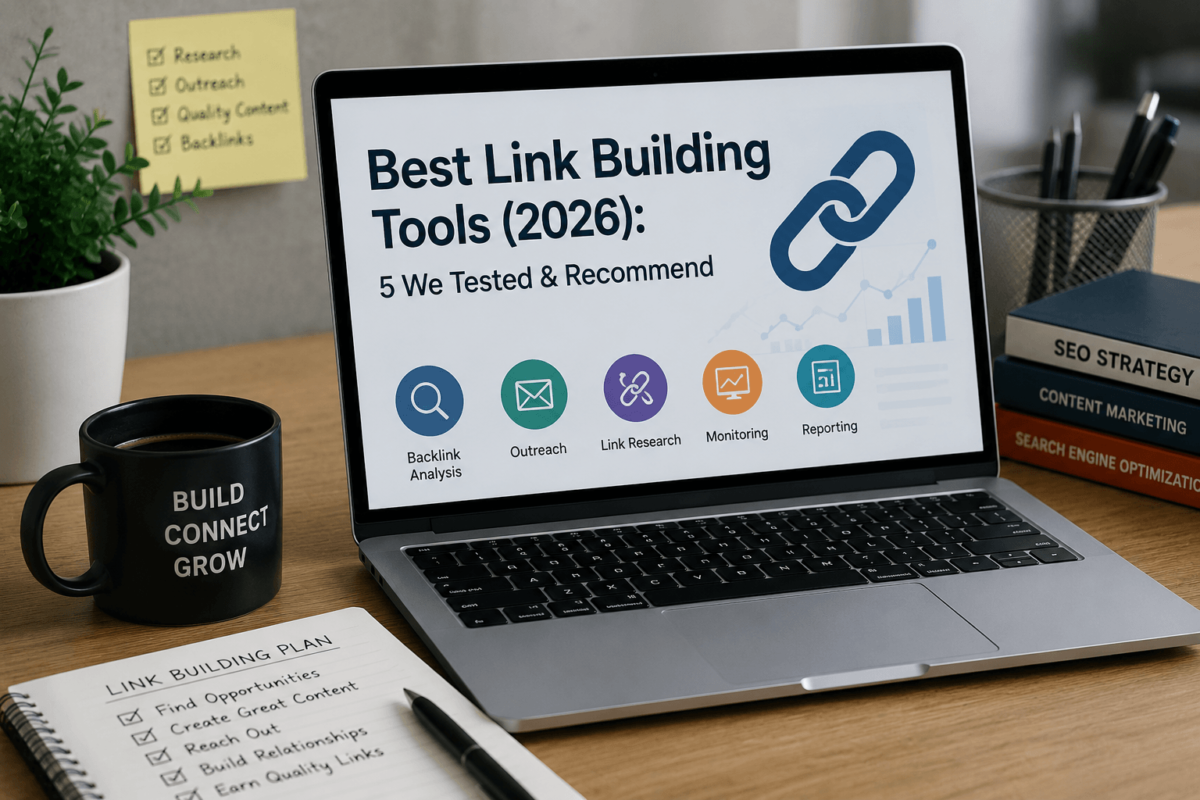
Best Link Building Tools (2026): 5 We Tested & Recommend
By Jaykishan Panchal · Updated 2026 · ~24 min read
I’ve been building backlinks professionally for 15-plus years, and the tooling has changed more in the last two than in the decade before it. There are dozens of link building tools competing for your subscription right now, but most of them either overlap heavily with what you already own or solve a problem you don’t actually have. I tested these five tools the way I’d test anything before recommending it to a client — by running a real campaign through each one, not just poking around a demo account.
Quick Answer: What are the best link building tools?
The best link building tools in 2026 are Ahrefs, Semrush, BuzzStream, Pitchbox, and Hunter.io. Ahrefs has the deepest, freshest backlink index, which makes it the strongest all-around pick for finding and vetting link opportunities. Semrush bundles solid backlink analysis with the rest of your SEO stack at better overall value. BuzzStream and Pitchbox are built specifically for outreach — BuzzStream for smaller, relationship-driven campaigns, Pitchbox for agencies running outreach at scale. Hunter.io fills the gap both leave behind: finding and verifying the email addresses you need before you can pitch anyone.
Quick Summary
- Best overall: Ahrefs — the deepest backlink index and the most cited Domain Rating data
- Best for agencies: Pitchbox — built for outreach across dozens of clients at once
- Best outreach software: BuzzStream — a simple CRM built for relationship-driven pitching
- Best value: Semrush — backlink analysis bundled with keyword research and site audits
- Best email finder: Hunter.io — the fastest way to find and verify outreach contacts
- Best for competitor backlink analysis: Ahrefs — see exactly which links are driving a competitor’s rankings
Best Link Building Tools at a Glance
Here’s how the five tools stack up side by side before we get into the details.
| Tool | Best For | Starting Price | Free Trial | Key Features | Ease of Use | Overall Rating |
|---|---|---|---|---|---|---|
| Ahrefs | Backlink research & competitor analysis | $29/mo | No | Site Explorer, Content Explorer, Link Intersect | Moderate | 4.8/5 |
| Semrush | All-in-one SEO value | $139.95/mo | Yes (7-day) | Backlink Analytics, Link Building Tool, Backlink Gap | Moderate | 4.6/5 |
| BuzzStream | Relationship-based outreach | $24/mo | Yes | Contact CRM, email templates, reply tracking | Easy | 4.2/5 |
| Pitchbox | Agency-scale outreach | $165/mo | No (demo only) | Automated prospecting, OEP scoring, sequences | Moderate–Hard | 4.4/5 |
| Hunter.io | Email finding & verification | Free; paid from $34/mo | No (free tier) | Domain Search, Email Finder, Verifier, Campaigns | Easy | 4.6/5 |
Pricing reflects publicly listed monthly rates as of 2026 and can change — check each vendor’s official pricing page before you buy.
The 5 Best Link Building Tools, Reviewed
We’re only recommending five tools here, on purpose. Every one of these earns its place in a real link building workflow — there’s no padded “honorable mentions” list. Here’s what each one actually does, where it falls short, and who should (and shouldn’t) buy it.
1. Ahrefs — Best Overall
Overview
Ahrefs built its reputation on one thing: the backlink index. It crawls the web on its own schedule instead of depending on Google, and refreshes that data every 15 to 30 minutes on paid plans. For link building, that means when you’re deciding whether a prospect is worth pitching, you’re looking at their backlink profile as it stands today — not last month.
Site Explorer, the tool most link builders live in, shows a domain’s or single page’s Domain Rating (DR), referring domains, and every backlink pointing at it, complete with anchor text and first-seen dates. Content Explorer lets you search the web for content on a topic and filter by referring domains, so you can find pages that already attract links and figure out why. For a deeper side-by-side, our Ahrefs vs. Semrush comparison breaks down where each tool pulls ahead. We’ve also covered Ahrefs on its own in a full Ahrefs review.
Best For
Agencies running competitor gap analysis, SEOs building outreach lists from scratch, or anyone who needs to check a prospect’s authority before sending a pitch.
Key Features
- Site Explorer: full backlink profile for any domain, subdomain, or URL, with Domain Rating (DR), URL Rating (UR), and referring domain counts
- Content Explorer: find link-worthy content by topic, filterable by referring domains and organic traffic
- Link Intersect: find sites linking to competitors but not to you — a fast way to build a prospect list
- Batch Analysis: check DR and backlink counts for hundreds of URLs at once
- Broken Link Checker: surface dead pages on any site so you can pitch a replacement link
Pros & Cons
|
|
Pricing
Ahrefs runs five tiers: Starter at $29/month, Lite at $129/month, Standard at $249/month, Advanced at $449/month, and a custom Enterprise plan starting around $1,499/month. Annual billing saves roughly 17%. There’s no traditional free trial, but Ahrefs Webmaster Tools is free for verified site owners and covers basic backlink data for your own domain.
Real-Life Example
We ran a competitor’s domain through Site Explorer, filtered referring domains by DR 40+, and exported the list. Cross-referencing it against our own backlink profile in Link Intersect turned up 60-plus sites linking to three competitors but not to us — a ready-made prospect list before we’d written a single pitch.
Our Verdict
Buy Ahrefs if backlink research is a weekly habit, not a once-a-quarter task. If you’re doing this occasionally or on a tight budget, Semrush’s bundled pricing or Ahrefs’ own $29 Starter plan will get you further per dollar.
2. Semrush — Best Value
Overview
Semrush’s Backlink Analytics and Link Building Tool sit inside the same subscription as keyword research, site audits, and rank tracking — which is the main reason it shows up so often in “best value” roundups. The Link Building Tool is worth calling out specifically: it generates a prospect list based on your target keywords, lets you track outreach status per prospect, and monitors whether links you’ve earned are still live.
It’s not as deep as Ahrefs’ Site Explorer, but for a team that wants backlink work bundled with everything else, it removes a subscription instead of adding one. You can read our full breakdown in the Semrush review.
Best For
SEO teams and in-house marketers who need backlink data as one part of a broader toolkit — not agencies whose entire job is link building.
Key Features
- Backlink Analytics: referring domains, Authority Score, and anchor text distribution for any domain
- Link Building Tool: auto-generates prospects from your ranked keywords and tracks outreach status
- Bulk Backlink Analysis: compare Authority Score across up to 200 domains at once
- Backlink Gap: see which domains link to competitors but not to you
- Bundled with keyword research, technical audits, and content tools in every plan
Pros & Cons
|
|
Pricing
Semrush has three core plans: Pro at $139.95/month, Guru at $249.95/month, and Business at $499.95/month, plus a custom Enterprise tier. Annual billing saves around 17%. New users typically get a 7-day free trial.
Real-Life Example
A SaaS client wanted their backlink profile compared against three direct competitors before a quarterly report. Backlink Gap surfaced 40 shared prospects worth pitching, and because the same login already had keyword tracking running, the report went out same-day instead of waiting on a second tool.
Our Verdict
Choose Semrush if you want backlink analysis as one line item in a bigger SEO subscription. Choose Ahrefs instead if link building is the majority of your work and you need the deepest possible data.
3. BuzzStream — Best Outreach Software
Overview
BuzzStream is a CRM built specifically for link building and digital PR outreach — not a backlink database, and it doesn’t pretend to be one. You feed it a list of prospects (often exported straight from Ahrefs or Semrush), and it manages contact info, email templates, follow-up sequences, and reply tracking so pitches don’t fall through the cracks.
Its BuzzMarker browser extension lets you add a site to your outreach list while you’re browsing it, which speeds up manual prospecting for link-bait and resource-page campaigns considerably.
Best For
Solo SEOs, small agencies, and content teams running relationship-driven outreach — guest posts, resource page links, HARO-style pitching — where personalization matters more than raw volume.
Key Features
- Contact database: email, social profiles, and site metrics in one record
- Email templates: merge fields and scheduled follow-ups
- Reply tracking: open, click, and reply tracking per email
- BuzzMarker extension: one-click prospect capture while browsing
- Ahrefs integration on Growth-tier plans and above, pulling DR straight into contact records
Pros & Cons
|
|
Pricing
BuzzStream starts at $24–$29/month for a single-seat Starter plan with roughly 1,000 contacts, jumping to around $124/month for the Growth tier and its 25,000-contact limit. Higher tiers scale toward custom Company pricing for larger teams. A free trial is available.
Real-Life Example
Running a resource-page campaign for a local client, we loaded 150 prospects into BuzzStream, sent a templated-but-personalized pitch to each, and used reply tracking to know exactly who to follow up with a week later — instead of digging through a shared inbox.
Our Verdict
Get BuzzStream if you’re doing hands-on, relationship-first outreach and want a simple system to keep pitches from getting lost. Skip it if you need automated, high-volume campaigns — that’s Pitchbox’s job.
4. Pitchbox — Best for Agencies
Overview
Pitchbox is built for agencies running link building at scale — often across a dozen or more client accounts at once. It automates prospecting (pulling from its own database plus your connected Ahrefs, Semrush, or Moz account), scores prospects with an Opportunity/Engagement/Prominence (OEP) score, and runs multi-step outreach sequences with automated follow-ups.
Where BuzzStream is built for one campaign at a time, Pitchbox is built to run many campaigns in parallel without losing track of any of them.
Best For
Agencies and in-house teams managing link building for multiple clients or brands at once, who need reporting they can hand straight to a client.
Key Features
- Automated prospecting: pulls from Pitchbox’s own database and connected SEO tools
- OEP scoring: prioritizes which prospects are worth pitching first
- Automated sequences: multi-step outreach with branching follow-ups
- Workspaces: campaign management for running multiple clients side by side
- Client-ready reporting dashboards
Pros & Cons
|
|
Pricing
Pitchbox starts at $165/month for the Pro plan, which is realistically a light-use tier — 2 users and a 2,000-email cap. The Advanced plan at roughly $420/month is where most agencies actually land, and Scale runs around $675/month. There’s no self-serve free trial; you’ll need to book a demo.
Real-Life Example
An agency running outreach for six e-commerce clients used Pitchbox’s OEP scoring to cut a 2,000-prospect list down to the 300 worth pitching, then let automated follow-up sequences handle non-responders — freeing the outreach team to focus only on replies.
Our Verdict
Pitchbox earns its price tag if you’re running outreach across multiple clients and need automation to keep it from falling apart. For a single site or a small in-house team, it’s more tool than you need — BuzzStream or Semrush’s Link Building Tool will cover it for a fraction of the cost.
5. Hunter.io — Best Email Finder
Overview
Hunter.io does one job and does it well: finding and verifying professional email addresses. Every other tool on this list assumes you already have a way to contact your prospects — Hunter.io is that way. Domain Search returns every email pattern associated with a company’s domain; Email Finder locates a specific person’s address when you already know their name and company.
Both come with a confidence score and verification, which matters because a bounced email doesn’t just fail to land a link — it can hurt your sending domain’s deliverability.
Best For
Anyone doing outreach who needs clean, verified contact data before hitting send — which, realistically, is every workflow in this article.
Key Features
- Domain Search: every email address pattern found for a given company domain
- Email Finder: locate one person’s email from name and company
- Email Verifier: confidence-scored deliverability check before you send
- Hunter Campaigns: basic sequenced outreach for smaller-scale sends
- Chrome extension for finding emails while browsing LinkedIn or a company site
Pros & Cons
|
|
Pricing
Hunter.io’s Free plan includes roughly 25–50 monthly credits. Paid plans start with Starter around $34–$49/month, Growth around $104–$149/month, and Scale around $209–$269/month, with custom Enterprise pricing above that. Annual billing saves close to 30%.
Real-Life Example
Before a digital PR push, we ran 40 target publications through Domain Search, verified the returned addresses, and cut our expected bounce rate from an estimated 15% down to under 3% — worth the subscription on its own.
Our Verdict
Hunter.io earns a spot in almost every outreach stack — not because it replaces Ahrefs or BuzzStream, but because it’s the missing piece between “found a great prospect” and “actually got their email in front of them.”
How We Tested These Tools
We didn’t rank these five tools off spec sheets. Each one went through the same evaluation, using it the way we’d use it for a real client campaign — building a prospect list, checking authority metrics, drafting outreach, and tracking replies — rather than just clicking through a demo.
- Backlink database size and freshness: how many referring domains it tracks and how often that data updates
- Outreach features: templates, sequencing, follow-up automation, reply tracking
- Reporting: how easy it is to hand a client, or your own boss, a clear picture of progress
- Ease of use: how long it takes a new team member to become productive
- Pricing: value relative to what a comparable stitched-together stack would cost
- Customer support: response time and quality when something breaks mid-campaign
- AI capabilities: how much of prospecting, scoring, or personalization the tool automates
- Integrations: whether it connects cleanly with the rest of an existing SEO stack
- Workflow efficiency: realistically, how many prospects-to-pitches you can move through in a week
How to Choose the Right Link Building Tool
The “best” tool depends entirely on how you work, not on which one has the biggest database. Run through these questions before you buy:
- Budget: Ahrefs and Semrush both run $100–$450/month at real-use tiers; BuzzStream and Hunter.io have far lower entry points if outreach, not research, is your bottleneck
- Agency vs. freelancer: solo operators rarely need Pitchbox’s multi-client automation; agencies running 10+ campaigns usually can’t live without it
- Outreach campaigns: if pitching is your main bottleneck, prioritize BuzzStream or Pitchbox over another backlink database
- Competitor analysis: Ahrefs and Semrush both handle this; Ahrefs’ Link Intersect is the faster path to a prospect list
- Digital PR: BuzzStream and Pitchbox both support relationship tracking that a spreadsheet can’t
- Backlink monitoring: Ahrefs and Semrush both alert you when links go live or drop
- Automation: Pitchbox leads here; BuzzStream and Hunter.io automate parts of the workflow, not all of it
- Reporting: agencies presenting to clients should weigh Pitchbox’s and Semrush’s built-in reporting heavily
- CRM integrations: check whether the tool connects to your existing SEO platform before buying a second one that overlaps
- Email verification: if you’re sending outreach at any volume, Hunter.io or a verified-email tool protects your domain’s deliverability
- Scalability: pick a tool with room to grow into rather than one you’ll outgrow in three months
How These Tools Support Different Link Building Strategies
A tool is only as good as the strategy behind it. Here’s how each approach maps to the tools above — and where to go deeper on our site.
- Guest posting: Ahrefs’ Content Explorer surfaces sites that already publish guest content in your niche; BuzzStream manages the pitch and follow-up.
- Broken link building: Ahrefs’ Broken Link Checker finds dead pages worth replacing. Our full broken link building guide walks through the pitch template that actually gets replies.
- Digital PR: Pitchbox and BuzzStream both track journalist relationships over time. See our digital PR strategy guide for a full campaign framework.
- Resource page outreach: Ahrefs’ Content Explorer, filtered by “resources” or “links” in the title, finds curated pages fast; BuzzStream’s browser extension captures them as you go.
- Skyscraper Technique: Content Explorer identifies the most-linked content on a topic so you know exactly what bar you need to clear.
- Competitor backlink replication: Ahrefs’ Link Intersect and Semrush’s Backlink Gap both do this natively — find who links to competitors but not to you.
- Unlinked brand mentions: Ahrefs and Semrush both offer alerts for mentions of your brand that don’t yet link back, which you can then request as a link.
- Link reclamation: Ahrefs’ historical data flags links you’ve lost, so you can reach out and ask for them back.
- HARO-style outreach: Hunter.io verifies journalist contacts before you pitch; see our list of HARO alternatives now that the original platform has changed.
- Relationship building: BuzzStream’s contact history keeps every past interaction visible, which matters when you’re pitching the same editor again next quarter.
For a broader view of tactics beyond tool-specific workflows, our link building strategies guide and our local link building guide cover the tactics side in more depth. If outreach itself isn’t an option for you right now, we’ve also got a guide on building backlinks without outreach.
How to Build High-Quality Backlinks Using These Tools
- Find competitors. Identify 3–5 sites ranking above you for your target keywords using Ahrefs or Semrush.
- Analyze backlinks. Run each competitor through Site Explorer or Backlink Analytics to see where their authority is coming from.
- Identify opportunities. Use Link Intersect or Backlink Gap to find sites linking to them but not to you.
- Find contact information. Run each target domain through Hunter.io’s Domain Search and verify the results.
- Send personalized outreach. Load contacts into BuzzStream or Pitchbox and send a pitch specific to their site — not a mail-merge template with their name swapped in.
- Track replies. Use your outreach tool’s reply tracking so nothing sits unanswered for weeks.
- Monitor backlinks. Once a link goes live, set up alerts in Ahrefs or Semrush to confirm it stays live.
- Measure SEO impact. Track ranking and organic traffic movement for the pages you built links to, not just the raw link count.
Common Link Building Mistakes to Avoid
- Buying spam links. Cheap link packages almost always come from Private Blog Networks or link farms that Google can and does devalue.
- Ignoring relevance. A DR 70 link from an unrelated niche is worth less than a DR 30 link from a genuinely relevant site.
- Overusing exact-match anchor text. A natural anchor text profile mixes branded, generic, and partial-match phrases — not the same exact keyword every time.
- Poor outreach personalization. Mail-merge pitches with the name swapped in get ignored at a much higher rate than pitches referencing the site’s actual content.
- Targeting low-quality websites. A link from a site with no organic traffic and no real audience rarely moves the needle, no matter what its DR says.
- Not monitoring lost backlinks. Links disappear when sites redesign, get penalized, or go offline — without monitoring, you won’t know until traffic drops.
- Ignoring link velocity. A sudden spike in backlinks after months of nothing can look unnatural to Google’s algorithms.
- Focusing only on Domain Authority. DA, DR, and Authority Score are all third-party estimates, not Google ranking factors themselves — relevance and real traffic matter more.
Real-Life Scenarios: Which Tool Fits Your Situation
Small Business Owner
You don’t need a full research suite for a handful of local link opportunities. Hunter.io’s free plan plus BuzzStream’s entry tier covers finding and pitching local partners, directories, and sponsorships without a big monthly bill.
Local SEO Agency
Running link building for several local clients at once calls for Semrush’s bundled backlink and keyword tracking, paired with BuzzStream for outreach until campaign volume justifies Pitchbox.
Affiliate Marketer
Ahrefs’ Content Explorer is built for exactly this: finding link-worthy resource content in a niche and replicating what already earns links, then reaching out with Hunter.io-verified contacts.
SaaS Startup
Digital PR tends to outperform cold guest-post outreach for SaaS. Pitchbox or BuzzStream, combined with a genuinely newsworthy angle, earns links from publications that would ignore a generic pitch.
Content Publisher
High-volume publishers benefit most from Ahrefs’ broken link and unlinked-mention alerts, which surface passive link opportunities without a dedicated outreach campaign for every single post.
Enterprise Marketing Team
Enterprise teams typically need Ahrefs or Semrush at the top tier for data depth, plus Pitchbox for coordinating outreach across multiple brand sites and regional teams without campaigns overlapping.
Tools That Pair Well With Your Link Building Stack
None of these five tools work in isolation. A few categories worth rounding out your stack with:
- SEO reporting platforms to turn raw backlink data into something a client or manager can actually read — see our SEO reporting guide.
- Website audit tools to make sure the pages you’re building links to are technically sound before you send traffic their way.
- Rank tracking software to confirm new links are actually moving rankings, not just sitting there.
- Email outreach platforms for teams whose pitching volume outgrows a single CRM — our email marketing for SEO guide covers deliverability basics.
- AI writing assistants to draft the linkable content itself once you know what earns links in your niche — see our roundup of AI SEO tools.
- Reliable web hosting so the linkable pages you’re promoting don’t slow down or go offline right when outreach starts paying off.
- Keyword research tools to make sure the content you’re building links to targets terms worth ranking for — start with our free keyword research tools list.
- Digital PR services for teams that want to outsource relationship-building with journalists entirely.
Frequently Asked Questions
What is the best link building tool?
Ahrefs is the best overall link building tool for most SEOs because of its backlink database size and update speed. That said, “best” depends on your job: Semrush is the better value if you need backlink data bundled with keyword research, BuzzStream or Pitchbox are better if outreach is your bottleneck, and Hunter.io is essential if you need verified contact emails before pitching anyone.
Is Ahrefs better than Semrush for backlinks?
For pure backlink data depth and freshness, yes — Ahrefs’ index is larger and updates more frequently. Semrush closes the gap by bundling backlink analysis with keyword research, site audits, and content tools in the same subscription, which makes it the better pick if backlinks aren’t your only focus. See our full Ahrefs vs. Semrush comparison for a category-by-category breakdown.
What tool is best for outreach?
BuzzStream is best for smaller, relationship-driven outreach where personalization matters more than volume. Pitchbox is best for agencies running outreach across many clients at once, since its automation and OEP scoring are built specifically for that scale.
What is the best free backlink tool?
Google Search Console is the best free source for your own backlink and mention data, though it only shows links Google has already indexed and lacks competitor data. Ahrefs Webmaster Tools is a strong free option for verified site owners who want DR and backlink counts for their own domain specifically.
Can AI build backlinks?
AI can speed up parts of link building — drafting personalized outreach emails, scoring prospects, and summarizing a site’s content before you pitch it — but it can’t replace the relationship-building and editorial judgment that actually earns a link. Tools like Pitchbox use AI for prospecting and scoring, not for automatically acquiring links on their own.
How many backlinks do I need?
There’s no fixed number. What matters more is how your referring domain count and relevance compare to the pages currently ranking for your target keyword — which is exactly what Ahrefs’ or Semrush’s competitor gap tools are built to show you, page by page.
Are paid backlinks worth it?
Buying links directly from link farms or PBNs violates Google’s guidelines and risks a manual penalty. Legitimate paid placements — like sponsored content clearly marked as such, with a nofollow or sponsored attribute — are a different, lower-risk category, but they’re not a substitute for earned, white-hat links.
What is white-hat link building?
White-hat link building means earning links through methods Google’s guidelines approve of — creating genuinely link-worthy content, guest posting on relevant sites, fixing broken links with a useful replacement, and building real relationships with journalists and site owners. It’s slower than buying links, but it’s the only approach that holds up over the long term.
Final Thoughts: Which Link Building Tool Should You Choose?
- Overall winner: Ahrefs
- Best budget option: BuzzStream
- Best agency choice: Pitchbox
- Best outreach tool: BuzzStream
- Best email finder: Hunter.io
- Which tool beginners should choose: Semrush, since keyword research and site audits are bundled in while you learn
- Which tool professionals should choose: Ahrefs paired with BuzzStream or Pitchbox, depending on outreach volume
No single tool on this list does everything. In practice, most working link builders end up pairing a research tool (Ahrefs or Semrush) with an outreach tool (BuzzStream or Pitchbox) and a contact-finding tool (Hunter.io). Before you commit to a full subscription, compare the free trials and demos side by side — Semrush, BuzzStream, and Hunter.io all let you test the actual workflow before you pay for a month you might not need.
If you’re just starting out, resist the urge to buy every tool on this list at once. Start with whichever bottleneck is actually slowing you down — research, outreach, or contact-finding — add the second tool once that workflow feels routine, and let your campaign results, not the feature list, decide what you add next.
Disclosure: TechCognate may earn a commission if you sign up for a tool through a link on this page, at no extra cost to you. We only recommend tools we’ve actually tested and would use ourselves. Pricing and features were accurate at the time of publication and may have changed — always confirm current details on the vendor’s official site.