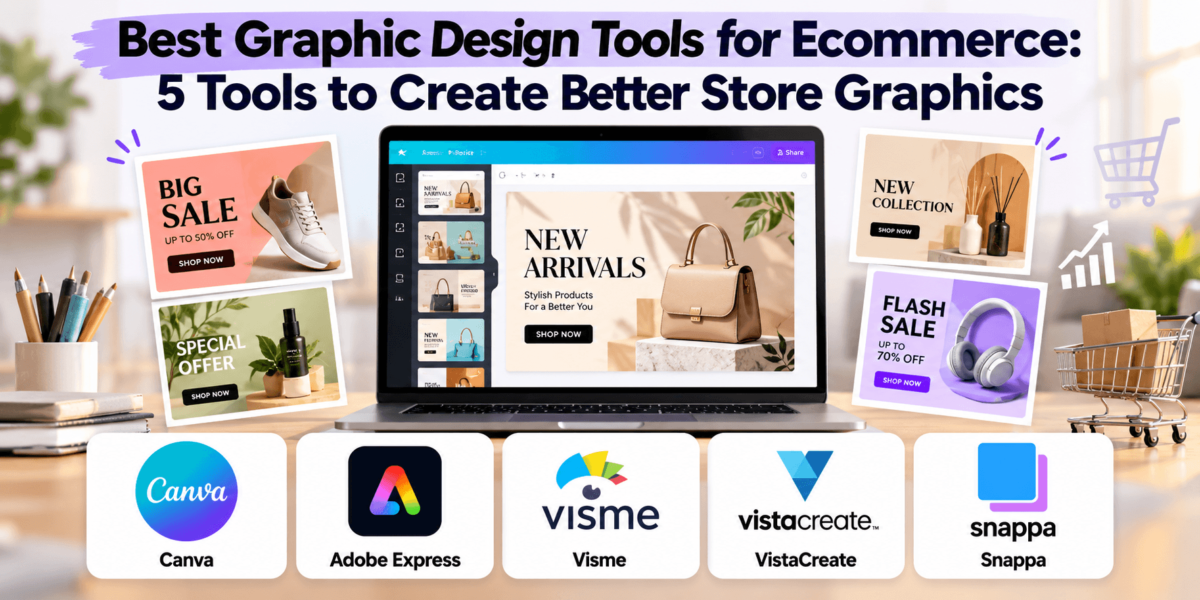
Best Graphic Design Tools for Ecommerce: 5 Tools to Create Better Store Graphics
Running an online store means constantly needing new graphics. A product launch needs a banner. A weekend sale needs social posts. An email campaign needs visuals. Suddenly, “just making one graphic” becomes a regular part of the job.
Updated October 2026 · 11 min read
The right graphic design tool turns that scramble into a repeatable workflow. The wrong one eats your afternoon, produces mismatched visuals, and leaves you paying for features you never open.
We compared five popular options for online sellers: Canva, Adobe Express, Visme, VistaCreate, and Snappa. Below you’ll find a quick comparison, a review of each tool, and a plain-English guide to choosing between them. If you’re still building the rest of your stack, our guides to the best website builders for ecommerce and the best Shopify apps for ecommerce are good companions to this one.
Disclosure: This article may contain affiliate links. If you purchase through one of these links, we may earn a commission at no extra cost to you.
Canva is the best graphic design tool for most ecommerce businesses. It combines a huge template library, a Brand Kit, and easy social media workflows in one beginner-friendly editor. Adobe Express suits Adobe users, Visme handles data-heavy content, VistaCreate is a budget-friendly Canva alternative, and Snappa is fastest for quick social graphics.
Quick Comparison: Best Graphic Design Tools for Ecommerce
Here’s the short version. Each tool is covered in detail further down.
| Tool | Best For | Ease of Use | Templates | Best Feature |
|---|---|---|---|---|
| Canva (top pick) | All-purpose store graphics | Very easy | Very large library | Brand Kit plus social templates |
| Adobe Express | Adobe users and brand-heavy teams | Easy | Large, with a premium tier | One-click resize and Adobe Fonts |
| Visme | Infographics, comparison charts, decks | Moderate | Strong for business content | Data visualization and interactive content |
| VistaCreate | Budget-minded sellers | Easy | Large library | Low-cost Pro plan with stock assets |
| Snappa | Fast social and ad graphics | Very easy | Smaller, focused set | Preset sizes in a simple editor |
Our Picks
The most complete all-rounder for store banners, social posts, ads, and email graphics.
Read the Canva review ↓A simple editor tied into Adobe’s fonts, stock assets, and wider creative ecosystem.
Read the Adobe Express review ↓Built for infographics, charts, and polished decks, not just social posts.
Read the Visme review ↓A friendly, lower-cost editor with plenty of templates and built-in stock assets.
Read the VistaCreate review ↓The fastest way to turn out a clean social post or ad without learning anything new.
Read the Snappa review ↓Best for beginners? Snappa has the shortest learning curve because its toolset is narrow. Canva is nearly as easy and gives you far more room to grow.
1. Canva — Best Overall for Ecommerce Graphics
| Best for | Sellers who want one easy tool for most marketing graphics |
| Ease of use | Very easy, even with no design background |
| Free plan | Yes, with limits on premium content and features |
| Standout | Template range and Brand Kit |
Why Canva Works for Ecommerce
Canva is best suited to ecommerce sellers who want an easy, all-purpose design platform with templates for social media posts, promotional graphics, presentations, and other marketing assets.
Think about a weekend sale. You might need a homepage banner, an Instagram Story, a Facebook ad, and an email graphic in the same afternoon. A template-heavy platform makes that workflow much faster, and that’s exactly where Canva earns its reputation.
Features That Matter for an Online Store
- Templates: If you’re producing five or six promotional graphics for a sale, starting from a ready-made layout saves far more time than building each from scratch.
- Brand Kit: Saving your logo, colors, and fonts means a Black Friday banner and a product launch email look like they came from the same store. Consistency builds trust, and it’s hard to maintain without one.
- Social planning and editing: Paid plans add tools such as background removal and content scheduling, which cut down the back-and-forth between design and posting.
- Collaboration: You can share designs and collect comments, and the team-focused plan adds shared brand controls for stores with more than one person making graphics.
- AI tools: Canva includes built-in AI design features, though monthly usage limits depend on your plan.
Here’s the catch: popular templates get reused a lot, so a few tweaks to colors, fonts, and layout go a long way toward keeping your store from looking generic. If you’re weighing Canva against a more professional interface tool, see our Canva vs. Figma comparison, or compare it head to head in Canva vs. Adobe Express.
✓ Pros
| × Cons
|
Canva Pricing
- Free plan: available, with limits on premium templates, assets, and AI usage.
- Pro: a single-user paid plan. Monthly billing runs roughly $15–$18 depending on the source and date, with a lower effective rate on annual billing.
- Business: priced per person for teams that need shared brand controls.
Pricing can change, so check the provider’s current pricing page before subscribing. View current pricing
Best for: Ecommerce businesses that want one dependable tool for most of their marketing graphics.
Canva isn’t the most powerful design software, and it doesn’t need to be. For sale banners, social posts, and email headers, it’s the easiest balance of speed, variety, and brand consistency, which is why it takes our top spot.
Try Canva →2. Adobe Express — Best for Adobe Users
| Best for | Sellers who want a simple editor backed by Adobe |
| Ease of use | Easy, with a quick-start template workflow |
| Free plan | Yes, with a smaller toolset and storage |
| Standout | One-click resize, Adobe Fonts, and Adobe Stock access on Premium |
Why Adobe Express Works for Ecommerce
Adobe Express is a web and mobile design app for quick marketing graphics, short videos, and social content. It suits ecommerce sellers who want a simple design workflow backed by Adobe’s ecosystem.
The Premium plan is where it gets interesting for a store. One-click resize turns a single campaign design into several formats, which matters when the same sale needs a square post, a vertical Story, and a wide banner. Premium also adds Adobe Fonts, a large library of Adobe Stock assets, brand kits, and the ability to schedule posts to up to three accounts per social network.
- Branding: Brand kits and a deep font library help your store keep a polished, consistent look.
- Image and video touches: Tools like background removal for video and simple animation let you add motion to product promotions without opening a separate editor. If video is a bigger part of your plan, see our guide to the best video editing software for ecommerce.
- AI features: Premium includes monthly generative AI credits. If AI imagery is your main goal, compare options in our best AI image generators roundup.
- Collaboration: The Teams plan adds co-editing and pooled storage for stores with several people designing.
Not every ecommerce business needs Photoshop-level control, and Adobe Express doesn’t pretend to offer it. It’s a quick editor that happens to plug into a very strong creative brand.
✓ Pros
| × Cons
|
Adobe Express Pricing
- Free plan: available, with basic tools and limited storage.
- Premium: around $10 per month on monthly billing at the time of writing.
- Teams: priced per seat with a two-seat minimum.
Pricing can change, so check the provider’s current pricing page before subscribing. View current pricing
Best for: Ecommerce businesses already in the Adobe world, or anyone who values Adobe Fonts and stock assets.
If you want something simpler than Photoshop but more polished than a bare-bones editor, Adobe Express is a smart middle ground. Choose it for the Adobe ecosystem, not because it beats Canva on templates.
Explore Adobe Express →3. Visme — Best for Presentations and Visual Content
| Best for | Infographics, charts, product comparison graphics, and decks |
| Ease of use | Moderate: more features means more to learn |
| Free plan | Yes (Basic), with a Visme watermark and limits |
| Standout | Data visualization and interactive content |
Why Visme Works for Ecommerce
Visme is a visual content platform for presentations, infographics, charts, reports, and social graphics. It is best suited to ecommerce businesses that produce data-heavy or educational content, such as product comparison graphics, infographics, and sales decks.
Most ecommerce graphics are quick promos. Some aren’t. If you publish buying guides, wholesale presentations, or comparison charts, a tool that treats data as a first-class citizen starts to look very attractive. Visme’s charts and widgets are built for exactly that kind of work.
- Infographics and comparison graphics: Great for turning specs, sizing charts, or customer data into something shoppers can scan.
- Brand control: A brand wizard and saved brand assets help keep long-form visuals on-brand.
- Interactive and exportable content: Higher plans add formats such as HTML5 export, useful for embedding interactive pieces on your site.
- AI features: Paid plans include monthly AI credits that scale by tier.
- Content ideas: Pair it with a content plan. Our roundup of the best content marketing tools and the data in our ecommerce statistics guide are natural starting points for visual stories.
✓ Pros
| × Cons
|
Visme Pricing
- Basic (free): available, with a watermark and limited features.
- Starter: roughly $12 per month per user on annual billing, and noticeably more on monthly billing.
- Pro: roughly $25 per month per user on annual billing. Enterprise is quote-based.
Pricing can change, so check the provider’s current pricing page before subscribing. View current pricing
Best for: Stores and content teams that need more than social posts, especially data-driven visuals and presentations.
Visme is overkill if all you need is a sale banner. But if your marketing leans on charts, guides, and decks, it can replace several tools at once.
See what Visme can do →4. VistaCreate — Best Canva Alternative
| Best for | Small stores and social media managers watching their budget |
| Ease of use | Easy, with a familiar template-based editor |
| Free plan | Yes (Starter) |
| Standout | Low-cost Pro plan with bundled stock assets and AI tools |
Why VistaCreate Works for Ecommerce
VistaCreate, formerly known as Crello, is an online design tool with templates, stock assets, and brand tools aimed at small businesses and social media managers. It’s a strong pick for sellers who want a Canva-style workflow at a lower price.
If you’re running a small store, this matters more than you might think. Between templates, stock photos, and video clips, the subscriptions behind a content calendar add up quickly. VistaCreate bundles a large asset library into its Pro plan, which keeps the monthly bill predictable.
- Templates and formats: A large template library covers social posts, stories, ads, and banners.
- Brand Kit: Save colors, fonts, and logos so promo graphics stay consistent.
- AI and image tools: Pro includes AI background removal, object removal, and an AI image generator, handy for cleaning up product shots.
- Social workflow: It pairs well with a scheduler. See our roundup of the best social media management tools for options.
✓ Pros
| × Cons
|
VistaCreate Pricing
- Starter (free): available, with core templates and a smaller asset library.
- Pro: about $10 per month when billed annually at the time of writing.
Pricing can change, so check the provider’s current pricing page before subscribing. View current pricing
Best for: Budget-conscious sellers who like Canva’s approach but want a lower monthly cost.
VistaCreate won’t overtake Canva on breadth, but it’s the most credible low-cost alternative here. For a small store posting regularly, the value is hard to ignore.
Try VistaCreate →5. Snappa — Best for Quick Social Graphics
| Best for | Fast social posts, blog graphics, and display ads |
| Ease of use | Very easy, with the shortest learning curve here |
| Free plan | Yes (Starter), limited to 3 downloads per month |
| Standout | Preset dimensions in a simple, focused editor |
Why Snappa Works for Ecommerce
Snappa is a browser-based graphic design tool built for non-designers who need marketing graphics quickly. It is best suited to small sellers who want preset sizes for social posts, display ads, blogs, and email graphics rather than a full creative suite.
That sounds simple, but there’s a big difference between a tool with every feature and a tool that gets out of your way. Snappa leans toward the second. You pick a size, start from a template, swap the text and image, and download.
- Preset dimensions: Sizes for social, ads, and blog headers take away the guesswork, especially when you’re building email graphics for your email marketing campaigns.
- Paid-plan extras: Pro adds unlimited downloads, background removal, custom fonts, and a Buffer integration for publishing from the editor.
- Collaboration: The Team plan supports up to five users, which suits a small in-house marketing group.
✓ Pros
| × Cons
|
Snappa Pricing
- Starter (free): available, limited to 3 downloads per month.
- Pro: around $10 per month billed annually, or about $15 billed monthly.
- Team: around $20 per month billed annually for up to five users.
Pricing can change, so check the provider’s current pricing page before subscribing. View current pricing
Best for: Small stores that want clean social graphics and ads fast, with minimal learning.
Snappa doesn’t try to do everything. If your needs are social posts, ads, and blog images, that focus is a strength. Outgrow it, and Canva is the natural next step.
Check out Snappa →Canva vs. Adobe Express vs. Visme vs. VistaCreate vs. Snappa
The tools overlap more than they differ, but the differences are what decide the right pick. Highlighted cells mark the strongest option in each row.
| Factor | Canva | Adobe Express | Visme | VistaCreate | Snappa |
|---|---|---|---|---|---|
| Ease of use | Very easy | Easy | Moderate | Easy | Very easy |
| Templates | Largest library | Large, premium tier | Strong for business formats | Large library | Smaller set |
| Ecommerce graphics | Broad coverage | Strong with Adobe assets | Infographics and comparisons | Good for promos | Banners and ads |
| Social media graphics | Excellent | Strong, plus scheduling | Good | Strong | Excellent for speed |
| Branding | Brand Kit | Brand kits, Adobe Fonts | Brand wizard | Brand Kit | Custom fonts (paid) |
| Image editing | Solid, background removal on paid | Solid, Adobe-backed | Basic | AI background and object removal | Background removal on paid |
| Collaboration | Strong | Strong on Teams | Available, pricier | Basic | Team plan, up to 5 users |
| AI features | Built-in AI tools | Generative credits | AI credits | AI image generator | Not a focus |
| Beginner-friendliness | Excellent | Very good | Good | Very good | Excellent |
| Overall value | Best all-round | Best for Adobe users | Best for data-heavy content | Best budget pick | Best for speed |
In practice, three questions settle most decisions. Do you need data-heavy visuals? Then look at Visme. Are you already in the Adobe ecosystem? Then look at Adobe Express. Do you mainly need quick, clean social posts? Snappa gets you there fastest. For everything else, Canva is the safest bet.
Try Canva for your ecommerce graphics →
Which Graphic Design Tool Is Best for Your Ecommerce Business?
You want an all-around design platform with a large template ecosystem, and you’d like one tool for banners, social posts, ads, and email graphics.
Try Canva →You want a simple design workflow backed by Adobe’s fonts, stock assets, and creative ecosystem.
Explore Adobe Express →Your marketing relies on infographics, comparison charts, presentations, or other data-driven content.
See what Visme can do →You like the Canva approach but want a lower monthly cost and bundled stock assets.
Try VistaCreate →You mostly need quick social posts and ads, and you’d rather skip a bigger learning curve.
Check out Snappa →Frequently Asked Questions
What is the best graphic design tool for ecommerce?
Canva is the best choice for most ecommerce businesses. Its templates cover social posts, ads, email graphics, and banners, and its Brand Kit keeps everything consistent. Adobe Express, Visme, VistaCreate, and Snappa are better fits for specific needs like Adobe workflows, data visuals, budget, or speed.
What is the easiest design tool for beginners?
Canva and Snappa are the easiest to learn. Snappa has the shortest learning curve because its toolset is narrow and built around preset sizes. Canva takes a little longer to explore but gives you far more templates, formats, and room to grow as your store’s content needs expand.
Can I create product graphics with these tools?
Yes. All five can handle promotional product graphics such as sale banners, social posts, ads, email headers, and comparison graphics. They are design tools, not product photography editors, so start with a clean product photo and use the tool for layouts, text, and branding.
Is Canva good for ecommerce businesses?
Yes, Canva is a strong fit for ecommerce. Its templates cover social posts, ads, email graphics, banners, and presentations, and the Brand Kit keeps visuals consistent across channels. The main limits are that some premium features need a paid plan and it offers less control than professional software.
Which tool is best for social media ecommerce graphics?
Canva is the best all-around choice for social media graphics because of its template range and content planning tools on paid plans. Snappa is the fastest for simple posts and ads, and Adobe Express adds scheduling and one-click resizing on Premium. For scheduling across channels, see our guide to social media management tools.
Do ecommerce businesses need professional graphic design software?
Most small and mid-sized stores don’t. Template-based tools handle banners, social posts, ads, and email graphics well. Professional software becomes worthwhile when you need heavy retouching, complex compositing, or custom artwork that templates can’t produce.
Can I create ecommerce ads with these tools?
Yes. Most of these tools include templates or preset sizes for social and display ads. Snappa highlights ad dimensions directly, while Canva and Adobe Express add resizing tools so one ad concept can become several formats. For measuring results, see our ecommerce analytics software guide.
Final Verdict: Which Ecommerce Graphic Design Tool Is Best?
For most online stores, Canva is the clear winner. It combines the largest template ecosystem, strong branding tools, and an editor anyone on your team can pick up in an afternoon.
- Best alternative: VistaCreate, if you like Canva’s approach but want a lower monthly cost.
- Best for a specific use case: Snappa for quick social graphics and ads.
- Best for beginners: Snappa for the simplest editor, or Canva if you want room to grow.
- Best for advanced visual content: Visme for infographics, charts, and presentations.
- Best for Adobe users: Adobe Express for Adobe Fonts, stock assets, and ecosystem ties.
Start with the free plan, build your next sale graphics, and see how it feels before you pay for anything. If you’re also working on conversions after the click, our guide to the best CRO tools is a logical next step.
Try Canva for your ecommerce graphics →Features and pricing change often. Always confirm details on each provider’s official site before you buy.