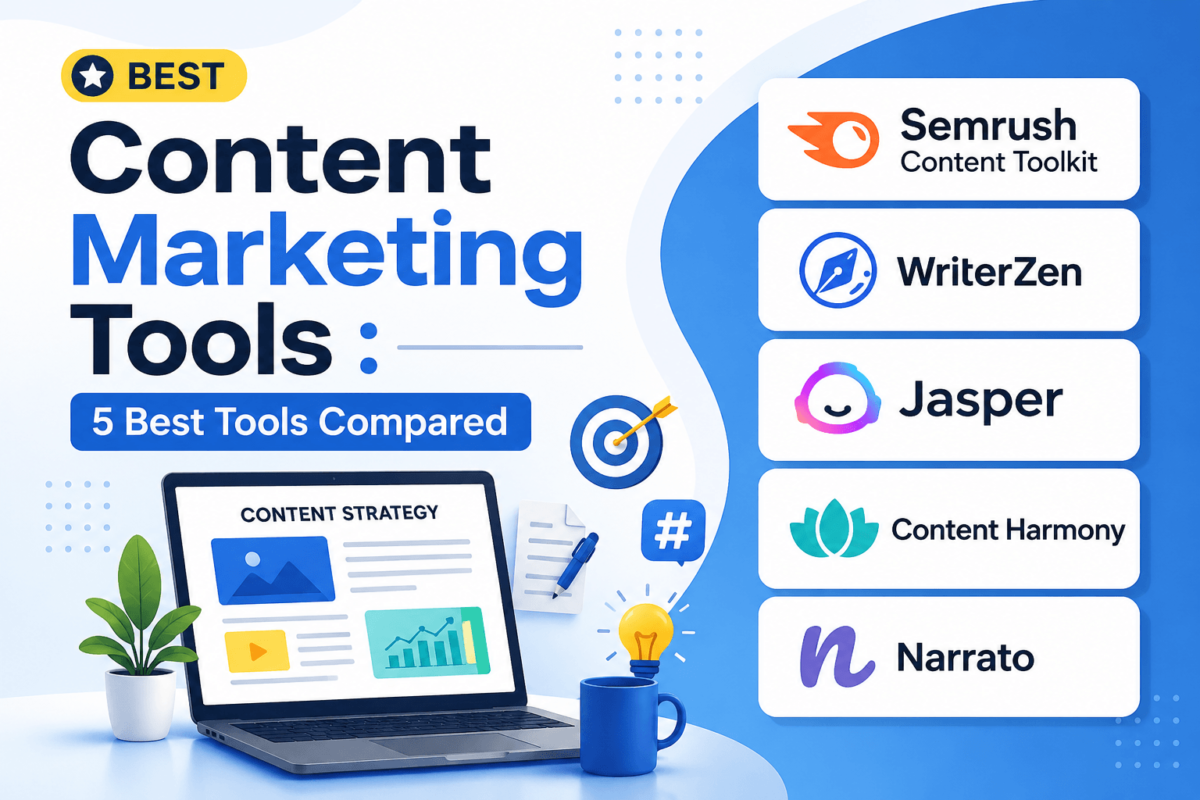
Best Content Marketing Tools (2026): 5 Best Tools Compared
By Jaykishan Panchal | Founder, TechCognate | Updated 2026
Quick Answer
If you need one tool that covers research, briefs, drafting, and optimization, Semrush Content Toolkit is the best all-around pick because it ties content directly to keyword and SERP data you’re probably already tracking. WriterZen wins on keyword clustering and topical planning. Jasper is the strongest pure AI writer for brand voice at scale. Content Harmony makes the most detailed content briefs for agencies briefing freelance writers. Narrato is the most affordable option for small teams that want writing, briefs, and a content calendar in one workspace.
Content marketing got a lot harder in 2026, not easier. Every competitor now has access to the same AI writing tools you do, which means output volume stopped being a competitive advantage the day everyone got it. Google’s helpful content systems have gotten better at spotting thin, templated writing, and AI search engines now decide what gets cited based on depth and structure, not just keyword coverage. Publishing more content isn’t the strategy anymore. Publishing content that’s actually researched, well-briefed, and genuinely useful is.
That’s exactly where a good content marketing platform earns its keep. The right tool doesn’t just generate paragraphs — it helps you figure out what to write about, gives your writers a real brief instead of a vague topic, checks that the finished piece actually covers what top-ranking pages cover, and keeps a team of writers and editors from stepping on each other. Do that consistently and you can save dozens of hours a month while producing content that outperforms a rival team that’s just cranking out AI drafts.
I tested and compared five content marketing platforms that consistently show up in agency and in-house marketer workflows: Semrush Content Toolkit, WriterZen, Jasper, Content Harmony, and Narrato. Below is an honest, detailed breakdown of what each one does well, where it falls short, what it costs, and who should actually buy it.
Quick Comparison Table
| Tool | Best For | Starting Price | Free Trial | AI Writing | SEO Features | Content Briefs | Team Collaboration | Rating |
|---|---|---|---|---|---|---|---|---|
| Semrush Content Toolkit | Teams already using Semrush for SEO | $60/mo | 7 days | Yes | Excellent | Yes | Good | 4.6/5 |
| WriterZen | Keyword clustering & topical planning | $39/mo | Yes | Yes | Excellent | Basic | Limited | 4.5/5 |
| Jasper | Brand voice AI writing at scale | $39/mo | 7 days | Excellent | Basic | Yes | Good | 4.4/5 |
| Content Harmony | Agencies briefing freelance writers | $50/mo | $10 trial | Limited | Excellent | Excellent | Good | 4.7/5 |
| Narrato | Budget-friendly all-in-one workspace | Free / $9/mo | Free plan | Good | Good | Good | Excellent | 4.3/5 |
Prices reflect published starting rates as of 2026 and change over time — confirm current pricing on each vendor’s site before buying.
1. Semrush Content Toolkit
Overview
Semrush Content Toolkit (formerly ContentShake AI) is the content production layer built into the Semrush platform. It takes the keyword and SERP data Semrush already collects and turns it into topic ideas, SEO briefs, and AI-assisted drafts inside one editor, so you’re not exporting keyword lists into a separate writing tool. If your team already runs Semrush for SEO, this toolkit is the most natural place to plug in content production.
Best For
In-house SEO teams, agencies managing multiple client sites, and mid-sized businesses that want content research and writing tied directly to real ranking data rather than a standalone AI writer.
Key Features
- Topic Finder that surfaces content ideas backed by real search volume
- SEO Brief Generator that pulls keywords, outlines, and competitor insights into one document
- AI Article Generator for unlimited standard drafts plus SEO-boosted articles with SERP analysis
- Content Optimizer that scores drafts for SEO, tone, and readability against top-ranking pages
- Built-in AI Chat inside the blog editor for rewrites and quick edits
- Direct integration with Semrush’s Site Audit, Position Tracking, and Social Poster
Pros
- Content briefs and drafts are grounded in the same keyword database used for tracking rankings
- One dashboard replaces a separate research tool, brief tool, and writing tool
- Repurposing turns one article into social posts, email, and Google Business Profile updates
- Closed-loop system: content performance flows back into Position Tracking automatically
Cons
- Full value depends on also using Semrush’s SEO toolkit — standalone value is lower
- AI drafts still need human editing for voice and nuance, same as any AI writer
- Country-specific topic data can be limited outside major markets
Pricing
The Content Toolkit starts at roughly $60/month as a standalone plan with a 7-day free trial. It’s also available bundled inside Semrush One packages ($199–$549/month), which add the full SEO, PPC, social, and AI Visibility toolkits. Solo bloggers and small teams are usually better served by the standalone Content Toolkit; agencies managing full SEO programs get more value from a Semrush One bundle. Pricing tiers change periodically, so confirm current numbers on Semrush’s site.
Real-World Use Cases
An agency managing ten client blogs uses the Topic Finder to build a monthly content calendar for each client, then hands the auto-generated briefs to freelance writers so every brief follows the same structure. An affiliate site owner uses the Content Optimizer to check draft articles against the top five ranking pages before publishing, closing content gaps that would otherwise take hours of manual competitor research.
Integrations
Native integration with the rest of the Semrush ecosystem (Site Audit, Position Tracking, Social Poster, AI Visibility Toolkit), plus WordPress publishing and Google Analytics/Search Console connections for performance tracking.
AI Capabilities
AI is used for topic ideation, first-draft generation, in-editor rewriting via AI Chat, and content repurposing into social formats. The AI leans on Semrush’s own SERP and keyword data rather than working from a blank prompt, which tends to produce more search-aligned first drafts than a generic AI writer.
SEO Capabilities
This is where the toolkit separates itself from pure AI writers: keyword research, SERP analysis, content scoring, and competitor content gaps all come from live Semrush data rather than a static training set, which matters for keyword targeting accuracy.
Performance & Support
The interface has a learning curve if you’re new to Semrush generally, but the content workflow itself (topic → brief → draft → optimize) is straightforward. Support includes live chat, an extensive knowledge base, and Semrush Academy courses. Enterprise-tier accounts get role permissions and priority support.
Final Verdict
If your team already relies on Semrush for keyword research and rank tracking, the Content Toolkit is the most efficient way to turn that data into published content without switching tools. It’s less compelling as a standalone purchase if you have no interest in the broader SEO toolkit.
Try Semrush Content Toolkit free for 7 days and see your first data-backed content brief in minutes.
Start Free Trial →2. WriterZen
Overview
WriterZen is built around one core problem: figuring out exactly which keywords and topics to target before a single word gets written. It pulls Google-sourced keyword data, groups related terms into topic clusters, filters for low-competition opportunities using its Keyword Golden Ratio, and hands writers an outline built from that research inside its own content editor.
Best For
SEO specialists, bloggers, and affiliate marketers who need serious topical-cluster planning and are willing to trade some collaboration features for deeper keyword and clustering control.
Key Features
- Topic Discovery for generating large batches of keyword ideas around a seed topic
- Keyword clustering that groups related terms into content-ready topic clusters
- Keyword Golden Ratio filter to surface genuinely low-competition, winnable terms
- Allintitle data and keyword rank tracking built into the same workspace
- Content editor with NLP-based on-page suggestions and a built-in plagiarism checker
Pros
- Best-in-class keyword clustering for building topic clusters and pillar content
- Golden Ratio filtering saves real time hunting for winnable long-tail keywords
- Flexible pricing, including one-time and lifetime-style credit options
- Strong value for solo operators and small teams focused on organic growth
Cons
- No heatmap or deep competitor-page visual analysis
- Credit-based system requires more careful usage tracking than flat subscriptions
- Steeper learning curve for the volume of filters and data on offer
- No native API and no dedicated mobile app
Pricing
WriterZen’s Basic plan starts around $39/month (roughly $27/month billed annually), with Standard at about $59/month and Advanced around $99/month as usage and credit needs grow. WriterZen also sells one-time credit packs for users who don’t want a recurring subscription, plus a custom Enterprise plan for larger organizations. A free trial is available before you commit.
Real-World Use Cases
A niche affiliate site uses Topic Discovery and the Golden Ratio filter to find fifty low-competition keywords in a weekend, then clusters them into four pillar pages before assigning any writing. A solo SEO consultant uses WriterZen’s rank tracking to monitor how newly published cluster content moves in the SERPs without paying for a separate rank tracker.
Integrations
WriterZen integrates with Google NLP for content analysis. It’s a more self-contained tool than the others on this list — it does not offer a public API, so it works best as a research-and-outline stage that feeds into your existing CMS or writing workflow rather than a fully connected pipeline.
AI Capabilities
AI assistance inside WriterZen focuses on outline generation and NLP-based writing suggestions rather than full long-form drafting, which fits its positioning as a research-first tool rather than a primary AI writer.
SEO Capabilities
This is WriterZen’s strongest category. Keyword research, topic clustering, search intent filtering, and competitor keyword gaps are all deep and genuinely differentiated — this is a tool built by and for people who think in keyword clusters and topical authority, not just individual keywords.
Performance & Support
New users report a real learning curve given how many filters and data views are available. Support runs primarily through documentation and video tutorials rather than 24/7 live chat, which fits its positioning as a self-serve tool for individual practitioners rather than an enterprise platform.
Final Verdict
WriterZen is the right pick when your bottleneck is topic and keyword strategy, not writing volume. Pair it with a dedicated AI writer if you also need heavy drafting support.
Build your next topic cluster in an afternoon with WriterZen’s keyword clustering and Golden Ratio filter.
Try WriterZen →3. Jasper
Overview
Jasper is one of the most established AI writing platforms on the market, built around the idea of teaching the AI your brand voice once and then reusing it consistently across every piece of content a team produces. It’s less a research tool and more a production engine — the strongest pure AI writer in this comparison.
Best For
Marketing teams and agencies managing multiple brand voices who need consistent, on-brand copy at volume across blogs, ads, email, and social — not just long-form SEO articles.
Key Features
- Brand Voice training so AI output matches a specific tone across every writer on the team
- Jasper Chat for conversational prompting and editing inside a single workspace
- Canvas, a document-style editor for long-form content with inline AI commands
- Knowledge assets that store product and brand facts so the AI stops inventing details
- Browser extension for using Jasper inside Google Docs, Gmail, and other web apps
- SEO mode for keyword-aware drafting, plus dozens of purpose-built templates
Pros
- Brand Voice consistency is genuinely strong across long content runs
- Works well beyond blog content — ad copy, email, and social all get proper templates
- Browser extension makes it usable inside tools your team already has open
- Mature product with a large template library and active development
Cons
- One of the pricier tools on this list, especially at the Pro tier
- Native keyword research and SERP analysis are thin compared to Semrush or WriterZen
- Business-tier pricing is custom, which makes budgeting harder for larger teams
- Still needs human fact-checking and editing like any AI writer
Pricing
Jasper’s Creator plan runs about $39/month billed annually (around $49/month billed monthly) for one seat, one Brand Voice, and the browser extension. Pro runs about $59/month annually ($69/month monthly) and adds multiple seats, additional Brand Voices, and more knowledge assets. Business is custom-priced for larger teams and agencies. Both Creator and Pro include a 7-day free trial.
Real-World Use Cases
A SaaS marketing team trains one Brand Voice from existing blog posts, then uses it to keep tone consistent across five different writers producing weekly content. An agency running content for multiple clients maintains a separate Brand Voice and knowledge asset library per client inside one Jasper workspace, cutting brand-mismatch errors that used to require an extra editing pass.
Integrations
Browser extension for Google Docs, Gmail, and most web text fields; native integrations for publishing and workflow tools; API access on higher tiers for teams that want to plug Jasper into their own content pipeline.
AI Capabilities
This is Jasper’s entire reason for existing. Content generation, editing, brand-voice matching, and multi-format output (blog, ad, email, social) are all deep and mature. Compare this to more research-first tools on our best AI writing tools roundup if pure drafting quality is your top priority.
SEO Capabilities
SEO mode gives basic keyword-aware drafting, but Jasper isn’t a keyword research or SERP analysis tool the way Semrush or WriterZen are. Most teams pair Jasper’s writing engine with a separate research tool for keyword targeting.
Performance & Support
The interface is polished and the learning curve is gentle for anyone who’s used a chat-style AI tool before. Support includes live chat and a documentation library; higher tiers get priority support and onboarding assistance.
Final Verdict
Jasper is the strongest choice when brand consistency across a high volume of content — not just blog posts — is the priority. Budget-conscious solo writers may find the pricing steep relative to lighter alternatives.
Train Jasper on your brand voice once and keep every writer on-brand from day one.
Start Jasper Free Trial →4. Content Harmony
Overview
Content Harmony is a research-and-briefing specialist. Rather than trying to write the article for you, it goes deep on analyzing search intent, competitor outlines, and the questions searchers are actually asking, then turns that into one of the most detailed content briefs available in this category.
Best For
Content marketing agencies and in-house teams that brief freelance or outsourced writers regularly and need every brief to hit the same quality bar without a strategist rewriting it each time.
Key Features
- Content Workflows that turn a target keyword into a full SERP-based brief automatically
- Search intent and topic analysis pulled from actual top-ranking pages
- Competitor outline extraction so writers see structural gaps before drafting
- “People Also Ask” and related-question mapping built into every brief
- Keyword reports with clustering to plan a topic before briefing individual pieces
Pros
- The most detailed, data-driven content briefs of any tool in this comparison
- Standardizes brief quality across an entire team or roster of freelance writers
- Strong competitive analysis surfaces content gaps competitors haven’t covered
- Credits stay valid for 90 days, so unused workflow credits aren’t wasted at month-end
Cons
- It’s a planning tool, not a writing tool — you’ll still need a separate AI writer or human writers
- Pricing is usage-based on content workflows, which can get costly for high-volume teams
- English-only support limits use for multilingual content programs
- Higher price point can be a stretch for individual freelancers or very small sites
Pricing
Content Harmony’s Standard plan starts at about $50/month for five content workflows, scaling to roughly $199/month for 25 workflows and $299/month for 50. A $10 trial unlocks the first ten workflow credits with no automatic billing, and those trial credits stay valid for a full year, making it low-risk to test before committing to a monthly plan.
Real-World Use Cases
An agency managing content for a dozen clients runs every target keyword through Content Harmony before it goes out to freelance writers, so every brief includes the same structure, competitor gaps, and PAA questions regardless of which strategist requested it. A publisher uses the keyword clustering reports to plan quarterly content calendars before individual briefs are ever generated.
Integrations
Exports briefs to Google Docs for easy writer handoff, and connects with common project management workflows for agencies managing multiple client accounts side by side.
AI Capabilities
AI here is used to synthesize SERP data into readable briefs and outlines rather than to generate finished articles — a deliberate scope decision that keeps the tool focused on research quality instead of trying to do everything.
SEO Capabilities
Search intent analysis, competitor outline extraction, and keyword clustering are all strong. This is a tool built specifically to answer “what does this page need to cover to compete,” which is a different (and in some ways harder) problem than basic keyword research.
Performance & Support
Reviewers consistently describe the interface as easy to learn and quick to set up. Support runs through documentation and online channels; it’s a smaller team than Semrush or Jasper, so response times can vary during peak periods.
Final Verdict
If your biggest bottleneck is turning “what should we write about” into a brief a freelancer can execute without back-and-forth, Content Harmony is worth the price. Pair it with an AI writer or your existing writing team — it’s not trying to replace either.
Test Content Harmony for $10 and see what a genuinely detailed SERP-based brief looks like.
Try Content Harmony →5. Narrato
Overview
Narrato is an all-in-one content workspace built to replace the scattered stack of a project management tool, a shared drive, and a separate AI writer with one platform. It combines content planning, an AI writing assistant, SEO briefs, and team collaboration in a single dashboard, aimed squarely at teams that don’t want to pay for (or manage) four separate subscriptions.
Best For
Small businesses, startups, and lean content teams that want writing, briefs, a content calendar, and freelancer management in one affordable workspace rather than a best-in-class point solution for each stage.
Key Features
- AI Content Genie for semi-automated blog and social content generation
- Automated SEO content briefs with keyword optimization guidance
- Content calendars, boards, and folders for planning and organizing work
- Advanced editor with grammar, readability, and plagiarism checks
- Freelancer management and payment tracking for teams outsourcing writers
- Over 100 AI templates for blogs, product descriptions, and social copy
Pros
- Most affordable full-workflow platform in this comparison, with a usable free tier
- Genuinely combines planning, writing, and collaboration instead of bolting them together
- Freelancer payment and management tools are rare at this price point
- Bulk content generation is useful for teams producing high volumes of short-form copy
Cons
- AI draft quality generally needs more editing than dedicated writers like Jasper
- Social scheduling is basic compared to a dedicated social media tool
- Fewer native integrations than larger platforms — mainly WordPress and a handful of others
- Recently changed ownership after an acquisition, so confirm current plan availability before subscribing
Pricing
Narrato offers a free plan with limited AI credits, a Pro plan starting around $9/month billed annually (about $12/month monthly), and a Business plan around $24/month annually (about $31/month monthly) that adds API access and white-labeling. Enterprise pricing is custom. This makes it the lowest-cost full-workflow platform in this comparison by a wide margin.
Real-World Use Cases
A startup with no dedicated content team uses the free tier to test AI-assisted blog drafts before committing budget to a paid content stack. A small agency uses Narrato’s freelancer management tools to brief, track, and pay a roster of contract writers from inside the same workspace where the content itself gets planned and reviewed.
Integrations
WordPress and Webflow publishing, Canva for visuals, and a handful of other native connections. It’s lighter on integrations than Semrush or Jasper, so heavier tech stacks may need manual exports for some workflows.
AI Capabilities
AI covers writing assistance, SEO briefs, ideation, grammar and readability checks, and bulk content generation. Output quality is solid for the price but generally requires more editing than premium AI writers — a reasonable tradeoff at this price point.
SEO Capabilities
Automated SEO content briefs and keyword optimization support cover the fundamentals well, though the research depth doesn’t match dedicated tools like WriterZen or Semrush’s Content Toolkit.
Performance & Support
Reviewers consistently call the interface intuitive and quick to onboard new team members. Support is available online, with documentation and video guides covering most common workflows.
Final Verdict
Narrato is the best value pick for small teams that need the full workflow — planning, writing, and collaboration — without paying for four separate subscriptions. Larger teams with more demanding SEO or brand-voice needs will likely outgrow it.
Start free on Narrato and manage your whole content workflow — briefs, drafts, and calendar — in one place.
Try Narrato Free →Detailed Feature Comparison
| Feature | Semrush Content Toolkit | WriterZen | Jasper | Content Harmony | Narrato |
|---|---|---|---|---|---|
| AI Writer | Yes | Limited | Yes | No | Yes |
| Content Briefs | Yes | Basic | Basic | Yes (best-in-class) | Yes |
| Keyword Research | Yes | Yes (best-in-class) | No | Yes | Basic |
| Topic Clustering | Yes | Yes | No | Yes | No |
| Content Optimization | Yes | Yes | Basic | Yes | Yes |
| Brand Voice | Limited | No | Yes (best-in-class) | No | Basic |
| SEO Scoring | Yes | Yes | Basic | Yes | Basic |
| Workflow Automation | Yes | No | Basic | Yes | Yes |
| Editorial Calendar | Basic | No | No | No | Yes (best-in-class) |
| Publishing | WordPress | No | Via integrations | Google Docs export | WordPress, Webflow |
| API Access | Higher tiers | No | Higher tiers | No | Business tier |
| Chrome Extension | Yes | No | Yes | No | No |
| Templates | Yes | No | Yes (best-in-class) | Brief templates | Yes (100+) |
| Team Collaboration | Yes | Limited | Yes | Yes | Yes (best-in-class) |
| Role Permissions | Yes | No | Yes | Basic | Yes |
| Analytics | Yes (via Semrush) | Rank tracking only | Basic | No | Custom reports |
| Plagiarism Checking | No | Yes | No | No | Yes |
| Readability Scoring | Yes | Yes | Basic | No | Yes |
| Competitor Insights | Yes | Yes | No | Yes (best-in-class) | No |
| Free Plan | No (trial only) | No (trial only) | No (trial only) | No ($10 trial) | Yes |
Pricing Comparison
| Tool | Monthly (from) | Annual Discount | Free Plan | Trial | Best Value For |
|---|---|---|---|---|---|
| Semrush Content Toolkit | ~$60/mo | Yes, ~17% | No | 7 days | Existing Semrush users |
| WriterZen | $39/mo | Yes, ~30% | No | Free trial | Solo SEOs & bloggers |
| Jasper | $39/mo (annual) | Yes, ~20% | No | 7 days | Brand-consistent teams |
| Content Harmony | $50/mo | Yes | No | $10 trial | Agencies briefing writers |
| Narrato | $9/mo (annual) | Yes, ~25% | Yes | Free plan | Small teams & startups |
Best Tool by Category
- Best Overall: Semrush Content Toolkit — the tightest link between research, briefing, and publishing, especially if you’re already in the Semrush ecosystem.
- Best for SEO Teams: WriterZen — unmatched keyword clustering and topical planning for teams that live in search data.
- Best for Agencies: Content Harmony — standardizes brief quality across every freelance writer on the roster.
- Best AI Content Platform: Jasper — the most mature brand-voice AI writer for high-volume, multi-format content.
- Best Budget Option: Narrato — a genuinely usable free plan plus the cheapest paid tier in this comparison.
- Best for Bloggers: WriterZen — low-competition keyword discovery is exactly what a solo blogger needs most.
- Best Workflow Management: Narrato — calendars, boards, and freelancer management in one place.
- Best Collaboration: Narrato, with Semrush Content Toolkit as the strongest runner-up for larger teams.
How to Choose the Right Content Marketing Tool
Start with what’s actually slowing your team down today, not the feature list that looks most impressive in a demo.
- Business size and budget. A solo blogger doesn’t need Content Harmony’s agency-grade briefing workflow; a 12-person agency will outgrow Narrato’s collaboration features fast.
- Where’s the real bottleneck? If you can’t figure out what to write about, buy a research tool like WriterZen. If topics are clear but drafting takes forever, buy a writer like Jasper. If briefs are inconsistent, buy Content Harmony.
- SEO requirements. Teams that live and die by organic traffic need real keyword and SERP data, not just an AI that sounds confident. GEO and AEO now matter as much as traditional SEO, and briefing tools that pull real SERP data help with both.
- Content volume. High-volume programs need workflow automation and role permissions; a two-person team doesn’t.
- Existing tech stack. If you already pay for Semrush, layering on the Content Toolkit is usually cheaper than adding a second unrelated subscription.
- Ease of use. A powerful tool nobody on the team actually uses is worse than a simpler one that gets adopted.
- Room to grow. Cheap tools that top out fast can cost more in migration headaches later than paying slightly more up front.
Benefits of Using Content Marketing Tools
- Save time. Automated research and briefing routinely cuts hours of manual competitor analysis down to minutes.
- Improve content quality. Data-backed briefs mean writers cover what actually matters instead of guessing.
- Increase publishing consistency. Calendars and workflow tools keep a content calendar from quietly falling apart mid-quarter.
- Enhance SEO performance. Real keyword and SERP data beats guesswork every time.
- Streamline collaboration. Shared briefs, comments, and role permissions cut down on the endless email-chain-and-Google-Doc shuffle.
- Scale content production. AI drafting and bulk generation let small teams produce at a volume that used to require a bigger headcount.
- Support AI-assisted workflows without sacrificing the human judgment that keeps content from reading like everyone else’s.
- Improve ROI. Every hour saved on research and coordination is an hour that goes back into strategy or higher-value writing.
Common Mistakes to Avoid
- Buying based only on AI features. A great AI writer doesn’t fix a broken keyword or briefing process.
- Ignoring workflow needs. A tool with brilliant research but no way to hand work to writers still creates bottlenecks.
- Overlooking integrations. A tool that doesn’t connect to WordPress or your CMS adds a manual export step to every single article.
- Skipping content strategy. No tool replaces deciding what topics actually matter to your business.
- Choosing enterprise software for small teams. Paying for role permissions and enterprise support you’ll never use is wasted budget.
- Ignoring scalability. A tool that’s cheap today but has no team tier will force a painful migration once you hire.
- Not testing free trials. Every tool in this comparison offers some form of trial — use it before committing to an annual plan.
- Neglecting onboarding. Even the best tool underperforms if the team never learns its more advanced features.
Content Marketing Statistics (2026)
Here’s the current data on why content marketing tooling matters more than ever — and where the biggest gaps in most teams’ strategies still sit. For the full dataset behind these numbers, see our Content Marketing Statistics page.
ROI & Lead Generation
- Content marketing generates roughly 3x as many leads as outbound marketing while costing about 62% less (Demand Metric). This is the single most-cited stat in the field because it’s been independently replicated by CMI, HubSpot, and DemandSage.
- Websites, blogs, and SEO content rank as the #1 ROI-generating marketing channel, cited by 27% of marketers, ahead of paid social (26%) and email (22%) (HubSpot, 2026 State of Marketing). This directly supports investing in tools built around organic content rather than paid channels.
- Median SEO ROI reaches 748% over three years, with B2B SaaS companies averaging 702% and breaking even around month seven (First Page Sage, 2026).
- The average cost per lead through content marketing is about $47, versus $121 through paid advertising (HubSpot/Kapost) — a gap that widens the longer a content program compounds.
- Companies with a documented content strategy are 3.5x more successful than those without one (CMI, 2026), which is exactly what a proper briefing workflow enforces.
- Only 36% of marketers can accurately measure content ROI despite 83% naming it a top priority (Genesys Growth, 2026) — a measurement gap that platform-level analytics can help close.
AI Adoption in Content Marketing
- 97% of content marketers plan to use AI in 2026, up from 90% in 2025 and 83% in 2024 (Siege Media) — AI-assisted content tooling has gone from optional to standard practice in two years.
- An estimated 94% of marketers will use AI in content creation in 2026 in some capacity (industry survey data), reinforcing why differentiated research and briefing matter more than raw output volume.
- 68% of businesses report increased content marketing ROI as a direct result of using AI (Semrush, 2024), though the gains concentrate among teams that pair AI with real strategy rather than using it alone.
- Marketers using AI report an average of 70% higher ROI compared to those who don’t (Kibo Commerce) — a meaningful gap that keeps widening as AI tooling matures.
- 38% of marketers now use AI specifically for editing and refinement, up from 19% in 2025 (CMI, 2026), showing the shift from AI-as-first-draft-generator toward AI-as-editor.
- Most B2B marketers remain in the early or “developing” stage of AI implementation, with only about 5% reporting advanced adoption (CMI, 2026) — meaning most of the ROI upside is still ahead, not behind.
Blogging & Organic Content Performance
- Blog posts rank among the top five highest-ROI content formats for 2026, according to HubSpot’s most recent State of Marketing survey.
- Compound blog posts — evergreen content that keeps growing in traffic value — generate 38% of all blog traffic despite making up only about 10% of total published posts (HubSpot), which is a strong argument for depth over volume.
- Blog posts with seven or more images receive 116% more organic traffic than posts with few visuals (Semrush, 2026).
- Small businesses are 23% more likely than the average firm to see measurable ROI from blog posts (HubSpot, 2026) — organic content remains one of the few channels where a small team can compete with a much bigger budget.
- Organic channels like SEO and email consistently outperform most paid channels in conversion rate across both B2B and B2C segments (FirstPageSage, 2024).
B2B vs. B2C Performance
- 43.3% of B2C content marketers report strategy success, compared to 32% of B2B marketers (Siege Media/Wynter) — a gap often tied to how tightly B2C content maps to immediate buyer intent.
- 56% of B2B marketers struggle to attribute ROI to their content efforts, and an equal 56% struggle to track the customer journey end to end (CMI, B2B research, n=1,015).
- Among B2B marketers, 12% say they exceeded content goals, 47% met most goals, and 31% reported mixed results — a distribution that underscores how execution quality, not just strategy, separates winners.
- 67% of enterprise marketers now say they have “proven ROI” from their content programs (CMI, 2026), showing that measurement infrastructure improves significantly at scale.
Video & Multimedia Content
- Short-form video under 60 seconds delivers the highest ROI of any content format in 2026 (HubSpot State of Marketing).
- 90% of marketers report a positive ROI from video content, and 95% agree video is now a critical part of their overall strategy (industry survey data).
- Emails that include video see 4–12% higher open rates and 1–2% more clicks than plain-text emails (GetResponse, 2024).
- 88% of marketers plan to increase or maintain their investment in infographics through 2026 (HubSpot Blog Research).
- Infographics are 30x more likely to be read than a plain written article and can lift website traffic by up to 12% (DemandSage).
Email Marketing & Distribution
- Email marketing delivers $10 to $36 in ROI for every $1 spent, making it one of the highest-return channels in most content programs (HubSpot).
- Some analyses put email ROI even higher, at up to $42 for every $1 spent (Firework), depending on list quality and segmentation.
- Pages with an embedded video rank an average of 53 positions higher on Google than pages without one (Forrester/Moovly).
Search & Content Discovery
- A large and growing share of searches now end without a click due to AI Overviews, pushing more weight onto content that’s structured to earn AI citations rather than just rank traditionally (RankFirms industry analysis, 2026).
- Trust in AI writing tools has shifted meaningfully in 2026, with trust in Claude nearly doubling to 55% among marketers year over year (Siege Media survey).
- Organic content that leads a company’s acquisition strategy tends to produce a meaningfully lower blended customer acquisition cost than paid-heavy strategies over time (industry benchmark analysis, 2026).
Figures above are drawn from published research by the Content Marketing Institute, HubSpot, Semrush, Demand Metric, Siege Media, First Page Sage, and DemandSage. Methodologies and sample sizes vary by source — treat these as directional benchmarks, not guarantees for any individual business.
Frequently Asked Questions
What is a content marketing tool?
A content marketing tool is software that helps teams research topics, plan editorial calendars, write and optimize content, and collaborate across the content production process — often combining keyword research, AI writing, and workflow management in one platform.
Which content marketing tool is best?
There’s no single best tool for every team. Semrush Content Toolkit is the strongest all-around pick for teams that want research and writing tied together, but WriterZen, Jasper, Content Harmony, and Narrato each win for specific use cases covered above.
Which tool is best for SEO?
WriterZen and Semrush Content Toolkit both offer the deepest SEO data, with WriterZen edging ahead specifically on keyword clustering and topical planning.
Which tool is best for AI writing?
Jasper is the strongest dedicated AI writer in this comparison, particularly for teams that need consistent brand voice across a high volume of content.
Can beginners use these tools?
Yes, though the learning curve varies. Narrato and Jasper are the most approachable for beginners; WriterZen and Content Harmony reward users who already understand SEO fundamentals.
Which tools integrate with WordPress?
Semrush Content Toolkit and Narrato both offer native WordPress publishing. Jasper and Content Harmony typically export to Google Docs or connect through browser extensions and integrations rather than direct WordPress publishing.
What is the difference between content strategy and content creation tools?
Content strategy tools (like WriterZen and Content Harmony) focus on deciding what to write about and how to structure it. Content creation tools (like Jasper) focus on producing the actual draft. Many teams need both.
Are content marketing tools worth it?
For any team publishing content regularly, yes — the time saved on research and briefing alone usually justifies the cost within the first month or two of consistent use.
Can these tools replace writers?
No. Every tool in this comparison still requires human editing, fact-checking, and judgment. AI drafts are a starting point, not a finished product ready to publish as-is.
What features should agencies prioritize?
Agencies should prioritize consistent brief quality, role permissions for managing multiple clients, and collaboration features — Content Harmony and Semrush Content Toolkit both fit this profile well.
Do I need a separate keyword research tool if I use an AI writer like Jasper?
Generally yes. Jasper’s SEO mode is basic compared to dedicated research tools, so most teams pair it with something like WriterZen or a full SEO suite for keyword targeting.
Is there a free content marketing tool?
Narrato offers a genuinely usable free tier. The other four tools in this comparison offer free or low-cost trials rather than permanent free plans.
How much should a small business budget for content marketing tools?
A solo operator or small business can get a functional stack for $0–$60/month using Narrato’s free or Pro tier alongside a lightweight research tool. Agencies and larger teams should expect $150–$500+/month depending on volume and headcount.
Can I use more than one of these tools together?
Yes, and many teams do — a common combination is WriterZen or Content Harmony for research and briefing, paired with Jasper for drafting.
Does AI-generated content hurt SEO?
Not inherently. Google has stated it doesn’t penalize content simply for being AI-assisted — it penalizes thin, unhelpful content regardless of how it was produced. Well-researched, edited AI-assisted content performs fine.
What’s the difference between a content brief and a content outline?
A content brief typically includes target keywords, search intent, competitor analysis, and audience notes. An outline is narrower — just the structural headings a writer will follow. Tools like Content Harmony generate both together.
Do these tools help with AI search visibility, not just Google rankings?
Indirectly. None of these five tools specifically optimize for AI Overviews or chatbot citations, but well-structured, comprehensive content produced through proper research and briefing tends to perform better in AI search results too. See our AI SEO guide for more on that specific challenge.
How often should I re-evaluate my content marketing tool stack?
Once a year at minimum, or any time your team size, content volume, or strategic priorities change significantly enough to outgrow your current plan tier.
What should freelance writers look for in a content marketing tool?
Freelancers generally benefit most from lighter, affordable tools like Narrato or WriterZen’s lower tiers rather than agency-scale platforms priced for teams.
Glossary
Content Brief: A document that outlines target keywords, search intent, competitor insights, and structural guidance for a writer before drafting begins.
Topic Cluster: A group of related pieces of content organized around one pillar topic, linked together to build topical authority.
Search Intent: The underlying goal behind a search query — informational, navigational, commercial, or transactional.
SERP: Search Engine Results Page — the list of results returned for a given search query.
Editorial Calendar: A planning tool that maps out what content publishes and when across a given time period.
Content Workflow: The sequence of steps — research, briefing, drafting, editing, publishing — a piece of content moves through before it goes live.
Brand Voice: A trained AI profile that captures a company’s specific tone and style so generated content stays consistent across writers.
Semantic SEO: Optimizing content around topics and meaning rather than exact-match keywords, so pages rank for the full range of related queries.
Entity SEO: Structuring content and data so search engines correctly identify the people, places, brands, and concepts a page is about.
AI Writing: Using large language models to generate first drafts, outlines, or full articles based on a prompt or brief.
Content Optimization: The process of revising a draft based on SEO, readability, and competitor benchmarks to improve its chances of ranking.
Evergreen Content: Content that stays relevant and continues driving traffic long after it’s first published, as opposed to time-sensitive news content.
Content Audit: A systematic review of existing content to identify what’s underperforming, outdated, or worth consolidating.
Repurposing: Adapting one piece of content into multiple formats — turning a blog post into social posts, an email, or a video script.
Conclusion
There’s no universal winner here — the right choice depends entirely on where your content process actually breaks down. Semrush Content Toolkit is the best overall pick for teams that want research and writing in one connected system. Narrato is the best budget option and the easiest way to get a full workflow running without a big commitment. For teams with more specialized needs, WriterZen is the strongest SEO and topic-research tool, Jasper is the best AI tool for brand-consistent writing at scale, and Content Harmony is the best agency tool for anyone who briefs freelance writers on a regular basis.
Rather than chasing the tool with the longest feature list, match your pick to your actual workflow, team size, and long-term content strategy. A tool your team will actually use consistently beats a more powerful one that sits half-configured after the first month.
Ready to fix the biggest bottleneck in your content process? Start a free trial with whichever tool above matches your team’s actual gap — research, briefing, or drafting — and see the difference a data-backed workflow makes on your next piece of content.
Looking for tools in other parts of your marketing stack? See our guides to the best SEO tools, best AI writing tools, best keyword research tools, best email marketing software, and best landing page builders.
Disclosure: This post contains affiliate links. If you purchase through one of these links, we may earn a commission at no additional cost to you. We only recommend tools we’ve researched and believe offer genuine value. Pricing and features were accurate as of publication and are subject to change — always confirm current details on each vendor’s site.