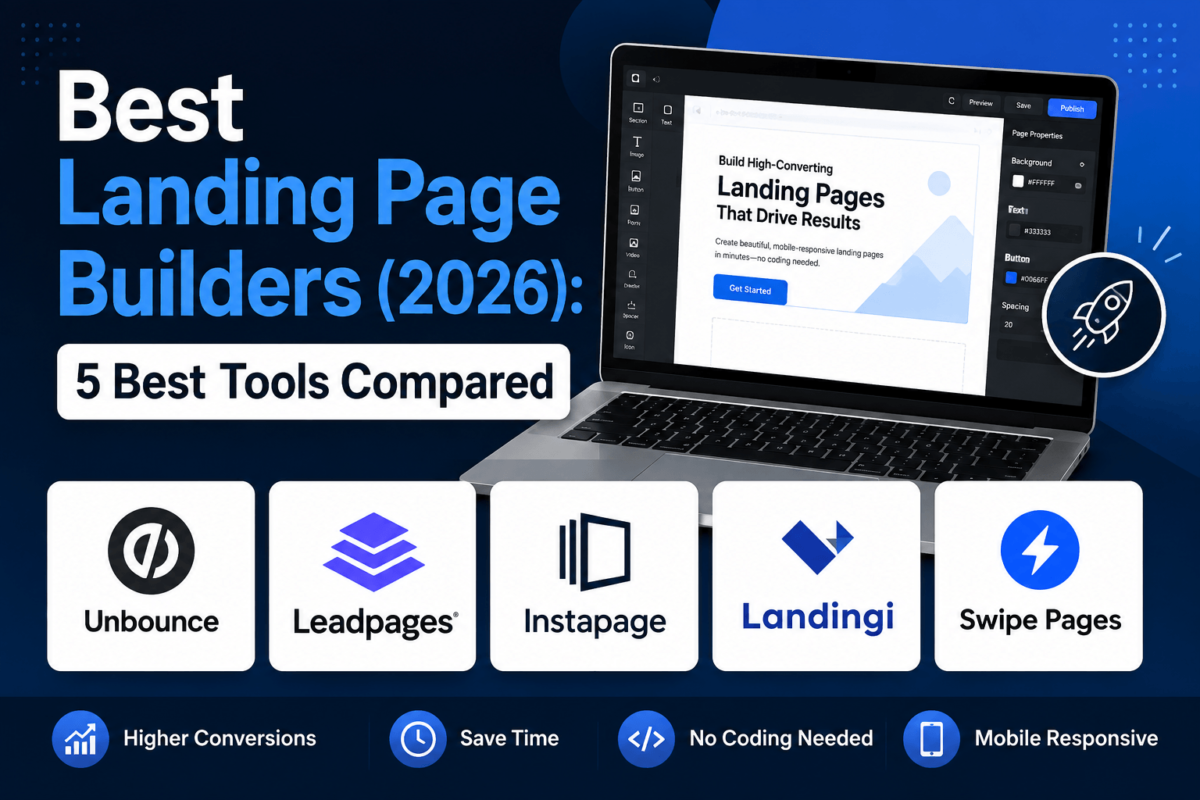
Best Landing Page Builders (2026): 5 Best Tools Compared
By Jaykishan Panchal · SEO & Digital Marketing Strategist · Updated August 2026 · 15+ years in SEO and conversion-focused marketing
Quick Answer
The best landing page builder overall is Unbounce, thanks to its AI-driven Smart Traffic optimization. Leadpages is the best pick for beginners and small businesses because it has no traffic caps and an AI page builder. Instapage wins for agencies and enterprise teams that need ad-to-page personalization at scale. Landingi is the best budget option with the largest template library. Swipe Pages is the fastest, mobile-first choice for paid social and Google Ads traffic.
You didn’t pay for that click to send someone to a homepage that’s trying to sell five things at once. A visitor who arrives from a Google ad, a Meta campaign, or an email newsletter has exactly one job to do — and a dedicated landing page, not your regular website, is the tool built to get them to do it.
That’s the entire case for the best landing page builders as a category. A general-purpose website builder is designed to keep visitors browsing. A landing page builder is designed to convert them — into leads, trial signups, or sales — and it does that with features your CMS was never built for: dynamic text replacement that matches ad copy to page copy, A/B testing that isolates a single variable, and analytics that tell you exactly where visitors drop off.
The difference shows up directly in your numbers. Marketers running dedicated landing pages instead of repurposed website pages consistently report higher conversion rates and a lower cost per lead, because every element on the page is working toward one action instead of competing with a navigation menu, a footer, and three other calls to action.
We tested and researched five landing page builders that are worth your time in 2026: Unbounce, Leadpages, Instapage, Landingi, and Swipe Pages. Every tool on this list is a genuinely capable, actively maintained platform, so you can trust that our recommendations aren’t just filler. Below, you’ll find honest reviews, a side-by-side feature comparison, a buying guide, conversion best practices, sourced statistics, and answers to the questions marketers ask most before choosing a landing page platform.
A quick note on how we approached this guide: we evaluated each tool on the same criteria — builder flexibility, AI capabilities, testing and optimization tools, integration depth, template quality, and value at each pricing tier — and cross-checked vendor claims against independent reviews, pricing pages, and user feedback rather than relying on marketing copy alone. Where a feature is genuinely limited or gated behind a higher tier, we say so directly, because a landing page builder that looks great in a sales demo but frustrates you at your actual traffic volume isn’t a good recommendation.
Quick Comparison Table
Here’s the shortest version of this entire guide. Every plan detail below can change, so treat this as a starting point and confirm current numbers on each vendor’s pricing page before you buy.
| Tool | Best For | Starting Price | Free Trial | AI Features | Templates | A/B Testing | DTR | Integrations | Mobile Optimized | AMP Support | Ease of Use | Rating |
|---|---|---|---|---|---|---|---|---|---|---|---|---|
| Unbounce | AI-driven CRO | Multiple monthly tiers (mid-range) | Yes | Smart Traffic + Smart Copy | 100+ | Yes (mid-tier+) | Yes | 60+ native, Zapier | Yes | No | Moderate | 4.6/5 |
| Leadpages | Beginners, no traffic caps | Multiple monthly tiers (low entry) | Yes | AI page generator | 250+ | Yes (mid-tier+) | Yes | 40+ native, Zapier | Yes | No | Easy | 4.5/5 |
| Instapage | Agencies, enterprise | Multiple monthly tiers (premium) | Yes | AI content + AdMap | 200+ | Yes (mid-tier+) | Yes | 120+ native | Yes | No | Moderate | 4.6/5 |
| Landingi | Budget & agencies | Multiple monthly tiers (lowest entry) | Yes | AI Composer | 400+ | Yes (paid tiers) | Limited | 170+ native, Zapier | Yes | No | Easy | 4.4/5 |
| Swipe Pages | Mobile / paid social | Multiple monthly tiers (low entry) | Yes | Swipe Genie AI | 40+ | Yes | Yes | Direct + Zapier | Yes | Yes (native) | Easy | 4.4/5 |
Want the definitions behind terms like A/B testing and conversion rate before you dig into the reviews? Our conversion rate optimization guide breaks the fundamentals down in plain English.
How We Evaluated These Tools
Each builder was assessed hands-on across six criteria: builder flexibility (how much creative freedom the drag-and-drop editor actually gives you), AI capabilities (page generation, copywriting, and traffic optimization), testing and analytics depth, integration breadth with common CRM and email tools, template quality, and real value at each pricing tier — not just the cheapest advertised price. We weighed vendor marketing claims against independent user reviews, current pricing pages, and documented feature limitations, and we noted plainly wherever a feature that sounds included in a sales page is actually gated behind a higher tier.
Best Landing Page Builders in 2026
1. Unbounce — Best Overall for AI-Driven Conversion Optimization
Overview
Unbounce launched in 2009 in Vancouver and has spent well over a decade building its reputation on one idea: landing pages should keep improving themselves after you hit publish. Its signature feature, Smart Traffic, uses AI to route each visitor to whichever page variant is statistically most likely to convert them — a genuinely different approach from waiting weeks for a manual A/B test to reach significance. Unbounce is best suited to marketers and agencies who are already spending real money on paid traffic and want that spend to work harder automatically. The platform has also leaned further into AI over the past two years, adding AI-assisted page building and copywriting on top of its original testing engine, so it now competes on both the build side and the optimize side of the workflow.
Key Features
- Smart Traffic: AI-based visitor routing that continuously sends traffic to your best-converting page variant based on device, source, and visitor behavior
- Smart Copy: built-in AI copywriting for headlines, CTAs, and ad text
- Drag-and-drop builder with both a fully freeform Classic Builder and a faster AI-assisted Smart Builder
- A/B and multivariate testing
- Dynamic Text Replacement (DTR) to match page headlines to a visitor’s exact search query
- Popups and sticky bars included on every plan, not gated behind a higher tier
- 100+ conversion-focused templates
- Real-time analytics dashboard with conversion and visitor-level data
- 60+ native integrations plus access to thousands more through Zapier
- Unlimited landing pages on every plan
|
Pros
|
Cons
|
Pricing
Unbounce prices in several monthly tiers, from an entry-level Build plan through mid-tier plans that unlock A/B testing and eventually Smart Traffic, up to custom Concierge pricing for high-volume agency accounts. All tiers include a 14-day free trial and a discount for annual billing. Unbounce has restructured its plans and limits more than once recently, so confirm current pricing and visitor caps directly on their pricing page before you commit.
Best For
Agencies and in-house marketing teams running meaningful monthly ad spend who want a platform that keeps optimizing pages after launch, not just one that builds them.
Why We Recommend It
If you’re already paying for every click, Smart Traffic effectively puts a second, always-on layer of optimization behind every page you publish. For teams spending enough on paid traffic that a 10–30% conversion lift moves the needle, that’s usually worth the premium over a cheaper, more static builder. In practice, this makes the most sense for a marketing team running several page variants for the same offer — Smart Traffic does the ongoing work of figuring out which one wins, instead of a marketer eyeballing a dashboard every few days.
Bottom Line: Unbounce
The AI-first pick for advertisers who want a landing page platform that keeps improving itself after you hit publish.
2. Leadpages — Best for Beginners & Small Businesses
Overview
Leadpages has spent over a decade positioning itself as the landing page builder for people who don’t want to think about landing page builders. It’s aimed squarely at solopreneurs, coaches, and small businesses, and its biggest structural advantage is one most competitors don’t offer: no visitor or traffic caps on any plan, so a viral campaign or a big ad push won’t trigger an overage bill. It has also expanded beyond single landing pages into lightweight full-site and blog publishing, positioning itself as a more complete starter toolkit than a narrow, single-purpose builder.
Key Features
- AI landing page generator: describe your offer and get a complete page structure back in about a minute
- Drag-and-drop builder with a large template library sorted by real-world conversion performance
- A/B split testing on mid-tier and above
- Dynamic Text Replacement for PPC campaigns
- Popup and alert bar builders included
- Built-in Leadmeter optimization score that scores your page as you build it
- No traffic or visitor caps on any plan
- Simple checkout functionality for digital product sales
- 40+ native integrations plus Zapier
- Can also publish lightweight full websites and blogs, not just single landing pages
|
Pros
|
Cons
|
Pricing
Leadpages offers an entry plan built for a single domain and solo use, a mid-tier plan that adds A/B testing and removes most limits, and custom pricing above that for larger accounts. Every plan includes a free trial and a discount for annual billing. Leadpages has adjusted its tier names and limits more than once in the past year, so check the official pricing page for current numbers.
Best For
Solopreneurs, coaches, course creators, and small businesses who want a fast, uncapped, beginner-friendly builder without hiring a developer.
Why We Recommend It
The combination of no traffic caps and an AI builder that gets you to a working page in minutes makes Leadpages one of the lowest-friction ways to get a real landing page live today instead of next week — without worrying that a good month of traffic will cost you extra. That’s especially valuable for anyone launching a webinar, a course cohort, or a seasonal promotion, where a sudden traffic spike is the goal, not a risk.
Bottom Line: Leadpages
The best value pick for small businesses that want unlimited traffic and a genuinely fast path from idea to published page.
3. Instapage — Best for Agencies & Enterprise Personalization
Overview
Instapage sits at the enterprise end of this category, built around what it calls post-click optimization: matching every individual ad to its own dedicated, personalized landing page. Its two standout features, AdMap and Collections, exist to solve a problem the other four tools here don’t fully address — making sure a visitor’s landing page experience actually matches the ad they clicked, at scale, across hundreds of campaigns. Instapage has consistently ranked among the highest-rated platforms in the category for customer satisfaction, largely on the strength of its collaboration and personalization tooling.
Key Features
- AdMap: visually connects each ad campaign or ad group to its matching landing page
- Collections: generate and centrally manage hundreds of personalized page variants from a single master template
- AI content generation for headlines, body copy, and CTAs
- Server-side A/B testing with statistical significance detection (mid-tier and above)
- Built-in heatmaps and scroll/click tracking (higher tier)
- Dynamic Text Replacement and audience-based personalization
- 200+ conversion-tested templates
- Team collaboration tools, including in-page commenting and approval workflows
- 120+ native integrations, including HubSpot, Salesforce, and Marketo
|
Pros
|
Cons
|
Pricing
Instapage’s entry plan covers the builder and basic AI content tools, a mid-tier plan adds A/B testing and dynamic text replacement, and enterprise-level personalization, heatmaps, and dedicated support sit behind custom pricing. A free trial is available on the entry tiers. Because Instapage prices enterprise deals individually, confirm current numbers directly with their sales team or pricing page.
Best For
Agencies managing multiple paid-ad clients and enterprise marketing teams running high ad spend across many campaigns that need message-matched, personalized pages at scale.
Why We Recommend It
When ad relevance and personalization — not just page design — are what’s capping your conversion rate, AdMap and Collections solve a workflow problem the other four tools here don’t fully tackle. An agency running fifty ad groups across a dozen clients gets the most value from this: instead of manually building fifty pages, Collections can generate and manage them from one template with the audience-specific details swapped in automatically.
Bottom Line: Instapage
The enterprise and agency pick, built for teams that need to match every ad to a personalized page at scale.
4. Landingi — Best Budget Option
Overview
Founded in Poland in 2011, Landingi has become the budget-conscious pick that punches well above its price point: a template library larger than any other tool in this comparison, a genuinely flexible drag-and-drop editor, and a growing AI toolkit, all at a fraction of what Unbounce or Instapage charge at entry level. It’s used by a wide range of businesses, from solo freelancers to larger marketing teams, and has increasingly positioned itself around automation features like programmatic pages that save real time for anyone managing dozens of campaigns at once.
Key Features
- AI Assistant/Composer: generates headlines, body copy, SEO metadata, and full page drafts from a short brief
- 400+ templates spanning industries and campaign types
- Smart Sections: reusable blocks (headers, footers, disclaimers) that update across every page at once
- EventTracker: built-in behavioral analytics — clicks, scroll depth, video plays — with no extra setup
- Programmatic landing pages: generate large batches of location- or product-specific pages from one master template
- Server-side A/B and multivariate testing
- Page importer that turns any existing URL into an editable template
- Native WordPress plugin for embedding pages without iframes
- 170+ integrations with CRM and email marketing tools
|
Pros
|
Cons
|
Pricing
Landingi’s entry plan is the lowest-cost option in this comparison, with a mid-tier plan that adds A/B testing and higher visitor limits, and agency/enterprise tiers above that with white-label and sub-account options. A free trial is available on every plan. Pricing tiers shift periodically, so confirm current numbers on Landingi’s official pricing page.
Best For
Small businesses, freelancers, and agencies that need to manage a high volume of client landing pages without paying enterprise prices for each one.
Why We Recommend It
For teams that don’t need Instapage-level personalization or Unbounce’s AI traffic routing, Landingi delivers most of the core feature set at roughly a third of the entry cost — budget you can put straight back into ad spend. Agencies in particular benefit from programmatic pages: a real estate or local-services agency, for example, can build one template and generate dozens of location-specific pages automatically instead of rebuilding each one by hand.
Bottom Line: Landingi
The best-value pick, offering the deepest template library and a surprisingly complete feature set at the lowest starting price in this comparison.
5. Swipe Pages — Best for Mobile & Paid Social Campaigns
Overview
Swipe Pages launched in 2020 out of Singapore with a narrow, focused pitch: every page it builds runs on AMP (Accelerated Mobile Pages) technology, engineered to load in well under a second on mobile networks. Since the majority of paid social and search traffic now arrives on a phone, that speed advantage translates directly into lower bounce rates and a lower cost per lead. It’s a more focused, narrower tool than the other four platforms here, and that focus is exactly the point — it does one thing (fast mobile pages) extremely well rather than trying to be a full marketing suite.
Key Features
- Native AMP pages plus Mobile Slides, a swipeable, app-like mobile page format
- Separate mobile and desktop editors for precise control over each layout
- Swipe Genie AI: generates an initial page draft to speed up the build process
- Dynamic Text Replacement for PPC ad-keyword matching
- A/B testing and built-in conversion analytics
- Multi-step forms with custom field types (sliders, toggles, date pickers)
- Agency sub-account structure for managing multiple client accounts
- Direct integrations with Zapier, Mailchimp, HubSpot CRM, Constant Contact, Zoho, and Google Analytics
|
Pros
|
Cons
|
Pricing
Swipe Pages offers a low-cost entry tier for a single domain, a mid-tier plan that adds direct integrations and more domains, and an agency tier with unlimited domains and priority onboarding. A free trial is available on every plan. As with the other tools here, confirm current pricing directly with Swipe Pages before purchasing.
Best For
Performance marketers and agencies running Meta, TikTok, or Google Ads campaigns where mobile page speed has an outsized effect on cost per lead.
Why We Recommend It
If most of your paid traffic is mobile — and for most PPC campaigns in 2026, it is — Swipe Pages’ AMP-first architecture solves for page speed at the platform level instead of asking you to optimize around it. This matters most for anyone running cold-traffic Meta or TikTok campaigns, where a visitor’s patience for a slow-loading page is close to zero and every extra second of load time is a lead you paid for and didn’t get.
Bottom Line: Swipe Pages
The mobile-speed specialist, built for advertisers who need pages that load almost instantly on phones.
Feature Comparison Table
Once you know your budget and use case, this is the table to scan feature-by-feature. “Yes (tier)” means the feature exists but isn’t on the entry-level plan.
| Feature | Unbounce | Leadpages | Instapage | Landingi | Swipe Pages |
|---|---|---|---|---|---|
| AI Builder | Smart Builder + Smart Copy | AI page generator | AI content generation | AI Composer | Swipe Genie AI |
| Templates | 100+ | 250+ | 200+ | 400+ | 40+ |
| A/B Testing | Mid-tier+ | Mid-tier+ | Mid-tier+ | Paid tiers | Included |
| Dynamic Text Replacement | Yes | Yes | Yes | Limited | Yes |
| AMP Pages | No | No | No | No | Yes (native) |
| Form Builder | Yes | Yes | Yes | Yes | Yes (multi-step) |
| Popup Builder | Yes, all plans | Yes | Add-on/higher tier | Yes | No |
| Analytics | Real-time dashboard | Leadmeter + analytics | Real-time + AI experiments | EventTracker | Built-in analytics |
| Heatmaps | No | No | Higher tier | No | No |
| CRM Integrations | 60+ native | 40+ native | 120+ native | 170+ native | Direct (HubSpot, Zoho) |
| Email Marketing Integrations | Native + Zapier | Native + Zapier | Native | Native + Zapier | Native (Mailchimp, Constant Contact) |
| Ecommerce Support | Via integrations | Checkout built-in | Via integrations | Via integrations | Limited, no native Shopify |
| Team Collaboration | Yes | Basic | Advanced (approval workflows) | Yes (agency tiers) | Agency sub-accounts |
| Mobile Optimization | Responsive | Responsive | Responsive | Responsive + mobile editor | Dedicated mobile editor |
| Speed | Standard hosting | Standard hosting | Standard hosting | Standard hosting | Sub-second (AMP) |
| Ease of Use | Moderate | Easy | Moderate | Easy | Easy |
| Best For | AI-driven CRO | Beginners, SMBs | Agencies, enterprise | Budget, agencies | Mobile, paid social |
Best Landing Page Builders by Use Case
No single tool wins every category. Here’s which builder we’d point you to depending on what you’re actually trying to do.
Best Overall: Unbounce
Unbounce takes the top spot overall because Smart Traffic does something none of the other four tools fully replicate: it keeps optimizing your pages automatically, on its own, after launch. For teams with real ad budgets, that ongoing lift compounds month over month.
Best for Beginners: Leadpages
The AI page generator, uncapped traffic, and a genuinely simple interface make Leadpages the easiest tool here to go from zero to a published, working landing page in a single afternoon.
Best for Agencies: Instapage
Approval workflows, in-page commenting, and Collections for managing hundreds of client page variants make Instapage the strongest fit for agencies juggling multiple accounts and stakeholders.
Best for Ecommerce: Landingi
None of these five tools is a dedicated ecommerce platform, but Landingi’s programmatic pages come closest — letting you spin up product- or category-specific landing pages at scale from one template. If your landing pages need to plug directly into a Shopify storefront, pair your landing page builder with a dedicated app from our best Shopify apps roundup.
Best for SaaS: Unbounce
SaaS landing pages typically convert lower than other industries because the ask (a signup, not a purchase) carries more consideration. Unbounce’s combination of AI copywriting and Smart Traffic is built for exactly that kind of continuous, incremental optimization.
Best for Lead Generation: Leadpages
Uncapped traffic, built-in checkout, and a straightforward form builder make Leadpages a strong lead-gen workhorse for coaches, consultants, and small B2B teams. If lead generation is your core focus, it’s also worth comparing dedicated platforms in our best lead generation software guide.
Best for Enterprise: Instapage
Heatmaps, server-side testing, dedicated support, and enterprise-grade security options make Instapage the safest choice for large organizations running high-volume, high-stakes ad campaigns.
Best Budget Option: Landingi
Landingi’s entry pricing undercuts every other tool on this list while still including A/B testing, hundreds of templates, and genuine automation features like Smart Sections and EventTracker.
Best AI Landing Page Builder: Unbounce
Smart Traffic remains the most mature AI-driven optimization feature in this category. Leadpages’ AI page generator is the fastest way to draft a page from scratch, so if speed-to-first-draft matters more than ongoing optimization, it’s a strong runner-up.
Best for Mobile Pages: Swipe Pages
Native AMP support gives Swipe Pages a mobile load-time advantage that a standard HTML builder simply can’t match, which matters directly for paid campaigns where most clicks land on a phone.
Landing Page Builder Buying Guide
What Is a Landing Page Builder?
A landing page builder is software purpose-built to create standalone, single-purpose web pages designed around one conversion goal — a signup, a purchase, a demo request — without needing a developer or your main website’s CMS. Unlike a general website platform, it’s optimized specifically for pages that live outside your main site’s navigation and exist to answer one ad, one email, or one offer.
Who Actually Needs a Dedicated Landing Page Builder?
If you’re running any kind of paid traffic — Google Ads, Meta ads, an email list, an affiliate campaign — a dedicated builder almost always pays for itself. If your traffic is entirely organic and you’re not running discrete, offer-specific campaigns, you may get more value from investing directly in your main website and its existing pages instead of adding a separate tool to your stack.
Landing Pages vs. Websites: What’s the Difference?
Your website exists to inform and to be browsed; it has navigation, multiple pages, and multiple goals. A landing page strips all of that away and asks a visitor to do exactly one thing. If you’re comparing the two categories directly, our best website builders and best AI website builders guides cover the full-site side of that decision.
Why Businesses Use Dedicated Landing Page Builders
Three reasons come up constantly: speed (publishing a campaign page in hours instead of waiting on a dev queue), message match (a page built specifically for one ad or offer converts better than a generic page), and testability (dedicated builders come with A/B testing and analytics baked in, not bolted on). There’s also a practical budgeting reason — when a marketing team can launch and test its own pages without pulling a developer off other work, campaigns get to market faster and cost less to iterate on.
No-Code Building
Every tool in this comparison uses a drag-and-drop, no-code editor. That matters because it puts page creation and iteration directly in a marketer’s hands, removing the dev-ticket bottleneck that slows down most campaign launches.
Conversion Optimization & Split Testing
Conversion rate optimization (CRO) is the discipline of systematically improving the percentage of visitors who complete your goal action, usually through structured A/B or multivariate testing. See our conversion rate optimization guide for a full breakdown of how the testing process actually works.
Dynamic Content & Personalization
Dynamic Text Replacement swaps page copy to match a visitor’s search query or ad group automatically, while deeper personalization (like Instapage’s Collections) tailors entire sections of a page to audience segments. Both reduce the gap between what someone clicked and what they land on.
Mobile Optimization & Page Speed
With mobile devices driving the majority of web traffic, a slow-loading page is one of the fastest ways to lose a conversion before a visitor even reads your headline. See our Core Web Vitals guide for the technical side of page speed, and consider a builder with native mobile optimization — or, for AMP-specific speed, a tool like Swipe Pages.
Integrations & Analytics
Your landing page builder needs to talk to the rest of your stack — your CRM, your ad platforms, and your email tool. Before committing to a builder, check it integrates with your existing email marketing software so leads flow automatically instead of requiring manual exports.
AI Capabilities
AI now shows up in this category in three distinct ways: generating full page drafts (Leadpages, Swipe Pages), writing copy (Unbounce, Landingi), and optimizing traffic routing after launch (Unbounce’s Smart Traffic). For a broader look at AI across the marketing stack, see our best AI marketing tools guide.
Security & Scalability
All five tools here include SSL by default and host on their own infrastructure, so you’re not responsible for server security. If you’re evaluating for a larger organization, check each vendor’s SSO, audit-log, and uptime SLA options at the enterprise tier before you commit. Scalability is worth stress-testing before you sign an annual contract, too — ask directly what happens to your account, and your bill, if a campaign goes viral and blows past your plan’s visitor limit.
Landing Page Best Practices
The builder you choose matters less than what you put on the page. These are the fundamentals that show up in almost every high-converting landing page, regardless of which of the five tools above you use.
Headlines & Copy
Your headline should state the offer and the benefit in one breath — a visitor decides whether to keep reading within seconds. Skip clever wordplay in favor of clarity.
Calls to Action
- Use one primary CTA per page — pages with a single, focused call to action consistently outperform pages with several competing options
- Write action-oriented button text (“Start My Free Trial”) instead of generic text (“Submit”)
- Place your primary CTA above the fold, and repeat it again after any long-form content
Social Proof & Testimonials
Testimonials, client logos, review counts, and case-study numbers all reduce the hesitation a new visitor feels before handing over their email or their card. Use real names, specific results, and (where possible) a photo — specificity is what makes a testimonial believable.
Forms
Every additional form field is friction. Ask only for what you genuinely need at this stage of the funnel, and consider a multi-step form (like Swipe Pages offers) if you need more information than a single-page form comfortably supports.
Images & Video
Use images that show your product or service in actual use, not generic stock photography. A short explainer or product-demo video, placed near your primary CTA, is one of the highest-leverage additions you can make to a landing page.
Trust Badges & Security Signals
Security seals, payment logos, and industry certifications matter most in categories where a visitor has real purchase-risk hesitation — financial services, health, and any first-time purchase from an unfamiliar brand.
Page Speed & Mobile Optimization
Every additional second of load time is measurable lost revenue. Compress images, avoid unnecessary scripts, and preview your page on an actual phone — not just your desktop browser’s mobile simulator — before you launch.
Color Psychology & Removing Distractions
Your CTA button should visually stand out from the rest of the page’s color palette, not blend into it. Just as importantly, remove your site’s main navigation menu from landing pages entirely — every exit link is a chance for a visitor to leave before converting.
Thank-You Pages, A/B Testing & Analytics
Don’t skip the thank-you page: it’s a free opportunity to confirm the next step, offer a related resource, or add a tracking pixel for ad-platform optimization. And treat your first published version as a draft, not a final answer — A/B test one element at a time (headline, CTA text, hero image) and let each test run long enough to reach statistical significance before acting on it.
Finally, actually look at your analytics. A landing page builder’s built-in dashboard will tell you where visitors drop off in a multi-step form, which traffic source converts best, and whether mobile visitors behave differently than desktop visitors on your page. That data, not a general best-practices list like this one, should ultimately drive your next test.
Landing Page Statistics (2026)
Numbers change how you prioritize. Here are the most relevant, sourced statistics on landing page performance heading into 2026 — useful both for setting realistic expectations and for making the case internally for why a dedicated landing page builder is worth the line item on your marketing budget.
| Statistic | Source |
|---|---|
| The median dedicated landing page converts at 6.6%, based on an analysis of 41,000 landing pages and 464 million visits. | Unbounce Conversion Benchmark Report |
| Across all page types (not just dedicated landing pages), the broader cross-industry average conversion rate is 2.35%. | WordStream |
| The top 25% of landing pages convert at 5.31% or higher; the top 10% convert at 11.45% or higher. | WordStream |
| SaaS landing pages have the lowest industry median at 3.8%, while financial services (8.4%) and events/entertainment (12.3%) rank highest. | Unbounce industry benchmarks |
| Mobile devices account for roughly 60% of global website traffic. | StatCounter |
| Desktop visitors convert at an estimated 3.9–4.3%, compared to 2.2–2.85% for mobile visitors. | Aggregated industry benchmark data |
| Mobile bounce rates run roughly 10 percentage points higher than desktop, in the 58–60% range. | StatCounter-based industry analysis |
| Reducing a form from five fields down to three can improve conversion rates by up to 50%. | Unbounce Conversion Benchmark Report |
| Pages that load in under one second can convert up to 3x higher than pages loading in five seconds. | Portent |
| Personalized CTAs convert 202% better than generic, default CTAs. | HubSpot (330,000+ CTAs analyzed) |
| Adding video to a landing page can increase conversions by up to 86%. | EyeView Digital |
| Landing pages with a single, focused CTA convert at roughly 13.5% on average, outperforming pages with multiple competing CTAs. | Unbounce (18,639 landing pages analyzed) |
| Social proof elements — testimonials, reviews, and trust badges — can lift landing page conversions by around 34%. | Invesp |
| Businesses with 40+ published landing pages generate roughly 12x more leads than businesses with 1–5 landing pages. | HubSpot |
For more sourced data on the broader marketing landscape these numbers sit inside, see our SEO statistics, content marketing statistics, and AI statistics pages. If you plan to promote your landing pages through an affiliate model like Swipe Pages supports natively, our affiliate marketing statistics roundup is a useful companion resource.
Benchmarks vary significantly by definition, industry, and traffic source — use these figures as directional context, not a universal target for your specific page.
Frequently Asked Questions
What is the best landing page builder in 2026?
Unbounce is the best overall pick thanks to its AI-driven Smart Traffic optimization, but the right choice depends on your budget and use case. Leadpages suits beginners best, Instapage suits agencies and enterprise teams, Landingi is the strongest budget option, and Swipe Pages wins for mobile-heavy paid campaigns.
Which landing page builder converts the best?
No single tool guarantees the highest conversion rate — that depends on your copy, offer, and audience. Unbounce’s Smart Traffic and Instapage’s ad-to-page personalization are the two features in this comparison most directly built to lift conversion rates automatically.
Are landing page builders worth the cost?
For any business running paid ads, yes. A dedicated landing page typically converts noticeably better than sending traffic to a general website page, and the cost of a builder is usually small relative to the ad spend it’s protecting.
Which landing page builder is easiest for beginners?
Leadpages, thanks to its simple interface, AI page generator, and lack of visitor caps that could otherwise create billing surprises for a first-time user.
Which builder has the best templates?
Landingi has the largest library at 400+ templates. Instapage’s smaller library is frequently praised for design polish, so the “best” answer depends on whether you value quantity or per-template design quality.
Which landing page builder includes AI features?
All five. Unbounce and Landingi lean into AI copywriting, Leadpages and Swipe Pages offer AI page generation from a prompt, and Unbounce’s Smart Traffic uses AI for ongoing traffic optimization after launch.
Can I build a landing page without knowing how to code?
Yes. Every tool in this comparison is a no-code, drag-and-drop builder designed specifically for marketers without development experience.
Which landing page builder is best for agencies?
Instapage, for its approval workflows and in-page collaboration tools. Landingi is a strong budget alternative for agencies managing many smaller client accounts.
Do these landing page builders work with Shopify?
Support varies. Most integrate with Shopify through Zapier or an embed code rather than a fully native connection. Swipe Pages specifically lacks a native Shopify block. For dedicated Shopify tooling, see our best Shopify apps guide.
Which landing page builder integrates with Mailchimp?
All five tools reviewed here offer a Mailchimp integration, either natively or through Zapier.
Which builders include A/B testing?
All five include A/B testing, though Unbounce, Leadpages, and Instapage gate it behind a mid-tier plan or higher. Swipe Pages and Landingi include some testing capability on lower tiers.
Can a landing page rank on Google?
Yes, though most marketers use landing pages for paid traffic rather than organic search, since they’re intentionally stripped of the navigation and internal linking that typically help pages rank. A well-optimized landing page with unique, substantive content can still rank for its target keyword.
What’s the difference between a landing page and a homepage?
A homepage serves multiple audiences and multiple goals with navigation to the rest of your site. A landing page serves one audience with one specific offer and one call to action, and usually has no site navigation at all.
Which landing page builder is fastest?
Swipe Pages, because it builds every page on AMP technology specifically engineered for sub-second mobile load times.
Which builder is best for lead generation?
Leadpages, thanks to its built-in checkout, simple form builder, and lack of traffic caps. See our best lead generation software guide for dedicated lead-gen platforms beyond landing pages specifically.
How much do landing page builders cost?
Pricing spans a wide range across this category, from budget-friendly entry tiers on tools like Landingi and Swipe Pages up to premium enterprise pricing on Instapage. Because every vendor here adjusts pricing and plan limits periodically, always confirm current numbers on the official pricing page before purchasing.
What is dynamic text replacement, and why does it matter?
Dynamic Text Replacement (DTR) automatically swaps landing page headlines and copy to match the exact keyword or ad a visitor clicked, which improves message match and typically lifts conversion rates for paid search campaigns.
Do I need a separate website if I use a landing page builder?
In most cases, yes. Landing page builders are purpose-built for single-goal campaign pages, not for hosting a full multi-page business website with navigation, blog content, and site architecture.
What’s the difference between AMP pages and regular landing pages?
AMP (Accelerated Mobile Pages) is a stripped-down page format designed to load almost instantly on mobile devices, at the cost of some design flexibility. Swipe Pages is the only tool in this comparison built natively on AMP.
How many landing pages does my business actually need?
As many as you have distinct offers or campaigns. Businesses running 40 or more landing pages generate substantially more leads than those running just a handful, largely because each page can be written specifically for one audience and one offer instead of a generic message.
Can I use a landing page builder for ecommerce?
Yes, though none of the five tools here is a dedicated ecommerce platform. Landingi’s programmatic pages come closest for product-specific landing pages, while Leadpages includes basic built-in checkout for simple digital product sales.
What’s a good landing page conversion rate?
It depends heavily on your industry and traffic source. As a rough benchmark, the median dedicated landing page converts around 6.6%, though SaaS pages typically run lower (around 3.8%) and lead-gen-heavy industries like events and financial services often run higher.
Do landing page builders include hosting?
Yes. All five tools host your published pages on their own infrastructure with SSL included by default, so you don’t need separate web hosting.
Can I connect a custom domain to a landing page builder?
Yes, every tool in this comparison supports connecting your own custom domain, typically starting on the entry-level paid plan.
Which tool is best for personalized landing pages at scale?
Instapage, through its Collections feature, which generates and manages large numbers of personalized page variants from a single master template — purpose-built for teams running many audience segments or ad groups simultaneously.
Are these tools good for solo marketers, or only agencies?
Leadpages, Landingi, and Swipe Pages all work well for solo marketers and small teams thanks to accessible entry pricing. Instapage and, to a lesser extent, Unbounce are better suited to teams with a real ad budget and more than one campaign running at once.
Can I migrate an existing landing page into one of these builders?
Landingi offers a page importer that turns an existing URL into an editable template, which is the most direct migration path of the five tools reviewed here. With the others, you’ll typically rebuild the page manually using the drag-and-drop editor and existing copy and images.
Do landing page builders replace the need for a web designer?
For most single-purpose campaign pages, yes — the templates and drag-and-drop editors in this comparison are built specifically so marketers can launch without design or development help. For a fully custom brand experience or a complex multi-page site, a designer or developer is still worth involving.
What happens to my landing pages if I cancel my subscription?
In almost every case, your published pages go offline when your subscription ends, since these platforms host your pages on their own infrastructure rather than yours. Export your page content and any collected lead data before cancelling.
Final Verdict
Every tool in this comparison is a genuinely capable landing page builder — the right pick comes down to your budget, your traffic source, and how much ongoing optimization you actually need versus a solid page you can publish and move on from.
| Category | Winner | Why |
|---|---|---|
| Best Overall | Unbounce | Smart Traffic delivers ongoing AI-driven optimization no other tool here fully matches |
| Best Value | Landingi | The lowest entry price with the largest template library |
| Best Enterprise Choice | Instapage | Heatmaps, server-side testing, and enterprise-grade collaboration |
| Best Beginner Choice | Leadpages | No traffic caps, an AI builder, and a genuinely simple interface |
| Best AI Choice | Unbounce | Smart Traffic and Smart Copy are the most mature AI feature set here |
| Best Agency Choice | Landingi | Programmatic pages and Smart Sections make managing many client accounts affordable |
If you’re still deciding, start with a free trial on your top pick — every tool reviewed here offers one — and test it against a real campaign before committing to an annual plan. Compare current pricing directly on each vendor’s site, since every platform in this space adjusts its tiers periodically, and run your own A/B test once you’re live rather than assuming any single builder guarantees a better conversion rate than the copy and offer you put on the page.
None of these five tools is a bad choice — they’re the strongest options in the category for good reason. The real risk isn’t picking the “wrong” builder, it’s picking one that doesn’t match how much traffic and testing you’re actually planning to run, and either overpaying for enterprise features you won’t use or outgrowing a budget tool within a few months. Match the tool to your traffic volume and your team size first, and the rest of this guide should get you to a confident decision.
Disclosure: TechCognate may earn a commission if you sign up for a tool through a link on this page, at no additional cost to you. This never influences which tools we choose to review or how we rate them — our recommendations are based on independent research and testing.