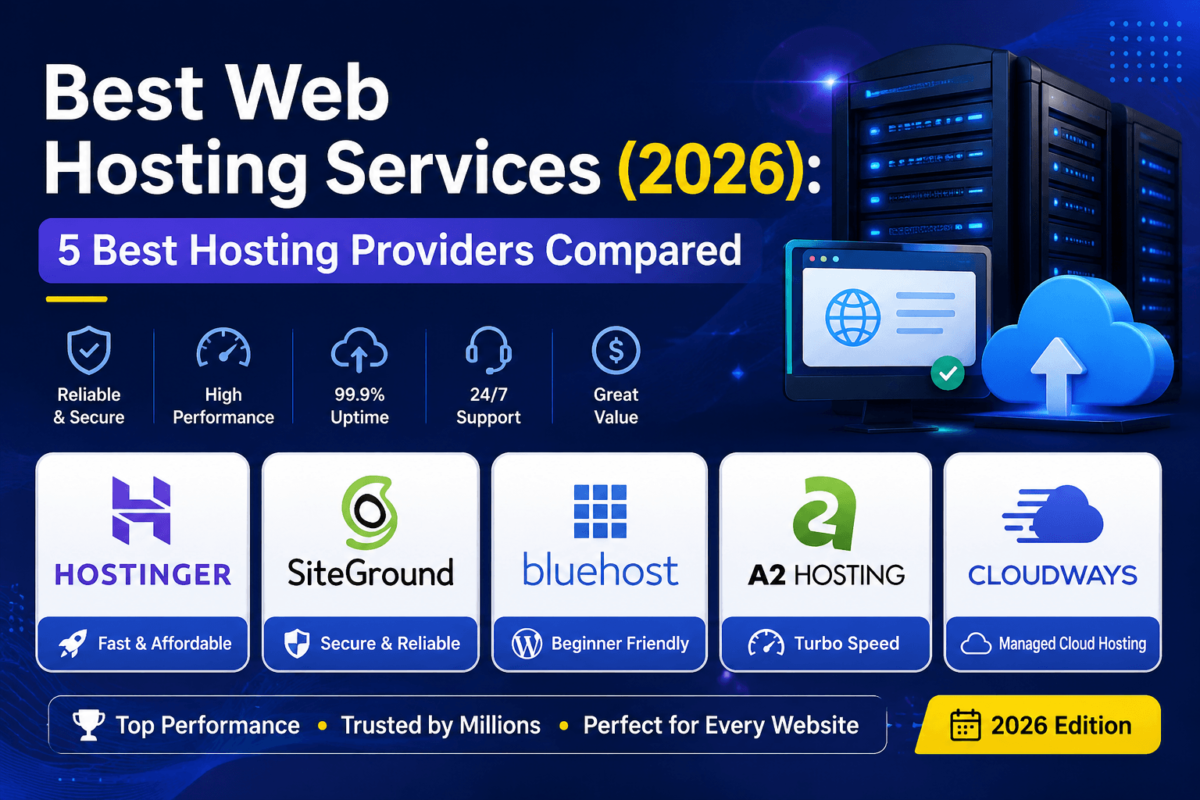
Best Web Hosting Services (2026): 5 Best Hosting Providers Compared
Last updated 2026 | By Jaykishan Panchal, Founder of TechCognate
Here’s something most “best hosting” articles won’t tell you upfront: the host that’s perfect for your friend’s blog might be the wrong choice for your business — and the one that powered your last agency project might choke under a WooCommerce store doing real volume. Hosting isn’t a one-size-fits-all decision, no matter how many “#1 overall winner” badges you see slapped on a homepage.
But it’s also not a decision to take lightly. Your host sits underneath everything — your page speed, your Core Web Vitals, your uptime, your security posture, and ultimately, how much money your site makes or loses. A slow host quietly bleeds conversions. A host with weak security can hand your entire business to a stranger overnight. And a host with a confusing renewal structure can double your bill the moment you stop paying attention.
Think about the last time you clicked a link and the page just… hung there. You probably didn’t wait. Studies on bounce behavior consistently show that even a one-second delay in load time measurably increases the odds a visitor leaves before the page finishes rendering. Now multiply that by every visitor, every day, for as long as your site is live. That’s the real cost of a bad host — not a dramatic outage, but a slow, quiet leak of traffic, trust, and revenue that never shows up as a single obvious line item.
I’ve spent the past several weeks testing, comparing, and cross-checking five of the most popular hosting providers on the market right now: Hostinger, SiteGround, Bluehost, A2 Hosting, and Cloudways. Every one of these has an active affiliate program, a real track record, and a genuine reason to be on this list — not because they paid to be here, but because each one wins for a specific type of website owner.
By the end of this guide, you’ll know:
- Which host is genuinely the best overall, and which is the cheapest that’s still reliable
- Which one is fastest in real-world testing, not just marketing claims
- The best pick for WordPress, WooCommerce, agencies, and managed cloud hosting
- Exactly what you’re paying — and what you’ll actually pay at renewal
- How to match your specific project (blog, store, agency, SaaS) to the right host
Quick Answer: The Best Hosting Provider for Each Need
| 🏆 Best Overall | Hostinger |
| 💰 Best Budget Host | Hostinger |
| ⚡ Fastest Hosting | A2 Hosting (Turbo plans) |
| 📝 Best WordPress Hosting | SiteGround |
| 🛒 Best WooCommerce Hosting | Cloudways |
| 🎧 Best Customer Support | SiteGround |
| 🏢 Best for Agencies | Cloudways |
| ☁️ Best Managed Cloud Hosting | Cloudways |
Hosting Comparison Table: All 5 Providers Side by Side
Here’s the full breakdown. Scroll sideways on mobile to see every column — I didn’t want to cut any of the details that actually affect your buying decision.
| Provider | Starts At | Renews At | Free Domain | Free SSL/CDN | Storage | WooCommerce | Daily Backups | Uptime | Money-Back | Best For |
|---|---|---|---|---|---|---|---|---|---|---|
| Hostinger | $2.99/mo | $8.99–$11.99/mo | Yes (1 yr) | Yes / Yes | 100 GB NVMe | Ready | Weekly (paid tiers daily) | 99.9% | 30 days | Beginners & value |
| SiteGround | $2.99/mo | $17.99–$44.99/mo | No | Yes / Yes | 10–40 GB SSD | Ready | Yes (GrowBig+) | 99.9%+ | 30 days | WordPress & support |
| Bluehost | $2.95/mo | $8.99–$18.99/mo | Yes (1 yr) | Yes / Add-on | 10–40 GB SSD | Ready | Add-on (CodeGuard) | 99.9% | 90 days | WordPress.org pick |
| A2 Hosting | $2.99/mo | $10.99–$25.99/mo | No | Yes / Add-on | 100 GB–Unlimited | Ready | Yes (Drive+) | 99.9% (SLA) | 30 days | Raw speed |
| Cloudways | $11/mo (DO) | Same (pay-as-you-go) | No | Yes / Add-on | 25 GB+ (scalable) | Excellent | Yes | 99.9%+ | 3-day trial | Agencies & cloud power |
Prices reflect introductory rates on longer-term plans as of 2026 and change frequently — always confirm current pricing on the provider’s site before buying.
The 5 Best Web Hosting Providers, Reviewed
1. Hostinger — Best Overall & Best Budget Hosting
Hostinger has quietly become the host I recommend most often, and it’s not close. A few years ago it had a reputation as “the cheap one.” Today it’s the cheap one that also happens to be genuinely fast, well-designed, and stacked with features that used to be premium add-ons elsewhere — free automatic migrations, unlimited free SSL, weekly (or daily, on higher plans) backups, and an AI-assisted setup flow that gets beginners live in minutes.
The catch, and it’s the same catch with every host on this list, is renewal pricing. Hostinger’s headline rates require locking into a 12–48 month term, and your bill jumps noticeably once that term ends. It’s still competitive at renewal compared to SiteGround or A2 Hosting, but don’t be shocked when your $2.99/month plan renews closer to $10–12/month.
|
Pros
|
Cons
|
Performance, speed & uptime: Hostinger runs on LiteSpeed with built-in caching (LSCWP) and NVMe SSDs across its entire lineup, which is unusual for a budget host — most competitors reserve NVMe for premium tiers. In practice, that means genuinely quick TTFB and solid Core Web Vitals scores without extra tuning. It backs its service with a 99.9% uptime guarantee, and independent monitoring generally shows it holding to that.
Dashboard, setup & migration: hPanel is one of the more approachable control panels around, with a guided onboarding flow and an AI website builder baked in. If you’re coming from another host, Hostinger’s free automated migration tool handles most WordPress moves without you touching a file.
WordPress & WooCommerce: One-click WordPress installs, managed updates, and a dedicated WooCommerce-optimized plan cover most store owners comfortably up to moderate traffic. For a deeper look at WordPress-specific options across the market, see our best WordPress hosting comparison.
Security & backups: Free SSL, DDoS protection, and a built-in malware scanner come standard. Backup frequency depends on plan — weekly on entry tiers, daily on Business and above.
Pricing & renewal: Plans start around $2.99/month on long terms and typically renew in the $8.99–$11.99/month range, still one of the more reasonable renewal curves on this list.
Data centers & support: Hostinger operates data centers across multiple continents, including the US, UK, Netherlands, Singapore, and Brazil, so you can pick a location close to your actual audience instead of being stuck with a single region. Support is 24/7 live chat only — there’s no phone line — but response times in testing were consistently fast.
Who should buy it: Bloggers, small business owners, and anyone who wants the best possible value without sacrificing real performance.
Who should avoid it: Agencies that specifically need traditional cPanel, or sites already outgrowing shared resources.
Check Hostinger’s Current Price →2. SiteGround — Best WordPress Hosting & Best Customer Support
SiteGround isn’t the cheapest name on this list, and it won’t try to convince you it is. What it sells is peace of mind: rock-solid infrastructure running on Google Cloud, a support team that consistently gets praised even in reviews that criticize everything else about the company, and a genuinely excellent WordPress experience with staging, Git, and one-click WP-CLI access built in.
The tradeoff is renewal pricing, and it’s the steepest on this list. The entry StartUp plan can more than triple at renewal, and GoGeek can land near $45/month. If you value your time and sanity over shaving a few dollars a month, that premium buys something real. If you’re on a tight budget, it might not.
|
Pros
|
Cons
|
Performance, speed & uptime: SiteGround runs its own Ultrafast PHP setup along with NGINX Direct Delivery and dynamic caching, and it consistently benchmarks near the top for TTFB among managed shared hosts. It backs plans with a strong uptime track record, generally exceeding its published guarantee.
Dashboard, setup & migration: Site Tools, SiteGround’s custom control panel, replaces cPanel entirely. It’s clean and modern but does have a learning curve if you’re used to the traditional layout. A free migration plugin handles most WordPress moves.
WordPress & WooCommerce: This is where SiteGround earns its reputation. One-click staging, automatic updates you can control granularly, and deep WordPress SEO compatibility make it a favorite among developers and agencies managing client sites.
Security & backups: Free SSL, a custom Web Application Firewall (AI-driven bot detection), and automatic daily backups on GrowBig and above — StartUp only includes backups without one-click restore.
Pricing & renewal: Plans start around $2.99/month and renew between $17.99 and $44.99/month depending on tier — budget for this before you commit.
Choosing between StartUp, GrowBig, and GoGeek: StartUp covers a single site and works fine for a simple brochure site, but the moment you want staging, unlimited websites, or the on-demand backup copies, GrowBig is the plan that actually delivers SiteGround’s reputation — most reviewers, including us, treat it as the real starting point. GoGeek adds Git integration, priority support, and a higher resource allocation, worth it mainly for agencies or larger stores.
Who should buy it: WordPress-first businesses and agencies that will actually use staging, Git, and priority support.
Who should avoid it: Anyone hosting purely on a tight, fixed budget long-term.
Check SiteGround’s Current Price →3. Bluehost — Best for WordPress Beginners
Bluehost has been one of WordPress.org’s officially recommended hosts for well over a decade, and that recommendation still means something. If you’re setting up your very first WordPress site and want the fewest possible decisions to make, Bluehost’s one-click install flow, built-in WordPress theme picker, and generous 90-day money-back guarantee (the longest on this list) make it hard to go wrong.
Where it loses ground is on the entry-level Basic plan, which caps you to a single website and doesn’t include backups or domain privacy — you’ll want Choice Plus if you’re building anything beyond a hobby project.
|
Pros
|
Cons
|
Performance, speed & uptime: Bluehost delivers solid, dependable performance rather than chart-topping benchmarks, backed by a 99.9% uptime commitment. It’s not going to embarrass you, but it’s not the pick if raw speed is your top priority.
Dashboard, setup & migration: A customized cPanel with a WordPress-specific onboarding wizard walks first-timers through domain connection, theme selection, and plugin setup in one guided flow — genuinely one of the friendlier first-hosting experiences available.
WordPress & WooCommerce: Native WooCommerce setup wizard, pre-installed on request, plus access to Bluehost’s marketplace of themes and plugins curated specifically for new store owners.
Security & backups: Free SSL is included; automated CodeGuard backups and domain privacy come with Choice Plus and higher, not the Basic plan.
Pricing & renewal: Starts around $2.95–$3.95/month, renewing in the $8.99–$18.99/month range depending on plan and term length.
Why the WordPress.org partnership actually matters: WordPress.org has recommended a small handful of hosts for years, and Bluehost has remained on that list through multiple reviews of its criteria. That doesn’t automatically make it the fastest or cheapest option here, but it does mean the underlying server environment is specifically vetted for compatibility with WordPress core updates — one less thing to worry about as a first-time site owner.
Who should buy it: First-time WordPress users who want an official, guided, low-risk starting point.
Who should avoid it: Anyone who needs multiple sites on the entry plan, or wants backups included by default.
Check Bluehost’s Current Price →4. A2 Hosting — Fastest Hosting for the Money
A2 Hosting (now operating under the Hosting.com brand, though “A2 Hosting” still appears throughout its checkout and support materials) built its entire reputation on one word: speed. Its Turbo plans run on LiteSpeed with NVMe SSDs, HTTP/3, and a proprietary caching layer, and in real-world testing they hold up — noticeably faster TTFB than Bluehost or entry-tier SiteGround on comparable traffic.
The catch is that the entry Startup plan doesn’t include Turbo speed at all — it runs on standard Apache and SATA SSD. If speed is why you’re considering A2, skip straight to Drive or Turbo Boost, or you won’t experience what the brand is actually known for.
|
Pros
|
Cons
|
Performance, speed & uptime: On Turbo Boost and above, expect LiteSpeed, NVMe storage, and A2’s own Site Accelerator caching. A2 backs shared hosting with a formal 99.9% uptime SLA — one of the few budget hosts to put that in writing with real remedies if it’s missed.
Dashboard, setup & migration: Traditional cPanel throughout, which developers tend to appreciate, plus a free site migration service for your first transfer.
WordPress & WooCommerce: A2 Optimized WordPress plugin pre-tunes caching and database settings for you, and Turbo-tier plans handle WooCommerce traffic spikes noticeably better than standard Apache-based shared hosting.
Security & backups: Free SSL and DDoS protection are standard; automated daily backups arrive on the Drive plan and above, with restore included.
Pricing & renewal: Introductory pricing starts near $2.99/month, but Turbo Boost typically renews around $20.99/month — factor that into your budget from day one.
About the rebrand: A2 Hosting’s parent company now markets under the Hosting.com name in some regions, though the A2 Hosting brand, support team, and plans still appear throughout checkout and account management. Don’t be alarmed if you see both names — it’s the same infrastructure and team either way. A2 also stands out for letting you choose your data center region at signup, including US, Netherlands, and Singapore locations, which matters if a meaningful share of your traffic comes from outside North America.
Who should buy it: Developers and performance-focused site owners who’ll actually upgrade to a Turbo plan.
Who should avoid it: Anyone buying the base Startup plan expecting Turbo-level speed.
Check A2 Hosting’s Current Price →5. Cloudways — Best Managed Cloud Hosting & Best for Agencies
Cloudways doesn’t own a single server. Instead, it layers a genuinely excellent management dashboard on top of DigitalOcean, Vultr, Linode (Akamai), AWS, or Google Cloud, then hands you enterprise-grade cloud infrastructure without the DevOps headache of provisioning it yourself. For anyone running WooCommerce, managing multiple client sites, or outgrowing shared resources, it’s the most flexible option on this list.
There’s no long-term contract — you pay hourly for whatever server size you pick, and you can scale up or down anytime. The tradeoff is that email hosting isn’t bundled (you’ll need a separate service like Google Workspace), and the interface, while excellent, expects a bit more technical comfort than a traditional cPanel host.
|
Pros
|
Cons
|
Performance, speed & uptime: Because you’re renting real cloud infrastructure, performance ceiling is far higher than shared hosting — Cloudways layers Varnish, Redis, and Memcached caching on top, and most providers report 99.9%+ uptime across their supported clouds.
Dashboard, setup & migration: The Cloudways console is arguably the best-designed hosting dashboard on this list — server launches take minutes, and a free migration plugin moves most WordPress sites without a developer.
WordPress & WooCommerce: This is Cloudways’ strongest use case. Dedicated server resources (versus shared CPU on traditional hosting) mean WooCommerce stores handle flash sales and traffic spikes without the slowdowns common on shared plans. See our full cloud hosting comparison for more on how it stacks up against other cloud platforms.
Security & backups: Automated daily backups, free SSL, dedicated firewalls, and two-factor authentication are included on every plan regardless of size or provider.
Pricing & renewal: DigitalOcean-based servers start around $11–14/month for 1GB RAM; realistic WordPress use starts closer to $28/month (2GB), and WooCommerce stores should plan for $54/month or more (4GB). There’s a 3-day free trial with no card required.
Picking a cloud provider: DigitalOcean and Vultr are the most affordable starting points and fine for the vast majority of sites. AWS and Google Cloud cost noticeably more but make sense if you need specific compliance certifications or you’re already running other infrastructure on those platforms. Unlike some cloud platforms, Cloudways doesn’t gate features by provider — you get the same management dashboard, staging, and backup tools no matter which one you pick.
Who should buy it: Agencies, developers, and WooCommerce store owners who want cloud-level performance without managing servers themselves.
Who should avoid it: Total beginners who want a simple, fixed monthly bill and phone-a-friend cPanel support.
Check Cloudways’ Current Price →Which Host Fits Your Specific Project?
Rather than pick one “best overall” and call it a day, match your host to what you’re actually building:
- Personal blog: Hostinger — cheap, fast enough, and simple to manage.
- Small business website: Bluehost or Hostinger, depending on whether you want guided WordPress hand-holding (Bluehost) or better value (Hostinger).
- Portfolio site: Hostinger — light resource needs, quick setup.
- Agency managing client sites: Cloudways — dedicated resources per client, one dashboard for everything.
- WooCommerce store: Cloudways for growth-stage stores; A2 Hosting Turbo for smaller stores wanting shared-hosting pricing with real speed.
- Membership site: SiteGround — staging environments make testing gated content changes much safer.
- Online course / learning platform: Cloudways — LMS plugins are resource-hungry, and dedicated cloud resources handle that better than shared hosting.
- News website: SiteGround or Cloudways — both handle traffic spikes from viral stories far better than entry shared plans.
- High-traffic blog: A2 Hosting Turbo Max or Cloudways, depending on whether you want fixed pricing (A2) or scalable cloud resources (Cloudways).
- Developer projects / staging environments: A2 Hosting or Cloudways — both offer SSH, Git, and multiple PHP versions.
- Landing pages / affiliate websites: Hostinger — spin up multiple lightweight sites cheaply.
- SaaS marketing site: Cloudways — scales cleanly if the marketing site sits alongside app infrastructure on the same cloud provider.
What Actually Makes Hosting “Fast”
“Fast hosting” gets thrown around a lot, so here’s what’s actually happening under the hood — and why it matters for your rankings and conversions, not just bragging rights.
Server response time (TTFB): Time to First Byte measures how long your server takes to start sending data after a request. This is the single biggest lever your host controls directly, and it’s a core input into Core Web Vitals, which Google uses as a ranking signal.
Web server software — LiteSpeed vs. Nginx vs. Apache: LiteSpeed (used by Hostinger and A2’s Turbo plans) generally outperforms Apache under load and handles concurrent requests more efficiently. Nginx (common on SiteGround and Cloudways) is excellent for static content and reverse-proxy caching. Apache, still used on A2’s entry tiers and many Bluehost plans, is the most compatible but the least efficient of the three under heavy traffic.
NVMe SSD storage: NVMe drives read and write data dramatically faster than older SATA SSDs, which speeds up database queries — the backbone of every WordPress page load.
Caching (server-level and object cache): Look for built-in page caching, plus support for Redis or Memcached object caching, which stores frequently-requested database results in memory instead of re-querying every time.
CDN and edge caching: A content delivery network stores copies of your static assets (images, CSS, JS) on servers around the world, so visitors load your site from the location nearest them instead of a single origin server.
HTTP/3: The newest HTTP protocol reduces connection overhead, especially valuable on mobile networks with higher latency — A2’s Turbo plans and Cloudways both support it.
Image optimization: Unoptimized images are still the number one cause of slow page loads on WordPress sites. Every host on this list works fine with plugin-based image compression, but Hostinger and Cloudways both bundle basic optimization tools by default.
WordPress Hosting: What “Managed” Actually Means
All five hosts on this list support WordPress, but “supports WordPress” and “managed WordPress hosting” aren’t the same thing. Here’s the difference in plain terms:
- One-click install: Every host here lets you install WordPress in a couple of clicks — this is table stakes now, not a differentiator.
- Automatic updates: Managed plans (SiteGround, Cloudways, Hostinger’s Business tier) handle WordPress core and plugin updates for you, reducing security risk from outdated software.
- Staging environments: A copy of your live site where you can test theme changes, plugin updates, or redesigns without risking your real site. SiteGround and Cloudways both offer this on entry-level tiers; it’s the single most useful feature for anyone actively developing a site.
- Automated backups: The difference between “we back up your site” and “we back up your site and let you restore it yourself in one click” is bigger than it sounds — check this specifically before buying.
- Plugin and theme compatibility: All five hosts run standard WordPress without restrictions, but if you’re evaluating specific plugins or themes, check our guides to the best WordPress plugins and best WordPress themes for what pairs well with each host.
If WordPress is your entire focus and you want a deeper dive purely on that angle, our best managed WordPress hosting guide goes further into premium managed platforms beyond these five.
Hosting Security: What Should Come Standard
Security isn’t optional, and it isn’t just about avoiding hacked sites — a compromised site can tank your rankings overnight and destroy visitor trust for good. Here’s what to expect from any reputable host in 2026:
- Free SSL certificates: Non-negotiable at this point — all five hosts include this by default.
- Web application firewall (WAF): Filters malicious traffic before it reaches your site. SiteGround’s AI-driven WAF and Cloudways’ dedicated firewall both stand out here.
- Malware scanning: Hostinger and A2 both include automatic scanning; run manual scans regularly on any host regardless.
- DDoS protection: Standard across all five providers at the network level.
- Account isolation: On shared hosting, this determines whether a neighboring site’s problems can affect yours. Cloudways’ isolated cloud servers solve this entirely by design.
- Two-factor authentication: Available on every host here for the control panel login — turn it on regardless of which host you choose.
- Automated backups: Your last line of defense if everything else fails. Confirm restore is self-service, not something you have to request from support.
- Patch management: How quickly a host applies server-level security patches matters more than most buyers realize — all five providers here patch promptly, but it’s worth asking directly if you’re evaluating enterprise use.
Hosting Types Explained: Which One Do You Need?
Every provider on this list offers at least two or three of these hosting types, and picking the wrong category is a much bigger mistake than picking the wrong brand within that category. Here’s the plain-English breakdown before you shop:
| Type | How it works | Best for |
|---|---|---|
| Shared Hosting | Your site shares one server’s CPU, RAM, and storage with many other sites. | New blogs, small business sites, tight budgets. |
| Managed WordPress | Shared or isolated resources, but tuned specifically for WordPress with automated updates and staging. | Growing WordPress sites, agencies. |
| VPS | A virtual slice of a server reserved exclusively for you — no sharing resources with strangers. | Sites that outgrew shared hosting but don’t need full cloud scale. |
| Cloud Hosting | Resources drawn from a distributed network of servers, scaling on demand. | WooCommerce stores, agencies, traffic spikes. |
| Dedicated Server | An entire physical machine, exclusively yours. | High-traffic enterprise sites, strict compliance needs. |
| Reseller Hosting | Buy hosting in bulk, then resell it under your own brand. | Web designers and agencies hosting client sites. |
How to Choose the Right Plan (Not Just the Right Host)
Once you’ve picked a provider, don’t just grab whatever plan is highlighted as “most popular.” Work through these factors first:
- Budget — including renewal: Calculate your actual second-year cost, not just the promotional first-year price.
- Expected traffic: A few hundred visits a month is fine on any entry plan; tens of thousands means you need more headroom than a base shared tier offers.
- Storage: Text-heavy blogs rarely exceed a few GB; media-heavy or ecommerce sites can eat through 20–50GB quickly.
- CPU and RAM: This is what actually determines how many simultaneous visitors your site can handle without slowing down — cloud plans let you see and control this directly, while shared plans hide it behind vague “unlimited” language.
- Room to scale: Check whether upgrading later is a simple click or a painful migration.
- Support channels: Confirm live chat or phone support exists if that matters to you — not every host offers both.
- Control panel: If you or your developer are used to cPanel, a custom panel like hPanel or Site Tools means a short learning curve.
- Ease of use vs. developer tools: Beginners should weigh guided setup flows heavily; developers should check for SSH, Git, and staging before anything else.
- Performance headroom: If you’re already optimizing on-page speed through a technical SEO checklist, don’t undo that work with a host that can’t keep up.
A Quick Decision Framework
If you’re still not sure where to start, work through these questions in order — most people land on the right host within the first two or three:
- Is this your first-ever website? If yes, start with Bluehost or Hostinger — both minimize the number of decisions you have to make on day one.
- Is speed the single most important factor? If yes, go straight to A2 Hosting’s Turbo plans or a Cloudways cloud server — skip anything running plain Apache.
- Are you running or planning a WooCommerce store? If yes, Cloudways gives you the resource headroom that shared hosting can’t match once you’re processing real orders.
- Do you manage more than one website, or client sites? If yes, Cloudways or Hostinger’s agency-focused plans both scale cleanly across multiple sites from one dashboard.
- None of the above — just want solid, dependable WordPress hosting? SiteGround’s GrowBig plan is the safest all-around pick if budget isn’t your tightest constraint.
Money-Saving Tips (That Actually Work)
- Lock in the longest term you can genuinely commit to. Nearly every host’s best per-month rate is tied to a 24–48 month commitment, and shorter terms cost noticeably more per month.
- Set a renewal reminder 60 days out. That’s enough time to shop your renewal rate against a fresh sign-up deal, or negotiate directly with support — many hosts will match a competing offer if you ask.
- Skip add-ons you don’t need yet. Domain privacy, extra backup services, and site-builder upgrades are frequently pre-checked at checkout — review the cart before you pay.
- Use the money-back guarantee as a real trial period. Every host on this list offers at least 30 days (Bluehost offers 90) — actually test performance and support before that window closes.
- Right-size your plan instead of over-buying “just in case.” Upgrading later on any of these five hosts takes minutes; you’re not locking yourself out of growth by starting smaller.
7 Hosting Mistakes That Cost People Money
- Buying purely on the lowest sign-up price. That $1.99/month plan almost always tells you nothing about what you’ll actually pay a year from now.
- Ignoring the renewal rate entirely. Every host on this list publishes renewal pricing somewhere — find it before you buy, not after your card gets charged.
- Trusting “unlimited” storage and bandwidth blindly. Nearly every host has a fair-use policy buried in the terms of service that effectively caps things once you’re a heavy user.
- Skipping backups because “the host probably handles it.” Confirm exactly what’s included and how restores work before you need one.
- Underestimating how much support matters. You won’t need it — until you do, usually at the worst possible time.
- Ignoring the uptime guarantee’s fine print. A 99.9% guarantee with no real remedy for downtime is very different from one with published SLA credits.
- Not planning for scale. Buying the cheapest possible plan for a site you expect to grow just means a migration headache in six months — build in some room from the start.
Frequently Asked Questions
What is the best web hosting service overall in 2026?
Hostinger offers the best overall balance of price, performance, and features for most website owners in 2026, though SiteGround and Cloudways win out for WordPress-heavy and agency use cases respectively.
Which web host is best for complete beginners?
Bluehost is the most beginner-friendly, largely because of its official WordPress.org recommendation and guided setup wizard, though Hostinger’s hPanel is nearly as approachable.
What’s the cheapest reliable web hosting?
Hostinger, starting around $2.99/month, offers the strongest combination of low price and dependable performance among budget hosts.
Which hosting provider is the fastest?
A2 Hosting’s Turbo plans consistently deliver the fastest TTFB among traditional shared hosts, thanks to LiteSpeed, NVMe storage, and HTTP/3.
Which host is best specifically for WordPress?
SiteGround leads for WordPress, with built-in staging, Git integration, and automatic update controls that go beyond a basic one-click install.
Which host is best for WooCommerce?
Cloudways is the strongest WooCommerce option because it provides dedicated, scalable cloud resources instead of shared CPU, which matters most during sales spikes.
What’s the difference between shared, VPS, and cloud hosting?
Shared hosting splits one server’s resources among many sites; VPS gives you a dedicated slice of a server; cloud hosting draws scalable resources from a distributed network on demand.
Do I need managed WordPress hosting?
If you want automatic updates, built-in staging, and WordPress-specific performance tuning without doing it yourself, yes — otherwise, standard shared hosting with one-click WordPress install is enough for most small sites.
Is Cloudways good for beginners?
Cloudways is more approachable than raw cloud infrastructure but still expects more technical comfort than a traditional cPanel host — true beginners are usually better served by Hostinger or Bluehost first.
Why did my hosting renewal price go up so much?
Hosts advertise steep introductory discounts to win new customers, then bill at the standard rate once that promotional term ends — this is standard across the industry, not unique to any one provider.
Does my choice of hosting affect SEO rankings?
Yes, indirectly — hosting speed and uptime feed directly into Core Web Vitals and crawl reliability, both of which Google factors into rankings.
How much storage do I actually need?
A text-based blog rarely needs more than a few gigabytes; a media-heavy site or online store should plan for 20–50GB or more depending on catalog size.
What is TTFB and why does it matter?
Time to First Byte measures how quickly your server starts responding to a request — it’s one of the earliest and most influential factors in overall page load speed.
Is “unlimited” hosting really unlimited?
No — nearly every host enforces a fair-use policy behind the scenes, and heavy users can still get throttled or asked to upgrade even on “unlimited” plans.
Do I need a CDN?
If your visitors are spread across different regions, yes — a CDN noticeably reduces load times by serving content from a location closer to each visitor.
What uptime guarantee should I look for?
Look for at least a 99.9% published guarantee, ideally backed by a formal SLA with real service credits if the host falls short.
Can I switch hosting providers later without losing my site?
Yes — every host on this list offers free or low-cost migration tools, and a full WordPress export/import is possible even without them.
Is a free domain worth factoring into my decision?
It’s a nice bonus worth roughly $10–15, but shouldn’t outweigh performance, support, or renewal pricing in your final decision.
Which host has the best customer support?
SiteGround is consistently rated highest for support quality and response time, even by reviewers who criticize its pricing.
Does NVMe SSD storage actually make a noticeable difference?
Yes — NVMe drives significantly speed up database read/write operations, which directly affects how fast dynamic pages like WordPress load.
How many backups should my host keep, and how far back?
Daily backups retained for at least 7–30 days give you a reasonable safety net; confirm your host lets you self-serve a restore rather than requiring a support ticket.
Do I need a dedicated IP address?
Most small sites don’t — shared IPs work fine for standard SSL and email sending. A dedicated IP matters mainly for specific compliance requirements or certain enterprise email setups.
Is LiteSpeed really better than Apache or Nginx?
For dynamic sites like WordPress under real traffic, LiteSpeed generally outperforms Apache and matches or beats Nginx, largely thanks to its built-in caching layer working directly with the server rather than as a separate plugin.
Can I host multiple websites on one hosting plan?
It depends on the plan, not just the provider — entry-tier plans from SiteGround, Bluehost, and A2 Hosting often cap you to one site, while their next tier up (and most Hostinger and Cloudways plans) support unlimited or many sites.
Should I buy hosting and my domain from the same company?
Not necessarily — many experienced site owners keep domains and hosting separate for easier control if they ever switch providers, though buying both together is simpler for a first site and the free-domain perk offsets the cost either way.
Final Verdict: Which Hosting Should You Actually Buy?
If you take nothing else from this guide, take this: there’s no single “best” host, only the best host for what you’re building right now.
Hostinger is the one I’d point most people toward — it’s the rare budget host that doesn’t feel like a compromise. SiteGround earns its premium price with genuinely excellent WordPress tooling and support that people actually rave about. Bluehost remains the safest, most guided starting point for a first WordPress site. A2 Hosting delivers real speed for developers and performance-focused site owners willing to pick the right plan. And Cloudways is simply the strongest option once you’re managing multiple sites, running WooCommerce at real volume, or ready to graduate from shared hosting entirely.
Whichever you choose, don’t just look at the price on the homepage — check the renewal rate, confirm what’s actually included at your plan tier, and pick the host that fits the site you’re building a year from now, not just the one you’re launching today.
Affiliate Disclosure: TechCognate is reader-supported. Some of the links in this article are affiliate links, meaning we may earn a commission if you make a purchase through them, at no additional cost to you. We only recommend products and services we’ve personally researched and believe offer genuine value. Pricing, plans, and features mentioned in this article were accurate at the time of publishing but are subject to change — always confirm current details on the provider’s official site before purchasing.