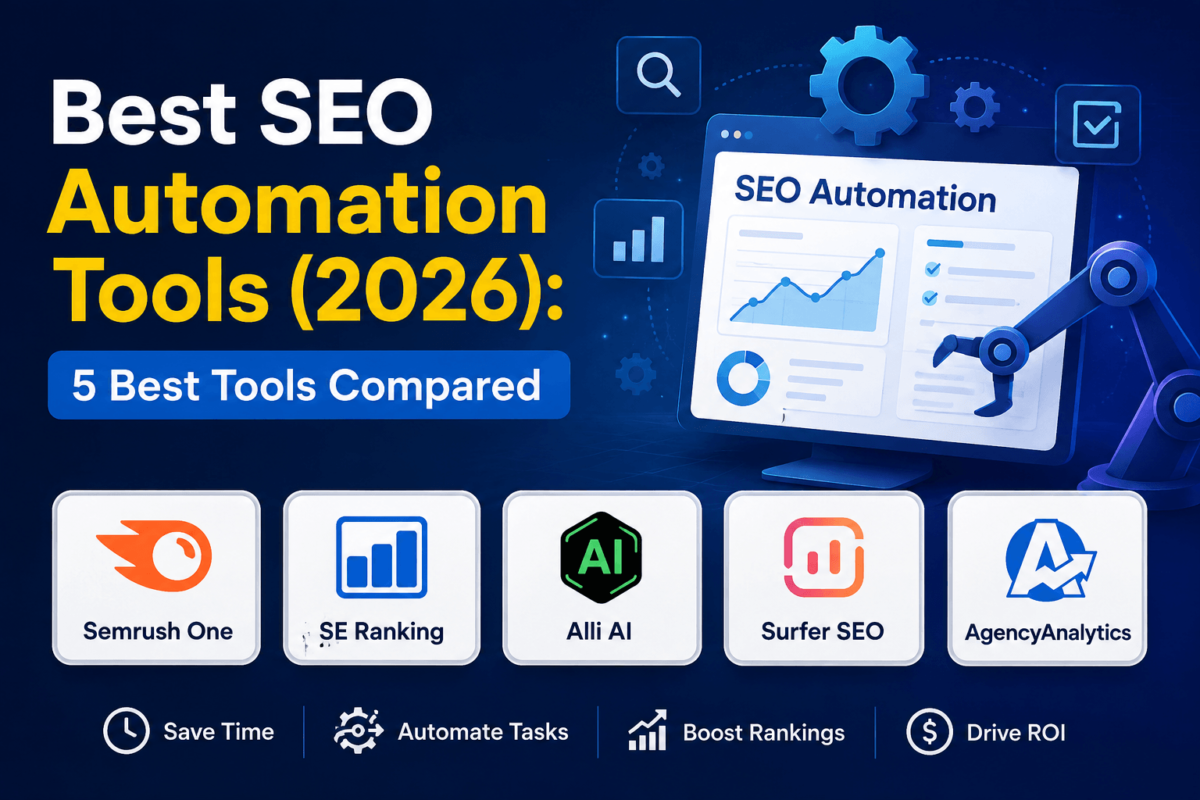
Best SEO Automation Tools (2026): 5 Best Tools Compared
A few months ago, one of our clients — a SaaS company sitting on about 4,000 indexed pages — asked a simple question that turned into a very long meeting: “Why does it take our team three weeks to publish a technical audit?” The honest answer was that nobody on the team was slow. The workflow was. Someone had to pull rankings manually, cross-reference them against Search Console, screenshot the Core Web Vitals report, format it all into a slide deck, and email it around for approval before a single fix got made.
That story isn’t unusual. It’s the default state of SEO at most companies in 2026, and it’s exactly the problem SEO automation tools are built to solve.
Search itself has gotten more complicated in the last two years, not less. Google’s AI Overviews now show up on a large share of commercial queries, ChatGPT and Gemini have become genuine discovery channels alongside the traditional blue links, and the sheer number of pages a mid-sized business needs to manage — product pages, location pages, blog posts, landing pages — keeps climbing. Manual SEO simply doesn’t scale against that kind of complexity. You cannot hand-audit a 10,000-page site every week, and you cannot manually check whether your brand is being cited inside an AI answer every time a competitor publishes new content.
That’s where automation earns its keep. The right SEO automation tool takes the repetitive, error-prone parts of the job — rank tracking, technical audits, reporting, on-page fixes, content scoring — and runs them on a schedule, in the background, without you lifting a finger. It doesn’t replace strategy. It replaces the busywork that used to eat the time you needed for strategy.
We tested and compared the leading platforms in this category — the ones that go beyond simple dashboards and actually automate the work — and narrowed it down to five tools worth your budget in 2026. Here’s exactly what each one does well, where it falls short, and which one fits your situation.
Quick Answer
The best SEO automation tools in 2026 are Semrush (Semrush One) for all-in-one automated rank tracking, audits, and AI visibility monitoring; SE Ranking for budget-friendly automated white-label reporting; Alli AI for deploying on-page SEO fixes automatically without developer help; Surfer SEO for automating content optimization at scale; and AgencyAnalytics for automating client reporting across every marketing channel.
- Semrush (Semrush One) — Best overall automation suite
- SE Ranking — Best value for automated reporting
- Alli AI — Best for automated on-page deployment
- Surfer SEO — Best for content optimization automation
- AgencyAnalytics — Best for automated client reporting
Best SEO Automation Tools: Comparison Table
Before we get into the individual reviews, here’s how the five tools stack up side by side on price, automation depth, and AI capability.
| Tool | Best For | Starting Price | Free Trial | Rating |
|---|---|---|---|---|
| Semrush (Semrush One) | All-in-one automation + AI visibility | $139.95/mo | 7 days | 4.8/5 |
| SE Ranking | Budget automated reporting | $65/mo | 14 days | 4.6/5 |
| Alli AI | Automated on-page deployment | ~$249/mo | 10 days | 4.5/5 |
| Surfer SEO | Content optimization automation | ~$89/mo | Money-back guarantee | 4.6/5 |
| AgencyAnalytics | Automated client reporting | ~$59/mo | 14 days | 4.7/5 |
Pricing shown reflects entry-level paid plans as of 2026 and can change — always confirm current pricing on the provider’s site before purchasing.
1. Semrush (Semrush One) — Best Overall SEO Automation Suite
Overview
Semrush has been the default all-in-one SEO platform for over a decade, and in late 2025 it took a serious swing at the AI search era with Semrush One — a bundle that pairs the classic SEO Toolkit with a dedicated AI Visibility Toolkit. If you’ve compared it before against Ahrefs or wondered how it stacks up in a straight Semrush review, the automation layer is where it separates itself furthest from the pack: scheduled crawls, automated rank checks, and now automated tracking of how often your brand gets cited inside ChatGPT, Gemini, Perplexity, and Google’s AI Overviews.
Best For
Agencies and in-house teams that want one platform to automate keyword tracking, technical audits, and AI-search monitoring instead of stitching three tools together.
Key Features
Position Tracking matters because it removes the single most repetitive task in SEO — checking rankings — and replaces it with a live, historical dashboard that updates on its own. Site Audit matters for the opposite reason: technical problems (broken links, slow pages, indexing errors) compound quietly, and catching them on a schedule instead of during a quarterly review is what actually protects your rankings. And Semrush Copilot, the platform’s AI recommendation engine, matters because it surfaces the two or three issues worth fixing first instead of leaving you to sort through a 200-item audit alone.
Automation Features
- Scheduled Site Audit crawls (daily, weekly, or monthly) with email alerts on new technical errors
- Automated, white-label PDF reports built and sent to clients on a recurring schedule via “My Reports”
- Daily automated rank tracking with ranking-drop alerts
- API access and integrations with Google Data Studio, Zapier, and Google Sheets for custom workflow automation
AI Features
The AI Visibility Toolkit is the headline addition: it tracks how often and how favorably your brand shows up inside AI-generated answers, which is quickly becoming as important as your position on page one. Semrush Copilot adds proactive, AI-written recommendations across the dashboard, and ContentShake AI handles first-draft content generation tied directly to keyword and SERP data — useful groundwork if you’re building out a full AI SEO strategy.
Pros
- The single deepest feature set in this category, backed by over a decade of ranking and backlink history
- First mover on genuinely automated AI-visibility tracking, ahead of most direct competitors
- Enormous integration ecosystem, so automated reports can feed straight into your existing stack
Cons
- Pricing climbs quickly once you add the AI Visibility Toolkit or move into the Semrush One tiers
- The sheer number of tools and reports can overwhelm a first-time user without onboarding
Pricing
The classic SEO Toolkit starts at $139.95/mo (Pro), $249.95/mo (Guru), and $499.95/mo (Business). If AI visibility monitoring matters to you, the Semrush One bundle runs $199/mo (Starter), $299/mo (Pro+), and $549/mo (Advanced), with custom Enterprise pricing above that.
Why We Recommend It
Semrush isn’t the cheapest option here, and it doesn’t need to be. It’s the platform that automates the widest range of SEO work under one login — technical monitoring, rank tracking, reporting, and now AI-search visibility — which is exactly the combination most growing teams end up needing anyway.
Best Alternative
If Semrush’s pricing is more than your budget allows, SE Ranking (reviewed next) delivers a comparable core automation feature set for a fraction of the cost.
2. SE Ranking — Best Value for Automated Reporting
Overview
SE Ranking is a full-stack SEO platform — rank tracking, site audits, backlink monitoring, on-page checking — built around a pricing model that undercuts Semrush and Ahrefs without cutting the automation features agencies actually rely on. We’ve covered it in depth in our full SE Ranking review and in a head-to-head SE Ranking vs Semrush comparison, and automated white-label reporting keeps coming up as its standout strength.
Best For
Freelancers, small agencies, and budget-conscious in-house teams that need genuine automation without enterprise-level pricing.
Key Features
The white-label, automated report builder is the feature that justifies the subscription on its own for agencies — it matters because client reporting is usually the most time-consuming recurring task on an account manager’s plate, and here it happens without anyone touching a spreadsheet. Scheduled website audits matter for the same reason Semrush’s do: catching a technical regression the week it happens is worth far more than catching it a month later during a manual review.
Automation Features
- Scheduled audits (daily, weekly, or monthly cron jobs) with issue-severity alerts
- Fully automated, branded PDF and dashboard reports sent to clients on a recurring schedule
- Automated daily keyword rank tracking across Google, Bing, mobile, and local packs
- Backlink monitoring alerts when links are gained or lost
AI Features
SE Ranking’s AI Content Editor scores and improves on-page content against top-ranking competitors, and its automated audit summaries translate raw crawl data into plain-language explanations — useful if you’re handing reports to clients who don’t speak “SEO.”
Pros
- Best price-to-automation ratio in this list
- White-label reporting genuinely rivals dedicated reporting tools, at no extra cost
- Shallow learning curve compared to Semrush or Ahrefs
Cons
- Keyword and backlink databases are smaller than Semrush or Ahrefs
- Some parts of the interface feel less polished than newer competitors
Pricing
Plans range from roughly $65/mo to $259/mo depending on keyword and project limits, with custom Enterprise pricing for larger agencies.
Why We Recommend It
For the price, nothing else in this list automates agency reporting as thoroughly as SE Ranking does. If your team’s biggest time drain is building client reports by hand, this is the fastest fix.
Best Alternative
If reporting needs to pull from channels beyond SEO — PPC, social, email, calls — AgencyAnalytics (reviewed below) is purpose-built for that broader use case.
3. Alli AI — Best for Automated On-Page Deployment
Overview
Alli AI takes a different approach than the other tools on this list. Instead of just telling you what to fix, it fixes it. After installing a lightweight code snippet, Alli AI can push title tag rewrites, meta descriptions, schema markup, internal links, and site speed optimizations live across an entire website — thousands or even millions of pages — without a developer ever touching the codebase. It genuinely markets itself as an SEO automation platform, and after testing it, that’s a fair description.
Best For
Agencies and enterprise teams managing large sites — or many client sites — who are tired of waiting weeks for a developer to ship a batch of on-page fixes.
Key Features
Site-wide optimization rules matter because they let you fix a pattern once — say, every product page missing a meta description — and apply it everywhere instantly, instead of editing pages one at a time. The Live Editor matters because it gives non-technical marketers a way to make real code-level changes visually, closing the gap that usually forces SEO recommendations to sit in a developer’s backlog for months.
Automation Features
- One-click deployment of thousands to millions of on-page code and content changes
- Automatic recrawling (weekly on base plans, daily on higher tiers) that surfaces fresh optimization opportunities
- Automated A/B testing of title tags that promotes the winning variant once results are statistically significant
- API access on Agency and Enterprise plans for custom workflow integration
AI Features
Alli AI’s recommendation engine identifies optimizable elements across your entire site and proposes fixes automatically, and it’s increasingly positioning itself around AEO and GEO — structuring pages so they’re legible to AI crawlers like GPTBot, ClaudeBot, and PerplexityBot, not just Googlebot. That’s a meaningful bet on where automation needs to go next, and it lines up with the shift we cover in our guide to Answer Engine Optimization.
Pros
- By far the most literal “automation” tool here — it deploys fixes instead of just recommending them
- Works with any CMS, including custom-built and legacy platforms that other SEO plugins can’t touch
- Removes the developer bottleneck that slows down most on-page SEO programs
Cons
- Because changes are deployed via JavaScript, verifying them means using Google Search Console’s URL Inspection tool rather than “view source”
- Pricing is steep for a single small site — the value case is really built around scale
- Automated recommendations still need a human review pass before mass approval, or you risk shipping a fix that hurts UX
Pricing
Plans generally start around $249–$299/mo for a single-site/consultant tier and scale to roughly $599/mo for agency use and $1,000+/mo for enterprise, with a 10-day free trial on every plan. Confirm current tier limits before purchasing, since Alli AI has adjusted its plan structure more than once in the past year.
Why We Recommend It
Every other tool in this article automates the discovery of SEO problems. Alli AI automates the fix itself. For agencies juggling dozens of client sites with limited developer bandwidth, that distinction alone can be worth the price.
Best Alternative
If you’d rather keep a developer in the loop on every deployment, Semrush’s Site Audit paired with Copilot delivers similar recommendations without pushing live changes automatically.
4. Surfer SEO — Best for Content Optimization Automation
Overview
Content optimization is one of the most repetitive parts of SEO — reading through the top ten ranking pages, counting how many times competitors mention a subtopic, checking word count and structure. Surfer SEO automates that entire research step and scores your draft against it in real time. We put it head-to-head with Ahrefs in our Surfer SEO vs Ahrefs comparison, and you can read our hands-on findings in the full Surfer SEO review.
Best For
Content teams, bloggers, and agencies that publish frequently and need to systematize the “does this article actually match what’s ranking” step of every article.
Key Features
The Content Editor’s real-time scoring matters because it turns an abstract, subjective judgment call (“is this article optimized enough?”) into a concrete number your writers can chase, which shortens the editing back-and-forth considerably. Grow Flow matters even more for automation purposes specifically: it generates a running list of prioritized SEO tasks for your site every week without you asking for it, functioning as a lightweight automated strategist sitting on top of your content plan.
Automation Features
- Grow Flow auto-generates a weekly, prioritized list of SEO tasks with no manual setup
- Automated Content Audits flag underperforming published pages that need a refresh
- Auto-generated content briefs and outlines pulled straight from live SERP data
- Native WordPress and Google Docs integrations that score content inline as it’s written
AI Features
Surfer AI can draft a full, structured article from a single keyword in minutes, and its newer AI Tracker monitors whether your content is being cited in ChatGPT and other AI answers — a genuinely useful automation given how much AEO and GEO now factor into content strategy.
Pros
- Fastest way to systematize content optimization across a whole editorial team
- Strong integrations mean writers rarely have to leave their existing workflow
- Grow Flow gives non-strategists a simple, automated to-do list
Cons
- Content Editor credits run out fast for high-volume publishers, forcing frequent upgrades
- Plan names and pricing have shifted more than once in 2026, which makes third-party pricing guides unreliable
- Scoring can overweight keyword density signals if used without editorial judgment
Pricing
Entry-level plans run roughly $89–$99/mo, mid-tier plans around $180–$220/mo, and Enterprise starts near $999/mo. Surfer doesn’t offer a traditional free trial but backs every plan with a 7-day money-back guarantee — check the live pricing page for current tier names, since these have changed recently.
Why We Recommend It
No other tool on this list automates the specific gap between “we published content” and “we published content that can actually compete on page one” as well as Surfer does.
Best Alternative
If you’re already paying for Semrush, its built-in SEO Content Template and ContentShake AI cover similar ground without a second subscription.
5. AgencyAnalytics — Best for Automated Client Reporting
Overview
AgencyAnalytics isn’t a keyword or audit tool — it’s the automation layer that sits on top of your entire marketing stack and turns raw data from 80+ sources (SEO, PPC, social, email, call tracking) into client-ready dashboards and reports, automatically. If reporting is the task eating the most hours on your team’s calendar every month, this is the tool built specifically to remove it.
Best For
Agencies managing multiple clients across multiple marketing channels who need to stop assembling monthly reports by hand — a natural companion to any tool on our list of best SEO reporting tools.
Key Features
Scheduled report generation matters because it eliminates the single most predictable, recurring piece of agency admin work — the monthly client report — entirely. Live, white-label client dashboards matter beyond that, because they replace a static PDF with something a client can check any time, which measurably cuts down on “can you send me an update” emails.
Automation Features
- Scheduled report building and email delivery on any recurring cadence you set
- Automatic data refresh across 80+ integrations, including Google Analytics, Ahrefs, and Meta Ads
- Anomaly detection that flags unusual performance swings without manual monitoring
- Optional automated rank-tracking add-on layered on top of core reporting
AI Features
“Ask AI” turns raw client data into written, plain-English insights automatically, and AI-generated executive summaries now appear at the top of reports — a small feature that saves account managers real time explaining what the numbers actually mean.
Pros
- Purpose-built for the single most time-consuming agency task: client reporting
- Massive integration library covers far more than just SEO data
- Live dashboards feel far more modern to clients than a static monthly PDF
Cons
- It’s a reporting layer, not an SEO platform — you’ll still need a tool like SE Ranking or Semrush alongside it for keyword research and audits
- Per-client pricing means costs climb quickly as your client roster grows
- Some advanced connectors and the rank-tracker add-on cost extra on top of the base plan
Pricing
The Freelancer plan starts around $59–$79/mo (5 clients), Agency runs roughly $179–$239/mo, and Agency Pro is about $349–$479/mo, with custom Enterprise pricing above that. A 14-day free trial is available with no credit card required.
Why We Recommend It
No SEO-first platform in this article automates cross-channel client reporting as thoroughly as AgencyAnalytics. If your team’s calendar is dominated by report-building every month-end, this is the tool that gives that time back.
Best Alternative
If you only report on SEO metrics and want to avoid a second subscription, SE Ranking’s built-in white-label reporting may cover enough ground on its own.
Which Tool Should You Choose?
There’s no single “best” answer here — the right pick depends entirely on what’s eating your time right now.
| If you are a… | Start with… |
|---|---|
| SEO beginner or solo blogger | SE Ranking — low cost, gentle learning curve |
| Agency managing multiple clients | SE Ranking or Semrush + AgencyAnalytics for reporting |
| Ecommerce business with a large catalog | Alli AI — automates fixes across thousands of product pages |
| Content team or content-led SaaS | Surfer SEO — automates optimization at publishing speed |
| Enterprise marketing team | Semrush One — the deepest, most complete automation suite |
| Affiliate marketer running multiple niche sites | SE Ranking — cost-efficient across many small sites |
SEO Automation Use Cases (With Practical Examples)
It helps to see automation applied to the actual tasks that make up an SEO workflow, rather than as an abstract feature list.
Keyword research: Instead of manually building keyword lists in a spreadsheet, tools like Semrush and SE Ranking automatically cluster related terms by search intent — a task covered in more depth in our guide to AI for keyword clustering — so you start content briefs with a finished map instead of a blank page.
Rank tracking: Every tool in this article checks your positions on autopilot and alerts you only when something actually moves, replacing the old habit of manually checking rankings every morning.
Technical SEO and site audits: Scheduled crawls in Semrush and SE Ranking catch broken links, duplicate titles, and crawl errors the day they appear, which pairs well with a standing technical SEO checklist so nothing slips through unreviewed.
On-page SEO: Alli AI deploys title, meta, and schema fixes site-wide without waiting on a developer, turning a months-long backlog into a same-day change.
Content optimization: Surfer SEO’s Content Editor scores drafts against live SERP data as your writers type, automating what used to be a separate competitive-research step for every article.
Internal linking: Alli AI’s automated internal linking suggestions strengthen site architecture without a manual link audit, and if you’re publishing at scale, our piece on programmatic SEO with AI covers how this scales to thousands of pages.
Competitor tracking: Automated share-of-voice and position-change alerts mean you find out a competitor overtook you the same week it happens, not at the next quarterly review.
Reporting: AgencyAnalytics and SE Ranking both build and send branded client reports on a schedule, removing the most tedious recurring task on most SEO teams’ calendars.
Backlink monitoring: Automated alerts flag new and lost backlinks in real time, so you catch a toxic link or a broken outreach placement before it compounds.
SEO Automation Statistics for 2026
The case for automation isn’t just anecdotal — the data backs it up, both on the productivity side and on why SEO itself still deserves the investment in the first place.
| Statistic | Number | Source |
|---|---|---|
| Marketers who say automation improves productivity | 91% | Thunderbit, 2026 |
| Average time saved per week from automating routine tasks | 6+ hours | HubSpot, 2026 |
| Increase in sales productivity from marketing automation | 14.5% | Nucleus Research, 2026 |
| Reduction in marketing overhead from automation | 12.2% | Nucleus Research, 2026 |
| Companies seeing positive ROI within 1 year of adopting automation | 76% | Marketo, 2026 |
| Marketers using AI tools in their workflow | 92% | Thunderbit / Digital Silk, 2026 |
| Median 3-year ROI delivered by SEO | 748% | FirstPageSage, 2026 |
| Of all website traffic driven by organic search | 53% | BrightEdge, 2026 |
| US Google searches ending without a click | 58.5%–64.8% | SparkToro / Digital Applied, 2026 |
| Zero-click rate on searches showing an AI Overview | ~83% | Similarweb, 2026 |
| Drop in position-one CTR when an AI Overview appears | Up to 58% | Ahrefs, 2026 |
| Marketers currently tracking their AI search visibility | Only 14% | Macro Digital Media, 2026 |
| SEO lead close rate vs. outbound leads | 14.6% vs. 1.7% | HubSpot / SeoProfy, 2026 |
| Global SEO services market size in 2026 | $84–$108 billion | Industry estimates, 2026 |
Two things stand out when you read those numbers together. SEO still delivers an outsized return compared to almost every other marketing channel — but the mechanics of search have shifted enough that manually tracking your visibility, especially inside AI answers, is no longer realistic. That gap between “SEO is more valuable than ever” and “only 14% of marketers are actually measuring the part that matters most” is precisely what automation is built to close. For a deeper breakdown of the underlying search data, see our full SEO Statistics 2026 report.
Expert Buying Guide: How to Choose an SEO Automation Tool
What Is SEO Automation?
SEO automation is the use of software to perform recurring SEO tasks — rank tracking, technical audits, reporting, on-page fixes, content scoring — on a schedule and without manual input. It doesn’t replace strategic thinking; it removes the repetitive execution work so a strategist’s time goes toward decisions instead of data collection.
Who Needs SEO Automation?
Anyone managing more than a handful of pages, more than one client, or more than one site benefits almost immediately. Solo bloggers with a single small site can often get by with lighter, manual tools longer — our roundup of best free SEO tools covers that stage well. But the moment you’re tracking dozens of keywords across multiple pages, or reporting to more than one stakeholder, automation stops being a luxury and starts being the only realistic way to stay on top of the work.
Which Features Matter Most?
Prioritize scheduled site audits over one-off crawls, since technical issues compound the longest between checks. Prioritize automated reporting if you manage clients — it’s the feature with the most direct, measurable time savings. Look closely at API access and integrations if you plan to plug the tool into an existing dashboard or AI SEO workflow, and weigh AI features honestly: a tool that automates content scoring and AI-visibility tracking is solving a genuinely different problem than one that only automates rank checks. Rank tracking automation and content optimization automation matter for different reasons entirely, so match the feature to the bottleneck you actually have.
Common Mistakes to Avoid
- Buying based only on price — the cheapest plan often lacks the specific automation (scheduled audits, white-label reports) you actually need, which defeats the purpose of buying an automation tool at all.
- Ignoring integrations — a tool that automates beautifully but can’t connect to your CMS or reporting stack just creates a second manual step: exporting its data.
- Not checking reporting quality before you buy — if client-facing reports are the goal, test the actual output, not just the feature list, before committing to a plan.
- Ignoring automation quality — some tools automate a task poorly (noisy alerts, shallow crawls) which creates more work reviewing false positives than it saves.
- Choosing too many overlapping tools — paying for automated rank tracking in three different platforms doesn’t triple the value; it triples the subscription cost.
Pros and Cons of SEO Automation
| Pros | Cons |
|---|---|
| Frees up hours every week previously spent on manual tracking and reporting | Automated recommendations still need human judgment before they’re deployed live |
| Catches technical issues and ranking drops far faster than manual review cycles | Over-reliance can lead to blindly approving fixes that hurt UX or conversion |
| Scales SEO execution across hundreds or thousands of pages that would be impossible to manage by hand | Subscription costs stack up quickly if you’re using several overlapping tools |
| Makes AI-visibility tracking realistic, where manual monitoring simply isn’t possible | Doesn’t replace strategy — a well-automated tool executing the wrong plan just fails faster |
Frequently Asked Questions
What is SEO automation?
SEO automation is software that performs recurring SEO tasks — rank tracking, site audits, reporting, on-page fixes, and content scoring — on a schedule without manual input. It handles the repetitive execution work so your team can focus on strategy and decision-making instead.
What are the best SEO automation tools in 2026?
The top tools are Semrush (Semrush One) for all-around automation, SE Ranking for budget-friendly automated reporting, Alli AI for deploying on-page fixes automatically, Surfer SEO for content optimization automation, and AgencyAnalytics for automated client reporting.
Is SEO automation worth it for small businesses?
Yes, particularly for rank tracking and technical audits, which are easy to neglect manually. Small businesses on a tight budget can start with a lower-cost automated platform like SE Ranking before scaling into more expensive suites as their site or client list grows.
Can AI fully automate SEO?
No. AI can automate data collection, technical monitoring, content scoring, and even the deployment of on-page changes, but strategic decisions — what to prioritize, how to position content, which links are worth pursuing — still require human judgment and oversight.
How much does SEO automation software cost?
Entry-level plans in this category typically start between $59 and $139 per month, with mid-tier agency plans running $200–$550 per month. Enterprise pricing for large sites or agencies is usually custom and can run well into four figures monthly.
What’s the difference between SEO automation and traditional SEO tools?
Traditional SEO tools require you to manually run reports, checks, and audits each time. Automation tools run those same processes on a schedule in the background and alert you only when something changes, removing the need for repeated manual checks.
Do SEO automation tools replace SEO specialists?
No. They remove repetitive manual work, but strategy, prioritization, content quality judgment, and reviewing automated recommendations before deployment still require an experienced SEO specialist.
What is the best free SEO automation tool?
There isn’t a fully free tool with genuine automation in this category — most rely on paid subscriptions to run scheduled crawls and reports. For a completely free starting point, see our list of best free SEO tools, though these require more manual checking.
Which SEO automation tool is best for agencies?
SE Ranking offers the strongest built-in automated reporting for the price, while AgencyAnalytics is the better choice if you need to automate reporting across channels beyond SEO, like PPC and social.
Which SEO automation tool is best for beginners?
SE Ranking has the shallowest learning curve of the platforms in this article while still offering genuine automation, making it the most approachable starting point for someone new to SEO tools.
Can SEO automation hurt my rankings?
It can, if automated recommendations are approved without review. Tools like Alli AI explicitly warn against blindly approving every suggestion, since some optimizations can technically follow best practice while harming user experience or conversions.
What is Alli AI used for?
Alli AI is used to deploy on-page SEO changes — title tags, meta descriptions, schema markup, internal links — automatically across an entire website via a JavaScript snippet, without needing a developer to implement each change.
Is Semrush good for automation?
Yes. Semrush automates rank tracking, technical audits, white-label reporting, and — through Semrush One — AI-visibility monitoring across ChatGPT, Gemini, and Perplexity, making it the broadest automation suite in this category.
What is SE Ranking best used for?
SE Ranking is best used for automated, white-label agency reporting alongside standard rank tracking, site audits, and backlink monitoring, all at a lower price point than most competitors.
Does Surfer SEO automate content writing?
Surfer AI can generate a full first draft automatically from a keyword, but the platform’s core strength is automating content scoring and optimization against live SERP data as writers draft and edit.
What is AgencyAnalytics used for?
AgencyAnalytics is used to automate marketing reporting across 80+ data sources — SEO, PPC, social, email, and calls — building white-label client dashboards and reports on a recurring schedule without manual assembly.
How do SEO automation tools help with AI search (GEO/AEO)?
Newer automation features track how often your brand is cited inside AI Overviews, ChatGPT, Gemini, and Perplexity, and some tools, like Alli AI, structure page content specifically to be legible to AI crawlers — automating a form of monitoring that’s essentially impossible to do by hand.
What automation features matter most in an SEO tool?
Scheduled site audits, automated rank tracking, automated reporting, and API access for custom integrations matter most for the majority of users. Which one matters most to you depends on where your current workflow is losing the most time.
How long does it take to see results from SEO automation?
The time savings are immediate, since automated tracking and reporting start working the moment they’re set up. Ranking improvements from the fixes automation surfaces typically take the same 6-12 months as any other SEO effort to show up in results.
Can SEO automation tools handle technical SEO audits automatically?
Yes. Semrush and SE Ranking both run scheduled crawls that automatically flag broken links, duplicate content, indexing errors, and Core Web Vitals issues, sending alerts without any manual crawl request.
What’s the best SEO automation tool for ecommerce?
Alli AI tends to fit large ecommerce catalogs best, since it can deploy title, meta, and schema fixes across thousands of product pages automatically — work that would be unrealistic to do manually at that scale.
Do I need multiple SEO automation tools or just one?
Most teams end up pairing two tools that solve different problems — for example, an all-in-one platform like Semrush or SE Ranking plus a specialized tool like Surfer SEO for content or AgencyAnalytics for cross-channel reporting — rather than one tool doing everything.
How do SEO automation tools use AI?
AI is used to prioritize which issues to fix first, generate content recommendations, write plain-language report summaries, and increasingly to track whether a brand is being cited inside AI-generated search answers — a task that would be impractical to perform manually at scale.
Final Verdict
Every tool on this list automates something real. The right one for you comes down to matching the automation to the bottleneck that’s actually slowing your team down.
- Best Overall: Semrush (Semrush One) — the most complete automation suite, covering rankings, audits, reporting, and AI visibility under one platform.
- Best Value: SE Ranking — near-identical core automation to the bigger suites, at a fraction of the price.
- Best Beginner Tool: SE Ranking — the shallowest learning curve without sacrificing real automation.
- Best Agency Tool: AgencyAnalytics — purpose-built to automate the single most time-consuming agency task: client reporting.
- Best Enterprise Tool: Alli AI — the only tool here that deploys SEO fixes automatically at true enterprise scale.
Conclusion
SEO in 2026 rewards teams that can move fast and stay consistent — checking rankings daily, catching technical issues within hours instead of weeks, and keeping an eye on how AI search engines represent your brand. None of that is realistic to do by hand anymore, which is exactly why automation has stopped being a “nice to have” for serious SEO programs.
If you’re just getting started or working with a tight budget, SE Ranking gives you the most automation per dollar. If you’re managing a large site or catalog and developer time is your bottleneck, Alli AI removes that constraint entirely. Content-heavy teams should lean on Surfer SEO, agencies drowning in client reports should look at AgencyAnalytics, and anyone who wants one platform to do all of it — including tracking your visibility inside AI search — should start with Semrush.
Whichever you choose, take the free trial seriously before committing. Automation should be solving a problem you actually have — not a feature list you were sold on. Match the tool to your real bottleneck, test it against your own site or client data, and only then commit to a plan.
Affiliate Disclosure: TechCognate may earn a commission when you purchase through links on this page, at no additional cost to you. This helps support our independent testing and research. All opinions and recommendations reflect our honest evaluation of each tool.