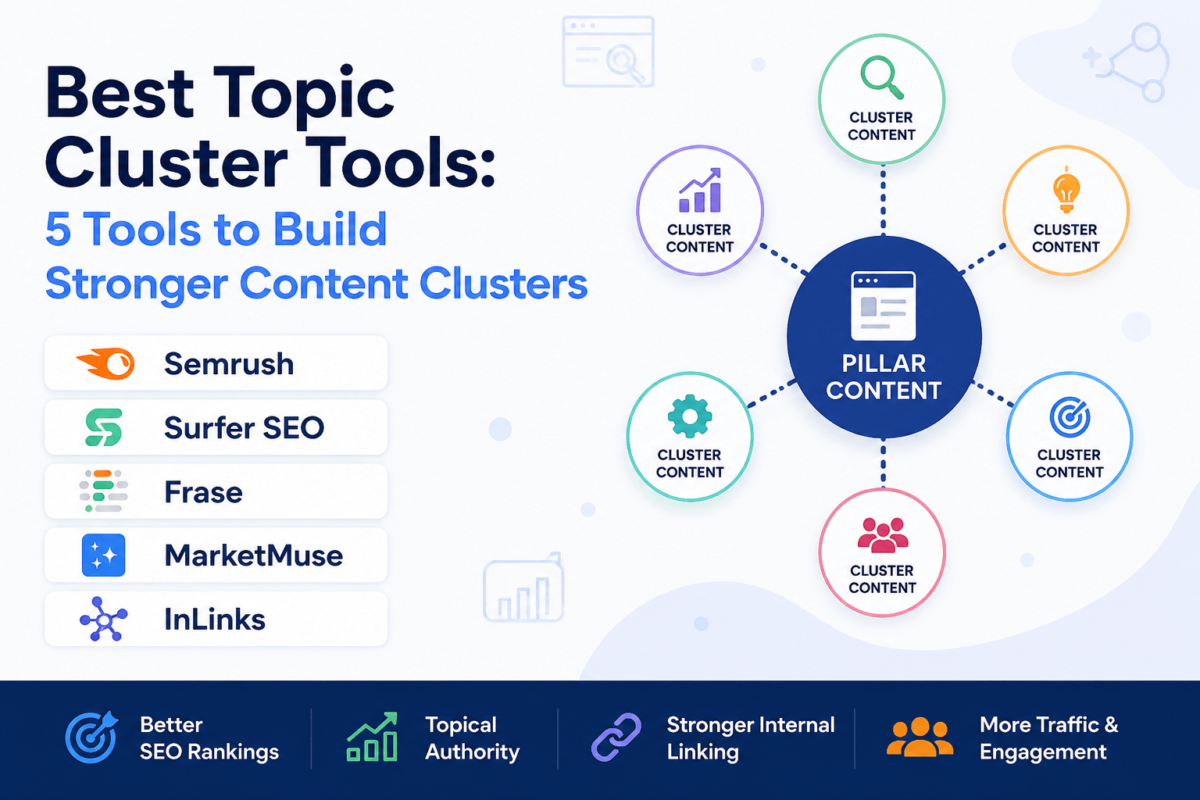
Best Topic Cluster Tools: 5 Tools to Build Stronger Content Clusters
Most sites don’t have a topic cluster problem. They have a random-pile-of-posts problem. Somewhere along the way, someone built a solid pillar page, then a handful of loosely related posts went up whenever a keyword idea showed up — no shared structure, no internal links tying them together, no clear signal to Google (or to ChatGPT, Perplexity, or Google’s AI Overviews) that the site actually knows the topic in depth.
A topic cluster tool won’t write the content for you, but it will do the part that’s easy to skip: mapping which subtopics belong together, showing where the gaps sit, and — in a couple of cases — handling the internal linking that ties a cluster into something search engines can actually read as one connected body of work. Below are five tools that genuinely help with that, what each one is actually good at, and where each one falls short.
Quick Answer: What Are the Best Topic Cluster Tools?
The best topic cluster tools split into two groups: platforms built around a single seed keyword (Semrush’s Topic Research, Surfer SEO’s Content Planner, Frase’s clustering) and platforms built around your site’s existing topical footprint (MarketMuse’s Content Inventory, InLinks’ Topic Planner). Semrush is the strongest overall pick if you want cluster planning folded into a full SEO platform. Surfer SEO and Frase are faster, lower-cost ways to turn a cluster plan into writer-ready briefs. MarketMuse and InLinks are built for teams managing topical authority across an already-large content library rather than starting from a blank page.
| Tool | Best For | Topic Cluster Strength | Starting Price |
|---|---|---|---|
| Semrush | Full SEO platform + cluster planning | Topic Research + Content Gap | $139.95/mo (cluster tools need Guru, $249.95/mo) |
| Surfer SEO | Guided brief-to-draft workflow | Content Planner + NLP clustering | From ~$89–99/mo (check current pricing) |
| Frase | Budget-friendly content briefs | Keyword clustering + SEO/GEO scoring | From ~$45/mo (check current pricing) |
| MarketMuse | Domain-wide topical authority | Content Inventory + Strategy Documents | Free tier; paid plans by quote |
| InLinks | Retrofitting internal links into existing clusters | Topic Planner + automated internal linking | Free tier; from $49/mo |
Semrush
Best for: Teams that want cluster planning built into a full SEO platform they’re likely already paying for.
Semrush needs no introduction as a full SEO platform, but its topic cluster functionality lives specifically inside the Content Marketing Toolkit — a layer most people who only use Semrush for keyword research or rank tracking never open.
Why Semrush Is Good for Topic Clusters
The Topic Research tool takes one seed topic and returns a visual map of related subtopics, headline ideas, and the questions people are actually asking around it — essentially the planning stage of a cluster laid out before you write anything. Pair that with the Keyword Magic Tool, which groups thousands of keywords into intent-based clusters automatically, and Content Gap analysis, which shows which subtopics competitors cover that your site doesn’t, and you get a data-backed starting point for deciding what the cluster should contain.
Key Features
- Topic Research tool maps subtopics, related headlines, and audience questions from a single seed keyword
- Keyword Magic Tool groups large keyword lists by shared search intent
- Content Gap analysis compares your domain against competitors to surface missing subtopics
- SEO Content Template generates a brief with recommended semantically related terms and word count targets
- Position Tracking monitors how each cluster page ranks over time in one dashboard
Best For
Teams already running (or planning to run) Semrush for keyword research, site audits, or rank tracking, who want cluster planning built into the same subscription rather than paying for a separate point tool.
Pros and Cons
| Pros | Cons |
|---|---|
| Topic Research and Content Gap are backed by one of the larger keyword databases in the category | Topic Research and the rest of the Content Marketing Toolkit are gated behind the Guru plan — Pro doesn’t include them |
| Cluster planning, execution, and rank tracking all live in one platform | Overkill if topic clustering is the only thing you need from an SEO tool |
| AI Visibility tracking shows how cluster content shows up in AI-generated answers, not just classic search | Higher monthly cost than the point solutions on this list |
Our Take
Semrush earns the overall pick here because it’s the only tool in this list that connects cluster planning to keyword research, competitor tracking, and rank monitoring without switching platforms. The catch is cost — you need Guru-tier access ($249.95/month, lower on an annual plan) to unlock the cluster-specific tools, so it makes the most sense for teams already using Semrush for other SEO work.
Surfer SEO
Best for: Writers and content teams who want the fastest path from a topic idea to a scored, ready-to-write outline.
Surfer SEO built its reputation on the Content Editor — a real-time scoring tool that grades a draft against the pages already ranking for a target keyword. The Content Planner extends that idea one step earlier, generating an entire cluster of related topics from a single seed term. For a closer look at how the platform performs outside of clustering, our Surfer SEO review covers the Content Editor and pricing in more depth.
Why Surfer SEO Is Good for Topic Clusters
Enter one broad topic and the Content Planner returns dozens of related subtopics and keywords, grouped using NLP so terms that share a search intent end up in the same bucket rather than scattered across a spreadsheet. Because Surfer’s SERP analysis runs on every keyword in that cluster, you also get a sense of what the top-ranking pages for each subtopic actually cover — useful for deciding how deep each cluster page needs to go before it’s competitive.
Key Features
- Content Planner generates a cluster map of related topics and keywords from one seed term
- NLP-based keyword clustering groups terms by shared subtopic and intent
- Content Editor scores drafts in real time against top-ranking pages for each cluster keyword
- SERP Analyzer breaks down competitor content structure, word count, and headings
- Direct integrations with Google Docs, WordPress, and the Surfer AI writing add-on
Best For
Writers and content teams whose main bottleneck is turning a topic list into an outline and a draft quickly — Surfer’s strength is the handoff from planning straight into writing, not deep keyword-database research.
Pros and Cons
| Pros | Cons |
|---|---|
| Fastest path from “here’s a topic” to a scored, ready-to-write outline | Plan names and prices have shifted more than once in 2026 — confirm current tiers before budgeting |
| Native Google Docs and WordPress integrations cut out extra copy-paste steps | Limited standalone keyword-discovery or backlink data |
| Entry-level pricing sits below Semrush’s Content Marketing Toolkit | Works best paired with a dedicated research tool upstream |
Our Take
Surfer is the pick when your team already knows roughly what a topic cluster should cover and needs a faster way to move from idea to optimized draft. It’s less suited to teams that need deep competitive keyword research from scratch.
Try Surfer SEO’s Content Planner →
Frase
Best for: Smaller teams and freelancers who need writer-ready briefs for every page in a cluster without paying full-suite prices.
Frase started as a content brief generator and has stayed close to that core job, even as it’s added AI drafting and, more recently, scoring for how well content is likely to get cited by AI search tools.
Why Frase Is Good for Topic Clusters
Frase’s keyword clustering groups related terms based on shared context, which is genuinely useful at the stage where you’re deciding whether two keyword ideas deserve separate cluster pages or belong on the same one. Once a topic is set, the brief generator pulls the top-ranking pages for that keyword and returns a structured outline in under a minute — headings, questions pulled from People Also Ask, and a content score baseline for how thoroughly the page needs to cover the topic.
Key Features
- Keyword clustering groups related terms by shared context and search intent
- SERP-based content briefs generated in under a minute per topic
- Dual scoring for traditional SEO and generative-engine optimization (GEO)
- Google Search Console integration flags existing pages ranking in positions 5–20 worth folding into a cluster
- Shared briefs support multiple writers working from the same cluster plan
Best For
Smaller content teams, freelancers, and agencies that need writer-ready briefs for every page in a cluster without paying for a full-suite SEO platform.
Pros and Cons
| Pros | Cons |
|---|---|
| Noticeably lower entry price than Surfer or Semrush’s content tools | No built-in keyword discovery or backlink data |
| Brief generation is genuinely fast — useful when briefing an entire cluster at once | Pairs best with a separate research tool for the initial topic list |
| GEO scoring is a rare feature at this price point | Reported pricing and plan structures vary across sources — check Frase’s own pricing page |
Our Take
Frase is the practical choice when someone else — you, a strategist, or a tool like Semrush — has already mapped the cluster and the bottleneck is producing consistent, structured briefs for every writer on the team.
MarketMuse
Best for: Larger content teams and agencies planning topical authority across an entire site, not one cluster at a time.
MarketMuse takes a different starting point than the other tools here: instead of beginning with a single keyword, it starts by crawling your entire site and modeling what you already cover, in depth, across every topic — then shows you where the gaps sit.
Why MarketMuse Is Good for Topic Clusters
The Content Inventory analyzes your site’s full topical footprint, and Content Strategy AI turns that analysis into cluster-level plans and Content Strategy Documents that recommend specific pages to create or update, with reasoning attached. The Personalized Difficulty score is the standout feature for cluster planning — it adjusts keyword difficulty based on your site’s existing authority on that topic, rather than giving every site the same generic score.
Key Features
- Content Inventory audits your site’s entire topical coverage, breadth and depth
- Content Strategy AI generates cluster-level plans and prescriptive Content Strategy Documents
- Personalized Difficulty scores keyword difficulty relative to your own site’s topic authority
- Optimize editor gives real-time Content Score feedback as writers draft
- Optional managed briefs from MarketMuse’s in-house editorial team
Best For
Larger content teams, agencies, and publishers planning topical authority across an entire content library rather than one pillar-and-supporting-posts project at a time.
Pros and Cons
| Pros | Cons |
|---|---|
| Personalized Difficulty is a genuinely different approach to keyword scoring | Pricing is no longer published — moved to a demo-quote model after the 2024 Siteimprove acquisition |
| Site-wide Content Inventory gives a real picture of topical authority gaps, not just one keyword | Third-party estimates of paid-tier costs vary widely — budget for a sales conversation |
| A free tier exists for testing the topic modeling before committing | More depth than most solo bloggers or small sites need for a single cluster |
Our Take
MarketMuse is worth the sales conversation if you’re planning topical authority at the domain level — dozens of clusters, not one. For a single pillar page and its supporting posts, it’s more tool than most sites need.
See What MarketMuse Can Map Out →
InLinks
Best for: Publishers with an existing content library who need to retrofit internal links and fill gaps in a cluster that’s already partly built.
InLinks approaches topic clusters from the internal linking and entity SEO side rather than the keyword-research side — which fills a real gap, since building the internal links between a pillar page and its supporting content is usually the step every other tool in this list leaves to you.
Why InLinks Is Good for Topic Clusters
The Topic Planner maps your existing content against a knowledge graph, clustering pages by entity and topic rather than exact-match keyword, and visualizing where your coverage is strong versus where whole subtopics are missing. Once content exists, InLinks’ internal linking engine suggests — or automatically inserts — contextual links between pillar and supporting pages, with varied anchor text pulled from the entities on each page. It also generates schema markup tied to that same entity data.
Key Features
- Topic Planner clusters existing content by entity and topic using a knowledge-graph model
- Automated internal linking suggests or inserts contextual links between pillar and supporting pages
- Entity-based content briefs and optimization scoring
- Automated schema markup generation tied to the same entity data
- Free tier available for testing before committing to a paid plan
Best For
Publishers and affiliate sites with an existing library of content who need to retrofit internal linking and fill gaps in a cluster that’s already partly built, rather than plan one from a blank page.
Pros and Cons
| Pros | Cons |
|---|---|
| The only tool here that automates internal linking at the page level | Steeper learning curve than the other tools — reviewers note it takes time to use fully |
| Free tier makes it possible to test the Topic Planner before paying | Content brief and writing tools are less developed than Frase’s or Surfer’s |
| Entity-based approach lines up well with how AI search tools read topical relevance | Less suited to greenfield keyword research than the other four tools |
Our Take
InLinks is the pick for sites that already have content scattered across a topic and need the connective tissue — internal links and entity structure — more than another keyword-research tool.
See What InLinks’ Topic Planner Finds →
Best Topic Cluster Tools Compared
Here’s how the five stack up across the parts of the cluster workflow that matter most.
| Tool | Topic Research | Topic Clustering | Content Planning | Internal Linking | Ease of Use |
|---|---|---|---|---|---|
| Semrush | Strong | Strong | Strong | Not included | Moderate |
| Surfer SEO | Good | Strong | Good | Basic | Strong |
| Frase | Good | Good | Good | Not included | Strong |
| MarketMuse | Strong | Strong (domain-wide) | Strong | Not included | Moderate |
| InLinks | Good (entity-based) | Good (knowledge graph) | Good | Strong | Moderate |
Which Topic Cluster Tool Should You Choose?
Feature lists only go so far — here’s how we’d match each tool to a specific situation.
- Best overall: Semrush — cluster planning tied to keyword research, competitor tracking, and rank monitoring in one platform.
- Best for beginners: Surfer SEO — the most guided path from a topic idea to a scored draft.
- Best for agencies: InLinks — multi-domain support and automated internal linking scale across client sites without manual work per site.
- Best for content optimization: Frase — content briefs and dual SEO/GEO scoring built specifically for the writing stage.
- Best for large content teams: MarketMuse — site-wide Content Inventory and Personalized Difficulty are built for topical authority at scale, not one cluster at a time.
What Is a Topic Cluster?
A topic cluster is a group of related pages built around one core subject: a single pillar page that covers the topic broadly, and several supporting pages that each go deep on one subtopic, all linked back to the pillar.
The pillar page targets the broad, high-volume version of the topic. The supporting pages target the narrower subtopics underneath it — the searches someone makes once they already know roughly what they’re looking for. Internal links tie the two together in both directions: they help visitors move naturally between related content, and they give search engines a clear map of which pages belong to the same topic. Search intent and semantic relevance are what determine which subtopics actually belong in the cluster — a subtopic only earns a spot if it matches what someone searching that term actually wants, not just because the words are related. Do that consistently across a cluster and you build topical authority: search engines, and increasingly AI answer engines, start treating your site as a credible source on the subject as a whole rather than on the exact keyword of whichever page someone happened to land on.
Main topic: Email Marketing
Pillar page: Complete Guide to Email Marketing
Supporting content:
- Email subject lines
- Email segmentation
- Welcome email sequences
- Email automation
- Email deliverability
- Newsletter strategy
How to Use a Topic Cluster Tool
The tools above handle different parts of this process, but the overall workflow looks the same no matter which one you pick.
- Choose a broad topic your site has (or wants) authority on — one with enough depth to support five or more supporting pages.
- Research the main topic with your tool’s topic or keyword research feature to see how large the subject actually is.
- Identify related subtopics — the clustering feature in Semrush, Surfer SEO, or Frase will surface most of these automatically.
- Group related keywords by intent so terms that belong on the same page don’t get split into two competing posts, and check keyword difficulty while you’re at it.
- Map search intent for each subtopic — informational, commercial, navigational, or transactional — since that determines the format each page should take.
- Create the pillar page first, covering the topic broadly enough to link out to every planned supporting page.
- Plan supporting content using the briefs or content strategy documents your tool generates, one per subtopic.
- Build internal links between the pillar and every supporting page — manually, or automatically if you’re using InLinks.
- Publish and optimize each page against the content score or feedback your tool provides — our WordPress SEO guide covers the on-page basics if you’re publishing there.
- Monitor performance and expand the cluster as new subtopics or competitor gaps appear, using your SEO reporting tool of choice.
Frequently Asked Questions
What is a topic cluster in SEO?
A topic cluster is a pillar page and a set of related supporting pages, all internally linked, built to demonstrate depth on one subject rather than covering it in a single isolated post.
What is the best topic cluster tool?
There isn’t one universal answer — it depends on whether you’re starting from a keyword (Semrush, Surfer SEO, Frase) or retrofitting an existing site (MarketMuse, InLinks). Semrush is the strongest overall pick if you want cluster planning inside a full SEO platform; see our best SEO tools roundup for how it compares outside of clustering specifically.
What is the difference between a topic cluster and a keyword cluster?
A keyword cluster groups search terms that share intent, usually to decide what a single page should target. A topic cluster is the broader structure built from those groupings — a pillar page plus every supporting page needed to cover the subject, linked together.
How do I create a topic cluster?
Pick a broad topic, research and group the subtopics underneath it, map search intent for each, publish a pillar page and supporting pages, link them together, then expand the cluster as gaps or new subtopics appear. The full workflow is laid out above.
Are topic cluster tools worth using?
For anything beyond a handful of pages, yes. Manually mapping subtopics, checking search intent, and tracking internal links across a growing site is slow and easy to get wrong at scale — these tools trade that manual work for a few hours of research and setup.
Can topic clusters improve topical authority?
Consistent, well-linked topic clusters are one of the more reliable ways to build topical authority, since they give search engines — and AI answer engines — repeated, connected evidence that a site covers a subject in depth rather than one page in isolation.
How many articles should a topic cluster have?
There’s no fixed number — it depends on how many genuinely distinct subtopics the main topic supports. Most clusters land somewhere between five and fifteen supporting pages around one pillar, though a narrow topic might only need three or four.
Do topic clusters still matter for SEO in the AI search era?
Arguably more than before. AI Overviews, ChatGPT, and Perplexity tend to pull from sites that demonstrate depth across a subject, and topic clusters are still one of the clearest ways to signal that depth — see our Answer Engine Optimization guide for more on how that plays out in practice.