Here’s something nobody tells you when you launch a new website: getting found used to be hard. Now it’s a completely different game.
A few years ago, you could launch a blog, write decent content, build a handful of backlinks, and start seeing traffic within three to six months. Google was the main arena, the rules were well-documented, and if you played them right, you had a shot.
That world doesn’t fully exist anymore.
Today, millions of people aren’t using Google at all for their searches. They’re typing questions directly into ChatGPT. They’re asking Perplexity to summarize research. They’re using Gemini to compare products. They’re triggering Google AI Overviews that answer questions before any organic result is ever clicked. Microsoft Copilot is embedded right inside Windows. Claude is answering questions in sidebars.
The search landscape has fractured — and most website owners are still optimizing for only one fragment of it.
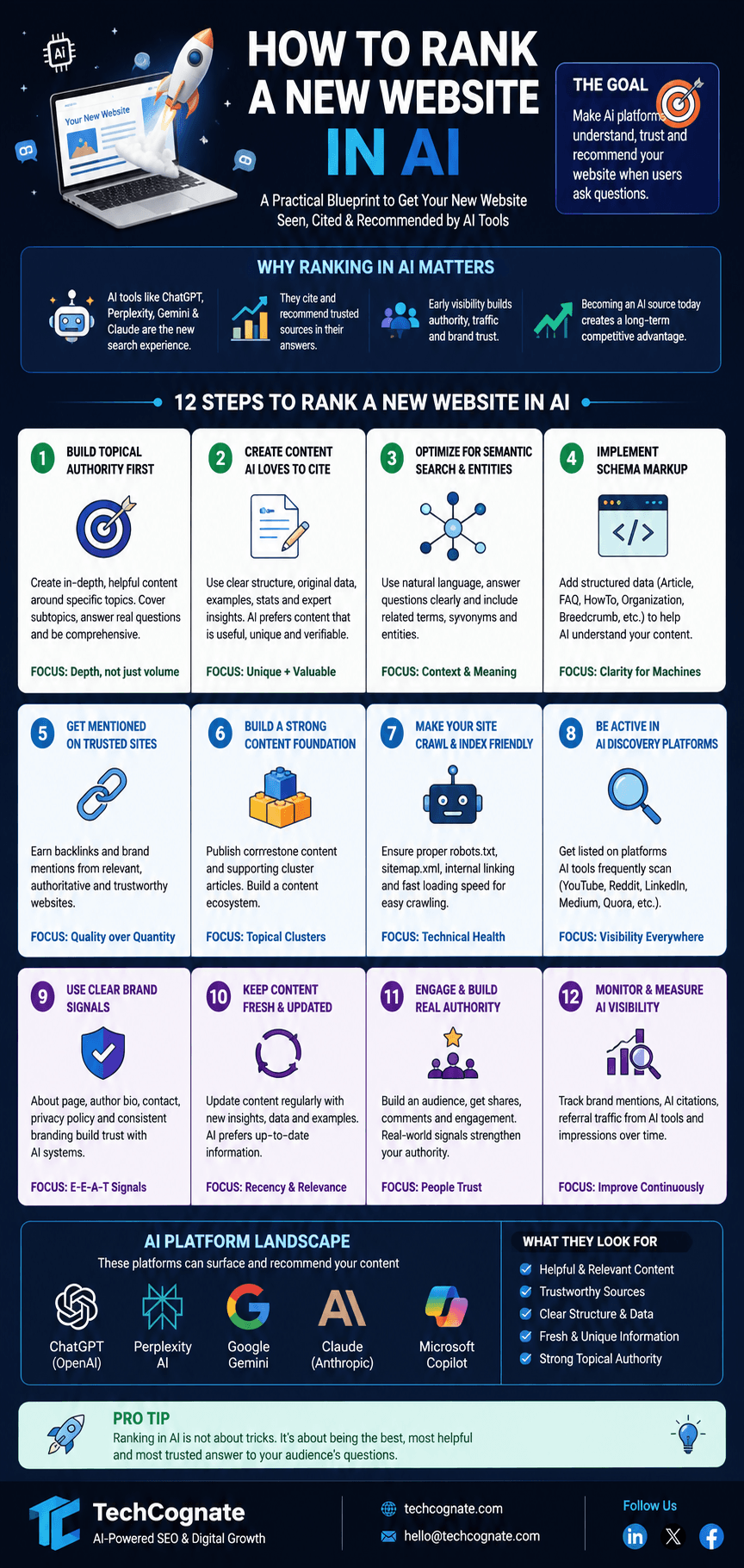
If you’re launching a new website in 2026 and you only think about traditional SEO, you’re already behind. You need to understand how AI search engines work, what makes them cite a source, and how to build a brand that these systems trust enough to recommend.
This guide gives you the complete roadmap. Not theory. Practical steps, in the right order, that actually move the needle for a brand-new website in both Google and AI-powered search. I’ve used these methods to rank sites from zero across competitive niches, and the principles here are the same ones I’d apply if I were starting a site from scratch today.
Let’s get into it.
Why Ranking a New Website Has Changed
The shift didn’t happen overnight, but it accelerated fast. Between 2022 and 2026, the way people discover information online changed more than it had in the previous decade.
The Old Search Paradigm vs. What’s Happening Now
In traditional search, a user would type a query, Google would return ten blue links, and the user would click one. Traffic was the currency. If you ranked #1, you got traffic. Simple.
Now? A user types a question into ChatGPT and gets a full answer — with maybe two or three source citations at the bottom. If your site isn’t one of those citations, you got zero exposure, even if you were ranking #1 in Google for that same query.
| Traditional SEO | AI Search Optimization (2026) |
|---|---|
| Target Google’s 10-blue-links results | Target Google + ChatGPT + Perplexity + Gemini + Copilot |
| Keyword density and backlinks dominate | Entity authority and semantic relevance dominate |
| Traffic is the primary metric | Citations and brand mentions matter equally |
| Optimize for crawlers and ranking algorithms | Optimize for LLM retrieval and citation logic |
| Thin content can survive with enough links | Thin content is invisible to AI systems |
| Rankings update in weeks | LLM knowledge may lag months behind real-time |
The Major AI Search Channels You Need to Know
Before you optimize for anything, you need to understand the landscape you’re optimizing for.
Google AI Overviews appear at the very top of Google results and directly answer user queries. If your content gets pulled into an AI Overview, you can get massive impressions — but if you’re not the source, those impressions go to whoever is.
ChatGPT, now integrated with web browsing, regularly cites external sources when answering questions in real time. Perplexity is arguably the most citation-heavy AI engine — it surfaces sources prominently and users often click through. Gemini is Google’s own AI, which means your E-E-A-T signals directly influence it. Microsoft Copilot is baked into Windows, Office, and Edge, making it hard to ignore for any brand targeting professionals.
Claude (that’s Anthropic’s AI) tends to favor authoritative, well-structured content when citing sources in its responses.
Each of these systems has slightly different ranking logic, but they share one core requirement: they trust sources that have established authority, original content, and clear entity signals.
AI search has fragmented the discovery landscape. Ranking in Google alone is no longer enough — you need to be the kind of source that AI systems choose to cite across multiple platforms.
Understanding How AI Search Engines Rank Content
To optimize for AI search, you need a basic working model of how these systems actually retrieve and select content. You don’t need to be an ML engineer — but understanding the mechanics helps you make better decisions.
How Large Language Models Work (The Short Version)
Large Language Models (LLMs) like GPT-4, Gemini, Claude, and others are trained on enormous datasets of text from across the internet. They learn patterns, relationships between concepts, and which sources tend to produce accurate, well-structured information. When a user asks a question, the LLM generates a response based on what it learned during training — and when it has real-time web access, it augments that with live search results.
Retrieval Augmented Generation (RAG)
RAG is the mechanism that allows AI systems to pull in live information rather than relying solely on training data. A system like Perplexity, for example, doesn’t just respond from memory — it searches the web in real time, retrieves relevant documents, and uses those to generate its answer. The documents it cites are the ones that ranked highest in its retrieval process.
This is why technical SEO still matters: if your page can’t be crawled or indexed, it can’t be retrieved. If it’s slow or broken, it gets deprioritized. The fundamentals carry over.
Semantic Search and Vector Embeddings
AI search doesn’t do keyword matching the way old search engines did. Instead, it uses semantic understanding — matching the meaning of a query to the meaning of content. Pages are converted into mathematical vectors (embeddings), and the AI retrieves the ones most similar to the query vector.
This is why topical coverage matters more than exact keyword matching. A page that thoroughly covers a topic from multiple angles will score higher in semantic relevance than a page that mechanically repeats a keyword phrase.
Knowledge Graphs and Entities
Google and other AI systems build Knowledge Graphs — structured databases of entities (people, places, organizations, products, concepts) and the relationships between them. When your brand, your authors, and your content are connected to established entities in these graphs, you inherit trust signals.
A new website that exists as an isolated island with no entity connections is hard for AI systems to evaluate. One that’s connected — via Wikipedia, Wikidata, social profiles, author pages, and brand mentions — gives the AI much more signal to work with.
Trust, Authority, and Source Selection
When an AI engine needs to cite a source, it doesn’t just pick the most popular result. It evaluates freshness (is this current?), authority (does this source know what it’s talking about?), and accuracy (does this content align with other trusted sources?). First-party data, original research, and expert opinion carry significant weight.
Think of AI source selection like a librarian recommending books. They don’t recommend the flashiest book — they recommend the most reliable, well-organized, clearly authored one. Build your site like that book.
AI systems retrieve and rank content based on semantic relevance, entity authority, freshness, and structural quality — not just keyword density or backlink counts.
The AI Ranking Framework: Four Phases
I use a four-phase framework when launching any site. Phase order matters — skipping ahead creates gaps that are hard to fix later.
Phase 1: Technical Foundation
Before you write a single word of content, your site needs to be technically sound. AI crawlers and Google’s bots both need clean access to your pages.
HTTPS is non-negotiable. Core Web Vitals need to pass — Largest Contentful Paint under 2.5 seconds, Cumulative Layout Shift under 0.1, Interaction to Next Paint under 200ms. Your robots.txt should allow AI crawlers (and you may want to add an llms.txt file — more on that later). Your XML sitemap should be submitted to Google Search Console and Bing Webmaster Tools. Canonical URLs should be set correctly to avoid duplicate content. Internal links should be crawlable, descriptive, and logical.
| Element | Why It Matters | Common Mistake |
|---|---|---|
| HTTPS | Trust signal for both Google and AI | HTTP-only or mixed content |
| Core Web Vitals | Ranking factor + UX signal | Heavy unoptimized images |
| XML Sitemap | Helps crawlers discover all pages | Not submitting to Search Console |
| Robots.txt | Controls crawler access | Blocking AI bots accidentally |
| Canonical URLs | Prevents duplicate content penalties | Missing canonicals on faceted pages |
| Internal Links | Passes authority and signals topic clusters | Orphan pages with no internal links |
| Clean URL Structure | Improves crawlability and readability | Dynamic, parameter-heavy URLs |
Phase 2: Entity Foundation
Entity SEO is the part most new site owners skip — and it’s one of the biggest reasons AI systems don’t recognize or trust new sites.
Your brand is an entity. Your author is an entity. Your organization is an entity. Google, ChatGPT, and Perplexity all use entity graphs to evaluate whether a source is trustworthy. If your entities aren’t established and connected, you’re essentially a ghost.
For a brand-new website, entity foundation means: create a Google Business Profile (if applicable), set up consistent social profiles on LinkedIn, X, Facebook, and YouTube, register your organization on Wikidata if possible, build an authoritative author page on your site with links to external profiles, and ensure your brand name, description, and contact information are identical across every platform.
The SameAs property in your Organization schema is how you tell Google that your website, LinkedIn, and Wikidata page are all the same entity. Use it.
Phase 3: Content Foundation
Content isn’t just about writing articles. It’s about building topical authority — the systematic coverage of a topic domain that signals to search engines and AI that your site is a definitive source.
Topical authority is built through topic clusters: a pillar page that broadly covers a topic, surrounded by supporting pages that dive deep into specific sub-topics. The internal links between them create a semantic web that’s easy for AI systems to map.
Before you publish anything, map your topic clusters. Identify your core topics (3–5 for a new site), create a pillar page for each, and plan at least 8–12 supporting articles per pillar. This structure tells AI systems exactly what you’re an expert on.
Phase 4: Authority Signals
Once your technical foundation, entity foundation, and content foundation are in place, you can start building authority signals — the external proof that other sources trust you.
Backlinks remain important, but the nature of the links matters more now. A citation from a .edu, a well-known industry publication, or an expert’s personal site is worth far more than 50 links from low-quality directories. Digital PR, original research, and expert roundups are the fastest ways to get the right kind of links — and the right kind of mentions in AI training data.
Build in phases: get your technical foundation right, establish your entities, build topical content clusters, then pursue authority signals. Doing these out of order creates gaps that are hard to close.
How AI Crawlers Discover New Websites
One of the most common questions I get from people launching new sites is: ‘How do AI systems even find me?’ It’s a fair question, and the answer is more layered than most people expect.
The Major Crawlers You Need to Know
| Crawler | Powers | User Agent |
|---|---|---|
| Googlebot | Google Search + Gemini + AI Overviews | Googlebot / Googlebot-Image |
| Bingbot | Bing + Microsoft Copilot | Bingbot |
| OpenAI GPTBot | ChatGPT training + browsing | GPTBot |
| OpenAI ChatGPT-User | ChatGPT real-time browsing | ChatGPT-User |
| Anthropic ClaudeBot | Claude training data | Claude-Bot |
| PerplexityBot | Perplexity AI responses | PerplexityBot |
| Common Crawl CCBot | Public crawl used by multiple LLMs | CCBot |
All of these crawlers operate similarly to traditional search bots: they follow links, read your sitemap, and respect your robots.txt. The key difference is that some (like GPTBot and ClaudeBot) are primarily crawling for training data, while others (like ChatGPT-User and PerplexityBot) are crawling for real-time answers.
How to Get Discovered Faster
For a new site, waiting for crawlers to organically discover you is too slow. You need to actively accelerate discovery.
Submit your XML sitemap to Google Search Console and Bing Webmaster Tools on day one. Use IndexNow — a protocol supported by Bing, Yandex, and others that lets you push new URLs to search engines immediately. Create an RSS feed for your content so aggregators and AI systems can subscribe to new posts. Build internal links from day one so every new page is reachable from at least two other pages. Get a few external links from existing sites early — even a basic directory listing or a guest post on an established site can jumpstart discovery.
Some sites are also experimenting with an llms.txt file — similar to robots.txt but specifically designed to give AI systems structured guidance about your content. It’s an emerging standard, not universally adopted yet, but worth watching.
Blocking GPTBot or ClaudeBot in your robots.txt. Some site owners do this intentionally to keep their content out of AI training data — but if you want AI visibility, you need these bots to crawl you. Check your robots.txt right now.
AI crawlers find you the same way Google does — through sitemaps, internal links, and external links. Submit sitemaps immediately, use IndexNow, and make sure your robots.txt isn’t accidentally blocking AI bots.
Build Topical Authority From Day One
Topical authority is the single biggest differentiator between sites that get cited by AI systems and sites that don’t. It’s also one of the most misunderstood concepts in modern SEO.
Authority isn’t just about having a lot of articles. It’s about having the right articles, organized the right way, covering a topic more completely than any competitor.
What Topic Clusters Actually Look Like
A topic cluster has three components: a hub page (your pillar), spoke pages (supporting content), and the internal links connecting them. The hub page targets a broad topic — think ‘Technical SEO Guide’ or ‘AI Search Optimization.’ The spoke pages go deep on sub-topics: ‘How to Fix Crawl Errors,’ ‘Core Web Vitals Explained,’ ‘How to Structure Internal Links.’
Every spoke page links back to the hub. The hub links out to every spoke. This creates a semantic web that AI systems can map — they can ‘see’ that your site has comprehensive expertise on the topic.
Content Velocity and Publishing Cadence
New sites need to publish at a meaningful cadence to build topical authority quickly. I typically recommend publishing a minimum of 3–4 well-researched articles per week in the first 90 days for a new site.
But here’s the mistake I see constantly: people publish a lot, but they publish randomly. They write about whatever occurs to them. You need to publish within your topic clusters strategically. Fill out your content map before you publish anything, then execute in a structured order: pillar page first, then supporting pages tier by tier.
Build your content calendar around entity relationships, not just keyword volume. ‘Best keyword research tools’ and ‘how to do keyword research’ are related entities — publishing them together reinforces your topical authority faster than publishing random individual articles.
Topical authority comes from complete, structured coverage of a topic domain — not just article count. Build topic clusters with hub pages and supporting spokes, and publish in a deliberate order.
Content That AI Loves to Cite
Here’s a useful mental model: AI systems cite sources for the same reason you’d cite a source in a research paper. You’d cite something that’s authoritative, clearly written, factually verifiable, and specific enough to actually support your claim.
Generic content that says ‘SEO is important for businesses’ with no data, no examples, and no unique insight? That’s not citable. Nobody quotes a textbook introduction.
The Characteristics of AI-Citable Content
| Characteristic | What It Looks Like in Practice |
|---|---|
| Original | Primary research, first-party data, unique case studies |
| Specific | Exact numbers, named examples, concrete outcomes |
| Structured | Clear headings, bullet lists, comparison tables, FAQs |
| Current | Publication date visible, updated regularly, references recent events |
| Evidence-based | Statistics with sources, quotes from named experts, methodology explained |
| Accurate | Consistent with other trusted sources, no internal contradictions |
| Well-attributed | Author clearly identified, their expertise established |
| Appropriately scoped | Answers one question thoroughly rather than multiple questions shallowly |
Notice that ‘long’ isn’t on that list. Length is a byproduct of thoroughness — not the goal itself. I’ve seen 800-word articles get cited consistently by Perplexity because they answered one specific question extremely well. And I’ve seen 5,000-word posts that never get cited because they covered everything superficially.
Perplexity in particular tends to cite content that has clear, scannable structure. If your content can be parsed into a direct answer within the first paragraph, followed by supporting evidence, you’re in a strong position. Think like a research paper abstract: lead with the conclusion, then prove it.
AI systems cite content that is original, specific, structured, and evidence-based. Generic filler content is invisible to AI retrieval systems regardless of word count.
How to Write AI-Friendly Content
Writing for AI isn’t a completely different skill from writing good content — but there are specific structural choices that significantly improve your chances of being cited.
Lead With the Answer
AI systems are trying to extract answers. If your answer is buried in paragraph five after three paragraphs of preamble, the retrieval system may miss it. Put your direct answer within the first 2–3 sentences of any section, then support it with evidence.
Use Question-First Headings
Headings that mirror natural language questions (‘How does Perplexity choose its sources?’, ‘What is topical authority in SEO?’) match exactly how users phrase queries to AI systems. These headings also improve your chances of being pulled into Google AI Overviews and featured snippets.
Structure Content for Extraction
Use comparison tables to present structured choices. Use bullet lists for feature sets and step-by-step processes. Use numbered lists for ordered procedures. Use FAQ sections at the end of articles to capture long-tail queries. Use bold text to highlight key facts (not to decorate random phrases).
Include Statistics with Sources
A claim like ‘email marketing has high ROI’ is generic and uncitable. A claim like ‘email marketing delivers an average ROI of $36 for every $1 spent, according to Litmus’s 2023 State of Email report’ is specific, sourced, and citable. AI systems are more likely to include statistics that they can trace to a credible source.
Add Expert Commentary
When you include a quote from a named expert, or attribute a perspective to a specific source, you’re giving the AI system a citation anchor. Even if it’s a quote from your own team’s analysis, naming the person and their credentials adds attribution value.
End With an FAQ Section
FAQ sections are gold for AI retrieval. Each question-answer pair is a discrete, extractable unit. Perplexity and Google AI Overviews both heavily favor FAQ-structured content. Aim for 10–15 focused FAQs per major article.
Using vague transition sentences as headings (‘Now Let’s Talk About SEO’). These add zero retrieval value. Every heading should tell the reader — and the AI — exactly what’s in that section.
Write answer-first content with question-based headings, structured formatting, sourced statistics, and FAQ sections. Each of these elements directly improves AI retrievability.
Structured Data That Helps AI
Structured data (schema markup) is the bridge between your HTML content and the semantic understanding that AI systems need. It’s machine-readable context — a way of saying ‘this section is an FAQ,’ ‘this person is the author,’ ‘this is a review of a product.’
Not all schema types are equal in terms of AI impact. Here are the ones that matter most for a new website trying to build AI visibility:
| Schema Type | Why It Matters for AI |
|---|---|
| Organization | Establishes your brand as a known entity with name, URL, logo, and social profiles |
| WebSite + Sitelinks Searchbox | Helps AI understand what your site is about at the domain level |
| Article / BlogPosting | Signals content type, author, publication date, and modification date |
| Person (Author) | Connects your author to the Knowledge Graph — critical for E-E-A-T |
| FAQPage | Creates directly extractable Q&A pairs for AI and Google AI Overviews |
| HowTo | Step-by-step content that AI systems can extract and present as procedures |
| BreadcrumbList | Helps AI understand site structure and page context |
| Speakable | Marks the portions of content most suitable for voice and AI extraction |
| Product / Review / AggregateRating | Critical for ecommerce and review sites — enables rich results |
| LocalBusiness | Essential for location-based entities and local AI search |
For a new content site, the minimum viable schema set is: Organization on every page (usually in a site-wide script), Article/BlogPosting on all posts, Person on your author page, BreadcrumbList on internal pages, and FAQPage on any page with FAQ content.
Google’s Rich Results Test and Schema Markup Validator are your validation tools. Deploy schema in JSON-LD format (not microdata). If you’re on WordPress, Rank Math and Yoast both handle the basics automatically — but you’ll need to extend them for Author Person and advanced Organization markup.
Schema markup is how you communicate structured context to AI systems. At minimum, implement Organization, Article, Person, BreadcrumbList, and FAQPage schema from day one.
Entity SEO for New Websites
If there’s one concept that separates modern AI SEO from traditional keyword SEO, it’s entity optimization. Entities are the people, places, organizations, products, and concepts that AI systems understand as distinct things in the world — not just strings of text.
Why Entity Recognition Matters
When Google or ChatGPT ‘knows’ your brand as an entity, they can connect it to associated concepts, track its reputation across sources, and include it in relevant answers confidently. When they don’t know your brand as an entity, they have to guess — and guessing creates uncertainty, which reduces citation probability.
How to Build Entity Recognition for a New Site
Start by establishing your brand consistently. Your brand name, description, founding date, location, and the people associated with it should be identical across your website, Google Business Profile, LinkedIn, Crunchbase, and any industry directories. Inconsistency across these sources creates confusion in the Knowledge Graph.
Create a Wikidata page for your organization if your brand meets their notability criteria. Even a basic listing with your website, founding year, and industry category helps establish your entity ID. This ID becomes the anchor that connects all your other profiles.
Build an authoritative author page on your site for each person who publishes content. Include their full name, credentials, photo, social profiles, and links to notable publications. Add Person schema with sameAs links to their LinkedIn, Twitter, and any Wikipedia or Wikidata presence.
Earn brand mentions — not just backlinks. A mention of your brand name on an authoritative site (even without a link) contributes to entity recognition. This is one of the reasons digital PR is so valuable for new sites: a well-placed feature in an industry publication creates an entity signal that pure link building doesn’t.
The Knowledge Graph Connection
Google’s Knowledge Graph and the entity databases used by LLMs overlap significantly, especially for organizations, people, and well-known products. Getting into the Knowledge Graph is a medium-term goal for most new sites — it usually requires some level of notability (press coverage, Wikipedia eligibility, Wikidata presence) — but you can begin building the signals immediately.
The fastest way to build entity recognition for a new site is to get your author entities established first, then your organization entity. Authors are easier to establish because they have clear identity signals (LinkedIn, industry profiles, published work). Once the author entity is strong, it elevates the organization entity associated with them.
Entity SEO means building a consistent, interconnected presence for your brand and authors across the web. Consistency, external profiles, and brand mentions are the core signals — not just backlinks.
AI SEO Content Strategy: Content Types That Drive Citations
Not all content types are created equal when it comes to AI citations. From watching what actually gets pulled into Perplexity answers, ChatGPT responses, and Google AI Overviews, here are the content formats that consistently outperform.
The Content Types That AI Systems Prefer
| Content Type | Why AI Systems Love It |
|---|---|
| Original Research & Studies | Unique data that can be cited as a primary source — highest citation value |
| Statistics Pages | Aggregated data with clear attribution — easy to extract and cite |
| Definitive Guides / Ultimate Guides | Broad topical coverage signals authority on a subject |
| Comparison Pages (A vs B) | Structured factual content that answers specific decision queries |
| Alternatives Pages | High commercial intent, clear entity relationships, frequently cited |
| Glossaries / Definitions | Directly answers ‘what is X’ queries — frequently extracted |
| Checklists & Templates | Practical, structured, downloadable value — easy to reference |
| Case Studies | Real-world evidence with specific outcomes — highly citable |
| FAQ Pages | Question-answer pairs are ideal for AI extraction |
| Industry Pages | Establishes vertical authority and entity relationships |
The Content Type Hierarchy for New Sites
When you’re building a new site, sequence matters. Don’t start with comparison pages before you’ve established your definitional content — AI systems need context about what your site covers before they’ll trust your comparative judgments.
Start with: foundational definitions and explainers. Move to: comprehensive guides and how-tos. Then add: comparisons, alternatives, and tools lists. Then: original research, data, and case studies. Finally, let programmatic content — location pages, calculators, template libraries — scale your coverage.
Comparison and Alternatives Pages: The Underused Goldmine
‘Tool A vs Tool B’ and ‘Best Alternatives to Tool X’ are two of the most frequently cited content formats in AI responses. Why? Because AI systems are constantly fielding decision queries from users who are comparing options. If your page provides a clear, structured, accurate comparison, you’re exactly what the AI needs.
Build these pages with a comparison table up top, a scoring rubric, use-case recommendations, and a clear verdict. Keep them updated — freshness signals matter for comparison content.
Original research, statistics pages, definitive guides, comparison content, and FAQs are the content formats AI systems cite most frequently. Build these first, in that order of priority.
Programmatic SEO for AI Visibility
Programmatic SEO — creating large volumes of structured, templatized content from a database — gets a bad reputation because it’s frequently abused. Done right, it’s one of the most efficient ways to build topical coverage at scale.
What Programmatic SEO Is and Isn’t
Programmatic SEO is not AI-generated spam. It’s creating a content template that produces genuinely useful pages at scale — like a page for every city you serve, every software integration you support, or every data point in your research database. The template has to produce unique, useful content for each variant. If every page looks the same with just one word swapped out, it’s not programmatic SEO — it’s just spam.
Programmatic Content Types That AI Systems Index Well
Calculators and tools are excellent — they create utility that earns natural backlinks and direct traffic. Location pages (city + service combinations) work well when each page has genuinely local content, not just name-swapped copy. Industry pages (‘SEO for healthcare,’ ‘SEO for lawyers’) create entity-specific authority. Integration pages (‘Tool A integrates with Tool B’) capture high-commercial-intent queries that AI systems frequently address. Dataset and statistics pages (‘average salary by state,’ ‘conversion rate benchmarks by industry’) become primary sources that get cited repeatedly.
The programmatic pages that get AI citations are the ones with original data. If you’re pulling data from a database and presenting it in a clear, structured format that doesn’t exist anywhere else, you have a citation-worthy asset. Generic location pages with no original content will never rank in AI.
Programmatic SEO scales topical coverage, but only works for AI visibility when each page provides genuinely unique value — not just template-swapped boilerplate.
Technical SEO Checklist for AI Visibility
Technical SEO hasn’t gone away — it’s just been joined by new requirements. Here’s the complete technical checklist for a site optimized for both traditional and AI search.
Crawlability and Indexation
Every page you want indexed needs a clear path from your sitemap and from internal links. Run a crawl with Screaming Frog or Sitebulb monthly. Ensure no important pages are blocked in robots.txt. Check your crawl budget — on large sites, low-value pages can eat into your budget and starve important ones.
Core Web Vitals
LCP (Largest Contentful Paint) should be under 2.5 seconds. CLS (Cumulative Layout Shift) should be under 0.1. INP (Interaction to Next Paint) should be under 200ms. Test on real mobile devices, not just desktop. Google’s PageSpeed Insights and CrUX data in Search Console are your best monitoring tools.
Mobile Optimization
Mobile-first indexing means Google primarily uses your mobile version for indexing and ranking. Your mobile experience needs to be as complete as your desktop. Don’t hide content in ‘read more’ accordions that don’t expand properly on mobile — AI systems may not trigger JavaScript interactions.
JavaScript Rendering
AI crawlers vary in their ability to render JavaScript. Some (like Googlebot) render JS well; others may only see static HTML. If critical content is behind JavaScript, ensure it’s also available in the initial HTML response. Check your page source (not inspect — source) to see what crawlers actually see.
Image SEO
AI image understanding has improved dramatically, but descriptive alt text is still the primary text signal for images. Use descriptive, keyword-informed alt text. Compress images. Use modern formats (WebP). Implement lazy loading for below-fold images. Structured data for images (ImageObject) helps AI systems understand visual content.
| Technical Factor | Target Benchmark | Check Tool |
|---|---|---|
| LCP | < 2.5 seconds | PageSpeed Insights |
| CLS | < 0.1 | Search Console CWV Report |
| INP | < 200ms | CrUX Dashboard |
| Page Size | < 1MB total | WebPageTest |
| Time to First Byte | < 800ms | GTMetrix |
| Crawl Depth | < 4 clicks from homepage | Screaming Frog |
| Internal Links per Page | > 3 relevant links | Screaming Frog |
| Images without Alt Text | 0% | Screaming Frog |
Technical SEO is the foundation that AI systems need to discover and access your content. If they can’t crawl it or render it, nothing else matters.
How to Get Cited by ChatGPT
ChatGPT is the largest AI assistant in the world by user count. Getting cited in ChatGPT responses — especially with web browsing enabled — is one of the highest-visibility outcomes in AI search.
Understanding ChatGPT’s Source Selection
When ChatGPT browses the web, it retrieves results using Bing’s index as the primary source. This means Bing SEO isn’t dead — it’s actually more relevant than ever. Make sure you’ve submitted your sitemap to Bing Webmaster Tools and that you’re not accidentally blocked by Bingbot.
ChatGPT also relies heavily on sources that appear in Common Crawl, OpenAI’s own training data, and sites that have been consistently mentioned in other AI responses over time. This creates a bit of a circular dynamic — popular sources get cited more, which makes them more popular — but it’s not unbreakable. New sites that establish authority quickly do get cited.
Practical Steps to Improve ChatGPT Citation Rates
Publish original research with unique data — this is the single highest-value citation driver. Earn mentions in established publications in your niche, especially those that are already cited frequently in AI responses. Use structured data to help ChatGPT understand your content’s type, author, and freshness. Keep content updated, since ChatGPT with browsing favors recently updated sources. Build your brand entity so ChatGPT ‘knows’ your brand across multiple contexts.
Search for questions in your niche on ChatGPT and note which sites get cited. Those are your citation competitors. Analyze their content structure, schema, and entity signals — then build something better.
ChatGPT citations come from Bing-indexed content combined with authority signals like brand recognition, original data, and established entity connections. Submit to Bing and build your entity presence.
How to Get Cited by Perplexity
Perplexity is where the action is for content citations. Unlike ChatGPT, which often summarizes without clearly attributing sources, Perplexity makes citations a core UX feature — users see exactly which sources were used and can click through. This makes Perplexity citations both valuable for traffic and important for brand credibility.
What Perplexity Prioritizes
Perplexity combines multiple search indices — it uses Google, Bing, and its own crawler. This means traditional Google SEO still matters for Perplexity visibility. But beyond ranking, Perplexity’s retrieval logic favors content that is: specific rather than general, structured for scanning, supported by evidence, and fresh.
FAQs perform exceptionally well in Perplexity. Structured comparison tables get extracted and displayed. Statistics with clear attribution get cited directly. Content that directly answers a well-defined question in the first paragraph of a section consistently gets pulled.
Format Optimization for Perplexity
Use H2 and H3 headings that are phrased as questions or direct statements. Lead each section with a direct answer, not a preamble. Include data tables wherever you’re comparing options or presenting structured information. Add an FAQ section at the bottom of every major article targeting long-tail variants of your primary topic. Keep your publication and last-updated dates visible.
Perplexity favors structured, evidence-based content with clear attribution. Optimize section headings as questions, lead with answers, and include FAQs and comparison tables.
How to Get Into Google AI Overviews
Google AI Overviews (formerly Search Generative Experience) are the AI-generated answer blocks that appear at the top of Google results. Getting included in an AI Overview can drive significant brand visibility — even if the user doesn’t click, they see your brand as a trusted source.
The Google AI Overviews Selection Criteria
Google selects AI Overview sources based on E-E-A-T signals, topical authority, structured data, and content that directly answers the query. The content doesn’t have to be ranking #1 — AI Overviews pull from multiple sources and sometimes surface results that rank outside the top 10.
Practical Optimization for AI Overviews
Focus on E-E-A-T first: Experience, Expertise, Authoritativeness, and Trustworthiness. Every piece of content should have a named, credentialed author. Your organization’s About page should be comprehensive and entity-rich. Your site should have a clear editorial policy or methodology page. External sources should mention your authors and brand.
Use FAQPage schema on any content that covers common questions. Use HowTo schema for procedural content. Make sure your Article schema includes datePublished and dateModified. Regularly refresh your content — AI Overviews favor fresh or recently updated sources.
Google AI Overviews show a strong preference for content that’s already ranking in the top 20 organic results for a given query. Focus on traditional SEO first, then optimize your content structure for AI extraction. The two aren’t in conflict — they’re reinforcing.
Google AI Overviews favor content with strong E-E-A-T, structured data, topical authority, and freshness. Traditional SEO ranking still matters — AI Overviews mostly pull from already-ranking content.
Common Mistakes That Prevent AI Rankings
I’ve audited hundreds of sites over the years, and the mistakes that prevent AI visibility are consistent. Here are the most common — and how to fix them.
| Mistake | Why It Hurts AI Rankings + Fix |
|---|---|
| Thin or generic content | AI systems don’t cite content that doesn’t say anything specific. Fix: every article needs a unique angle, original data, or expert perspective. |
| No author entity | AI systems can’t evaluate E-E-A-T without a named, verifiable author. Fix: create author pages with credentials, photos, and social profile links. |
| AI-generated spam content | LLMs recognize generic AI output — it’s trained on it. Low-information content gets ignored. Fix: use AI as a research and drafting assistant, then add original insight. |
| Blocking AI crawlers in robots.txt | If bots can’t crawl you, AI systems can’t cite you. Fix: check robots.txt and specifically allow GPTBot, ClaudeBot, and PerplexityBot. |
| No entity signals (no social profiles, no GBP, no schema) | AI systems can’t recognize your brand as an entity. Fix: build your entity presence across all major platforms. |
| Missing or broken internal links | Crawlers can’t map your topic authority without links. Fix: audit internal links monthly and ensure every page links to related content. |
| No structured data | AI systems miss content context without schema. Fix: implement Organization, Article, Person, FAQ, and BreadcrumbList schema at minimum. |
| Publishing without a topical strategy | Random publishing creates no topical authority. Fix: map your content clusters before publishing anything. |
| Outdated content left unrefreshed | AI systems prefer fresh sources. Fix: schedule content audits every 6 months and update high-priority pages. |
| No original research or data | Generic content has no citation anchor. Fix: publish at least one original data piece per quarter. |
The most common AI ranking killers are thin content, missing entity signals, blocked crawlers, and no topical strategy. Fix these first before investing in more content. For a deeper dive, see our guide to the biggest SEO mistakes to avoid.
90-Day AI SEO Roadmap
Here’s the exact roadmap I’d execute if I were launching a brand-new website today with AI visibility as a core goal. Week-by-week, milestone-by-milestone.
Weeks 1–2: Foundation
Technical setup: ensure HTTPS, configure robots.txt to allow major AI crawlers, submit XML sitemap to Google Search Console and Bing Webmaster Tools, configure IndexNow, set up Google Analytics 4 and Search Console monitoring.
Entity setup: create brand social profiles (LinkedIn, X, Facebook, YouTube), set up Google Business Profile if applicable, write a comprehensive About page with Organization schema, create author profile pages with Person schema and sameAs links.
Content strategy: map your 3–5 core topic clusters, identify 8–12 supporting pages per cluster, prioritize your first 10 articles by topical authority and search intent alignment.
Weeks 3–4: Content Launch
Publish your first pillar page for your primary topic cluster. Publish 3–4 supporting articles linked to that pillar. Implement FAQPage schema on all articles that include FAQ sections. Set up your blog’s RSS feed. Get your first external link or brand mention through a guest post, directory listing, or press mention.
Month 2: Content Acceleration
Increase publishing cadence to 4–5 articles per week. Fill out your content cluster map for your top 2 topic areas. Publish your first original data piece (even a simple survey or benchmark analysis). Begin digital PR outreach for brand mentions and backlinks. Implement HowTo schema on any procedural content. Add BreadcrumbList schema site-wide.
Month 3: Authority Building
Launch your second and third topic clusters. Publish your first comparison and alternatives pages. Audit and update any Month 1 content based on Search Console performance data. Pursue 3–5 quality quality backlinks through outreach or digital PR. Check your site’s citation rates in Perplexity and ChatGPT by searching for topics you’ve covered and noting whether your site appears. Submit a Wikidata entry for your organization if eligible.
| Phase | Focus | Key Actions | Success Metric |
|---|---|---|---|
| Weeks 1–2 | Foundation | Tech setup, entity setup, content strategy | Site indexed, entities established |
| Weeks 3–4 | Content Launch | First pillar + supporting articles | First 10 pages indexed |
| Month 2 | Acceleration | Publishing at scale, original research | 30+ pages indexed, first external mentions |
| Month 3 | Authority | Comparison content, backlinks, monitoring | First AI citations appearing |
The 90-day roadmap prioritizes foundation over speed. Get your technical setup and entity signals right in weeks 1–2, then execute content systematically. Don’t skip phases to publish faster.
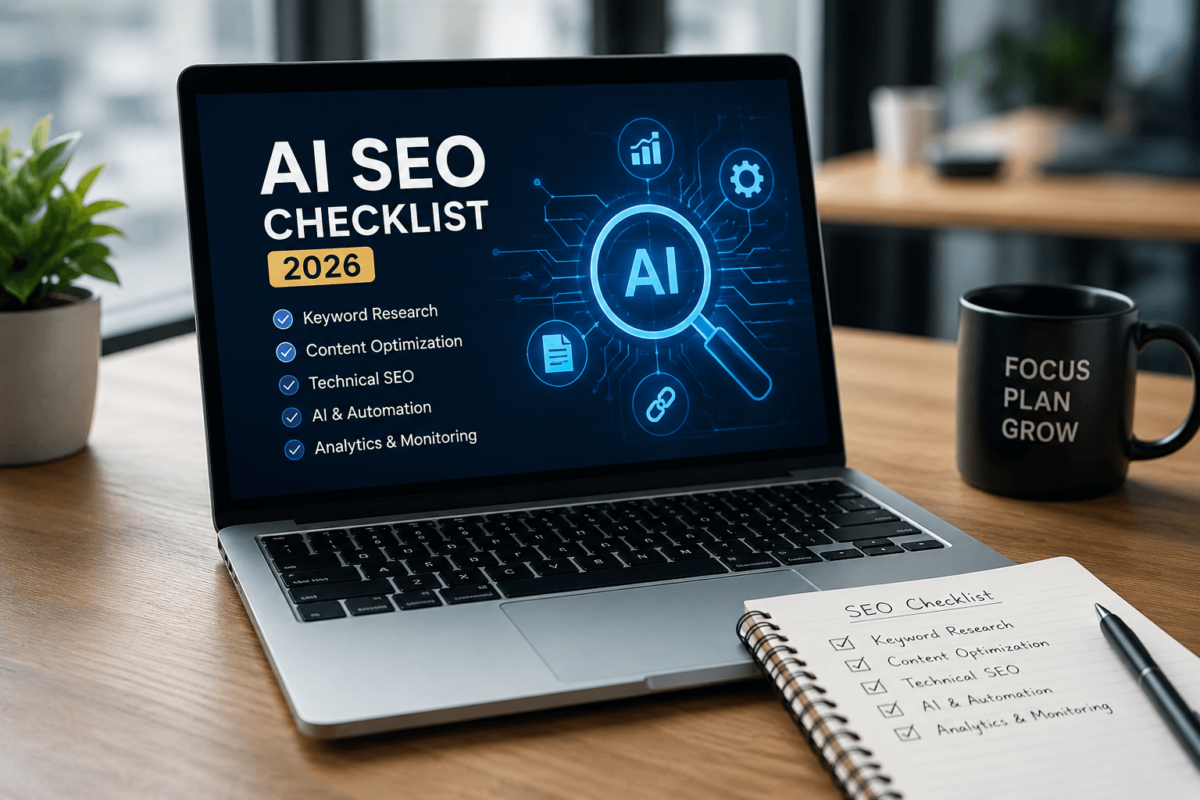
Complete AI SEO Checklist (100+ Checkpoints)
Use this as your master reference. Check these off as you build and launch your site.
Technical SEO
- HTTPS enabled with valid SSL certificate
- robots.txt configured — allows Googlebot, Bingbot, GPTBot, ClaudeBot, PerplexityBot, CCBot
- XML sitemap created and submitted to Google Search Console
- XML sitemap submitted to Bing Webmaster Tools
- IndexNow API key configured and integrated
- RSS feed created and accessible
- Core Web Vitals passing: LCP < 2.5s, CLS < 0.1, INP < 200ms
- Mobile responsive design confirmed
- Page Speed score > 85 on mobile (Google PSI)
- Critical content available in static HTML (not JS-only rendered)
- No broken internal links (checked monthly)
- No orphan pages (every page linked from at least 2 internal pages)
- Canonical URLs set on all pages
- No duplicate content issues
- Clean URL structure (no parameters on indexable content)
- 404 error page returns 404 status code (not 200)
- Redirect chains resolved (301s point directly to final destination)
- All images have descriptive alt text
- Images compressed and served in WebP format
- Lazy loading implemented for below-fold images
- Crawl depth < 4 clicks from homepage for all important pages
- Log files monitored for crawl frequency and errors
Entity & Brand Signals
- Google Business Profile created (if applicable)
- LinkedIn company page created and complete
- Twitter/X profile created with brand name
- Facebook business page created
- YouTube channel created
- Crunchbase listing created (for organizations)
- Wikidata entry created (if notability criteria met)
- Brand name consistent across all platforms
- About page comprehensive with organization history and mission
- Contact page with consistent NAP (Name, Address, Phone)
- Author pages created for all content contributors
- Author photos, bios, and credentials visible
- Author social profiles linked from author pages
- Editorial policy or methodology page published
Schema Markup
- Organization schema on every page (in site-wide script)
- WebSite schema with name and url on homepage
- Article/BlogPosting schema on all blog posts
- Article schema includes author, datePublished, dateModified
- Person schema on author profile pages
- Person schema includes sameAs links to LinkedIn, Twitter, Wikidata
- BreadcrumbList schema on all internal pages
- FAQPage schema on all pages with FAQ sections
- HowTo schema on all procedural/step-by-step content
- Speakable schema on key answer sections
- Product/Review schema on review content
- LocalBusiness schema if applicable
- All schema validated in Google Rich Results Test
- No schema errors in Search Console rich results report
Content Quality
- Topic cluster map documented for all core topics
- Pillar pages created for each major topic cluster
- Supporting pages linked to and from each pillar
- Each article has a named, credentialed author
- Each article has a visible publication date
- High-priority articles show last-updated date
- First paragraph of each section answers the section heading directly
- Comparison tables included where comparing options
- At least one FAQ section per major article (10+ questions)
- Statistics cited with named sources
- Expert quotes attributed to named individuals with credentials
- Original research or data published (at minimum quarterly)
- Content audit scheduled every 6 months
- Outdated content updated or redirected
Authority Signals
- First external link obtained within 30 days of launch
- Digital PR outreach strategy documented
- Guest posting opportunities identified in target niche
- Brand mentioned in at least 3 external sources within 90 days
- Industry directory listings submitted
- Backlink profile monitored in Ahrefs or Semrush
- No toxic backlinks (disavow file maintained if needed)
AI-Specific Optimization
- llms.txt file created (experimental — maps site structure for AI)
- Content tested for Perplexity citation by searching relevant queries
- Content tested for ChatGPT citation (with web browsing enabled)
- Google AI Overviews monitored for brand appearance
- AI visibility tracking set up (manual or via tool)
- Speakable schema added to key answer sections
- Answer-first format verified in all major article sections
This checklist covers 100+ checkpoints across technical SEO, entity signals, schema, content quality, authority building, and AI-specific optimization. Work through it systematically, not randomly.
Frequently Asked Questions
How long does it take to rank a new website in AI search?
Most new sites see their first AI citations within 3–6 months, assuming they’ve built proper entity signals, published structured content, and earned some external mentions. Full topical authority — where you’re regularly cited across multiple AI platforms — typically takes 12–18 months of consistent execution.
Can ChatGPT ‘rank’ my website?
ChatGPT doesn’t rank websites the way Google does. It cites sources when users have web browsing enabled or when using Perplexity-style retrieval. Your goal with ChatGPT is to become a citation source — which means your content needs to be discoverable via Bing (ChatGPT’s primary search backend) and well-structured enough to be extracted as an answer.
Does AI SEO replace traditional SEO?
No. AI SEO builds on traditional SEO. Google’s index is still the primary source for most AI retrieval systems. Technical SEO, content quality, and backlinks all remain important. What AI SEO adds is entity optimization, structured data, and content formats specifically designed for AI extraction.
Do backlinks still matter for AI visibility?
Yes, but in a nuanced way. Backlinks from authoritative sources create brand entity signals that AI systems use to evaluate trust. The links themselves still pass PageRank through Google’s index. And pages that rank well organically tend to get cited by AI systems more often. Quality over quantity matters more than ever.
What is Generative Engine Optimization (GEO)?
GEO is the practice of optimizing content specifically for retrieval and citation by AI-powered generative search engines (ChatGPT, Perplexity, Gemini, etc.). It encompasses entity optimization, structured data, content formatting for AI extraction, and authority signals that influence AI source selection. Learn more in our full breakdown of Generative Engine Optimization.
Can a brand-new website get AI citations quickly?
It’s rare but possible. If you publish original research that fills a genuine data gap, earns press coverage, and is well-structured, you can get cited by Perplexity within weeks. For most new sites, however, building the technical and entity foundation first takes 4–8 weeks, and meaningful citation rates develop over months.
How do AI crawlers work differently from Googlebot?
Most AI crawlers work similarly to Googlebot at a mechanical level — they follow links, read HTML, and index content. The key differences are: (1) some AI crawlers (like ClaudeBot) primarily crawl for training data, not real-time retrieval, (2) others (like PerplexityBot) crawl for real-time response generation, (3) JavaScript rendering capability varies by bot. Check each bot’s official documentation for specifics.
Should I use AI-generated content on my website?
AI can be a powerful drafting and research tool, but publishing raw AI output without editorial input is a mistake for AI visibility. LLMs recognize generic AI patterns and tend to cite content with original insight over generic summaries. Use AI for structure, drafts, and research — then add your expertise, original data, and perspective.
Does schema markup help ChatGPT understand my site?
Indirectly, yes. Schema markup helps Google’s index better understand your content — and ChatGPT with web browsing uses Google/Bing results as sources. More directly, structured data makes your content easier to parse and extract, which improves citation rates across all AI platforms that do real-time retrieval.
How does Perplexity choose its sources?
Perplexity uses a combination of search results (Google, Bing) and its own crawler. It favors content that: (1) ranks well organically for the query, (2) directly answers the question in a structured format, (3) is recent and from an established domain, (4) includes clear attribution and evidence. FAQ sections, comparison tables, and answer-first formatting all improve Perplexity citation rates.
What is Answer Engine Optimization (AEO)?
AEO is optimizing content specifically to be selected as the answer in AI and voice search responses. It focuses on structured formatting, FAQ optimization, featured snippet optimization, and content that directly addresses conversational queries. AEO is closely related to GEO but predates the current AI search wave — it emerged from voice search optimization. See our comparison of SEO vs. GEO vs. AEO vs. LLMO for the full picture.
What is semantic SEO?
Semantic SEO is the practice of optimizing for meaning and topic relationships rather than individual keywords. It involves using entity-rich language, covering related concepts comprehensively, establishing topical clusters, and building internal link structures that reflect the semantic relationships between topics. AI systems that use vector embeddings for search are directly rewarded by semantic SEO.
How do I know if my site is getting cited by AI systems?
Manual checking is the most reliable method right now: search for your key topics on ChatGPT (with browsing), Perplexity, and Gemini and look for your brand. Some SEO tools (like Semrush’s AI Overviews tracker) monitor AI Overview appearances. There’s no single dashboard for all AI citations yet — this is an area of tooling development.
What is an llms.txt file?
An llms.txt file is an emerging (not yet standardized) convention for giving AI systems structured information about your site’s content. Similar to how robots.txt gives instructions to crawlers, llms.txt aims to help AI systems understand what your site contains and how it should be used. It’s experimental and not universally supported, but worth implementing as the standard develops.
Does page speed matter for AI visibility?
Yes. Page speed affects your Google ranking, which is the primary driver of whether AI systems that use Google’s index will retrieve your content. Additionally, AI crawlers and real-time retrieval systems generally favor pages that respond quickly. A slow site may get crawled less frequently, reducing the freshness of its index representation.
Is Wikipedia important for AI SEO?
Wikipedia and Wikidata are highly trusted sources that are well-represented in LLM training data. If your brand or key topics have Wikipedia or Wikidata entries, AI systems are more likely to have accurate information about them and to recognize them as established entities. Getting your organization into Wikidata (which has lower notability requirements than Wikipedia) is a practical early goal.
What is the Knowledge Graph and how do I get into it?
Google’s Knowledge Graph is a database of real-world entities and their relationships. Getting into it typically requires demonstrating notability through press coverage, Wikipedia/Wikidata presence, and consistent brand signals across multiple authoritative sources. For most new sites, Knowledge Graph inclusion is a 12-18 month goal. Focus on entity signals first — GBP, schema, social profiles, consistent NAP — and the Knowledge Graph often follows.
Can I rank in multiple AI systems simultaneously?
Yes, and that should be your goal. The optimization strategies overlap significantly: topical authority, entity signals, structured content, and E-E-A-T all improve your visibility across Google, ChatGPT, Perplexity, Gemini, and Copilot simultaneously. You’re not optimizing for one system at the expense of another.
How important is author E-E-A-T for AI citations?
Increasingly important. AI systems that evaluate source trustworthiness look at whether content has a credentialed author whose identity can be verified. A named author with an established professional profile (LinkedIn, industry publications, speaking engagements) significantly strengthens your E-E-A-T signals across all AI platforms.
What’s the fastest way to get a brand-new website indexed?
Submit your sitemap to Google Search Console and Bing Webmaster Tools on day one. Use the URL Inspection tool to request indexing for your most important pages. Implement IndexNow for automatic new-page submission to Bing-connected engines. Get one external link pointing to your site as soon as possible. Create a Google Business Profile that links to your site. These five actions together typically get a new site indexed within 48-72 hours.
Final Thoughts: Build the Site AI Systems Want to Cite
If you’ve read this far, you have the complete roadmap. Let me leave you with the mindset that ties it all together.
AI search systems — whether it’s ChatGPT, Perplexity, Gemini, or whatever emerges next year — are trying to do what every good researcher does: find the most reliable, specific, well-organized information available and share it with their audience. They’re not trying to suppress you or favor established players arbitrarily. They’re optimizing for quality.
The sites that get cited consistently are the ones that have earned it. They’ve built real entity signals. They’ve published original, specific, well-structured content. They’ve established credible authors. They’ve maintained technical excellence. They’ve been patient and consistent.
None of that is fast. A new site will not get mentioned in Perplexity the week after launch. But with the right foundation, the right content strategy, and the right entity signals, you can absolutely build a site that gets cited by AI systems within 3–6 months. I’ve seen it happen.
The brands that are building AI visibility right now — while most competitors are still ignoring it — are the ones that will own the AI search landscape in 2027 and beyond. That window of first-mover advantage exists. Don’t waste it.
Build the site that deserves to be cited. The citations will follow.