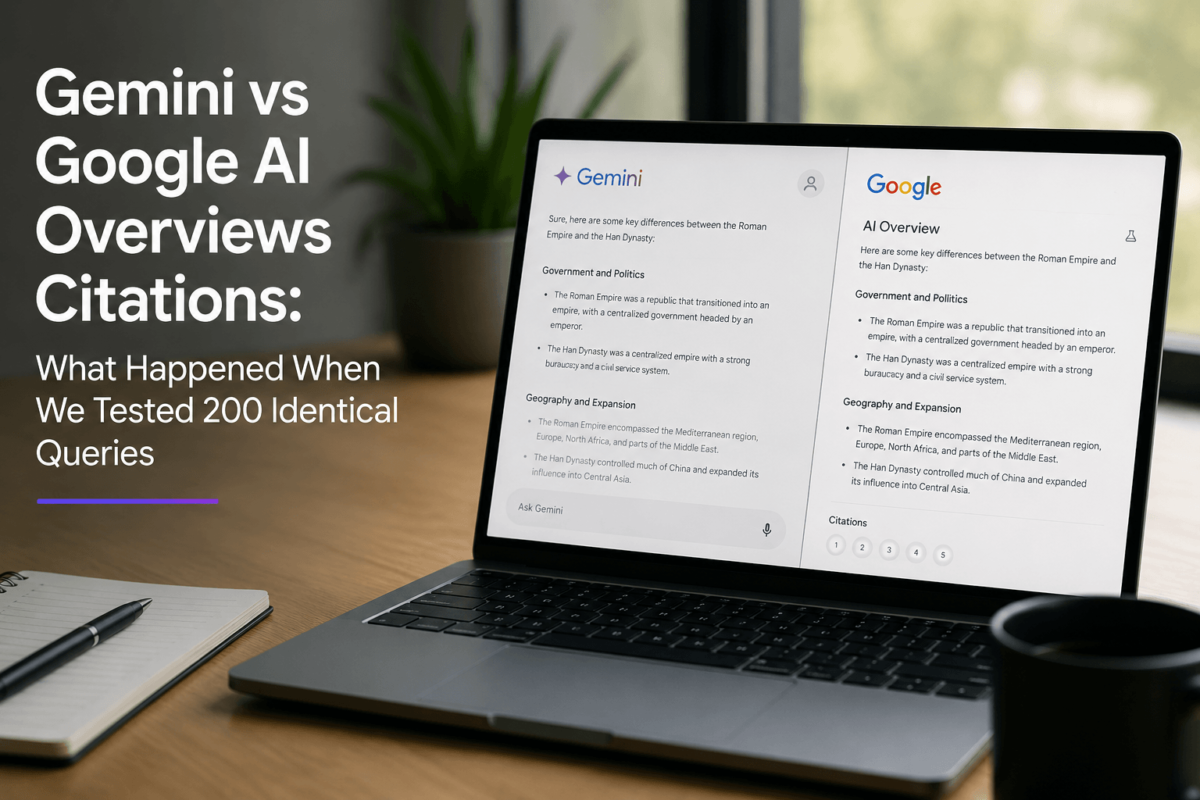
What Happened When We Tested 200 Identical Queries
A Large-Scale Citation Overlap Study for SEO, GEO & AEO Professionals
No — Gemini and Google AI Overviews do not reliably cite the same sources. Across our 200-query dataset, overall citation overlap averaged just 32%, meaning nearly 7 out of 10 citations were unique to one platform. While both systems share a preference for high-authority domains on informational queries, they diverge sharply on commercial, local, and news topics — making a dual-platform optimization strategy essential for modern publishers.
- →Overall citation overlap is just 32% — lower than most marketers expect
- →Gemini produces more unique citations per query — avg 6.2 vs 4.8 for AI Overviews
- →Informational queries show the highest overlap at 52%; news queries the lowest at 11%
- →AI Overviews concentrate citations among established publishers; Gemini casts a wider net
- →Gemini has a stronger freshness bias — citing content under 90 days old 44% of the time
- →AI Overviews exhibit lower citation volatility — results are more consistent across runs
- →Health and education verticals share the most sources; ecommerce and local the least
- →GEO strategies must account for both systems independently
- →Building entity authority and topical depth gives you the best shot at appearing in both
Introduction
Most marketers assume Gemini and Google AI Overviews pull from the same source pool because both come from Google. Our research found a more nuanced — and in many ways more interesting — reality.
When we ran 200 identical queries through both systems and extracted every citation, the data told a story that challenges a core assumption in the AI search optimization world: that getting your content surfaced in one system automatically helps you in the other. It does not — at least not reliably.
The reality is that Gemini and Google AI Overviews are genuinely different retrieval systems operating on different ranking signals, freshness weightings, and content preferences. For publishers and SEOs, that distinction has direct revenue implications as AI-generated answers increasingly replace traditional blue-link clicks.
This study set out to answer a deceptively simple question: when both systems receive the exact same query, do they cite the same sources? We analyzed citation patterns across 200 queries, 8 industry verticals, 5 query intent types, and hundreds of unique domains. What we found should change how you think about GEO strategy in 2026.
Study Methodology
Rigorous methodology is everything in a citation overlap study. If the testing conditions are not controlled, the data becomes meaningless. Here is exactly how we designed and executed this research.
Dataset: 200 Identical Queries
We assembled 200 queries designed to represent realistic search behavior across the full spectrum of user intent and industry verticals. The distribution was intentional:
Testing Environment
Controlling the test environment was critical to ensuring results reflected genuine algorithmic differences rather than personalization artifacts:
Measurement Metrics
We tracked six core metrics throughout the study:
| Metric | Definition |
|---|---|
| Citation Overlap Rate | Percentage of cited domains appearing in BOTH systems for a given query. A 32% overlap means that if Gemini cited 10 domains, roughly 3 also appeared in AI Overviews for the same query. |
| Unique Domain Share | Percentage of citations appearing in only one system. Gemini’s 41% unique share means a large portion of its citations are never surfaced by AI Overviews. |
| Citation Diversity Score (CDS) | Proprietary score (0–10) measuring distinct root domains across all queries in a vertical. Higher = wider publisher base. |
| Domain Concentration Rate | Percentage of total citations attributable to the top 20 domains. High concentration suggests authority bias. |
| Freshness Index | Percentage of cited content published within the past 90 days. Indicates how much each system favors recency. |
| Authority Source Ratio | Share of citations going to .gov, .edu, Wikipedia, and established media brands versus independent publishers and blogs. |
Key Findings
Overall Citation Overlap Is Surprisingly Low at 32%
This was the headline finding that set the tone for everything else. Across all 200 queries, the average citation overlap between Gemini and Google AI Overviews was just 32%. For every ten sources cited by one system, fewer than four appeared in the other.
One surprising finding was how consistent this gap proved across different query volumes. Whether a query generated 4 citations or 9, the overlap rate hovered between 28% and 36% for most categories. This suggests the divergence is structural — baked into how each system evaluates and retrieves sources — rather than a quirk of any particular query set.
Informational Queries Show the Highest Overlap at 52%
When users are asking broad knowledge questions — how something works, what a term means, background research — both systems converge on roughly the same high-authority sources. Our informational query subset showed a 52% overlap rate, the highest of any intent category we tested.
This makes intuitive sense. For evergreen educational content, both Gemini and AI Overviews are drawing from the same trust signals: Wikipedia, government agencies, major medical institutions, and established media outlets. Examples that illustrated this clearly included “how does compound interest work” (both systems cited Investopedia, NerdWallet, and the SEC) and “symptoms of type 2 diabetes” (both pulled Mayo Clinic, the CDC, and the American Diabetes Association).
Commercial Queries Diverge More — Overlap Drops to 18%
On commercial-intent queries — product comparisons, best-of lists, buying guides — the overlap rate collapsed to just 18%. The two systems are pulling from fundamentally different source pools when users are in research-to-purchase mode.
AI Overviews showed a strong preference for established review publishers and recognized brand editorial content: CNET, The Wirecutter, PCMag, Healthline. Gemini cast a noticeably wider net, regularly citing mid-tier review blogs, niche comparison sites, forum threads (particularly Reddit), and newer publishers that would not crack AI Overviews’ citation list for the same query.
News Queries Produce the Largest Citation Differences — Only 11% Overlap
Nothing illustrated the divergence between these two systems more starkly than news and trend queries. With an overlap rate of just 11%, the two systems were essentially operating in parallel universes when processing current-events questions.
AI Overviews showed a clear preference for AP News, Reuters, major national newspapers, and local TV station websites. Gemini drew from a more eclectic mix: independent newsletters, newer digital-native publications, Substack writers with large followings, and even YouTube video transcripts.
AI Overviews Favors Traditional Publishers More Often
The domain concentration data for AI Overviews looked almost like a traditional Google SERP from 2019: heavy representation from established publishers, government sites, and recognizable brands. The top 20 domains accounted for 58% of all citations recorded — a high concentration rate that reflects a conservative, authority-first retrieval strategy.
This matters enormously for publishers. If your domain is not already in Google’s inner circle of trusted sources — the kind of domain that appears in featured snippets and top-3 organic positions — breaking into AI Overviews is genuinely difficult. The system appears to use traditional quality signals (PageRank, E-E-A-T indicators, historical performance) as a primary filter before any content-level evaluation.
Gemini Shows Broader Citation Diversity — Source Diversity Score of 7.4
Our Source Diversity Score (SDS) came in at 7.4 out of 10 for Gemini versus 5.9 for AI Overviews. In SaaS and technology, Gemini regularly cited Reddit threads, developer documentation, GitHub repositories, and independent tech blogs alongside major publishers. In travel, it mixed TripAdvisor and Booking.com with newer travel influencer blogs.
The risk is that Gemini’s broader net means more citation instability. Our volatility analysis found that Gemini’s citations changed between runs at a significantly higher rate than AI Overviews. Appearing in a Gemini citation today does not guarantee you will appear tomorrow — making ongoing monitoring essential.
Industry-Level Citation Overlap Breakdown
The platform-wide numbers tell one story. The industry-level data reveals something more nuanced: the degree of overlap varies dramatically depending on the vertical. Here is what our data showed across 8 industries:
| Industry | Overlap | Level | Key Observation |
|---|---|---|---|
| Health & Medical | 52% | High | Both cite Mayo Clinic, NIH, WebMD heavily |
| Finance | 38% | Moderate | Investopedia shared; Gemini pulls more fintech blogs |
| SaaS / Technology | 29% | Moderate | G2, Capterra overlap; Gemini uses Reddit/forums more |
| Ecommerce | 18% | Low | AIO favors retail brands; Gemini pulls review sites |
| Travel | 34% | Moderate | Tripadvisor shared; Gemini uses newer travel blogs |
| Local SEO | 15% | Low | AIO uses Google Business Profile data; Gemini pulls directories |
| News | 11% | Very Low | Entirely different publishers; timing-dependent |
| Education | 47% | High | Wikipedia, .edu sites heavily shared |
The most striking divergence is in Local SEO, where AI Overviews heavily leverages Google’s own ecosystem — Business Profile data, Maps reviews, local schema — while Gemini relies more on third-party directories. Health remains the area of strongest overlap because both systems have implemented conservative citation policies directing users to the same short list of medically authoritative sources.
Gemini vs AI Overviews: Full Metric Comparison
The table below summarizes our key findings across all measured dimensions. Use this as a quick reference for your GEO strategy:
| Metric | Gemini | AI Overviews | Winner |
|---|---|---|---|
| Overall Citation Overlap Rate | 32% | 32% | Tied |
| Unique Domain Share | 41% | 27% | Gemini |
| Avg Citations Per Query | 6.2 | 4.8 | Gemini |
| Informational Query Overlap | 52% | 52% | Tied |
| Commercial Query Overlap | 18% | 21% | AI Overviews |
| News Query Overlap | 11% | 11% | Tied |
| Government Site Citations | 12% | 19% | AI Overviews |
| Wikipedia Citations | 14% | 9% | Gemini |
| Educational (.edu) Citations | 8% | 11% | AI Overviews |
| Publisher Concentration | Moderate | High | Gemini |
| Freshness Bias (<90 days) | High (44%) | Moderate (31%) | Gemini |
| Citation Volatility (same query) | High | Low | AI Overviews |
| Source Diversity Score (SDS) | 7.4 / 10 | 5.9 / 10 | Gemini |
| Brand / Commercial Domain Bias | Moderate | High | Gemini |
| Evergreen Content Citation Rate | 56% | 69% | AI Overviews |
Real-World Citation Examples from Our Dataset
Numbers are useful, but concrete examples make the patterns tangible. Here are five representative queries from our dataset that illustrate the citation divergence in practice:
- Investopedia.com
- Fidelity.com
- NerdWallet.com
- Vanguard.com
- Reddit (r/personalfinance)
- Investopedia.com
- Fidelity.com
- SEC.gov
- Forbes.com
- Mayo Clinic
- Healthline.com
- American Heart Association
- WebMD
- Harvard Health Blog
- Mayo Clinic
- Healthline.com
- American Heart Association
- CDC.gov
- G2.com
- Reddit (r/projectmanagement)
- Forbes Advisor
- Clickup.com blog
- Capterra.com
- Forbes Advisor
- PCMag.com
- TechRadar.com
- G2.com
- TechCrunch.com (3 days prior)
- The Verge
- MIT Technology Review
- Wired.com
- Independent AI newsletter (Substack)
- Reuters.com
- Associated Press
- BBC News
- Wall Street Journal
- Yelp.com
- Angi.com
- HomeAdvisor.com
- Thumbtack.com
- Google Business Profile aggregation
- BBB.org
- Yelp.com
What This Means for SEO and GEO
Why Citation Visibility Matters Now
The shift from organic clicks to AI-generated answers is not a future event — it is happening right now, and it is accelerating. Studies from multiple analytics platforms in early 2026 show that AI Overviews are appearing for roughly 35–40% of all Google queries, with zero-click rates rising accordingly. Getting cited in an AI answer is the new version of ranking on page one. The difference is that the mechanism for earning that citation is different from traditional ranking — and the two systems require somewhat different strategies.
The Future of Organic Traffic
Here is the uncomfortable reality the data surfaces: if you are not optimizing for AI citations, you are optimizing for a shrinking slice of total search traffic. Our data shows that the two platforms are not competing for the same citation slots — they are drawing from mostly different pools. This means publishers who optimize for both platforms can effectively double their AI citation surface area.
E-E-A-T Signals Are the Foundation
Google’s E-E-A-T framework (Experience, Expertise, Authoritativeness, Trustworthiness) turns out to be a remarkably accurate predictor of AI citation behavior. Domains with strong E-E-A-T indicators appear disproportionately often in both Gemini and AI Overviews citations, particularly on YMYL topics. Building author pages, citing credentials, documenting sources, and maintaining editorial standards are not just traditional SEO best practices — they are GEO prerequisites.
Entity Building and Knowledge Graph Presence
One pattern we noticed repeatedly in high-citation domains was strong entity presence in Google’s Knowledge Graph. Organizations and individuals with verified Knowledge Panel entries, clear entity disambiguation, and well-documented brand profiles appeared more consistently in AI citations — especially in AI Overviews. If an AI system is going to cite a source as authoritative, it needs to identify that source as a recognized entity.
Digital PR and Earned Media
The sources that appeared most frequently in both systems were almost universally the subjects of consistent earned media coverage. Being cited by other high-authority publishers is a signal that both Gemini and AI Overviews appear to weight heavily. Digital PR — earning mentions and links from recognized publications — remains one of the highest-leverage activities for building AI citation authority.
Structured Data and Content Clarity
Content that AI systems can easily parse, attribute, and summarize gets cited more often. Our data suggests that FAQ schema, HowTo schema, Article schema, and Author schema all correlate with higher citation rates. For a deep dive, see our guide on schema markup for AI search.
How to Earn Citations from Both Gemini and Google AI Overviews
Based on our 200-query dataset, here is a practical eight-step framework for building AI citation authority across both platforms. Each step addresses a specific gap we identified in the data.
Both Gemini and AI Overviews favor sources they can identify as known, credible entities. If Google’s Knowledge Graph does not know who you are, your AI citation potential is limited regardless of content quality.
Create and verify a Google Business Profile. Build a Wikipedia or Wikidata entry if your brand qualifies. Ensure your About page is detailed and verifiable. Pursue a Knowledge Panel through consistent NAP citations. Add Organization and Person schemas.
Assuming brand recognition alone is sufficient. Many well-known industry brands have weak entity signals because they have never systematically built them.
AI systems cite content they can summarize, attribute, and verify. Vague, promotional, or thinly sourced content is rarely cited regardless of how well it ranks organically.
Write with clear factual claims backed by primary sources. Structure content with explicit answers in the first 100–150 words. Use descriptive H2s that mirror conversational query language. Include data and original research — these are highly citable.
Writing for engagement metrics rather than informational density. Highly shareable content and highly citable content are not the same thing.
Both systems reward depth of coverage, not just a single high-quality article. Gemini especially showed a strong preference for domains with broad, deep coverage of a specific topic cluster.
Build content hubs with 10–20+ interlinked articles covering every meaningful subtopic. Identify gaps competitors are not addressing. Update and expand existing articles rather than creating redundant content. Use internal linking to signal topical relationships. See: What is GEO?
Creating a single “ultimate guide” and calling it done. AI systems evaluate the entire domain’s topical depth, not individual articles in isolation.
Our domain concentration analysis shows that the most-cited sources in both systems are consistently the most-cited sources across the entire web. Earned media directly improves AI citation probability.
Develop a proactive digital PR program targeting publications that already appear in AI citations for your topic. Create original research and data studies. Respond to HARO and journalist query platforms consistently.
Pursuing links purely for SEO purposes. AI citation signals weight editorial relevance and context over raw link quantity.
AI systems extract citation metadata much more efficiently when content is clearly marked up with appropriate schema. Schema-annotated content appeared more consistently in citation lists, especially in AI Overviews.
Implement Article, FAQPage, HowTo, and Person schemas. Add datePublished and dateModified to all articles. Use BreadcrumbList schema for content hierarchy. Mark up author credentials with Person schema including sameAs links. See: Schema for AI Search.
Implementing schema as a one-time project. Every new article should include relevant schema from day one — not as an afterthought.
Gemini’s freshness bias is significant: 44% of its citations were published or updated within 90 days. Content not refreshed in 12+ months is at a systematic disadvantage for Gemini citations specifically.
Establish a quarterly content audit process for your most important articles. Add a “Last Updated” date visible to users and marked in schema. Make substantive updates — new data, updated statistics, current examples. Prioritize updating content on topics with high news velocity.
Making invisible changes or adding a few sentences without improving depth or currency. AI systems can assess content substance, not just the modification date.
Trustworthiness is evaluated at both the domain and the page level. The most-cited sources universally display strong trust signals: clear authorship, transparent funding, editorial policies, and accurate factual records.
Publish detailed author bios with real credentials and social verification. Create a transparent About page explaining your editorial process. Correct factual errors quickly and document corrections. Avoid clickbait headlines. Be transparent about commercial relationships.
Treating trust signals as cosmetic. A single trust-signal violation — like an undisclosed affiliate relationship or an uncorrected factual error — can undermine all other optimization work.
Our volatility analysis showed Gemini citations change significantly between runs. What works today may not work next month. You cannot optimize what you are not measuring — and AI citation systems are actively evolving.
Set up monthly test protocols to check whether your key articles are being cited for their target queries. Use a standardized set of 20–30 test queries. Track citation appearance rates over time. See: Track AI Search Traffic.
Checking once and assuming it is stable. Citation patterns shift with system updates, and ongoing benchmarking against competitors is essential.
Lessons Publishers Should Learn from This Data
The 32% overlap rate makes this point unambiguously: being visible in AI Overviews and being visible in Gemini require overlapping but distinct strategies. Publishers who build their GEO approach around a single system are leaving roughly 70% of the combined AI citation opportunity on the table. Think of it like the difference between ranking on Google and ranking on Bing — both matter, and the strategies share a foundation but diverge in meaningful ways.
Traditional domain authority remains the strongest predictor of AI Overviews citations. But Gemini’s broader citation diversity shows that authority alone is not enough to dominate AI visibility. Topical depth, content freshness, and structured data all play larger roles in Gemini. The foundational work of building domain authority pays dividends across both systems; the incremental work of adding topical depth and freshness tips the scales in Gemini.
Publishers who build deep coverage of a specific niche build a moat against both algorithmic changes and new competitor entrants. The counterintuitive takeaway: sometimes being the definitive source on a narrow topic is more valuable for AI citation than being a general-interest publisher with broad coverage of many topics.
Our finding that 44% of Gemini’s citations were under 90 days old should motivate every editorial calendar review. Content freshness is no longer just a best practice — it is a direct driver of Gemini citation probability. Publishers who treat evergreen content as a set-it-and-forget-it asset are at growing risk of citation displacement as competitors update more frequently.
Predictions for 2026 and Beyond
Both systems are moving toward personalized citation selection based on user history, location, and stated preferences. As these systems mature, citations will become increasingly user-specific — meaning the same query could return different citations for different users.
Gemini’s freshness bias is a preview of where the industry is heading. Both systems will increasingly incorporate real-time content from live web crawls, news feeds, and social platforms. Publishers with high-frequency content operations will have structural advantages.
Video, audio, and image content are increasingly being cited in AI responses alongside traditional text. YouTube transcripts already appear in some Gemini citations in our dataset. Publishers who produce content in multiple formats will have more citation surface area.
Within 18 months, GEO will likely be a line item in every enterprise SEO budget, and specialized GEO agencies will emerge to serve the mid-market. The practices in this study — entity building, topical depth, freshness management, schema markup — will become standard operating procedures.
Today, monitoring AI citations requires manual testing protocols like the one we used in this study. Within 12–18 months, dedicated citation tracking platforms will emerge that automate this process at scale — similar to how rank tracking tools transformed traditional SEO measurement. Publishers who build manual monitoring habits now will be well-positioned to adopt these tools when they arrive.
Frequently Asked Questions
Not reliably. Our 200-query study found an average citation overlap of just 32%. The two systems share sources most often on informational queries about stable topics (health, education, finance basics), and diverge most sharply on news, commercial, and local queries. Assuming the two systems share a citation pool is one of the most common — and costly — misconceptions in GEO strategy today.
Gemini consistently cited more unique domains per query, averaging 6.2 citations versus 4.8 for Google AI Overviews. Gemini also showed a higher Source Diversity Score (7.4 vs 5.9), meaning it draws from a wider pool of publishers across its full query set. AI Overviews is more selective but more consistent in which sources it chooses.
Focus on the fundamentals of traditional SEO with a GEO twist: build genuine domain authority through high-quality content and earned backlinks, demonstrate E-E-A-T signals across your site, use structured data (Article, FAQPage, Author schema), and create definitive content that comprehensively answers common questions in your niche. AI Overviews has a strong authority bias, so domain-wide credibility matters more than any individual optimization tactic.
Gemini rewards freshness, topical depth, and structured data in ways AI Overviews does not. Prioritize regular content updates, build deep topical coverage in your niche, earn citations from independent authorities (Reddit, forums, niche publications), and ensure your content clearly and directly answers the query in the opening paragraphs. Gemini is more accessible for newer publishers with concentrated expertise in a specific area.
Yes, significantly — particularly for AI Overviews. Our domain analysis found that sites with strong E-E-A-T indicators (detailed author credentials, transparent sourcing, editorial policies, correction practices) appeared far more consistently in citation lists. E-E-A-T is arguably more important for GEO than for traditional SEO, because AI systems are explicitly trying to identify the most trustworthy sources, not just the most trafficked ones.
Partially, and increasingly. AI-generated answers with citations are reducing click-through rates on traditional organic results for many query types. However, AI citations often drive qualified click-throughs from users who want more detail than the AI summary provides — making AI citation traffic valuable even if lower volume. The strategic shift is from optimizing for position one to optimizing for citation inclusion.
Citation overlap refers to the percentage of domains cited by both Gemini and Google AI Overviews for the same query. A 32% overlap rate means that for any given query, roughly one-third of cited sources appear in both systems, while the remaining two-thirds are unique to one platform. Measuring citation overlap is fundamental to GEO strategy because it reveals how much of your citation optimization transfers across platforms — and how much requires separate effort.
Several factors drive the divergence: different training data compositions, different freshness weighting algorithms, different thresholds for what counts as an authoritative source, and likely different optimization objectives. Google may optimize AI Overviews to align with existing search quality standards, while Gemini operates with different quality criteria as a standalone product. The result is two systems with genuinely distinct views of what constitutes a citable source.
Final Thoughts
The data is clear: Gemini and Google AI Overviews are not the same system in different wrappers. They have distinct citation philosophies, different freshness priorities, and different tolerance for source diversity. And that distinction matters enormously for any publisher, brand, or SEO team trying to build visibility in the age of AI search.
The most important practical takeaway from our 200-query study is this: you need a dual-platform GEO strategy. Optimizing for AI Overviews alone leaves you invisible in Gemini for roughly 70% of queries. Optimizing for Gemini alone means you are missing the conservative, high-authority citation ecosystem that AI Overviews represents.
The good news is that the foundation is the same: build genuine expertise, demonstrate trustworthiness, create substantive content that directly answers real questions, and earn recognition from other credible sources in your space. The incremental differences — freshness for Gemini, domain concentration for AI Overviews — can be addressed as optimization layers on top of that foundation.
Start with the eight steps in this guide. Measure monthly. And remember: in the age of AI search, getting cited is the new page-one ranking.