The Shift to AI-Driven Search
The way people find information online is undergoing the most significant transformation since Google’s founding. For two decades, SEO meant keyword research, backlink building, and on-page optimization. That playbook still matters — but it is no longer enough.
Today, search engines are not simply matching keywords to documents. They are reading your content, understanding its meaning, identifying the entities within it, and synthesising answers for users before those users ever click a link. This is the age of AI search — and it demands a fundamentally new approach.
Google AI Overviews (formerly Search Generative Experience) already surfaces AI-generated summaries above traditional blue links for millions of queries. Microsoft Copilot is embedded inside Bing. Perplexity, You.com, and a growing ecosystem of AI-native search engines are trained to pull answers directly from well-structured web content.
Structured data is the language AI uses to understand websites. Schema markup is how you speak that language.
This guide covers everything you need — from what schema markup is and why it matters, through to advanced AI SEO strategy that will future-proof your website as search continues to evolve. For deeper context on the broader AI SEO landscape, see our Complete Guide to AI SEO in 2026.
What Is AI Search?
Before you can optimise for AI search, you need to understand how it differs from the traditional model you are likely familiar with.
Traditional Search vs. AI Search
| Traditional Search | AI Search |
|---|---|
| Keyword matching | Entity and semantic understanding |
| Returns list of ranked links | Generates direct answers with citations |
| Crawler indexes text | AI models extract meaning and relationships |
| Keyword density signals quality | Structured data signals authority |
| First click wins | Citation in AI summary wins |
| 10 blue links | AI overview + supporting links |
AI search engines — including Google AI Overviews, Microsoft Copilot, and Perplexity — use large language models (LLMs) to synthesise information from multiple sources. Rather than simply returning a list of URLs, they generate a conversational answer and cite the sources they used. This means your goal shifts: instead of ranking #1 for a keyword, you want your website to be cited as an authoritative source inside AI-generated answers.
Google AI Overviews
Google AI Overviews (the consumer-facing evolution of the Search Generative Experience) is the most important AI search surface for most website owners. To be cited in an AI Overview, Google’s systems must be able to:
- Identify the topic and entities on your page
- Understand how your content relates to the user’s query
- Trust your content as authoritative on the subject
- Extract a precise, accurate answer from your page
Schema markup accelerates all four of these processes. For a full breakdown of ranking in AI Overviews, read our guide on AI-First SEO: How to Rank in Google’s AI Overviews.
Entity Understanding and Semantic Search
Modern AI search is built on entity-based understanding. An entity is a well-defined concept — a person, place, organisation, product, or topic — that exists independently of any single document or keyword string. Google’s Knowledge Graph contains billions of entities and the relationships between them. Schema markup answers these questions explicitly, reducing ambiguity and increasing your chances of appearing in AI-generated answers.
What Is Schema Markup?
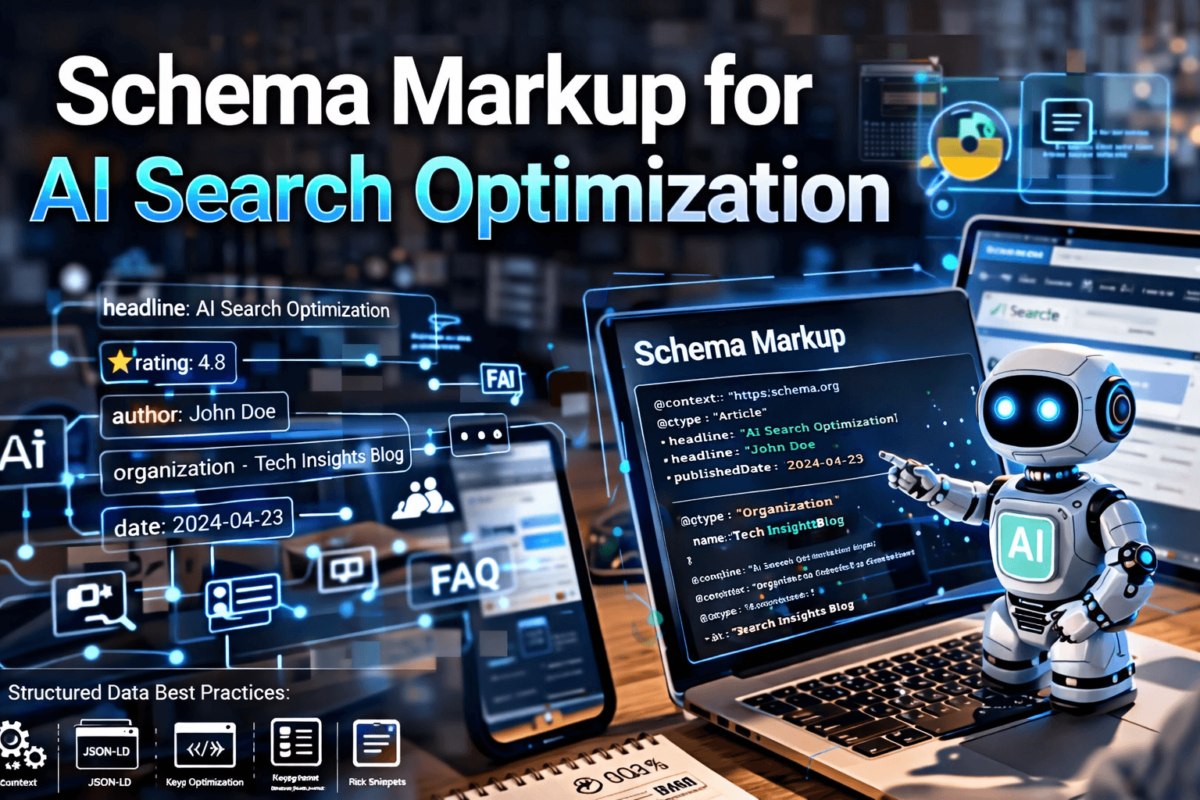
Schema markup (also called structured data) is code you add to your web pages that explicitly tells search engines and AI systems what your content means — not just what it says.
Think of it this way: your page content is written for human readers. Schema markup is a parallel layer of machine-readable metadata written for search engine crawlers and AI systems. Both layers say the same thing, but in different languages.
Schema.org: The Standard Vocabulary
Schema.org is a collaborative project founded by Google, Microsoft, Yahoo, and Yandex in 2011. It defines a shared vocabulary of types (Article, Product, FAQ, Organisation, Person, and hundreds more) that webmasters can use to describe their content. Because all major search engines have agreed on this vocabulary, a single implementation will be understood by Google, Bing, Apple Spotlight, DuckDuckGo, and any AI system that follows web standards.
Schema Implementation Formats
| Format | Description | Recommendation |
|---|---|---|
| JSON-LD | Embedded in a <script> tag in the page <head>. Easy to implement and maintain. | ✅ Use this |
| Microdata | Inline HTML attributes. Harder to maintain. Now largely obsolete. | ⚠️ Avoid |
| RDFa | Attribute-based inline format. Used in some legacy systems. | ⚠️ Avoid |
Google explicitly recommends JSON-LD for all new structured data implementations. Always place JSON-LD inside a <script type="application/ld+json"> tag in the <head> section of your HTML — never in the page body or CMS shortcodes that render in the body.
Core Schema Types for Websites
Blog posts, guides, news articles
Pages with question-and-answer sections
Step-by-step instructional content
Brand and company information
Author profiles and bios
Physical or digital products
Physical store or service locations
Page hierarchy within a website
Why Schema Markup Matters for AI Search
This is the most important section of this guide for anyone optimising for AI content ranking and Google AI Overviews SEO. Understanding the mechanism by which schema markup influences AI search outcomes will inform every decision you make about your structured data strategy.
4.1 Entity Recognition
AI search systems are fundamentally entity-resolution machines. Without schema markup, an AI must infer entities from context — a process that introduces ambiguity. With schema markup, you state your entities explicitly. Your Article schema names the author as a Person entity. Your Organization schema identifies your brand. Your Product schema defines exactly what you are selling.
- Clear entity declaration = faster, more accurate indexing
- Entity matching to Knowledge Graph = citation eligibility in AI answers
- Rich entity connections = stronger topical authority signals
4.2 Content Context and Topic Hierarchy
AI systems need to understand not just what is on a page, but where that page sits within a broader topic hierarchy. A breadcrumb schema tells AI that this Article is part of the Technical SEO cluster, which is part of your overall SEO content hub. This hierarchy helps AI understand the depth and breadth of your expertise on a subject. See our Technical SEO Checklist 2026 for how this fits into a complete technical SEO stack.
4.3 Answer Extraction for AI Overviews
Google AI Overviews are built from extracted answer fragments. FAQ schema is the most direct way to make your content extractable. By explicitly marking up a question and answer pair, you are pre-packaging an answer for Google’s AI to use. Pages with FAQ schema are significantly more likely to appear in AI Overviews for question-based queries.
Schema markup does not guarantee AI Overview citations, but it dramatically lowers the barrier. It tells AI systems exactly what you know, who you are, and why they should trust you — in a language they process natively.
4.4 E-E-A-T Signals and Trust
Google’s quality guidelines emphasise Experience, Expertise, Authoritativeness, and Trustworthiness (E-E-A-T). Schema markup is one of the clearest ways to communicate E-E-A-T signals:
- Person schema with
sameAslinks to LinkedIn confirms author identity - Organization schema with
sameAslinks to Wikipedia builds brand entity trust - Article schema with
datePublishedanddateModifiedsignals content freshness - Review schema aggregates social proof
How AI Processes Your Web Pages
Understanding the AI content processing pipeline helps you make better decisions about where to invest your structured data efforts.
Googlebot fetches your page HTML, including JSON-LD schema in the <head>
AI models identify named entities, topics, and semantic relationships
Extracted entities are matched to nodes in Google’s Knowledge Graph
E-E-A-T signals, schema data, and link authority determine trustworthiness
For AI Overviews: the most relevant, trustworthy fragments are selected and synthesised
The Google Knowledge Graph Connection
The Google Knowledge Graph is Google’s database of entities and relationships — a web of interconnected facts about people, places, organisations, products, creative works, and more. When your schema markup explicitly connects your author to their LinkedIn profile, or your organisation to its Wikipedia page, you are asking Google to map your entities to existing Knowledge Graph nodes.
Once your entities are mapped to the Knowledge Graph, they become part of Google’s world model. This enables your brand name to appear in Knowledge Panels, your author bio to appear in author carousels, and your content to be cited in AI Overviews on related topics — even queries that don’t perfectly match your page’s keywords.
The Most Important Schema Types for AI SEO
Not all schema types carry equal weight for AI search optimisation. The following types have the most direct impact on AI content ranking, Google AI Overviews SEO, and entity recognition.
6.1 Article Schema
Best Used For
- Blog posts & guides
- Tutorials & news articles
- Opinion pieces
AI Impact
- Author entity recognition
- Content freshness signals
- Publisher entity connection
Article schema is the foundation of AI SEO for content websites. It tells AI exactly what your page is: a piece of editorial content, who wrote it, when it was published, and what organisation published it. It directly supports Experience and Expertise signals in E-E-A-T evaluation.
6.2 FAQ Schema
FAQ schema is arguably the highest-ROI schema type for AI search in 2026. It packages your content as a series of explicit question-answer pairs — exactly the format that AI Overview systems use to extract answers.
Write FAQ answers in 40–80 words — detailed enough to be useful, concise enough to be extractable by AI systems. Use 5–8 high-quality, directly relevant questions per page rather than overloading with 30+.
6.3 HowTo Schema
HowTo schema marks up step-by-step instructional content. AI systems strongly prefer structured, sequential content when answering procedural queries — and HowTo schema makes the structure machine-readable. Best for: tutorials, setup guides, installation instructions, recipes, and DIY content.
6.4 Organization Schema
Organization schema is critical for brand entity establishment. Without it, AI systems cannot reliably identify your website as belonging to a known, trustworthy brand. Best deployed on your homepage and About page. The sameAs field is critical — link to your Wikipedia page, Wikidata entry, LinkedIn company page, and social profiles.
6.5 Person Schema
In the E-E-A-T era, author authority is a first-class ranking signal. AI systems use Person schema to verify that a named author exists, that they have relevant credentials, and that they are associated with a trustworthy organisation. Best for: author bio pages, staff pages, bylines.
6.6 BreadcrumbList Schema
Breadcrumb schema maps your page’s position within your website’s content hierarchy. This helps AI understand the topical context of individual pages and signals that your site has depth of coverage on a subject. For implementation details, see our Technical SEO Checklist.
Schema Implementation: Complete Technical Guide
Below are production-ready JSON-LD templates for every major schema type. Replace all placeholder values (shown in ALL_CAPS) with your actual data before deploying.
7.1 Article Schema Template
Use this on every blog post, guide, and tutorial page on your site.
<script type="application/ld+json">
{
  "@context": "https://schema.org",
  "@type": "Article",
  "mainEntityOfPage": {
    "@type": "WebPage",
    "@id": "https://techcognate.com/YOUR-POST-SLUG"
  },
  "headline": "YOUR ARTICLE HEADLINE (under 110 characters)",
  "description": "YOUR META DESCRIPTION (150-160 characters)",
  "image": "https://techcognate.com/images/YOUR-IMAGE.jpg",
  "author": {
    "@type": "Person",
    "name": "Jaykishan Panchal",
    "url": "https://techcognate.com/about"
  },
  "publisher": {
    "@type": "Organization",
    "name": "TechCognate",
    "logo": {
      "@type": "ImageObject",
      "url": "https://techcognate.com/logo.png"
    }
  },
  "datePublished": "2026-03-01",
  "dateModified": "2026-03-19"
}
</script>
7.2 FAQ Schema Template
Add this to any page that has a Questions & Answers section. Each question-answer pair should appear visibly in the page body as well as in the schema.
<script type="application/ld+json">
{
  "@context": "https://schema.org",
  "@type": "FAQPage",
  "mainEntity": [
    {
      "@type": "Question",
      "name": "What is AI search optimization?",
      "acceptedAnswer": {
        "@type": "Answer",
        "text": "AI search optimization is the process of structuring
          content so AI search engines can understand, extract,
          and present accurate answers from your content."
      }
    },
    {
      "@type": "Question",
      "name": "Does schema markup help rank in Google AI Overviews?",
      "acceptedAnswer": {
        "@type": "Answer",
        "text": "Yes. Schema markup helps AI systems identify entities,
          understand page context, and extract answer fragments."
      }
    }
  ]
}
</script>
7.3 HowTo Schema Template
<script type="application/ld+json">
{
  "@context": "https://schema.org",
  "@type": "HowTo",
  "name": "How to Add Schema Markup to a WordPress Website",
  "description": "Step-by-step guide to implementing JSON-LD schema markup.",
  "totalTime": "PT20M",
  "step": [
    {
      "@type": "HowToStep",
      "name": "Choose Your Schema Type",
      "text": "Identify the correct schema type for your content."
    },
    {
      "@type": "HowToStep",
      "name": "Write Your JSON-LD Code",
      "text": "Create the structured data object using JSON-LD format."
    },
    {
      "@type": "HowToStep",
      "name": "Insert Into Page Head",
      "text": "Place the script block in your <head> section."
    },
    {
      "@type": "HowToStep",
      "name": "Validate Your Schema",
      "text": "Use Google Rich Results Test to check for errors."
    }
  ]
}
</script>
7.4 Organization Schema Template
Place this on your homepage and About page. The sameAs array is critical — include every verified external profile for your brand.
<script type="application/ld+json">
{
  "@context": "https://schema.org",
  "@type": "Organization",
  "name": "TechCognate",
  "url": "https://techcognate.com",
  "logo": "https://techcognate.com/logo.png",
  "description": "SEO tool reviews and AI search optimization guides.",
  "sameAs": [
    "https://twitter.com/techcognate",
    "https://linkedin.com/company/techcognate",
    "https://facebook.com/techcognate"
  ]
}
</script>
7.5 Person Schema Template
<script type="application/ld+json">
{
  "@context": "https://schema.org",
  "@type": "Person",
  "name": "Jaykishan Panchal",
  "url": "https://techcognate.com/about",
  "jobTitle": "Founder",
  "worksFor": {
    "@type": "Organization",
    "name": "TechCognate"
  },
  "sameAs": [
    "https://linkedin.com/in/jaykishanpanchal",
    "https://twitter.com/jaykishanpanchal"
  ]
}
</script>
7.6 BreadcrumbList Schema Template
<script type="application/ld+json">
{
  "@context": "https://schema.org",
  "@type": "BreadcrumbList",
  "itemListElement": [
    { "@type": "ListItem", "position": 1, "name": "Home", "item": "https://techcognate.com" },
    { "@type": "ListItem", "position": 2, "name": "SEO", "item": "https://techcognate.com/resource" },
    { "@type": "ListItem", "position": 3, "name": "Schema Markup for AI Search", "item": "https://techcognate.com/schema-markup-ai-search" }
  ]
}
</script>
7.7 Adding Schema via CMS Plugins
If you prefer not to edit raw HTML, several WordPress plugins automate schema generation:
- Rank Math — Most powerful free option; integrates with Gutenberg and Custom HTML blocks
- Yoast SEO — Handles Article, Person, Organization automatically
- Schema Pro — Granular control for advanced schema stacks
- Google Tag Manager — Inject schema via custom HTML tag on any CMS
Testing and Validating Your Schema Markup
Never deploy schema without testing it first. Invalid schema can trigger Google Search Console warnings and may cause your structured data to be ignored entirely.
| Tool | Purpose |
|---|---|
| Google Rich Results Test | Checks whether your schema is eligible for rich results in Google Search. The primary tool for AI SEO purposes. |
| Schema Markup Validator | Validates schema against the official Schema.org specification. More thorough than the Rich Results Test. |
| Google Search Console | Shows structured data errors across your entire site over time. Check the Enhancements reports regularly. |
| Bing Webmaster Tools | Validates structured data for Bing and Microsoft Copilot indexing. |
Common Validation Errors and Fixes
| Error | Cause | Fix |
|---|---|---|
| Missing required field | Required properties (name, url) are absent | Add the required field as shown in Schema.org docs |
| Invalid JSON syntax | Trailing comma, missing bracket, or unclosed string | Use a JSON linter (jsonlint.com) to find syntax errors |
| Wrong schema type | Using Article schema on a product page | Match schema type to page content type |
| Invisible content | Schema content doesn’t match visible page content | Never markup content that isn’t visible to users |
| Nested entity error | Author Person schema missing name property | Always include all required properties in nested objects |
After deploying new schema, allow 2–4 weeks for Google to recrawl and reassess affected pages before evaluating impact. Monitor the Enhancements section in Search Console for any new warnings.
AI Search Optimization Strategy
Schema markup is one component of a broader AI search optimisation strategy. This section connects the technical dots into a comprehensive approach for AI content ranking.
9.1 Entity Optimization: Build a Recognisable Brand
- Deploy Organization schema on your homepage with all
sameAslinks - Deploy Person schema on your author page with verified external profiles
- Consistently use the same name, URL, and description for your brand across all external platforms
- Pursue citations and mentions on authoritative external websites (Wikipedia, industry directories, news sites)
- Build a Wikidata entry for your brand or personal entity if you have sufficient notability
9.2 Semantic Content and Topic Clusters
AI search rewards depth of expertise over breadth of keywords. The topic cluster model — a pillar page supported by cluster pages, all internally linked — maps directly to how AI systems build topical authority graphs. When every page in your cluster has proper schema markup connecting entities, you create a machine-readable knowledge web that AI systems can traverse and trust.
For a deep-dive into building topic clusters, see our Complete Guide to AI SEO in 2026 which covers the full cluster architecture workflow.
9.3 Full Schema Coverage Across Your Site
Every page on your site should have at minimum: WebPage schema, Breadcrumb schema, and either Article, Product, or LocalBusiness schema depending on content type. FAQ schema should be added to any page that answers questions.
9.4 Internal Linking for AI Entity Graphs
Internal links do more than distribute PageRank. In the AI search era, they define the relationships between entities on your site. Anchor text in internal links should be descriptive and entity-specific — not generic phrases like “click here” but precise references like “entity SEO strategy” or “technical SEO checklist.” This anchor text becomes part of the AI’s entity relationship graph for your site.
Related: Technical SEO Checklist 2026 · Core Web Vitals Guide · AI SEO Strategy Guide
The Future of SEO in the AI Era
10.1 AI-Generated Answers Are Becoming the Default
Google’s data consistently shows that users prefer AI-generated summaries for informational queries. As AI Overviews expand to more query types and more markets, the proportion of searches that result in a direct click to a website will continue to decline — unless your website is the cited source inside the AI answer. Schema markup is the primary technical lever for increasing your citation probability.
10.2 Entities Are Replacing Keywords as the Core Signal
Keyword-based SEO is not dead, but it is being supplemented — and in some areas replaced — by entity-based optimisation. A page that is established as an entity-level authority on “technical SEO” will rank for hundreds of keyword variants it has never explicitly targeted, because AI understands that the entity covers the concept.
10.3 Structured Data Will Become Table Stakes
In 2024, schema markup was a competitive advantage. By 2027, it will be baseline infrastructure — the digital equivalent of having a sitemap or HTTPS. Websites that have not implemented comprehensive schema will find themselves increasingly invisible to AI search systems, regardless of their content quality or backlink profile. The time to build your schema foundation is now.
10.4 Multimodal Search and Beyond
Future AI search systems will process not just text but images, audio, and video. Schema markup for ImageObject, VideoObject, and AudioObject will become increasingly important as AI learns to index and cite multimodal content. Begin building expertise in these schema types now. Also explore our AI-First SEO guide for how these trends are already reshaping search results.
Common Schema Markup Mistakes (and How to Fix Them)
Use a JSON validator before deploying. Every missing comma or bracket breaks the entire schema block.
Never use schema to describe content that isn’t visible on the page. Google penalises this as spam.
A FAQ that is marked as Article schema provides no FAQ benefit. Always match type to content.
Check Schema.org and Google’s docs for each type. Missing required fields make schema ineligible for rich results.
“Admin” as author name provides zero E-E-A-T value. Always use a real person’s name with a verified profile.
Without sameAs, AI cannot connect your entity to the Knowledge Graph. Always add verified external profile URLs.
A site with 200 posts and schema only on the homepage has 199 missed opportunities. Every page needs schema.
Failing to update dateModified signals stale content to AI systems. Update it every time you meaningfully revise a post.
Adding 30 FAQs to a post waters down the signal. Use 5–8 high-quality, directly relevant questions.
Placeholder URLs and names in deployed schema signal low-quality to Google’s quality algorithms. Always personalise every field.
Advanced AI SEO Strategy
12.1 Topic Authority Architecture
To become a cited source in AI Overviews for a competitive topic, you need documented depth — not just one great article, but a structured cluster of interconnected content that collectively covers every facet of the topic.
- 1Map your topic to sub-topics
Identify every angle, question, and use-case your target audience searches for.
- 2Create a pillar page
Build a comprehensive guide like this one for the core topic.
- 3Build cluster pages
Create supporting pages for each sub-topic with appropriate schema on each.
- 4Interlink with descriptive anchor text
Connect all cluster pages to the pillar and to each other using entity-rich anchor text.
12.2 Entity Graph Building
Advanced entity SEO involves deliberately constructing a web of connected entities on your site. Every article you publish should name its author (Person entity), its publisher (Organization entity), its primary topic (Article/WebPage entity), and where relevant its subject entities — the tools, companies, people, or places it discusses.
When your sameAs links connect these entities to external Knowledge Graph nodes, you build a machine-readable map that AI search systems can navigate. Sites with dense, accurate entity graphs are disproportionately cited in AI answers because AI can confidently verify what the site is about and who is responsible for it.
12.3 Semantic Keyword Integration
Semantic keywords are terms that AI systems associate with a topic entity, even if they were not in the original search query. Including them naturally in your content helps AI classify your page correctly.
Structured data · Knowledge graph · Semantic search · Entity understanding · AI indexing · JSON-LD · Rich results · AI Overviews SEO · Content ranking signals · Featured snippets · Voice search optimisation
12.4 Knowledge Graph Optimization
- Create a Wikipedia page or Wikidata entry for your brand (requires notability — pursue press coverage first)
- Ensure your brand name is used consistently across all external citations, social profiles, and directories
- Claim your Google Business Profile and keep it updated
- Get cited on authoritative educational and industry sites (.edu, .gov, major publications)
- Maintain consistent NAP (Name, Address, Phone) information for local entities
Frequently Asked Questions
The following questions and answers are marked up with FAQ schema in the page head for AI extraction.
What is AI search optimization?
AI search optimization is the practice of structuring your website’s content, metadata, and schema markup so that AI-powered search engines — including Google AI Overviews, Microsoft Copilot, and Perplexity — can understand, trust, and cite your content in AI-generated answers. It combines technical SEO, entity optimisation, and structured data strategy.
Does schema markup help rank in Google AI Overviews?
Yes. Schema markup is one of the most direct technical signals you can send to Google’s AI systems. FAQ schema makes your content directly extractable as answer fragments. Article schema establishes authorship and freshness. Organization and Person schemas build the entity trust that determines whether Google treats your site as a citable authority.
Which schema types help AI search the most?
For most content websites, the highest-impact schema types in order are: (1) FAQ schema for direct answer extraction, (2) Article schema for content authority signals, (3) Person schema for E-E-A-T and author trust, (4) Organization schema for brand entity recognition, and (5) BreadcrumbList schema for topical hierarchy context. Deploy all five on every key content page.
Is schema markup necessary for future SEO?
Increasingly, yes. Schema markup has evolved from a nice-to-have to core infrastructure for websites that want visibility in AI search results. As AI Overviews and AI-generated summaries capture more search traffic, the gap between schema-optimised and non-optimised sites will widen substantially. Implementing comprehensive schema now is one of the highest-ROI technical SEO investments you can make.
How do I test if my schema markup is working?
Use the Google Rich Results Test to validate individual pages. Monitor Google Search Console’s Enhancements section for site-wide structured data errors and warnings. After deploying new schema, allow 2–4 weeks for Google to recrawl and reassess affected pages before evaluating impact.
Can I use multiple schema types on the same page?
Absolutely — and you should. A well-optimised blog post should have Article, FAQ, Person, BreadcrumbList, and WebPage schema all deployed simultaneously. Each type communicates different information to AI systems and contributes to a comprehensive entity profile for the page. Stack them as separate JSON-LD <script> blocks or as a single block with an @graph array.
Schema Stack for This Article
For reference, here is the complete recommended schema stack for a pillar article like this one. Implement all six schemas simultaneously for maximum AI search visibility.
| Schema Type | Purpose in This Article |
|---|---|
| Article | Declares content type, author, publisher, and dates |
| FAQPage | Marks up all questions in the FAQ section for AI extraction |
| BreadcrumbList | Maps page hierarchy: Home › Resources › Schema Markup |
| Person | Author entity with E-E-A-T credentials and sameAs links |
| Organization | Publisher entity connecting to brand Knowledge Graph node |
| WebPage | General page metadata and canonical URL declaration |
See Section 7 for the complete JSON-LD code for each of these schema types.
Schema Markup Is Infrastructure, Not Optional
We began this guide by noting that structured data is becoming the language AI uses to understand websites. After 15 sections, we can sharpen that claim:
Schema markup is no longer a differentiator — it is infrastructure. In 2026 and beyond, websites without comprehensive structured data are increasingly invisible to AI search systems, regardless of their content quality, backlink profile, or keyword rankings. The time to build your schema foundation is now.
The good news is that the implementation playbook is clear. Start with Article, FAQ, Organization, Person, and BreadcrumbList schema on your core content pages. Test every implementation before deploying. Build entity connections using sameAs links. Expand to full-site schema coverage methodically. Monitor performance in Google Search Console.
The websites that will dominate AI search over the next three to five years are not necessarily the ones with the most backlinks or the highest domain authority by traditional measures. They are the ones that have done the foundational work of making their entities, content, and expertise legible to AI — and schema markup is how you do that.