SEO vs SEM (2026): The Real Difference, Proven Examples & Simple Strategy for Real Results
Still confused about SEO vs SEM? We break down the real difference in plain English — with examples, a comparison table, and a simple strategy to use both for maximum traffic in 2026.
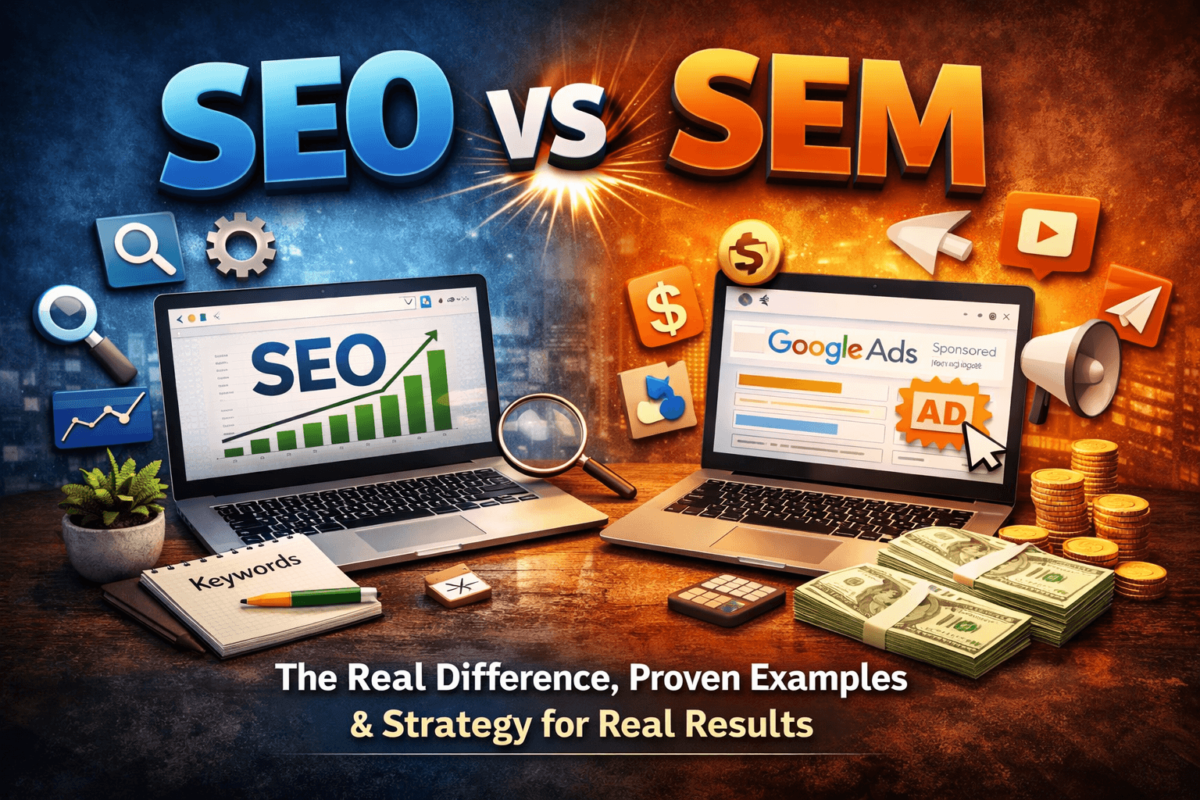
SEO (Search Engine Optimization) is how you earn free, organic traffic from Google over time — think of it as planting seeds. SEM (Search Engine Marketing) is how you buy traffic instantly through paid ads — think of it as renting a billboard. The bottom line? Use SEM when you need results now, and build SEO when you want traffic that lasts.
Quick Summary (The TL;DR Version)
Short on time? Here’s everything you need to know in one quick scan:
The real power move in 2026? Use both together strategically. SEO builds your foundation. SEM fuels your growth while you wait.
What Is SEO? (And Why Everyone Talks About It)
Let’s be honest — ‘SEO’ gets thrown around a lot, and it can sound more complicated than it really is.
SEO stands for Search Engine Optimization. In plain English, it means making your website or content good enough that Google (or Bing, or any search engine) decides to show it to people when they search for something relevant.
Here’s the deal: Google has one job — give users the most helpful, relevant results possible. SEO is your job of convincing Google that your content deserves a top spot.
The Three Pillars of SEO
Think of SEO as a three-legged stool. Remove any leg and the whole thing tips over.
On-Page SEO
What’s on your actual pages: keywords, headings, content quality, images, internal links. This is the stuff you can control directly.
Off-Page SEO
What happens outside your site, mainly backlinks. When other reputable sites link to yours, Google sees it as a vote of confidence.
Technical SEO
The behind-the-scenes stuff: site speed, mobile-friendliness, crawlability, structured data. Think of it as the foundation your house is built on.
A Real-World SEO Example
Sarah’s Bakery in Austin, Texas
Meet Sarah. She runs a local bakery in Austin, Texas. She writes a blog post titled ‘Best Gluten-Free Birthday Cakes in Austin’ and optimizes it properly — good keyword targeting, fast page load, a few backlinks from local food bloggers.
Four months later, she’s ranking on page one for that search and getting 300 free visitors a month. No ad spend. Zero.
That’s SEO doing its thing. It took time, but now it runs on autopilot.
SEO is powerful — but it’s not magic. It requires consistency, patience, and a solid understanding of what your audience actually searches for.
What Is SEM? (Paid Search, Explained Simply)
SEM stands for Search Engine Marketing. While SEO earns traffic for free (organically), SEM means paying to show up at the top of search results — almost instantly.
The most common form of SEM is Google Ads (formerly Google AdWords), where you bid on keywords and pay each time someone clicks your ad. That’s why you’ll hear the term PPC — Pay-Per-Click.
So what actually matters with SEM? Three things: the right keywords, a compelling ad, and a landing page that converts.
How SEM Bidding Works
You sell handmade leather wallets. You set up a Google Ad targeting the keyword ‘handmade leather wallet for men.’ You bid $1.20 per click. If 500 people click your ad this month, you pay $600. If 20 of those buy a $65 wallet, you made $1,300. That’s a solid return on ad spend (ROAS).
But here’s the catch — the moment you stop running that ad, the traffic disappears. Unlike SEO, there’s no compounding effect. You pay to play, every single time.
A Real-World SEM Example
Jake’s HVAC Company in Phoenix
Jake owns an HVAC company in Phoenix. It’s June. Temperature is hitting 110°F and people’s ACs are breaking down left and right. He can’t wait six months for SEO to kick in — he needs jobs NOW.
So he runs a Google Ad for ’emergency AC repair Phoenix.’ Within 24 hours, his phone is ringing. He’s paying $8 per click, but each new customer is worth $400+. The math works.
SEM is speed. It’s the fast lane. It just costs money to stay in it.
If you’re tracking ROI on your ad campaigns — and you absolutely should be — tools like Google Analytics (free) or platforms like SEMrush and SpyFu can help you see which keywords and ads are actually converting, so you’re not burning budget blindly.
SEO vs SEM — What’s the Real Difference?
Here’s the honest version nobody tells you:
SEO is free in dollars but expensive in time. SEM is expensive in dollars but free in time. Neither is truly ‘free.’
Think about it this way: if you have more time than money (hello, early-stage startup or solo blogger), SEO is your best path. If you have more money than time (established business, product launch, seasonal promotion), SEM makes a lot of sense.
The Frustration with SEO
You write a killer blog post, do everything right, and then… wait. And wait some more. It can take 3 to 6 months to see real movement. That’s genuinely tough when you have bills to pay.
The Relief with SEO
Once you rank, you rank. A blog post written two years ago can still drive traffic today. That’s the compounding magic of organic search.
The Frustration with SEM
It can get expensive fast if you don’t know what you’re doing. Bid too high, target the wrong keywords, or send people to a weak landing page — and you can burn through a budget with nothing to show for it.
The Relief with SEM
You hit ‘Go’ on your campaign and traffic shows up the same day. Seriously — same day. That kind of speed is invaluable when you’re launching a product or running a time-sensitive promotion.
So which one is better? Neither — and both. The question is really: what does your situation actually call for right now?
SEO vs SEM Comparison Table
Here’s a side-by-side breakdown to make this crystal clear:
| Feature | SEO | SEM |
|---|---|---|
| Cost | Free (time investment) | Paid per click / impression |
| Time to Results | 3–6+ months | Immediate (same day) |
| Traffic Type | Organic (unpaid) | Paid (ads) |
| Long-term Value | Very high — compounds over time | Stops when budget runs out |
| Skill Required | Content, tech SEO, link building | Ad copywriting, bidding, analytics |
| Best For | Long-term brand building | Quick wins, promotions, testing |
| Beginner Friendly? | Yes, with patience | Requires budget + learning curve |
| ROI Timeline | Slow but lasting | Fast but ongoing cost |
Real-Life Examples: SEO vs SEM in Action
Theory is nice, but let’s talk about real scenarios — the kind you might actually be living right now.
The Local Plumber
The problem: Mike’s plumbing business in Columbus, Ohio gets most of his work from referrals, but he wants more consistent leads.
The action: He runs Google Ads targeting ’emergency plumber Columbus’ for quick wins, while simultaneously publishing helpful blog posts like ‘Why Your Toilet Keeps Running’ to build organic traffic.
The result: Within a week, his SEM campaign brings in 4 new jobs. Six months later, his blog starts ranking and he cuts his ad spend by 40% because organic traffic is picking up the slack.
The combination is the move. SEM buys him time while SEO builds momentum.
The E-Commerce Store
The problem: Lisa sells handmade candles on her Shopify store. She launched two months ago and has zero traffic.
The action: She runs targeted Google Shopping ads on her best-selling candles while optimizing product pages for long-tail SEO keywords like ‘lavender soy candles gift set.’
The result: Ads drive immediate sales. Three months later, her product pages start ranking organically and she’s getting sales from both channels. Her cost-per-acquisition drops significantly.
The Affiliate Blogger
The problem: David writes product reviews and earns affiliate commissions, but he’s starting from scratch and can’t afford to wait a year for Google to notice him.
The action: He focuses almost entirely on SEO — publishing in-depth, genuinely helpful reviews targeting low-competition keywords. He also uses a tool like Ahrefs or Ubersuggest to find keyword gaps competitors aren’t covering well.
The result: After 8 months, he has 15 posts ranking on page one, driving 4,000 organic visitors per month and earning $2,200/month in affiliate commissions — completely passively. No ad spend needed.
For affiliate bloggers, SEO is usually the primary play. Tools like Ahrefs or its alternatives help you find the keyword opportunities that make the difference between ranking and disappearing.
The Startup That Needed Traffic Yesterday
The problem: A SaaS startup just launched a project management tool and needs to validate their market fast. They have runway for 6 months.
The action: They run aggressive SEM campaigns targeting competitor keywords and high-intent search terms like ‘best project management tool for remote teams.’
The result: Within 30 days, they have data on which messages convert, which audiences are most engaged, and what features users care about. They use that data to refine their product AND their long-term SEO content strategy.
SEM as a market research tool. Underrated.
When Should You Use SEO vs SEM?
So which one should you actually pick? Here’s an honest breakdown:
✅ Use SEO If…
- You’re playing the long game and building a brand for years, not months
- You’re a blogger, creator, or affiliate marketer where paid traffic doesn’t pencil out
- You want compounding returns — traffic that grows even when you’re not actively working
- You have more time than budget right now
- Your niche has manageable competition and you can realistically rank
- You’re building content assets that will hold value for years
🚀 Use SEM If…
- You need traffic or sales NOW — not in 6 months
- You’re launching a product and need to validate demand fast
- You have seasonal promotions, events, or limited-time offers
- You have a higher average order value where CPC is worth it
- You’re targeting highly specific, high-intent buyers
- You want to test messaging or audiences before committing to long-form SEO content
⚡ Use Both If…
- You’re a growing business with some budget and a long-term vision
- You want to dominate both paid and organic search results
- You’re using SEM data to inform your SEO keyword strategy — smart move
- You want fast wins now while building durable traffic for the future
How to Combine SEO + SEM for Maximum Results
Here’s the strategy smart marketers use in 2026 — using SEM speed and SEO staying power together. This isn’t theory; it’s a proven playbook.
Start with SEM for Quick Wins
Launch a focused Google Ads campaign targeting your highest-intent keywords. Keep your budget tight at first — $10 to $20 per day is enough to get real data. Your goal isn’t to make money yet. Your goal is to learn.
Mine Your SEM Data for Gold
After 4 to 6 weeks of running ads, dive into your Google Ads search terms report. Look at which keywords are actually converting — not just getting clicks, but leading to real actions like purchases, sign-ups, or calls. These are your money keywords.
Build SEO Content Around Your Winners
Take those high-converting keywords and build long-form SEO content around them. Blog posts, landing pages, comparison guides, how-to articles — whatever format matches the search intent. This is where tools like Semrush, Ubersuggest, or even the free Google Search Console become invaluable.
Gradually Reduce Ad Spend on Ranking Keywords
As your SEO content starts climbing the rankings — typically 3 to 6 months in — you can start dialing back your ad spend on those specific keywords. Why pay $3 per click when you’re already getting free organic traffic for the same search? Reallocate that budget to new keywords or new audiences.
Scale Organically and Maintain SEM for High-Value Terms
Keep your SEM running for high-value, competitive terms where the ROI justifies the cost. Let SEO own the long-tail and informational keywords. Over time, you’ll find your cost-per-acquisition dropping steadily while your organic traffic grows. That’s the goal.
💡 Pro tip: Use Google Search Console (free) regularly to track which organic queries are bringing traffic. If you see unexpected keywords sending visitors your way, those might be great targets for new content or ad campaigns.
Wait — Is SEO Really Free?
Great question, and one worth addressing directly.
Technically, organic traffic is free. Google doesn’t charge you when someone clicks on your organic result. But SEO itself? Not exactly free. Here’s what SEO actually costs you:
So is SEO cheaper than SEM? Often, yes — especially long-term. But ‘free’ is a bit of a myth. Call it a lower ongoing cost once the foundation is built, and the ROI tends to improve dramatically over time.
Common Mistakes People Make Choosing Between SEO and SEM
Let’s save you some headaches. Here are the biggest mistakes marketers and business owners make when it comes to SEO vs SEM:
❌ Mistake #1: Going All-In on SEM Without Any SEO Foundation
Running ads with zero organic presence means you’re completely dependent on a paid channel. The moment your budget dries up or ad costs spike, your traffic disappears. Build your SEO base, even if it’s just the basics.
❌ Mistake #2: Waiting for SEO to Deliver Before Starting SEM
Some businesses avoid paid ads entirely, convinced that SEO will eventually cover everything. But if you’re in a competitive market and you need revenue to survive the next 6 months, waiting for organic results can be fatal. Use SEM to bridge the gap.
❌ Mistake #3: Not Tracking Conversions
Running SEM without conversion tracking is like driving blindfolded. You need to know which keywords, ads, and landing pages are actually producing customers — not just clicks. Set up Google Ads conversion tracking before you spend a single dollar.
❌ Mistake #4: Targeting Broad Keywords with SEM
Bidding on ‘shoes’ instead of ‘women’s running shoes size 8 wide’ will drain your budget fast. SEM works best with specific, high-intent keywords where the searcher knows what they want and is ready to act.
❌ Mistake #5: Producing Thin SEO Content
Churning out 300-word blog posts stuffed with keywords might have worked in 2015. In 2026, Google rewards depth, expertise, and genuine usefulness. If your content doesn’t actually help someone, don’t expect it to rank.
Quick Guide to SEO and SEM Tools Worth Knowing
You don’t need to spend a fortune on tools, especially when starting out. Here’s a practical breakdown:
Free Tools That Are Actually Useful
See how your site performs in Google Search. Which queries bring traffic, which pages are indexed, any errors. Essential.
Understand your audience, traffic sources, and what users do on your site.
Basic keyword research, especially useful if you’re already running Google Ads.
Good for beginners doing keyword research without a budget for paid tools.
Paid Tools Worth the Investment (When Ready)
The gold standard for backlink analysis, keyword research, and competitor spying. Pricey but powerful.
An all-in-one platform covering SEO, SEM, social, and content. Great for agencies or businesses managing multiple channels.
Budget-friendly alternative with solid keyword research and SERP analysis.
Especially useful for SEM: see what keywords competitors are bidding on and what their ads look like.
When you’re scaling your SEM campaigns, tracking your ROI carefully becomes critical. Platforms like Google Ads have built-in reporting, but pairing them with dedicated analytics helps you see the full picture — especially if you’re running multiple traffic sources simultaneously.
Frequently Asked Questions
Neither is universally better — it depends on your goals and timeline. SEO delivers long-term, compounding traffic that doesn’t cost money per click. SEM delivers immediate, controllable traffic that requires ongoing budget. Most successful businesses use both. If forced to choose one, SEO offers better long-term ROI; SEM wins for speed and precision.
Absolutely. Millions of successful websites and blogs run entirely on organic traffic. It’s slower, but it’s sustainable and cost-effective long-term. Many bloggers, content creators, and small businesses rely solely on SEO and do extremely well. You don’t need SEM to succeed — you just need patience and consistency.
It varies wildly depending on your industry, keywords, and competition. Simple local service ads might cost $1 to $3 per click. Competitive industries like insurance, legal services, or finance can run $20 to $50+ per click. You can start a Google Ads campaign with as little as $5 to $10 per day, but you’ll need enough budget to gather meaningful data — typically at least $300 to $500/month to test properly.
Realistically? You’re looking at 3 to 6 months to see meaningful results in most niches, sometimes longer in competitive markets. New websites take longer because they have no domain authority yet. Established sites with existing traffic can rank new content faster. The frustrating truth: SEO is a long game. The rewarding truth: the results compound and can last for years.
If you have a budget (even $200 to $500/month), starting with a small SEM test campaign while building your SEO foundation is smart — it gets you quick feedback and traffic while your organic presence grows. If your budget is near zero, focus on SEO: start a blog, target low-competition keywords, learn the fundamentals. It’s slower, but it’s the most accessible path for beginners.
No — Google has confirmed that running paid ads has zero direct impact on organic rankings. They are completely separate systems. However, SEM can indirectly help by driving traffic that increases brand awareness, which might lead to more branded searches and backlinks over time. But the effect is indirect and not guaranteed.
For local businesses, both channels have specific tactics. Local SEO includes optimizing your Google Business Profile, getting local citations, and earning local backlinks. Local SEM means running geographically targeted Google Ads to reach nearby customers. Local service businesses often see the fastest ROI from SEM because the intent is extremely high — someone searching ‘plumber near me’ right now needs a plumber right now.
So What Should You Actually Do?
Here’s the simplest possible takeaway after all of this:
If you want fast traffic, go SEM. If you want lasting traffic, build SEO. If you want both — which is the smart play — use them together.
SEO is the long game. It’s planting an orchard — takes time to grow, but eventually it feeds you indefinitely. SEM is the short game. It’s buying fruit at the store — quick and reliable, but costs money every trip.
The businesses that win long-term aren’t choosing one over the other. They’re using SEM data to fuel their SEO strategy. They’re using SEO to reduce their dependence on paid traffic over time. They’re treating digital marketing as a system, not a single tactic.
Start where you are. If budget allows, test SEM quickly to get data and revenue. Use that data to build SEO content that keeps working long after you stop paying for ads. Reinvest the organic wins back into testing new paid channels.
And remember — neither SEO nor SEM is a silver bullet. They’re tools. The skill is knowing when and how to use each one.
If you’re just starting out and feeling overwhelmed — take a breath. Start with the basics: set up Google Search Console, write genuinely helpful content, and maybe run a small $10/day Google Ads test on your best keyword. Learn as you go. Everyone who’s good at this was once a complete beginner.
Want Us to Handle Your SEO & SEM Strategy?
TechCognate’s team of SEO experts can build a custom strategy that combines both channels for maximum results. Let’s talk.
Get a Free Strategy Call →