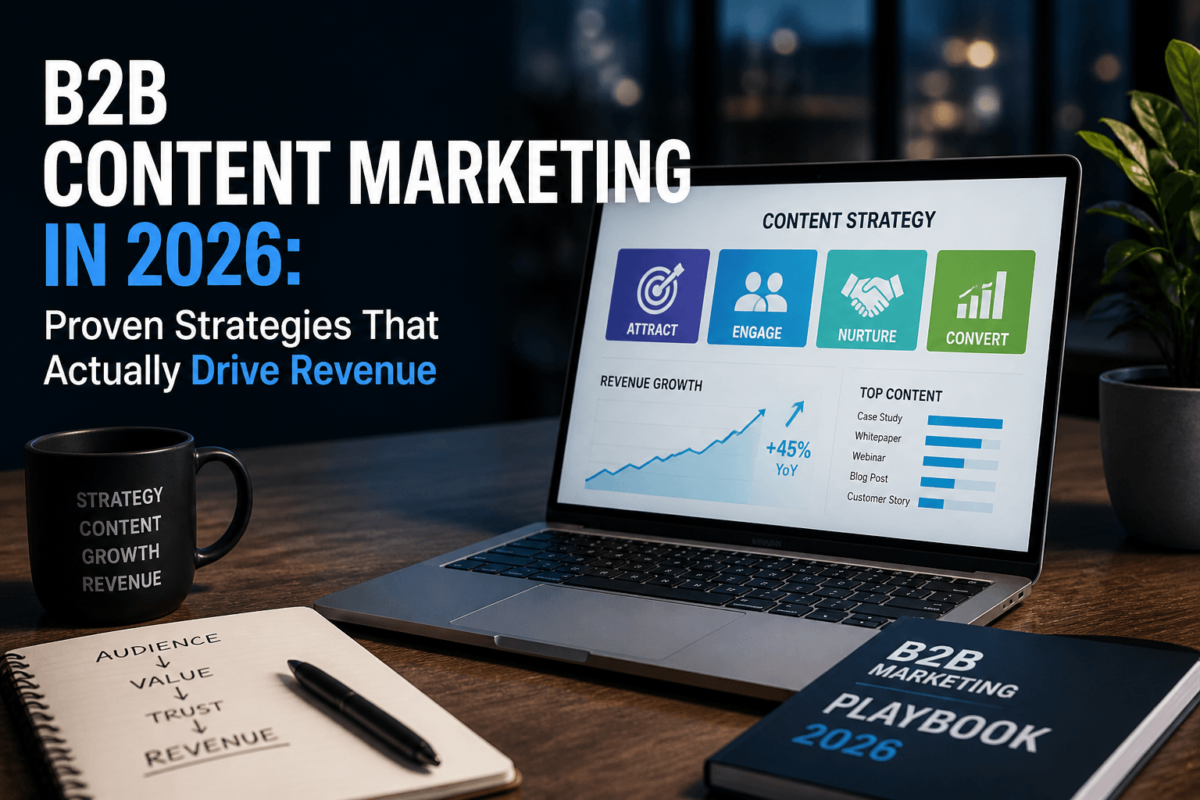
B2B Content Marketing in 2026: Proven Strategies That Actually Drive Revenue (No Fluff)
The real playbook for getting leads, building trust, and growing — not just filling a blog.
B2B content marketing is the practice of creating and distributing valuable, relevant content to attract, educate, and convert business buyers — not just fill a blog. In 2026, it’s one of the highest-ROI channels available: brands that do it right generate consistent inbound leads, shorten sales cycles, and build the kind of trust that paid ads simply can’t buy. Done properly, B2B content doesn’t just drive traffic — it drives revenue.
✅ Quick Summary
- What it is: B2B content marketing = creating content that educates and converts business buyers across their entire journey
- Why it matters: Builds trust, drives organic leads, and shortens sales cycles without increasing ad spend
- Key strategies: Intent-driven content, thought leadership, content repurposing, SEO + AEO, and multi-channel distribution
- Common mistakes: Publishing generic content with no distribution plan and no buyer journey alignment
- Best channels: Long-form blog posts, LinkedIn, email newsletters, case studies, webinars, and YouTube
- Expected results: 3–12 months to see compounding organic results; long-term ROI far exceeds paid channels
📋 On This Page
What Is B2B Content Marketing? (Simple Explanation)
Let’s cut through the noise. B2B content marketing is simply the practice of creating useful content — articles, videos, case studies, emails, LinkedIn posts — that helps business buyers make smarter decisions. And in doing so, it makes your brand the obvious choice.
Think of it this way: imagine you’re a CFO looking for a new expense management platform. You’re not going to buy from the first Google ad you see. You’re going to research, compare, read reviews, and maybe read a few guides. The brand that shows up with genuinely helpful content at each of those stages? That’s who gets the demo — and eventually, the deal.
That’s B2B content marketing in action.
It’s different from B2C because the buyer journey is longer, there are usually multiple decision-makers involved, and the stakes are higher. You’re not convincing someone to buy a $30 T-shirt — you’re helping a team justify a $50,000 software investment.
In 2026, the best B2B content doesn’t just rank on Google. It also shows up when buyers ask ChatGPT, Perplexity, or Google’s AI Overview for recommendations. That’s why this guide covers SEO, AEO (Answer Engine Optimization), and GEO (Generative Engine Optimization) together — because they’re all part of the same game now.
Why Most B2B Content Fails (And How to Fix It)
Here’s the thing — most B2B brands publish a lot of content and get very little in return. If that sounds familiar, you’re not alone. In my experience, content failure usually comes down to the same handful of mistakes, and none of them are particularly complicated to fix once you know what to look for.
Too Generic, Too Safe
Most B2B content sounds like it was written by a committee of people who were terrified of saying anything remotely controversial. “Content marketing is important.” “SEO can help your business grow.” Thanks, Captain Obvious. Generic content doesn’t rank, doesn’t engage, and definitely doesn’t convert. You need a point of view.
No Distribution Strategy
Publishing a blog post and waiting for traffic is like setting up a booth in the middle of a forest and expecting customers. The publish-and-pray approach doesn’t work. Most great B2B content dies in obscurity because no one thought about how it would actually reach the target audience after it was live.
No Buyer Journey Alignment
This one kills pipeline. Most brands produce awareness-level content (“What is X?”) and then wonder why they’re not getting leads. Without bottom-of-funnel content — comparison pages, ROI calculators, case studies, implementation guides — you’re educating your buyers and then sending them to a competitor who does have that content.
Ignoring Intent-Based Content
A buyer searching “Salesforce vs HubSpot for mid-market SaaS” is 80% of the way to a buying decision. Are you showing up there? Most brands aren’t. They optimize for vanity traffic terms and miss the high-intent keywords that actually drive demos and signups.
No Real Expertise or Point of View
With AI-generated content flooding the internet, generic information is now essentially worthless. What actually works in 2026 is original research, first-hand experience, and genuine opinions. If your content sounds like it could have been written by anyone, it won’t rank — and even if it does, it won’t convert.
Proven B2B Content Marketing Strategies for 2026
Intent-Driven Bottom-Funnel Content
Thought Leadership Backed by Real Data
Content Repurposing Engine
SEO + AEO + GEO Combined
Multi-Channel Distribution
Content + Sales Alignment
Personal Branding on LinkedIn
Data-Backed Content
Best Content Types for B2B (With Real Examples)
Blog Posts & Long-Form Guides
Still the backbone of B2B content. Long-form guides (2,000–5,000 words) consistently outperform short posts for rankings and time-on-page. Depth and original perspective beat word count.
Case Studies
Your most powerful bottom-funnel asset. A case study showing a specific result — “How Company X Reduced Churn by 34% in 90 Days” — converts far better than any “why choose us” page.
Whitepapers & Research Reports
High-value gated content that positions your brand as an industry authority. Best for lead generation when the topic justifies the gate. Ungated whitepapers also work well for SEO in 2026.
LinkedIn Content
The highest-leverage organic channel for B2B in 2026. Short-form text posts, carousels, and video clips work best. Personal profiles consistently outperform brand pages.
Email Newsletters
Owned media at its best. A newsletter that delivers genuine value week after week builds an audience no algorithm can take away — keeping warm leads engaged during long 3–12 month sales cycles.
Webinars & Live Events
High-trust, high-engagement format. A well-run 45-minute webinar with genuine credibility can generate dozens of qualified pipeline opportunities on a specific, targeted topic.
Video Content (YouTube + LinkedIn)
Growing fast in B2B. Buyers watch YouTube tutorials and thought leadership videos as part of their research. Even lo-fi smartphone videos build trust faster than polished brand content.
Comparison Pages
The intersection of high-converting content and monetization. “Best [Tool Category],” “[Brand A] vs [Brand B],” and “Top Alternatives to [Competitor]” pages convert at the highest rates in B2B.
5. The Affiliate Marketing Angle Most B2B Brands Completely Miss
Most B2B content marketing guides don’t mention this at all — which is a massive missed opportunity. If you’re already creating comparison posts, tool roundups, and resource pages, you’re leaving money on the table if you’re not monetizing them with affiliate links.
Here’s how it works: you recommend software, tools, or platforms your audience genuinely needs. If they sign up or purchase through your link, you earn a commission. The best part? It’s passive — the content earns while you sleep.
Best Affiliate Content Types for B2B
- “Best [Tool Category] for [Audience]” — e.g., Best CRM Tools for Real Estate Agencies in 2026
- “[Brand A] vs [Brand B]” — e.g., HubSpot vs Salesforce: Which CRM Is Right for Your Team?
- “Top [Category] Software” roundups with affiliate links to each tool
- “[Tool] Alternatives” — e.g., Best Alternatives to Zoom for Enterprise Video Conferencing
- “[Tool] Review” — honest, in-depth reviews with pros, cons, and use-case fit
Practical Tips for B2B Affiliate Content
- Always disclose affiliate relationships — it builds trust, not undermines it
- Only recommend tools you’d genuinely use or have used. Fake recommendations destroy credibility fast
- Use structured comparison tables — they’re scannable, rank well, and make it easy for readers to decide
- Check affiliate programs on platforms like Impact.com, ShareASale, PartnerStack, and CJ Affiliate
- Target high-ticket B2B SaaS tools — commissions of $50–$500+ per referral are common
Done right, affiliate-monetized comparison content can generate five figures a month in passive revenue while simultaneously building brand authority. It’s one of the most underutilized strategies in B2B content marketing.
Traditional vs Modern B2B Content Marketing: What’s Changed
Here’s a side-by-side look at how the approach has evolved — and what the 2026 strategy actually looks like in practice.
| Approach | Old Way | 2026 Strategy | Impact |
|---|---|---|---|
| Goal | Drive traffic | Drive revenue & pipeline | Higher ROI |
| Content Focus | Generic blog posts | Intent-driven, buyer-aligned content | Better conversions |
| SEO | Keyword stuffing | Topical authority + AEO/GEO | Rank + AI citation |
| Distribution | Publish & pray | Multi-channel amplification | 3x more reach |
| Sales Alignment | Content sits in a silo | Sales-enabled content at every stage | Shorter sales cycles |
| Measurement | Page views & traffic | Pipeline influence & MQL volume | Prove content ROI |
| Thought Leadership | Rarely prioritized | Founder-led, data-backed insights | Trust & inbound leads |
| Affiliate / Monetization | Ignored or accidental | Strategic comparison & tool posts | Passive revenue |
How to Build a B2B Content Marketing Strategy (Step-by-Step)
Strategy without execution is just a document. Here’s the practical, step-by-step process for actually building something that works.
Define Your Ideal Customer Profile (ICP)
You can’t write content for “everyone.” The more specific your ICP, the more useful your content. Define: company size, industry, job title, pain points, goals, objections, and how they consume content.
Map the Buyer Journey
Different content for different stages. Awareness-stage buyers need education. Consideration-stage buyers need comparison and validation. Decision-stage buyers need case studies, ROI proof, and implementation reassurance.
Keyword + Intent Research
Use tools like Ahrefs, Semrush, or even Google Search Console to find the keywords your ICP is actually searching. Prioritize intent over volume — a keyword with 200 searches/month and clear buying intent beats one with 20,000 searches and no conversion potential.
Build a Content Cluster Plan
Topical authority beats individual keyword rankings. Build “clusters” — one pillar page covers a broad topic comprehensively, and multiple supporting articles dive deep into specific subtopics. This structure signals expertise to both Google and AI tools.
Create Human-First Content
In 2026, the bar for content quality is high. Generic AI-generated content gets filtered out by search engines and ignored by buyers. Human-first means: original insights, real examples, clear opinions, and a writing style that sounds like an actual person — not a corporate brochure.
Build a Distribution Strategy
For every piece of content, plan the distribution before you hit publish. This means: LinkedIn post on personal account, email newsletter mention, internal Slack share to get early engagement, outreach to 2–3 people who might share it, and repurposing into a carousel or short video.
Optimize for Conversion
Traffic without conversion is vanity. Add clear CTAs to every piece of content — but match the CTA to the buyer stage. A top-funnel blog post might CTA to a related guide; a comparison page should CTA directly to a demo or free trial.
Track Performance and Iterate
Measure what matters: MQLs influenced by content, demo requests from organic, pipeline attributed to content, and keyword ranking progress. Don’t obsess over page views — they don’t pay salaries.
Real-Life B2B Content Marketing Examples That Actually Worked
SaaS Company Builds a Lead Engine With Bottom-Funnel SEO
Imagine a mid-sized SaaS company in the HR tech space — let’s call them TeamPulse. They had a decent blog full of awareness-level content (“What is Employee Engagement?”) but almost zero leads from it.
Their content team shifted strategy. They mapped every competitor name and use case, then built a cluster of comparison and alternative pages: “TeamPulse vs Lattice,” “Best Employee Engagement Software for Remote Teams,” and “Top Leapsome Alternatives.”
Within 6 months, those pages drove 40% of all inbound demo requests. The pages ranked for high-intent queries, matched buyer language, and converted at 4x the rate of their top-funnel content. The entire project took one content strategist and a decent writer. The cost was minimal. The pipeline impact was significant.
Founder Goes All-In on LinkedIn Personal Branding
A B2B agency founder — let’s say she runs a paid media consultancy — decides to post on LinkedIn 4x per week for six months. Not polished corporate content. Real stuff: wins, failures, client lessons, hot takes on industry trends, and behind-the-scenes of running the business.
By month three, her posts are regularly getting 10,000–30,000 impressions. Inbound DMs start coming in weekly. By month six, the agency has more qualified leads than it can handle — from LinkedIn alone. No paid ads. No SEO. Just consistent, authentic personal content that built trust at scale.
Content-Led Affiliate Revenue Stream
A B2B tech blogger focused on SaaS tools for small businesses builds a content hub of comparison pages: “Best Accounting Software,” “QuickBooks vs FreshBooks vs Wave,” “Top Invoicing Tools for Freelancers.”
Each page is genuinely thorough — 2,000+ words, original testing, honest pros and cons. Within 12 months, the pages rank on page one for dozens of high-intent keywords. Affiliate commissions from Xero, FreshBooks, and other platforms generate $8,000–$12,000 per month in passive revenue. The content that drives it was written once and earns indefinitely.
Frequently Asked Questions
What is B2B content marketing in simple terms?
B2B content marketing means creating helpful, relevant content — articles, videos, emails, case studies — that attracts and educates business buyers. Instead of interrupting potential customers with ads, you give them something genuinely useful, which builds trust and positions your brand as the go-to solution when they’re ready to buy.
How long does B2B content marketing take to work?
Realistically? Expect 3–6 months before you see meaningful organic traffic, and 6–12 months to see significant lead generation impact. That timeline assumes consistent publishing (at least 2–4 quality pieces per month) and an active distribution strategy. Bottom-funnel content often produces results faster — some comparison pages generate leads within 30–60 days of ranking.
What type of content works best for B2B?
It depends on the buyer stage, but the highest-performing content types in 2026 are: bottom-funnel comparison and alternative pages (for conversions), long-form SEO guides (for organic traffic), case studies (for trust and sales enablement), LinkedIn personal content (for reach and relationship-building), and email newsletters (for retention and pipeline nurturing).
Is SEO still important for B2B content marketing in 2026?
Absolutely — but SEO in 2026 isn’t just about Google rankings anymore. You also need to optimize for AI-generated answers (AEO) and AI tool citations (GEO). That means structured content with clear definitions, FAQ sections, and quotable summaries. Brands that adapt their SEO strategy to include all three will have a significant advantage over those still optimizing for Google alone.
How do you measure B2B content marketing success?
The metrics that actually matter: Marketing Qualified Leads (MQLs) from organic, demo or trial requests attributed to content, pipeline influenced by content, keyword ranking progress for target terms, and email newsletter growth. Vanity metrics like total page views are less important unless you can connect them to actual revenue or lead generation outcomes.
Can B2B content marketing generate passive income?
Yes — and it’s one of the most overlooked opportunities in the space. By building comparison pages, tool roundup posts, and honest software reviews, B2B content creators can earn significant affiliate commissions from SaaS companies, platforms, and tools they recommend. The content is written once and earns passively. The key is ranking for high-intent keywords and joining the right affiliate programs (PartnerStack, Impact.com, ShareASale, CJ Affiliate).
Final Thoughts: Keep It Real, Keep It Useful
B2B content marketing isn’t magic, and it isn’t complicated. But it does require consistency, genuine expertise, and a willingness to create content that’s actually useful — not just content that fills space on a blog.
The brands winning with content in 2026 are the ones creating real insights, showing up across multiple channels, aligning with their sales teams, and optimizing for how modern buyers actually research — including AI tools. They’re also the ones smart enough to monetize that content with affiliate opportunities along the way.
The brands struggling? Still publishing generic “Top 10 Marketing Tips” posts with no distribution plan and no point of view. Don’t be that brand.
Start with one strategy. Build it properly. Distribute it aggressively. Measure what matters. Then add the next strategy. You don’t need to do everything at once — you just need to start, stay consistent, and focus on content that actually helps your audience. Not content that just fills space.