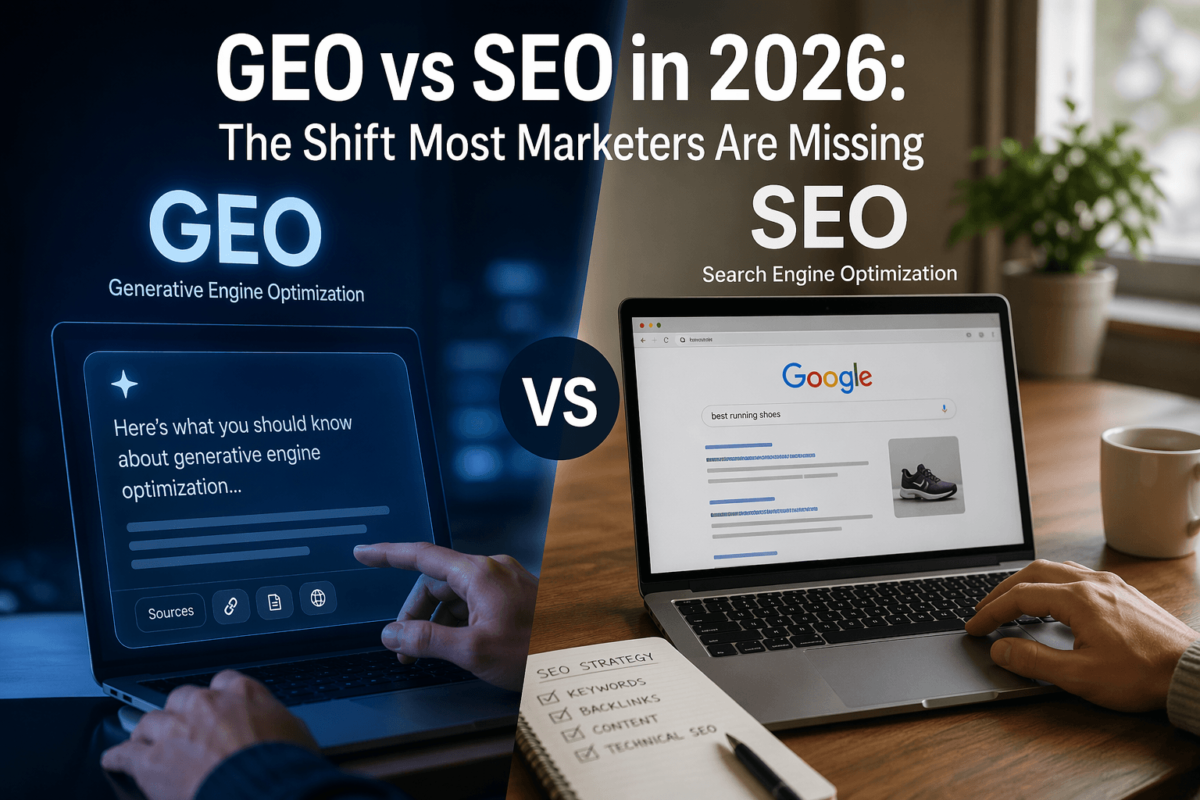
SEO (Search Engine Optimization) is about ranking on Google. GEO (Generative Engine Optimization) is about getting your content cited inside AI-generated answers on tools like ChatGPT, Perplexity, and Google’s AI Overviews. In 2026, doing only SEO isn’t enough. AI-powered search is eating into traditional click-through traffic fast, and brands that ignore GEO are quietly losing visibility — even when they rank on page one. The good news? A lot of what makes great SEO content also supports GEO. You just need to structure it smarter.
- SEO = ranking on traditional search engines (Google, Bing) through keywords, backlinks, and technical optimization
- GEO = getting your content cited or quoted inside AI-generated answers (ChatGPT, Google SGE, Perplexity, Gemini)
- AI-powered search now influences 40%+ of search sessions in the US (2026 estimates)
- GEO focuses on structured answers, authority signals, and content clarity
- Both SEO and GEO matter in 2026 — they’re complementary, not competing
- Affiliate marketers especially benefit from GEO-optimized “answer-style” content
- Practical steps: structure content for AI extraction, use schema, write clear definitions, build topical authority
What Is SEO? (And Why It Still Matters)
Let me be upfront about something: SEO isn’t dead. Not even close. But it is changing in ways most people aren’t paying attention to.
SEO — Search Engine Optimization — has been the backbone of digital marketing for over two decades. At its core, it’s the process of optimizing your website and content so that search engines like Google rank you higher in their results pages (SERPs).
Here’s the thing though. When most people think about SEO, they picture keyword stuffing blog posts and building shady backlinks. That version of SEO? Yeah, that’s dead. Modern SEO in 2026 is a whole different beast.
The Core Pillars of Modern SEO
Traditional SEO breaks down into four main areas:
- On-Page SEO Optimizing your content, title tags, meta descriptions, headers, and internal links. It’s the stuff you can control directly on your pages.
- Technical SEO Page speed, Core Web Vitals, mobile-friendliness, crawlability, structured data/schema markup, HTTPS. Google needs to be able to find, read, and rank your content.
- Off-Page SEO Backlinks from authoritative sites, brand mentions, social signals. This is how Google measures your reputation and authority.
- Content SEO Writing high-quality, search-intent-matched content that answers what users are actually looking for. This is where most of the battle is won or lost.
How Google’s Algorithm Has Evolved
One mistake I made early on was treating SEO like it was a static game. “Rank for keyword, get traffic. Done.” Spoiler: that stopped working around 2015.
By 2026, Google’s ranking system incorporates deep learning models (Google has said as much), E-E-A-T signals (Experience, Expertise, Authoritativeness, Trustworthiness), user behavior signals, and a growing AI-generated summary layer called AI Overviews (formerly SGE).
That last point is where GEO comes in. But before we get there, let’s be clear: SEO still drives billions of clicks per day. Google processes over 8.5 billion searches daily. A huge chunk of those still result in organic clicks to websites. Ignoring SEO would be business suicide.
- High-quality, helpful content — Google’s Helpful Content updates have doubled down on this. Thin, generic content is getting crushed.
- Search intent matching — Writing content that actually answers what the user wants, not just what they typed.
- Topical authority — Covering a subject deeply across multiple pages. One good article isn’t enough anymore.
- Technical foundations — Site speed, Core Web Vitals, mobile-first indexing. See our Technical SEO Checklist for the full breakdown.
- Internal linking — Connecting related content on your site signals topical depth to Google.
- Core Web Vitals — Google uses these as a ranking factor. See our Core Web Vitals Guide for exactly what to fix.
- Keyword stuffing — Google’s algorithms see right through it
- Thin, 300-word blog posts — They’re invisible now
- Low-quality backlink schemes — More harm than help
- Ignoring user experience — Bounce rates and engagement signals matter
SEO is not dead. But it’s no longer enough on its own. In 2026, SEO is your foundation — the table stakes. Everything else builds on top of it.
What Is GEO? (Generative Engine Optimization Explained)
GEO is probably the term you’ve been hearing more and more in 2025–2026 marketing circles, and honestly, a lot of people are still confused about what it actually means. Let me break this down in plain English.
Generative Engine Optimization (GEO) is the practice of optimizing your content so that AI-powered search engines and generative AI tools include, quote, or cite your content in their AI-generated responses.
So what does that actually mean for you? Here’s the situation: when someone asks ChatGPT “What’s the best CRM for small businesses?” or searches Google and gets an AI Overview at the top of the results — the AI had to pull that answer from somewhere. GEO is about making your content one of those sources.
Which Platforms Does GEO Apply To?
- Google AI Overviews (formerly SGE) The AI-generated summary boxes that now appear at the top of many Google searches
- ChatGPT and ChatGPT Search OpenAI’s AI chatbot now has live web browsing and cites sources
- Perplexity AI Probably the most GEO-friendly platform right now; it heavily cites sources and shows where its answers come from
- Google Gemini Google’s AI assistant, deeply integrated into Search
- Microsoft Copilot Built into Bing search and Microsoft 365 tools
- Claude by Anthropic Used via API by thousands of apps and services
Most people get this wrong: they think GEO is just “writing for ChatGPT.” It’s actually about writing content that any AI model can extract, understand, and cite when generating answers. The platform doesn’t matter as much as the principles.
Why GEO Matters More Than Ever in 2026
Here’s some context that should make this very real for you. According to multiple industry studies and search trend analyses entering 2026:
- AI Overviews now appear for an estimated 40–50% of informational queries on Google
- ChatGPT Search (launched late 2024) had over 100 million weekly users within months
- Perplexity reached over 15 million daily active users — mostly educated, high-intent users
- Click-through rates from Google have been dropping year-over-year as zero-click searches increase
If you’re creating content — for your business, your blog, your clients — and you’re not thinking about GEO, you’re already falling behind. The brands and creators who understand this now are going to have a significant head start.
GEO is not about ranking. It’s about being referenced. The user might not come to your site — but your expertise shapes the answer they receive. Brand authority is the new backlink.
GEO vs SEO: The Key Differences (What Actually Changed)
Most people in the industry explain this by saying “SEO is for Google, GEO is for AI.” That’s… not wrong, but it’s oversimplified. Let me give you a more useful breakdown.
The Goal Is Different
Your goal is to get your page to rank in positions 1–10 on a search results page. A user sees your link, reads your meta description, maybe clicks through. You get a website visit.
Your goal is to get your content cited, paraphrased, or quoted inside an AI-generated answer. The user might not visit your site at all — but they’re consuming your information and your brand gets attributed.
The Content Format Is Different
SEO content tends to be long-form, comprehensive, keyword-optimized, with internal links, pillar/cluster structures, and a focus on keeping users on your site.
GEO content needs to be answer-forward. AI models love content that:
- Opens with a direct, clear definition or answer
- Uses headers that mirror natural questions (“What is X?” “How does X work?”)
- Breaks down complex topics into short, quotable paragraphs
- Includes authoritative data, statistics, and citations
- Answers follow-up questions in the same piece
Think about it from the AI’s perspective. When ChatGPT or Perplexity is generating an answer, it’s looking for clear, credible, structured information that it can extract and synthesize. Your content needs to be that source.
The Ranking Factors Are Different
For SEO: domain authority, backlinks, keyword relevance, page speed, user engagement signals (time on page, bounce rate), Core Web Vitals.
For GEO: content clarity (can the AI easily extract your answer?), source authority (do other authoritative sources link to you?), entity recognition (is your brand a known entity in Google’s Knowledge Graph?), schema markup (do you use structured data to help machines understand your content?), and quotability (are your sentences concise and factual enough to stand alone?).
GEO vs SEO: Full Comparison Table
← Swipe to see full table →
| Feature | SEO | GEO |
|---|---|---|
| Goal | Rank on Google search results pages | Get cited/quoted inside AI-generated answers |
| Platforms | Google, Bing, Yahoo, DuckDuckGo | ChatGPT, Perplexity, Google SGE, Gemini, Copilot |
| Strategy | Keywords, backlinks, technical SEO, on-page optimization | Structured answers, authority signals, quotable content, entity optimization |
| Content Style | Long-form, keyword-rich, pillar pages, internal linking | Direct answers, clear definitions, short answer blocks, FAQ-style |
| Ranking Factors | Domain authority, backlinks, page speed, keyword match, UX | Content clarity, source authority, schema markup, entity recognition, citations |
| Measurement | Organic traffic, keyword rankings, CTR, impressions | AI citation rate, brand mentions in AI answers, visibility in SGE snapshots |
| User Behavior | User clicks a link and visits your site | User gets answer directly from AI without visiting your site |
| Future Relevance | Still critical, but declining as AI answers grow | Rapidly growing — essential for next-gen search visibility |
Real-Life Examples: GEO vs SEO in Action
Okay, let me get practical here. Abstract theory is great, but you need to see what this actually looks like in the wild.
The Blog Post That Ranks vs The Blog Post That Gets Cited
Imagine two pieces of content about “best project management tools for freelancers.”
The SEO version is 3,000 words long. It has proper keyword density for “project management software,” “freelance tools,” and related terms. It has internal links to 10 other pages, a table of contents, lots of images with alt text, and loads fast. It ranks #3 on Google. Gets 800 organic visits a month.
The GEO version is different. It opens with: “The best project management tools for freelancers in 2026 are Notion, ClickUp, Trello, and Asana — chosen for their ease of use, free tier availability, and time-tracking features.” It then explains each tool with a short, clear paragraph including a definition, key features, and best use case. Each section answers a specific question a freelancer would ask.
What happens? The GEO version gets pulled into Perplexity answers. It gets cited in ChatGPT responses when users ask about freelance tools. It appears in Google’s AI Overview for the query. The website might not even get the click — but the brand attribution builds up. Over time, users start searching for “[site name] project management tools” directly.
I’ve seen this happen with sites in the affiliate space: their GEO-optimized pages drive fewer direct visits but dramatically more brand searches and direct traffic over 3–6 months.
Listicle vs Answer-Style Content
This is one of the clearest performance differences I’ve observed in 2025–2026.
Traditional listicle format: “15 Best Email Marketing Tools in 2026 (#7 Will Surprise You!)” — loads of superlatives, vague descriptions, affiliate links crammed in everywhere, no real depth per tool.
Answer-style format: “What is the best email marketing tool for small businesses?” Opening answer: “For small businesses with under 2,000 subscribers, Mailchimp and MailerLite are the top picks due to their generous free plans, drag-and-drop email builders, and automation features.” Then each section goes deeper with specifics.
The listicle might still rank okay for its target keyword in Google. But the answer-style piece gets cited in AI tools constantly. And here’s the kicker — it also converts better. Why? Because it speaks directly to the reader’s problem. For affiliate marketing, this is huge. Answer-style content has demonstrably higher conversion rates because users arrive with their question already framed, and your content answers it directly.
Affiliate Product Reviews in the GEO Era
Let’s talk about affiliate content specifically, since that’s where GEO has the most underrated impact.
Old school affiliate review: 2,500-word article about “Best VPN for Streaming 2026” — SEO-heavy intro, vague product descriptions, lots of affiliate call-to-action buttons. Relies heavily on Google ranking to drive traffic.
GEO-optimized affiliate review: Starts with a direct answer box. “Best VPN for streaming in 2026: ExpressVPN for overall speed, NordVPN for price-to-performance, Surfshark for budget users.” Then: each VPN gets a section that opens with a bolded one-liner summary, includes specific data (“99.9% uptime, 3,000+ servers, AES-256 encryption”), and answers the key question: “Who should buy this?”
The GEO version gets cited in AI answers. Users asking ChatGPT “what VPN is good for Netflix?” might get a response that cites your piece. Two touchpoints instead of one. Affiliate conversion rates go up.
How to Optimize for SEO + GEO in 2026
Alright, this is the part you actually came for. Let me walk you through a practical optimization framework that covers both SEO and GEO — because in 2026, you need both working together.
Step 1: Start With Intent-First Keyword Research
Before you write a single word, you need to understand not just what people are searching, but what they’re trying to accomplish. Search intent is everything.
- Use tools like Ahrefs, SEMrush, or even Google’s People Also Ask section to find question-based queries
- Categorize intent: Informational (“what is X”), Navigational (“[brand] login”), Transactional (“buy X online”), Commercial (“best X for Y”)
- For GEO, prioritize informational and commercial investigation queries — these are where AI tools generate the most answers
- Look for queries where Google already shows an AI Overview or Featured Snippet — these are GEO goldmines
One thing most people get wrong: they do keyword research for SEO and then write content. For GEO, you need to also think about “what question would someone type into ChatGPT?” and write content that answers that question as directly as possible.
Step 2: Structure Your Content for AI Extraction
This is the most important GEO step, and it’s also the easiest to implement once you know about it.
- Open with a direct answer
The very first paragraph after your title should answer the main question. Don’t bury the lead.
- Use question-based H2s and H3s
Instead of “Types of Email Marketing Software,” write “What are the Different Types of Email Marketing Software?”
- Keep paragraphs short (2–4 sentences)
AI models parse short, clear sentences much more effectively than dense paragraphs.
- Define your key terms explicitly
“CRM stands for Customer Relationship Management. It is software that helps businesses track and manage customer interactions.” Clean definitions = high GEO citability.
- Add a TL;DR or summary section
AI models love summarized content. A bullet-point summary at the top or bottom of your article is basically a gift to AI extraction.
Step 3: Add Clear Answer Blocks
Think of answer blocks as SEO’s featured snippet optimization on steroids. These are short, standalone sections of your content that directly answer a specific question.
- Bold the question as a subheading
- Answer in 2–4 sentences immediately below
- Keep the answer factual and specific — avoid vague claims like “it depends”
- Include supporting data or statistics where possible
If you’re writing about “how long does SEO take to work,” an answer block might look like: “SEO typically takes 3–6 months to show significant results for new websites. For established domains with existing authority, improvements can be visible within 4–8 weeks of optimization. Competitive industries may take 6–12 months to see meaningful ranking movement.” That kind of answer is exactly what AI tools pull when users ask the question.
Step 4: Implement Schema Markup and Technical Structure
If content is the language, schema markup is the grammar that helps machines understand your content perfectly.
- Article schema — Tell Google and AI crawlers that this is an article, who wrote it, when it was published, and when it was updated
- FAQ schema — Marks up your FAQ sections so search engines display them as rich snippets. Also helps AI models identify Q&A pairs in your content.
- HowTo schema — Perfect for step-by-step guides. Explicitly labels each step for machine parsing.
- Product schema — Essential for affiliate content. Marks up product name, description, rating, and price.
- BreadcrumbList schema — Helps AI understand your site structure and where a page sits within your content hierarchy
Don’t skip this step. Schema markup is one of the clearest signals you can give both Google and AI platforms that your content is well-structured, accurate, and trustworthy. See our full guide on Schema Markup for AI Search.
Step 5: Build Topical Authority (Not Just Keyword Authority)
Here’s a concept that bridges SEO and GEO beautifully: topical authority. Topical authority means that your website is recognized — by Google and by AI models — as a credible, comprehensive source on a specific subject area.
- Create content clusters: a main pillar page on a broad topic + supporting posts on subtopics
- Cover topics in breadth AND depth — don’t just write one article on email marketing, write 20 well-interlinked ones
- Update content regularly — AI models and Google both favor freshness for many query types
- Build your author’s E-E-A-T profile: author bio pages, bylines on industry publications, LinkedIn presence, social proof
- Get cited by high-authority sites — this builds both backlink authority (SEO) and source trustworthiness (GEO)
I’ve seen sites with half the domain authority of competitors outrank them in AI answers simply because they had deeper, more comprehensive coverage of a specific topic area. Depth beats domain authority in the GEO world.
Step 6: Optimize for Featured Snippets and AI Summaries
Featured snippets — the little boxes at the top of Google results — are GEO’s closest SEO equivalent. Getting a Featured Snippet is essentially Google manually saying “this content best answers this query.” That same judgment directly influences AI Overviews.
- Target questions and queries that currently show Featured Snippets — if a snippet exists, Google has already identified the query as “answerable”
- Match the format of the current snippet (paragraph, list, table) and write a better version
- Use the target question as your H2 heading, then answer it in the very next paragraph
- For list-based snippets, use actual HTML lists (numbered or bulleted) in your content
- Keep your snippet-target paragraph to 40–60 words for the best extraction rate
For a deep dive on this, check out our guide on How to Rank in Google’s AI Overviews.
Step 7: Earn and Display Credibility Signals
AI models don’t just look at content quality — they look at whether a source can be trusted. This is the authority component of GEO.
- Cite your statistics with clear sources (“According to HubSpot’s 2026 Marketing Report…”)
- Include author credentials and publication dates on all content
- Get your brand entity into Google’s Knowledge Graph — this can be done through Wikipedia pages, Wikidata, and being mentioned on authoritative sources
- Earn editorial links from news sites, industry publications, and .edu/.gov domains
- Display trust badges, certifications, and social proof prominently on your site
The more credibility signals you have stacked, the more likely AI tools are to trust your content enough to cite it. Think of it like a citation in an academic paper — AI is much more likely to reference sources that are themselves well-referenced.
The 4-Layer Visibility Stack
Think of modern search visibility as four layers stacked on top of each other. Each layer builds on the one below it — and together they create a compounding visibility effect.
GEO + Affiliate Marketing: A Goldmine Most Marketers Are Ignoring
If you’re an affiliate marketer, content creator, or running a niche site, GEO might be the single biggest unlock available to you right now. Here’s why.
Why Answer-Style Content Converts Better
There’s a fundamental truth about affiliate conversions that GEO brings into sharp focus: people buy when their specific question is answered. Not when they wade through a listicle that’s secretly just SEO fluff with affiliate links sprinkled in.
When someone asks ChatGPT or Perplexity “what’s the best budgeting app for couples?” and gets an answer that cites your content — they arrive at your page pre-qualified. They already got a recommendation from an AI they trust. You just need to seal the deal.
Answer-style content does this naturally. It speaks directly to a use case. It builds micro-trust through specificity. And because it’s optimized for GEO, it reaches users at multiple touchpoints — not just when they search Google.
Which Affiliate Niches Benefit Most from GEO
- Software / SaaS tools Users constantly ask AI chatbots for tool recommendations. If your review content gets cited, you get qualified, high-intent traffic.
- Financial products Investing apps, budgeting tools, credit cards — high-intent questions, high affiliate commissions, active in AI search.
- Health and wellness People ask AI assistants health questions constantly. GEO-friendly health content builds long-term authority.
- Home and lifestyle Product comparison content works extremely well in AI Overviews and Perplexity.
- Education and online courses “Best courses for X” queries are heavily populated by AI Overviews in 2026.
Practical GEO Tips for Affiliate Content
- Start every review with a one-sentence verdict (“Jasper AI is best for marketing teams that need long-form content at scale”)
- Include a structured pros/cons section — AI loves clearly delineated information
- Add a “Who is this for?” and “Who should avoid this?” section — these are extremely quotable
- Use comparison tables between products — these frequently get pulled into AI Overviews
- Include real data: pricing tiers, feature counts, user ratings — specificity = citability
Common Mistakes to Avoid
- Creating content for search engines instead of humans — Google’s HCU updates punish this
- Ignoring Core Web Vitals — Page speed is a ranking factor
- Building links without building authority — Low-quality links are now a liability
- Skipping schema markup — Without it, Google can’t identify your answer blocks
- Writing answers that are too long — Google snippets pull 40–60 word answers, not 200-word essays
- Only targeting head keywords — Long-tail questions are where AEO wins
- Publishing generic content — AI models won’t cite “7 tips for better SEO” articles
- Ignoring brand building — GEO rewards recognized, trusted brands over anonymous sites
- Focusing only on Google — ChatGPT, Perplexity, and Gemini are now significant traffic sources
- Writing for keywords instead of concepts — LLMs understand topics, not keyword density
- Using inconsistent terminology — This confuses AI models’ understanding of your content
- Neglecting content freshness — AI models favor content that’s regularly updated and verified
Frequently Asked Questions
GEO stands for Generative Engine Optimization. It’s the practice of optimizing your content to be cited, quoted, or featured inside AI-generated answers on platforms like ChatGPT, Google AI Overviews, Perplexity, and Gemini. Unlike traditional SEO which focuses on getting website clicks from search results, GEO focuses on getting your content included in AI responses — even if the user never directly visits your site.
Absolutely. SEO is still one of the most powerful marketing channels available. Google still processes over 8.5 billion searches daily, and organic search still drives massive amounts of traffic globally. What’s changed is that SEO now needs to work alongside GEO — not replace it. Brands that do both will dominate. Brands that do only one will leave significant visibility on the table.
SEO aims to rank your pages in traditional search engine results pages (SERPs) so users click through to your website. GEO aims to get your content cited inside AI-generated answers. SEO success is measured in rankings, organic traffic, and clicks. GEO success is measured in AI citations, brand mentions in AI responses, and appearance in AI Overviews. The content strategies differ too — SEO favors comprehensive long-form content with keyword optimization, while GEO favors structured, answer-first content that’s easy for AI to extract and quote.
Technically, yes — but it’s rare and usually short-lived. Most AI tools pull content from sources that are already well-established online, which typically means they have some SEO foundation (backlinks, domain authority, quality content). That said, newer sites with excellent content structure, clear answers, and good schema markup have gotten cited by AI tools despite modest SEO metrics. The most sustainable strategy is to build both simultaneously — solid SEO fundamentals plus GEO-friendly content formatting.
Both, and here’s why: SEO brings steady, predictable organic traffic that you can forecast and build a business around. GEO opens up new discovery channels — users who find your recommendations through AI tools tend to be highly qualified and further along in the buying journey. For affiliate marketing in 2026, the optimal strategy is to write answer-style content that satisfies both engines. Create content that ranks on Google AND gets cited by AI. That dual-channel approach consistently outperforms either strategy alone.
GEO-optimized content is answer-first, structured, and specific. It opens with a direct answer to the main question, uses question-based subheadings, keeps paragraphs short (2–4 sentences), includes clearly defined terms, provides specific data and statistics with sources, and uses schema markup so machines can parse the structure. Think of it as content that’s designed to be easily quoted — every section should be able to stand alone as a credible, useful piece of information.
GEO results can actually appear faster than traditional SEO rankings. Once you publish well-structured, answer-optimized content on an established domain, AI crawlers can pick it up and start citing it within weeks. For newer sites, it typically takes 2–4 months of consistent GEO-focused content production before you start seeing regular AI citations. Compare this to SEO where a new site might take 6–12 months to see meaningful organic ranking improvements.
Final Thoughts: Where Do You Go From Here?
If you’ve made it this far, you already understand something that a lot of marketers are still figuring out: the way people find information is changing fast, and the brands that adapt now are going to be in an incredible position 12–24 months from now.
Here’s the honest truth: GEO isn’t replacing SEO. It’s adding a new layer of complexity to an already complex game. The good news is that the fundamentals overlap significantly. Write genuinely useful content. Be specific. Be structured. Be credible. Answer real questions from real people.
If you’re creating content today, here’s where I’d focus your energy:
- Audit your top 10 existing pieces of content and restructure them with direct answer openings, question-based headings, and FAQ sections
- Add schema markup to every piece of content you publish going forward
- For your next piece, write it for an AI chatbot first, then optimize it for Google — you’ll find the result serves both audiences better
- Start tracking your brand mentions in AI tools using tools like Brandwatch, Mention, or even just manually searching Perplexity for your key topics
- Build topical authority by creating content clusters — one pillar page, five to ten supporting posts, all interlinked and focused on answering every question someone in your niche would ask
Start small, but start now. You don’t need to overhaul your entire content strategy overnight. Pick one piece of content this week. Apply the GEO principles from Step 2 and Step 3 above. See what happens to its AI visibility over the next 30 days.
The marketers who are going to win in 2026 and beyond aren’t the ones with the biggest budgets or the most backlinks. They’re the ones who understand that content is now read by both humans and machines — and write accordingly. You’ve got this.
Want help implementing GEO + SEO for your site?
TechCognate helps businesses build content strategies that rank on Google and get cited by AI. Let’s talk.
Get in Touch →