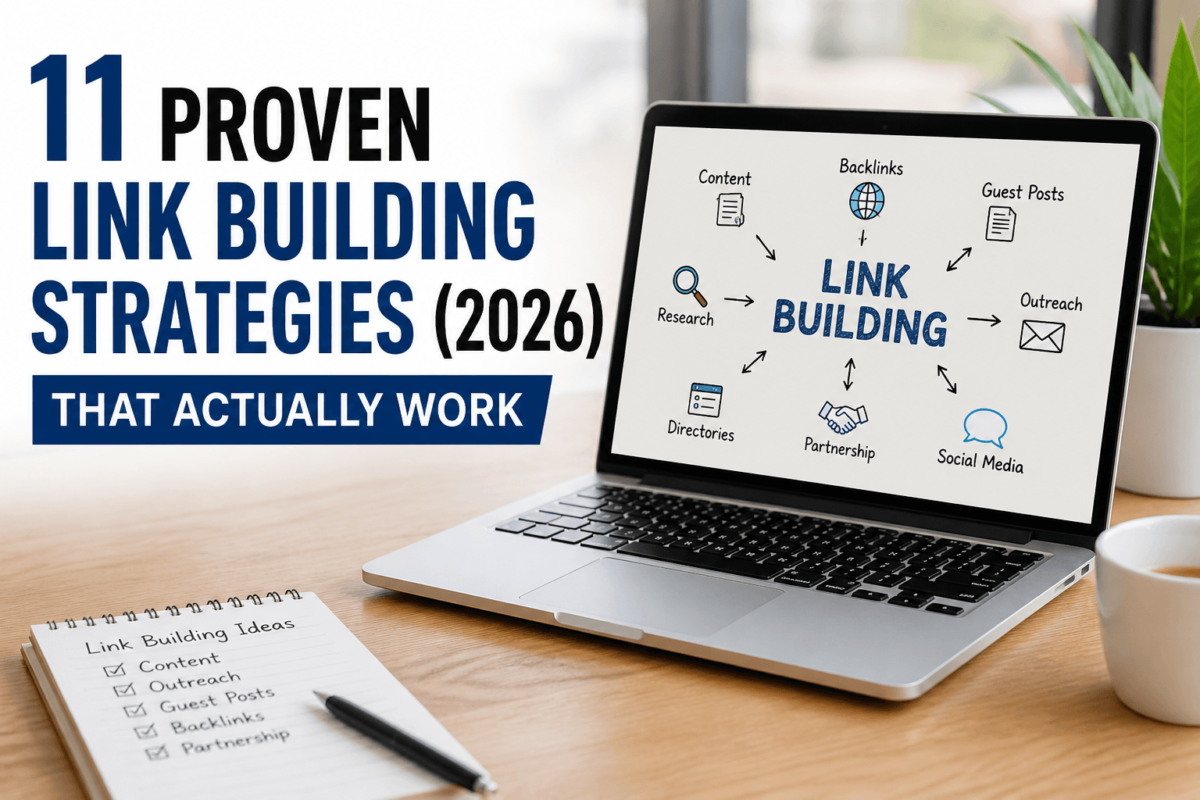
Link building in 2026 is the process of earning high-quality backlinks from authoritative websites to signal trust and relevance to both traditional search engines and AI-driven platforms like Google SGE and ChatGPT. The strategies that work today focus on genuine value, digital PR, and content that earns citations — not spammy directories or mass email blasts. This guide gives you 11 tested tactics, real outreach scripts, cost breakdowns, and everything you need to actually move the needle.
📋 In This Guide
Let’s be real — the link building landscape has changed more in the last two years than in the previous decade combined. Between Google’s Helpful Content updates, the rise of AI-generated search results, and the death of old-school link schemes, what worked in 2021 is either dead or actively dangerous for your site.
And yet, backlinks still matter. A lot. Every major ranking study confirms that links remain one of the top two or three ranking factors. The difference is that the bar has been raised. A hundred mediocre links now hurts you. Fifteen strong, relevant links can push you to page one.
I’ve spent years running link building campaigns for SaaS products, content blogs, and e-commerce brands. I’ve failed spectacularly a few times (more on that later), and I’ve also watched a single digital PR campaign generate 40+ referring domains in under a month. This guide is everything I wish I’d had earlier.
Whether you’re starting from zero or trying to break through a plateau, these 11 strategies are the ones that are actually working right now — in 2026.
Quick Summary (What You’ll Learn)
- What link building actually means in the age of AI search
- The 11 best link building strategies for 2026 — ranked by ROI
- Real outreach email scripts you can copy and adapt
- Cost vs. ROI breakdowns for every tactic
- The #1 mistake that kills most campaigns before they start
- How to optimize for AI citations (AEO & GEO)
What Is Link Building in 2026? (Simple Explanation)
At its core, link building is still the practice of getting other websites to link to yours. But the why and how have evolved dramatically.
In the old days, a backlink was just a vote. Volume was king. You’d blast out hundreds of guest posts, build links in comment sections, and stuff anchor text. Google has since built sophisticated systems to detect and penalize exactly that behavior.
Today, link building is really about building topical authority and trust signals. Search engines — and increasingly AI models — want to understand: Is this website a genuine authority in its space? Do real publishers and experts reference it? Does its content get cited organically?
There’s also a newer dimension most guides don’t cover: GEO (Generative Engine Optimization). When ChatGPT, Perplexity, or Google’s AI Overview answers a question, it pulls from sources it considers trustworthy and well-cited. Getting your content cited in those AI answers is now a legitimate traffic and authority channel — and it starts with the same fundamentals as classic link building.
Why Most Link Building Fails Today
Here’s a failure story. Early in my career, I ran a campaign for a B2B SaaS client. We built 200 links over three months — guest posts, Web 2.0 profiles, forum links. Rankings? Flat. Traffic? Barely moved. The client churned. I learned an expensive lesson.
The problem wasn’t effort. It was that we were building links that Google didn’t care about. Here’s what most campaigns get wrong:
1. Zero Personalization in Outreach
Most link building emails look like this: ‘Hi [First Name], I loved your post about [Topic]. Would you be open to a guest post?’ The recipient has received 50 identical emails this week. The reply rate is basically zero.
Real outreach requires genuine research. You need to know the site, reference something specific, and make a case for why your content adds real value to their audience.
2. Targeting the Wrong Sites
A DR 15 blog that’s clearly built for links won’t help you. Neither will a site that has nothing to do with your niche. Google’s algorithms have gotten very good at understanding whether a link comes from a contextually relevant, genuine source.
3. Skipping Content Investment
You can’t build great links to mediocre content. If the page you’re promoting isn’t the best resource on its topic — genuinely useful, original, well-researched — no serious publisher will link to it.
4. Ignoring the AI Search Layer
Almost no one is thinking about how their content gets cited by AI. This is a huge missed opportunity in 2026. More on this in the strategies below.
11 Proven Link Building Strategies for 2026
Digital PR — The Highest-ROI Play
Digital PR is what happens when you combine traditional public relations with SEO goals. You create genuinely newsworthy content — a data study, a bold industry report, a controversial opinion piece — then pitch it to journalists and publications that cover your space.
Why it works: Journalists are always looking for original data and expert quotes. If you give them something real to write about, you earn links from high-authority news sites and industry publications that you simply can’t buy or replicate with other tactics.
Here’s what actually worked for me: We ran an original study analyzing 500 SaaS pricing pages. The findings were counterintuitive (shorter pricing pages converted 30% better). We pitched it to SaaS newsletters, marketing blogs, and a few journalists on Twitter/X who cover product growth. Within three weeks we had 28 referring domains, including two that were DR 80+.
How to do it:
- Identify a data gap or counterintuitive angle in your niche
- Survey your audience, analyze public data, or run an experiment
- Create a dedicated landing page with the full study
- Build a targeted media list (journalists + newsletters + podcasts)
- Write a compelling pitch email (see outreach scripts below)
Tools: BuzzSumo (for finding journalists), Muck Rack, Respona, Hunter.io for email finding
HARO Alternatives and Journalist Outreach
HARO (Help a Reporter Out) was the gold standard for earning links through expert quotes. It got acquired and essentially collapsed in 2024. But the underlying opportunity — connecting journalists with experts — is bigger than ever.
The new players are Qwoted, Featured.com, Help a B2B Writer, and SourceBottle. Sign up for all of them. Set up keyword alerts. When a journalist or content creator is looking for an expert in your space, respond fast with a concise, quotable answer.
The key to winning here: don’t write an essay. Give them a punchy, usable quote in 2-4 sentences. Journalists need material that fits into their article. Make their life easy.
Linkable Asset Creation
A linkable asset is any piece of content so useful that people in your industry naturally want to reference it. This could be a free tool, a comprehensive glossary, an original data study, an infographic, a calculator, or an ultimate guide.
The question to ask yourself: ‘If I were writing a blog post about [topic X], would I want to link to this resource?’ If the answer is yes, you have a linkable asset.
I’ve seen free tools work incredibly well for this. A SaaS company in the HR space built a simple salary calculator. It took two weeks to build. Three years later it had over 1,200 referring domains because every article about salary negotiation wanted to reference it.
Broken Link Building (The Modern Version)
The concept is simple: find a page in your niche that links to a resource that no longer exists (404 error), create a better version of that resource, then email the site owner to suggest replacing the dead link with yours.
What’s changed in 2026: this used to be a high-volume numbers game. Now it’s most effective when you’re genuinely creating superior content, not just a clone. The emails that work are specific, short, and low-ask.
Use Ahrefs or Semrush to find pages with broken outbound links in your niche. Filter for sites with a Domain Rating of 40+. The success rate on personalized outreach for broken link building is typically 5–15%, which is solid.
Hi [Name],
I was reading your article on [specific topic] and noticed the link to [resource name] is returning a 404. Thought you’d want to know!
I actually just published a comprehensive guide covering the same topic — [Your Page Title]. It might be a useful replacement for your readers. Either way, no worries if it’s not a fit. Just wanted to flag the dead link.
[Your Name]
Resource Page Link Building
Resource pages are curated lists of links on a particular topic — think ‘Best SEO Tools,’ ‘Top Marketing Resources,’ or ‘Free Design Assets.’ They exist in almost every niche, and they’re specifically built to link out.
To find them, use search operators like: [your topic] + inurl:resources or [your topic] + "useful links". You’ll surface pages that are literally designed to link to content like yours.
The pitch here is low-effort and low-ask. You’re not asking them to write about you or create content. You’re suggesting a logical addition to a list they’ve already built. Conversion rates can be as high as 20–25% with the right approach.
Hi [Name],
Found your [Topic] resources page while researching — great curation.
I wanted to suggest one addition: [Your Page Title]. It covers [specific angle] which I didn’t see represented on your list. [One sentence on why it’s useful to their audience].
Happy to send over more details if it sounds like a fit. Thanks either way!
Guest Posting (Done Right)
So, does guest posting still work? Short answer: yes — but only when you’re genuinely contributing to a publication, not just placing a link on a mediocre site that accepts everyone.
The guest posts that move the needle in 2026 are on real publications with engaged readerships. Think Entrepreneur, Search Engine Journal, HubSpot Blog, niche industry sites with actual traffic. These require effort — pitching real angles, writing quality content, passing editorial review.
What to avoid: ‘guest post brokers,’ sites that charge a fee to publish, or any site where every article is clearly written for link placement. Google can detect these patterns at scale.
The right approach is to build genuine relationships with editors and contributors in your space. Follow them, engage with their content, contribute useful ideas before you pitch. The link becomes a byproduct of a real relationship.
Co-Marketing and Strategic Partnerships
This is one of the most underused link building tactics. Find companies that serve the same audience but aren’t direct competitors, and build something together — a joint report, a co-hosted webinar, a co-written guide, an integration.
When you co-create content with a partner, you both promote it and link to it. If your partner has a larger audience or stronger domain, you benefit from their distribution. If they have thousands of customers, you might get mentioned in their product documentation, help center, or blog.
One campaign I worked on: we partnered with a project management tool (we were an analytics platform). We co-published a ‘State of Remote Work’ report. Both companies promoted it to their email lists. Result: 60+ links in the first month, conference keynote invitation, and a long-term affiliate relationship.
AI Citation Optimization (AEO / GEO)
This is the most forward-looking strategy on this list, and almost no one is doing it deliberately yet — which means there’s a real first-mover advantage.
AI search engines like Google’s AI Overviews, Perplexity, and ChatGPT browsing pull answers from sources they consider authoritative, well-structured, and clearly written. Getting cited by these systems drives referral traffic and builds brand authority in a way that compounds over time.
How to optimize for AI citations:
- Write definitions and explanations that directly answer common questions
- Use clear, structured headers (H2s and H3s for every major concept)
- Include comparison tables, numbered lists, and step-by-step frameworks
- Add schema markup (FAQ schema, HowTo schema) to your key pages
- Build topical authority by covering all angles of a topic, not just one page
- Get cited by sites that AI systems already trust (major publications, .edu, .gov)
The connection to link building: sites with strong backlink profiles are more likely to be trusted by AI systems. Traditional link building and AEO/GEO optimization reinforce each other.
Skyscraper Technique 2.0
Brian Dean’s original Skyscraper technique was about finding popular content and creating something better. In 2026, ‘better’ means more than just longer. It means more accurate, more original, better designed, and enriched with primary research or expert interviews.
The key update: don’t just go longer. Go deeper. A 4,000-word guide that includes original survey data, expert quotes, interactive elements, and a downloadable template will consistently outperform a 10,000-word wall of text that’s just padding.
After publishing, reach out to every site linking to the original content and present your version. Use Ahrefs or Semrush to find those backlinks. The pitch isn’t ‘link to me instead’ — it’s ‘here’s a fresher, more comprehensive resource your readers will appreciate.’
Podcast and Video Guesting
Every podcast episode published with you as a guest typically results in at least one link (the show notes page) and often more (social shares, episode pages, guest bio pages). Niche podcasts in your industry can be especially valuable because those audiences are highly targeted.
The same applies to being featured in YouTube videos or video interviews. These create backlinks from video description pages and often from associated blog posts.
How to find opportunities: Search ‘[your niche] podcast guest’ on Apple Podcasts or Spotify. Look for shows that feature guests regularly (not just solo hosts). Pitch yourself as a subject matter expert with a specific angle — not a generic ‘I’d love to come on your show’ ask.
Reclaiming Unlinked Brand Mentions
Someone mentioned your brand, product, or content — but didn’t link to you. This happens more than you think. Tools like Google Alerts, Ahrefs Alerts, and Brand24 can help you find these mentions automatically.
When you find one, reaching out is easy. You’re not cold pitching — they already know who you are. A simple, friendly email asking them to add a link to the mention converts at 40–60% in many cases. This is arguably the lowest-effort, highest-conversion link building tactic that exists.
Tools: Ahrefs (Content Explorer > unlinked mentions), Google Alerts, Brand24, Mention.com
Strategy Comparison: At a Glance
Here’s a quick breakdown of each strategy by effort, cost, and expected return:
| Strategy | Difficulty | Cost | ROI Potential | Best For |
|---|---|---|---|---|
| Digital PR | Hard | $$$ | ⭐ Very High | Brands, agencies |
| Broken Link Building | Medium | $ | ⭐ High | Any niche |
| HARO / Journalist Outreach | Medium | Free–$ | ⭐ Very High | Experts, founders |
| Linkable Assets | Medium | $$ | ⭐ High | SaaS, tools |
| Resource Page Links | Easy | Free | Medium | Blogs, education |
| Guest Posting | Medium | $$ | Medium | New sites, authority |
| Co-Marketing / Partnerships | Hard | $$ | ⭐ Very High | B2B, established brands |
| AI Citation Optimization | Easy | Free | ⭐ High (future) | All sites |
How to Build High-Quality Backlinks: Step-by-Step
Identify Your Link Opportunities
Start with competitor backlink analysis. Use a tool like Ahrefs, Semrush, or Moz to pull the backlink profiles of your top 3 competitors. Export the list and filter for sites with Domain Rating 40+ that are contextually relevant. These are your priority targets — if they linked to your competitor, there’s a reason they might link to you. Next, run broken link searches and resource page searches in your niche. Build a master spreadsheet with columns for URL, DR, site topic, contact info, and outreach status.
Create Link-Worthy Content
Before you send a single email, you need something worth linking to. Ask yourself: would a journalist, blogger, or researcher genuinely want to reference this page? If not, build something better. The formats that earn the most links in 2026: original data studies, free tools and calculators, comprehensive guides with unique angles, expert roundups (from genuine experts, not just bloggers), and opinion pieces with a clear, defensible point of view.
Find Contact Information
For each target site, find the right contact person. This is usually the editor, content manager, or site owner. Tools like Hunter.io, Snov.io, and RocketReach work well for finding verified email addresses. For journalists and freelancers, check their Twitter/X bio — many list their email there. Do not use generic info@ or contact@ emails. Your outreach will never reach the decision-maker.
Send Personalized Outreach
Keep emails short. Under 150 words is ideal. The goal of the first email is not to close the deal — it’s to start a conversation. Reference something specific about their site, make your ask clear in one sentence, and make it easy for them to say yes.
Hi [Name],
I saw your recent piece on [Topic] — [specific observation about their article].
We actually just published a study on [related topic] that found [key surprising stat]. Thought it might be useful context for future coverage.
Happy to share the full report if you’re interested.
[Your Name] │ [Title] │ [Company]
Follow Up (Once)
Most replies come from the follow-up, not the first email. Wait 5–7 business days, then send a single follow-up. Keep it brief — just a 2-sentence nudge referencing your original email. Don’t send more than one follow-up; it damages your sender reputation and your brand.
Track Everything
Use a spreadsheet or a dedicated outreach tool like Pitchbox, Respona, or NinjaOutreach to track every contact, email sent, reply, and link acquired. This data helps you improve your success rates over time and identify which types of sites are most responsive. Key metrics to track: outreach-to-reply rate, reply-to-link rate, average DR of acquired links, and cost per link (total cost / links acquired).
47 Links in 6 Weeks — How We Did It
Here’s a campaign breakdown from a content marketing client in the B2B software space. They had a decent blog but virtually no backlinks (DR 18 when we started).
The Setup
We identified a data gap: nobody had published a comprehensive study on how long SaaS onboarding flows actually took across different product categories. We surveyed 300 SaaS users, compiled the data, and built a standalone landing page with charts and methodology.
The Outreach
We built a prospect list of 180 targets: SaaS bloggers, product managers who wrote newsletters, journalists at marketing publications, and podcast hosts who covered B2B software. We sent personalized emails (not from a template — actually researched each contact).
The Results
What Made It Work
The data was genuinely original — nobody else had it. The outreach was specific and short. And the page itself was well-designed, with shareable charts and a clear methodology section that made journalists comfortable citing it.
The failure we avoided: on a previous campaign for the same client, we’d tried bulk guest posting on generic sites. Sixty posts. Zero measurable impact. Lesson learned.
Essential Tools for Link Building in 2026
You don’t need every tool on this list. Start with one backlink analysis tool, one outreach tool, and one monitoring tool. Here’s what’s worth considering:
Backlink Analysis & Prospecting
Ahrefs
The gold standard for backlink research, broken link finding, and competitor analysis. Worth every penny for serious campaigns.
Semrush
Strong alternative to Ahrefs, especially if you also want keyword research in the same platform.
Moz Pro
Good for beginners; the Link Explorer tool is solid for basic prospecting.
Outreach & Email
Respona
Built specifically for link building outreach. Integrates with Ahrefs and automates the most tedious parts of prospecting.
Hunter.io
The best email finder. Fast, accurate, and has a generous free tier.
Pitchbox
Enterprise-grade outreach platform with strong reporting. Better for agencies.
Monitoring & Alerts
Google Alerts
Free and surprisingly useful for tracking brand mentions.
Brand24
More powerful monitoring, includes social media and forum mentions.
Ahrefs Alerts
Set up backlink alerts so you’re notified whenever you gain or lose a link.
AI & Content
Surfer SEO
Useful for optimizing content to earn featured snippets and AI citations.
Clearscope
Excellent for topical authority building. Helps you cover a topic comprehensively enough to become the go-to reference.
Frequently Asked Questions
Most campaigns start showing measurable ranking improvements in 60–90 days, though highly competitive niches can take 6 months or more. The timeline depends on the authority of links acquired, how competitive your target keywords are, and whether your on-page SEO is already solid. Link building without good on-page SEO is like pouring water into a leaky bucket.
It varies enormously. A basic broken link building campaign using your own time costs almost nothing. Digital PR campaigns, if outsourced, can run $2,000–$10,000+ per month. In-house campaigns using tools like Ahrefs ($99–$399/month) and outreach software ($50–$200/month) can deliver strong results for under $1,000/month total if you’re willing to do the work.
Yes, if you’re doing it on legitimate publications with real audiences and genuine editorial standards. No, if you’re using link brokers, buying guest posts, or publishing on sites that exist solely for links. Google’s 2024 spam update specifically targeted low-quality guest post networks. The rule of thumb: if a site would link to anyone who pays, it’s not worth your time.
White hat link building earns links through content quality, genuine outreach, and legitimate relationship building. Black hat involves purchasing links, link schemes, or manipulating anchor text at scale. Black hat tactics can deliver short-term results but carry real penalty risk — algorithm updates and manual actions can erase months of progress overnight. In 2026, the risk-reward ratio for black hat is genuinely terrible.
AI search is changing where users find answers, but it’s actually increasing the importance of being cited by authoritative sources — because AI systems pull from exactly those sources. Sites with strong backlink profiles, clear topical authority, and well-structured content are more likely to be cited in AI-generated answers. Think of AI search as a new distribution channel that rewards the same things traditional SEO rewards: genuine expertise, clear writing, and authoritative links.
There’s no magic number. It depends on your niche competitiveness, the quality of those links, your site’s overall domain authority, and on-page factors. I’ve seen brand-new pages rank on page one with 10–15 high-quality backlinks in low-competition niches. In competitive spaces like finance or health, you might need hundreds of strong links. The best approach: analyze what the current top-ranking pages have, and build a realistic plan to be in the same ballpark — plus produce genuinely better content.
Final Thoughts
Link building isn’t dead — it’s just evolved. The tactics that worked through pure volume and manipulation have been neutralized. What remains is what always should have mattered: creating genuinely valuable content and building real relationships with people who want to share it.
The good news is that this makes link building more sustainable, not less. A strong linkable asset can earn you backlinks for five years. A well-run digital PR campaign can drive 50+ referring domains in a month. Unlinked brand mention reclamation takes an afternoon and converts at rates most paid tactics can’t touch.
Start with one tactic. Pick the strategy that fits your current resources — if you’re solo and bootstrapped, start with broken link building and unlinked mentions. If you have a budget and a brand story to tell, invest in digital PR. If you have strong content already, double down on linkable assets.
Measure everything. The data will tell you what’s working. Double down on that. Drop what isn’t.
And remember: every link you earn through a real relationship, real content, or real data is an asset that builds compounding value over time. That’s the game worth playing in 2026.