Ever wonder why your pages just won’t rank — even after you’ve done everything “right”? You’ve got decent content, some backlinks, and your site loads reasonably fast. But you’re stuck on page two. Sometimes page three.
Here’s the truth: the SEO game in 2026 is less forgiving than it’s ever been. Google’s algorithms have gotten disturbingly good at detecting thin, manipulative, or poorly structured content. AI tools have flooded the web with mediocre articles. And users? They bounce faster than ever when they land on something that doesn’t immediately answer their question.
The mistakes that used to quietly hold you back are now actively destroying rankings. I’ve seen sites lose 40–60% of their organic traffic almost overnight because of issues that were completely fixable — if they’d caught them earlier.
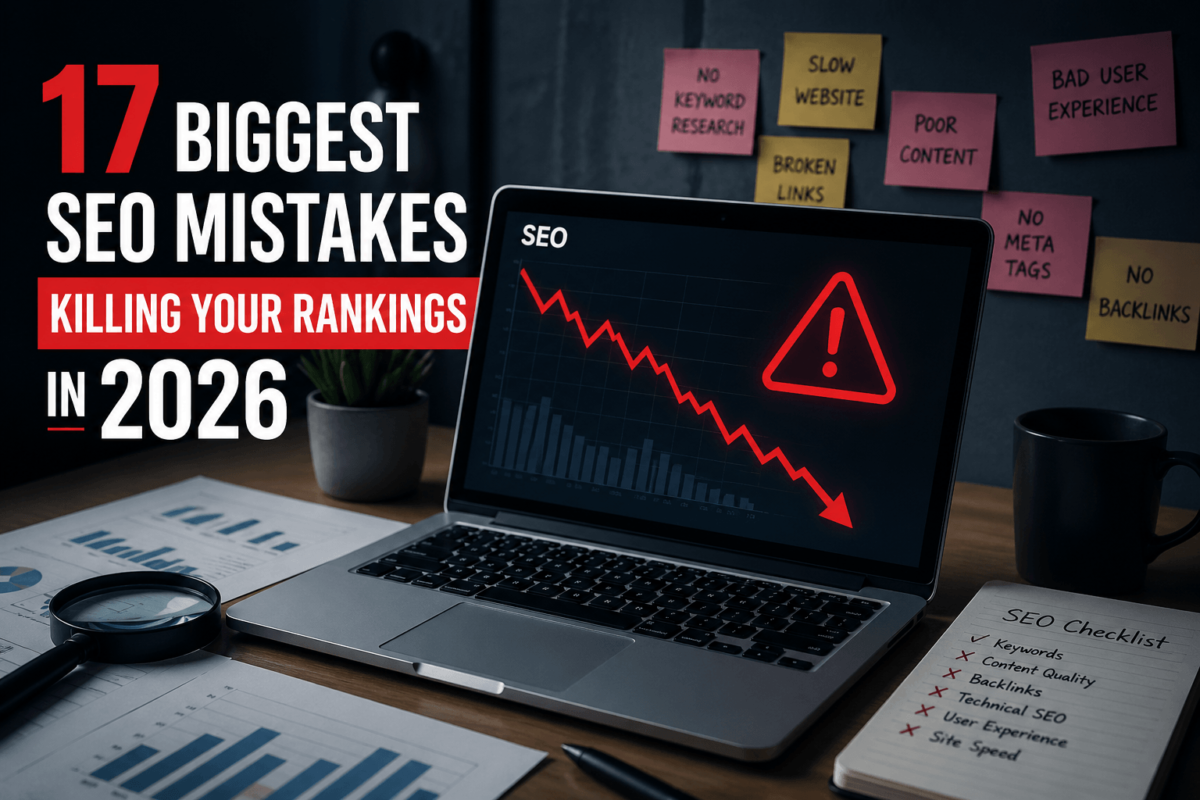
This guide breaks down the 17 biggest SEO mistakes in 2026, explains exactly what’s going wrong, and gives you a clear path to fix each one.
⚡ Quick Summary: Key Takeaways
- Weak EEAT signals (Experience, Expertise, Authority, Trust) are the #1 silent ranking killer in 2026
- Publishing AI content without human editing is actively hurting sites — Google’s quality raters are trained to spot it
- Ignoring search intent shifts means you’re optimizing for the wrong page type
- Poor internal linking leaves PageRank stranded on pages that can’t convert it into rankings
- Not optimizing for featured snippets and AI Overviews = missing 30–40% of click opportunities
- Topical authority now outweighs individual keyword targeting — breadth + depth together win
- Most sites track traffic obsessively but never connect it to conversions — a fatal strategic mistake
- A zero content refresh strategy guarantees slow ranking decay — even your best posts will slide
The 17 Biggest SEO Mistakes in 2026
Confusing Core Web Vitals With General Site Speed High Impact
Most people think “Core Web Vitals” means the same thing as “make your site faster.” It doesn’t. Core Web Vitals are a specific set of user experience metrics Google measures — Largest Contentful Paint (LCP), Interaction to Next Paint (INP), and Cumulative Layout Shift (CLS). Site speed is a broader concept that includes Time to First Byte (TTFB) and page load time.
A site that loads in 2 seconds but has a jumpy layout (high CLS) or sluggish interactive elements (high INP) will still get dinged by Google — even if your general “speed score” looks fine.
Crawl Budget Waste on Duplicate or Low-Value Pages High Impact
If Googlebot is spending its crawl budget on paginated archive pages, URL parameter duplicates, or thin tag pages, it’s not crawling your most important content. This is especially dangerous for large sites with hundreds or thousands of pages.
Ignoring Structured Data (Schema Markup) High Impact
Structured data isn’t just for rich snippets anymore. In 2026, it’s a critical signal for AI Overviews, featured snippets, and knowledge panels. Most people set up basic Organization schema once and call it done — but you also need Article, FAQ, HowTo, Product, Review, and Breadcrumb schema working together.
Optimizing for Keywords Instead of Search Intent Critical
You can perfectly optimize a page for a keyword and still not rank — because you got the search intent wrong. When someone searches “best CRM software,” Google knows that’s a commercial investigation query. Users want a comparison article, not a product homepage. If you send them to a product page, you’re mismatching intent and you’ll lose every time.
Search intent has four types: informational (“how does X work”), navigational (“[brand] login”), commercial (“best X for Y”), and transactional (“buy X now”).
Thin or Redundant Content Competing Against Itself High Impact
Keyword cannibalization — where multiple pages on your site target the same query — is still rampant. It confuses Google, splits your ranking signals, and often means neither page ranks well.
site:yourdomain.com "target keyword" to find duplicate intent pages. Consolidate them with 301 redirects, or differentiate them enough that they serve completely different queries.
Ignoring Title Tag and Meta Description Optimization High Impact
Meta descriptions don’t directly influence rankings, but they dramatically affect CTR — and CTR affects rankings. A page ranking #3 with a compelling title can out-click a #1 result with a bland one. Most people write title tags once and never revisit them.
Misusing AI-Generated Content Critical
Publishing raw, unedited AI content in 2026 is one of the fastest ways to destroy your site’s rankings. When you flood your site with unedited AI articles, your content becomes statistically average — it says what every other AI-generated piece says, in roughly the same way. Google’s Helpful Content System penalizes sites at a domain level — not just at the page level.
One client published 50 AI articles per month. Within 90 days, their organic traffic dropped 40%. The content added nothing new — no original perspective, no real-world experience, no EEAT signals.
No Topical Authority Strategy High Impact
Most SEO blogs still recommend targeting individual keywords with individual articles. That worked in 2018. In 2026, Google wants to see that you’re an authority on a topic — not just a page that happens to mention a phrase. Topical authority means covering a subject comprehensively: the main topic, all related subtopics, adjacent questions, and supporting content — all interlinked logically.
No Content Refresh Strategy Medium-High
Publishing great content and never updating it is like planting a garden and never watering it. Rankings decay. Statistics go stale. Search intent shifts. Competitors publish better versions. Most people only update content when they notice a major traffic drop — always playing catch-up.
Ignoring EEAT Signals Critical
EEAT (Experience, Expertise, Authoritativeness, Trust) is the quality framework Google’s quality raters use. It absolutely influences rankings, especially in YMYL (Your Money or Your Life) niches. Weak EEAT looks like: anonymous authors, no credentials, no original research, no citations, and no clear editorial standards.
Chasing Links Instead of Building Authority High Impact
Most link building in 2026 is performative. People obsess over domain authority scores and quantity — and completely ignore whether the links actually make sense. Google has gotten very good at identifying manipulative link patterns: sudden spikes, over-optimized anchor text, or links from irrelevant sites can all trigger penalties.
Ignoring Internal Linking Architecture High Impact
Most people treat internal linking as an afterthought — adding a few related posts at the bottom and calling it done. Internal links distribute PageRank across your site. They tell Google which pages are most important. A poorly interlinked site can have great content and still struggle to rank because authority never gets distributed to the right pages.
Not Optimizing for Featured Snippets and AI Overviews High Impact
Google now shows AI-generated summaries at the top of many results — and the sources they pull from get massive visibility. Most sites aren’t optimizing for this at all. To be quoted in an AI Overview or win a featured snippet, your content needs to directly answer the question and use the right format (definition box, numbered list, table, or short paragraph).
Tracking Traffic Instead of Conversions High Impact
Traffic is vanity. Conversions are sanity. I’ve worked with companies celebrating 100,000 monthly visitors while their actual revenue from organic search was near zero. Traffic that doesn’t convert is expensive to produce and maintain.
Poor Mobile Experience High Impact
Google has been mobile-first for years, but plenty of sites still deliver a frustrating mobile experience. Tiny tap targets, text that overflows the screen, pop-ups that block content, and slow-loading images on mobile connections all hurt rankings.
Over-Reliance on SEO Tools Instead of Strategy Medium
SEO tools are incredible — but there’s a trap. Spending so much time analyzing data that you never actually execute a strategy. I’ve seen teams run dozens of audits, export thousands of keyword ideas, and publish nothing. They’re busy doing SEO without actually doing SEO.
Ignoring Local SEO Signals (Even for Non-Local Businesses) Medium
Most people think local SEO only matters for brick-and-mortar businesses. That’s wrong. Even B2B SaaS companies, bloggers, and ecommerce brands benefit from local SEO signals — especially for location-specific landing pages, local link acquisition, and Google Business Profile authority.
Real-Life Examples: What These Mistakes Look Like in Practice
The AI Content Trap
A mid-sized affiliate site in personal finance started using AI to scale from 5 articles/month to 60 in early 2024. By Q3 2024, they’d published over 400 new posts. Traffic initially spiked, then crashed — down 52% within six months.
The problem: the AI content was statistically indistinguishable from a hundred other sites. No original data, no author expertise, no lived experience. Google’s Helpful Content Update devalued their entire domain.
Search Intent Mismatch Killing a Product Page
A B2B software company was trying to rank their product homepage for “project management software.” They had solid backlinks, great Core Web Vitals, and a well-written page — but couldn’t crack page one.
The issue: that keyword is a commercial investigation query. Users want comparison articles — not a product landing page.
Internal Linking Transformation
A large cooking blog had 800+ posts but terrible internal linking. New articles sat isolated with no links from established pages. Their top-performing posts weren’t linking to monetized content.
How to Fix These SEO Mistakes: A Step-by-Step Action Plan
-
Run a Comprehensive Site Audit
Before fixing anything, get a clear picture of where things stand. A thorough audit covers technical issues, content quality, on-page optimization, backlink profile, and Core Web Vitals.
- Use Screaming Frog (free up to 500 URLs) to crawl your site and identify technical errors
- Export your data from Google Search Console — impressions, clicks, CTR, average position
- Pull a content audit spreadsheet: URL, traffic, backlinks, word count, last updated date
- Run Core Web Vitals via PageSpeed Insights for your top 20 pages
-
Fix Technical Foundations First
No amount of great content or links compensates for a technically broken site. Prioritize in this order:
- Fix crawl errors and redirect chains
- Resolve Core Web Vitals failures (LCP, INP, CLS)
- Implement missing schema markup
- Canonicalize duplicate content
- Ensure all important pages are indexed
-
Realign Content With Search Intent
Go through your top 20 most important pages and manually check the SERP for each target keyword. Ask: does my content format and angle match what’s ranking? If not, update or create a new piece that matches intent.
-
Build Topical Authority and Internal Links
Map out your topic clusters. Identify gaps — subtopics you haven’t covered. Create a content calendar to fill those gaps over the next 90 days. As you publish, link new pieces from established pages and build intentional internal linking paths toward conversion pages.
-
Strengthen EEAT Signals Across the Site
- Add detailed author bios with credentials, photos, and social links
- Add an editorial policy or “About” page explaining your publishing process
- Link to authoritative sources (government, academic, industry publications)
- Add original data, expert quotes, or case studies to high-priority pages
- Display trust signals: SSL, privacy policy, contact information, business address
-
Track What Actually Matters
Set up proper conversion tracking in GA4. Connect Search Console to GA4. Create a simple dashboard that shows: organic traffic, conversions from organic, keyword ranking movement, and Core Web Vitals status. Review it weekly.
SEO Mistakes Quick Reference Table
| Mistake | What Happens | Fix | Impact |
|---|---|---|---|
| Confusing CWV with speed | Incomplete fixes; CLS/INP still failing | Use PageSpeed Insights for CWV specifically | High |
| Wrong search intent | Page won’t rank despite good optimization | Match content format to SERP top results | Critical |
| Raw AI content | Domain-level quality demotion | Add EEAT signals; use AI as draft only | Critical |
| No topical authority | Slow ranking velocity; low domain trust | Build topic clusters with pillar + spokes | High |
| Ignoring internal links | PageRank stranded; orphaned pages | Audit + rebuild internal link architecture | High |
| No content refresh | Gradual ranking decay on older posts | Quarterly refresh on declining pages | Medium-High |
| Weak EEAT signals | Low trust in YMYL niches | Add bios, sources, editorial standards | Critical |
| Tracking traffic only | No ROI clarity; wrong optimization focus | Set up GA4 conversions + Search Console | High |
| No schema markup | Missing rich results + AI Overview citations | Add relevant schema for all content types | High |
| Over-relying on tools | Busy work with no execution | 20% analysis, 80% action rule | Medium |
Frequently Asked Questions About SEO Mistakes
Final Thoughts
Most SEO problems aren’t mysterious. They come down to a handful of repeatable mistakes — wrong content format, ignored technical issues, thin authority signals, and a measurement system that tracks the wrong things.
Every single mistake on this list is fixable. Some take an afternoon. Some take six months. But all of them are within your control. What separates sites that consistently win in search from those that spin their wheels isn’t budget, team size, or even domain age — it’s the discipline to fix the fundamentals, the patience to build real authority, and the clarity to track what actually drives business results.
Start with the audit. Fix the technical foundation. Align your content with actual search intent. Build topical depth. Add EEAT signals to everything. Then measure conversions, not just traffic.
Do that consistently, and 2026 can be your best SEO year yet.
🚀 Want a Free SEO Audit for Your Site?
Our team at TechCognate identifies exactly which of these 17 mistakes are holding your rankings back — and builds a clear plan to fix them.
Get Your Free SEO Audit →