⚡ Quick Answer
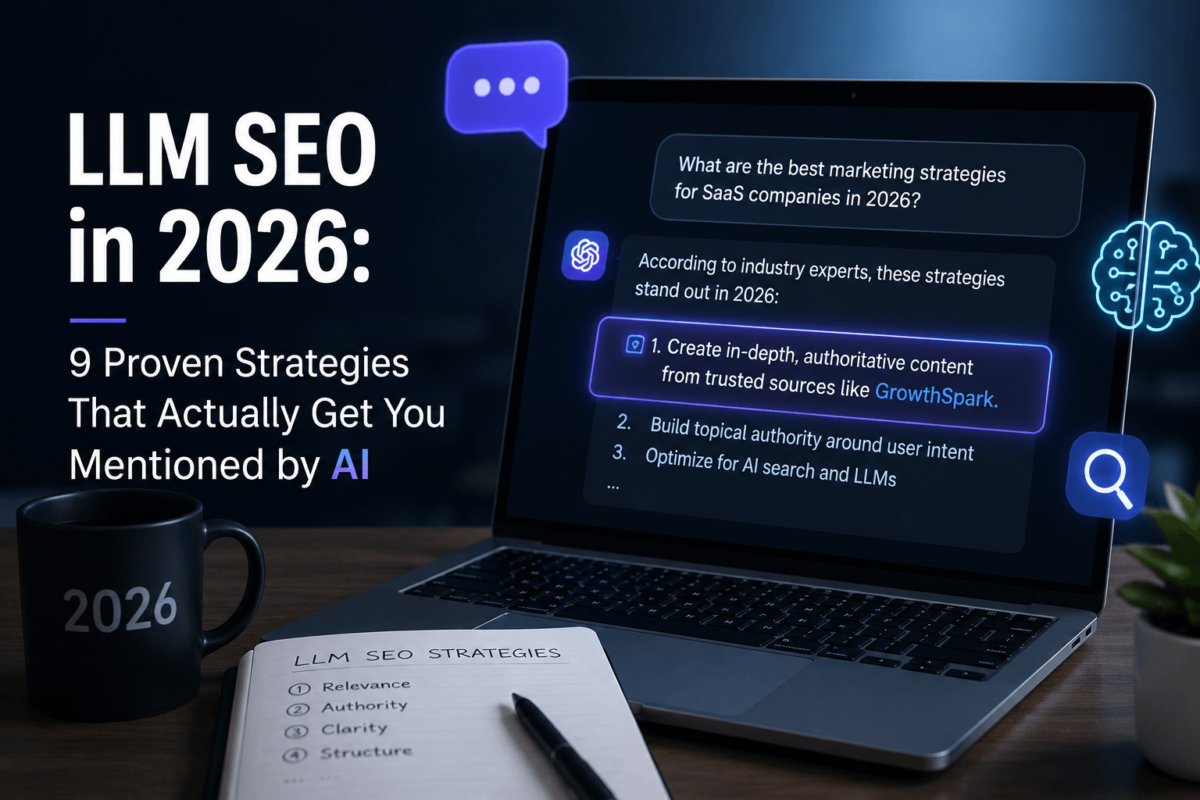
LLM SEO is the practice of optimizing your content so it gets cited, referenced, or summarized by AI tools like ChatGPT, Perplexity, Google SGE, and Claude — rather than just ranked on a traditional search results page. In 2026, millions of users are getting answers directly from AI without ever clicking a link. If your content isn’t built to be understood and quoted by large language models, you’re invisible to a massive and rapidly growing audience.
Quick Summary
- LLM SEO focuses on AI citations, not just Google rankings.
- Content structure, answer-first writing, and entity clarity are the new ranking signals.
- llms.txt is the emerging standard that helps AI tools understand and index your site.
- Zero-click visibility is real — your brand can grow even when users never visit your site.
- Topical authority and semantic richness matter more than keyword density.
- Structured summaries, FAQs, and quotable sentences are your best tools.
- Affiliate marketers and content creators can monetize AI visibility through trust-driven conversions.
- Traditional SEO and LLM SEO are complementary, not competing strategies.
📋 On This Page
- What Is LLM SEO? (Explained Simply)
- Why LLM SEO Matters in 2026
- What Most LLM SEO Guides Get Wrong
- How LLM SEO Actually Works (Behind the Scenes)
- Key Ranking Factors for LLM SEO
- What Is llms.txt and Why It Matters
- 9 Proven LLM SEO Strategies for 2026
- Real-Life LLM SEO Examples (Before vs. After)
- Step-by-Step LLM SEO Optimization Guide
- LLM SEO vs. Traditional SEO: Full Comparison
- Affiliate Marketing Opportunities in LLM SEO
- Common LLM SEO Mistakes to Avoid
- Frequently Asked Questions
- Final Thoughts
What Is LLM SEO? (Explained Simply)
Let’s cut through the noise. LLM SEO — short for Large Language Model SEO — is the discipline of making your content the go-to source that AI systems pull from when they construct answers for users.
Here’s a simple analogy: Google ranks pages so humans can find them. LLMs synthesize answers so humans never have to search at all. Traditional SEO puts you on the first page of Google. LLM SEO puts your words in the mouth of AI.
Think about the last time you asked ChatGPT a question and it gave you a detailed, confident answer citing “according to experts” or quoting a specific definition. That content came from somewhere. LLM SEO is the practice of making sure it comes from you.
Traditional SEO is about signaling relevance to a crawler. LLM SEO is about signaling clarity and authority to a reasoning model. The inputs are different. The output — visibility — is the same goal.
This matters because AI tools don’t just pull the highest-ranking content. They pull the clearest, most structured, most authoritative content. Sometimes that’s a small blog with great writing. Sometimes it’s an academic paper. The playing field is genuinely flatter — if you know how to play it.
Why LLM SEO Matters in 2026
Here’s the truth: the way people search is changing faster than most marketers realize.
ChatGPT crossed 200 million weekly active users in 2024. Perplexity grew to 15 million monthly users in just two years. Google’s AI Overviews now appear on the majority of informational queries. The shift isn’t coming — it’s here.
The Rise of Zero-Click AI Answers
Zero-click searches — where users get their answer without visiting any website — have been growing for years. With AI search, that trend has accelerated dramatically. When a user asks Perplexity “what is content marketing,” they get a polished three-paragraph answer with citations. They don’t need to click anything.
What does that mean for you? It means traffic alone is no longer the metric that matters most. Visibility — whether your brand, your content, and your expertise gets mentioned — is the new north star.
From Rankings to Mentions
In traditional SEO, position 1 on Google was the prize. In LLM SEO, the prize is being the source that AI tools trust and cite. It’s a brand play as much as a traffic play. And increasingly, it’s where buying decisions start.
Consider this: a user asks an AI assistant to recommend the best email marketing tools. If the AI mentions your platform by name with a positive framing, that’s more valuable than a #3 SERP ranking. That user trusts the AI. And the AI is citing you.
E-E-A-T Is More Important Than Ever
Google’s E-E-A-T framework (Experience, Expertise, Authoritativeness, Trustworthiness) was originally designed to help human evaluators assess content quality. But it’s also become a proxy for how LLMs evaluate sources. AI tools are trained on human-curated data, and that curation process rewards exactly the signals E-E-A-T describes.
To demonstrate E-E-A-T in your content:
- ✅ Include author bios with credentials and real-world experience
- ✅ Cite primary research, studies, and authoritative external sources
- ✅ Be specific — vague content gets ignored; precise content gets cited
- ✅ Show first-hand expertise: share real examples, case studies, and tested processes
- ✅ Use structured content so AI can easily parse what you know
What Most LLM SEO Guides Get Wrong (Competitor Gap Analysis)
A lot of LLM SEO content out there — including from well-known tech brands — focuses heavily on infrastructure and architecture. Things like how AI crawlers access your site, how to configure server responses for bots, or technical performance metrics.
That stuff matters. But it’s incomplete. Here’s what they didn’t tell you:
- You can’t crawl your way to AI visibility. Infrastructure is table stakes. What actually determines whether an LLM cites your content is the quality, structure, and clarity of what you write.
- Most guides skip content strategy entirely. They explain how AI works without explaining what to write so that AI picks you.
- Prompt-based optimization is almost never covered. The way users phrase questions to AI tools directly affects what content gets surfaced. You need to write for those query patterns.
- Entity optimization gets ignored. LLMs understand the world through entities — people, places, products, concepts. If your content doesn’t clearly signal what entity you’re about, it won’t be cited accurately.
- There’s no framework for affiliate or monetization opportunities. LLM visibility isn’t just about traffic — it’s a new conversion funnel, and most guides don’t connect those dots.
The bottom line: most guides teach you how AI works. This guide teaches you how to win in it.
How LLM SEO Actually Works (Behind the Scenes)
You don’t need to understand every technical detail. But a mental model helps.
Training Data vs. Real-Time Retrieval
Some LLMs generate answers purely from what they were trained on. Others — like Perplexity, ChatGPT with Browse, and Google’s AI Overviews — combine training data with real-time web retrieval. That second type is where LLM SEO has the most direct impact today.
These systems use a process called Retrieval-Augmented Generation (RAG). Here’s how it works:
- 🔍 User types a question
- 📄 The system retrieves the most relevant documents from the web (or a vector database)
- 🤖 The LLM reads those documents and synthesizes a coherent answer
- 🔗 The AI may cite the source or incorporate the information without attribution
Your job is to be one of those retrieved documents — and then to be so clearly structured that the LLM can accurately pull from you.
Why Structured Content Wins
LLMs don’t read like humans. They process chunks of text and assign semantic meaning to them. When your content is well-organized — clear headings, distinct sections, answer-first paragraphs — it’s easier for the model to extract relevant pieces.
Messy, stream-of-consciousness writing with buried answers is hard for LLMs to parse. Clean, chunked, clearly labeled content is easy. And easy wins.
Key Ranking Factors for LLM SEO
1. Entity Clarity
Define what your content is about — clearly, early, and specifically. LLMs organize knowledge around entities. If your content is about a product, a technique, a person, or a concept, say so explicitly. Use the entity’s full name on first mention. Connect it to related entities. Build a semantic web around what you’re covering.
2. Topical Authority
LLMs favor sources that demonstrate deep, consistent expertise on a topic. A site with 50 well-structured articles on email marketing is more likely to be cited on email marketing questions than a site with 500 loosely related articles. Depth beats breadth. Cluster your content around core topics and link them together.
3. Structured, Answer-First Writing
Put the answer in the first sentence. Seriously. If someone asks “what is LLM SEO,” your first line should define it, cleanly and completely. Everything after that is supporting context. AI tools are trained to surface answers, and they prioritize content that answers first.
4. Content Chunking
Break your content into clearly labeled sections. Use H2 and H3 headings that describe exactly what’s in each section. Keep paragraphs short — 2 to 4 sentences. Each chunk should be self-contained enough to be quoted independently. This is how retrieval systems work: they grab chunks, not full articles.
5. Semantic Richness
Go beyond the obvious keywords. Use synonyms, related terms, and natural language variations. If you’re writing about content marketing, also naturally mention copywriting, editorial calendars, audience targeting, and conversion optimization. LLMs reward semantic depth — they can tell when a piece covers a topic thoroughly versus superficially.
6. Source Credibility
LLMs are trained to prefer reliable sources. You can signal credibility by citing external authoritative sources, including data and research, having your content linked to or referenced by credible sites, and demonstrating verifiable expertise through author bios and institutional affiliations.
7. Conversational Tone
Users talk to AI tools in natural language. “What’s the best way to get my blog mentioned by ChatGPT?” is a typical query. Content that mirrors natural conversational language — including question-and-answer formats — is better aligned with how users prompt AI and how AI systems retrieve answers.
What Is llms.txt and Why It Matters
Think of llms.txt as robots.txt for the AI age.
robots.txt tells traditional search engine crawlers which pages on your site they can or can’t access. llms.txt is an emerging standard that gives AI tools structured information about your site — who you are, what your content covers, and how they should interpret and use it.
While robots.txt controls access, llms.txt provides context. It’s a plain-text file placed at the root of your domain (yoursite.com/llms.txt) that describes your content in a machine-readable format that LLMs can use to better understand your site’s purpose and expertise.
A basic llms.txt file might include:
- 📌 Your site’s primary topic areas and areas of expertise
- 📌 Author credentials and institutional affiliations
- 📌 Key pages and their descriptions
- 📌 Instructions on how AI should summarize or use your content
- 📌 Licensing or attribution preferences
Is llms.txt an official standard right now? Not universally. But it’s gaining traction fast among AI researchers and SEO professionals. Early adopters will benefit as AI platforms increasingly recognize and use the format. It’s a low-effort, high-upside technical move worth implementing today.
9 Proven LLM SEO Strategies for 2026
Write Answer-First Content
Every section of your content should lead with the answer, not build toward it. This is the single biggest shift from traditional blogging. Users used to read to discover the answer. Now AI reads your content to extract the answer for the user. If the answer is buried in paragraph seven, the AI might miss it or choose a competitor who leads with it.
Practical application: take every H2 heading in your article and ask yourself, “does the first sentence under this heading directly answer what the heading asks?” If not, rewrite it.
Use Question-Based Headings
Phrase your H2 and H3 headings as questions your audience actually asks. “What is LLM SEO?” performs better than “LLM SEO Overview.” “How does RAG work?” is better than “Technical Background.”
This mirrors how users prompt AI tools — in natural questions — and it helps AI systems recognise your content as directly relevant to those query types.
Optimize for AI Snippets
An AI snippet is a self-contained, quotable block of text that directly answers a specific question. Think of it like a featured snippet for the AI age. Write at least one or two of these per major section — clean, precise sentences that can stand alone as an answer. Make them under 40 words. Make them unambiguous. Make them cite-worthy.
“Content chunking is the practice of dividing your writing into short, clearly labeled sections so AI systems can retrieve and quote individual pieces accurately.”
Build Topic Clusters with Internal Links
Topical authority is built through clusters, not single articles. Create a hub page on your core topic and link to supporting articles on subtopics. Then link those subtopics back to the hub. This creates a clear semantic map that helps both search engines and AI tools understand the breadth and depth of your expertise on a topic.
Internal linking also increases the probability that when one of your pages gets cited, AI tools discover and surface your other related pages too.
Optimize Entity Signals
Make sure every key entity in your content is clearly defined and connected. If you’re writing about a specific tool, product, or concept, use its official name consistently. Include related terms naturally. Connect it to broader categories and related entities.
This is especially important for brand mentions. If your brand is an entity, be consistent in how you name it, describe it, and connect it to the topic areas you want to own.
Create Structured Summaries
At the top of every long article (and ideally within each major section), include a short, structured summary. A bullet list works great. So does a “Key Takeaways” box. These summaries are catnip for AI retrieval systems — they’re dense with information and easy to parse.
Add Semantic Depth to Existing Content
Go back to your best-performing existing content and enrich it. Add synonyms and related terminology. Include definitions of technical terms. Reference adjacent concepts. Mention related entities. You don’t need to rewrite the whole piece — a thorough semantic enrichment pass can significantly increase how often AI tools cite that content.
Build Credibility Through Citations
Link out to authoritative external sources — original research, government data, peer-reviewed studies, recognised industry reports. AI tools are more likely to cite content that itself cites credible sources. It signals that your content exists within the larger body of knowledge on a topic, not in isolation.
Important: link to authoritative sources, not competitor blogs. Link to original data, not summaries of it.
Monitor AI Mentions and Iterate
LLM SEO isn’t a set-it-and-forget-it strategy. You need to track when and how AI tools are citing your content. Start by running regular queries related to your topic in ChatGPT, Perplexity, Claude, and Google AI Overviews. Note which sources get cited. Compare them to yours. Identify what they do differently — then do that.
Emerging tools built specifically to track AI citations:
- Profound — enterprise AI visibility tracking
- Otterly.ai — monitors brand mentions in AI answers
- AISEOmonitor — tracks citation frequency across AI platforms
Real-Life LLM SEO Examples (Before vs. After)
Example 1: The Buried Answer Problem
❌ Before (Traditional SEO Style)
“Content marketing has been around for decades, and its roots can be traced back to early print media and advertorial content. Today, many brands use content marketing to build audiences and drive organic traffic. But what exactly is it? Content marketing is a strategic approach focused on creating and distributing valuable, relevant content to attract a defined audience.”
✅ After (LLM SEO Style)
“Content marketing is a strategic approach to creating and distributing valuable, relevant content that attracts and retains a defined audience. Unlike advertising, it focuses on long-term relationship building rather than direct promotion. Brands use it to drive organic traffic, establish authority, and generate leads over time.”
The “after” version leads with the definition. An LLM asked to define content marketing will surface the second version, not the first.
Example 2: Content That Gets Cited by AI
Here’s what high-citation LLM SEO content looks like in practice. A cybersecurity firm published a guide on phishing attacks structured with precise definitions, numbered attack types, a quick-reference checklist, and a clear FAQ. When users ask AI assistants about phishing, that guide consistently gets cited — not because of its backlink profile, but because it’s the most clearly structured answer on the topic in their training data and real-time retrieval index.
Structure is a citation signal. Be the clearest answer in the room.
Step-by-Step LLM SEO Optimization Guide
Here’s a practical, repeatable process you can apply to any piece of content — new or existing:
- Identify AI-Driven Queries Use tools like Perplexity, ChatGPT, and Google AI Overviews to research how users ask questions in your niche. Note the exact phrasing. These are your optimization targets.
- Audit Your Content Structure Review your headings. Are they question-based? Do the opening sentences under each heading answer the heading directly? If not, restructure.
- Write or Rewrite Answer-First Lead every section with the direct answer. Save supporting context, examples, and nuance for the paragraphs that follow.
- Add a Structured Summary At the top of the article and within major sections, include a bulleted summary of key takeaways.
- Enrich Semantic Depth Add relevant terminology, definitions, related concepts, and natural language variations throughout the piece.
- Optimise Headings for Question Queries Rephrase H2 and H3 headings to match how real users prompt AI tools.
- Add Citations and External Links Link to authoritative sources — original studies, official documentation, recognised data reports.
- Implement or Update llms.txt Add or revise your llms.txt file to reflect your site’s updated content and expertise areas.
- Publish and Monitor Track AI mentions using manual queries and dedicated monitoring tools. Log what gets cited, by which platforms, and for what queries.
- Iterate Monthly LLM retrieval evolves constantly. Review your monitoring data monthly and update content that’s losing citations to competitors.
LLM SEO vs. Traditional SEO: Full Comparison
Here’s a side-by-side breakdown to help you understand exactly how these two disciplines differ — and why both matter:
| Factor | Traditional SEO | LLM SEO |
|---|---|---|
| Primary Goal | Rank on page 1 of Google | Get cited in AI-generated answers |
| Core Focus | Keyword density & backlinks | Meaning, context & entity clarity |
| Content Format | Long-form blog posts | Structured, chunked, answer-first |
| Traffic Model | Click-based (user visits site) | Zero-click visibility & brand mentions |
| Optimisation Target | Search engine crawlers | LLM retrieval & summarization |
| Success Metric | SERP rankings, organic traffic | AI citation frequency & brand mentions |
| Content Style | Keyword-focused articles | Conversational, quote-worthy sentences |
| Technical Layer | Meta tags, schema markup | llms.txt, structured data, clear H-tags |
| Link Building | Backlinks drive authority | Source credibility & citation worthiness |
| Content Length | Longer is often better | Clarity beats length every time |
You don’t have to choose. LLM SEO and traditional SEO are complementary. Content that ranks well on Google and is structured well for AI is twice as powerful as content optimised for just one.
Affiliate Marketing Opportunities in LLM SEO
Here’s an angle most content creators are sleeping on: LLM visibility creates a powerful new affiliate funnel.
Here’s how it works: a user asks ChatGPT or Perplexity to recommend the best project management tools. The AI mentions three or four platforms by name, often with brief descriptions. That user then goes to search for those specific platforms. They find your review or comparison article. They click your affiliate link. You earn a commission.
Your content didn’t get the direct AI click. But it got the brand trust. The AI created intent. Your content captured conversion.
How to Monetize AI Visibility
- 💰 Write definitive comparison articles: “X vs. Y: Which is Better for [Use Case]” — these get cited by AI tools for comparison queries.
- 💰 Create tool roundups with clear structure: “Best [Category] Tools in 2026” with verdict boxes and scoring tables.
- 💰 Build review content with E-E-A-T signals: first-person experience, specific use cases, verified testing data.
- 💰 Use affiliate links on pages that AI tools consistently surface for product-related queries.
- 💰 Optimise for “what is the best X” and “X alternative” query types — these are high-intent AI prompts.
Tools to track and monetise AI-driven traffic:
- 🛠️ Impact.com — affiliate tracking
- 🛠️ Semrush — keyword and topic research
- 🛠️ Ahrefs — backlink and authority analysis
- 🛠️ Surfer SEO — content optimisation scoring
The shift from “AI mentions → user trust → site visit → conversion” is becoming the primary affiliate funnel in high-intent niches. Get ahead of it now.
Common LLM SEO Mistakes to Avoid
❌ Writing for Keywords Instead of Meaning
Stuffing your content with exact-match keywords doesn’t impress LLMs. They understand meaning, not keyword repetition. Instead:
- Use a keyword 4–6 times naturally, not 17 times forcefully
- Cover semantically related terms: e.g. for “email marketing,” also discuss segmentation, automation, deliverability, and open rates
- Depth of coverage beats keyword density every time
❌ Ignoring Content Structure
Walls of text are essentially invisible to AI retrieval systems. Structure isn’t just for readers — it’s a core LLM ranking signal. Fix it by:
- Using clear H2 and H3 headings for every major idea
- Leading each section with a direct answer (not a preamble)
- Keeping paragraphs to 2–4 sentences maximum
❌ Over-Optimizing to the Point of Sounding Robotic
Content that sounds like it was written by an AI — perfectly structured, zero personality — feels low-trust to both human readers and AI systems. Write like a knowledgeable friend, not a technical manual. Signs you’ve gone too far:
- Every sentence starts with a keyword
- There are no opinions, examples, or first-person observations
- The writing passes no “would a human say this?” test
❌ Skipping the FAQ Section
FAQs are gold for LLM SEO — naturally question-and-answer structured, which is exactly how AI retrieves content. Every post should have one. At minimum, answer:
- What is [topic]?
- How does [topic] work?
- What are the benefits of [topic]?
- How long does [topic] take?
- What tools are used for [topic]?
❌ Publishing Without E-E-A-T Signals
Anonymous content with no credibility signals will struggle to be cited by AI. Before optimising for LLMs, make sure you have:
- A named author with a bio and credentials
- At least 2–3 citations to external authoritative sources
- First-hand experience or original data in the piece
- A publication or last-updated date
Frequently Asked Questions About LLM SEO
LLM SEO is the practice of optimising your content to be cited, referenced, or summarised by large language model-powered AI tools such as ChatGPT, Perplexity, Google AI Overviews, and Claude. It focuses on answer-first writing, structured content, entity clarity, and source credibility rather than traditional keyword ranking signals.
Traditional SEO is about getting your pages ranked in Google’s search results so users click through to your site. LLM SEO is about getting your content cited in AI-generated answers, which often means visibility without a click. The two disciplines share some principles — quality content, credibility signals, technical accessibility — but differ significantly in content structure, writing style, and success metrics.
llms.txt is an emerging plain-text file standard, placed at your website’s root directory, that provides AI tools with structured context about your site — including your topic areas, expertise, key pages, and content preferences. Think of it as a machine-readable introduction to your site designed specifically for large language models. It’s analogous to robots.txt but focused on providing context rather than restricting access.
Not in the traditional sense of a ranked list. But you can become a consistently cited source for specific topics and query types. AI tools with real-time retrieval (like Perplexity and ChatGPT with Browse) pull from the live web, so content that’s well-structured, clearly authoritative, and semantically rich has a higher probability of being retrieved and cited. Over time, consistent citation builds brand presence within AI ecosystems.
No. LLM SEO and traditional SEO are complementary strategies. Google still drives significant organic traffic, and traditional ranking signals still matter. The smart approach in 2026 is to optimise for both simultaneously — structured, answer-first content serves both AI retrieval and Google’s featured snippets. Think of LLM SEO as an extension of your content strategy, not a replacement.
The most direct method is manual testing: run relevant queries in ChatGPT, Perplexity, Google AI Overviews, and Claude, and look for your brand, domain, or specific phrasing. For scaled monitoring, use dedicated tools:
- Otterly.ai — tracks brand mentions in AI answers
- Profound — monitors AI citation frequency
- BrandMentions — broad mention tracking including AI platforms
Monitoring AI mentions should become a regular part of your analytics workflow.
For AI tools with real-time web retrieval (Perplexity, ChatGPT Browse), well-optimised content can start appearing in citations within weeks of publication. For training-data-based responses (models with fixed knowledge cutoffs), the timeline is longer — your content needs to be indexed, crawled, and potentially incorporated into future training runs. Focus on real-time retrieval optimisation first for faster results.
Final Thoughts: The Future of Search Is AI — Are You Ready?
The way people find information is changing at a pace most marketers haven’t fully reckoned with. In 2026, AI tools aren’t the future of search — they’re the present. And they’re growing faster than any platform shift we’ve seen since the mobile revolution.
LLM SEO isn’t about gaming the system. It’s about genuinely being the best, clearest, most trustworthy answer to the questions your audience is asking. Structure your content for clarity. Lead with answers. Demonstrate real expertise. Build topical depth. Make your brand easy to understand, cite, and trust.
Do those things, and you won’t just rank in search engines — you’ll be the source that AI tools reach for when they need a reliable answer.
The brands winning in AI search in 2026 aren’t the ones who optimised last. They’re the ones who started optimising for how AI thinks while everyone else was still counting keywords.
Your immediate action list:
- ✅ Pick your best-performing post and rewrite the intro to lead with the answer
- ✅ Add a Quick Summary bullet box at the top
- ✅ Rephrase all H2 and H3 headings as questions
- ✅ Add a FAQ section with at least 5 questions
- ✅ Create or update your llms.txt file
- ✅ Run your target queries in ChatGPT and Perplexity — note who’s getting cited
Continue Reading
Want Your Content to Get Cited by AI?
TechCognate helps brands build AI-visible content strategies that grow traffic from both Google and generative AI platforms.
Let’s Talk Strategy →