An AI SEO workflow is a structured, repeatable system that uses artificial intelligence tools — combined with human oversight — to research, create, optimize, and publish content at scale. In 2026, with Google’s SGE and AI answer engines like Perplexity dominating search results, having a smart workflow isn’t optional anymore. Done right, it cuts your content production time by 60–70% while actually improving ranking quality.
- An AI SEO workflow combines automation + human editing to produce ranking content faster
- Most workflows fail because they skip the human review layer — don’t make that mistake
- The right tool stack (research → draft → optimize → publish) is the backbone of scalability
- Optimizing for Google SGE and AI answer engines is now a non-negotiable part of SEO
- You can realistically scale from 4 to 30+ optimized posts/month with the right system in place
- Affiliate monetization can be baked directly into your workflow without sounding salesy
What Is an AI SEO Workflow? (Simple Explanation)
Here’s the truth — most people hear ‘AI SEO workflow’ and picture someone hitting a button and watching Google rankings roll in. That’s not how it works.
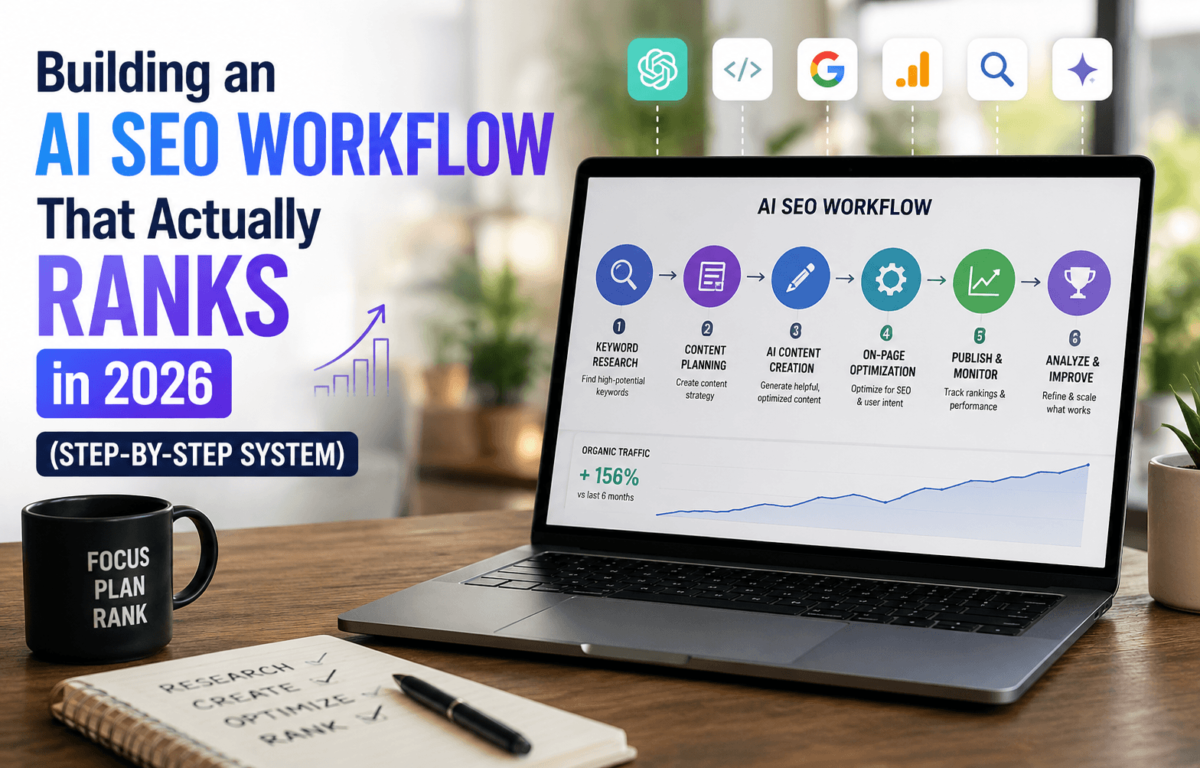
An AI SEO workflow is a connected series of steps where AI tools handle the heavy lifting (keyword research, content drafting, optimization suggestions) while you — the human — guide strategy, review output, and add real experience to the content.
Think of AI as your highly efficient intern. Fast, knowledgeable, but needs direction and a final check before anything goes live.
Why Most AI SEO Workflows Fail
Ever wonder why your AI content isn’t ranking even though you’re publishing consistently? Here’s what’s really going on:
- No clear keyword-to-intent mapping — traffic without conversion is useless
- Publishing AI drafts without editing — Google’s quality signals catch this fast
- Tool overload with no integration — 7 tools open but no clear pipeline
- Zero optimization for AI search engines like ChatGPT or Perplexity
- Treating AI content like set-and-forget — SEO still requires iteration
What actually works in 2026 is a lean, connected workflow where every step feeds the next. Let’s build that.
The Exact AI SEO Workflow — Step by Step
Keyword Research with AI
Start with intent-first keyword research. Use a tool like Ahrefs or Semrush to find low-competition, high-intent keywords, then feed that list into ChatGPT or Claude to cluster by topic and identify content gaps. If you’re running a lean operation, no-code SEO automation tools can handle a lot of this clustering and gap analysis automatically.
Search Intent Mapping
For each keyword, define: Is this informational, navigational, or transactional? This single step determines your entire content structure.
I run the top 5 SERP results through a quick AI prompt: “Analyze these URLs and tell me the dominant search intent and content format.” Takes 3 minutes and saves hours of guessing.
Content Brief Generation
Use an AI tool (Frase, Surfer SEO, or a custom GPT prompt) to generate a detailed content brief that includes: target keyword, related terms, H2/H3 structure, word count range, and competitor gaps.
AI Content Drafting
Feed your brief into your AI writing tool of choice. I personally use Claude for long-form because the output tends to be more structured and less repetitive than other tools.
Set your prompt to match your brand voice. Paste in the brief, specify the audience, and ask for a conversational but authoritative tone. First draft usually takes under 10 minutes.
The Human Editing Layer — The Missing Piece
This is where 90% of AI SEO workflows drop the ball. Most people publish AI drafts raw. That’s a ranking death wish in 2026.
Here’s my editing checklist:
- Add 1–2 personal anecdotes or real-world observations
- Replace any generic phrases with specific, experience-based language
- Check every factual claim — AI hallucinates, and Google penalizes inaccurate content
- Adjust tone to match your brand (not a corporate manual, not a casual tweet — find your middle)
- Break up any paragraph over 4 lines — readability = lower bounce rate
Optimization for SEO + AEO
Run the edited draft through Surfer SEO or NeuronWriter to optimize for keyword density, semantic coverage, and heading structure. Then, optimize for Answer Engine Optimization (AEO):
- Include a direct 2–3 sentence answer near the top
- Use question-based H2s and H3s
- Add an FAQ section with concise, snippet-friendly answers
- Structure content with clear definitions for AI engines to extract
Publishing + Internal Linking
Don’t just hit publish and walk away. Use a tool like LinkWhisper or manually identify 3–5 internal linking opportunities. Internal links distribute authority and help Google understand your content architecture. For teams publishing at volume, automating your content publishing pipeline can eliminate hours of manual scheduling every week.
Scaling the System
Once your workflow is dialed in for one post, document it as an SOP (Standard Operating Procedure). Then:
- Batch keyword research monthly (4–8 hours, once a month)
- Brief + draft 5–10 posts per week with AI
- Dedicate 2 hours/day to human editing
- Schedule and publish in batches
The AI SEO Tool Stack (What I Actually Use)
Position these as ‘what I use’ in your content — not sponsored pushes. Authentic recommendations convert far better and don’t trigger reader skepticism. To track performance across all these tools in one place, a dedicated AI SEO dashboard makes a meaningful difference once you’re publishing at scale.
Traditional SEO vs. AI SEO Workflow
| Factor | Traditional SEO | AI SEO Workflow |
|---|---|---|
| Speed | Slow (days per post) | Fast (hours per post) |
| Cost | High (writers + tools) | Lower (AI + lean team) |
| Scalability | Limited by human bandwidth | High (system-driven) |
| Human Effort | High on all tasks | Focused on editing + strategy |
| AEO Optimization | Often overlooked | Built into the workflow |
| AI Detection Risk | N/A | Mitigated with editing layer |
Real-Life Example: Niche Blog From 0 to 28 Posts/Month
Here’s a real-world scenario of how this workflow plays out for a niche personal finance blog targeting beginner investors:
Avg. position: 34
3 posts hit page 1
+340% organic traffic
How to Avoid AI Detection (Without Losing Efficiency)
Here’s the thing — AI detection tools are imperfect, but Google’s quality raters are not. Here’s what actually reduces detection risk and improves quality simultaneously:
- Add first-person observations and hypothetical scenarios
- Vary sentence length deliberately — short punchy sentences followed by longer explanatory ones
- Rewrite any section that reads like a list of facts with zero opinion
- Run through Originality.ai before publishing — aim for under 20% AI probability
- Never publish a draft with zero edits. Even 30 minutes of humanization changes everything
Optimizing for Google SGE + ChatGPT Rankings
AI-powered search results in 2026 pull answers from structured, authoritative content. To get featured:
- Answer the primary question within the first 100 words
- Use schema markup (FAQ, HowTo, Article) — it signals structure to AI crawlers
- Write in clear, complete sentences that stand alone as answers
- Keep paragraphs tight — AI engines prefer scannable over dense
- Build topical authority by publishing cluster content around a pillar page
Common Mistakes to Avoid
- Publishing raw AI output — Google’s helpful content system will catch it
- Ignoring search intent and writing what ‘feels right’
- Using 10 tools with no documented workflow — leads to chaos and burnout
- Keyword stuffing — still a thing people do, still a thing Google penalizes
- Skipping internal links — one of the easiest ranking boosts people ignore
- Not updating older content — refreshing posts every 6 months can 2–3x their traffic
FAQs
What is an AI SEO workflow?
An AI SEO workflow is a structured system that uses AI tools to speed up and improve the process of creating SEO-optimized content — from keyword research to publishing — while keeping a human editing layer to ensure quality and authenticity.
Is AI SEO still effective in 2026?
Yes — but only when done right. Raw AI content without human editing struggles to rank. A hybrid approach that leverages AI for efficiency and humans for quality consistently outperforms both fully manual and fully automated strategies.
Can AI-generated content rank on Google?
AI-assisted content absolutely ranks. Google’s focus is on helpful, accurate, well-structured content — not on who (or what) wrote it. The human editing layer is what ensures your content meets that bar.
How do you avoid AI content detection?
Add personal observations, vary sentence structure, rewrite generic-sounding sections, and always run a final human edit. Tools like Originality.ai can help you spot high-risk passages before publishing.
What tools are best for an AI SEO workflow in 2026?
A solid stack includes: Ahrefs or Semrush for research, Claude or ChatGPT for drafting, Surfer SEO for optimization, Originality.ai for detection checks, and Zapier or Make.com for workflow automation.
How long does it take to see results with an AI SEO workflow?
Most niche sites see measurable ranking movement within 60–90 days of consistent publishing. Traffic growth compounds — the more you publish with quality, the faster rankings build.
Final Thoughts
Most people are still approaching AI SEO like it’s 2022 — pick a tool, generate content, publish, repeat. That’s not a strategy, that’s noise.
What actually works in 2026 is a real workflow: intentional keyword research, smart briefs, AI-assisted drafting, and a non-negotiable human editing layer. Add AEO optimization and a scaling system on top of that, and you’ve got a content engine that compounds over time. If you’re ready to go beyond manual workflows, explore how AI SEO automation systems can run the entire pipeline with minimal hands-on time.
The SEO game has shifted. The winners aren’t the ones who publish the most AI content — they’re the ones who’ve built the smartest system for combining AI speed with human judgment.
Build the workflow. Trust the process. Iterate monthly. That’s how you rank faster with less work in 2026.