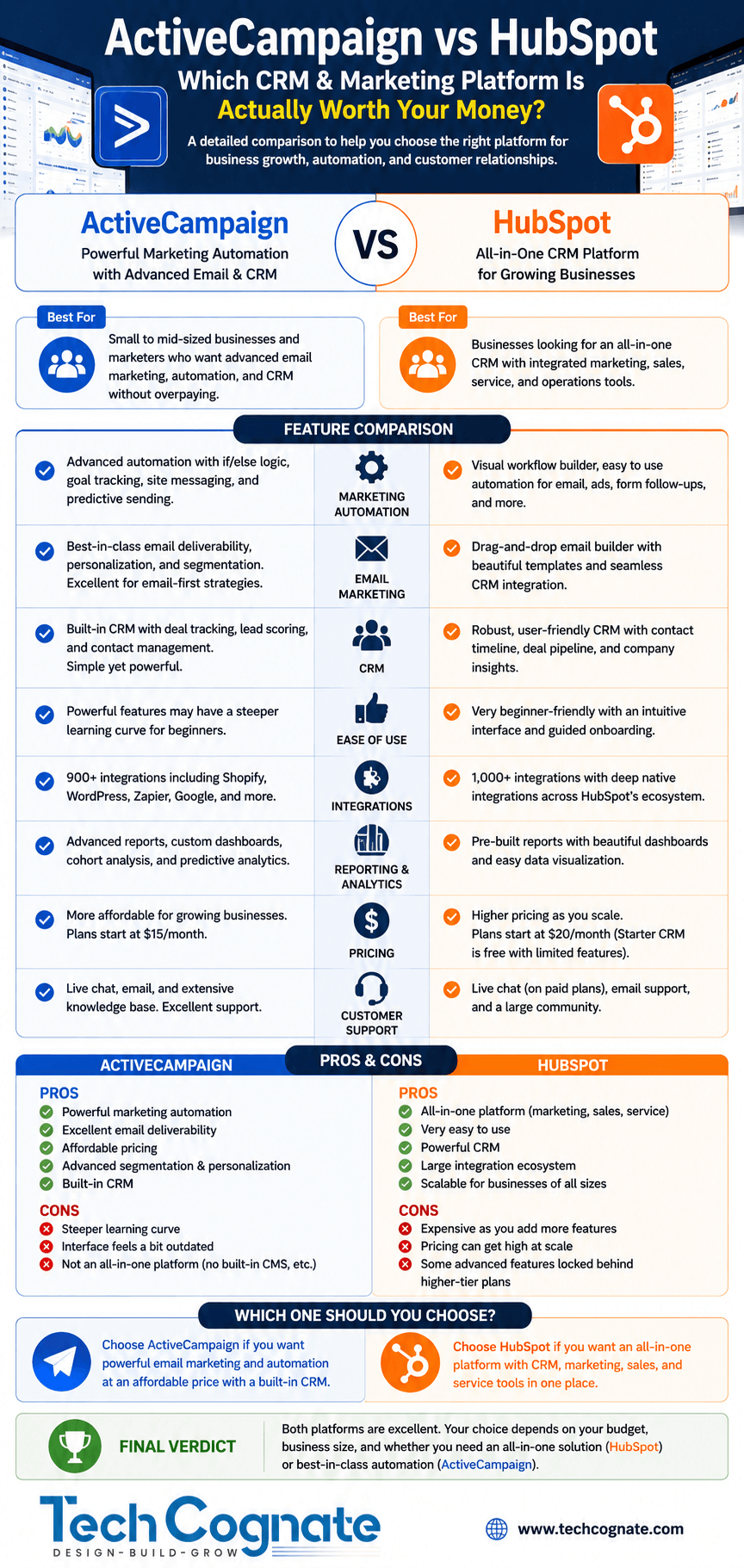
ActiveCampaign vs HubSpot — full platform comparison infographic
Best Automation
ActiveCampaign
Best CRM
HubSpot
Best Ecommerce
ActiveCampaign
Best AI Features
HubSpot
Best Value
ActiveCampaign
Best Overall
HubSpot
What Is ActiveCampaign?
Founded in 2003 in Chicago, Illinois, ActiveCampaign started as a simple email marketing tool and has since grown into one of the most sophisticated marketing automation platforms available for small and mid-sized businesses.
Today, ActiveCampaign serves over 180,000 customers across 170+ countries. The platform sits in a unique middle ground — it’s more powerful than basic email marketing tools like Mailchimp, but more affordable and approachable than enterprise platforms like Salesforce or Marketo.
→Messaging — SMS, site messages, Facebook Custom Audiences
→Ecommerce Integrations — deep Shopify, WooCommerce, and BigCommerce integrations
✔ Strengths
Best-in-class visual automation builder Exceptional email deliverability rates Highly flexible segmentation & tagging More affordable at equivalent features Deep ecommerce integrations with revenue tracking
✘ Weaknesses
CRM is less robust than HubSpot’s No free plan — only a 14-day trial Reporting can feel complex Steeper learning curve for new users Limited landing page & CMS features
What Is HubSpot?
HubSpot was founded in 2006 by Brian Halligan and Dharmesh Shah at MIT and has grown into one of the world’s leading CRM and marketing platforms. The company went public in 2014 and now serves over 200,000 customers across 120+ countries.
What sets HubSpot apart is its Hubs model — each product (Marketing Hub, Sales Hub, Service Hub, CMS Hub, Operations Hub) can be used standalone or combined into a unified platform. This modular approach makes HubSpot highly scalable, which is part of why it’s the go-to platform for growing businesses and enterprise teams.
Core Products
→Marketing Hub — email, automation, landing pages, social media, ads
→Service Hub — help desk, knowledge base, tickets, customer feedback
→CMS Hub — website builder, blog, SEO tools, A/B testing
→Operations Hub — data sync, automations, and workflow extensions
→Commerce Hub — payments, invoices, quotes
✔ Strengths
Excellent free CRM — no credit card required Seamless cross-Hub integration Best-in-class reporting & attribution Excellent AI features via Breeze Strong onboarding, Academy & community
✘ Weaknesses
Costs escalate rapidly at Pro/Enterprise Advanced automation locked behind $800+/mo Contract lock-in frustrates long-term users Onboarding fees can be $3,000+ Contact limits get expensive as lists grow
Ease of Use
Both platforms offer polished dashboards and intuitive navigation, but there are real differences in how quickly new users get up and running.
HubSpot
HubSpot’s dashboard is one of the most user-friendly in the marketing software category. The navigation is logical, setup wizards guide you through the basics, and the free plan lets you explore without any financial commitment. Most users can send their first email within an hour of signing up. HubSpot also invests heavily in onboarding — their in-app guides, HubSpot Academy courses, and Community forum mean you’re rarely stuck without help.
ActiveCampaign
ActiveCampaign is more powerful, but that power comes with added complexity. The automation builder is excellent, but it takes time to truly understand how automations interact with contacts, deals, and tags. New users often describe a steeper initial learning curve compared to HubSpot. That said, once you understand how ActiveCampaign’s system works, it’s extremely flexible. Power users often describe it as the most capable email and automation platform they’ve ever used.
🏆 Winner: HubSpot — More intuitive onboarding and a free plan that lets new users learn at no risk.
CRM Features Comparison
A CRM stores and manages all your customer data — contacts, deals, communication history, and sales pipeline stages. This is where the two platforms diverge most for sales-heavy teams.
Feature
ActiveCampaign
HubSpot
Contact Management
Strong tagging & segmentation
Excellent — lifecycle stages, lists
Deals / Opportunities
Visual deal pipelines
Advanced deal tracking & forecasting
Pipeline Management
Good — visual drag-and-drop
Excellent — customizable pipelines
Lead Scoring
Robust contact scoring
Predictive AI lead scoring
Sales Sequences
Limited
Excellent — automated follow-ups
Meetings Scheduler
Third-party integrations
Built-in meeting link tool
Quotes & Payments
No
Yes — native quotes & Commerce Hub
CRM Reporting
Good
Best-in-class dashboards
🏆 Winner: HubSpot — Deeper pipeline tools, native meeting scheduling, quotes, and predictive lead scoring make HubSpot the clear CRM winner.
Email Marketing Comparison
Email is where both platforms started, but they’ve each evolved differently. ActiveCampaign treats email marketing as a core competency. HubSpot treats it as one part of a bigger marketing stack.
Feature
ActiveCampaign
HubSpot
Drag & Drop Editor
Excellent — modern & flexible
Very Good — clean interface
Templates
900+ templates
80+ templates
Personalization
Deep — tags, conditions, merge fields
Good — tokens & smart content
A/B Testing
Yes — subject lines & content
Yes — subject, content, send time
Deliverability
Industry-leading (~98%)
Strong (~97%)
List Management
Tag-based flexible system
List-based with smart lists
Transactional Email
Yes (add-on: Postmark)
Yes (via API or Marketing Hub)
🏆 Winner: ActiveCampaign — Deeper personalization, more templates, superior deliverability, and tag-based flexibility give ActiveCampaign the edge for serious email marketers.
Marketing Automation
This is where ActiveCampaign absolutely shines. Marketing automation is the ability to create rule-based workflows that send emails, update contact data, trigger notifications, and move contacts through your funnel — without manual intervention.
ActiveCampaign Automation
ActiveCampaign’s visual automation builder is widely regarded as the most powerful in its class for small and mid-market businesses. Key features include:
→Visual drag-and-drop workflow canvas with unlimited steps
→Split testing of automation sequences
→Goal tracking within automations to skip ahead when objectives are met
→Conditional logic — If/Else branches for highly personalized journeys
→Site and event tracking for behavior-based automation
→500+ pre-built automation templates
💡 Real-World Example
A contact visits your pricing page three times without buying. ActiveCampaign detects this, triggers an automation, tags them as “High Intent,” sends a personalized email from your sales rep, and if they don’t reply in 48 hours, starts a nurture sequence — all automatically.
HubSpot Automation
HubSpot’s automation (called Workflows) is solid, especially on Professional and Enterprise plans. You can automate email sequences, contact property updates, deal stage changes, and internal notifications. However, HubSpot’s automation is not as flexible as ActiveCampaign’s at the same price point — and many advanced features require the Professional tier at $800/mo.
Feature
ActiveCampaign
HubSpot
Visual Builder
Excellent canvas builder
Good workflow editor
Conditions / Logic
Advanced if/else branches
Good — improves at Pro tier
Split Testing
Yes — test automation paths
A/B testing on emails only
Pre-built Templates
500+
~100
Behavior Triggers
Excellent — site visits, events
Good — page views, forms
AI Automation
AI-suggested next steps
AI-driven Breeze Copilot
🏆 Winner: ActiveCampaign — More flexible, more powerful, and more affordable at equivalent levels. If automation is your priority, ActiveCampaign wins by a wide margin.
AI Features
Artificial intelligence has rapidly changed what marketing platforms can do. Both platforms have invested heavily in AI — but in different areas.
Predictive send time optimization AI email content & subject line suggestions Predictive lead scoring from behavioral signals Win probability prediction for deals AI segmentation recommendations
🏆 Winner: HubSpot — HubSpot’s Breeze platform is a more comprehensive AI system covering prospecting, content, CRM, and customer service.
Ecommerce Features
If you run an online store, your marketing platform needs to integrate deeply with your ecommerce data — purchase history, cart abandonment, product views, and revenue tracking.
🏆 Winner: ActiveCampaign — Deeper native integrations, RFM segmentation, and ecommerce-specific automation make it the better pick for online stores.
Pricing Comparison
Pricing is where the two platforms diverge most dramatically — especially at scale.
Plan
ActiveCampaign
HubSpot
Free
No (14-day trial only)
Yes — CRM, email (limited)
Starter
$15/mo — 500 contacts
$15/mo — Marketing Starter
Plus / Pro
$49/mo — 1,000 contacts
$800/mo — Marketing Pro
Enterprise
Custom pricing
$3,600/mo
Per-seat fees
Included in base plans
Adds up quickly at higher tiers
Annual discount
~20% off
~10–15% off
⚠️ Hidden Costs to Watch
HubSpot charges for contacts above your plan limit · Additional Hubs (Sales Hub, Service Hub) add significant monthly costs · Onboarding fees for Professional and Enterprise HubSpot can be $3,000+ · ActiveCampaign’s transactional email (Postmark) is a separate add-on
📊 Bottom Line on Pricing
For small businesses and teams under 10 people, ActiveCampaign is almost always more affordable. For mid-market and enterprise companies that need the full HubSpot suite, the higher investment often pays for itself in efficiency gains.
Sales Features
Feature
ActiveCampaign
HubSpot
Pipeline Management
Visual drag-and-drop
Advanced with custom stages
Sales Forecasting
Basic
Advanced with AI forecasting
Meetings Scheduler
Calendly integration needed
Built-in meeting links
Quotes & Proposals
No native quoting
Yes — quotes and e-sign
Call Tracking
Via integrations
Built-in with Sales Hub Pro
🏆 Winner: HubSpot — Native meeting scheduling, quotes, sequences, forecasting, and call tracking make HubSpot the better platform for dedicated sales teams.
🏆 Winner: HubSpot — Multi-touch attribution, advanced custom dashboards, and AI-powered forecasting give HubSpot a clear edge in reporting depth.
Customer Support
Feature
ActiveCampaign
HubSpot
Live Chat
Yes (all plans)
Yes (Pro+ plans only)
Phone Support
Enterprise only
Pro+ plans
Certifications
No formal certifications
HubSpot Academy certifications
Community
Yes — active community
HubSpot Community (very active)
🏆 Winner: HubSpot — HubSpot Academy certifications, a massive community, and faster Pro-tier support give it the edge — though ActiveCampaign’s chat support on all plans is a nice touch.
Pros and Cons
ActiveCampaign
✔ Pros
✔ Most powerful marketing automation builder in its class ✔ Excellent email deliverability — consistently industry-leading ✔ Affordable at small business scale — more features per dollar ✔ Deep ecommerce integrations with Shopify, WooCommerce, BigCommerce ✔ Highly flexible tagging and segmentation system ✔ 500+ pre-built automation templates ✔ Solid contact-based pricing — not per-seat
✘ Cons
✘ No free plan — only a 14-day trial ✘ CRM is less robust than HubSpot’s for larger sales teams ✘ Steeper learning curve for non-technical users ✘ Reporting can feel complex and requires setup time ✘ Landing page builder lags behind HubSpot’s ✘ Customer support can be slow outside business hours
HubSpot
✔ Pros
✔ Free CRM is genuinely excellent — no credit card required ✔ Seamless integration across Marketing, Sales, and Service Hubs ✔ Best-in-class reporting and multi-touch attribution ✔ HubSpot Academy — certifications, courses, learning resources ✔ AI-powered features via Breeze are among the best in market ✔ Better for enterprise compliance — HIPAA, SSO, advanced permissions ✔ Native meeting scheduling, quotes, and payments
✘ Cons
✘ Pricing escalates rapidly at Professional and Enterprise tiers ✘ Advanced automation locked behind $800+/mo plans ✘ Long-term users report contract lock-in and pricing increases ✘ Onboarding fees for Pro/Enterprise can be $3,000+ ✘ Contact limits can get expensive as your list grows
Real User Reviews
To give you an honest picture, here’s what users on G2, Capterra, and Reddit consistently say about each platform.
ActiveCampaign — What Users Say
💬 What Users Love (G2 & Capterra)
Users consistently praise ActiveCampaign’s automation flexibility, saying it does things other platforms simply can’t. Many highlight the platform’s deliverability rates and the depth of contact segmentation. Ecommerce teams particularly love the Shopify integration and revenue tracking capabilities.
⚠️ Common Complaints
The most frequent complaints center on price increases as contact lists grow, occasional slowness in the interface during peak periods, and frustration with customer support response times on lower-tier plans. Some users also note that the platform’s power can be overwhelming for beginners.
HubSpot — What Users Say
💬 What Users Love (G2 & Capterra)
HubSpot users rave about how everything works together — CRM, email, landing pages, and sales tools in one place. The free CRM gets particularly high marks as a starting point. The HubSpot Academy is mentioned frequently as a resource that helps teams get more out of the platform.
⚠️ Common Complaints
Pricing is the number one complaint. Users who start on the free or Starter plan often feel forced into expensive Professional tiers just to unlock features they expected to be standard. Long-term users report frustration with annual price increases and limited flexibility in contracts.
Industry-Specific Recommendations
🏪
Small Businesses
ActiveCampaign Starter at $15/mo gives powerful automation tools without enterprise pricing.
→ ActiveCampaign
🏢
Marketing Agencies
HubSpot’s Partner Program, white-label reporting, and client portals make it the industry standard for agencies.
HubSpot dominates B2B SaaS with sequences, deal forecasting, and lifecycle stage management.
→ HubSpot
🏭
Enterprise
HubSpot scales better with custom objects, advanced permissions, SSO, HIPAA, and dedicated CSMs.
→ HubSpot
🧑💼
Freelancers
ActiveCampaign Lite is ideal — powerful automation at a price that won’t break the bank.
→ ActiveCampaign
🌍
Nonprofits
HubSpot offers significant nonprofit discounts via TechSoup — many access Pro at 40–90% off.
→ HubSpot
Migration Guide
Moving from ActiveCampaign to HubSpot
1Export all contacts as CSV from ActiveCampaign, including custom fields and tags
2Map ActiveCampaign tags to HubSpot contact properties or lists
3Recreate automation workflows in HubSpot — expect this to take time, the logic differs
4Migrate email templates — you’ll need to rebuild them in HubSpot’s editor
5Update all web forms and landing pages to point to HubSpot
6Run both platforms in parallel for 30 days to verify automation accuracy
7Transfer integrations and test API connections
Expected Timeline: 4–8 weeks for a thorough migration.
Moving from HubSpot to ActiveCampaign
1Export contacts and deal data from HubSpot CRM
2Plan your tagging strategy — ActiveCampaign uses tags where HubSpot uses lists
3Rebuild automation workflows — ActiveCampaign’s builder is different but more flexible
4Migrate email templates to ActiveCampaign’s editor
5Reconnect ecommerce integrations (easier with ActiveCampaign’s native connectors)
6Set up deal pipelines and lead scoring rules
💡 Migration Tip
Regardless of which direction you migrate, use a 30-day parallel running period where both systems are active. This lets you catch data discrepancies and ensure no contacts fall through the cracks during the transition. Don’t try to migrate everything at once — prioritize active contacts and running automations first.
Alternatives to Consider
If neither ActiveCampaign nor HubSpot feels like the right fit, here are the top alternatives and when to choose them:
HubSpot — full suite, SSO, SLAs, dedicated support
Sales-heavy B2B org
HubSpot — pipeline management and deal forecasting excel
Email-first business
ActiveCampaign — best-in-class automation and deliverability
Budget-conscious startup
ActiveCampaign — more features per dollar at lower tiers
Fast-growing SaaS
HubSpot — scales with lifecycle stages and sales enablement
Freelancers / solopreneurs
ActiveCampaign Lite — simple and affordable
Nonprofit organizations
HubSpot — generous nonprofit discount program
Final Verdict
After testing both platforms across dozens of use cases, here’s the honest bottom line: neither ActiveCampaign nor HubSpot is universally better. The right choice depends entirely on your business model, team size, and what you need the platform to do.
✔ Choose ActiveCampaign if…
•Email marketing and automation are your primary needs •You run an ecommerce store on Shopify or WooCommerce •Budget is a primary concern with under 5,000 contacts •You need advanced if/else automation logic without enterprise prices •Email deliverability is a top priority •You’re a freelancer, solopreneur, or small team
✔ Choose HubSpot if…
•You need a full CRM with sales pipeline and deal management •You run a B2B or agency that needs marketing and sales aligned •Reporting and attribution are critical business requirements •You’re scaling past 20 employees and need enterprise-grade tools •AI features (prospecting, content generation) matter to your workflow •You want one platform for marketing, sales, service, and CMS
⚡ Don’t Choose Either If…
You have a tiny list under 500 contacts and no plans to grow — a free Mailchimp or Brevo plan might suit you fine. Or if you’re an enterprise with complex data needs and a large budget, Salesforce Marketing Cloud might be worth the investment instead. Also check out our guide on AI-powered marketing strategies to complement whichever platform you choose.
It depends on your priorities. ActiveCampaign is better for email marketing and automation — especially at small business budgets. HubSpot is better as an all-in-one CRM and growth platform, particularly for B2B companies and larger teams.
Which is cheaper — ActiveCampaign or HubSpot?
ActiveCampaign is generally more affordable for small businesses. The Starter plan starts at $15/mo. HubSpot’s free plan exists, but meaningful automation requires the Professional tier at $800/mo — a significant jump.
Which has a better CRM?
HubSpot has a significantly better CRM. It’s more feature-rich with native meeting scheduling, quotes, sequences, and better reporting. ActiveCampaign’s CRM is solid but better suited to simple deal tracking for small teams.
Which has better marketing automation?
ActiveCampaign wins on marketing automation — by a wide margin at comparable price points. Its visual builder is more flexible, supports more complex logic, and includes 500+ pre-built templates. You can learn more about automation systems here.
Which has better email marketing?
ActiveCampaign edges out HubSpot for email marketing with better deliverability, more templates, deeper personalization, and a more advanced sending system. HubSpot’s email tool is solid but secondary to its CRM.
Does ActiveCampaign have a free plan?
No. ActiveCampaign does not offer a free plan — only a 14-day free trial on all plans. HubSpot, by contrast, offers a genuinely free CRM with basic email marketing features.
Is HubSpot worth the price?
For mid-market and enterprise businesses that need a full sales and marketing suite, yes — HubSpot delivers exceptional value. For small businesses or email-focused teams, the Professional and Enterprise tiers are often more than what’s needed.
Which platform is easier to use?
HubSpot is easier to get started with. The free plan, guided setup, and HubSpot Academy make onboarding straightforward. ActiveCampaign has a steeper learning curve, though power users often prefer its flexibility once mastered.
Which is better for Shopify?
ActiveCampaign has a deeper, more native Shopify integration — including revenue attribution, product-based segmentation, and ecommerce-specific automation templates. HubSpot’s Shopify integration works but is less developed.
Which is better for agencies?
HubSpot is the agency standard. The HubSpot Partner Program, client-level reporting, and ability to manage multiple accounts make it the better platform for marketing agencies.
Can I migrate from one platform to the other without losing data?
Yes, with preparation. Both platforms support contact exports via CSV. You’ll need to remap custom fields and rebuild automations manually — there’s no direct migration connector. Allow 4–8 weeks for a thorough migration.
Which has better AI features?
HubSpot’s Breeze AI platform is more comprehensive — covering content creation, prospecting, customer service, and data enrichment. ActiveCampaign’s AI is more focused on predictive sending and lead scoring. Learn more about AI-powered tools for marketers.
Which platform scales better?
HubSpot scales better for large organizations that need enterprise features like SSO, custom objects, advanced permissions, and multi-Hub integration. ActiveCampaign scales well for growing email and automation needs but has fewer enterprise safeguards.
Can ActiveCampaign replace HubSpot?
For email marketing and basic CRM needs — yes. For full sales enablement, reporting, service tools, and enterprise CRM functionality — no. The two platforms serve overlapping but distinct use cases.
What is the best CRM for small business?
For small businesses prioritizing email automation, ActiveCampaign is the top pick. For small businesses that need a free starting point with a full CRM, HubSpot’s free plan is hard to beat.
Which platform is best for B2B?
HubSpot is the preferred platform for B2B companies, especially in SaaS, professional services, and enterprise sales. Its Sales Hub, sequences, meeting scheduling, and lifecycle stage management align well with complex B2B sales cycles.
Which platform is best for ecommerce?
ActiveCampaign is the better choice for ecommerce — particularly for Shopify and WooCommerce stores. Deeper integrations, RFM segmentation, abandoned cart flows, and revenue attribution give it a clear advantage.
Are there hidden costs with HubSpot?
Yes. Contact limits, additional Hubs (Sales Hub, Service Hub), and onboarding fees for Professional/Enterprise can significantly increase your total cost. Always model out your full cost based on contact count and required features before committing.
Which is better for email deliverability?
ActiveCampaign consistently ranks among the top email marketing platforms for deliverability rates. Their infrastructure and compliance monitoring are excellent. HubSpot is also strong, but ActiveCampaign is the deliverability leader.
Does HubSpot have SMS marketing?
Yes. HubSpot offers SMS marketing as part of Marketing Hub Professional and Enterprise plans, and through the Operations Hub. ActiveCampaign also offers SMS as an add-on.
Which platform is better for lead nurturing?
ActiveCampaign excels at lead nurturing with its multi-step automation sequences, conditional logic, and behavior-triggered campaigns. HubSpot’s lead nurturing is solid on Professional+ plans.
What makes ActiveCampaign unique?
ActiveCampaign’s combination of visual automation power, ecommerce integrations, deliverability, and affordability at small business scale is what makes it unique. No other platform in its price range matches its automation depth.
What makes HubSpot unique?
HubSpot’s integrated platform — combining CRM, marketing, sales, service, and CMS in one system — is its defining advantage. The seamless data flow across Hubs, combined with AI features and the HubSpot Academy, creates an ecosystem that’s hard to replicate. Check out how AI is reshaping modern SEO and marketing.
Which platform is better for nonprofits?
HubSpot — the company offers nonprofit discounts through TechSoup that can reduce the cost of HubSpot Professional significantly. Many nonprofits access HubSpot at 40–90% discounts.
Can I use ActiveCampaign as a CRM?
Yes. ActiveCampaign has a built-in CRM with deal pipelines, contact records, task management, and lead scoring. It works well for small to mid-sized sales teams, though it lacks the depth of HubSpot’s Sales Hub.
About the author
Jaykishan Panchal
Founder, TechCognate · SEO Strategist & WordPress Expert
Jaykishan Panchal is the founder of TechCognate and an SEO strategist with 15+ years of hands-on experience driving organic growth for businesses worldwide. He specialises in technical SEO, content strategy and GEO (Generative Engine Optimisation), helping brands stay visible in both traditional search and AI-driven discovery.