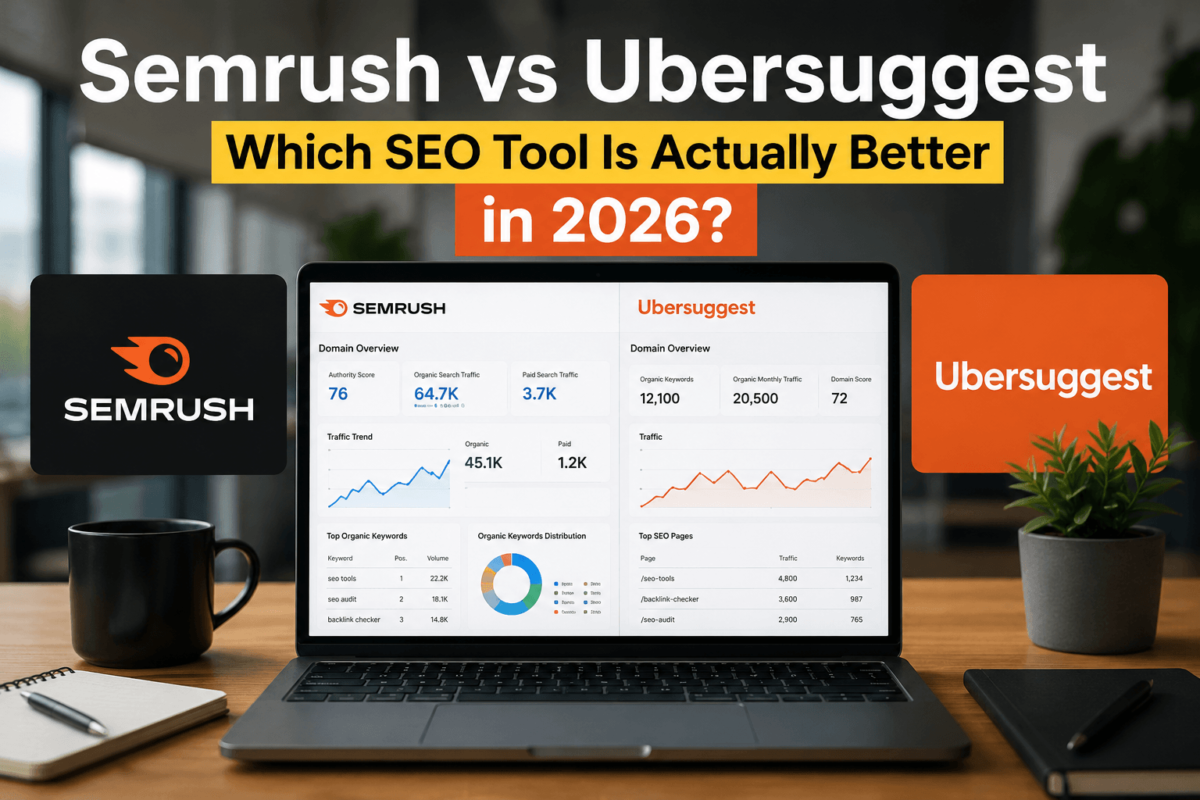
Semrush vs Ubersuggest 2026: Which SEO Tool Actually Deserves Your Budget?
A practical, feature-by-feature comparison for bloggers, agencies, ecommerce stores, and everyone in between
Quick Answer
If you’ve spent any time researching SEO tools, you’ve probably landed on this exact question: Semrush or Ubersuggest? They get compared constantly, and for good reason. They sit at almost opposite ends of the same market. One is a full marketing platform that costs as much as a car payment. The other is a budget-friendly tool built by Neil Patel’s team that promises most of the same value for a fraction of the price.
Here’s the short version, because you shouldn’t have to read 10,000 words just to get an answer: Semrush is the more capable, more accurate, and more complete tool. Ubersuggest is the more affordable, more beginner-friendly tool. Neither of those statements is an insult to either product. They’re built for different budgets and different stages of a website’s growth.
If you want the long version — the actual feature comparisons, the pricing breakdowns, the honest pros and cons, and specific recommendations based on what kind of site you run — that’s what the rest of this article covers.
Who This Comparison Is For
This guide is written for the people who actually buy these tools, not for SEO theorists. That includes:
- Small business owners trying to figure out if they need an expensive tool at all
- Bloggers and content creators choosing their first real SEO platform
- Affiliate marketers building niche sites on tight budgets
- Freelance SEO consultants deciding what to bill clients for
- Agencies managing SEO across multiple client accounts
- Ecommerce stores on Shopify or WooCommerce trying to grow organic traffic
- SaaS companies and marketing managers evaluating tools for a team
- Anyone who typed “Semrush vs Ubersuggest” into Google and got eleven affiliate-marketing articles that all say the same thing
What You’ll Learn
By the end of this article, you’ll know exactly how these two tools compare on keyword research, backlink data, site audits, rank tracking, content tools, AI features, pricing, and support. You’ll also get a clear answer for your specific situation — whether that’s “I run one blog and have $30 a month to spend” or “I manage SEO for twelve client accounts and need an API.”
One quick note before we dive in: both companies update pricing, plans, and features regularly, and Semrush in particular has restructured its plans more than once over the past year. The numbers and feature sets in this article reflect what’s publicly listed as of mid-2026. Always check the current pricing pages before you buy, because SaaS pricing has a way of shifting overnight.
Quick Comparison Table
Here’s the at-a-glance version. Every row in this table gets its own detailed section later in the article, so think of this as your map.
| Category | Semrush | Ubersuggest |
|---|---|---|
| Founded | 2008 | 2010 (acquired by Neil Patel, 2017) |
| Best For | Agencies, serious SEOs, mid-to-large businesses | Beginners, solo bloggers, budget-conscious sites |
| Starting Price | $117–$140/month (Pro plan) | $29/month (Individual plan) |
| Keyword Database | Tens of billions of keywords across 140+ countries | Billions of keywords, smaller and less granular dataset |
| Backlink Database | Trillions of backlinks, frequent re-crawls | Smaller index, less frequently refreshed |
| Site Audit | Deep technical audit, up to 100,000+ pages per crawl on Pro | Functional audit, fine for small-to-mid sites |
| Rank Tracking | Daily, desktop and mobile, up to 500+ keywords on Pro | Available on all paid plans, smaller keyword caps |
| Local SEO | Dedicated Local toolkit (add-on, priced per location) | Basic local tracking included, not a dedicated toolkit |
| AI Features | AI Visibility Toolkit, AI Article Generator, MCP for AI assistants | AI Writer for blog content and social copy |
| Content Tools | Full Content Marketing Toolkit (Guru and above) | Content Ideas tool plus AI Writer |
| PPC Research | Advertising Toolkit, competitor ad copy, ad history | Basic competitor ad visibility, far less depth |
| Competitor Analysis | Deep domain comparison, gap analysis, Share of Voice | Domain overview with traffic and keyword estimates |
| Free Version | Limited free account (10 keywords tracked, capped searches) | Free plan with daily search limits |
| Free Trial | 7-day free trial, credit card required | 7-day free trial on monthly plans |
| Ease of Use | Steeper learning curve, dense interface | Simple, beginner-friendly dashboard |
| Learning Curve | Several weeks to feel fluent | A day or two to get comfortable |
| Overall Rating | 9.2 / 10 for capability and depth | 7.8 / 10 for value and simplicity |
| Winner | Best for serious, ongoing SEO work | Best for getting started without overspending |
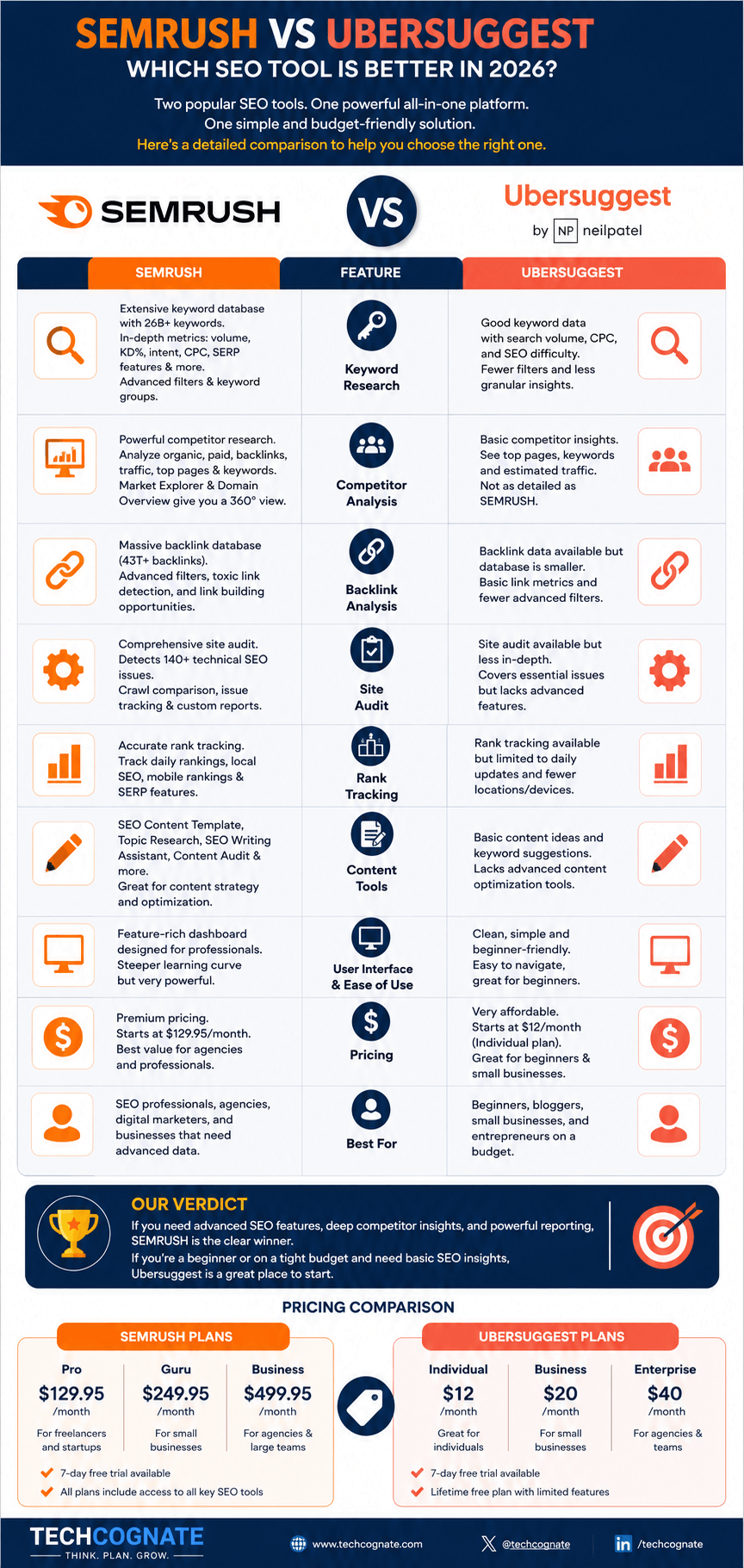
TL;DR — Quick Recommendations by Situation
You don’t need to read the whole article to make a decision today. Here’s the short answer based on where you’re starting from.
If you’re a beginner
Buy Ubersuggest. You don’t yet know which features you’ll actually use, and there’s no reason to pay Semrush prices to find out. Ubersuggest’s Individual plan covers keyword research, a usable site audit, and rank tracking for around $29 a month. Learn on that, then upgrade once you understand what you’re missing.
If you’re an agency
Buy Semrush. Clients expect white-label reports, deeper backlink data, and the kind of competitive intelligence that Ubersuggest simply doesn’t offer at the same depth. The Guru or Business plan pays for itself the moment you’re managing more than two or three accounts.
If you’re serious about SEO as a long-term channel
Buy Semrush. If organic search is going to be a primary growth channel for your business — not a side project — the data accuracy gap between these two tools will eventually cost you more in missed opportunities than the subscription ever would.
If you’re on a tight budget
Buy Ubersuggest, or consider the lifetime deal if you’re confident you’ll use it for years. At $29 to $99 a month, or a one-time lifetime payment, it’s one of the few SEO tools that genuinely respects a small budget instead of nickel-and-diming you with add-ons.
If you’re running an ecommerce store
Lean toward Semrush, especially once you’re past the early stage. Product-level keyword research, competitor price and ad intelligence, and technical audits at scale matter more as a catalog grows. A small Shopify store just starting out can get by on Ubersuggest, but most ecommerce brands outgrow it within a year.
If you publish a lot of content
Buy Semrush Guru or above. The Content Marketing Toolkit — topic research, content briefs, and an AI-assisted optimization workflow — is built for teams publishing several pieces a week. Ubersuggest’s Content Ideas tool is fine for occasional inspiration, but it won’t carry a serious content operation.
If I were starting a brand-new affiliate site today with less than $100 a month to spend on tools, I’d start with Ubersuggest and put the savings into content and a few backlinks. Once that site is consistently pulling in around 30,000 monthly visits, I’d switch to Semrush — that’s usually the point where the gap in data depth starts costing you more in missed keyword opportunities than the subscription would.
What Is Semrush?
Semrush launched in 2008 as a keyword research and competitive analysis tool. Over the years it grew into what’s now best described as an all-in-one marketing platform, not just an SEO tool. The SEO toolkit is still the core product, but Semrush also covers PPC research, content marketing, social media tracking, market research, and — as of late 2025 — a dedicated AI Visibility toolkit aimed at tracking how brands show up in AI-generated answers from tools like ChatGPT and Google’s AI Overviews.
Semrush is a publicly traded company, and Adobe announced its acquisition of Semrush in late 2025 in a deal reportedly worth close to $1.9 billion, expected to close sometime in the first half of 2026. That’s worth knowing if you’re signing an annual contract, since Adobe’s acquisitions have historically come with pricing and structure changes down the line.
Company and History
Semrush is based in Boston, with development teams spread across multiple countries. It started as a Russian-founded company before relocating its headquarters and restructuring as a U.S.-based public company. Today it serves millions of marketers worldwide, ranging from solo freelancers to enterprise teams at large corporations.
Major Products Inside Semrush
- SEO Toolkit — keyword research, site audit, position tracking, on-page SEO, backlink analysis
- Content Marketing Toolkit — topic research, content briefs, an AI article generator, and content optimization scoring
- Advertising Toolkit — competitor PPC research, ad copy history, and keyword gap analysis for paid search
- Local Toolkit — listing management and local rank tracking, priced per business location
- Social Media Toolkit — competitor social tracking and scheduling
- AI Visibility Toolkit — tracks brand mentions and citations across AI assistants and AI-powered search results
- Trends — market research and traffic-pattern analysis for entire industries, sold as a separate add-on
Who Should Use Semrush
Semrush makes the most sense for agencies juggling multiple client accounts, in-house SEO teams at companies where organic traffic is a real revenue driver, and serious affiliate marketers or content publishers who need accurate data to make decisions worth real money. If you’re billing clients, reporting to a boss, or making investment decisions based on keyword and competitor data, the deeper dataset usually pays for itself.
Semrush Pros
- One of the largest keyword and backlink databases in the industry
- Genuinely all-in-one — SEO, content, PPC, and social research live in the same place
- Strong technical site audit that catches issues most cheaper tools miss
- Frequent data refreshes and active product development
- Now offers MCP (Model Context Protocol) access, letting AI assistants like Claude or ChatGPT pull live Semrush data directly into a workflow
Semrush Cons
- Expensive, especially once you start adding extra user seats or toolkit add-ons
- Pricing structure has gotten more complicated with the Semrush One bundles layered on top of the original Pro, Guru, and Business tiers
- Dense interface that takes real time to learn
- No self-serve cancel button — you have to contact support to cancel a subscription
- Single user seat per account by default; additional seats cost extra on every tier
What Is Ubersuggest?
Ubersuggest started life as a simple, free tool that pulled keyword suggestions from Google Suggest. Neil Patel — a well-known figure in digital marketing and co-founder of Crazy Egg and Hello Bar — acquired it in 2017 and rebuilt it into a full SEO suite. The pitch hasn’t changed much since: give people most of what they need from an SEO tool without charging Semrush-level prices.
Neil Patel’s Role
Neil Patel is the public face of Ubersuggest, and that matters more than it would for most software products. His name brings a built-in audience and a massive free education library — blog posts, YouTube videos, and webinars that double as onboarding material for the tool. It also means some people approach Ubersuggest skeptically simply because of how aggressively it’s marketed. Worth judging the tool on what it does, not on how it’s promoted.
Core Features
- Keyword research with search volume, keyword difficulty, and CPC estimates
- Site audit with Google Search Console integration
- Rank tracking across desktop and mobile
- Backlink data and a backlink checker
- Content Ideas tool for finding what’s already performing well on a topic
- AI Writer for blog posts, social captions, and meta tags
- A Chrome extension that overlays keyword data directly onto Google search results
- Biweekly group coaching calls with Neil Patel, included on paid plans
Target Audience
Ubersuggest is built for solo bloggers, small business owners, freelancers, and anyone who needs functional SEO data without an enterprise budget. It’s not trying to compete with Semrush feature-for-feature — it’s trying to cover the 70 to 80 percent of SEO work that most small operators actually need, at a fraction of the price.
Ubersuggest Pros
- Genuinely affordable, with monthly plans starting around $29 and lifetime one-time-payment options available
- Simple, clean dashboard that’s easy to learn in a day or two
- All core features are available on every paid plan — you’re paying for higher usage limits, not gated features
- Free training and coaching included, which is genuinely useful for beginners
- No setup fees and no contracts on the monthly plans
Ubersuggest Cons
- Keyword difficulty scores tend to underestimate real competition
- Backlink and referring-domain counts run noticeably lower than Semrush, Ahrefs, or Moz
- Organic traffic estimates tend to run higher than what tools with larger datasets report
- No API access
- Missing advanced features like detailed keyword gap analysis and lost-backlink tracking
- The free plan is limited to a small number of daily searches, which makes it more of a demo than a usable free tier
Semrush vs Ubersuggest at a Glance
Before getting into the feature-by-feature breakdown, here’s a wider lens on how the two tools stack up across the categories that actually drive a purchase decision.
| Category | Semrush | Ubersuggest | Winner |
|---|---|---|---|
| Data Depth | Tens of billions of keywords, trillions of backlinks | Smaller dataset, fewer countries covered in depth | Semrush |
| Pricing | $117–$500+/month, add-ons stack up fast | $29–$99/month, or one-time lifetime plans | Ubersuggest |
| Ease of Use | Dense, takes time to learn | Simple, intuitive from day one | Ubersuggest |
| Site Audit Depth | Crawls up to 100,000+ pages, detailed technical checks | Solid for small-to-mid sites, less granular | Semrush |
| Content Tools | Full Content Marketing Toolkit with AI briefs | AI Writer plus basic content ideas | Semrush |
| AI Visibility Tracking | Dedicated AI Visibility Toolkit and MCP access | Not a dedicated feature | Semrush |
| Support for Beginners | Semrush Academy courses, but a steep learning curve | Built-in coaching calls, simpler interface | Ubersuggest |
| Agency Features | White-label reporting, Share of Voice, API on Business plan | No white-label reporting or API | Semrush |
The pattern here is consistent throughout this whole article: Semrush wins almost every category that involves data depth and professional-grade features. Ubersuggest wins on price and approachability. Neither tool is “wrong” — they’re just solving different problems.
Feature-by-Feature Comparison
This is the longest section of the article, and for good reason. “Which tool is better” isn’t a single question — it’s about fifteen different questions stacked together. Let’s go through them one at a time.
Keyword Research
Winner: SemrushKeyword research is the feature most people open these tools for first, so it’s worth starting here. Semrush’s keyword database is significantly larger and covers more countries and languages with real depth, not just a token presence. You get search volume trends going back years, keyword difficulty scoring that’s been refined over more than a decade, and related-keyword suggestions pulled from actual search and clickstream data.
Ubersuggest’s keyword research tool covers the basics well — search volume, CPC, competition, and seasonal trend data — and for a single blog or small site, it usually gives you a perfectly workable starting list. Where it falls short is in keyword difficulty accuracy. Several independent reviews and user reports note that Ubersuggest’s difficulty scores tend to underestimate how competitive a keyword actually is, which can lead you to target terms that look easier than they really are.
If you’re just looking for a list of topics to write about, Ubersuggest gets you there. If you’re making investment decisions — choosing which keywords to build a content strategy or paid campaign around — Semrush’s data is the safer foundation. If you want to dig deeper into building a keyword list the right way, see our long-tail keyword research guide.
Competitor Research
Winner: SemrushBoth tools let you plug in a competitor’s domain and see their top keywords, estimated traffic, and top pages. Semrush goes considerably further with keyword gap analysis (showing exactly which keywords a competitor ranks for that you don’t), Share of Voice tracking across an entire market category, and historical data that lets you see how a competitor’s visibility has changed over years, not just the current snapshot.
Ubersuggest’s domain overview is genuinely useful for a quick gut-check on a competitor — you can see their estimated traffic, top keywords, and backlink count at a glance. It’s just shallower. There’s no real gap analysis tool, and the historical view is limited.
Backlink Analysis
Winner: SemrushThis is one of the bigger gaps between the two tools. Semrush’s backlink index is one of the largest in the industry, re-crawled frequently enough to catch new and lost links quickly. Multiple independent reviews comparing backlink and referring-domain counts have found Ubersuggest consistently reports lower numbers than Semrush, Ahrefs, or Moz for the same domain — not because those domains have fewer links, but because Ubersuggest’s index simply hasn’t found them.
For link building work — finding link opportunities, auditing a site’s backlink profile before a Google penalty review, or doing competitive link gap analysis — this difference matters a lot. Ubersuggest’s backlink checker is fine as a directional indicator (“does this domain have roughly a little or a lot of backlinks”), but it’s not the tool you want for serious link-building strategy. For a deeper dive into building links the right way, check our link building strategies guide.
Technical SEO and Site Audit
Winner: SemrushSemrush’s Site Audit tool crawls a site and flags issues across more than 140 technical and on-page checks — broken links, duplicate content, crawlability problems, Core Web Vitals issues, structured data errors, and more. On the Pro plan you can crawl up to 100,000 pages per project, which covers everything from a small blog to a mid-sized ecommerce catalog.
Ubersuggest’s audit covers the fundamentals well: it pulls in Google Search Console data, flags common on-page issues, and gives you a prioritized list of fixes. For a small site, it does the job. Where it shows its limits is on larger or more technically complex sites, where the lack of granular crawl settings and deeper technical checks starts to matter.
If you’re managing a 30-page blog, either tool’s audit will catch your real problems. If you’re managing a 5,000-product ecommerce catalog with faceted navigation and pagination issues, you want Semrush. Our technical SEO checklist covers what to look for beyond any single audit tool.
Rank Tracking
Winner: Tie, with a caveatBoth tools track keyword rankings daily across desktop and mobile, and both let you segment by location. The real difference is volume. Semrush’s Pro plan tracks up to 500 keywords, Guru extends that to 1,500, and Business goes up to 5,000. Ubersuggest’s Individual plan caps out at 300 tracked keywords, which is plenty for a single site but starts to feel tight once you’re managing rankings across multiple properties or a large content library.
If you’re tracking rankings for one site with a focused keyword list, Ubersuggest covers it. If you’re tracking hundreds of keywords across multiple client sites, Semrush’s higher caps and multi-location tracking on Guru and above make more sense.
Local SEO
Winner: SemrushSemrush has a dedicated Local toolkit built specifically for businesses that depend on local search — think dentists, restaurants, law firms, or any multi-location business. It includes listing management, review monitoring, and local rank tracking, priced per business location as an add-on rather than bundled into the core plans.
Ubersuggest includes basic local rank tracking on its paid plans but doesn’t have an equivalent dedicated local SEO toolkit. For a single-location small business that mostly cares about ranking in their own city, Ubersuggest’s basic local tracking might be enough. For multi-location businesses or agencies serving local clients, Semrush’s Local toolkit is built for exactly that job. See our local SEO strategies guide for more.
Content Marketing
Winner: SemrushSemrush’s Content Marketing Toolkit, available on Guru and above, includes a Topic Finder for discovering content ideas, a Content Optimizer that scores drafts against top-ranking pages, an AI Article Generator, and an SEO Writing Assistant that plugs into Google Docs and WordPress. It’s built as an actual workflow — research, draft, optimize, publish — rather than a single isolated feature.
Ubersuggest’s content tools are simpler: a Content Ideas tool that shows you what’s already performing well for a given topic, plus the AI Writer for drafting posts and social copy. It’s enough to keep a single blog moving, but it doesn’t offer the same depth of optimization scoring or topic clustering that a content-heavy publishing operation usually wants.
Content Optimization
Winner: SemrushContent optimization tools score your draft against what’s already ranking for a target keyword and suggest related terms, ideal length, and readability improvements. Semrush’s Content Optimizer does this well and integrates directly into a writing workflow. Ubersuggest doesn’t have a dedicated content-scoring tool in the same vein — its strength is generating ideas and first drafts through the AI Writer, not refining an existing piece against competitor benchmarks.
If your content strategy depends on hitting specific on-page optimization targets for competitive terms, this is a real gap. If you’re mostly publishing helpful, well-written content and letting good writing do the work, it matters less. Our AI content optimization guide covers this in more detail.
AI Writing Tools
Winner: Depends on what you needBoth tools now include AI writing features, and they’re aimed at slightly different jobs. Semrush’s AI Article Generator works inside its broader content optimization workflow, pulling in keyword and competitor data to inform the draft. Ubersuggest’s AI Writer is more standalone — pick a keyword, generate a title, then generate an outline and full draft, with options to regenerate sections you don’t like.
For straightforward blog drafting on a budget, Ubersuggest’s AI Writer is genuinely handy and included in the price of the plan. For AI-assisted content that’s tightly integrated with SEO data and optimization scoring, Semrush’s version is the stronger tool — though you’re paying Guru-tier prices to get it.
SERP Analysis
Winner: SemrushSemrush shows detailed SERP feature data for any keyword — featured snippets, People Also Ask boxes, local packs, video results, and how often these features appear and change over time. This kind of granularity matters if you’re trying to win a featured snippet or understand why a competitor outranks you despite a weaker backlink profile.
Ubersuggest shows SERP results too, but with less detail on which specific SERP features are present and how volatile they’ve been historically. It’s enough to see who you’re competing against; it’s not enough to reverse-engineer why the SERP looks the way it does.
PPC Research
Winner: SemrushSemrush’s Advertising Toolkit shows competitor ad copy history, estimated PPC budgets, and which keywords competitors are bidding on — useful whether you’re running Google Ads yourself or just trying to understand a competitor’s paid strategy. This kind of paid-search intelligence is a meaningful part of why agencies pay for Semrush specifically.
Ubersuggest shows some competitor ad visibility, but it’s a much thinner layer of data. If PPC research is a core part of your work, Semrush is built for that job in a way Ubersuggest simply isn’t trying to be.
Advertising Intelligence
Winner: SemrushBeyond basic PPC keyword research, Semrush layers in ad copy archives, landing page tracking for competitor campaigns, and display advertising intelligence. This is overkill for a single blogger but genuinely valuable for an agency pitching a paid media retainer alongside SEO work.
Social Media Tools
Winner: SemrushSemrush’s Social Media Toolkit, sold as a separate add-on, covers competitor social tracking and post scheduling. Ubersuggest doesn’t have an equivalent social media management feature, though its AI Writer can generate social captions as part of its content tools. Neither tool is trying to replace a dedicated social media platform like Buffer or Hootsuite, but Semrush at least offers something in this category.
Reporting
Winner: SemrushSemrush supports white-label, branded PDF and dashboard reports, plus integrations with Looker Studio for custom reporting builds on the Guru plan and above. For agencies, this is a meaningful part of the value proposition — clients see a polished report with your branding, not Semrush’s.
Ubersuggest’s reporting is simpler and more functional — clean dashboards and exportable data, but no white-label branding option. If you’re a freelancer reporting directly to a client without needing your own branding on the report, this matters less. See our SEO reporting guide for how to structure client reports either way.
Integrations
Winner: SemrushSemrush integrates with Google Analytics, Google Search Console, Google Business Profile, Google Ads, Looker Studio, and a long list of CRM and project management tools. Ubersuggest’s integration list is shorter — Google Search Console, Google Analytics, WordPress, and a few SEO-adjacent tools like SEOZoom. It covers the essentials but doesn’t reach as far into a broader marketing stack.
API Access
Winner: SemrushThis one isn’t close. Semrush offers API access exclusively on its Business plan, letting you pipe data directly into custom dashboards or internal tools. Ubersuggest has no API access at all, for any plan. If your workflow depends on programmatic access to SEO data, Ubersuggest is off the table entirely, full stop.
Workflow Automation
Winner: SemrushSemrush’s API access and MCP support open the door to real workflow automation — scheduled reports, automated data pulls into internal dashboards, and AI assistants that can query Semrush data directly. Ubersuggest doesn’t offer this kind of automation layer. Its workflow is built around logging into the dashboard and working through the interface manually. Our AI SEO workflow guide covers how tools like this fit into an automated pipeline.
Chrome Extensions
Winner: TieBoth companies offer a free Chrome extension that overlays keyword and SEO data directly onto Google search results as you browse. Semrush’s extension shows keyword difficulty, search volume, and SERP data; Ubersuggest’s does something very similar. Neither one clearly beats the other here — they’re both genuinely useful for quick, in-the-moment research without opening the full dashboard.
Learning Resources
Winner: Tie, for different reasonsSemrush Academy offers free courses and certifications covering SEO, content marketing, and PPC — genuinely solid material if you want a structured education alongside the tool. Ubersuggest leans on Neil Patel’s enormous free content library — blog posts, YouTube videos, and the biweekly group coaching calls included with paid plans. Both are strong; they just suit different learning styles. Semrush Academy feels more like a course. Ubersuggest’s resources feel more like ongoing mentorship.
Customer Support
Winner: Ubersuggest, slightlyUser reviews for Ubersuggest frequently mention detailed, attentive email support and the value of the included coaching calls. Semrush’s support is solid too, with live chat and a large knowledge base, but as a bigger company serving a much larger customer base, response times can vary more. Neither tool has a reputation for bad support — this is more a difference in feel than in substance.
User Experience
Winner: UbersuggestThis is where Ubersuggest actually does a nice job. The dashboard is clean, the navigation is straightforward, and you can find what you’re looking for without a lot of hunting. Semrush packs in so many tools that the interface can feel dense even for experienced users, let alone someone opening it for the first time. If you’ve ever opened Semrush and felt a little lost in the sidebar, you’re not alone — that’s a common first reaction, even among people who end up loving the tool once they learn it.
Mobile Experience
Winner: Neither tool excels hereBoth Semrush and Ubersuggest are built primarily as desktop web applications. Neither has a dedicated, fully-featured mobile app that replicates the full dashboard experience. If you need to check rankings or run quick research from a phone, both work reasonably well in a mobile browser, but neither was designed mobile-first.
Speed
Winner: SemrushSemrush’s larger infrastructure tends to load reports and run audits more consistently quickly, especially on larger sites. Some Ubersuggest users have reported occasional loading hiccups, particularly during heavier research sessions — usually solved with a refresh, but a mild annoyance during a focused work session.
Data Accuracy
Winner: SemrushThis is the throughline across almost every section above, so it’s worth stating plainly: Semrush’s larger, more frequently refreshed dataset produces more reliable numbers across keyword volume, backlink counts, and traffic estimates. Ubersuggest’s data isn’t useless — independent comparisons generally find its keyword volume figures reasonably close to Google’s own Keyword Planner — but its backlink counts and traffic estimates tend to diverge more from reality, usually running lower on backlinks and higher on estimated traffic compared to tools with bigger crawl budgets.
We’ll go deeper on this in the dedicated Data Accuracy Test section later in the article, including what that actually means for the decisions you make with the data.
Index Freshness and Updates
Winner: SemrushSemrush re-crawls its keyword and backlink indexes more frequently, which matters most for fast-moving niches or anyone tracking newly published competitor content. Ubersuggest’s index updates on a slower cycle, which can mean a delay before brand-new backlinks or ranking changes show up in your reports.
Scalability
Winner: SemrushSemrush is built to scale from a single freelancer up to an enterprise team managing dozens of properties, with plan tiers and add-ons designed for exactly that growth path. Ubersuggest’s plan structure tops out at its Enterprise tier, which is still modest compared to what Semrush Business or Enterprise can handle. If you expect to outgrow a small operation within a year or two, that’s worth factoring into the decision now.
Enterprise Features
Winner: SemrushSemrush offers custom Enterprise pricing with dedicated account management, onboarding support, and bespoke configurations for large organizations. Ubersuggest doesn’t have an equivalent enterprise tier or sales process — its top plan is still a fixed, self-serve subscription. If you’re at the size where you need a dedicated account manager, Semrush is the only one of the two even offering that conversation.
Agency Features
Winner: SemrushBetween API access, Share of Voice tracking, white-label reporting, and the ability to manage dozens of client projects under one account, Semrush is clearly built with agencies in mind at the Business tier. Ubersuggest’s plans can technically be used by an agency on a tight budget, but you’ll be working around the lack of white-label reports and limited project caps rather than working with built-for-purpose features.
White Label Reporting
Winner: SemrushSemrush lets agencies generate fully branded PDF and dashboard reports for clients, removing Semrush’s own branding entirely. This is a meaningful differentiator for client-facing work. Ubersuggest has no white-label reporting option, so any report you send to a client will carry Ubersuggest’s branding.
Team Collaboration
Winner: SemrushSemrush supports multiple user seats (at extra cost per seat on every tier) with shared projects and permission settings. Ubersuggest’s Business and Enterprise plans support a few user seats as well, but the collaboration tools are more basic — fewer permission settings and less granular control over who can see or edit what.
Pricing Comparison
This is the section most people actually came here for, so let’s be specific instead of vague. Prices below reflect publicly listed rates as of mid-2026. Both companies adjust pricing periodically, so treat these as a strong baseline and double-check the current pricing pages before you buy.
Semrush Pricing
Semrush’s core SEO Toolkit comes in three tiers, each billed monthly or annually (annual billing saves around 17 percent):
| Plan | Monthly Price | Annual Price (per mo.) | Includes |
|---|---|---|---|
| Pro | $139.95 | $117.33 | 5 projects, 500 tracked keywords, core SEO toolkit |
| Guru | $249.95 | $208.33 | 15 projects, 1,500 keywords, content tools, historical data |
| Business | $499.95 | $416.66 | 40 projects, 5,000 keywords, API access, white-label reports |
Semrush also sells Semrush One, a newer bundle that pairs the traditional SEO toolkit with the AI Visibility Toolkit. Those bundles start around $199 a month for the entry tier and scale up similarly to the Classic plans.
What’s Not Included in the Base Price
This is the part most comparison articles gloss over, and it matters for your actual budget. Several add-ons sit outside the core plans:
- Additional user seats — priced per seat per month on every tier, since each account includes only one user by default
- Local SEO toolkit — priced per business location
- Content Marketing Toolkit add-on — available standalone if you’re on Pro and want content tools without upgrading to Guru
- Advertising Toolkit — sold separately for deeper PPC research
- AI Visibility Toolkit — available standalone or bundled into Semrush One
- Traffic & Market Trends — a premium add-on for market-level traffic analysis
A solo user on the Pro plan paying $117 to $140 a month will likely pay close to the sticker price. A small agency on Guru with a few extra seats and a couple of add-ons can realistically end up paying two to three times the advertised plan price. That’s not a hidden fee in the deceptive sense — Semrush lists all of this clearly — but it’s easy to miss if you only look at the headline number.
Ubersuggest Pricing
Ubersuggest’s pricing is much simpler, and the simplicity is part of its appeal. Three monthly tiers, plus one-time lifetime plans for each:
| Plan | Monthly Price | Lifetime Price | Includes |
|---|---|---|---|
| Individual | $29 | $290 one-time | 1–3 domains, 300 tracked keywords, full feature set |
| Business | $49 | $490 one-time | Higher usage limits, more projects, full feature set |
| Enterprise | $99 | $990 one-time | Highest limits, more user seats, full feature set |
The detail that’s easy to miss: Ubersuggest doesn’t gate core features behind higher tiers the way Semrush does. Keyword research, site audit, rank tracking, backlink analysis, and the AI Writer are all available on the Individual plan. What you’re paying for as you move up tiers is higher usage limits — more tracked keywords, more domains, more searches per day — not access to entirely new tools.
The Lifetime Deal
Ubersuggest’s lifetime plans are genuinely unusual in this market. Pay once, and you keep access (including future updates) for as long as Ubersuggest continues operating that plan tier. At roughly 10 months of the monthly price, the lifetime deal pays for itself well within a year for anyone confident they’ll keep using the tool long-term.
The catch worth knowing about: lifetime purchases are typically final and non-refundable, and some users have reported feature changes or seat reductions on lifetime plans over time. If you’re going this route, read the current terms carefully and don’t treat it as a purely risk-free decision just because it’s framed as a deal.
Refund Policy
Semrush offers a 7-day money-back guarantee on new subscriptions, separate from its 7-day free trial — useful if you start a paid plan and immediately realize it’s not what you expected. Ubersuggest’s monthly plans come with a 7-day free trial as well, though a credit card is required upfront; lifetime plan purchases are generally final.
Free Trials
Both companies offer a 7-day free trial, and both require a credit card to start it — so mark your calendar if you’re testing either tool without intending to commit, since auto-renewal kicks in the moment the trial ends unless you cancel first.
Renewals and Cancellation
Here’s a genuine point in Ubersuggest’s favor: you can cancel or downgrade to a free account at any time directly from your dashboard, with no contracts on monthly plans. Semrush, by contrast, doesn’t have a self-serve cancel button — you have to contact support via chat, fill out a cancellation form, and confirm by email. It’s not a dramatic obstacle, but it is an extra step that’s worth knowing about before you sign up for an annual plan.
If you’re comparing the two purely on price-per-feature, Ubersuggest wins clearly at the entry level. But run the math on your actual use case before deciding — a $29/month Ubersuggest plan that doesn’t have the backlink data you need to do real link building isn’t actually cheaper than a $140/month Semrush plan that does the job correctly the first time.
Data Accuracy: What the Numbers Actually Show
“Which tool has more accurate data” gets thrown around a lot in comparison articles, often without much explanation of what that actually means in practice. Here’s the honest version, based on patterns that show up consistently across independent reviews, user reports, and how each company’s data infrastructure is built.
Keyword Volumes
Multiple independent users have cross-checked Ubersuggest’s keyword volume numbers against Google’s own Keyword Planner and found them reasonably close for most common search terms. Semrush’s keyword volumes are also generally reliable and, because of a larger sample size and more frequent updates, tend to hold up slightly better on long-tail and lower-volume keywords, where smaller datasets have more room for noise.
Practical takeaway: for high-volume, well-established keywords, both tools will likely point you toward similar decisions. For niche, long-tail, or newly trending terms, Semrush’s larger sample size gives you a bit more confidence.
Traffic Estimates
This is one of the more commonly cited gaps. Several reviews comparing the two tools on the same domains have found that Ubersuggest’s organic traffic estimates tend to run higher than what Semrush reports for the same site — and higher than what tools with larger crawl infrastructure, like Ahrefs, typically estimate. Traffic estimation is inherently an approximation for every SEO tool, since none of them have direct access to a site’s actual analytics unless you connect it yourself. But a consistent pattern of running high is worth knowing if you’re using these estimates to value a website for acquisition, benchmark against competitors, or report results to a client.
Backlinks and Referring Domains
This is the clearest, most consistently reported gap between the two tools. Independent comparisons checking the same domains across multiple tools have repeatedly found that Ubersuggest reports meaningfully fewer backlinks and referring domains than Semrush, Ahrefs, or Moz for identical sites. This isn’t a difference in methodology so much as a difference in crawl scale — Semrush’s backlink index is simply larger and refreshed more often, so it finds more of what’s actually out there.
If you’re doing link-building outreach, disavow file preparation, or trying to understand exactly how a competitor built their backlink profile, this gap is large enough to change your conclusions. If you just want a general sense of “does this site have a strong link profile,” either tool’s directional read is probably fine.
Site Audit Findings
Both tools catch the obvious technical issues — broken links, missing meta tags, duplicate content, slow pages. Semrush’s deeper crawl settings and larger check list tend to surface more nuanced technical issues on bigger sites, which matters more as a site’s page count and complexity grow. On a small site, the two audits will likely flag a very similar list of problems.
Ranking Positions
Rank tracking accuracy depends heavily on how frequently a tool checks positions and how it handles localized or personalized search results. Both tools track daily and segment by location, and in most side-by-side comparisons, day-to-day ranking positions reported by the two tools are close enough that the difference rarely changes a strategic decision. Where Semrush pulls ahead is in tracking volume — being able to monitor thousands of keywords rather than a few hundred — not in the precision of any single ranking check.
Here’s the honest summary if you don’t want to read the methodology: trust either tool’s keyword volume and ranking data for day-to-day decisions. Trust Semrush more for backlink and traffic numbers, especially if real money is riding on the conclusion.
Real Use Cases: Which Tool Fits Your Situation
Generic advice only goes so far. Here’s how the decision tends to play out across the specific situations people actually search this comparison for.
Best for Bloggers
Ubersuggest, in almost every case. A blogger’s core needs — keyword ideas, a basic technical audit, rank tracking for a focused list of target terms, and occasional content inspiration — are squarely inside what Ubersuggest does well. Unless you’re running a large multi-author blog with serious traffic and revenue behind it, Semrush’s extra depth is more than you need.
Best for Affiliate Marketing
It depends on the stage of the site. A brand-new affiliate site benefits from Ubersuggest’s low cost while you’re still figuring out which niches and keywords are worth pursuing. Once a site is established and earning consistent commission revenue, Semrush’s deeper competitor and backlink data becomes worth the higher price — especially for understanding why a competing affiliate site outranks you.
Best for Agencies
Semrush, without much debate. White-label reporting, Share of Voice, deeper backlink data, and the ability to manage many client projects under one account are the kinds of features agencies need to justify charging clients for SEO work in the first place.
Best for Ecommerce
Semrush tends to be the better long-term fit, particularly for catalogs with more than a handful of products. Technical audits at scale, competitor pricing and ad intelligence, and product-level keyword research all matter more as a store grows. A very small, early-stage Shopify or WooCommerce store can reasonably start on Ubersuggest and graduate to Semrush as the catalog and traffic grow. See our ecommerce SEO guide for the full playbook.
Best for SaaS Companies
Semrush, mainly because SaaS companies are usually competing in crowded, high-CPC keyword spaces where backlink quality and competitor PPC intelligence genuinely move the needle. The Content Marketing Toolkit is also a good fit for the kind of high-volume content publishing many SaaS marketing teams run.
Best for Local SEO
Semrush’s dedicated Local toolkit is purpose-built for this, especially for multi-location businesses or agencies serving local clients. A single-location small business with simple local SEO needs can likely get by on Ubersuggest’s basic local tracking.
Best for YouTube
Neither tool is primarily built for YouTube SEO, though Semrush’s broader keyword data can still inform video titles and descriptions targeting search-adjacent terms. If YouTube growth is your main focus, neither of these tools should be your primary platform — that’s a job for dedicated video SEO tools.
Best for Amazon Sellers
Neither tool specializes in Amazon’s internal search algorithm, which works differently from Google. Both can help with the broader content and SEO strategy surrounding an Amazon-selling brand (like a supporting blog or off-Amazon traffic), but for actual Amazon keyword research, a dedicated Amazon SEO tool will serve you better than either Semrush or Ubersuggest.
Best for Startups
Ubersuggest, early on. Startups are usually cash-conscious and still validating which channels and keywords matter, which plays directly to Ubersuggest’s strengths. Once a startup has product-market fit and is investing seriously in organic growth as a channel, that’s the natural point to move to Semrush.
Best for Large, Established Companies
Semrush, clearly. Enterprise pricing, dedicated account management, deeper data, and integrations with the kind of marketing stack larger companies already run all point in the same direction. Ubersuggest simply isn’t built or positioned for this tier of buyer.
Pros and Cons
Semrush
Pros
- Largest and most frequently updated keyword and backlink database of the two
- Genuinely all-in-one platform covering SEO, content, PPC, and social research
- Deep technical site audits that scale to large, complex sites
- White-label reporting and agency-grade features
- API access and MCP support for automation and AI workflows
- Active, well-funded product development
Cons
- Expensive, and the real cost climbs fast once you add seats and toolkit add-ons
- Steep learning curve for new users
- No self-serve cancellation — you have to contact support
- Single user seat included by default on every plan
- Pricing structure has grown more complex with Semrush One layered alongside Classic plans
Ubersuggest
Pros
- Dramatically more affordable, with a rare lifetime-payment option
- Simple, beginner-friendly interface
- All core features available on every paid tier — you’re paying for limits, not locked features
- Free coaching calls and a huge library of free educational content
- No contracts on monthly plans, and self-serve cancellation
Cons
- Backlink and traffic data noticeably less accurate than Semrush
- Keyword difficulty scores tend to underestimate real competition
- No API access at all
- Missing advanced features like deep keyword gap analysis and lost-backlink tracking
- Free plan is limited enough to function mostly as a demo
Which Tool Is Easier to Learn?
Ubersuggest, without much debate. Most users feel comfortable navigating it within a day or two. The dashboard groups features logically, and there isn’t much hidden behind menus or secondary tabs.
Semrush takes longer — usually a few weeks before you stop feeling like you’re hunting for things. That’s partly a function of how much the platform does. A tool covering SEO, PPC, content, social, and now AI visibility tracking is going to have more surface area than a tool focused mainly on core SEO basics. Semrush Academy’s free courses help shorten that learning curve if you’re willing to invest the time upfront.
Which Tool Gives Better ROI?
This genuinely depends on what stage you’re at, and it’s worth being honest about that instead of picking a winner just to have one.
For a solo blogger or small business spending $29 a month, Ubersuggest’s ROI is excellent simply because the bar for “worth it” is low — even modest traffic gains easily justify the cost. For an agency billing clients thousands of dollars a month for SEO services, Semrush’s higher price is a rounding error against the revenue it helps generate and protect, especially through more accurate competitor and backlink data that informs strategy decisions worth real money.
Where this gets interesting is the middle ground: a growing business spending somewhere between $30 and $150 a month deciding whether to upgrade. That’s the threshold worth watching closely, and it’s exactly where the practical advice earlier in this article (start cheap, upgrade once traffic and revenue justify it) tends to apply best.
Which Tool Is Better for AI SEO?
“AI SEO” covers a few different things — optimizing for AI Overviews and chat-based answer engines, structuring content so AI assistants can parse and cite it, and tracking how often a brand shows up in AI-generated responses. On all three, Semrush is currently the stronger tool, and the gap is fairly wide.
AI Search and Google AI Overviews
Semrush’s AI Visibility Toolkit specifically tracks how a brand or domain shows up across AI-driven search and answer platforms, including ChatGPT, Google AI Overviews, and others. Ubersuggest doesn’t currently have an equivalent dedicated feature for tracking AI search visibility.
ChatGPT Visibility
Semrush’s AI Visibility tools extend specifically to monitoring brand mentions inside ChatGPT responses, which is a newer but increasingly important visibility metric as more people use conversational AI tools instead of traditional search.
Entity SEO and Knowledge Graph Optimization
Neither tool has a dedicated “entity optimization” feature in the way some specialized tools do, but Semrush’s broader keyword and topic research naturally supports building the kind of comprehensive, well-linked topical coverage that helps search engines and AI systems understand what a site is actually an authority on.
Semantic SEO and Topic Clusters
Semrush’s Topic Finder and Keyword Magic Tool support building out topic clusters — groups of related content that reinforce each other’s relevance to a subject. Ubersuggest’s Content Ideas tool can inform individual topic choices but doesn’t offer the same cluster-mapping workflow.
Internal Linking and Schema Support
Neither tool generates schema markup directly, though Semrush’s Site Audit flags structured data errors as part of its technical checks. For actually building out internal linking structures or generating schema, you’ll likely want a dedicated tool or a developer regardless of which platform you choose for keyword and competitor research. Our schema markup for AI search guide covers the structured data basics.
Bottom line: if AI visibility tracking matters to your strategy right now, Semrush is the only one of the two actively building in that direction. For the bigger picture on optimizing for this shift, see our guide to Generative Engine Optimization.
Which Tool Is Better for Traditional SEO?
For the fundamentals — keyword research, on-page optimization, technical audits, backlink analysis, and rank tracking — Semrush is the more capable tool, mostly because of its larger and more frequently refreshed dataset. That said, “better” and “necessary” aren’t the same question. Ubersuggest covers the same fundamental categories competently enough for most small-site SEO work, just with a smaller dataset behind it.
Which Tool Is Better for Beginners?
Ubersuggest. The interface is simpler, the price is forgiving if you’re still learning what you actually need, and the included coaching calls give new users a place to ask questions without feeling lost.
Which Tool Is Better for Professionals?
Semrush. Once you know SEO well enough to use deep competitor and backlink data to make real strategic decisions, Semrush’s depth stops being overwhelming and starts being genuinely useful.
Which Tool Is Better for Agencies?
Semrush, covered in detail earlier in this article. White-label reporting and deeper client-facing data make it the more defensible choice when you’re charging for SEO services.
Which Tool Is Better for Small Businesses?
It depends on the business, but for most small businesses just starting their SEO efforts, Ubersuggest offers enough capability without overspending. Small businesses in competitive local markets or crowded niches may find Semrush’s deeper data worth the jump sooner than others.
Which Tool Is Better for Enterprise?
Semrush, and it’s not particularly close. Enterprise pricing, dedicated support, API access, and the scale to manage dozens of properties are all things Ubersuggest simply isn’t built to offer.
Alternatives Worth Considering
Semrush and Ubersuggest aren’t the only two options out there, and depending on your needs, one of these might actually be a better fit than either of them.
Ahrefs
Ahrefs is generally considered Semrush’s closest direct competitor, with a backlink index that many SEOs consider the most accurate in the industry. It’s priced similarly to Semrush and is worth a look if backlink analysis and content research are your top priorities. See our Ahrefs vs Semrush comparison for the full breakdown.
Moz
Moz was one of the original SEO software companies and still offers solid keyword research and a well-respected Domain Authority metric. It’s generally positioned in the mid-price range, between Ubersuggest and Semrush. Read our Moz review for a closer look.
Mangools
Mangools (which includes KWFinder) is a genuinely good budget option with a clean, simple interface — often mentioned alongside Ubersuggest as an affordable alternative to the bigger platforms. Our Mangools review covers what it’s best at.
SE Ranking
SE Ranking sits in the middle of the market, offering a good chunk of Semrush-level functionality at a noticeably lower price point. Worth considering if Semrush feels like overkill but Ubersuggest feels too thin. Check our SE Ranking review for more.
SpyFu
SpyFu specializes heavily in competitor PPC and keyword history, with a particular strength in showing a domain’s historical ranking and ad data over time. Our SpyFu review covers where it fits in.
Serpstat
Serpstat is an all-in-one platform similar in spirit to Semrush but priced more affordably, popular among agencies looking for a lower-cost alternative without sacrificing too much depth.
Raven Tools
Raven Tools focuses on reporting and is often used by agencies specifically for client-facing dashboards and white-label reports, sometimes alongside another tool for the research itself.
Majestic
Majestic is backlink-analysis-only, but it’s deeply respected in that specific niche, with metrics like Trust Flow and Citation Flow that some SEOs still prefer over Semrush’s or Ahrefs’ backlink scoring.
Final Verdict
Let’s not dodge this with an “it depends” and call it a day — that’s a cop-out and you didn’t read this far for a non-answer. Here’s where things actually land.
Choose Semrush If…
- You’re running SEO for clients, a growing business, or anything where the data needs to hold up under scrutiny
- You need backlink data accurate enough to build a real link-building strategy on
- You’re managing multiple sites, multiple projects, or a multi-person team
- You want white-label reporting or API access
- You care about tracking AI search visibility as part of your strategy
- Your monthly marketing budget can comfortably absorb $140 or more without it being a strain
Choose Ubersuggest If…
- You’re just starting out and don’t yet know which features you’ll actually use long-term
- You’re running one or two sites with a focused, manageable keyword list
- Your budget is genuinely tight, and $29 to $99 a month is a meaningfully different decision than $140-plus
- You want a simple, fast-to-learn interface over maximum data depth
- You’re drawn to the lifetime-payment option and are confident you’ll use the tool for years
Our Recommendation
Best Overall: Semrush. It’s the more complete, more accurate, and more capable platform, and it’s built to grow with you from a solo project up to an enterprise operation.
Best Value: Ubersuggest. For what it costs, the feature set is genuinely hard to argue with, especially with every core tool available on its cheapest plan.
Best Beginner Tool: Ubersuggest. The combination of low price, simple interface, and included coaching makes it the easier first SEO tool for almost anyone.
If you remember nothing else from this article, remember this: the right tool is the one that matches where you actually are right now, not where you hope to be in two years. Buy for your current stage, and upgrade when the tool you’re using starts visibly running out of road. That’s a far better strategy than overpaying for capability you won’t touch for months, or underpaying and making decisions on data that isn’t solid enough to trust.
Frequently Asked Questions
These questions come from the kinds of things people actually ask in Google’s “People Also Ask” boxes, Reddit SEO threads, and Quora — the real, practical questions someone deciding between these two tools wants answered.
Is Ubersuggest worth paying for?
Yes, for the audience it’s built for. If you’re a solo blogger, small business owner, or beginner working with a limited budget, Ubersuggest’s paid plans deliver real, usable SEO data at a price that’s hard to beat. It’s not worth paying for if you need agency-grade backlink accuracy or API access — it simply isn’t built for that.
Can Ubersuggest replace Semrush?
For basic SEO work on a small site, mostly yes. For agency work, large-scale technical audits, deep backlink analysis, or anything requiring API access, no. Ubersuggest covers a meaningful subset of what Semrush does, not the whole thing.
Does Semrush have better keyword data?
Generally yes, especially for long-tail and lower-volume keywords where a larger sample size matters more. For high-volume, well-established keywords, the gap between the two tools narrows considerably.
Which tool has better backlinks data?
Semrush, by a meaningful margin. Independent comparisons consistently show Ubersuggest reporting fewer backlinks and referring domains than Semrush for the same domains, mainly due to a smaller crawl index.
Which tool is easier to use?
Ubersuggest. Its dashboard is simpler and faster to learn, while Semrush’s broader feature set makes for a denser, more complex interface.
Can beginners use Semrush?
Yes, but expect a learning curve of a few weeks before it feels intuitive. Semrush Academy’s free courses can help speed that up if you’re willing to invest the time.
Can agencies use Ubersuggest?
Technically yes, especially smaller agencies on tight margins, but you’ll be working around the lack of white-label reporting and the smaller dataset rather than working with features built specifically for agency use.
Is Ubersuggest accurate?
It’s reasonably accurate for keyword search volume. It tends to run less accurate on backlink counts (typically lower than reality) and organic traffic estimates (typically higher than what larger-dataset tools report).
Which tool is better for blogging?
Ubersuggest, for most bloggers. The feature set lines up well with what a blog actually needs, and the price doesn’t punish you for not running a large operation.
Which tool is better for ecommerce?
Semrush tends to be the better long-term fit as a store’s catalog and traffic grow, mainly due to deeper technical audit capabilities and competitor intelligence. Very small or early-stage stores can reasonably start with Ubersuggest.
How many keywords does Semrush have in its database?
Semrush’s keyword database spans tens of billions of keywords across more than 140 countries, though the exact figure changes as the company updates its index. Check Semrush’s own pricing or database page for the current count.
Is Semrush overpriced?
It depends entirely on what you need from it. For a solo blogger, yes, it’s more tool and more cost than necessary. For an agency or business making real decisions on the data, most users find the price justified by the depth and accuracy of what they get.
Does Ubersuggest have a free plan?
Yes, but it’s limited to a small number of daily searches, which makes it function more as a demo than a fully usable free tool for ongoing work.
Does Semrush have a free plan?
Yes, a limited free account exists, capped at a small number of tracked keywords and daily search requests, similar in spirit to Ubersuggest’s free tier.
Which tool is better for affiliate marketing?
It depends on the site’s stage. New affiliate sites benefit from Ubersuggest’s low cost while testing niches and keywords. Established, revenue-generating affiliate sites usually benefit more from Semrush’s deeper competitor and backlink data.
Can I cancel Semrush anytime?
You can cancel, but there’s no self-serve cancel button in the dashboard. You’ll need to contact Semrush support via chat, submit a cancellation form, and confirm by email.
Can I cancel Ubersuggest anytime?
Yes, monthly plans have no contracts, and you can cancel or downgrade to a free account directly from your dashboard at any time.
Does Semrush offer a free trial?
Yes, a 7-day free trial is available on paid plans, though a credit card is required upfront and auto-renewal begins once the trial ends unless you cancel.
Does Ubersuggest offer a free trial?
Yes, a one-time 7-day free trial is available for monthly subscriptions. Lifetime plan purchases don’t include a trial in the same way and are generally final once purchased.
Is Semrush good for local SEO?
Yes, particularly with its dedicated Local toolkit, which includes listing management and local rank tracking, priced per business location as an add-on.
Is Ubersuggest good for local SEO?
It covers basic local rank tracking on paid plans, which is enough for many single-location small businesses, but it doesn’t have a dedicated local SEO toolkit the way Semrush does.
Which tool is better for technical SEO audits?
Semrush, especially for larger or more complex sites. Its Site Audit tool checks for more than 140 technical issues and can crawl significantly more pages per project on its paid plans.
Does Ubersuggest have an AI writer?
Yes. Ubersuggest’s AI Writer can generate blog post titles, outlines, full drafts, social media captions, and SEO meta tags, included in the price of any paid plan.
Does Semrush have AI content tools?
Yes, including an AI Article Generator and an SEO Writing Assistant that integrates with Google Docs and WordPress, available as part of the Content Marketing Toolkit on Guru and above.
Which tool tracks AI search visibility, like Google AI Overviews or ChatGPT mentions?
Semrush, through its AI Visibility Toolkit. Ubersuggest doesn’t currently offer an equivalent dedicated feature for tracking how a brand appears in AI-generated answers.
Does Semrush have an API?
Yes, but only on the Business plan. Pro and Guru do not include API access.
Does Ubersuggest have an API?
No. Ubersuggest does not currently offer API access on any plan.
Which tool is cheaper overall?
Ubersuggest, by a wide margin at the entry level — $29 a month compared to Semrush’s $117 to $140 a month for the equivalent starting tier.
Which tool is better for content marketing?
Semrush, mainly due to its full Content Marketing Toolkit, which includes topic research, content briefs, and optimization scoring beyond what Ubersuggest’s Content Ideas tool and AI Writer offer.
Can I use both tools at the same time?
Plenty of people do, especially during a transition period. Some users run Ubersuggest for day-to-day keyword and content ideas while using Semrush (or a trial of it) for deeper competitor and backlink research on specific projects.
Which tool has a better Chrome extension?
Both extensions are genuinely useful and roughly comparable, overlaying keyword and SEO data directly onto Google search results as you browse.
Does Semrush offer PPC keyword research?
Yes, through its Advertising Toolkit, which includes competitor ad copy history, estimated PPC budgets, and bid-keyword data.
Does Ubersuggest offer PPC keyword research?
It shows basic competitor ad visibility, but with far less depth than Semrush’s dedicated Advertising Toolkit.
Is Semrush better for SaaS companies?
Generally yes, particularly because SaaS companies often compete in crowded, high-CPC keyword spaces where backlink quality and competitor PPC intelligence have a meaningful impact on strategy.
Which tool is better for WordPress sites?
Both integrate with WordPress reasonably well, primarily through their respective SEO writing or content plugins and Google Search Console connections. Neither has a dramatically better WordPress-specific advantage over the other.
Does either tool work with Shopify?
Neither tool has a dedicated native Shopify app, but both can analyze a Shopify store’s SEO performance the same way they would any other website, by connecting Google Search Console and Google Analytics.
Which tool offers white-label reports?
Semrush, on the Guru plan and above. Ubersuggest does not currently offer white-label reporting on any plan.
How often does Semrush update its data?
Semrush re-crawls its keyword and backlink indexes frequently, though the exact cadence varies by data type and isn’t published as a fixed schedule.
How often does Ubersuggest update its data?
Ubersuggest updates on a slower cycle than Semrush, based on user reports and independent reviews, which can mean a delay before new backlinks or ranking changes appear in your data.
Is the Ubersuggest lifetime deal a good idea?
It can be, if you’re confident you’ll use the tool for years. It pays for itself in roughly 10 months compared to the monthly price. The trade-off is that lifetime purchases are typically final and non-refundable, so it’s worth testing the monthly plan first if you have any doubt.
Which tool is better for keyword gap analysis?
Semrush, clearly. Its keyword gap tool lets you directly compare your site against multiple competitors to find exactly which keywords they rank for that you don’t. Ubersuggest doesn’t offer an equivalent dedicated gap analysis feature.
Does Semrush or Ubersuggest integrate with Google Search Console?
Both do. Connecting Google Search Console is a standard part of the site audit setup process on each platform.
Which tool is better for tracking competitors over time?
Semrush, mainly because of its historical data access (available on Guru and above) and Share of Voice tracking, which show how a competitor’s visibility has changed over months or years rather than just a current snapshot.
Is Semrush worth it for a single small business website?
It can be, but it’s worth being honest about whether you need that level of depth yet. Many single-site small businesses are well served by Ubersuggest until growth or competitive pressure makes the deeper data worth the higher cost.
A Quick Buying Checklist
Before you commit to either tool, run through this list. It takes five minutes and will save you from buying the wrong tier or the wrong tool entirely.
- How many sites or projects do you actually need to manage right now? (Not in a year — right now.)
- Do you need backlink data accurate enough to build an outreach or link-building strategy on, or just a general sense of link profile strength?
- Will anyone outside your own team see the reports — a client, a boss, a partner? If so, does white-label branding matter to you?
- Do you need API access or plan to automate any part of your SEO workflow?
- What’s your actual monthly budget, including the realistic chance you’ll need an add-on or extra seat later?
- How much time can you invest in learning a new tool this month?
- Is tracking AI search visibility (ChatGPT, AI Overviews) part of your strategy, or is that not a priority yet?
- Would you rather start cheap and upgrade later, or start with more capability than you need today?
If most of your answers point toward “small, simple, budget-conscious, just getting started,” Ubersuggest is the more sensible buy. If most of your answers point toward “client-facing, multi-site, data-dependent, scaling,” Semrush is worth the higher price.
Decision Matrix
If you want a simple scoring exercise, rate how much each factor matters to you on a scale of 1 to 5, then check which tool that factor favors. Add up the points for each tool and see which one comes out ahead for your specific situation.
- Budget sensitivity (low budget = high score)Favors Ubersuggest
- Need for accurate backlink dataFavors Semrush
- Need for a simple, fast learning curveFavors Ubersuggest
- Managing multiple client accountsFavors Semrush
- Need for white-label reportingFavors Semrush
- Need for API access or automationFavors Semrush
- Tracking AI search visibilityFavors Semrush
- Running a single small site or blogFavors Ubersuggest
- Long-term cost predictability (lifetime deal appeal)Favors Ubersuggest
- Scaling to enterprise size eventuallyFavors Semrush
Tally up which tool your priorities favor more often. If it’s close to even, that’s usually a sign you’re not yet at the size where the more expensive tool’s advantages outweigh its cost — which means Ubersuggest is probably the safer starting point.
Related Reading